Glu Games Teams Up With Katy Perry

We may be seeing a new trend with mobile games – studios teaming up with big stars to use their audience for instant acceptance of the game, while at the same time presenting an experience that will no doubt draw in millions of downloads.

It worked before, as Glu Games teamed up with Kim Kardashian on the mobile game Kim Kardashian: Hollywood, which has resulted in millions of downloads and millions of dollars generated for both parties. Now, it appears that Glu is at it again, working alongside singer Katy Perry for a new mobile effort, according to VentureBeat.

Perry, coming off a very well received Super Bowl halftime show this Sunday (with the left sharks and all), will be the subject of a new free-to-play game, based around the performer herself. It will feature her “voice, likeness and personality,” according to the company.

Glu chief executive officer Niccolo de Masi stated that Perry is “arguably the most recognized musician in America. She is a cultural icon and we expect to translate key elements of her success into an innovative, highly entertaining mobile experience.

“We anticipate that Katy’s significant global audience, including more than 170 million fans on social media, will make her a strong gaming partner for Glu.”

The game has a release scheduled for later this year for both iOS and Android – and could be the first in a new trend of “hot hirings” for mobile games to come. That shouldn’t be a surprise, considering that the mobile gaming market is now nearing a worth of $25 billion, and a chunk of that came from the success of Kim Kardashian: Hollywood.

Part of the reason for the success of Kim Kardashian: Hollywood is that it took an already successful game and revised it to fit with a star that had a huge audience. The nature of the game went very well with the nature of Kim Kardashian’s fans, and by working with a proven design the game was able to take off swiftly. It’s not just about finding a celebrity with a large audience; it’s about matching the right game to that audience.

Of course, it just makes sense. Stars like Kardashian and Perry have a huge following outside of the mobile world, and “gamifying” their experience into a mobile release guarantees that said audience will be along for the ride, along with those that were interested in the game to begin with. The hundreds of millions that Kim Kardashian: Hollywood generated shows that the formula works – and could pave the way for others to try their hand on the mobile market, provided their popularity is good enough.

And with 77.1 million followers on Facebook, 64.6 million followers on Twitter and 14.9 million viewers on VEVO, it’s a pretty safe bet that Katy Perry is, indeed, a firework for the mobile market.
Instagram Takes A Cue From Vine To Ensure Users Won’t Miss Branded Content

A new update on the platform that is ever-growing with favor from teens might look a little familar to you. If you’re a fan of the way video content plays and then loops on Vine, you’ll be happy to know that Instagram video will now also loop continuously until it is scrolled past. That being said, videos also can also no longer be paused.

Video on Instagram still aren’t as popular as photos on the platform, so this update may be a move to elevate video on the platfrom that is so known for being one centered around photography.

A benefit for users and brands alike will be that the likelihood of users actually viewing these videos should, in theory, be much greater. This is great news for brands on the platform who are already seeing much greater engagement rates on Instagram than on other social platforms.

Take a look at how it works:

https://instagram.com/p/ye6JumKrAv/

A video posted by pepsi (@pepsi) on Jan 30, 2015 at 7:22am PST

Creating Virtual Reality From Cardboard

We’ve seen a number of virtual headsets revealed thus far that promise mesmerizing, engulfing experiences, including the Oculus VR, Samsung VR and Sony’s forthcoming Project Morpheus. However, all of these are bound to cost a pretty penny, and not everyone can afford such tech. Enter the VISR.

This new virtual headset, which is currently going through a KickStarter campaign, promises to provide a beautiful virtual reality experience without the hefty price tag. The durable virtual headset is made out of cardboard, and retails for around $30 – but promises a unique experience that will immerse players into their experiences.

This smartphone-compliant virtual reality headset allows users to put their smartphones into the product, then put on the rig and see what the experience has to offer. With the help of a downloadable app, users can split the smartphone image, thus creating a simulated 3D experience, no matter what they seem to be playing.

With the campaign, VISR vows that it can make virtual reality “something that can be experienced for everyone.”

The program is a bit familiar with Google Cardboard’s, providing a more affordable virtual reality experience without the need for a heavier set-up that could weigh down on the user’s head over a prolonged period of time. Though some may question the quality, VISR promises that the headset will be sturdy enough for repeated use, thanks to a low-cost laminated corrugate with high durability, powered by the smartphone. It will also come fully assembled, so users can just open it up and begin to play.

There is a question whether or not the campaign will be a success, though. The KickStarter currently has less than two days to go, and is only at about two-fifths of its final goal, sitting at 9,137 pounds – well short of the 25,000 pound goal. There could be a push in the final few hours, though, and VISR’s affordable dream could become a reality.

PlayStation Stands Out For Sony’s Quarter

Sony reported mixed earnings for its last quarter, with overall the corporation showing a healthy increase in income (up over 100 percent) on revenue that’s up by 6 percent. These numbers are estimates, though, as Sony notified investors it’s not ready to declare final numbers for the Sony Pictures division, which suffered a massive hacking attack late last year. Still, the rest of the company did well overall, with areas like Home Entertainment & Sound and Imaging Products & Solutions showing decreases. However, its film division managed to actually eke out a small profit, despite a controversial hack and the lack of a nationwide release for the comedy The Interview. Sony’s video game business was the bright spot, as the PlayStation 4 continued to thrive.

Games and Network Services reported sales of $4.4 billion (¥531.5 billion yen) for the three months at the end of last year, noted GamesIndustry International. That’s a 16.8 percent increase over the previous year, a nice boost considering that the PS4 was popular enough already with its launch in November 2013. In addition, Sony reported that 6.4 million PS4’s were shipped for the quarter, up from 4.5 million the previous year.

That’s not to say all Sony game consoles did well, though. PlayStation TV, the broadcast equivalent of the company’s PS Vita handheld, was weak enough that it resulted in a $93 million (¥11.2 billion) write down, with a drop in shipments for the PS Vita itself, down to 1.4 million (from the previous year’s two million).

Software, though, was on the rise, with a total of ¥147 billion following last year’s 128 billion yen. Network services also saw a “boost,” even with service interruptions, doubling from ¥50 billion to ¥100 billion. PlayStation Plus is said to be a huge driving force in this area.

Games and Network Services overall saw a 122 percent increase year-over-year to $228 million (¥27.6 billion). This led to an overall business total of $21 billion (¥2,557.8 billion) and a net income of $736 million (¥89 billion).

As for the film division, Sony Pictures Entertainment showed a profit of $20 million (¥24.3 billion) for the fiscal third quarter, even with its problems, although Sony Pictures in itself saw a 90 percent fall in operating income over the previous year. The biggest box office hit for the company at the time was Brad Pitt’s Fury, while holiday release Annie came up as a slight disappointment.

Overall, the quarter “is expected to include approximately $15 million (¥1.8 billion) in investigation and remediation costs,” according to the company, in terms of what the cyber-attack has done.

So what does this all mean Sony still has issues to work out, like boosting its mobile business and trying to restore television sales and profits to their long-ago glory, but the company is back on an even keel after several years of rocky results. The interesting story here is the emergence of the PlayStation 4 as a key element in the company’s strategy, a leader in the console business that can help drive other areas of the company. This is not to say the rest of the PlayStation products can coast to victory; the PS Vita, the PS TV, and the PlayStation 3 are all struggling to find relevance in the future of the PlayStation brand.

Sony will no doubt press forward with more exclusive content for the PlayStation 4, and while Microsoft is making good headway with the Xbox One, the PS4 won’t be giving up the number one position in the console business any time soon (if ever!). What will be interesting to watch is how Sony can take advantage of this leadership to boost other products and services, and what new ones may be introduced over the next year or so with the PlayStation 4 as a key element.

Now Hiring For February 4: Sony Pictures, Amazon, And More

[a]listdaily is your source for the hottest job openings for senior management and marketing in games, entertainment and social media. Check here every Wednesday for the latest openings.

Having trouble getting out of bed in the morning Consider these eight tricks to wake up earlier.

Here are this week’s [a]list jobs:

For last week’s [a]list jobs postings, click here. Have a position you’d like to place with us Email us at pr@ayzenberg.com.

Teens Continue To Leave Facebook For Instagram

Facebook continues to lose traction among teenagers, according to RTT News. The teenage audience has been migrating to other apps, and the the trend continues according to the latest numbers.

A recent survey conducted by Magid Social Media indicates that a large number of teens, between the ages of 13 and 17 years old, have left Facebook and Twitter in favor of other social sites. Instagram, Pinterest and Snapchat have apparently gained these viewers, offering more interactivity in terms of posting pictures and having more avid conversations.

Facebook dropped to 88 percent in teenage use, a drop from last year’s 94 percent. As far as why they may have left the service, some believe it is due to the fact that their parents and relatives can see their posts all too easily, while other sites offer a bit more security.

Snapchat has managed to gain 50 percent of this audience, while Instagram was close behind with 25 percent, according to the poll results.

Another survey conducted by Piper Jaffrey back up these findings, according to Metro’s site. Adelaide Lobenthal, one of the youngsters who spoke up during the study, explained, “People say, like, if you didn’t Instagram it, it didn’t happen.”

Instagram still has a bit of a strain when it comes to connecting to other users as easily as you could through Facebook. However, perhaps that’s what certain teen users want, being able to share pictures with others without direct interaction – or fear that those relatives may see something that they shouldn’t. (Snapchat has a similar “private conversation” set-up, so that not everyone can see what’s being discussed.)

While Facebook isn’t too worried about the move over to Instagram – it owns the photo site – Snapchat could pose a threat down the road, with its rise in social audience and privacy features that make it easy to post things that not everyone will be able to see.

The real concern for Facebook is that advertisers may begin to look at other social media in order to reach teenagers. The shift may be small in numbers right now, but part of the issue is the cool factor. Is Facebook losing the thought leaders and influencers among teenagers That could be a signal to certain brands that other social media is the right place to be. That’s something both Facebook and different brands will be paying attention to in the future.

Expect leading brands to keep an eye on what teens are getting into as far as social sites go – and where the staff of such sites go in terms of offering features to perhaps bring them back…

Twitter’s New Use Of Promoted Tweets

For a while there, the only place you could see promoted tweets through certain companies was through Twitter itself. However, according to Adweek, the social media site has plans to expand its reach over to other sites.

With the new plan, Twitter vows to increase its ad exposure using promoted tweets on other sites. These include a number of partners where the messages can be seen, including Flipboard and Yahoo!’s Japanese division. Both sites already feature Twitter integration, through streams of messages that make it easy for viewers to see what’s going on.

The ads will look quite familiar to those who have seen them on Twitter, since they have the “same look and feel that is native,” according to the company.

“For the thousands of brands already advertising on Twitter, these new partnerships open a significant opportunity to extend the reach of their message to a larger audience,” said Twitter in a blog post.

Brands that take part in the program will be able to gauge the same targeting information and creativity that they did through the main Twitter site. It’s supposedly going to tie in with the MoPub ad network that was purchased a couple of years ago, in an effort to expand its already existing audience.

With this network in place, Twitter can reach a potential one billion users on mobile devices across various websites and properties. Its promoted tweets campaign has already been effective thus far, with 185 billion impressions outside Twitter. This will no doubt increase that even further.

“What makes Twitter unique is that tweets can flow from Twitter to other mediums seamlessly, like TV, websites and mobile applications,” the company explained.

The site has made a few changes in an effort to appeal to a much broader audience, with instant timelines that make it easy for new users to get acquainted, as well as a video player that utilizes the Snappy TV service that it picked up last year.

It may take a while to see how effective this program truly is, but if any site knows a social outreach, it’s certainly Twitter.

The Numbers Behind Mobile Gaming’s Great Super Bowl

The Super Bowl brought a number of memorable ads this year, but what was surprising was the mobile companies that advertised their games. A new Game of War: Fire Age ad featuring Kate Upton debuted; uCool invested millions in a small spot for Heroes Charge; and Liam Neeson vowed revenge in a costly but effective Clash of Clans ad.

Now the question is if the ads were effective — and, according to Adweek, they most certainly were, despite competition from car companies and big-budget Hollywood blockbusters-to-be.

“It reminds me of GoDaddy— do people know what domains are (and) do people know what hosting is I would expect no,” said Tuong Huy Nguyen, a research analyst for Gartner. “But, on the flip side, it says something about where gaming has gotten to today. It truly has become much more mass market, it’s not just what 18-to-32 year old males do.”

Out of all three companies, uCool’s Heroes Charge came in as the rookie but it still ran some good business. Following the TV ads that ran last year (and leading up to Sunday’s commercial), the brand has managed to allocate 75 percent of its marketing through TV, and 25 percent through digital.


“Through television, we’re seeing a ten-fold growth in our player volume, and with more than one million apps for players to choose to engage with, it’s really increased the cost to market in what is now an overly saturated area,” said Benjamin Gifford, vice president of user experience for uCool.

As for Upton and the new Game of War ad, Nguyen stated, “It ties into that mass-market appeal. (But) I’m going to say I’m skeptical of how successful that would be.”


Both Heroes Charge and Game of War generated good viewership both on television and through online video, but Clash of Clans got the most buzz with Neeson, as many ranked it amongst the best Super Bowl commercials.

“It wasn’t just the use of Liam Neeson — it was the story they were telling,” said Derek Rucker, professor of marketing at Northwestern University’s Kellogg School of Management. “If you’re going to advertise for this massive audience, one thing to think of is how do you maximize your investment. Part of that is that you should show up with creative worthy of the Super Bowl.” (Which would explain why some believe that the brief Heroes Charge trailer was one of the weakest being offered, as it didn’t have much of a story to tell.)


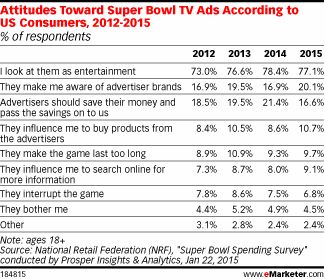
Mobile also made an impact as far as using phones and tablets during the Big Game was concerned, according to eMarketer. Its stats indicate that 32 percent of respondents in a recent poll used their devices for Facebook, Twitter and other social media, while 20 percent tracked stats through sports-related apps like ESPN. Games were in third place with 19 percent, and no doubt that viewers of the above ads may have played a part in downloading and playing them.

Adweek’s analysis is superficial as far as mobile games are concerned, since it fails to take into account the long-term value of the users acquired by this means. Are game players acquired through TV advertising more or less valuable than game players acquired by other means That answer won’t be known for months, as it takes time for these games to monetize.

Still, the Big Game seems to mean big business to mobile game companies. We’re likely to see more TV ads next year for mobile games during the Super Bowl, for a variety of reasons.

Larger Devices Are Changing Mobile

In the past, millions of users have relied on smaller mobile devices for both viewing and buying purposes, but it appears that the larger-screen peripherals could slowly but surely be taking over, according to Adweek.

With bigger devices, like tablets and the iPhone 6 models, people are able to take in a larger experience than they would on a smaller device. As a result, the Super Bowl was taken in with a larger viewership (NBC offered the game on streaming services, along with broadcast). This may be something that marketers will want to take note of, especially with even more devices likely to be introduced this year.

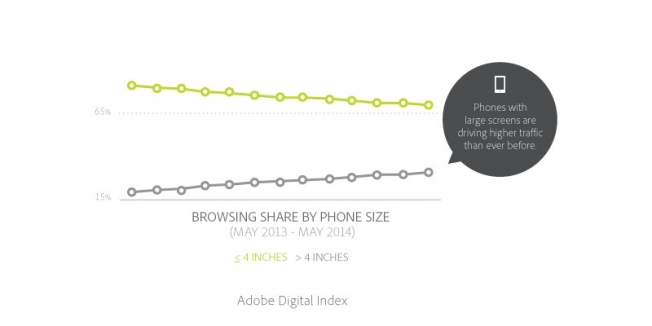
A report from Adobe Digital Index (ADI) indicates that phones with larger screens (four inches or more) are getting more traffic than they were in the past, while traffic from smaller devices are actually declining. The chart below shows that the increase and decrease in statistics aren’t sharp, but they are steady enough to notice a change in trend.

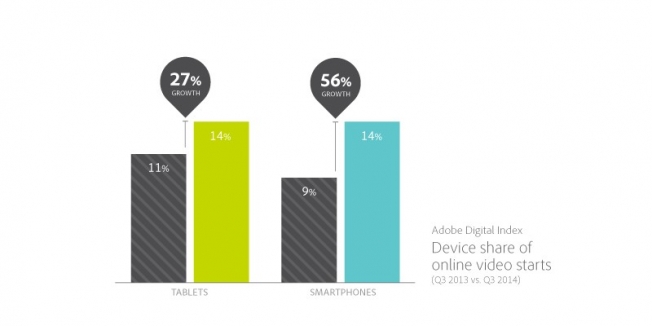
Larger-screen devices make videos easy to view, as ADI’s results indicate. The second graph below shows that consumption on tablets larger in size increased by 27 percent, while larger smartphones showed a rise by 56 percent, between the third and fourth quarters of last year.

With such a convenient, large device in their hands, users may be compelled to utilize them for more things on a daily basis — including purchases. ADI data indicates that mobile has a 29 percent share of online revenue overall during the Thanksgiving holiday, mostly through iPhone and iPad devices. The third chart below shows a breakdown of just how vital sales were for each device.

Also, according to the report, 46 percent of shoppers believe that they’re less likely to search for multiple options when using a specific app from a company, indicating that a simpler user interface may be their preferred choice when it comes to purchases. This may indicate that marketers should seek ways to draw in more owners of these larger devices, including such options as pre-roll video clips and other savvy tools that will make it easier to find and purchase the items they need.

Video consumption — and purchases — are likely to pick up this year, especially with new companies working on larger, convenient devices for release over the next few months. So don’t be surprised if marketers take part in a big upswing for these devices, in hopes for a better outreach.

Who knows? They just might play a bigger part in the Thanksgiving holiday sales for this year…

Wargaming’s Rocking New Deal With Vevo

Wargaming.net has done quite a suitable job when it comes to the word-of-mouth popularity from its online games, including World of Tanks, World of Warplanes, and the forthcoming World of Warships. Wargaming has taken an interesting turn with its latest sponsorship deal, as it has joined forces with music video service Vevo to spread the word about Wargaming through totally unique channels.

The campaign, which will target the general rock and metal genres that the music channel has to offer, will focus on three of Wargaming’s biggest titles, including Tanks, Warships and World of Warplanes, with better awareness of the brand, according to Pocketgamer.biz.

Video game companies have marketed through other mediums before, such as co-branding cars in NASCAR, featured advertisements in film and other means. However, this really marks the first time that a video game company has specifically targeted a music channel for advertising, one that could be quite lucrative for both companies. It’s a different approach for Wargaming, and one that targets a demographic that may not be accessible through other media, or at least not as easily.

Starcom Media Vest group considers the deal a “coordinated takeover of Vevo’s rock and metal genres,” which will begin this month in various markets, including the United Kingdom, United States, Italy, Spain, France and Ireland. The Russian and Southeast Asian markets will follow soon thereafter, although a specific date wasn’t given.

“The Wargaming.net brand has been looking for a viable global music partner for some time,” said Al King, global brand director for the company. “We needed the right fit with our audience and a way to satisfy their love of rock and metal music. Vevo delivers this and the campaign that SMG’s LiquidThreat has negotiated is the perfect experience for our audience to relate to their interests and increase their excitement about the brand.”

Wargaming has already been highly successful at attracting an audience, as millions of gamers have flocked to the company’s free-to-play offerings on both PC and mobile, with tournaments being held on a regular basis and promotional items – like tanks from Brad Pitt’s feature film Fury – becoming available. Still, this deal should help bring more exposure to the games, while introducing a music channel that may introduce avid competitors to new tunes on their playlist.