
Last week Valve revealed its grand plan for putting Steam into the living room, and in the process raised many questions. Is Gabe Newell crazy, or crazy like a fox? Will Valve’s new controller really allow keyboard and mouse games to work in the living room? Can the ‘GabeCube’ take business away from video game consoles by Nintendo, Sony, or Microsoft? What’s the real potential for profit here?
Valve’s announcement, presented in three parts, puts forth an interesting picture. Valve is creating its own Linux-based operating system, SteamOS, centered around running games. This OS will be free, and people are encouraged to install it on any computer. Valve already has many games running on SteamOS and plans to get many more on the OS. Games can also be streamed within your home from a PC or Mac to a device running SteamOS.
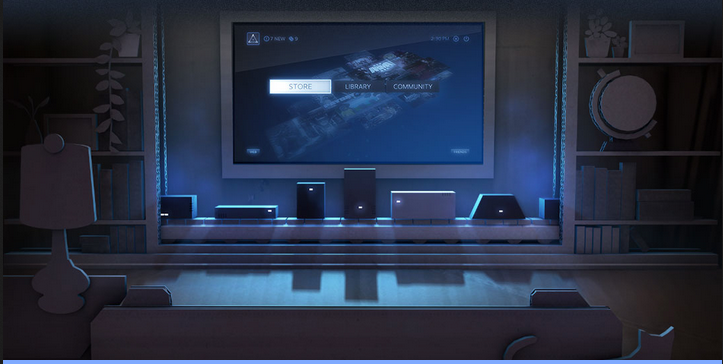
The intent is to have an easy-to-use way to run PC-style games in the living room/family room on your big-screen TV, and for the hardware part of it Valve is creating a specification for Steam machines. Valve is making a prototype Steam machine to test, but will apparently leave it open to a number of manufacturers to build these boxes in a variety of configurations and prices. Finally, Valve introduced a new controller which is designed to replace a keyboard-mouse combo for games, in most cases.
It’s an ambitious vision that has many observers thinking Valve is nuts. How can they hope to compete against the video game console business, especially when some are even questioning whether the market for dedicated game consoles can survive Valve’s concept is a good strategic move for a number of reasons, though there are there are many risks and obstacles ahead . Still, it’s important to realize that Valve won’t be measuring success the same way that Sony or Microsoft or Nintendo will.
Look at Valve’s position. It’s created the leading digital distribution system for PC games and has benefited tremendously from the interest in PC gaming over the last few years (and the lack of retail space for PC games). However, PC sales are sinking, and desktop systems (the core of the PC gaming market) are suffering worst of all as tablets begin to take the lead for most home computing needs. Steam’s potential for growth is not great in the PC market alone, especially globally as emerging markets preferentially adopt smartphones and tablets over PCs. There’s no room for Steam to appear on tablets or smartphones. What does Valve do
As market leader in digital distribution, Valve logically looks to expand the size of the market. The next battleground for large companies like Google, Apple, Amazon, Intel, Sony, and Microsoft is the living room, where everyone is trying to take control of the giant screen. Valve naturally wants to compete there, and of course seeks to minimize the risk and maximize the benefit. While Valve is well off compared to most developers, it’s not anywhere near the league of giant hardware manufacturers when it comes to piles of cash. Valve has to do an end run around this obstacle.
Valve is cleverly offloading the riskiest part of the concept by ceding hardware manufacturing to others. There’s huge inventory risk if you build a lot of devices and no one buys them — just ask Blackberry or Microsoft with their recent write-offs of nearly a billion dollars each over unsold hardware. Valve is probably asking for some payment for each device that bears an official Steam label, so Valve wins no matter how many devices are sold.
Meanwhile, Valve has the potential to expand its Steam audience (and sales of software) if new buyers can be persuaded to try out the Steam hardware. The market potential depends on the Steam machine prices and features, of course, but any market growth is a benefit for Valve.
Let’s not kid ourselves about the difficulties of this venture. These Steam machines are very likely to be more expensive than equivalent consoles, due to smaller manufacturing volumes if nothing else. (Some Steam machines may be extra quiet, or extra small, or upgradable, or expandable, all of which adds cost.) Moreover, the manufacturers of Steam machines need to make a profit on the hardware since they won’t be getting any piece of the software revenue, unlike a console maker (who gets around $7 for each piece of software sold). If you want a Steam machine that produces graphics on par with a $399 PS4, it’s certainly not going to cost any less than that, and will likely cost $100 or $200 more.

The controller that Valve has come up with has interesting potential, but at this point it’s still potential. There’s a lot of refinement needed, and until we can actually see how well classic PC mouse-and-keyboard games can play on it we don’t know if it will work well enough to attract a sizable market. An important point here is the price. Valve has yet to say how much this controller will cost, but based on the components included (touchpads, a high-resolution touchscreen, advanced haptics) it’s not going to be any less than the $60 a console controller goes for now. A $99 price would not be a surprise given fairly low volumes and Valve’s probably desire to avoid a loss on each one. Priced at $99 the Valve controller may be a tough sell.
Who’s the target audience for Steam Machines The most obvious market is existing Steam owners, who already know about the service and appreciate it. However, those owners already have a PC that plays games pretty well (or very well). Why would they want to spend hundreds of dollars on a new box just so they can play a PC game in the family room… with a controller that may or may not work as well as the keyboard-and-mouse that they’re used to Yeah, that seems unlikely.
The best bet in the near term for the Steam machines lies in the possibility of a low-cost streaming device that you can plug into your TV, similar to Google’s ChromeCast. Valve has already talked about being able to stream games from your Mac or PC to the living room TV with the right hardware. Here’s where there could be a significant market among current Steam users — a $100 bundle of a dongle and a new Valve Controller that allows you to play your favorite PC game on a big screen would be a hit. It might even work at $125 or $150, if the games you can play work well enough. Get something enormously popular like DOTA 2 on there and you may well have a winner.
That’s all speculation, though. We won’t find out more about the GabeCube until next year, when the initial fervor over Sony and Microsoft’s new machines has died down a bit. Valve would no doubt like to roll out machines for sale before the summer Steam Sale, when the value proposition of the new device can be clearly underlined. There is some potential there, but Microsoft and Sony execs probably aren’t losing any sleep over this.
Yet.

