Everything We Know About Apple Watch Ad Plans So Far

Setting up advertising for a new platform is a “risk-and-reward” process, as it provides a new platform in which to present innovative new ways to advertise, while, at the same time, coming up with problems that some ad agencies may have a hard time overcoming.

In this particular case, the Apple Watch could face an uphill struggle. TapSense recently unveiled a new ad platform that works specifically with the device, and, as you can see above, it provides some interesting advertising techniques that take up the full display of the Apple Watch.

While the platform looks workable on the surface, some questions have come into play regarding its effectiveness. The platform was originally advertised as “hyper-local targeting” with “Apple Pay integration.” However, according to Apple Insider, this may not be the case, as the advertising won’t be able to utilize advertising that works with built-in watch fades, nor will it be compatible with the Apple Pay service. In addition, development guidelines put in place by the company may not even allow advertising to be used on the device in the first place. Concerns have also arisen in regards to keeping users’ privacy in check, as certain ads would utilize location and other pieces of information for specific targeting practices.

Since the original announcement yesterday, TapSense updated its initial announcement, stating that the advertising intentions could be blocked entirely with Apple’s development guidelines. “Both Apple’s WatchKit SDK and the TapSense SDK are in Beta and APIs are subject to change,” the company explained. “As and when Apple makes the WatchKit guidelines available, we will review it carefully to ensure our DSK is both in compliance and approved by Apple.”

Apple hasn’t confirmed any plans in terms of approving a plan for advertising on its Apple Watch just yet, and there’s no guarantee that such plans will be put in place. While some of the company’s more popular devices do utilize advertising, others, like Apple TV, don’t use it at all, outside of displaying key choices for movies and TV shows from the App Store.

Another question with the effectiveness of advertising is the inability for advertising to use the Apple Pay service. TapSense’s firm stated “although Apple Pay integration with Apple Watch is a great convenience for the consumer, the TapSense SDK will not integrate directly with Apple Pay. To redeem a coupon from an ad, it would need to have a readable barcode that can be scanned at the point of sale, or the ad could be added to Passbook and then delivered to Apple Watch to be redeemed.” For some, this could be more troublesome than the initial discount is worth.

‘The Interview’ Is Now Sony’s Most Successful Online Film

The Interview, the now-infamous lowbrow political comedy starring James Franco and Seth Rogen, is making news in a positive way just weeks after it sat at the center of a massive hacking attack on distributor Sony Pictures.

Sony Pictures announced today that online sales and rentals of The Interview — launched through the Internet and video-on-demand distribution channels after threats of violence compelled major theater chains to scrap its Christmas release — total over $31 million, making Franco and Rogen’s controversial flick about an assassination attempt against North Korean dictator Kim Jong-un Sony’s most successful online film of all time.

Though Sony still has a long ways to go to recoup The Interview’s $44 million pre-promotion production budget, it is likely the film will serve as an important trial balloon for studios looking to hop on the mobile bandwagon, if unintentionally so.

Competitors eager to adapt to consumers’ desire to watch their favorite shows on the go could make The Interview the opening shot in a long series of films following mobile-first release schedules.

Stats On UK Gamers You Need To Know

It’s no secret that Microsoft has a wealth of data at its disposal. With its own personal database, as well as access to data gathered by 3rd parties who survey people and ask about their gaming habits, Microsoft can get its hands on a plethora of data regarding who is using their products and how – all with ease.

Microsoft tends to utilize Bing data to judge the popularity of a game compared to other releases. It can also determine how its users are using its gaming consoles, which in turn helps advice Microsoft where to focus its efforts.

The results regarding the typical gender or age of gamers have been shifting since the introduction of mobile games. According to a study done in the UK by the IAB (Interactive Advertising Bureau), Microsoft can observe that 52 percent of gamers are female while the remaining 48 percent are male. In addition to more female gamers, there also seems to be a bigger age range of gamers, the largest group being between the ages of 25-44. This study shows how the arrival of mobile devices has enabled everyone from all ages to game wherever they are. This being said, the definition of “gamer” has now been update to include players of casual mobile games like Candy Crush or Flappy Bird.

What you can take away from all this is simple – a game’s initial popularity can now be tracked by following web search results, a process Microsoft uses Bing data to accomplish.

The release of Destiny marked a big day for gamers, which is apparent when analyzing search results (above). Destiny was launched around the same time as the Sims 4 and FIFA 15, however it had a dramatically higher number of searches regarding it. Using data like this, Microsoft can focus their advertising and offer deals to boost sales.

By following the activity of Xbox One consoles, Microsoft discovered that in the last month 91 percent of consoles were used just for gaming, 45 percent of them were used for video, 43 percent socializing, 38 percent internet, 37 percent music, and 12 percent live TV. It’s clear that gaming consoles are used for much more than purely gaming; however gaming is still its dominant use.

This Week’s [a]list Jobs – January 7th

[a]listdaily is your source for the hottest job openings for senior management and marketing in games, entertainment and social media. Check here every Wednesday for the latest openings.

Start your new career off on the right foot with tips for staying happy at work.

Here are this week’s [a]list jobs:

  • Warner Bros – Manager, Digital Marketing (Burbank, Calif.)
  • Netflix – Creative Insights Planner (Beverly Hills, Calif.)
  • Paramount – Manager, Digital Marketing (Los Angeles, Calif.)
  • Hulu – Director, Media (Santa Monica, Calif.)

For our most recent [a]list jobs postings, click here. Have a position you’d like to place with us Email us at pr@ayzenberg.com.

Razer’s New Android/PC Gaming Console

A lot of manufacturers are trying to redefine the way that people play video games in the comfort of their living room, between consoles like the Xbox One and PlayStation 4, and new machines like the forthcoming Steam Boxes and the OUYA. However, Razer may have taken the cake with the announcement of its newest device, the Forge TV.

Available later this quarter for the price of $99.99 (or $149 with the Serval controller and Cortex: Stream software bundled in), the Forge TV is a high-performance Android TV micro-console that will be able to provide both mobile and PC gaming experiences for the living room. The console utilizes Cortex: Stream software put together by the company to allow PC games to stream to your living room, as well as support for Bluetooth-enabled peripherals, such as Razer’s own Serval game controller and Turret keyboard and mouse devices.

https://youtube.com/watch?v=D_A1gyYRTgc

While other companies, like Alienware and other manufacturers, have previously attempted to optimize PC game experiences for the living room, Razer hopes to break the mold with its Cortex: Stream software ($40). Using this, players will be able to take part in ultra-low latency PC gaming with full-HD resolution, across either a Wi-Fi or Ethernet connection. This would open up plenty of streaming opportunities, without the need for massive PC hardware or hard drive storage. That enables the low price and, in turn, better convenience for general audiences that aren’t willing to pay $600+ for a new device, assuming you already have a capable gaming PC. The $130 Turret gaming mouse and lapboard (a slim keyboard designed to be used on your lap) allows the use of any PC game, including ones that haven’t been optimized for use with a controller.

The Serval Bluetooth controller works with the Forge, and also with Android smartphones and tablets (you can clip on a smnartphone to the controller), as well as with compatible PC games. The Forge can handle up to 4 controllers, though additional Servals are $80 each.


“Razer Forge TV is a device that is able to bring together the most popular elements of an entertainment center,” said Min-Liant Tan, co-founder and CEO of Razer. “It powers popular music and movie apps and plays Android TV games that an entire family can enjoy. For the hardcore gaming audience, it will bring PC gaming to the couch. Razer Forge TV is what we see as the future of consoles.”

While the Cortex: Stream service isn’t avaialble yet, the company is planning on launching a beta with it in Q1 2015, the same time as the Forge TV device. Each of these consoles will come with the ability to use the service right off the bat, which steals one of the major selling points of Valve’s long-delayed Steam boxes. It will be interesting to see how Valve responds to this direct and compelling competition.

Those in attendance at the Consumer Electronics Show this week can stop by Razer’s booth and check out the Forge TV, along with the company’s other newly announced devices, including the Nabu X, its debut in the wearable tech department, and the Open-Source Virtual Reality project.


App Usage Grew 76% in 2014

Think that applications aren’t used that much on mobile devices Think again.

TechCrunch has reported that, per a report released by mobile analytics firm (and recent Yahoo! acquisition) Flurry, apps were used quite a bit on mobile devices this past year. The growth year-over-year has increased a staggering 76 percent for the year, with Shopping-based apps leading the charge, followed by Utilities & Productivity and Messaging. Each of these based apps have managed to see triple-digit growth on their own over the past year alone.

Meanwhile, Games continue to show slow but steady progress as well, although not as quickly as other applications on the market. In addition, Music, Media and Entertainment categories also showed some slight increases, but, again, not as much as the other departments.

Flurry defined “app usage” as a user opening an app and recording some form of session with it, such as playing a quick game or browsing a website for information (for a potential sale or other purposes).

The company managed to track an impressive 2.079 trillion app sessions over the year, with the daily session record actually clocking in on New Year’s Eve of last year, with 8.5 billion sessions recorded for that day alone.

The growth of Shopping applications couldn’t be missed, as seen in the chart below. They’ve managed to increase the highest with 174 percent, while Utilities & Productivity followed closely behind with 121 percent, and Messaging (Social) was in third with 103 percent. As you can see, the growth continued across the board, but numbers dwindled with other categories, with the lowest growth being Games at 30 percent. Of course, Games were already immensely popular on mobile devices, so it looks like people are beginning to find other uses for smartphones and tablets than just playing games.

Shopping managed to surge thanks in part to pre-existing retailers launching their own devoted apps (or improving upon previously released ones) and new start-ups entering the scene, including the likes of Threadless and Curbside. From Flurry’s findings, commute time was the highest around 9 AM and around noon (during lunch time), and then once again during “prime time” around 8 PM. Utilities & Productivity saw a spike with the introduction of Office on Windows devices (via Microsoft) as well as iOS and Android. As for messaging, Facebook led the charge, not only with Facebook Messenger, but also the acquisition of the popular WhatsApp service.

More findings on the report can be found over at TechCrunch.

Sony’s Big PS4 Sales Numbers

Although its PlayStation Network was put into question over the holidays with server issues, it was no doubt a good season for Sony and its PlayStation division.

The company recently provided sales data for its PlayStation 4 console, as well as its PlayStation Plus service, which provides a handful of free games to its subscribers each month, as well as other bonus items. Needless to say, Sony has a good head start as the year rolls onward.

According to Sony, 18.5 million PlayStation 4 consoles have been sold through worldwide, with 4.1 million systems accounted for from Black Friday through the end of 2014. The PS4 therefore appears to continue its installed base lead over its competition at Microsoft and Nintendo, and intends to keep it with a number of exclusive titles, including the forthcoming The Order: 1886, Bloodborne and Uncharted 4: A Thief’s End. We have yet to hear from Microsoft and Nintendo as to how many consoles they sold in the last quarter, but it’s a fair bet that if they had surpassed Sony’s sales we would have heard about it by now.

In addition, the attach rate for the PlayStation 4 is just over four games per console, with global software sales sitting at 81.8 million units worldwide leading into the beginning of 2015. Over the holiday period, over 17.8 million games were sold in both physical form and via digital download.

As for the PlayStation Plus service, its subscriber rate has never been higher. There are currently 10.9 million subscribers to the service across all consoles, although PlayStation 4 undoubtedly leads the pack, since it’s required to access online features like multiplayer.

All of this comes as good news for the company, despite the recent slump on PlayStation Network following hacker attacks over the holiday season. To make up for it, the company announced that it will provide a ten percent discount to all users on their next digital purchase through the Network, as well as five additional days of service to PlayStation Plus subscribers.

The news also comes on the heels of Sony’s confirmation of a subscription plan for its PlayStation Now cloud-gaming service, which kicks off next week.

Kickstarter Funds More Than $1,000 A Minute For Games

There’s no question that Kickstarter has become a powerful tool when it comes to raising money for projects, but nobody knew that it would have such a stellar year when it came to getting games off the ground.

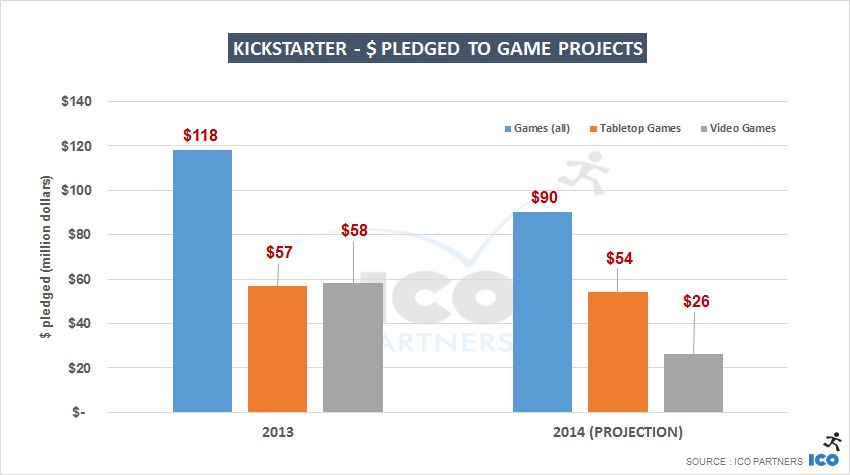
The company recently provided its numbers for the year when it came to crowdfuding game projects, and, across 1,980 different projects, the platform has managed to raise $89.1 million. That’s just a small amount of the 22,252 projects that were successfully funded, to the tune of $529 million, but still a significant part. The numbers indicate that, with the amount donated, the site was able to raise more than $1,000 a minute over the entire year.

It’s important to note that these figures from Kickstarter cover both video games and tabletop games, with tablteop games accounting for roughly $54 million of the total according to Thomas Bidaux of ICO Partners. He also noted that these numbers are down from 2013, which had $118 million raised for games, with the drop in video games accounting for the difference.

Kickstarter also reported that, out of all the months in the year, August was the one that produced the most successful projects, with 2,311 hitting goals overall. When it came to a certain day when the most pledges came in, Wednesday was earmarked as the highest day.

Other numbers from the company’s findings include the following:

-2.2 million people made their first ever KickStarter pledges over the course of the year, across a variety of projects

-1,125 people backed over 100 projects overall, though no amount was given in terms of their pledges

That’s not to say that everyone was sold on the process, however. GamesIndustry International reported that some developers, like the legendary Peter Molyneus, felt it just wasn’t effective enough.

“It’s impossible not to notice a sense of apathy towards KickStarter these days,” chimed in independent game developer Agustin Cordes. “Previously I would tweet about an adventure needing backers, and experience an outpouring of support with retweets, favourites and such. Today, I say ‘KickStarter’ and not even crickets reply.”

Could KickStarter continue this trend as the New Year rolls on Only time will tell . . .

‘League of Legends’ To Get Dedicated Network

League of Legends has no doubt taking over the world, with millions of players taking part in MMO-based sessions online and attending tournaments, both in person and online, to watch the pros battle each other for big prizes. Now, Riot Games is taking the next step to devoting itself to the game, by working with several internet service providers to set up a special network optimized for League of Legends.

The company explained in a forum post that it plans to improve connectivity speed and stability for players in the United States. The company is currently in discussions with both ISPs in both the U.S. and Canada to enable players to get closer access to a dedicated network, stabilizing play sessions and connectivity with other players.

“Currently, ISPs focus primarily on moving large volumes of data in seconds or minutes, which is good for buffered applications like YouTube or Netflix but not so good for real-time games, which need to move very small amounts of data in milliseconds,” said Riot Games brand strategist Charlie Hauser, speaking with GamesIndustry International. “On top of that, your internet connection might bounce all over the country instead of running directly to where it needs to go, which can impact your network quality and ping whether the game server is across the country or right down the street.”

Hauser expects the services to be up and running by the end of March, although contract negotiations with certain ISPs are still happening. “This network should bring a marginal improvement for everyone – coast to coast,” said Hauser. “West Coasters are impacted by this as well – we’ve seen traffic in San Francisco get bounced across the country before finally getting to the server.”

Such a move could help create a new devoted network for online gaming, one with higher speeds and processing that would enable game sessions to go faster across the board. It’s not an unfamiliar strategy, as several companies, such as Activision and Microsoft, have set up devoted servers in the past for such games as Call of Duty and Halo.

Plantronics Teams With Microsoft For Licensed Xbox One Audio Peripherals

On Sunday, the global leader in audio communications, Plantronics Inc., revealed that it will be providing advanced audio and chat solutions for Xbox One gamers around the world. With officially licensed audio peripherals optimized for performance with the Xbox One, Plantronics could change your entire gaming experience.

“Xbox One brings fans true gaming immersion to the living room and new, connected ways to enjoy media,” said Branden Powell, Director of Accessories at Xbox, in an article on CNNMoney. “With its commitment to innovation, Plantronics was a natural partner as we looked for solutions that offered the high-quality audio and clear communication essential to deliver the best Xbox One experience.”

Plantronics has worked closely with Microsoft since 2002, producing all Xbox Live headsets for the original Xbox console. The headset company also created the popular Halo 2 Special Edition headset in 2004, which became the best-selling third-party headset accessory of that console generation.

“We are thrilled to be working with Microsoft to provide products to support Xbox One and continue our support for Xbox 360,” said Dorothy Ferguson, head of gaming marketing at Plantronics. “With our proven expertise in creating mobile, gaming and entertainment products that offer uncompromising audio, clear two-way chat, and long-wearing comfort, our upcoming Xbox One products are sure to excite.”

Plantronics Gaming features a one-of-a-kind flagship RIG Gaming Audio System, which offers competitive players premium audio and voice chat. It also enables gamers to connect and move freely between all of their gaming and entertainment devices with just one headset. RIG fuses top-notch game audio and live voice chat (at home and on-the-go) with mobile audio, music, and apps.

RIG Gaming Audio System, RIG Flex and RIG Surround are currently available worldwide.