Amazon Studios To Release 13 New Pilots In January

By Sahil Patel

Amazon Studios has unveiled the full list of pilots coming to its Prime Instant Video streaming service in January. It features seven previously announced drama, comedy, and docu-series pilots, and six new kids pilots.

As usual, the talent behind these potential series is stellar; the adult-oriented slate includes shows from Samuel Baum (“Lie to Me”) and Sam Shaw (“Manhattan”); Cris Cole (“The Bill”) and Shawn Ryan (“The Shield”); Frank Spotnitz (“The X-Files”); Will Graham (“Onion News Network”); Alex Gibney (“The Armstrong Lie”); and Carlton Cuse (“Lost”) and Randall Wallace (“Braveheart”).

Amazon Studios also plans to beef up its kids’ programming slate, with four new animated pilots and two live-action pilots from a roster of creators that includes May Chan (“Phineas & Ferb”), Carol Greenwald (“Arthur”), Jennifer Hamburg (“Daniel Tiger’s Neighborhood”), Rob Hoegee (“Generator Rex”), Guy Toubes (“The Adventures of Chuck & Friends”), Angelo Santomero (“Creative Galaxy,” which was greenlit by Amazon), and Joanna Lewis & Kristine Songco (“Sullivan & Son”).

All of these pilots will arrive on Prime Instant Video in the US, UK, and Germany on January 15, after which viewers will get the chance to watch each for free and rate whether they like them or not. Amazon Studios will then determine which pilots get a shot at a full season, to join the likes of “Alpha House,” “Mozart in the Jungle,” and “Transparent” in the company’s original programming slate.

Check out the full list of what’s coming…

This article was originally posted on VideoInk and is reposted on [a]listdaily via a partnership with the news publication, which is the online video industry’s go-to source for breaking news, features, and industry analysis. Follow VideoInk on Twitter @VideoInkNews, or subscribe via thevideoink.com for the latest news and stories, delivered right to your inbox.
 

5 Predictions For Digital Video In 2015

By Peter Csathy

2014 proved to be a transformational year for digital-first video and the YouTube economy. The short-form video world essentially “grew up” and traditional media, major brands, and even previously cynical Northern California investors took notice.

It was easy to see why: 2014 introduced the video content-driven mega-deal. Disney bought leading multi-channel network Maker Studios for up to $1 billion, Otter Media uploaded rival MCN Fullscreen in a deal rumored to be up to $300 million, and European-based RTL Group tried on StyleHaul for a deal that values that vertically-focused MCN up to $200 million.

So, with that backdrop, here are my top five predictions for digital video in 2015:

1. The pace of MCN acquisitions will accelerate as more studios jump into the M&A game rather than try to figure out this new content platform themselves.

Some leading MCNs ripe for acquisition include foodie-focused Tastemade, dance-focused DanceOn, Latino-focused MiTu, sports-focused Whistle Sports, and Collective Digital Studio. (Note: Manatt Venture Fund is an investor in DanceOn and Whistle Sports is a client.

2. But the MCN action won’t be just domestic.

International becomes a major new battleground in the borderless digital video world. Companies big and small will extend their reach via major partnerships, investment, and M&A. Notable 2014 deals included RTL’s acquisition of StyleHaul, Sky’s $7 million strategic investment in Whistle Sports, and Fullscreen’s partnership with major Indian MCN Qyuki.

3. Major consumer brands follow suit.

For the first time, marketing dollars shift in significant scale from traditional media to more measurable digital platforms. This takes the form of branded content — not just ads. As a result, investors place major bets on ad-tech companies to maximize and measure those spends. We will see a number of significant ad-tech exits like Yahoo’s recent acquisition of BrightRoll for $640 million. Several brands will go even further and invest big to become digital-first lifestyle media companies themselves a la Red Bull, developing and aggregating content. GoPro, Pepsi, and Marriott have proudly announced such ambitions.

Read more…

This article was originally posted on VideoInk and is reposted on [a]listdaily via a partnership with the news publication, which is the online video industry’s go-to source for breaking news, features, and industry analysis. Follow VideoInk on Twitter @VideoInkNews, or subscribe via thevideoink.com for the latest news and stories, delivered right to your inbox.
Marketers Pay Attention To Female Gamers

Video games have changed quite a bit over the years, as has the audience that’s playing them. In addition to a larger portion of online streaming gamers and “hardcore” fans of titles like World of Warcraft and League of Legends, women are also playing a larger part, taking a majority stake in the mobile gaming audience and getting a fair share of numbers on consoles and PC as well.

According to Adweek, YouTube has begun noticing this trend and has picked up on it, indicating that female viewership of gaming content has doubled over the past year, with women over the age of 25 becoming the fastest growing demographic for video game-themed clips on its online network.

The IDC concurred with YouTube’s findings, stating that 45 percent of eSports fans (who either watch an event online, attend in person or actually play a competitive part) were women.

“Ten years from now, the next great global sports leagues will not be played on soccer pitches – it will be online,” said Lewis Ward, IDC gaming research director. This no doubt points towards the possibility of better equality with players, male and female alike.

As a result, brands and marketers are beginning to pay attention to the growing demographic. Coca-Cola recently held a Mario Kart 8 gaming session on Twitch, featuring both male and female players taking part. Before that, Pizza Hut became a sponsor for the eSports Defense of the Ancients 2 competition at Madison Square Garden, which, again, featured a diverse audience of male and females; and Amazon is getting a piece of the action, not only picking up a number of developers for its own game studios, but also creating a team-up with fellow sponsors like Foot Locket and Axe.

“With so many eyeballs and so much time spent, it’s making gaming as an entertainment expression a very attractive media platform,” said Matt Wolfe, global head of gaming for Coca-Cola. The company plans to diversify with its gaming content over the year, and experimenting with new ideas that caters to all types. “As a game maker myself, I would certainly like to explore those waters.”

Oculus Rift’s Marketing Future

Even though the Oculus Rift still has yet to see a finalized release date, we do know that it’s coming sometime this year – and it has the potential to be an exquisite marketing tool for certain brands.

The Rift has already been used a number of times before for marketing purposes, with a number of companies utilizing the 3D tech at shows like San Diego Comic-Con to advertise a number of properties, such as movies like Pacific Rim, X-Men: Days of Future Past and Into the Storm. However, according to Adweek, that’s just scratching the surface, as marketers could come up with new methods in terms of using the technology to paint a much bigger picture.

That’s not to say some companies haven’t gotten a jump start on the process. Marriott has already teamed up with Oculus to present a 4D travel experience that allows people to visit another location from the convenience of a kiosk at the hotel. Still, some companies are already planning on thinking bigger.

“We didn’t really have any virtual-reality work this time last year,” said Nancy Bennett, chief content officer for Two Bit Circus, whose agency dabbles greatly in the virtual reality department. “Now we’ve built our own camera rigs, we’ve built our own livestream viewing capability, so directors can actually see the (360-degree) spherical projection while they are on set. It’s a lot of technical geekery going on, but this enthusiasm is not just because the space seems to be blossoming. There’s a lot of forces at work – look at what Facebook has invested in VR.” She is, of course, referring to the company’s record $2 billion investment in Oculus VR.

The device has gained huge buzz at the Consumer Electronics Show this week, and intends to be used greatly at South By Southwest in a few weeks by a number of companies. This could very well open a gateway to new virtual reality-based business.

“I knew that virtual reality would become important to the public at some point, but I thought it would take a much longer time,” said Oculus Rift founder Palmer Luckey, speaking to Adweek. “I did not take into account the fact that unlike some new technologies, VR has already established mindshare as a concept.

“Time travel, flying cars, artificial intelligence and VR are all sci-fi stapes – and we are in the lucky position of bringing one of those things to life.”

With Google, Samsung and other companies delving into their own projects in virtual reality, Oculus probably shouldn’t dilly-dally too long when it comes to release – but, according to the company, we’re “months” away…so the future isn’t too far off.

Console Gamers Still Love Physical Games

A lot more companies are adopting digital game distribution on their platforms, including Microsoft with its Xbox consoles, Sony with the PlayStation systems, and Valve’s Steam service. However, that’s not to say that some gamers still don’t prefer the “old-school” method of physical games.

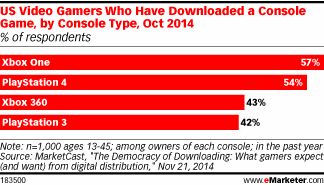
A poll posted by eMarketer, conducted by MarketCast, indicates that half of video gamers in the U.S. who own an Internet-connected console have purchased a game via digital download in the previous year. That said, though, 53 percent of those polled still prefer the physical copy of games in comparison to digital. By comparison, only 22 percent indicated that they prefer the digital approach.

The numbers also show that, in the past year, digital distribution of gamers made up only 18 percent of total console game purchases, compared to 82 percent of physical copies bought.

That’s not to say that these trends will stay that way, however. People are starting to lean more towards the convenient digital download method, with 76 percent of those polled indicating that the method was the future of game buying, even if some didn’t prefer that method (due to the lack of holding a game physically in their hands).

48 percent of those polled expected to personally download more games via digital over the next two years as well, which could show an upswing in favor of online services.

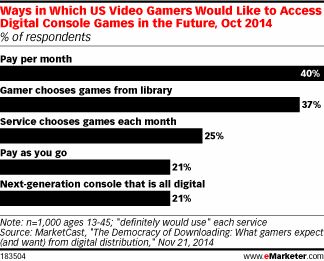
With such subscription plans as EA Access and PlayStation Now in place (see our previous story today), it appears that gamers are starting to get hooked on the idea of a Netflix-style service as well. 40 percent of those polled said they would be interested in some form of streaming subscription service, while 37 percent prefer a service that allows the ability to subscribe to specific downloads per month, so they can choose from a virtual library. (This is where something along the lines of Sony’s service would definitely come into play.)

That said, while online purchases and services are surging, the online console gamer audience continues to be rather small. eMarketer estimates 49.1 million U.S. online console gamers in 2015, which makes up less than one-fifth of Internet users in general and just over 15.3 percent of the general population. This number will grow over the next few years, but only in a minor sense, to 55.2 million in 2018 – which still just goes over one-fifth of the overall Internet audience. By comparison, mobile gaming will see a bigger increase, going up from 133.9 million to 170.7 million over the next three years for smartphones, and 115.8 million to 136.6 million for tablets.

Phablet Activations Conquered Christmas


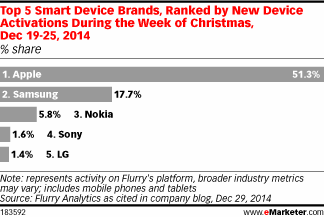
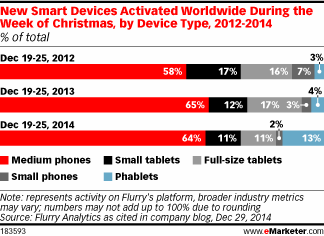
Looks like phablets were a popular gift item over the holidays! Thirteen percent of smart devices activated over the past week were the tablet’s smaller sibling, finally superceding tablet activations, which held at 11 percent according to eMarketer.

Apple remained the most popular brand, accounting for over 51 percent of device activations while Samsung was in 2nd place at 17.7 percent. The iPhone 6 Plus was largely behind this device type taking over.

Medium-sized phones continue to reign supreme, however, retaining most of its share of activations, going down only 1 percent from last year at this time.

Why The Internet Of Things Is Slow To Catch On

The Internet of Things, or, the concept that the future of networking is centered on connected products and appliances, has been met with an unexpectedly chilly reception by consumers so far.

A new case study by Nielsen subsidiary Affinnova may provide marketers with the information required to dissect why.

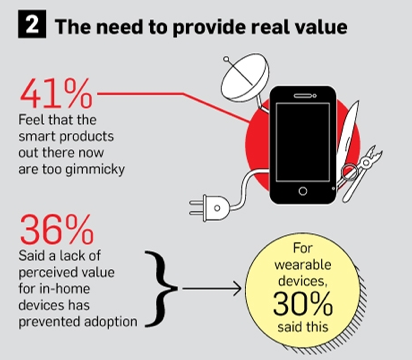
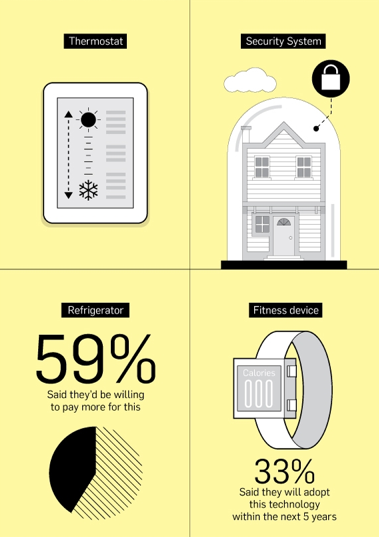
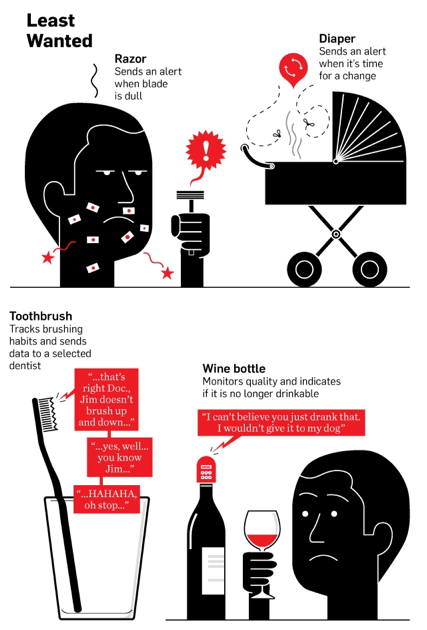
Affinnova’s case study, which saw consumers evaluate more than four million product concept variations and name their desired functions, states that consumers harbor a lack of understanding about the pros and cons of so-called “smart” products.

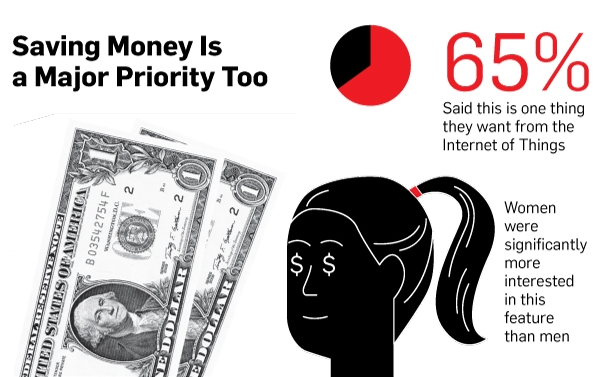
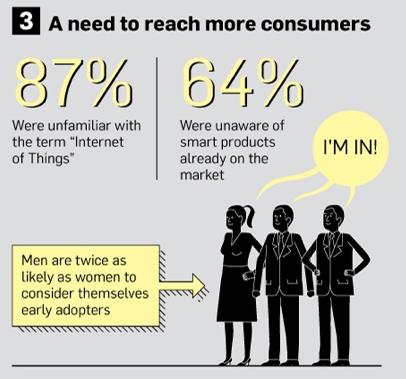
Fifty-seven percent of consumers surveyed by Affinnova agreed that the Internet of Things would be “just as revolutionary as the smartphone”, but a staggering 92 percent professed a lack of knowledge about smart objects’ benefits other than to say they’d “know it when they see it.”

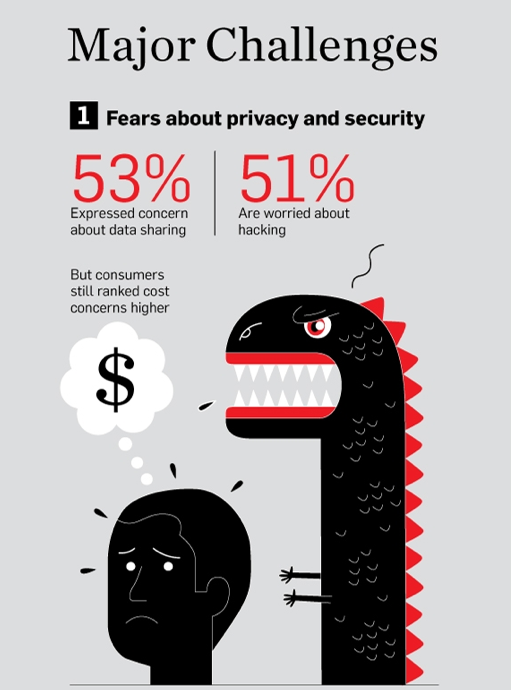
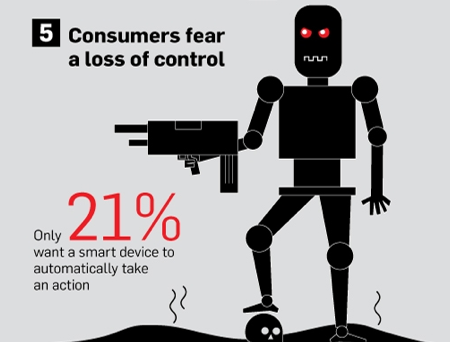
Privacy is another major concern for would-be Internet of Things adoptees. Affinnova says consumers are worried about the security of personal data collected by web-enabled smart objects; 41 percent surveyed worry those smart objects could go so far as to take certain actions they didn’t agree to, possibly compromising their safety or security as a result.

One silver lining for smart object marketers and proponents: Affinnova’s case study found that consumers see the Internet of Things as an inevitability, regardless of their concerns. Fifty-eight percent surveyed said “people will wonder how we ever lived without [smart objects]” in just two decades’ time.

Inevitably or otherwise, it would be wise for manufacturers and marketers to work to address concerns with smart objects now to prevent a massive backlash down the road.

“As the Internet of Things continues to find its place in the mainstream consumer market,” a second study by consulting firm Aquity concluded, “brands need to vet their ideas carefully amongst consumers and explore a broad range of options.”


CES 2015: This Console Brings Android Gaming To The Living Room

We’ve all been made aware of mobile’s gaming takeover these past few years. Younger consumers are flocking to Android and iOS devices as core-friendly gaming experiences move into handheld’s domain.

If one startup has its way, however, console gaming just might find an unlikely friend in Android.

China-based Snail is preparing for the release of their OBox, an Nvidia K1-powered “modular computer” essentially designed to run Android games on home television sets. The device, targeted towards lower-income gamers in China and the United States, is unique in its ability to render existing games into 3D without any porting work required from the original developer. Though Snail is mum on the exact schematics of this functionality, a TechCrunch writer testing it out at CES described it as “a bit choppy, but more than functional.”

Snail’s OBox, demonstrated at CES. (photo credit: TechCrunch)

Snail plans on differentiating themselves from traditional console manufacturers by offering their OBox in multiple hardware configurations, allowing for levels of customization unprecedented in the field. Snail isn’t revealing exact prices for different setups, but it could be expected that some will cost more than others.

Snail, themselves a game developer with a wide reach in their native China and abroad, plans to reach into their extensive library of Android games to provide the OBox with first-party support. The OBox’s library is obviously contingent on whether or not Android remains a go-to platform for mobile gaming, though the numbers so far are highly encouraging.

Snail’s bid to bring console and mobile gaming together, regardless of how well it succeeds, is an ambitious move. Consumers enjoy their Android games on the small screen; it remains to be seen whether they’ll feel the same way when those same games appear on a television, though Snail thinks they will.

Microsoft Prepared For Black Friday Sales

We previously mentioned this in our other Black Friday article, but Microsoft has taken the digital approach when it comes to providing certain users with a special deal in time for the big holiday selling weekend.

The company has launched its new Black Friday page, which highlights a number of deals for consumers across all areas, including consoles, games, Xbox Video programs and much more.

Games appear to be the big highlight here, as a number of digital releases are available for dirt cheap through the entire week, running through December 1st. These include big Xbox One releases like Killer Instinct Ultra Edition Season 1, Assassin’s Creed IV: Black Flag, Forza Motorsport 5: Game of the Year Edition and Angry Birds Star Wars, among others.

Several Xbox 360 games are on sale as well, many of which go for $2.99, including such Electronic Arts favorites as Burnout Paradise, Bulletstorm and others. The full list of deals can be found over on Major Nelson’s website.

That’s not all. Microsoft also has several sales planned on Black Friday itself. Although other digital deals haven’t been revealed yet, the company will host several big Black Friday bargains in its Microsoft stores, including games like Sunset Overdrive and Call of Duty: Advanced Warfare for $15 a pop, and special deals on consoles and Surface Pro tablets. Those sales will kick off online tomorrow night, starting at 12 AM EDT.

While this will no doubt give Microsoft some big exposure over the holiday weekend, don’t count Sony out. In addition to two previously announced PlayStation 4 bundles featuring the likes of Grand Theft Auto V and LittleBigPlanet 3, the company has announced a week-long sale of cooperative games running through December 2nd, including such games as Rayman Legends, Resogun and Lego The Hobbit. In addition, those who spend $100 or more on these games through December 2nd will be eligible for a $15 credit on their PlayStation account.

Indeed, gamers, it may just be time to break out the wallets.

King’s ‘Candy Crush Soda Saga’ Events

King Digital’s latest game Candy Crush Soda Saga is certainly making waves on the mobile front, and the publisher isn’t holding back when it comes to providing it with, ahem, sweet promotion.

The company celebrated the launch of the game with celebrity events in both New York and London, including a parade down Broadway in Manhattan with 20 giant Candy Bear floats and waves of purple soda, according to VentureBeat.

In addition various New Yorkers with candy helmets, along with a soda-drenched taxi, a Candy-based hotdog cart, and others in costumes roamed the streets in New York. Molly Sims, an actress who’s also an avid Candy Crush Saga fan, also took part in the festivities.

“New York is such a great setting to celebrate the launch of Candy Crush Soda Saga,” said Alex Dale, chief marketing officer at King, in a statement. “It is a perfect backdrop to bring to life the key elements of the new game, Candy Crush Soda Saga — Soda, Candy Bears, color, magic, and lots of fun! We hope our players are as entertained by it as they are by our games.”

Meanwhile, in London, King had plenty of candy-based items for show as well, including a large illuminated candy bear near the Thames River, right under the Tower Bridge. Recording artist Nicole Sherzinger was in attendance for that event.

This is just the latest promotion for King’s game, as it’s also gotten quite a bit of attention with its Facebook video, as well as a television campaign that’s spreading like wildfire. Of course, considering the company generated $260 million in revenues over the last quarter, it can certainly afford to do so.

And it doesn’t appear to be slowing down anytime soon. With millions of mobile devices expected to be gifted this holiday season, King is likely to continue with Candy Crush Soda Saga‘s promotions for some time to come.