Microsoft And Nokia Elope

In a somewhat surprising move, Microsoft announced late Monday that it is buying the majority of Nokia’s cellphone business (including its non-smartphone business) along with a ten-year license to Nokia’s patent portfolio for a total of 5.44 billion euros, or over $7.17 billion.

The deal with see former Microsoft exec Steven Elop, current CEO of Nokia, once again become a Microsoft employee as executive VP of devices and services. Some 32,000 Nokia employees will become Microsoft employees when the deal is finalized.

This deal puts Elop in the frontrunner position to become the new CEO of Microsoft when current CEO Steve Ballmer steps down in the next year.

Nokia will continue in business with its remaining goods and services, which is about equal to the business it’s selling to Microsoft. Nokia will focus on its businesses making cellular networking equipment, its Here location-based services, and other “advanced technologies,” according to a statement.

What this deal means to the Xbox division isn’t immediately clear, though it might mean even greater cooperation with Windows Phone in some fashion.

Source: AllThingsD

Mystery Of The Missing Chocolate

An interesting marketing campaign from European chocolate maker Milka is based around producing the product differently. The company produced 10 million bars with a ‘missing’ piece (the bars were actually the normal weight, with each square being slightly bigger than normal). Inside the wrapper is a digital code that you can redeem for the missing piece, or send the missing piece to someone. The piece arrives in the mail with a personalized note you entered online. The video explains the process in detail.

https://youtube.com/watch?v=H6NWTJyWHqc

Could games give out digital goods with this much meaning It’s an area that deserves more experimentation.


Source: AdWeek

Microsoft Re-Brands Xbox Live Marketplace

Coinciding with the currency change that took place with its latest system update last week, Microsoft has changed the name of its Xbox Live Marketplace to something new. Say hello to the Xbox Games Store!

Now whenever consumers visit the Store for online purchases, they will see the rebranding while being able to make purchases like before. This retitling will also be in place for the Xbox One when it launches later this year.

“That’s right, (Xbox Live Marketplace) is now called the Xbox Games Store, and will sit alongside the Xbox Music Store and Xbox Video Store,” said a Microsoft spokesperson speaking with Joystiq. “This is to make it easier for consumers to find content both on Xbox 360 today and Xbox One when it launches in November.”

Source: Joystiq

LEGO Enters The Toy-Game Fray

LEGO has seen a great number of successes in video games over the years, including games based on Pirates of the Caribbean, Star Wars and Harry Potter. However, its next iteration could see the introduction of physical toys onto the market, similar to what Activision has done with Skylanders and what Disney recently did with the Infinity project.

LEGO will launch a new game next summer called LEGO Minifigures Online that will take advantage of collectible figurine, which players can then use in a virtual game to coincide with their release. The figures will be sold in “blind bags” so players won’t know what to expect from their figure purchases, unlike the other games mentioned above.

“We want players to get the same feeling they get from unwrapping a figure as when they get that character in game,” explained Lawrence Poe, executive producer at Funcom, during the game’s first demos at Gamescom.

“LEGO games come with certain expectations of quality – and LEGO has very high values as a company – so Minifigures Online has to reflect all of that.”

The game will release on PC, iOS and Android.

Source: MCV

Warner Bros. And Nvidia Launch ‘Batman’ Promo

Nvidia is ready to give away Batman to those who take part in an upcoming promotion for its processors.

The deal with WB Games will see Nvidia giving away a free digital copy of its upcoming action game Batman: Arkham Origins to anyone who purchases a GTX 600 or GTX 700 series graphics card by January 31, 2014. The game will also implement exclusive Nvidia-based features, like the TXAA anti-aliasing and PhysX.

“The Batman: Arkham games are visually stunning and it’s great that we are able to continue building upon the amazing graphics with Batman: Arkham Origins,” Warner’s senior VP of production and development, Samantha Ryan, stated. “With Nvidia’s continued support, we are able to deliver an incredibly immersive gameplay experience.”

Batman: Arkham Origins releases on October 25.

Source: MCV

‘Warcraft’ Movie Filming In February?

We’ve seen a lot of video game-based films over the past few years, but one based on World of Warcraft could definitely generate some excitement, especially amongst the rabid hardcore fan base. According to a recent tweet from a production database company, we may not be waiting too long.

This tweet indicates that Legendary Pictures has locked in a date for filming after setting up offices at Canadian Motion Picture Park in Vancouver, British Columbia. It states that filming is likely to start as soon as January 13.

Duncan Jones is currently tapped to direct the film, taking the place of Sam Raimi who was originally on the project. No word yet on who’s been cast for the film, but we’re likely to know more over the next few months as the film prepares to enter production.

Source: Polygon

On Ouya’s Bad Taste

Ouya has been looking for ways to create some buzz around its Android-powered $99 console, which was introduced in July to mixed reviews and unremarkable sales. So you might think posting a company-created ad on its YouTube site might generate some enthusiasm. Perhaps, if fans liked it, the video would go viral and get a lot of people to notice Ouya.

Ouya posted a video Wednesday night to its YouTube channel, a 30-second animated bit featuring a gamer projectile vomiting in dismay over standard console games. The response was rapid and overwhelmingly negative, so Ouya quickly pulled the ad. Ouya has confirmed that this ad was in fact put out by the console manufacturer, but it was only meant to “get feedback” from users rather than stay a permanent installation. The company explained this in a statement to Eurogamer, where it added: “We are experimenting with animated content and posted this video briefly to get feedback from our community. Stay tuned for our official video!”

The [a]list daily reached out to some industry veterans in PR and marketing to get some reactions to the video, and thoughts on how Ouya should proceed with its marketing and PR for the console. It’s an extraordinarily difficult time for marketing a new console, with all of the money and attention being lavished on new consoles from Sony and Microsoft – just ask Nintendo.Scott Steinberg, head of video game consulting firm TechSavvy, offers some straightforward advice to Ouya. “Ouya’s best strategy at this point is to acknowledge, explain, address and apologize for the issue. As a company, it needs to acknowledge that there’s a disconnect, explain how the issue occurred, address viewers’ concerns, and apologize for the mistake,” said Steinberg. “Once done, the business can begin moving forward and adapting messaging to be more user-friendly. Simply ignoring the problem won’t make it go away – however, once confronted, so long as it’s dealt with in a professional manner that acknowledges audiences’ opinions and takes their voice to heart (including showing steps the company is taking to address these concerns) both customers and the company should be able to move on.”A marketing executive who’s been in the game industry for many years wonders about the way the ad is targeted. “This doesn’t appear to be part of a market research test. The ad is pretty much done, other than perhaps an end slate and call to action. BUY NOW!,” said the exec. “It completely misses the consumer benefit part of the proposition and relies solely on gamers’ “disgust” over bad and remade games that aren’t different from their predecessors. It would be interesting to hear from them what their approval process will be to ensure that this sort of thing never happens on their platform.”The exec went on to get specific about the response to the ad and its content. “Everyone is talking about a bad ad and there’s nothing in it that sets Ouya apart from the competition. They’re using words like amateur, crass, gross, disgusting . . . nothing that you’d want your brand associated with. They could have talked about their $99 price point, their Android operating system, their FREE games that will never burn your wallet, their appeal to the common man…anything.”From a PR standpoint, Ouya’s ad may not be all bad news. “Anytime people are talking about you, people are talking about you. So that’s good, right ” said a veteran PR executive who has dealt with a wide range of games with a variety of publishers. “Particularly when everyone is mostly talking about your two competitors (to be kind), who are about to outspend in marketing the entire net worth of your company by a factor of 10X.”“It’s interesting watching the indignation and scorn that the online world has heaped on the promo and speaks volumes to why Ouya was “testing” the video with their audience instead of rolling it out wide. It’s really not much worse than most of the nonsense that Cartoon Network puts on its channel after 10 PM and is almost charming in its clear lack of demographic connection and understanding. Also, the Internet loves to hate things.”There’s nothing like some examples from the history of video game advertising to put Ouya’s ad into perspective. “The spot itself reminds me of 90’s-era game advertising (especially the stuff that came out of the UK), where ads were taken to controversial eXXXtremes in order to seem “authentic” or grab the attention of the mysterious gamer but really just came across as eye-rolling, Poochie-style cultural whiffs,” said the PR exec, citing numerous examples. “Does it fall flat Absolutely. But this also explains why it wasn’t front and center on Ouya’s website, Facebook page, YouTube channel, Twitter account, Vine, Vimeo, Instagram, etc.”“I am a bit perplexed by this spot since Ouya has seemed really on top of their messaging for most of their short history — everything about their Kickstarter was well done and still serves as a model for running a campaign on that platform, Sony and MS are just now climbing onto the indie bandwagon that Ouya clearly recognized and embraced much earlier and the price point of the hardware indicates that they both recognize their strengths and weaknesses,” continued the PR exec. “Granted, the polish is off the apple a bit since the boxes have begun landing in people’s laps and the realization is setting in that $99 isn’t going to buy you something with the same quality of design or software catalog as a system from Sony or Microsoft.”“Sometimes a bit of disruptive marketing is exactly what a product needs to remain relevant or resurface in the public eye. It must be hard for the Ouya crew to break through the XboxOne and PS4 noise right now, so they’re probably testing several different methods of doing so. It’s unfortunate that an asset that was not fully vetted or ready for primetime managed to get out in the wild, but people occasionally need reminders that there are no secrets on the Internet.”

The Indie Revolution

The landscape for independent game developers has seen a massive change in the last few years. The rise of online games, downloadable PC games, games in a browser, social and mobile games brought new opportunities for small developers to create games. Developers could attract a paying audience without the necessity of building a huge amount of capital for inventory creation, distribution and sales. Finding money for game development has an important new option with crowdfunding from sites like Kickstarter and IndieGoGo.

This revolution had largely bypassed consoles until a few years ago, when Xbox Live Arcade, PlayStation Network and now Nintendo’s eShop began allowing smaller games a chance to appear. There were plenty of restrictions, though, and it was not an inexpensive, easy process like putting mobile games in the App Store or Google Play. Now consoles are fully joining the indie revolution, with Sony, Nintendo and Microsoft all making it easier for smaller developers to publish titles on consoles.

InXile Entertainment was quick to take advantage of the Kickstarter revolution, and now is eyeing the possibilities for consoles in the future. Wasteland II has been delayed by six weeks, but the beta will release on the original schedule. It’s quite a feat for any game developer for a project of this size and scope. The [a] list daily sat down with InXile CEO Brian Fargo, long-time veteran of the industry, to discuss the pending arrival of Wasteland II and the changing game market.

Fargo wants to create a great RPG in the classic tradition, and from the appearance of the software in its current form he’s succeeding. “I want to make it unbelievable,” said Fargo. “I want to show that you can make an unbelievable game without a publisher.” Fargo’s lined up a top-flight team of writers and designers (including the team from the original Wasteland) along with experienced programmers and artists using Unity to build a game that looks like a very worthy successor to the original RPG.

The focus is on quality, according to Fargo. “Here’s the great thing. If I take money from a publisher, what do they want at the end of the day They want to make a profit,” Fargo points out. “If I take money from my neighbors, friends, and family, they want their money back, and probably a small profit. If I take it from a VC, they want to make a profit. Money from crowdsourcing They just want a good game. It’s the most pure form of financing you can get. Universally, people say, take your time, get it right. We’ve waited 20 years, don’t worry about it. You know what a relief that is. ”

That’s not what you typically hear from publishers, who are usually focused on getting the game to market as quickly as possible. “If I’m in a situation where I’m humping to get paid, and I’m worried about my guys . . .  fifty percent of my brainpower is fighting with someone and trying to get paid, and every milestone is like a hostage negotiation . . . I don’t think you make as good a game,” Fargo said.

Fargo believes there is still more to learn about bringing games to market through the crowdfunding process. “The process was already much more sophisticated on Torment than it was on Wasteland,” Fargo points out. “Whatever worked six months ago might not work today. Who’s to say if I did the exact same Torment campaign today I’d get the same amount of money There’s an emotional component to it. To me it’s all about timing, and what your messaging is at the time. I bet you I would arrive at some different kinds of conclusions if I was doing it today.”

The console market is something that Fargo plans to think about after Wasteland II has shipped. Microsoft, Sony, Nintendo are all saying that indies are more important to them, but the details still haven’t been fully revealed. “It’s been happening, and I’ve heard from Microsoft,” Fargo said. He recalls how it used to be when dealing with Microsoft. “I used to want to publish directly on the Xbox, and it was ‘OK, how many retail SKUs are you going to put out ‘ I always felt there was there this huge disconnect — why do I have to put products on a retail shelf in order to be on XBLA ”

Now the situation is completely different. “You’re hearing Microsoft reaching out, they’re saying ‘Hey, we want you on the machine,’ they’re making the calls,” Fargo said. “You can use the hardware as a development kit, making it more accessible, because indies can’t afford to buy [development kits]. It used to be that if you shipped on Sony first you could never be on the Xbox. Now they’re like ‘Well, we’re flexible, maybe there’s features…’ There’s a different dialog there.

“They’ve come full circle in a matter of ninety days on every part of it, including the ability to be on the platform at all. Sony was already there. They go one step further with their Dev Pub fund, where they actually give developers money upon delivery of a game. You’re actually hearing executives at both those companies — and Nintendo, I should say — talk about why indies are important. Someone called it the Cambrian explosion of creativity, I love that phrase.”

Fargo pointed out that digital distribution has led to games that can be improved over time incrementally, a big change from the past. “In the PC world, even in tablets, you can ship things that are unfinished, refine it and make it right. In the console business there were no policies that allowed that to happen. So there were whole types of games and experiences that you wouldn’t have gotten to do,” said Fargo.

“You look at DOTA 2, Minecraft, League of Legends — how much better have they gotten over time because of that iteration cycle You didn’t get that on console before. You look at DOTA 2 in its present state, it would have been a virtual impossibility to have nailed that on day one. So you have to have that cycle. You get a better game if you allow that to happen.”

“We don’t imagine that we ship a game and it’s over the next day. Those days are over,” Fargo said. “How scary would it be to go back ten years ago when we would make a game like Fallout, and you would just work on it, you wouldn’t show anybody anything, and then you’d just ship it and keep your fingers crossed that you nailed the right things. We’ll look back on those days and say ‘Those were the crazy old days!’

Marketing Wasteland II is not something Fargo is planning for, particularly. “I’m not worried about it,” Fargo said. “Word of mouth will carry the day. There’ll be enough initial people that will respond positively towards it. Shadowrun‘s a good example, I don’t know where they are now but they were number one or two in the Steam store for a week solid. I think word of mouth’s the most important thing — these days, it’s everything. We’re all pretty jaded from advertising.”
Piracy, Pricing, And Used Games

The games industry’s pet peeve for decades was piracy. The issue dominated discussions at industry conferences. Countless hours were spent creating and enabling various forms of copy protection. Industry studies claimed billions of dollars in lost sales due to pirated copies, though the amounts were always speculative. The issue has become less critical, being replaced in prominence by the issue of used games and how that represents lost revenue for publishers and developers.

Piracy and DRM is still an issue in certain quarters. Certainly DRM can cause a fierce reaction on the part of consumers. Look no further than the furor over Sim City’s requirement for an online connection, or the original Xbox One requirement to check in with Microsoft every day. Yet for many companies, worrying about DRM or piracy is a thing of the past. Rather, piracy has become a desirable means of product distribution — when your game is free-to-play, you want as many copies as possible in the hands of players.

DRM has become a non-issue for many games primarily because those games are tracking each individual user. It’s really another form of digital rights management, but it’s invisible to the user. For instance, League of Legends is free-to-play, and has no DRM in the usual sense. Anyone can download and play the game, or give a copy to a friend. The game, of course, tracks each individual player — and once you purchase a Champion or a skin, you can use that whenever you log in from any computer. What you can’t do is give that virtual item you purchased to your friend. Hello, that’s digital rights management in action.. the dreaded DRM that can put so many consumer knickers in a twist when implemented clumsily. Here, no one notices or complains — it just seems obvious and reasonable.

Similarly,used games are a common cause for complaint among developers and publishers, since a used game sale returns no revenue to the original developer. GameStop derives the majority of its profits from used games, which causes much teeth-gnashing amongst developers and publishers. Solutions are already being implemented, but it’s not solving the “problem” of used games per se — because that’s not the real problem. The problem is getting sufficient revenue from games for the publishers and developers to make a profit.

Pricing is constrained by consumer reluctance to pay more than $60 for games, especially when there’s no way to return a game if it turns out you don’t like it. That leads to consumers being cautious about what they buy, or buying a used game initially to reduce the amount of money at risk. Publishers would dearly love to raise prices for next-gen games, but you see no move afoot to do that. What you see instead is an increased amount of downloadable content (DLC) with many games even offering it on day one of a game’s availability.

Here we see one part of the solution at work, thanks to the reality of digital distribution. A publisher no longer has to include everything in a boxed product because bits can be sold online. New content can be created and sold to customers on a regular basis without the need to create physical product. The industry can go further, though.

Digital distribution sets pricing free. There’s actually a continuum of pricing options to be explored between free-to-play and $60 up front. Why not try $20, or $10, as an initial price Will Wright sees free-to-play as just another form of demo for many games. The question becomes how much demo you allow before charging for it, and that’s a marketing and design issue. When the boxed retail version of the game is seen as just another way to package and price the product, rather than the only version of the game that exists, many possibilities spring into being.

Digital pricing can be changed instantly, with no awkward price protection that’s required when you’re dealing with packages sent to retailers. Just look at Steam sales to see how discounting can drive amazing boosts in sales. Gabe Newell has reported increases of 3,000 percent or more in sales, with no effect on retail store sales as far as can be determined. Overall revenue from such sales can be much greater than the usual revenue for the game at a ‘normal’ price.

You could provide a $60 package that is sold at retail while still providing a basic game for download at $10, with DLC that adds up to $75 or $100. The $60 price then becomes a great bargain (that’s ‘anchor pricing‘ in action). Perhaps you could ‘window’ availability, similar to how movies appear in theaters, then after a month or three they appear on a premium cable service, then perhaps on Blu-ray and then streaming. A game might follow a similar strategy by splitting its content into various pieces or collections.

Microsoft, Sony and Nintendo are already looking at selling the full retail version of a game digitally, on the same day the game is first available in stores. It’s happening with some titles now on the 3DS, and next-generation consoles will see that as standard. Sure, not everyone has the bandwidth needed to make that an easy option, and boxed products will be a major part of game revenue for years. Still, the change is beginning, and we’ve only just begun to see the impact.

Ultimately, sitting around complaining about how some general industry issue like piracy or used games is a waste of time. Looking for an industry-wide solution is also generally unproductive. The best answer is to figure out a solution that your company can implement, and then implement it. That may not work for some other company , but let them figure out their own solutions. There’s not one right answer, but there are a variety of possible answers that will help to a greater or lesser degree. Focusing on solutions is going to benefit all of the industry in the long term.

Activision’s Hirshberg On Next-Gen COD

Editor’s note: Veteran entertainment journalist John Gaudiosi is now a regular contributor to [a]list daily.

Activision’s Call of Duty franchise has topped $8 billion in global sales and remains one of the most successful game franchises of all time. With Infinity Ward revealing some of the multiplayer capabilities for Call of Duty Ghosts today in Los Angeles, we caught up with Activision Publishing CEO Eric Hirshberg to discuss the challenges of raising the bar in the crowded shooter genre and explain what next gen will bring to Call of Duty in this exclusive interview. 

What are the challenges of introducing a new Call of Duty franchise every year?

The challenge is the same to Call of Duty as it is for a lot of franchises that have been successful over a long period of time, which is simply striking the right balance between bringing new ideas and innovation to the game each and every year so that it has enough novelty and enough new thinking in it to continue to bring people back. But at the same time you have to stay true to and honor the game that everyone has fallen in love with. Therein lies the creative balancing act that our developers have done a terrific job with. We’ve shown a willingness to allow Call of Duty to reinvent itself to an extent every year and to play with some of the rules in adventurous ways. Taking it into the future and introducing branching storylines in the campaign as we did last time with Black Ops 2 and introducing dynamic maps as we’re doing this year with Ghosts. These are all things have a pretty fundamental impact on the gameplay and yet don’t disrupt the appeal of the gameplay that people have come to know and love.

What do you feel will differentiate Ghosts from past Call of Duty experiences?

Ghosts is a new sub brand and a new set of characters and a new world for Call of Duty. Infinity Ward is bringing a lot of new ideas to multiplayer like dynamic maps, character customization and four or five new game modes that are incredibly fun. These are all things that are going to make the game very fresh and a very cool new entry into the franchise. But at the same time these guys know how to make a Call of Duty game better than anybody and all that that represents.

What have you learned from online fans that you’re applying to the multiplayer for Ghosts?

We have a great feedback loop with our fans. We have a great dialogue with our fans. We have a very engaged and vocal audience and that provides a lot of inspiration and stimulus for our developers. They’re very engaged with the fans and what they want. They have a lot of community outreach and there’s a big feedback loop when you have a community that size and that passionate.

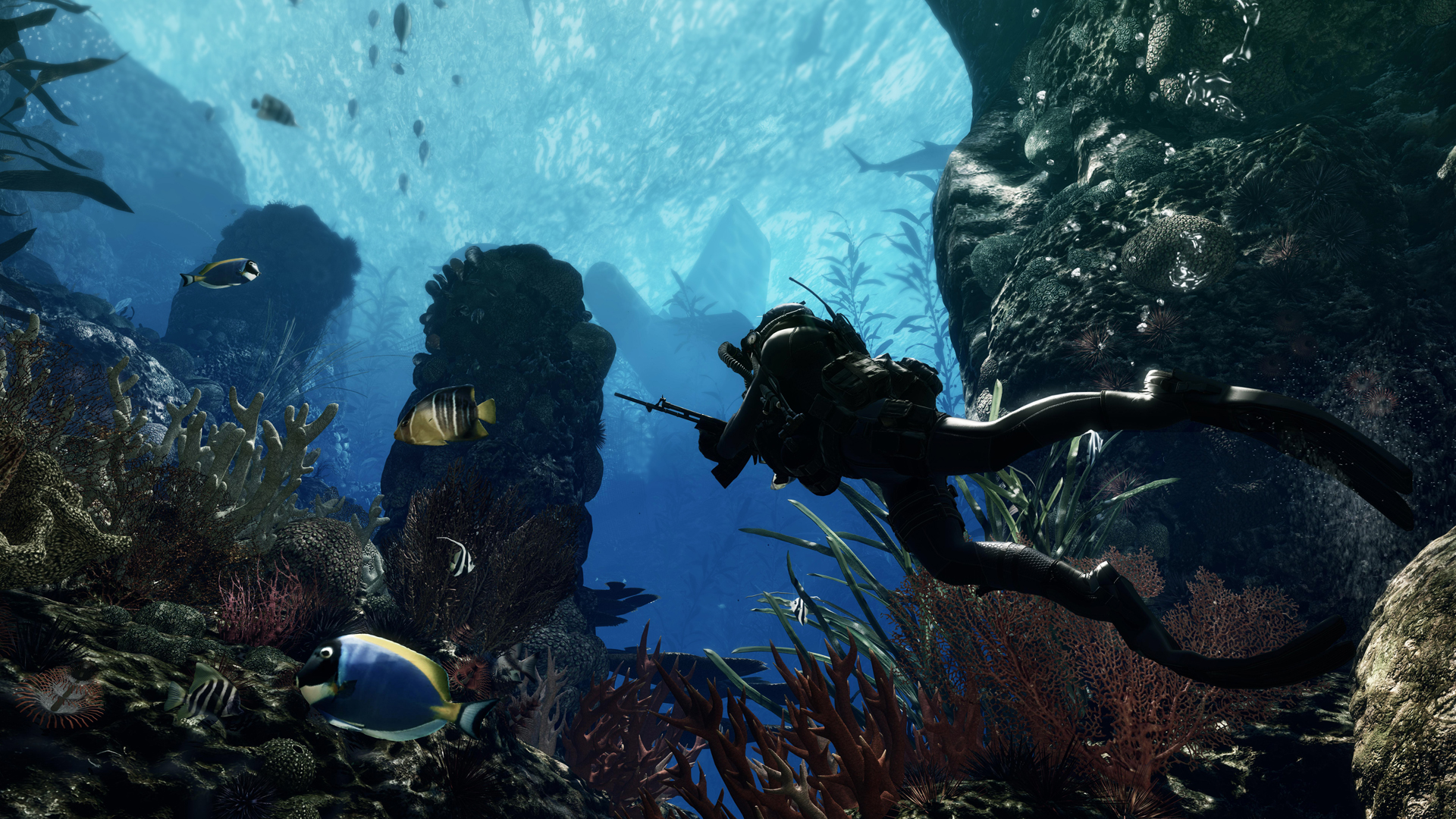
‘Ghosts’ screen shot (click to enlarge)

Can you talk about what’s new with multiplayer?

The new engine and the new graphics translate beautifully into multiplayer. The character customization is really fun, being able to sort of express yourself and have an identity that’s yours in Call of Duty multiplayer is really cool. There’s a lot of depth and options to that and the dynamic map moments are really fun. They’re very well designed to provide meaningful tweaks to the gameplay. The maps in Call of Duty have always been incredibly well designed as stages for battle, but they’ve been inert. They don’t move, they don’t change, and learning the maps has been a matter of learning where the hiding places are and where the good vantage points are. This has a whole different spin on that phrase of learning the maps because now you have to figure out what the maps can do, what you can do to them, and what they can do to you. You can change things within the map to block a pathway or to bring down a bridge or change the flow of the map. Sometimes things happen to you like an earthquake or a downed power line or a flood that changes the world around you. It’s really a cool new twist on the game.

What do you feel next gen has opened up for the Call of Duty franchise with Ghosts?

Probably most demonstrable is the new engine we created with the next gen engine. That has an immediate impact on the atmosphere in the game. Ghosts is going to be the best looking Call of Duty game ever and that’s not just in the environments, it’s also in your ability to connect with the characters. As you’ve seen in tech demos there’s a whole different level of human connection with the characters than we’ve ever had before.

What do you feel will define next generation gaming?

If you look at the innovations that are being promoted by the first parties for making the hardware, there’s a bigger focus on connectivity with the share button on the PS4 and the ability to Skype with your friends while gaming on Xbox One. There are a lot of ideas that seem to be taking connected gaming and making it more social. That’s one area that I would be looking at carefully to see if that inspires any really compelling new gameplay experiences.

The ideal Call of Duty second screen was on display at E3 (click to enlarge)

What opportunities do you see in mobile games, especially with second screen when it comes to Activision franchises?

Our approach has been to use mobile as a great way to expand the appeal of our core franchises and expand your ability to interact with our core franchises. You’re going to see a really robust and innovative second screen application for Call of Duty Ghosts. Obviously, we’ve had a couple of very highly rated and good selling games under the Skylanders brand. We’ve also had a couple of great selling games for Call of Duty with Zombies. We’ve built a lot of great capabilities in mobile, but the thing I’m most excited about is the ubiquity of second screen. Whether it’s the smartphone in your pocket or a tablet, the ability to connect with the next gen hardware will be in a much more seamless way. We can really have our games comes to life on a second screen in a much more robust way. We were a little ahead of this with Call of Duty Elite. We were the first ones to allow you to create the load-out of your character on your tablet or your smartphone and then push it into the console. On the current generation we had to do a lot of technological gymnastics in order to make that happen. The consoles just weren’t designed with those devices in mind because those devices didn’t exist when these consoles were designed. Now with next gen, there’s a much more robust connectivity with other devices. You’ll see a lot of creativity and a lot of energy coming from developers with the next gen in this area.