Ello Just Might Say ‘Ello’ To Advertising After All

Ello, the upstart social network founded last year as a minimalist, expressly ad-free alternative to Facebook, might not be holding onto its biggest promise after all.

An email Ello sent to its users today touting support for embedded sound and video from YouTube, Vimeo, DailyMotion, SoundCloud, and Mixcloud includes an interesting loophole that evidently permits those third-party, ad-supported services to bring their ads to Ello’s pages along with them.

If true, the loophole would represent quite a reversal for a social network once so committed to its ad-free mission statement that it signed a ‘Public Benefit Corporation‘ agreement making it virtually impossible for third parties to profit from its users’ data.

Either way, advertisements are an inevitability for any social network looking to become a major player. By their nature, social networks are a dream for brands and marketers thanks to their vast, oft-diverse user bases; couple that with the simple fact that those same users like free stuff, and ads — especially those displayed through a means similar to many a social network’s Promoted Posts — are an obvious choice for social sites seeking profitability and revenue generation.

For Ello’s part, the Colorado-based social network states it will uphold its commitment to an ad-free experience by allowing its users to opt out of select third-party posts. “Ello will never sell ads,” today’s email reads. “Hide posts that may contain 3rd party ads from your settings page,” it continues, with a photo of the relevant settings button included.

Mobile apps are also on the way this year for Ello, as they look to recapture a portion of the whirlwind of media attention they received last year.

Divnich: ‘Most Opportunistic Times’ For Developers

Jesse Divnich has moved on from his role as an analyst with EEDAR to become the vice president of product strategy at games publisher Tilting Point. His long familiarity with the industry’s metrics have put him a good position to assess where the game industry is at and where it’s headed. Speaking with GamesIndustry.biz, Divnich shared that on a personal level, he quite enjoys those stretches where the industry is too uncertain for any analyst to provide a clean and definitive perspective.

Jesse Divnich

“Those are the most opportunistic times for publishers and developers,” Divnich said. “Those that rely solely on the data will become market laggards always playing catch-up or having to pay high multiples to acquire their way into an emerging market. Those with the skill, foresight, and ability to reach beyond their grasp will see new market opportunities before others and take full advantage of them before the data agrees with them.”

Not surprisingly, as a former analyst Divnich ascribes great importance to data as a tool for companies to use to get ahead in the business. Of course, in times of rapid change, the key data that you’d like to have is often incomplete or unavailable. “When that data is missing, however, that is when the industry separates the strong from the weak,” Divnich said. “It’s how companies like Electronic Arts came to power in the console industry, how the Nintendo Wii became the top selling platform during a time when all the consumer surveys said gamers wanted bigger and faster consoles, and how King and Supercell turned into billion dollar companies in what seemed to be overnight.”

That situation has served as a catalyst for the formation of companies like Tilting Point, which is offering a variety of publishing services to developers in the mobile arena, from funding to PR and marketing. That’s been a growing field, as more an more companies realize they can use their business expertise to help developers with great games but little business savvy succeed in a crowded market.

“The new digital publishers that are popping up have helped turn this environment into a buyer’s market, which is what it should be,” Divnich said. “Developers are now in a stronger position at the negotiation table vis-à-vis publishers. If a developer has something truly unique to offer and it has market potential, they should be in a favorable position to land the best publishing partner. That’s much healthier for our industry, which used to be dominated by a handful of gatekeepers who had a stranglehold on retail distribution.”

While free-to-play games are the most common business model on mobile these days, Titling Point works with each developer on the model that suits them the best. “Most publishers and developers these days are allergic to premium on mobile,” Divnich said. “We are not, and we respect that for some developers, the opportunity to make $300,000 to $3 million in revenue is sometimes a better and less risky proposition then trying to shoot for the stars, potentially making nothing. Leo’s Fortune for example will likely do at least $6 million in gross revenue throughout its lifetime, a figure we are perfectly comfortable with given the budget and total expenditure of the game.”

Consumers have embraced free-to-play games in a big way, Divnich said, but they’re also becoming a lot more savvy about monetization practices, and “less enthused” for hard paywalls or energy systems that require users to pay to keep going.

“Consumers have begun to ask ‘What’s the catch ‘ when downloading a free-to-play game, and they are spotting what the ‘catch is and churning before the game can hook them into the core loop,” Divnich said. “We are seeing this reflected in lower retention rates across the board, especially at Day 2 and Day 7.”

2014 A Record Year for Game M&A

The good news, Digi-Capital reports, is that 2014 saw a record $24 billion in exits for game companies, from IPOs to acquisitions, across the globe. The bad news, as Digi-Capital’s managing director Tim Merel cautions, is that growth in the games business overall is only forecast to show single-digit growth for the next few years, and that will make it tougher for companies in the middle.

Tim Merel

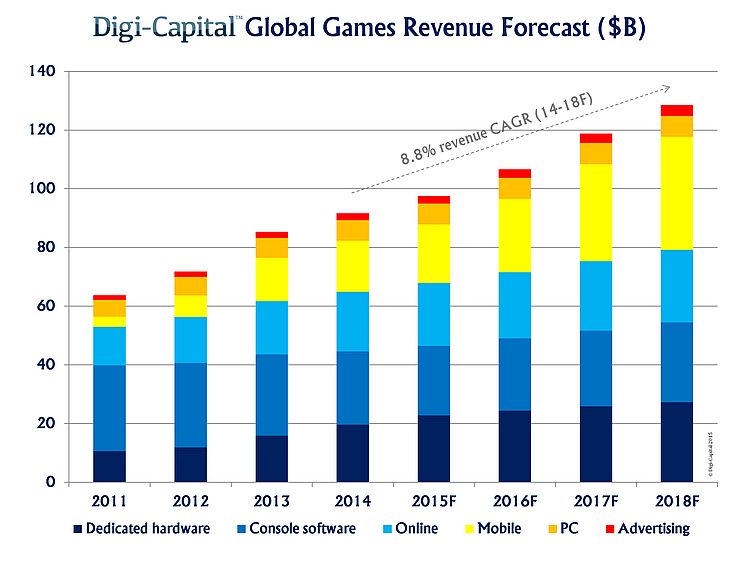
According to a new report from Digi-Capital, $15 billion of that record total for 2014 came through acquisitions, with $8.1 billion from five major deals. The remaining $9 billion was through IPOs, largely from Asian companies. “Asia accounted for over half the games IPOs in 2014, and has dominated games IPOs for the last 5 years,” said Merel. Asia is the number one market for games by revenue. Digi-Capital predicts it will reach US$45 billion in revenue by 2018, out of a total US$100 billion worldwide, with China, Japan, and South Korea leading that growth.

Mobile — which drove more than half of that $24 billion value — is the only sector of the industry showing “strong double-digit growth,” and Virtual Reality is the only other sector that has potential to breakout. As such, Digi-Capital forecasts a compound annual growth rate (CAGR) for games software and hardware of 8.8 per cent between 2014 and 2018.

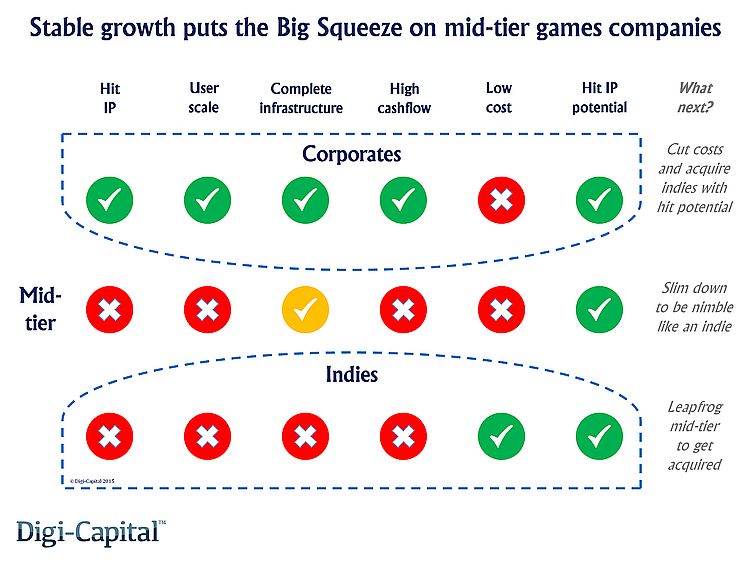
“That sounds healthy,” Merel noted. “But it’s single digit growth and that changes things. A lot. In markets with single digit growth, a rising tide no longer lifts all boats. Competition becomes about the difference between the great and the good.

“In this phase of the market, corporates with hit IPs, user scale and cashflow can invest in the high costs of marketing and infrastructure to compete in a stable growth market, although this reduces everybody’s margins. Indies don’t have hit IPs yet or the scale advantages, but they don’t have the costs either. Both can produce hit games, even if they are few and far between. Mid-tier games companies have no hit IPs yet, no scale advantages, but infrastructure and marketing costs. They can produce hit IPs too, but their cost bases increase their risk.”

In other words, mid-sized companies need to grow to a larger size in some fashion in order to avoid stagnation or a downturn. The trick is that companies need to find some advantage that they have and organize around that to best effect. So it may be a large existing audience, or access to a hit IP, or a particularly creative design team, or a great understanding of a particular market segment.

The one thing that any company can’t afford to do in this growing, evolving game industry is to be complacent. Repeating the successes of yesteryear in the same fashion today, and next year, and the year after, is not a recipe for growth. That’s true in every aspect of the business, from design to distribution to marketing.

What EVO Means To Gaming And eSports

There’s no question that the face of eSports has changed quite a bit over the years, with games like DOTA 2 and League of Legends drawing millions of fans and getting special tournaments where large cash prizes are at stake. But there’s another arena where players are gathering and creating a large, robust community – fighting games.

A number of tournaments, like the Capcom Cup, celebrate the art form of the fighting game, but there’s no bigger stage for the medium than EVO, a yearly tournament that takes place in Las Vegas and brings the best tournament players from around the world to compete in a variety of games, including Capcom staples like Street Fighter IV and Ultimate Marvel vs. Capcom 3.

This year’s tournament, which takes place from July 15-17 at the Paris Hotel in Las Vegas, should be bigger than ever. Not only are older favorites coming back to the tournament, but companies are bringing some of their biggest releases as well, including Bandai Namco’s forthcoming Tekken 7 and WB Games’ Mortal Kombat X, which releases in April.

Over the years, EVO has become quite big with popularity, not only with in-person attendees who get into the rhythm of each match and cheer on its combatants, but also with an online audience, as millions of fans flock to EVO’s Twitch channel to see the action happen live. And it’s getting bigger with each year.

Not only is the fighting community staying loyal to EVO, but also companies. Last year, the tournament was host to Bandai Namco’s initial Tekken 7 announcement, which created huge buzz in the industry. Nintendo has also turned around its thoughts on the tournament, at first not allowing organizers to use their Super Smash Bros. games, but later changing its mind and embracing the idea of competition. (This year’s tournament will include two Smash Bros. games, including the much-beloved Super Smash Bros. Melee for GameCube – a favorite amongst hardcore fighting fans.)

And, of course, Twitch makes an ideal business partner for a tournament such as this, allowing those who couldn’t make it in person to see each match as it happens, with live commentary from Joey “MrWizard” Cuellar and others. It’s a highly energetic experience that fans get into every year – with a larger growing base with each new tournament.

News outlets have also picked up on certain stories coming out of EVO, like in 2011, when an 8-year old named Noah (Child Prodigy) managed to work his way up the ranks. Considering the tournament is open to a number of players (and not just pros), it’s great to see such folks get their opportunity to shine.

So, yes, EVO 2015 will be a big deal when it takes place this summer, once again attracting the fighting elite and their loyal fans as they mix it up in a number of titles. You can bet companies will be on hand as well with their titles and accessories, as well as plenty of news generating from the event, including more on Tekken 7, which should launch for PlayStation 4 and Xbox One sometime later this year.

Those interested in learning more about EVO can do so here. Key moments from last year’s tournament can be found below.

https://youtube.com/watch?v=H7Wb5lS2u5A

For PAX South, Highlighting Independent Creators Is Key

PAX South is gearing up right now to take over San Antonio, Texas, this weekend, and it promises to be the first in another series of successful shows for the Penny Arcade crew. The PAX gaming festival began as a celebration of games and gamer culture in Seattle, WA and has since grown to four consumer shows and a developer event annually. The annual conventions include an expo floor filled with playable builds of upcoming tabletop, console, and computer games, a conference program of game industry speakers, music concerts, freeplay areas, industry parties, an independent games showcase, game tournaments and more. Since its inception in 2004, the show has experienced skyrocketing attendance, with tens of thousands of attendees at all four events.

The PAX South show looks like another good opportunity for game marketers to not only show their best games to attendees, but also to get some insights into the gaming enthusiasts in the region and what they are looking forward to playing this year. The region is home to plenty of gamers, as well as strong developer communities in the nearby Austin area and other parts of Texas. Check out the website at www.paxsite.com for more information.

The [a]listdaily spoke with Robert Khoo, president of Penny Arcade, to get some insights on the upcoming event.

Why did you choose San Antonio as the next place for expanding PAX?

There are a lot of factors that go into a city choice, logistically (hotel room capacities, infrastructure, airports, etc), but once those hurdles are cleared it really comes down to the vibe of the city. Truth be told, after a nearly three year search for a good central location, I flew into San Antonio for a site tour not thinking much of it, but in a few hours I was in l love with the place. The uniqueness of the city, the Riverwalk, the gaming culture in San Antonio and the surrounding cities — I knew we found our spot.

The exhibit floor from a previous PAX show

What are some of the exciting things at PAX South that attendees can look forward to?

I think having one roof in which to celebrate just the culture of gaming is a really amazing thing to be a part of. Everyone has their passion, right But how often to tens of thousands of like-minded individuals get to gather in one spot to participate and cheer on the thing they love the most It’s really a special feeling. But specifically, we’ve got panels, concerts, YouTuber autograph sessions, a giant exhibition hall, freeplay, tournaments, and more, all focused on PC, Console and Tabletop gaming.

What is the size of the audience you expect for PAX South, both in attendance and those seeing it online or through social media?

Although we don’t really track “numbers” these days, it’ll be comparable to our other shows in terms of size and crowds. I will say something important to note is that we only have a limited number of Friday and Sunday badges left, so if you planned on showing up onsite to buy tickets, follow @official_pax on twitter to make sure they’re still available.

What are some of the games that people will get an advance look at during PAX South?

I think one of the best parts to PAX is our push to highlight independent creators. So right along with some of the bigger names like Nintendo, Alienware, and Gearbox are a ton of smaller 1 to 2 person teams working on innovative and unique titles that you just wouldn’t find elsewhere. We also dedicated our show competition to tabletop games only, meaning we selected from a pool of entrants the best and brightest for those creating analog titles. So be sure to check out the PAX South Tabletop Indie Showcase on the floor as well!

What eSports are going to be at PAX South, and how big a draw do you expect them to be?

eSports aren’t huge at any of our PAXes, so if you see them at the show, it’ll be a smaller presence. We try to keep a good balance to all the different parts of the game community and culture.

Things We’ve Learned From NATPE 2015 (Thus Far)

NATPE 2015 is taking place at the Fontainebleau Miami Beach Resort this week, providing companies and individuals with the opportunity to break down the barriers between traditional and digital media with a number of ideas that could very well shape the future of technology as we know it.

Here are some of the stories we’ve learned about thus far from the event this week…

YouTube Set To Launch Originals Later This Year

Per a report from Broadcasting Cable, YouTube has begun preparing a number of original series – both reality-based and scripted – by year’s end, according to Alex Carloss, the head of originals for the channel, during NATPE this week.

However, users shouldn’t expect the traditional standards of broadcasting when the series do go live. “We’re not in the TV production game at a TV level, but we’ll fund beyond what (YouTube creators) would typically be able to realize,” said Carloss.

Episodes can run anywhere between five to 90 minutes each. Carloss continued, “I just heard the head of FX (John Landgraf) over the weekend opine that if you could remove restrictions of duration from 22 minutes or 44 minutes, you could rightsize your storytelling to what was appropriate.”

User-generated content will continue to be a focus on the channel, though. “I don’t think you would want to move too far beyond (our established) playbook,” said Carloss. “But you could imagine a series of sketches stitched together and working, or an unscripted reality show focused on wish fulfillment or a next generation talk show shot in someone’s bedroom. You’ll see us really try to work our playbook but then try to raise that bar.

“We want to be able to double-down on wins and fail fast on misses,” he added.

More details on YouTube’s plans can be found here.

Stations Like Their Programming Partnerships

During NATPE this week, station-based programmers voiced their support over their own programming, which provides better control over schedules and inventory, according to Broadcasting Cable.

“It’s not exclusively about owning a piece of content for the sake of a back end that may or may not come down the road, it’s more about having control and taking back control. For our groups, it’s more about having a say at the table,” said Sean Compton, Tribune Media president of strategic programming and acquisitions.

“We are trying more than ever before to control our time periods,” said Robert Sullivan, Scripps Media VP of programming. “We were handling those time periods over (to the studios) and saying program them for us.”

Three groups on the panel – Scripps, Tribune and Raycom, have each worked with syndicators in regards to partnerships with programming, and that’s bound to continue, although there’s better preference to off-net sitcoms, rather than first-run shows. “We’re never doing two year deals again,” said Sullivan. “Never. Katie killed our daytime time periods.”

High prices and long-term commitment have proven to be hindrances with some deals, according to the team. “We were a big buyer of sitcoms,” said Compton. “For the most part, deals were four or seven years. A sitcom that came out a couple of years ago had the potential of being 11 years. I freaked out about that. I want to be in this business for a while and I don’t want to be living with that down the road.

“It’s not just about owning a piece of the show, it’s not just about controlling your destiny, a lot of it has to do with having the freedom to program your stations.”

Sullivan added, “The culture has changed, industry has changed and we have to pivot. We didn’t get into it to have more leverage over the studios. We want to partner with the studios when the content is right at the right price. Studios are approaching us and saying let’s approach it from a multi-partnership standpoint – that’s glaciers moving in terms of how the studios have always run.”

More details on this panel can be found here.

Overstock.com Trying Hand At Original Content

As if enough teams aren’t producing original content, Overstock.com is getting into the action, according to this report from Broadcasting Cable. The company announced during a press conference that a video streaming subscription would be coming, tying in with the company’s Club O loyalty program.

“We have this tremendous traffic and we have a deep understanding of our customers,” said CEO Patrick M. Byrne. “We know what they are looking for.”

An unnamed third party will team up with Overstock, providing not only movies but also TV shows. A download (or to rent) system should be introduced sometime midway through the year, but a better subscription based video-on-demand program will be included down the road, with the possibility of original programming.

“We chose NATPE because as we’ve been spinning this effort out, we’ve discovered that NATPE is the place to go, it’s where the deal making happens,” said Byrne. “We are here to deepen our relationships in this industry. When this gets launched, we intend to be a player in original content.

“I travel around the world to meet people,” he continued. “There are opportunities to turn that into some original content.”

The Club O membership currently runs at $19.95 per year, although members would pay an additional per-download fee once content is introduced.

More details can be found here.

Big Winners at NATPE Reality Breakthrough Awards

NATPE isn’t just about big deals; it’s about providing awards to those that provide breakthroughs in reality television. And the inaugural Reality Breakthrough Awards allowed them to do just that, according to Variety.

Shark Tank, ABC’s show about people trying to launch business ideas, won the reality competition series categories, while USA Network’s Chrisley Knows Best – which features an eccentric patriarch and his family – won in the docu-soap category.

Other winners included Anthony Bourdain’s Parts Unknown in the factual program category, NBC’s Hollywood Game Night for best game show, and Discovery Channel’s Naked and Afraid won for best reality format.

The show was strictly business, with no lavish dance numbers to be found, but it still recognized those that made huge strides forward in the reality TV department.

Look for more stories from NATPE tomorrow!

What Marketers Will Be Paying Attention To At The First PAX South Ever

For years, the Penny Arcade Expo events — or PAX, for short — have gained a huge following with the gaming community, with each one selling out of tickets in a matter of hours and drawing thousands of folks from around the world. PAX South, making its debut in San Antonio this week, should be no exception.

Although the event won’t be as big as PAX Prime or PAX East events — they’ve been established for years, and this is just an upstart — it will be a big draw for local developers and companies alike, and provide tons of stuff for attendees to be excited about.

With that, here are what is sure to be the biggest draws at this year’s event.

The debut of the New Nintendo 3DS

Last week, Nintendo announced that its newer model 3DS (cleverly named The New Nintendo 3DS) would be arriving at retail on February 13th for $199.99. PAX South will mark the first time that users will be able to go hands-on with the device, testing out its smoothed-over 3D and playing new games like The Legend of Zelda: Majora’s Mask 3D and Monster Hunter 4 Ultimate. In addition, the Nintendo Store is rumored to be allowing for a few pre-orders of the limited edition Zelda model, though Nintendo has yet to confirm.

In addition, several Wii U games should be on hand as well, including forthcoming games like Kirby and the Rainbow Curse and Mario Maker, among others. It’s a great opportunity for fans to check out what’s coming up.

Gearbox Software

Since Gearbox Software is a Texas-based company, its presence at PAX South should be quite immense. The team already has a huge Community Day event planned for the entire weekend of the show, with a number of panels and the opportunity to meet-and-greet with certain members of the crew, including president Randy Pitchford.

Gearbox has a lot of energy going into PAX South, with forthcoming games like Homeworld and Battleborn in development, along with the recently announced Borderlands: The Handsome Collection, which will debut on Xbox One and PlayStation 4 this March with Borderlands 2 and Borderlands the Pre-Sequel in one convenient package. It’s possible that these games could be on the show floor as well, with 2K Games likely to be in attendance.

Regardless, game fans won’t want to miss what this team has up its sleeves — and they could win something for their trouble as well.

BioWare Base

Like Gearbox, BioWare has a huge following of gamers, mainly due to its highly successful Dragon Age: Inquisition, which debuted for consoles and PC late last year with flying colors. The BioWare Base will host a number of panels in its own right, along with special signings and giveaways of shirts and other goods.

In addition, educational panels regarding artwork and storytelling will also take place, and cosplay fans will be able to take part in a parade on Saturday.

Twitch.tv

Popular broadcasting channel Twitch will be on hand at the event, with a number of personalities hosting a Town Hall meeting for fans, as well as live gameplay sessions, which will of course be broadcasted over the company’s official channel. In addition, a special party on Friday night will feature plenty of playable stations for Blizzard’s Heroes of the Storm, along with karaoke, dancing and giveaways.

Those who can’t attend PAX South will get to take part in the fun as well, as Twitch will line up a number of giveaways for folks watching at home. So, it’s almost as good as being at the event. Almost.

Independent Games Aplenty

As with any PAX-related events, South will be a huge spot for emerging independent game developers. Devolver Digital already has a number of promising projects lined up for its booth on the show floor, including Enter the Gungeon and Magnetic; and other small-group developers will be showing off their wares for PC and consoles, including Hive Jump, Titan Souls (pictured above), Sportsball, Moonrise, Stellar, Rebel Galaxy and others.

Plus, the way that the booths are set up, fans will be able to discuss these projects with developers while they play, gaining insight that will help them get better. It’s a great way to get to know the people behind the games.

Windows 10’s Gaming Possibilities

Microsoft has a big event planned on Wednesday, which should provide a great deal of inormation about the company’s forthcoming Windows 10 update. Although details have yet to be revealed regarding what the new operating system will bring, it could no doubt change the landscape for Microsoft’s PC userbase — and, yes, that includes games.

Led by CEO Satya Nadella, the company has undergone a few changes to bring its stock to an all-time high, with a focus on not only cross-platform support for its products, but also a huge leap forward for its video game division, led by the popular Xbox One.

Windows 10 is likely to bring with it a new desktop operating system, as seen in the photo above, that makes it easier for programs to be accessed. This is even better for gamers that want to launch their titles right away, rather than jumping through sub-menu after sub-menu just to begin a round of Halo: Spartan Assault or Hydro Thunder Hurricane. There’s a possibility that users can activate their programs by voice command as well, as Windows 10 is likely to have support for Cortana, the company’s patented voice recognition system.

There’s also word that a new Xbox app within Windows 10 will make buying and browsing for games that much easier, as well as tracking progress with Achievements and seeing what their friends are up to on interactive activity feeds. Microsoft hasn’t broken down just how smoothly the downloading process will work, but its main goal is ease of use with the new program, so we’ll likely see something come out of that.

Integration isn’t just limited to PCs, laptops, and notebooks, though. Windows 10 is likely to be introduced acroos a full specturm of devices, including desktops, tablets, and smartphones, allowing users to access their data and applications much more easily than before — and probably have more access to games in the process. As well, Microsoft is rumored to be making it easier than ever to develop applications that run across all of its platforms, with the goal of leveraging its major market share on desktops to bring more apps to mobile devices. In particular, this could mean game developers could easily support not just PCs, but Windows tablets and Windows smartphones with the very same application and only a minor amount of effort. Which could result in a huge increase in the number of games available on Windows mobile devices.

SmartGlass, the company’s connected application that works with a number of Xbox One games, may also see better integration with Windows 10-related products, making it easier to activate a “second screen” experience with the likes of Halo and other games.

Finally, depending on the power of the service, Microsoft could very well introduce a new line-up of games to attract a bigger Xbox-style audience. Although it’s doubtful we’ll see something like Halo: The Master Chief Collection running on a mobile device anytime soon, that’s not to say we can’t see the original Halo running in some form — or maybe even one of the newer titles in the series. And Microsoft could always figure out a side release to coincide with the forthcoming Halo 5: Guardians, as a way to appeal further to the gaming public.

It’s even possible that Microsoft may introduce some new hardware at this event, though we wouldn’t expect to see a mobile Xbox One. Still, seeing some games appear on both the Xbox One and on mobile devices might be in the offing, which would certainly open a new front in the console wars.

More details on Microsoft’s plans with Windows 10 will be unveiled tomorrow, but don’t be surprised if they provide a number of changes for the better.

Marketing Technology Spending Could Reach $130 Billion By 2018

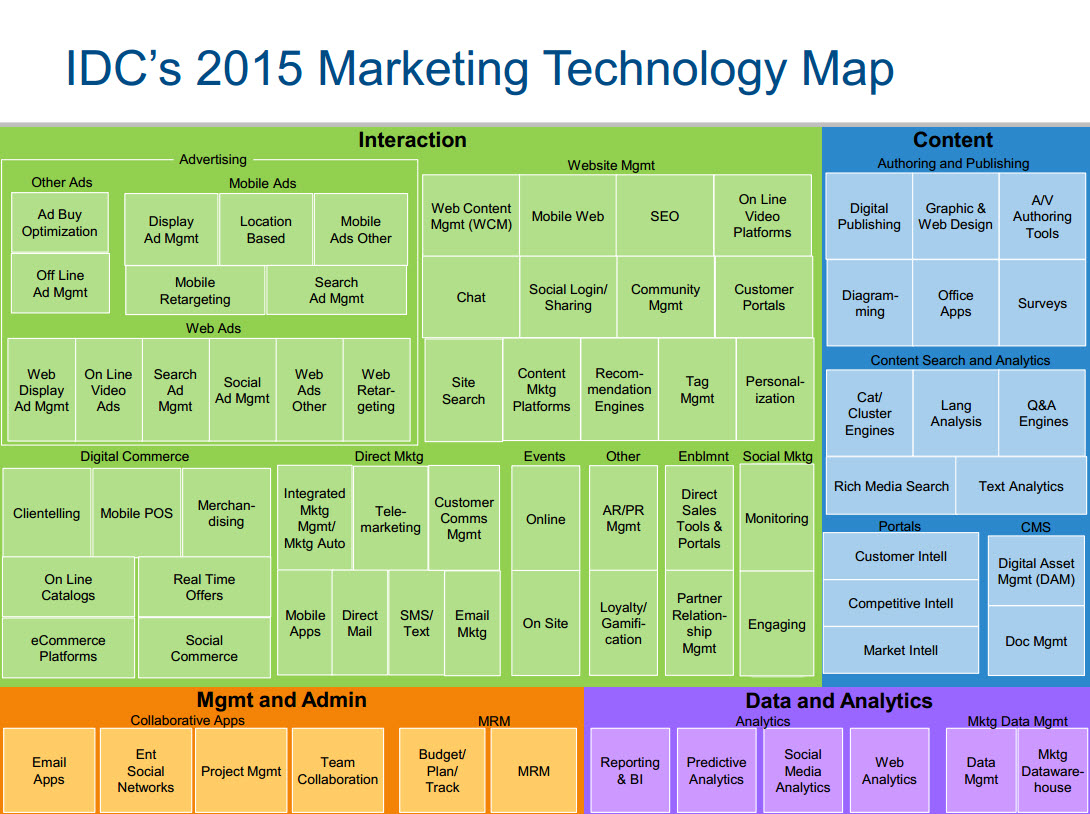
Marketing technology looks to have a big next five years according to IDC’s latest insights. They predict the market will grow by $32.3 billion in 2018 to reach a total of $130 billion in just five years. By that calculation, the marketing technology sector will have a compound annual growth rate of 12.4 percent.

With such growth in an ever-growing and changing landscape , IDC broke down the offerings in a more manageable way. Still, it’s very much a complex and inter-dependent system which marketers are tasked with navigating.

Google: ‘Retailers Should Embrace Mobile Tech’

Having a good mobile strategy when launching a new business-oriented website is a key to great success, as accessibility for consumers on-the-go can help be a big draw for shopping and purchasing purposes.

That said, Pablo Slough, head of mobile ad solutions for the Americas over at Google, recently spoke at the PSFK Future of Retail Event in San Francisco, discussing how more retailers can use mobile technology for better effectiveness.

The story, originally posted by PSFK, highlights Slough’s focus on mobile strategy as far as retailers are concerned. A number of consumers use their phones as personal assistants on a daily basis, like looking up key information on certain items that they’re after, or even keeping communication with someone, whether it’s business related or personal. Retailers need to find a way to grasp this to their advantage, according to Slough.

“Fighting” against the system in an attempt to work out their own program isn’t the key ingredient to success with mobile. Rather, it should be embraced and used effectively.

Slough pointed out that half of the people that utilize their mobile devices are usually in store, and once they find the pertinent information for said item, that could lead them that much closer to a purchase.

Slough highlighted three key areas in which retailers can gain the most from mobile integration: great user experience, relevant ads and insightful measurement.

The video below highlights Slough’s discussion on these topics, and it goes into a good ten-plus minutes, with him discussing the finer points that retailers should pay attention to. It’s a great topic for those who want more insight in terms of the mobile front, since it’s growing to huge leaps and bounds with millions of smartphones and tablets in the hands of consumers. There’s definitely a business market to take part in here.