7 Stats That Show YouTube’s Power Over Youth

By: Jessica Klein

Younger viewers have begun to consider YouTube as their go-to viewing hub over traditional television. Not only did 13- to 24-year-olds report that they were more entertained by YouTube content than traditional TV shows, according to Defy Media’s new Acument Report: Constant Content, but they also espouse lots of respect for YouTube creators. In fact, 69 percent of those between 13 and 17 suggested that YouTube stars could be perfectly successful TV or movie stars.

Defy conducted this survey with Hunter Qualitative Research and KnoWhy Research. The companies surveyed 1,350 people between the ages of 13 and 24. Here’s some statistics they got indicating the growing power of YouTube over young people.

1. Millennials watch 11.3 hours of free online video per week.

They also report watching 10.8 hours of weekly subscription digital video. Meanwhile, this demographic only watches 8.3 hours of scheduled television each week. Guess which category YouTube falls under

2. YouTube videos are rated higher by 13- to 24-year-olds than free broadcast and cable TV offerings online.

It’s not even digital vs. linear TV that’s determining entertainment levels for millennials. Content that originates on YouTube is simply more entertaining according to 76 percent of millennials surveyed, while just 55 percent feel that way about free TV offerings online.

3. The older millennials get, the more polished they want their YouTube content.

While 46 percent of 13- to 17-year-olds say they’re more likely to watch content on YouTube that looks more “polished,” 57 percent of those between the ages of 18 and 24 go for the professional-looking videos on the video platform.

Read more…

This article was originally posted on VideoInk and is reposted on [a]listdaily via a partnership with the news publication, which is the online video industry’s go-to source for breaking news, features, and industry analysis. Follow VideoInk on Twitter @VideoInkNews, or subscribe via thevideoink.com for the latest news and stories, delivered right to your inbox.

GDC 2015: Microsoft, Sony Preview The Future

The flurry of announcements and sessions at GDC continues, and the two most important companies in the console market aren’t just sitting on their hands. Both Microsoft and Sony made some important announcements, and by looking at what was said (and not said) you can get an idea of what’s going to be important to them in the coming year. After all, GDC is the most important show of the year for influencing developers and the rest of the business. E3 and Gamescom are big, but they are aimed at influencing the consumers. GDC is where companies have a chance to influence the development community and the businesses that serve them, so actions taken here can have an outsized influence over the rest of the year.

Sony’s clearly putting a tremendous effort into VR with Project Morpheus, and it shows. The company’s demos are more impressive, the hardware looks more refined, and for the first time Sony has given a hint about a ship date: the first half of 2016. The screen resolution is now 1920 x 1080with a refresh rate (doubled from last year) of 120Hz, and the new 5.7-inch screen also has a higher field of view (nearly 100 degrees). The latency is now significantly lower, under 18 milliseconds. The OLED screen produces gorgeous colors, too. There are now nine LED sensors on the outside, providing better resolution to the PlayStation Eye camera for better tracking.

Sony’s got great game development resources to put into Project Morpheus, of course, but let’s not forget Sony Pictures as a possible source of content — and all of the Hollywood connections there. There should be no shortage of VR experiences ready for Project Morpheus next year.

Sony’s got a comfortable lead in the console market, but as that competition heats up they will need to bring more to the table — and Project Morpheus looks like it’s a major part of Sony’s plans. One advantage Project Morpheus will have is that it’s integrated into a complete ecosystem already. Sony’s got proven controllers (the Dual Shock and the Move, both of which are readily tracked by the Eye camera), the Eye camera, and the power of the PS4. We’re not exactly sure what other hardware you might need for an Oculus Rift, but if you have a PS4 you’ve already got the core you need for Project Morpheus. That should make the hardware an easier sell.

Don’t ignore the PlayStation Network, either, which will be able to easily deliver new content for Project Morpheus. There are a lot of moving parts necessary to make VR a viable business, and Sony already has the essential pieces. What remains is more engineering, and a lot of hard work integrating all those pieces — and constructing the right marketing strategy for them. And, of course, the content, which is really the key. The hardware is only important in that it delivers the experience, but if the experience isn’t compelling enough, it won’t matter how good the marketing or the hardware or the business model is.

Meanwhile, Microsoft is making headway on its grand effort to unify its various platforms under Windows 10. The company released more information at GDC, and Phil Spencer outlined the core. Microsoft wants to enable one identity, one universal app, one store, and one game that runs across all Windows devices, Spencer said. “The core product of what you are building will extend across the whole Windows 10 community including Xbox,†he said. “Our investment in Windows Store has never been higher than it is now. You will be able to develop and distribute your game across the entire ecosystem using that one store.â€

Meanwhile, indie developers continue to be important to Microsoft. ID@Xbox director Chris Charla confirmed the program would soon cover Windows 10, enabling developers to self-publish on an array of Windows devices, from phones to tablets to the upcoming HoloLens. Microsoft will leave it up to developers to determine whether they will allow touchscreen, keyboard, and game pad players to play with each other. To date, Charla said the ID@ Xbox program has seen more than 1,000 Xbox One dev kits sent to indies and 40 games shipped, with more on the way.

Looming over all of the Windows 10 talk is the impact that DirectX12 is likely to have by significantly increasing game performance on the Xbox One as well as on PCs. We’re going to see more graphics power unleashed by DirectX12, and with Windows 10 going across platforms (including mobile devices), developers will be able to bring games to more devices faster. Microsoft even announced an upcoming device that will let you use all your Xbox One peripherals on PCs, though the price wasn’t shared. There’s also the streaming functionality that will let you play your Xbox One games on Windows 10 devices…. and possible vice-versa as well.

Microsoft is finally unleashing the power of its PC market share to influence its success in the console market — as well as using its gaming strength on PCs and on mobile. The Xbox Live service is being given an important role on the new Windows (with an Xbox app for everyone running Windows 10), which means games will be more important, too. This is all part of Microsoft’s strategy to wrest the console leadership away from Sony, and to make Microsoft more of a player in the mobile market.

It’s going to be an interesting year ahead for console gaming.

Can ‘House of Cards’ Help ‘Monument Valley’ Sell?

Featuring a video game in a popular TV show can actually pique interest in said game, as some viewers may wonder, “Hey, where can you play that” with just a peek at gameplay. The latest show to do this is Netflix’s House of Cards, as lead character Frank Underwood, portrayed by Kevin Spacey, dips into the popular mobile game Monument Valley briefly over the course of the season.

The conspicuous addition of the game has the Internet wondering if it is a product placement or a plot point.

Underwood, who no doubt builds plenty of tension over the course of the season with his sinister actions (as he did in the previous two), utilizes the game as a way to decompress — something that’s made it a popular hit in the real world as well.

A company called appFigures recently broke down how an appearance of a game in a TV series like this can have an impact on the game’s sales. It explained that the series has a devoted following. Last season alone, over 670,000 people bing-watched the entire run of the show’s second season — only accounting for two percent of total Netflix subscribers. There’s a possibility that season three’s numbers could surpass that easily — and that means more eyes on Monument Valley.

appFigures, a powerful app store intelligence platform, also measured the ranks data from the show’s third season debut this weekend to get an idea of what effect the game would have when it appeared in the series, which is around episode five. According to its stats, almost exactly five hours after the third season became available on Netflix, the game showed an increase in popularity on the App Store.

The company reports that the iPad edition of Valley has become the #2 overall paid app, right behind Minecraft: Pocket Edition. The Google Play version didn’t perform too bad either, as it managed to get to the #11 spot on the paid app charts.

Monument Valley House of Cards Grossing App

appFigures broke down the findings on its blog, utilizing a number of charts to show its increase in popularity following the release of the third season of the series. It was also quick to note that many users were actually interested in paying the game’s $3.99 fee before even getting a chance to try it out, which it found to be uncommon, as some titles offer a “freemium” version to try before needing to purchase the full game.

What’s more, the company concluded that “such a prominent feature in a leading series proves to be the ultimate advertisement. At this point, the effect is even greater than that we recently looked at for apps that purchased Super Bowl ads — without the large price tag! It would appear as though this is a much more receptive audience.”

Clearly, if something’s good enough for Frank Underwood, clearly it can work for us as well . . .


Twitch Stands To Benefit From Expansion Into Poker

Usually, when people watch gaming action on Twitch, they tune in to catch players give their all in games like Pokémon, League of Legends and Call of Duty, among other titles. However, pretty soon, they’ll be able to tune in to see a different kind of game unfold – poker.

According to a report from the Wall Street Journal, Twitch has already experimented with showcasing poker matches on its streaming site, with some channels testing the format as soon as last November. It’s apparently a beneficial move, as said channels have already reported audiences in the seven-figure digits.

Twitch recently streamed nearly an hour of poker during January 2015, and noted that, with this massive success, it’s only reached less than one percent of the overall video streamed for the site. Obviously, video games will continue to be the huge emphasis for its success, but it appears that there’s room for a few card players as well.

“Like videogames, poker is a game and we’ve grown that into a huge business,” said Scott Ball, the Twitch exec in charge of the project.

To keep matches fair, matches are broadcast with a four-minute delay, since cards are also shown to the audience to keep them involved in a match. (This would prevent them from reporting said cards to players who may be broadcasting the action on their own channel.)

With the help of several professional online poker players, Twitch could easily take on the likes of ESPN when it comes to poker tournaments and other events, which easily rack up millions of dollars in prizes and a fairly large viewership.

This move could easily boost Twitch’s audience numbers, which already tops more than 100 million monthly viewers. This is a tremendous increase from the 45 million it had back in the end of 2013 – thus prompting Amazon to make its move and purchase the company last year.

It’s a move that needed to be made, though, especially with Steam recently announcing that it would launch its own service, Steam Broadcasting, which is currently in beta. Well, it looks like that Twitch is certainly betting big – and has the poker team to back it up.

All Eyes Are On Pinterest’s User Growth

Pinterest has been getting a lot of well-earned attention lately for the care with which they are creating their marketing opportunities. Right under our noses, they’ve been creating new ways to discover apps, experimenting with new ad units and really driving user growth, especially among male users.

The social network is doing a lot to overcome its perceived marketing hurdles, the biggest of which is the number of users and penetration. Have users Marketers definitely take note there.

“[Pinterest’s] growth may be more limited than other services, simply because what you do on Pinterest — find and pin things that you like — isn’t necessarily something that large numbers of people may want to do,” Debra Aho Williamson, principal social media analyst at eMarketer, wrote in the report. “[But] in a year when marketers are starting to worry about ‘dark social’ platforms where most conversations are private, there’s a polar opposite—Pinterest.”

New data from eMarketer shows that Pinterest will see 47.1 million users this year, which is a hefty 11.4 percent increase year over year, which isn’t surprising as the Pew Internet Research Project ranked Pinterest as the 2nd fastest growing social platform just behind Instagram. This means that more than a quarter of total social network users in the US will be on Pinterest, with almost as many using it on a monthly basis. When put in that perspective, it is understandable that there’s a flurry of interest.

It may surprise you that while Pinterest has the reputation of being a mostly female platform that the network sees equal gender splits in India, South Korea, Japan and Brazil. The company is on track to see that 20 percent of its users is male by 2019.

“Pinterest has a lot of work to do to become a major player in digital advertising. Early results from its advertising tests have been generally positive, and its user interface has been a defining and differentiating characteristic for the platform since it exploded onto the scene in late 2011,” says eMarketer.

WATCH THIS: ‘Age of Yahoo’ Trailer For ‘Community’ Season Six

By: Jessica Klein

Yahoo has finally released a trailer for season six of Community that features actual footage from the upcoming season.

The trailer teases some new cast members, classmates, and inmates alongside returning Community stars Joel McHale, Gillian Jacobs, Danny Pudi, and Alison Brie. New cast members in the show include Paget Brewster as the school’s consultant and Keith David as a retired scientist. You can check out the trailer here.

This article was originally posted on VideoInk and is reposted on [a]listdaily via a partnership with the news publication, which is the online video industry’s go-to source for breaking news, features, and industry analysis. Follow VideoInk on Twitter @VideoInkNews, or subscribe via thevideoink.com for the latest news and stories, delivered right to your inbox.

What Millennials Really Want (And Don’t)

Nailing down the habits and desires of millennials can be tough for a marketer, but it can be done, provided you find the right materials needed to get an idea of what they’re looking for.

The Washington Post recently published a report breaking down what millennials want – and don’t want – through eight general bullet points, which, in some ways, also compare with certain needs that came from their parents years ago as well. The full article can be found here, but we broke down some of the points below:

First off, millennials are into cheap goods, and not necessarily large items, such as a house. “The millennial generation cares more about price than quality, at least compared to prior generations,” reads the report. “Yes, quality is still important, but given that they have lower incomes and more debt, cost is an especially big consideration for many millennials.”

Millennials also have a thing for health, with eating right playing a bigger part over Gen X and Baby Boomers. However, getting a television isn’t, oddly enough. “It shouldn’t be too much of a surprise that only three in 20 millennials think it’s really important to own a television,” the report states. “Millennials have grown accustomed to consuming media on their laptop screens, tablets and smartphones. millennials may still love cable TV and movies, but they want to watch it on the small(er) screen.”

With health being of importance, athletic gear is also in demand, particularly with athletic apparel and footwear, according to the report. So, of course, vehicles, like cars, aren’t on the “hot” list, as nearly a third of millennials don’t feel the need to purchase a car. “Millennials are gravitating toward cities, where they can use public transit, car-sharing services, Uber, taxis, bicycles and their feet to get around. Helps with the health kick, too.”

As you may expect, social media is in huge demand with millennials. “Everybody knows that Millennials are the Facebook generation. But it’s not just about staying connected with friends. Millennials look to social media to make decisions about brands they want to buy. That’s a wake-up call for companies still searching for strategies to reach people between the ages of 15 and 35,” says the report.

So what’s the final thing that isn’t on their list A luxury bag, of all things. As only ten percent of those millennials polled believe that it’s important, but not a big priority. 30 percent said they might purchase it if they really need it, but it’s indifferent otherwise.

Game Development On The Rise Worldwide

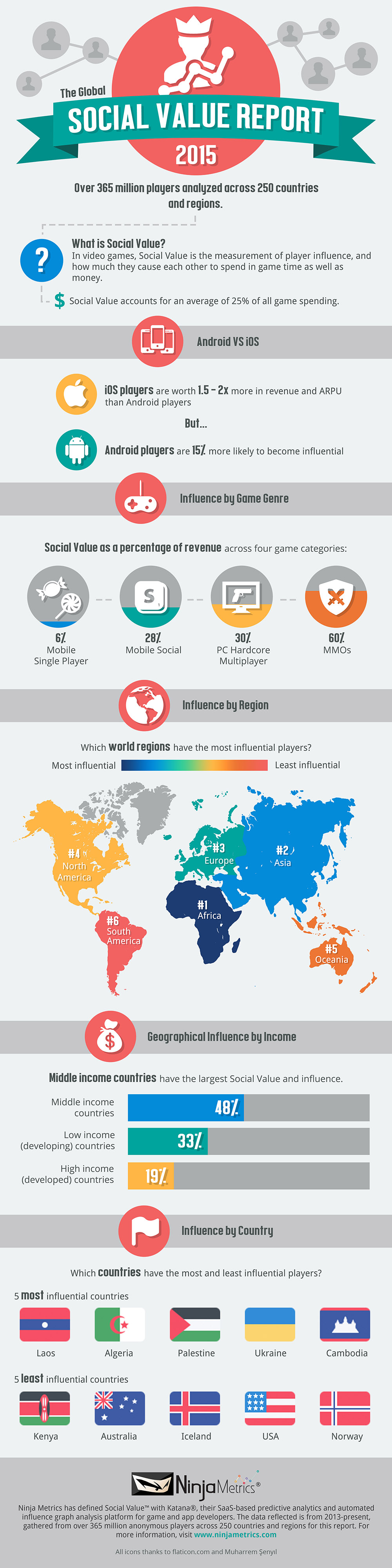
The game industry continues to be strong worldwide, thanks to smart game development and effective marketing that panders to certain markets, particularly in the United States and China. Today, a new report from Ninja Metrics indicates that other countries are picking up in game development as well, slowly but surely getting their own piece of the pie.

The report, analyzing over 300 million users, implies that developing countries like Laos and Algeria are helping drive the global spending when it comes to games.

First up, social value is weighed in an Android vs. iOS format. iOS players are worth one and a half to two times more in revenue and ARPU than Android players. That said, Android players are 15 percent more likely to become influential in the long run.

Getting into game genre influence, 60 percent of it comes from massive multiplayer online (MMO) games, while PC Hardcore/Multiplayer is close behind, with 30 percent. Mobile social rounds out the top three with 28 percent, while mobile single player lags behind at six percent.

The most important part of the report, however, breaks down influence by world regions — and you’d be surprised who’s number one. Africa actually takes the lead when it comes to being the most influential country, followed by Asia, Europe and North America. Oceania and South America play their parts as well in the fifth and sixth positions.

Geographical influence by income breaks down with 48 percent coming from middle income countries, 33 percent from low income (developing) communities and 19 percent from high income (developed) countries. That says a lot when it comes to the creation of games, especially from studios just getting started in the industry.

Another aspect of the report that we found fascinating was a breakdown of influence by country. Surprisingly enough, the top five consist of Laos, Algeria, Palestine, Ukraine and Cambodia. Coming up as the least influential countries were Kenya, Australia, Iceland, the United States and Norway.

These numbers say quite a bit, and point out just what kind of effect smaller countries can have on the overall market. Regardless, game development will keep going strong.

Core Gamers Drive PC Game Sales

With mobile gaming on the rise, some might think that it’s the “hot market” when it comes to the game industry. And it is – but you shouldn’t count out PC, as it’s likely to see an increase thanks to a core market.

The Open Gaming Alliance, a non-profit organization that keeps tabs on everything happening with the games industry business, is set to unveil its seventh annual research report at the end of this month. With it, using research from market research firm DFC Intelligence, it intends to explain how the PC gaming industry will grow even larger over the next few years. Estimates indicate that the market will rise from $26 billion in 2014 to $35 billion by 2018.

“Much of the growth is driven by pure demographics. We continue to identify a core group of consumers for whom playing on the PC is a major pastime,” said DFC analyst David Cole. “This is, in fact, a fairly new demographic that skews highly male and is only increasing in buying power.”

The report will break down specifics, such as the impact of hardware spending (like who goes all out for buying devoted gaming PC’s and such), as well as the overall growth of eSports, and how competitive gaming has become such a hot spectator sport, driven by such games as Wargaming’s World of Tanks and Riot’s League of Legends.

“In past years much of the growth in PC games has been due to adoption of the platform in Asia. Now we are estimating a potential 86 million PC gamers outside Asia that we have targeted as market growth drivers,” continued Cole.  “These are the consumers that are driving spending not just on software, but also on PC hardware, as they buy expensive equipment to play, view and record games.”

OGA board member and Research Subcommittee chairman Matt Ployhar also had some input on this growth. “The recipe that keeps PC gaming on top is simple:  the platform is accessible to all markets, and especially so with the free-to-play and freemium content; the hardware continues to evolve with gamers’ lifestyles, offering more choice and freedom; and, due to the ubiquity of PC’s globally, it’s easier to share, communicate and be more sociable with friends and family,” he explained. “These same factors, in part, also help explain the meteoric rise of eSports.”

Once more details emerge from this report, they’ll certainly paint a larger picture of what we can expect from this market. But good news is definitely ahead for both devoted and casual game players in this field.

Tags:

What Can Alibaba Do For OUYA?

OUYA’s Android-based game console created an initial splash with a successful KickStarter a couple of years ago, but languished in the market after that, held back by a lack of great games and the inability to easily add any Android game. The company shifted to a platform strategy, hoping its curated game store would be more popular than its hardware. However, OUYA has not had much of an impact, being overshadowed by the success of the PS4 and Xbox One, and the more directly competitive Fire TV and the Android TV boxes heading to market. That’s not the end of OUYA’s story, though, as a new investment breathes significant life into the business.

Chinese e-commerce giant Alibaba announced a $10 million into OUYA, and has begun working with the OUYA team to incorporate more software into the system, providing a library of games that could expand beyond 1,000 different offerings, according to the Wall Street Journal.

In addition, this deal could help open up a new market for the OUYA store or perhaps even the hardware, as Alibaba seeks to introduce a game console to China, following that country’s recent lifting of a ban on game consoles. As a result, many players will now be able to access a much-wider Android market with the system, while at the same time paying an affordable price in comparison to more expensive systems, such as the Xbox One and PlayStation 4.

This is the latest investment by Alibaba, who also paid $215 million for a chunk of mobile-messaging start-up team Tango in 2014, along with other companies, such as search-engine Quixey and shipping provider ShopRunner, according to the article. Alibaba also invested $120 million into Kabam, and perhaps that may mean seeing Kabam games on an Alibaba console.

So what does this mean It shows that Alibaba is quite serious about being a formidable competitor in the gaming market. Rumors of Alibaba developing a console for the Chinese market seem ever more probable; the company might even use the OUYA design (suitably updated, no doubt, with a newer processor for top-notch gaming power). OUYA’s store front, library of games, and user interface may all be of use to Alibaba as well. The Chinese market is wide open for consoles right now with no established base, and Alibaba’s immense size and bank account are powerful weapons. A lower-priced console would certainly be more popular than the high-priced Sony and Microsoft offerings. Alibaba may even be thinking about exporting such a console to other countries, where it could be an excellent way to bring Alibaba’s store front to a wide audience. Games may be just the way to sneak a store into people’s homes.

We certainly wish both companies the best of luck, as it’ll be interesting to see where this partnership goes from here.