PlayStation Debuts Original, Live-Action Series ‘Powers’

By: Jessica Klein

PlayStation’s original series Powers debuted yesterday with its first three episodes, marking the company’s first live-action series.

Powers is now available for people to watch on PS3 and PS4 in addition to PlayStation’s YouTube channel (if you’re just looking for episode one) and website. The first episode runs for one hour and is free for everyone. Seven more will follow the initial three, all of which PlayStation Plus members can watch for free (others have to pay per episode through the PlayStation Store).

Here’s episode one…

This article was originally posted on VideoInk and is reposted on [a]listdaily via a partnership with the news publication, which is the online video industry’s go-to source for breaking news, features, and industry analysis. Follow VideoInk on Twitter @VideoInkNews, or subscribe via thevideoink.com for the latest news and stories, delivered right to your inbox.

Now Hiring The Week: March 11th

[a]listdaily is your source for the hottest job openings for senior management and marketing in games, entertainment and social media. Check here every Wednesday for the latest openings.

Learn to lead creatively with these tips.

  • Netflix – Director of Marketing, Original Films (Beverly Hills, Calif.)
  • Coca-Cola – Senior Manager, Entertainment Marketing (Atlanta, Georgia)
  • Epic Games – Community Manager (Salt Lake City, Utah)
  • Ayzenberg – Social Media Intern (Pasadena, Calif.)
  • Ayzenberg – VP, Digital (Pasadena, Calif.)

For last week’s [a]list jobs postings, click here. Have a position you’d like to place with us Email us at pr@ayzenberg.com.

The Rise Of The Branded Emoji

While Taco Bell has been petitioning the Unicode Consortium to add a taco emoji— albeit is very Taco Bell-looking taco– to the existing emoji system, other brands have been seeking out ways around it, riding on messaging apps’ wild popularity to extend their brand.

Broad City Emoji EmoticonA screenshot of Broad City‘s emoji library.

Mentos got their own emojis, using their colorful rounded product as the base for some fun designs on the Ultratext messaging platform. Last month, both Ikea and Coca-Cola released their own branded emojis, with Ikea’s emojis notably containing a very cute plate of Swedish meatballs.

On Snapchat, General Electric developed a periodic table of elements and now, Comedy Central’s Broad City has a line of emojis using the show’s jokes which can be downloaded as a separate app.

It’s no wonder there’s a ton of brand interest in this space, as long as mobile messaging apps continue to accrue a ton of users. While in total, mobile apps have grown 115 percent , message apps have led much of that growth at 316 percent, surpassing gaming and social networking apps. It is, according to Flurry, the fastest-growing app category, but largely ignored by many brands.

In the US alone, 23 percent of smartphone users use IM services as opposed to SMS, but messaging app use is much more mature in other countries like Spain, Singapore and South Korea, where these apps are the dominant form of communication on mobile.

“The benefit of this type of marketing is that you are not interrupting or seeking to changing consumer behavior, but rather adding content into an existing, frequent behavior. If the content is good, people will use it and engage with it,” said venture captial firm Greycroft Partners’ Ellie Wheeler.

Taco Bell may be waiting with bated breath to see the inclusion of the taco alongside the pizza and hamburger emojis, but for now, some savvy marketers are having no problem finding their way into messaging.

Beyond Ikea’s and Coke’s branded product emojis, it would certainly be interesting to see more character-oriented emoji’s similar to Broad City. What would League of Legends and Marvel emojis look like, for example

And what about Facebook’s growing bevy of chat stickers that are no longer relegated to just the Messenger app, but can be used in conversations on posts in-stream Will opportunities for branded stickers be created there, too

It’s clear that we’re moving away from text-based messaging to a much more enhanced messaging experience, whether it’s emojis, video, photos and more, and any brand who figures out creative opportunities to break into the new ways in which we communicate is ahead of the curve.

Ikea's Swedish meatballs emoji.Ikea’s Swedish meatballs emoji, complete with flag.

Thoughts On Apple Watch As A New Game Platform

With the Apple Watch slated to hit retail next month, many developers are no doubt hard at work on concentrated apps for the wearable device that will make proper use out of it. While most are focusing on experiences that relate to watch-style wear (such as the old-school Dick Tracy-style walkie talkie), some are actually working on games that can use the device in a number of innovative ways.

The Guardian recently posted an article where game developers explained how the Apple Watch can actually be a viable game platform, breaking down a number of ways that its use could innovative, through various experiences – and not just ports of Pac-Man and Tetris.

Obviously, the right approach has to be made, according to Will Luton, designer of the popular Pebble game Pixel Miner. “Integrating heart rate and pedometers obtrusively into game loops or attempting to shrink down smartphone titles onto a smaller device may get some traction early on as players explore the device and its capabilities, but they won’t be sustainable.

“The correct approach is to consider how the device is used and build from there. Smart watches are high frequency, short session devices that have low precision controls. This means that interfaces have to be very simple, such as one touch or menu-based systems. If smartphone games are designed to be played whilst waiting for a coffee, smart watch games should be designed to be played in an elevator ride.”

The article brought up a couple of examples of this, including mini-games from Nintendo’s Wario Ware series, which could be played in spurts with just a few simple motions and gestures, combining together into a larger game experience. There’s no doubt that developers would benefit from this format.

But that’s not all, as new ideas could also be explored. “One thing that game developers like is new modes of interaction and control,” said developer and researcher Michael Cook. “GDC ran their annual alt.ctrl workshop recently that’s all about new ways to interact with games. Apple’s already emphasizing these minimalistic ways of communicating through the watch, like doodling on the screen, tapping another person’s wrist remotely, and so on.

“The small screen and simple interactions also remind me of what Robin Baumgarten is doing in his game design experiments. Baumgarten’s latest creation is Line Wobbler, a game that you played on a single line of flashing lights. Designing games for really small platforms like a single dimension or a screen as small as a watch is a really cool challenge.”

“Persistent” games can also play a big part, allowing users to trade data with one another from a simple pass-by – similar to Nintendo’s StreetPass program for the Nintendo 3DS. “I do actually think there are some great possibilities for ‘persistent games’— games that you are playing all the time, alone or with friends,” says developer Bennett Foddy. “For these games, the watch makes it possible to check in on your progress whenever you have an idle nanosecond, without starting an app or pulling out your phone. These might be games that are played by tapping the phone at certain times, or by being at certain locations: the depth won’t come from the software itself but from the way that it fits in with your everyday life.”

“Developers will have to get better at placing more of the experience in the mind and less of it on screen,” says game developer Moo Yoo, who worked at Moshi Monsters creator Mind Candy until going independent. “I imagine a huge demand for highly interlinked social games and dynamically generated social narratives. You can take the example of a game like FarmVille which gave context and a real-world meaning to gifting a virtual animal. A smartwatch game could be a system of proposals, acceptances, and rejections – either in a dating sim or a game of diplomacy.”

More ideas on what Apple Watch gaming could be like can be found in this article here. It’s obviously got a ways to go, but developers can certainly find a way or two to make them truly innovate – and not just be “gimmicks”, as it were. If the Apple Watch and other wearables gain a large audience as many expect, this could be a significant new source of revenue for game companies who are, er, watching out for new opportunities.

‘Chrono Wars’ Brings Ambitious Gaming to Facebook

Facebook games are quite common these days, with players partaking in everything from Angry Birds to Marvel Heroes, interacting with their friends and followers while fighting for as high a score as they can muster. However, Narvalous wants to change the way players approach Facebook games – and it has an ambitious release that could very well get the job done.

The mobile publisher has announced the release of Chrono Wars: Light of Darkness, a new Facebook game that’s easily one of the most stunning – and ambitious – releases yet for the social site. The game follows the usual massive multiplayer online (MMO) adventure format, as players complete missions in the hopes of fixing the fabric of time, which has been torn apart by heinous forces. The missions will send players through six historical eras, using three different classes – the mage, the berserker, and the knight.

Where Chrono Wars is different from other games is with the use of an unmatched 3D gaming engine. The FancyBeans Fancy 3D engine enables the usage of 3D character models and backgrounds, providing more depth than the usual Facebook offerings available. That said, the game experience is currently limited to PC users only, although Narvalous hopes to make it available to Mac owners soon.

“With Chrono Wars, Narvalous is proud to bring to our avid gamers IMAX-quality 3D graphics and an unprecedented client gameplay experience via a browser interface or a PC launcher,” said Jay Tang, president of Narvalous. “We worked with the developer, FancyBeans, and the global publisher, Gamewave, in four intensive months to adapt the game for the North American market. So far the Closed Beta testing retention rate has risen four times from a month ago. We believe the game is on track to make a big hit in 2015. We welcome other publishers or platforms to contact us for channeling opportunities.”

This could mark a huge upswing in popularity for Facebook games, especially considering the historical twist on the game (with characters like Robin Hood and Jeanne D’Arc involved), and it also looks to provide a good amount of revenue for the company, with various premium content available, including gear and weapons.

The trailer below provides a better glimpse of what Chrono Wars has to offer. Interested players can check it out here.

Microsoft Leading Consoles On Free-To-Play Games

In the past, if players were looking for free-to-play games, they’d have to turn to either PC or mobile devices to find them. However, given Microsoft’s recent business decisions, it appears that the company is quite serious about bringing the format to Xbox One – in a number of ways.

A few decisions over the past week have fueled that change in direction, including the announcement of Wargaming’s highly popular World of Tanks for Xbox One (following its massive success on Xbox 360); the multiplayer action game Gigantic, which will be coming from Motiga sometime later this year; the confirmation that Microsoft’s own Fable Legends would be a free-to-play release, structured in a similar manner to Riot Games’ immensely popular League of Legends; and Hi-Rez Studios’ Smite, which has been confirmed to go into early access testing on the Xbox One starting this week.

So what does this mean It means that Microsoft is starting to move forward on the idea of offering free content for Xbox Live regular and Gold members alike, providing a number of alternatives for those who might be too tight on a budget to purchase a $60 title. The company is no stranger to the format, as it’s introduced hit games like Happy Wars and World of Tanks on the Xbox 360, generating huge audiences as a result.

The Xbox One got a free-to-play boost in the past year as well, including titles like Killer Instinct, Project Spark and Warframe (which is also available on PS4) providing a good amount of gameplay with no purchase required. (Microsoft also released the active Xbox Fitness program to Xbox Live Gold members for no charge.)

This new avenue of business could be good for not only players, but developers as well. Expanding highly regarded franchises to a new format can be a tremendous value to publishers, enabling them to bring a similar yet somehow new experience to players, and opening the door to potential business through microtransaction purchases and other features – without gouging them like crazy, as some “freemium” models have been known for in the past.

Microsoft can also benefit from this shift, as it not only brings more of these projects on board its system, but can also advertise them as a key ingredient to the success of Xbox One. While its focus on premium games like Halo 5: Guardians would remain steadfast, the company could easily promote free-to-play releases to its Xbox Live Gold members, thus increasing memberships and benefits to make the service worthwhile. Free weekend events could also be more concurrent, allowing those who don’t yet have Xbox Live Gold the chance to see what it’s like to be a member – and maybe even offer a discounted rate as well, as it did in the past month, lowering its price temporarily to $39.99 for one year.

It’s too soon to tell just how well these titles will do, but if the numbers from Happy Wars, Project Spark and World of Tanks are any indication, they’re bound to be hits – and that’s good news all around, for players, developers, publishers and Microsoft alike.

Apple Watch Redefines The Wearable Market

So it’s officially happening – the Apple Watch will launch in the U.S. on April 24th, featuring a number of compatible apps and features, and ranging anywhere in price from $350 to $10,000 or more, depending on which model consumers want to go for and the choice of wristbands.

But along with a refined interest in Apple products, the announcement could also bring good news for the wearable tech market in general. ABC News has reported that the Watch will be a big seller for Apple, but will also generate interest in other pieces of technology, which will be good news for competitors.

“There is clearly interest in the category,” said Ben Wood, chief of research for CCS Insight. “If Apple can make this work and they can give the industry a few pointers, then I think you’re going to see the other players saying, ‘We’re going to have another go.’ I think you’ll see a halo effect.”

Although Apple’s Watch won’t be the first one on the market – Samsung beat it to the punch a few months ago with its own model – it will no doubt be one of the most popular, in spite of its price (compared to other watches). Its compatibility and apps will give it widespread appeal, form all appearances. The demo today showed how the Watch can take phone calls, process messages, and even summon a car via Uber — as well as pay for products at 700,000 different locations and open compatible hotel room doors. The broad array of functionality is sure to be expanded as developers hop on board, and don’t be surprised when games start appearing on the Watch.

While Apple’s new wearable will no doubt be off to a strong start, its relatively high base price (and stratospheric high-end price) will keep people looking at other, lower-priced alternatives. Pebble is another company that has stood out with its wearable tech line-up, according to CCS Insight. The company revealed a number of watches that come with various sizes and features, which can cater to audiences that aren’t necessarily looking for Apple’s.

“I think it is interesting for Pebble to get out there and highlight its capabilities” with the devices, according to Wood.

Now it’s just a matter of prodding tablet and iPhone owners to upgrade to an Apple Watch. “What I am hoping to see are the reasons why I need an Apple Watch in my life,” Wood continued. “I think Apple has been very smart in announcing this ahead of time. They were able to control the message. The single biggest advantage that I see is the fact that they were able to exploit their most valuable asset: the development community.”

It’s still too early to tell if the Apple Watch will be a big hit, but, judging by the buzz on the Apple site following its revealing of details, we could be in for a huge shift in the wearable tech market. And that’s good news for all involved, not just the “big A”.

The Growing Power of Podcasts

Some may think that podcasting is a simple art, putting a microphone in front of them and recording themselves saying what they want about a number of topics. However, there’s a certain finesse to doing the right kind of podcast, the kind that generates big audience numbers and more interest in the field.

That said, it appears that interest in podcasting has grown immensely, according to a number of new charts put up by Digiday. The site reports that a full 17 percent of the U.S. population 12 and over listen to at least one podcast per month, based on an Edison Research study.

The first chart above indicates that around 27 million Americans listen to a podcast once a week, based on a random sampling of 2,000 Americans aged 12 and up. There was a slight drop in listenership back in 2013, but the numbers continue to grow steadily over the years, reaching the 17 percent peak for this year. This shows that there’s still a great interest in podcasts, ranging across various topics from television to video games to entertainment.

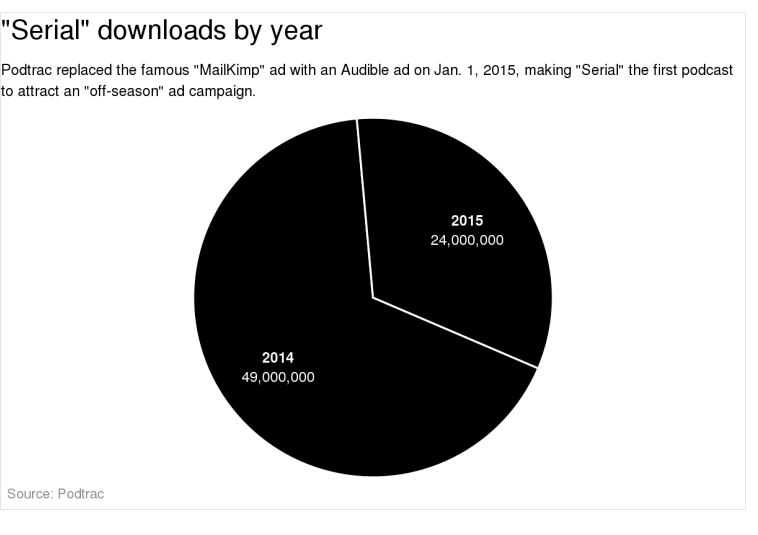
The Serial podcast show continues to be the most successful podcast out there, with an audience of over six million unique downloads per episode (according to Podtrac). The show has managed to rack up 72 million total downloads in all, with roughly 24 million of those taking place this year. As you can see from the numbers above, it was able to generate a strong “off-season” ad campaign, and will no doubt continue to increase going into its second season.

That said, advertising for podcasts remains minimal at best, mainly because audiences are still growing for it. The podcast ad market spend is around $34 million, and should remain on that level through 2016, according to a ZenithOptimedia report. A good portion consist of wealthy or “well-to-do” types, with 24 percent of Americans with a college degree listening to the shows, while 26 percent of those make more than $100,000 annually, according to Infinite Dial.

Podcasting “is really interesting from a sizzle perspective as a media professional,” said John Tuchtenhagen, senior vice president of media at Digitas, “but in terms of scale, it’s a pebble in the ocean compared to Spotify or Pandora or terrestrial radio.”

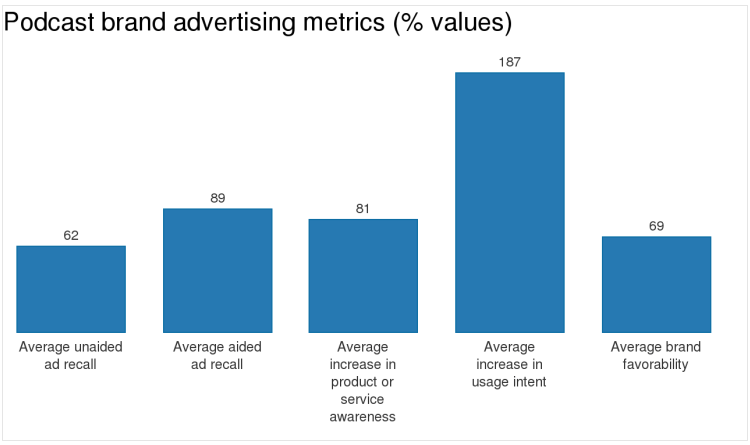
There is room for even more growth, as many companies have featured their advertising on podcasts, like Google, PayPal and HBO. More companies should take interest as well, with advertising results in 62 percent average unaided ad recall, an 81 percent average increase in product or service awareness, a 187 percent increase in usage content (the highest overall) and a 69 percent average brand favorability rating. So, yes, there’s a market there.

If you haven’t heard podcasts lately, definitely do some shopping around. Whether it’s Serial, the array of ESPN podcasts or the likable nature of Gamertag Radio, there’s definitely something to listen to.

ESPN Brings The eSports Competition

Some people believed that eSports wouldn’t find a place on broadcast television, due to a lack of interest in the field compared to traditional sports. However, that isn’t stopping some major networks from trying to take part in eSports competitions, as it’s a growing phenomenon that attracts millions of viewers and fans.

ESPN is the latest network to take this gamble, as it will once again bring eSports to the forefront with the forthcoming Heroes of the Dorm event, which kicks off later this month and concludes in late April, according to MCV.

American and Canadian university students will compete in Blizzard’s action-packed Heroes of the Storm multiplayer online battle arena (MOBA) game, in the hopes of waiting over $450,000 in tuition fee contributions. The winning team will be able to earn up to $25,000 per year for the remainder of their time at the university of their choosing, while senior and graduate students will be able to apply a contribution towards their student loan repayments.

ESPN plays to televise the eSports event within the area, although there’s no word if it will see national broadcast. At the very least, it should also be available for online viewing, especially considering that eSports-style events get big numbers online. Tournaments that have run over on Twitch.tv are clear evidence of that.

This is quite a turnaround for ESPN when it comes to the thought of eSports, as the president of the sports network, John Skipper, stated that the competitive event is “not a sport” and even compared it to a competition level along the lines of chess. Perhaps the network changed its mind when it saw what kind of numbers events were drawing both online and in person (like any given League of Legends tournament, which generates huge interest regularly).

That’s not to say we’ll be seeing eSports coverage on a weekly basis, but this is definitely a step in the right direction. And who knows, ESPN may sponsor more events like this and slowly grasp that eSports are just as popular as traditional sports. And a little more exciting than golf matches, yes

Check out the teaser trailer for Heroes of the Dorm below.

3 Takeaways For Marketers From WMC 2015

In case you missed it while at GDC in San Francisco, across the pond, the Mobile World Congress was happening at the same time. It’s a gathering of the biggest mobile hardware makers in the world in Barcelona, Spain, where they show off their latest and greatest gadgets and talk trends and business.

The [a]listdaily has summarized the following take-aways from across the web from a marketer’s POV:

Mobile Marketers Choose To Focus On VR

From The Verge:

“… this year saw an explosion of interest in virtual reality, which is more associated with the Game Developer Conference held concurrently in California. It almost felt like there was more VR stuff here at MWC than there was two months ago at CES, which includes a much broader range of technology products… VR’s explosion at MWC this year highlights where we’re at with mobile technology and technology in general. Smartphones are so pervasive, so common, that even major new device announcements from the largest companies in the world don’t engender the same excitement they might have a few years ago. Samsung will surely sell more Galaxy S6 smartphones this year than all of the VR headset makers combined have to date. But for lovers of technology, what’s more exciting: a new smartphone that’s just marginally better than last year’s model or an entirely new experience unlike anything before it Based on the buzz surrounding HTC’s Vive (which isn’t even a finished product), the answer to that question is clear.”

Mobile Marketing Moves From CPI To Brand Campaigns

From CNBC:

“There is a resurgence of unique creative within mobile. With 2014’s trend of video having run its course, brands and agencies are looking to differentiate their branding on mobile platforms by using unique ad units that can be transacted using programmatic direct platforms, an emerging tool in the ad-tech space that integrates directly into the ad servers of the publishers to avoid fraudulent inventory. No longer is mobile marketing the “cost per install” market it was in the past. The big pivot in the ad-tech space is the rapid pace that brand dollars are now entering the ecosystem. Using the same strategy to drive a $1 install of a game is very different than trying to influence the purchase of a $90,000 car. This gap will undoubtedly lead to massive change in the coming years as traditional ad units and technology will be replaced by new companies, platforms and new activation-based marketing techniques powered by technologies like Bluetooth and innovative devices such as wearables.”

How A Chinese Smartwatch Became The Surprise Hit Of The Show

From The Verge:

“The Huawei Watch has turned heads, if nothing else, which could have a knock-on effect for the company’s phones. But even if Huawei’s efforts come to nothing, it’s notable that a company best known for routers and cell towers is even attempting to join the conversation around fashion and high-touch industrial design. Huawei would be one of the least likely US brand successes of all time, but as its Mobile World Congress presence shows, wearable technology is new enough to be anyone’s game.”

Some Thoughts…

While it’s no news that telecoms and mobile in particular, have become one of the biggest industries in the world, mobile is just emerging as an advertising and branding medium. It’s also interesting to note that there is still so much opportunity for innovation and not just in terms of products and services.

Looking at what’s going on in Silicon Valley and where VC investment is going, we should be see the next wave of mobile innovation also happen an an organizational and systems level. The “sharing” economy that is powering new services such as AirBnB and Uber is yet to come to the mobile world and with that we’ll probably see a lot of new brands emerging as access to the Internet via mobile is becoming a utlity.

Infrastructure blog CircleID points to Tim Höttges, the CEO of Deutsche Telekom, who indicated that from a technology perspective this means that what we will see is: softwarization, virtualization, convergence (of infrastructure) and data analytics (connecting different value chains). CircleID also adds gamification to this, for educational purposes.

“The end result for customers will have to be that use of services, applications and devices is effortless,” he says.

With all this going on, the mobile space will be one for marketers to follow closely this year, because these devices are now powerful enough and running on high-speed networks making everything from VR to big beautiful immersive branding campaigns to rival TV  a reality for the masses.

Are you ready?