What Millennials Are Looking For From Brands

Millennial users — along with Gen Z (born after 1998), for that matter — can be a little hard to predict when it comes to finding an effective advertising program. Yesterday, we posted an article that got more into the minds of millennials. Today, we’re following up with a report posted over at AdWeek, which breaks down just what these types of audiences are seeking from brands.

The latest edition of a Cassandra report by Deep Focus indicates that millennials find email marketing to be acceptable compared to the Gen Z audience. That said, Gen Z believes that online advertising is a more tolerable practice.

28 percent of Gen Z consumers polled by the company indicated that they prefer marketers to reach them through online ads, while only 16 percent of millennials feel the same way.

Jamie Gutfreund, CMO of Deep Focus, indicated that brands that don’t pay attention to the growing Gen Z audience “are losing an opportunity to anticipate the future of consumer behavior,” despite how different they may be from millennials.

The survey actually spoke with over 900 Gen Z consumers, between the ages of seven and 17, along with 500 of their parents, while the millennials consisted of age groups between 18 and 34 years old. As a result, a large infographic was compiled, which you can find below.

The numbers are broken down below, but here are some basic stats reported from the survey . . .

60 percent of those in Gen Z believe a cool product would be better over a cool experience. Meanwhile, 77 percent of those in the millennials group feel that a cool experience would actually be better than product. That’s an interesting reversal.

As far as outreach, millennials prefer email over other forms of contact, with 43 percent over social media’s 29 percent and online ads taking 16 percent. Meanwhile, Gen Z prefers social media by 34 percent, just a nudge over email’s 33 percent.

Favorite websites were a stark difference between the two groups. While millennials prefer the ease of use with Amazon.com, Gen Z feels that watching videos via YouTube is the cool way to go.

Then there’s ad preference, in which both millennials and Gen Z report low numbers when it comes to ads that feature celebrities and athletes. Millennials report 20 percent preference, while Gen Z is a little higher at 27 percent. Meanwhile, ads creating an emotional connection fared a little higher, with 31 percent of millennials preferring them, compared to 20 percent of Gen Z.

 

Plays.TV Set To Create Gaming Moments

Everyone wants to get in on the social gaming action these days, especially with the likes of Twitch.tv drumming up 100 million monthly viewers that watch gameplay for hours on end. Now, a spin-off from gaming site Raptr wants to capture these moments for gamers to watch any time.

Re/Code reports that Raptr has launched Plays.tv, a new channel that works closely with PC gamers. It enables users to download an application that records game screens any time they play, and they can simply press a key and have a short clip ready to share with the rest of the gaming community. Plays.tv connects with a number of social sites, such as Twitter, Facebook and YouTube, so clips can be shared outside of its site.

“Games are designed to have these moments of delight,” Raptr CEO Dennis Fong said. “It’s a pretty cool moment that’s a window into other people and for discovering new games, new worlds and new experiences.”

Users can decide how long a game clip to record, anywhere from 20 seconds to 20 minutes. Fong believes this casual approach could easily drive “tens of millions” of users onto the site to create their own gaming memories.

Raptr built the site with a little help from new funding, as it raised $14 million through partners like AMD, Accel Partners, DAG Ventures and Tenaya Capital.

As innovative as this sounds, Sony does something similar with its PlayStation 4, enabling users to share gaming sessions simply with the push of a button (marked SHARE) and then edit their gameplay clips for upload to YouTube and other sites. However, Plays.tv focuses more on the PC gaming community, where there are thousands of titles available – and way more opportunity to diversify broadcasts with content from more popular games like League of Legends, as well as more obscure titles.

Fong believes that the new service won’t be direct competition to Twitch, since it’s being optimized for longer video sessions and live viewing events, including forthcoming eSports tournaments that weren’t yet detailed.

How successful Plays.tv will be depends on what kind of audience it brings in. But, with a tie-in to the Raptr service, it has a chance for success. Here’s hoping the team goes places with it – and creates a few memories in the process.

Warner Bros. Wins Over Gamers

Warner Bros.’ games division is slowly pacing itself for a stellar 2015, between such forthcoming hits as Mortal Kombat X, Batman: Arkham Knight and Mad Max. Today, it announced two new promotions that are sure to get gamers excited – and rake in dollars for its highly-regarded franchises at the same time.

First up, as reported by MCV UK, the publisher will kick off three major pro tournaments in alignment with the forthcoming launch of Mortal Kombat X, the latest in the bloody brawling franchise. The publisher recently introduced its Mortal Kombat Worldwide Competitive Program, which will host the tournaments. Players will be able to compete across the globe for cash and other prizes, using their favorite characters from the Kombat series.

The campaign kicks off on April 19, as Xbox One owners in North America and Europe can compete in the Mortal Kombat X ESL Pro League Tournament’s weekly competitions. From there, 16 finalists will emerge, and battle in the grand finals in Los Angeles on July 11.

The Mortal Kombat Cup will also offer plenty of competition over the summer, with finalists competing in the Japan Expo in Paris on July 5th. Finally, the Fatal 8 Exhibition Tournament kicks off April 11, with tickets being offered through NetherRealm’s Twitch channel, where highlights of Mortal Kombat X were recently shown.

“NetherRealm Studios is a huge supporter of the pro fighting game scene and to be able to work with ESL on the Pro League Tournament allows us to take the Mortal Kombat X competition beyond what we’ve ever done before,” series co-creator Ed Boon said.  “We’ve seen some incredible match-ups in the past and we can’t wait to see what this next level of competition brings.”

Mortal Kombat X arrives in stores and on the digital marketplace on April 14 for Xbox One, PlayStation 4 and PC. The Xbox 360 and PlayStation 3 versions will arrive over the summer.

Meanwhile, for those that aren’t so heavily into Kombat – or simply just want to be Batman – WB Games has an offer for them as well. The publisher has announced a joint partnership with Sony Computer Entertainment America to introduce a limited edition Batman Arkham Knight PlayStation 4 bundle, which will be available on June 23, the same day the game releases.

For $449.99, users can buy the limited edition Batman system, which comes with a grey-colored system and similarly colored controller, as well as a copy of Arkham Knight for play. A regular bundle featuring Arkham Knight will be on sale as well, with a regularly-colored system, for $399.99.

The item is sure to be a collector’s item amongst Batman fans, and Sony has already launched pre-orders for the system, for those that are interested.

WB Games is having a killer year – and it’s not even summer yet.

Making Money As a Professional Gamer

Professional gamers can now make an excellent living from playing games, but it’s not just revenue from eSports tournaments or from live streams via Twitch and YouTube. There are a variety of ways to make money from eSports – if you’re good enough. The Huffington Post recently posted an article discussing how money can be made from professional video games, talking to various people within the industry.

For instance, Lauri “Cyanide” Happonen managed to make a decent living, after becoming a Season 1 World Champion in a renowned League of Legends tournament. He’s since retired, but continues to stream sessions through Twitch.tv. He’s done pretty well for himself, gathering 9.5 million collective views, with over 150,000 followers.

Between streaming and making YouTube videos, he’s managed to drum up a pretty good income. His eight tutorial videos currently on his channel have managed to gather 900,000 views, with over 40,000 subscribers in all.

“Cyanide” is just one of the many stories out there. Another user, Michael “Imaqtpie” Santana, at age 23, has managed to amass $8,000 monthly through streaming, thanks to an audience of around 18,000-40,000 with each of his streams, gathering 83 million collective views in all.

Twitch provide plenty of means to make money, after becoming a verified Twitch partner in its network. This earns them a portion of the revenues generated from the broadcast, but also provides users the opportunity to subscribe to the channel for $4.99, with access to extra perks like exclusive emoticons and other uses in chat.

To effectively create Twitch partners, the user must have 500 concurrent videos and stream at least three times a week. From there, “effective cost per 1000 impressions” (or eCPM) are measured, with starting users earning $.70 to $1.40 per view, but eventually gaining speed into the $1.00-$2.50 range.

The streamer has control of advertisements, including revenue and brand that ties in with them, and can earn $1.00 eCPM with three commercials per hour and 2,000 concurrent viewers. With those numbers, a user can easily earn $240 weekly, or $960 a month – or even more of they get more viewers and eCPM – up to around $6,400 monthly, or as you can see above, even higher.

The more subscribers a user gets, the more they earn in revenue from there, as 100 subscribers would equal $250 extra per month for these Twitch partners. More could obviously add up to more money, while making the streaming channel extra revenue as well. (Subscribers also have the option of adding a Paypal button for donations, or prize giveaways.)

In addition, streamers can earn revenue through select sponsorships, who can team up with either individual players or eSports-related teams. There’s also room for digital space, so the streamers can add their own special links to social pages, Paypal and other links, including affiliation to companies like Amazon. Monthly traffic through these sites can generate revenue as well, depending on referrals to the site. For instance, 100 people purchasing $500 worth of gaming gear would equal earnings of around $3,250 per month through Amazon alone.

YouTube opens up a revenue channel as well, as users can link their game sessions to their devoted pages, and earn money based on Google’s advertisement model. This can mean $.90 CPM for video banner ads, and an average of $6.50 for pre-roll video ads. Calculate a high number of views for these, and it’s easy money for the streamer.

Top streamers can make around $100,000 or more yearly, according to Jeffrey “Trump” Shih, who recently spoke with Forbes about the business. Sponsorships make up a big part of that, although some players also offer coaching lessons to novice players to earn money on the site (with an income of around $1,500 monthly for private StarCraft II sessions alone).

Being a professional gamer that makes a living from streaming takes time and patience. An audience won’t come overnight, even with the greatest of gimmicks, and social media outreach plays a huge part as well. However, those truly devoted to it will definitely find a way, and that’s an opportunity in itself.

Microsoft Looks To Win The Holidays With ‘Halo 5: Guardians’

Ever since its cryptic reveal at Microsoft’s pre-E3 press conference back in 2013, Microsoft has been building considerable buzz behind its highly anticipated sequel, Halo 5: Guardians. This weekend, it pushed the hype train even further, not only unveiling a pair of live-action ads for the forthcoming game, but also the much-anticipated release date: October 27.

The two live-action ads are featured below, and feature “both sides of the story,” from both the perspective of the main hero, Master Chief, as well as a new UNSC-based hero named Spartan Locke. Both of these stories should provide a new take on the single player campaign that players have gotten used to over the years, from previous games.

In addition, Guardians will also come with a new multiplayer mode, featuring a variety of match styles and maps for players to tackle, along with a wide range of weapons, including familiar favorites and new additions. This mode recently got a great deal of attention with the launch of a limited beta on Xbox One, which drew in thousands of fans who took part in sessions.

“We wanted Halo 5: Guardians to be the game that pays off the epic promise of the Halo universe in scope and scale and drama,” said Bonnie Ross, Head of 343 Industries. “We want to amaze players with the sheer size of the worlds and battles they’ll experience, even as they question everything they thought they knew about its heroes, marvels and mysteries. #HunttheTruth is only the beginning and we can’t wait to debut the game to Xbox fans around the world at E3 this June.”

The ads, which partly aired during the season finale of The Walking Dead, drew a large number of viewers, and also tied in to an ongoing Hunt the Truth Tumblr blog, which features actor/comedian Keegan-Michael Key as Benjamin Giraud, a journalist trying to uncover the truth behind the events in Guardians, as well as Master Chief’s mysterious past.

Perhaps the most intriguing part of this campaign, however, is the reveal of a release date, as Microsoft will ship Halo 5: Guardians, both in physical and digital form, worldwide starting October 27th. That puts it in a pivotal spot for the forthcoming holiday season, giving it plenty of time to take on any heavy competition, including Ubisoft’s forthcoming Assassin’s Creed Victory and Activision’s forthcoming Call of Duty game, which hasn’t yet been announced.

Better yet, it gives Microsoft the jump on its main competition at Sony, since that team hasn’t announced its holiday plans as of yet. Uncharted 4: A Thief’s End was originally considered to be the “big-seller” for the PlayStation 4 over the holiday season, but developer Naughty Dog recently delayed that title to spring 2016, leaving quite a void for Sony to fill.

Considering the best-selling success of Microsoft’s Halo games – including The Master Chief Collection, which launched on the Xbox One late last year – Guardians should have no trouble being a significant seller for the console. Now all eyes are on the forthcoming E3 event, where the game should have a huge presence, alongside Microsoft’s other holiday offerings for the system.


Revenue From MOBA Games Set To Dominate 2015

For years, MMORPG (massive multiplayer online role-playing game)-style games have been dominant in the game industry, with Blizzard’s World of Warcraft leading the charge. However, the MOBA (multiplayer online battle arena) genre has been picking up steam, thanks to games like League of Legends and Smite. According to Gamesindustry International’s latest analysis, they could be on their way to leading the forefront of the industry.

EEDAR analyst Ed Zhao laid out an examination of the market, explaining how the free-to-play approach with certain games, like most MOBA’s, is an effective approach for publishers.

“Firstly, the upside is tremendous: F2P allows for an unparalleled audience size, which can be a bedrock for engagement and community,” explained Zhao. “In addition, users can spend infinite amounts of money. While traditional retail titles have relied on a gated $60 for access, F2p titles can generate hundreds from their core users through a plethora of visual and game-affecting microtransactions.”

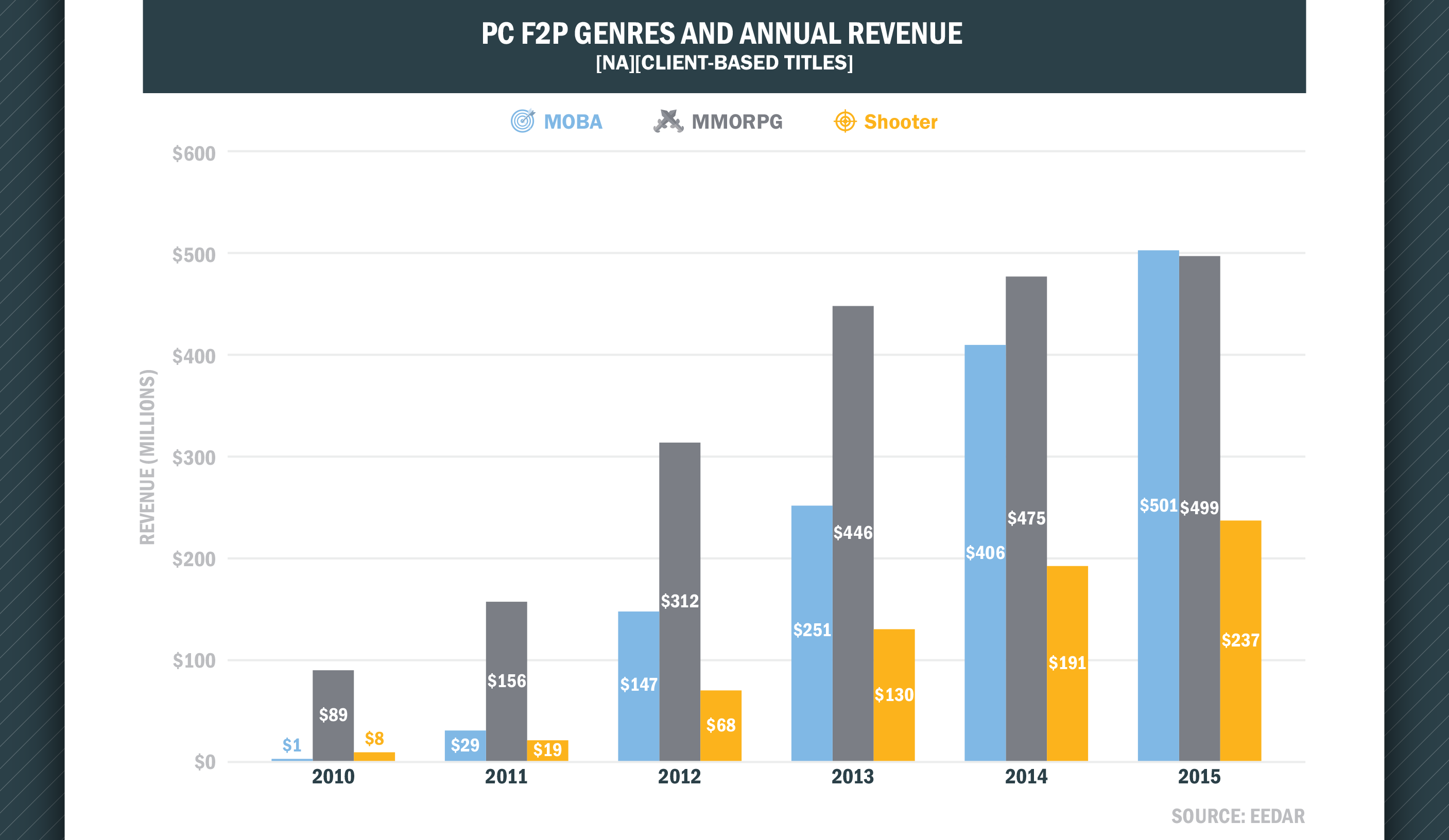
MOBA’s seem to take advantage of this formula quite nicely. “MOBAs can take advantage of a large, competitive audience while monetizing through champion-specific microtransactions,” Zhao continued. “While the biggest revenue driver in F2P has historically been the MMORPG, EEDAR predicts that, by year’s end, MOBA titles will reach $501 million annually in North America and account for the greatest percentage of F2P dollars.”

The chart above shows the increase in popularity with the genres. Back in 2010, it was clear that MMORPG led the charge, with barely any sign of effort from the MOBA field. However, just five years later, MOBAs have managed to catch up, even flying past the traditional shooter field by over double, at $501 million compared to $237 million. Meanwhile, MMORPGs stand at just under $500 million, putting MOBAs in the lead.

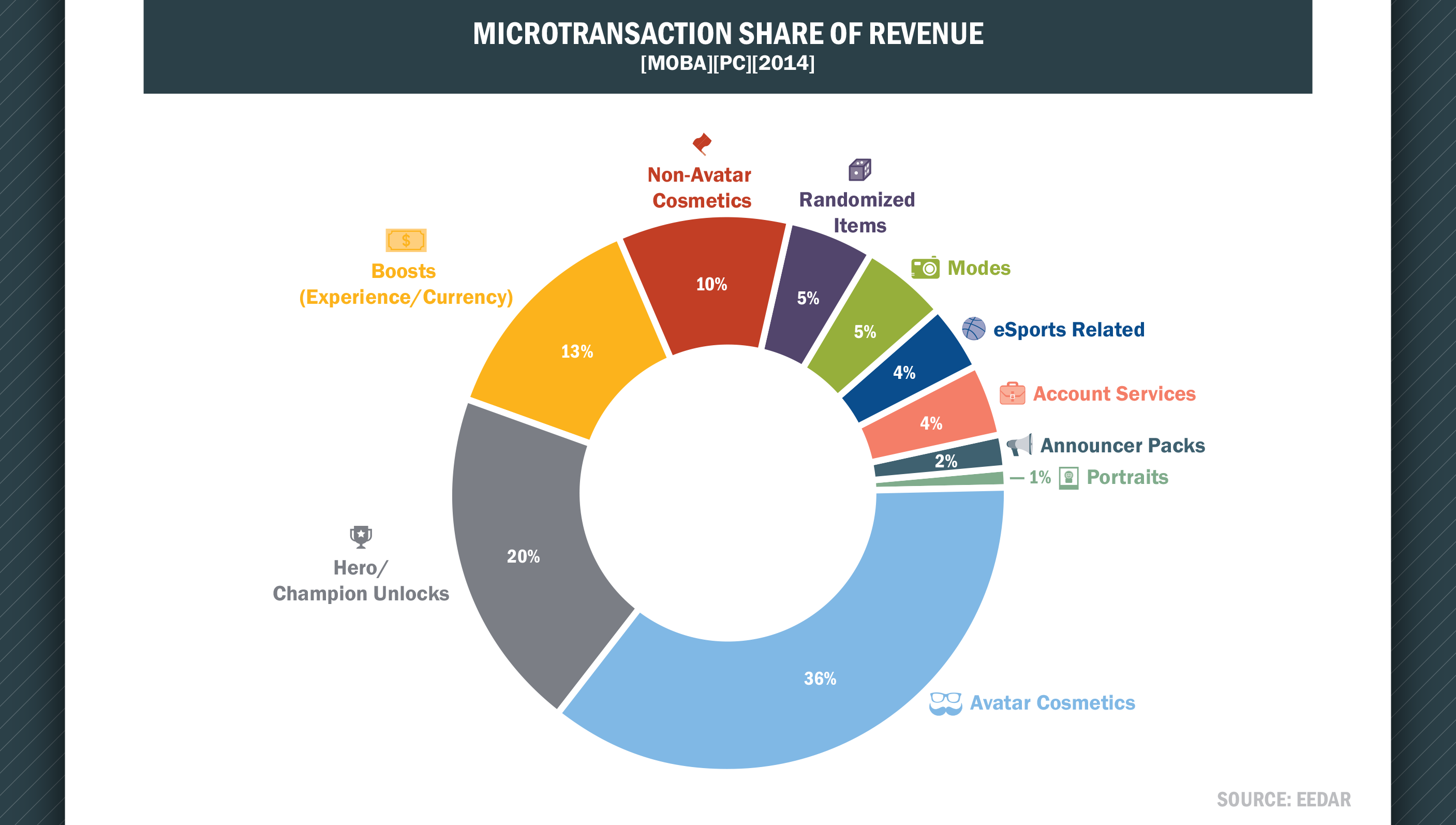
“Titles such as League of Legends and DOTA 2 generate their greatest amount of revenue in this way, with an estimated $180 million (or 36 percent of revenues) coming from avatar vanity items,” said Zhao. “One primary reason is the bird’s eye third-person view, which allows players to constantly view these cosmetics. This isn’t the case for other genres, such as F2P shooters, where a first-person view can obscure; thus, avatar cosmetics are only the third highest revenue driver for F2P shooters.”

Another chart breakdown, pictured above, indicates just where the money is spent with microtransactions, with avatar cosmetics taking the largest chunk. Closely behind are hero/champion unlocks and boosts, with other eSports related goods going more into single-digits.

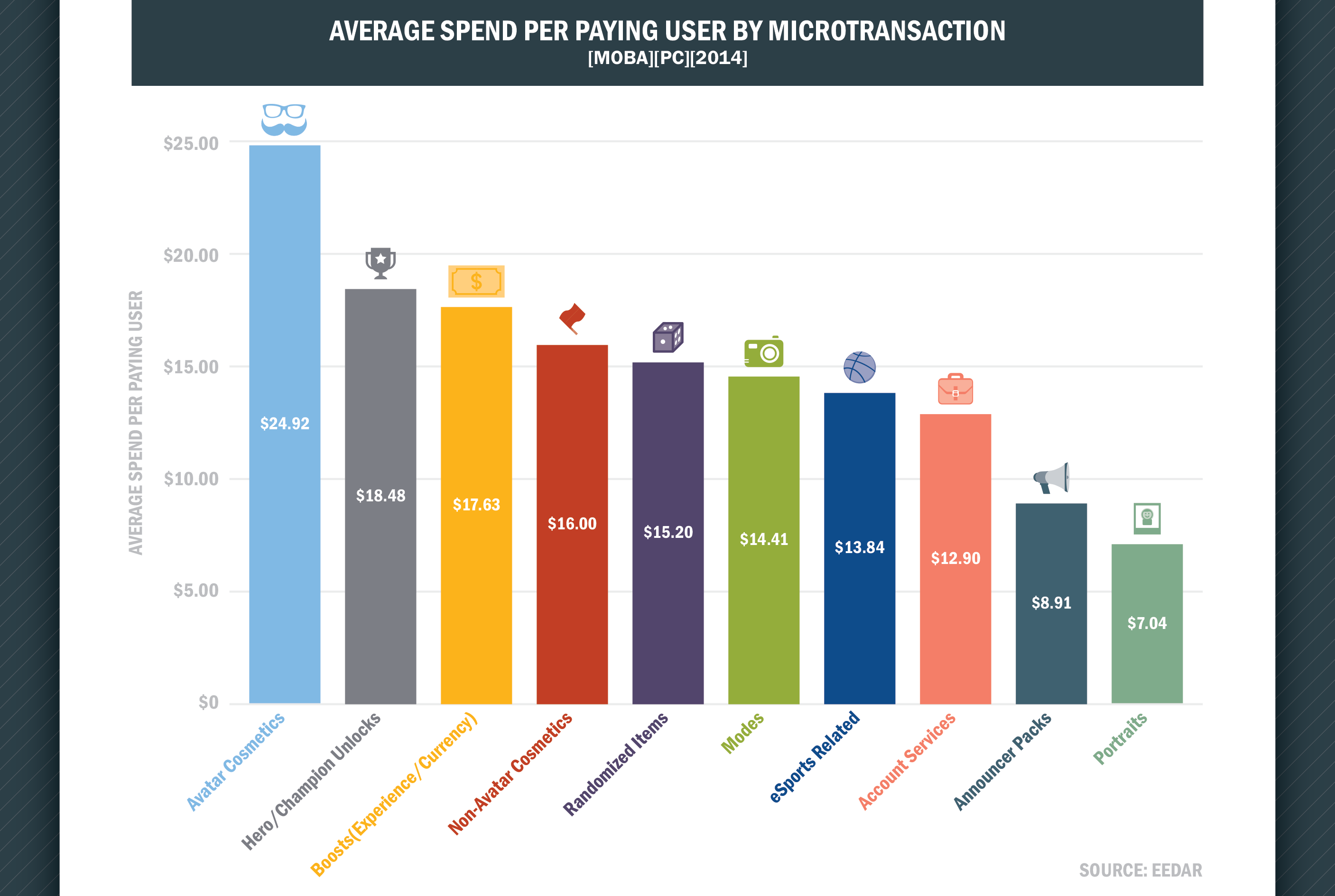
Avatar cosmetics also lead the way in terms of what an average user spends in a game, with nearly $25. Closely behind, as with the other chart, are hero/champion unlocks and boosts, followed by other items.

“Ultimately, certain games benefit more from different business models,” said Zhao. “F2P is perfectly suited for MOBAs due to large audience sizes, fierce competition, and individual character investment. Other genres, such as MMORPGs, monetize well with hybrid subscription models.

“Geography can also be an important factor, as Western Markets are happy to purchase premium titles such as Call of Duty or Battlefield whereas Eastern Markets prefer F2P variants. Choosing the correct business model is fundamentally important for a game’s success, but that choice has to foremost adhere to gameplay and audience.”

This could be the year that MOBAs step up and truly show who is the champion.

‘Pokémon’ Symphonic Tour Set To Please Fans

With the popularity of video games on the rise, it appears that videogame-based music tours (where symphonies play arrangements of music from games) are also picking up in popularity. Nintendo continues to capitalize on the success of its Legend of Zelda franchise with an accompanying Symphony of the Goddesses tour, which is still going strong this year; and the Video Games Live tour has several dates as well, selling out nearly every venue it appears at.

Now, the Pokémon franchise, which has been a best-seller for years over at Nintendo, is getting in on the action, with the announcement of a Symphonic Evolutions tour. The Pokémon Company, in partnership with Princeton Entertainment, recently announced 30 dates for the show, which will later expand into a world tour that covers the globe. For now, though, the tour will run from May 1st to February 5, stopping in such locations as Los Angeles, Chicago, Toronto and New York, among others. The official Symphonic Evolutions page has the full tour list.

With this new showcase, millions of fans will celebrate popular tunes from the Pokémon series, with a combination of orchestral arrangements and carefully timed visuals, to make them feel every classic moment from the Pokémon series. Players will also be able to meet up with friends and newcomers, in the hopes of battling and trading legendary Pokémon characters with one another.

The show has been an early success so far, with sold-out dates in Pittsburgh and Washington D.C., which indicates that the forthcoming tour should be a bit hit as well. And it could attract new Pokémon fans to the fold, especially those with an interest in music.

“Pokémon: Symphonic Evolutions is a spectacular showcase of the memorable music that has been a hallmark of the Pokémon franchise for nearly 20 years,” said J.C. Smith, director of Consumer Marketing at The Pokémon Company International. “The concert series serves as a thank you to fans and an invitation to share our passion for Pokémon by reliving some of our fondest memories with the brand. We look forward to seeing fans of all ages enjoying this very special Pokémon orchestral event together.”

Considering that many of the Pokémon video games remain on the best-seller charts, it shouldn’t be a surprise that The Pokémon Company sees this as a new way to celebrate the legacy, while presenting it as a new art form. Of course, it’s also a great marketing tool, keeping interest high in the franchise in-between new releases, while making money from the events.

As for what’s next for the franchise, we’ll have to wait a little while, as Nintendo likely has plans to unveil the next Pokémon game in an online Direct special set to air during E3. And with the company’s plans to move into mobile with the help from DeNA, there’s a good chance the franchise could make an impact there as well.

In the meantime, though, fans can simply catch ’em all while enjoying the music from the series.

MCNs And The Business Of Servicing Creators

by Brendan Gahan

Late last year, New Media Rockstars made waves with their coverage of an exchange Maker Studios had with a potential advertiser, the advertiser had $30k for influencer brand deals and Maker responded stating they didn’t do deals under $200k.

Many creators were outraged by this information, and a reporter for NMR went so far as to say that this should be a “red flag to creators currently signed with Maker because it essentially says that a lot of money is being left on the table strictly because the MCN doesn’t want to deal with helping mid-level and smaller channels — creators who could really benefit from ANY added income — which is the majority of their client base.”

It’s expected that some are frustrated with MCNs – thirty thousand dollars is likely more than most creators in Maker’s network make off their channels in a given year, and I agree that creators need to be cautious.

Staffing Brand Integrations

First and foremost, brand deals take time to do well – I’ve been doing these since 2006 and have overseen thousands. They take A LOT of time when major brands, and multiple ad agencies are involved due to the layers of approvals. Before you get to the actual work there tends to be rounds of contract negotiations, and then, once a project is awarded there’s client and talent management, rounds of feedback, project managers, and so on. People’s time adds up very quickly, and with attorneys charging $350+ an hour expenses add up.

We’re in a service industry, and that requires man hours because how well you treat your clients is just as important as the quality of work you do. Although, digital advertising is booming, we haven’t been able to automate a lot of things – this is still largely a relationship based business.

So, an account manager at an MCN is vital for providing support and resources to the channels – but he or she has only so many hours in the day. How many clients can they ‘deal’ with while maintaining a reasonable level of service 1 5 10 20 It varies, but there’s certainly diminishing returns at some point. Clients don’t feel special if they’re being rushed, their phone calls never get returned, or you hardly know their name.

Read more…

This article was originally posted on VideoInk and is reposted on [a]listdaily via a partnership with the news publication, which is the online video industry’s go-to source for breaking news, features, and industry analysis. Follow VideoInk on Twitter @VideoInkNews, or subscribe via thevideoink.com for the latest news and stories, delivered right to your inbox.


Android Tops iOS In Game Sessions

For a while now, many mobile experts believed that gameplay sessions for Android devices would top those for Apple’s iOS ones — and it appears that finally happened.

A new report from Chartboost indicates that Android devices have finally topped iOS devices in mobile game sessions, not only in the United States but also South and Central America. Both formats were neck-and-neck back in December, but at the beginning of the year, Android managed to press forward with 51 percent of game sessions, compared to 49 percent for iOS.

It only got better for Android in February, as its lead extended by three percent, for a total of 54 percent of game sessions on mobile devices.

That’s a small victory for Android, even though Chartboost indicated that iOS gamers still tend to spend more money on their game sessions, with popular titles like Clash of Clans and Candy Crush Soda Saga.

As you can see from the chart above, iOS and Android have gone almost opposite directions in success since August 2014, with IOS having the lead with 56 percent and Android behind with 44 percent. It’s easy to see that the tables have turned.

Now the question is what’s next — and Chartboost’s CEO and co-founder Maria Alegre believes that more developers could make the switch to Android as the first target for games in the future. “While iOS has typically been where game developers start with user acquisition, we see the window of exclusive focus on iOS shrinking,” she explained.

While iOS will continue to have a stronghold over the market, Alegre believes that Android should become more relevant. The ARPU (Average Revenue Per User) for both iOS and Android games are becoming a bit more parallel, instead of Apple’s devices simply taking the lead. “That combination of higher traffic and smaller difference between ARPU will make Android overall a more attractive business opportunity,” she said.

Provided it can make all the right business moves, this could be a big year for Android as the gameplayer’s mobile OS.