The Mobile Tipping Point Is Here

Mobile advertising has certainly come a long way, even to the point where it’s more used than traditional desktop advertising — and some companies may change their approach as a result.

VentureBeat has reported mobile advertising has seen a significant increase, based on findings from a recent report from Opera Mediaworks.

The platform has already seen a large amount of attention from companies, serving 90 percent of the top global advertisers and reaching out to over 800 million unique mobile users. However, Opera noted an even larger growth for the medium, with a five-times increase between today and a year ago. Video ads have jumped the highest in that time, going from 2.5 percent early last year to nearly 13 percent now. And that video is responsible for a large amount of revenue for publishers, accounting for 55 percent.
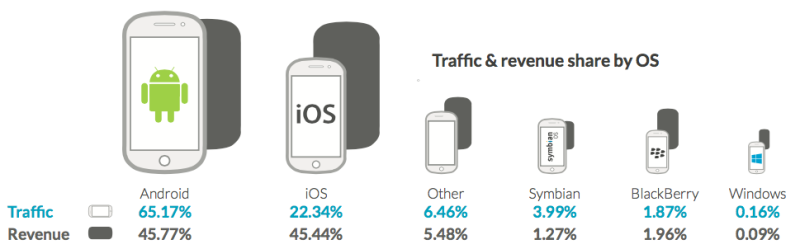
As you can see in the chart above, Android takes up the biggest portion of that revenue, with 65 percent of traffic accounted for, and 45 percent of revenue. iOS is in second place with only over 22 percent of traffic, but about the same amount in terms of revenue. Meanwhile, Windows had such a low count that it couldn’t even muster one percent in either category.

“What we get excited about is TV for the next generation,” said Opera CMO Will Kassoy, speaking with VentureBeat. “The number one action that consumers do after a brand campaign is click to watch more video.”

While the numbers don’t represent the entire mobile advertising ecosystem, they show that video has made quite an impact, between a number of mobile advertising acquisitions and its increase over the competition by a staggering 20 percent.

“We hit a major milestone in Q4,” continued Kassoy. “We surpassed $100 million in revenues for the quarter for the first time. We’re the largest independent ad network, and our reach is now over one billion monthly impressions.”
The U.S. has the largest count with this change in video ads, followed by other nations like Canada, the U.K. and Australia. This is mainly due to the size of infrastructure, and quality of video offerings. As you can see from the chart above, the growth of video in both impressions and revenue delivered to publishers and app developers is incredible, and not likely to stop anytime soon.
Social networks play a part in this advertising, too. It’s the biggest leader for impressions and revenue, followed by general music, video and media, communications services and games.
As for what division got the most attention in video, movie and television entertainment unsurprisingly lead the charge, followed by other, food and drink, and automotive, as indicated by the chart above. Games fell into the lower count here, probably due to developers focusing more on game content than commercials (though some apps still do it).

“The key question is how do you drive marketing effectiveness and efficiency,” said Kassoy. “The brands that are more advanced and sophisticated are moving from awareness — like TV— to some form of engagement . . . which would lead to learning more about a product or service, and ultimately to a purchase.”

AdWeek has reported that Google is already adapting to the shift to mobile advertising, seeing as how desktop numbers have dwindled. “The purchase funnel is officially dead,” said Jerry Dischler, vice president of product management at Google. “What we’re seeing are these short bursts of activity that we’re calling micro-moments. We see the new challenge for marketers is to be there at those moments anytime, anywhere.”

With smartphones accounting for more than half the searches across ten countries (including the U.S.), Google wants to take more of a focus on mobile, a plan it intends to reveal later today at the AdWords Performance Summit, which can be seen here.

This includes expanding location-based tools for more businesses, as well as gauging the success of a mobile ad. “We’ve been building on it since December — we expect by the end of the year that this will work for thousands of advertisers in more than 10 countries,” said Dischler.

5 Questions With Jay Baage On This Year’s [a]list Video summit

We’re pleased to announce that on August 19 at the W Hollywood Hotel, we’ll be holding the [a]list video summit. While video as a format has always gleamed with potential, particularly this year, mobile has pushed the format into the limelight as older platforms and new apps are reinvigorating the video space. The challenge to marketers to is make the most of it.

We sat down with Jay Baage, executive director of [a]listdaily at Ayzenberg to talk about what attendees can expect, how to get involved, and why video is so important right now. 

Jay BaageJay Baage, Executive Director, [a]listdaily
Why was it important to hone in on video for this [a]list summit?

At last year’s [a]list summit in July, we focused in on influencer marketing. That is still one of the most exciting fields of marketing with so much native talent emerging everyday on different social content platforms like YouTube, Vine and Instagram. In the last year, we have seen so many other important developments in the broader field of video marketing that we felt it made sense to spotlight some of those as well at this year’s summit.

One of the biggest developments is that Facebook video now finally rivals YouTube in scale and many new interesting rivals are on the horizon, offering brand marketers a whole new landscape that they need to map out for themselves. What does the audience look like on these platforms What do the ad formats and other marketing opportunities provide and where can you get the most bang for your buck

What will the programming of the [a]list summit be like What trends are you focusing on?

We’ll be talking to top talent and executives running brand studios as well as emerging video content and platforms expected to grow exponentially over the coming years, such as streaming video services covering everything from eSports to make-up tutorials. We’ll also be taking a look at what video opportunities there are for marketers on emerging virtual and augmented reality platforms such as Facebook-owned Oculus and Microsoft’s HoloLens.

I think that there has never been a more exciting time to be a marketer with so many exciting new forms of interactive content and interesting technologies to tap into, but the question is: if you strip away all the hype, what will actually give you better results than TV or any other medium It’s a challenge all brand marketers face. Embrace new marketing platforms to stay relevant, but at the same time maximize ROI throughout the transition.

What are some things marketers should expect to happen in the video sphere in the coming year?

I’m so excited about all the great premium content for online platforms being announced at the IAB NewFronts in NYC going on. We are also seeing big live-streamed events. Most recently, the unauthorized Periscope streams from the weekend’s Mayweather vs. Pacquiao fight, but also big organized stunts by brands like the Red Bull Stratos jump with skydiver Felix Baumgartner which got a lot of traction.

I’m personally excited to hear what’s next in terms of premium and live video content from the speakers at this year’s summit and where the best opportunities are for brands to get involved.

Michelle Phan is keynoting this coming summit, but what other speakers can attendees expect to be at the event?

Yes, we are so excited about have Michelle Phan on board for the summit. Not only is she an amazing on-camera talent, but she understands the importance of building a brand and working with the right partners. She has built a business empire to show for it. In all, we’ll have over 30 speakers representing some of the most innovative content, platforms and technologies in the field of video right now. We will also hear from top brands about their strategies and tactics when it comes to video. Expect a lively discussion!

What are some ways that people can be involved in [a]list summit if they are interested?

There are a few speaking and sponsorship opportunities available, so anyone interested can email me directly jbaage@ayzenberg.com. Also tickets are available on the summit event page. For those who have not experienced an [a]list summit, you’re in for a treat. We try to bring in the best of current art and culture and it’s a fun and creative atmosphere and plenty of opportunities for networking and hanging out with some of the best brand marketers in the business.

Machinima Signs Powerhouses For Future Programming

Following a funding deal with Warner Bros. earlier this year, Machinima has seen a boost in interest when it comes to its original online programming – and, judging by its recent NewFronts 2015 presentation, it’s about to get even better.

The online channel made its NewFronts debut this week, and came out swinging with the announcement of several original projects, including ones based in the popular DC Comics universe. In addition, other companies have also come on board, including Metro-Goldwyn-Mayer, Bunim/Murray Productions, and Blue Ribbon Content. Other big names joined the fray as well, including horror writer Clive Barker and producer Roberto Orci.

“Fandom and gaming engenders so much passion and engagement: it’s a cultural shift uniquely connecting with the most valuable millennials,” said Chad Gutstein, CEO of Machinima. “It’s this deep connection to our audience that has made Machinima the ninth largest video entertainment platform in the United States, and the second most watched programmer on YouTube. With our new slate, we are reminding our fans and our clients of one very important fact: Machinima is back!”

Considering how much online video has flourished over the past few years with the popularity of such channels as Netflix and the just-launched HBO Now, there’s no question that Machinima feels like it can play a big part in it – especially with original programming that’s set to be a huge draw for its core audience, as well as those outside it.

This line-up includes a trio of new DC Comics products, including a second season of Justice League: Gods and Monsters Chronicles, the original Hero Product series by Blue Ribbon Content, and #4Hero, an adaptation of the cult classic Dial H For Hero.

Other original shows will get their attention as well, including Barker’s Creepy Pasta, a show that focuses on a number of viral urban legends; a short-form series based on MGM’s cult favorite RoboCop, Bunim/Murray’s original animated series Happy Wheels; Jerome ASF’s The Baka Chronicles, which follows the popular Minecrafter through a series of virtual adventures; and High School 51, Orci’s sci-fi adventure that revolves around a special school.

These series should make their premieres over the next year, along with returning favorites like Chasing the Cup, Realm, Deck Wars, Sanity Not Included and others.

With its reach of over 170 million viewers per month, Machinima should have no trouble keeping up this audience. Now, if we could just get a Batman v Superman animated series to go along with the forthcoming film…

12-Year Old Does Game Research; Becomes a Character

It’s a question many people are asking these days — why aren’t female heroes getting more recognition lately But rather than simply asking, 12-year old Madeline Messer actually decided to put her research to good use — and it’s certainly paid off in more ways than she could expect.

The Washington Post initially posted Messer’s story back in March, where her parents allowed her to download the top 50 apps in the Endless Runner category, as part of research to see how many female characters were available to play in the games, without the need to pay for them. Her research pulled up some interesting numbers, as noted in the hand-written chart below.

The notes are hard to read, but the breakdown is that only 18 percent of the games had characters with unidentifiable genders, and 98 percent offered bod characters. Meanwhile, only 46 percent of the apps had girl characters to offer at all. Furthermore, 90 percent of the apps offered the boy characters for free, while only 15 percent offered girl characters for no cost. That’s a staggering set of numbers, especially considering that the popular Temple Run, downloaded more than a billion times, has a general audience of 60 percent females.

When the apps do offer girl characters, Messer found that players are charged an average of $7.53, a larger price than the $.26 average the apps cost to begin with. Temple Run Oz in particular is the worst culprit, charging $29.97 for the only female character in the game.

“These biases affect young girls like me,” said Messer. “The lack of girl characters implies that girls are not equal to boys and they don’t deserve characters that look like them. I am a girl; I prefer being a girl in these games. I do not want to pay to be a girl.”

But not all mobile companies are that way. The Hunger Games lets you choose between a male and female character from the start, and other games follow that tradition as well. And Golden Monkey Media has even gone as far as to make Messer a prominent part of its latest mobile release, Noodles Now.

Sean Henry, founder of the company, asked if Messer wanted to be a character in his game, complete with a designed avatar based on her likeness and full voiceover. She jumped on the opportunity, and expressed joy playing as a female character.

“It’s so fun playing as ‘me’ in Noodles Now,” she said. “It’s really cool to be delivering noodles on a flying scooter.”

Sean added, “It was a real pleasure to get Maddie’s character into our game. She’s a terrific role model for young people everywhere.”

Noodles Now is available on iOS.

Pixability Goes In-Depth On YouTube Best Practices

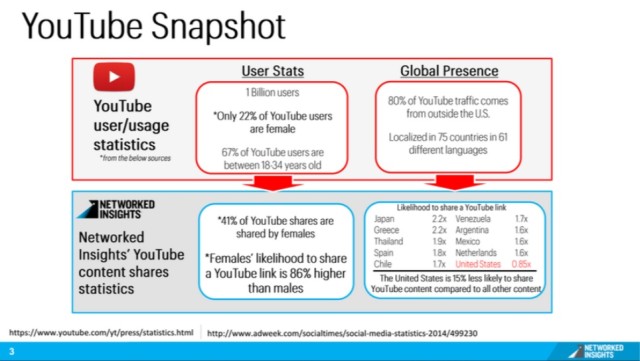
YouTube has become home to a number of success stories, with users like PewDiePie and others generating big money and huge interest through original content, as reported in this previous story. That said, some users are still trying to find the right way to get their foot in the door. Don’t worry, though – there’s a book for that.

A new book called YouTube Channels For Dummies is now available, co-written by Pixability CMO Rob Ciampa and VP Professional Services’ Theresa Moore. It’s the latest release in Wiley’s For Dummies series, which simplifies terms and instructions for getting into certain subjects.

With so many marketers trying to shift their media budgets towards online video, the book’s release seems timely, covering a variety of topics that help those get a better understanding of just how useful YouTube can be to success. This includes such elements as Making a Home On YouTube, Making Good Videos, Growing and Knowing Your Audience, and how YouTube Channels Are Serious Business.

“From established global brands to young independent creators, YouTube offers an enormous opportunity to share stories through video, create a community, and even build a business,” said Jim Habig, marketing manager for YouTube.

The book breaks down crucial steps, from getting an understanding of how to build a channel initially on YouTube to managing it, to building an audience and understanding the analytics that come from them. Video editing tips are also included, so that amateur mistakes can be avoided.

“With extensive experience in the online video business – both personally and at Pixability – this book builds upon a foundation of deep video marketing expertise, insight into brand and consumer trends in online video, and experience helping global brands leverage YouTube as a revenue generator,” said Clampa, co-author of YouTube Channels For Dummies. “The book covers everything an individual, an MCN, brand or agency needs to know to build a measurable YouTube strategy.”

“From channel creation to audience discovery, advertising, monetization and analytics, we left no stone unturned,” added Moore. “We distilled years of professional experience on YouTube into a comprehensive resource that addresses every element required to build a business on YouTube.”

YouTube Channel For Dummies is available for both paperback and in Kindle form over on Amazon. It looks to be a good tool for those that want to make YouTube work for them.

GamesBeat Summit Preview

There’s a continuing desire to tap into the brains of top executives to find out what they know about the industry, and that’s something VentureBeat has become very good at doing. The GamesBeat Summit 2015 will bring together 180 gaming executives from all segments of the industry “to develop a blueprint for the industry’s expansion in 2015,” according to the GamesBeat Summit web site.

The summit will explore themes like platforms (including games-as-a-service), global expansion, brands and franchises, monetization, understanding gamers, and the ongoing deals occurring in the game industry. Some of the most useful times, of course, will be the various receptions and meals, where networking is fostered and connections can be forged.

The summit kicks off on Tuesday with Tim Merel of Digi-Capital, who will provide his company’s latest figures on the growth of the mobile game market and the prospects for AR and VR. Insights will follow from speakers like Nolan Bushnell (founder of Atari), John Riccitiello (CEO of Unity), and Thomas Hartwig from King Digital.

The crossover from big media companies into games will be explored by David Haddad from Warner Bros. Interactive Entertainment and Peter Levin from Lionsgate Interactive. Samsung’s relaunch of its platform will be discussed by VP Mihail Pohontu, and veteran game investor Rick Thompson will close out the day talking about the investment climate for games with VentureBeat’s Dean Takahashi.

Wednesday at GamesBeat Summit will find a variety of sessions from the transformation of a mobile developer (ZeptoLab, as told by its CEO Misha Lyalin) to what sort of games we might expect from cloud supercomputing. Kent Wakeford, Kabam COO, will talk about the increasing importance of the mobile game franchise, and there will be concurrent sessions to cover international expansion, brands, monetization, dealmaking, and understanding gamers.

The day concludes with a variety of talks from execs such as Sony’s Adam Boyes, GREE’s Andrew Sheppard, and Super Evil’s Kristian Segerstrale. Attendees will aslo get to learn about Marvel’s path into digital games with peter Phillips, and how Google Play is growing from Google’s Jamil Moledina.

This event promises to be an intense master-class in all aspects of the game industry, giving attendees an overview of the state of the business and where it might be heading in the next year. The people at this summit will be the some of those shaping the direction of the game industry in the next few years, so getting their insights is important. The chance for networking with such people can be even more important, if you have something they might be interested in.

Even the selection of speakers and the topics tells you a great deal about what’s important in the games industry these days. Obviously mobile is hugely important and becoming more so, and Digi-Capital’s upcoming report will confirm that (the mobile segment of the business is projected to grow to $45 billion by 2018). Mobile is also dominating investment and exits in the last twelve months, and that pace probably won’t change. When was the last time you heard of a new console game publisher being founded

Globalization continues to be a hot topic, as China continues on pace to become the world’s largest game market — and Asia will have over half the total mobile game revenues in the world by 2018, according to Digi-Capital. Following along with that is the continuing evolution of monetization and business models, as publishers experiment with all sorts of ways to generate revenue from games.

Perhaps the most important information to glean from the GamesBeat Summit is a greater understanding of gamers, and how that audience has grown, globalized, and evolved. Regardless of what you take from GamesBeat Summit, there will be plenty of insights to be gained from this event.

YouTube’s Global Head of Gaming Talks Shop

While Twitch is an undeniable force in the gaming world with over 100 million viewers a month, Google’s YouTube channel has plenty of stature as well, including a variety of Let’s Play videos along with official game trailers, special videocasts and other content.

Ryan “Fwiz” Wyatt knows all about the gaming scene on YouTube, as he’s the global head of gaming for the channel, after stints that included both Machinima and Major League Gaming. The personality and eSports commentator recently spoke with Re/Code about the state of YouTube’s gaming scene.

He noted that 40 percent of the video site’s top 200 channels focus on gaming, with “hundreds of millions” of viewers in toll. Part of that, “Fwiz” believes, is due to the convenience some developers have provided with video tools. “Grand Theft Auto just put out that tool that lets editors create content and put it out on YouTube easier,” he said. “I think they realize there’s a great marketing vehicle behind all this content that’s being created around the games, and they want to figure out how to be a part of it. Even mobile games, especially in Australia and Japan, are looking at video content as ways to market and grow their game.”

eSports is also growing on the channel, despite the competition from Twitch. “In a lot of ways, it’s still nascent, but in a lot of ways it’s starting to mature and grow into something much bigger,” said “Fwiz”. “I think we can do better and do more to empower eSports creators on our platform. There’s no doubt that we need to do more with eSports, and we’re going to.”

Continuing on the topic, he added, “I think we can do more and will do more with the live product, and that doesn’t just impact gaming. That impacts all verticals that utilize it – news, sports and so forth.”

Interaction has a degree of value with live streams, “Fwiz” added, even with just comments. “The big thing you have to work on is: How do you make sure creators and fans can constantly engage in the most intimate possible way When we look at live chat in particular, it can’t just be the comment system that you know today. The way you interact in VOD (video-on-demand) is very different from how you interact when a broadcast is live. That’s really critical, to be able to engage.”

Let’s Plays have a huge presence on the channel. “People like going down the rabbit-hole, viewing games through another person’s lens,” he said. “But we’re seeing higher-quality, produced video content now, as well. At the surface level, PewDiePie might just be playing a game and having fun, but you’re seeing production – funniest moment montages and so forth.”

However, there are restrictions put in place by publishers that can get in the way, such as Nintendo with its Let’s Play stance. “Ultimately, (it is each) publisher’s decision if they want to tap into monetization from a creator and so forth,” said “Fwiz.” “I believe a lot of publishers understand the incredible marketing value that they get from creators making compelling, amazing content around their games. At the same time, Nintendo is creating avenues that they can still claim monetization and work with the Nintendo Creators’ Program.

“We do try to make sure that conversation is beneficial to both parties, but at the end of the day, if that’s what Nintendo or a publisher wants to do, that’s their decision. And I think we’ve seen a lot of interesting feedback from the creators about that decision. We have to support both the publisher and the creator on things like this.”

Regarding what a publisher can do in regards to keeping control of their games, “Fwiz” advised, “There’s a direct correlation between watch time on YouTube and sales of games, especially pre-sales. To be honest with you, not a lot are pushing on this because they understand the fallout if they decided to take creators’ money and the importance of working collaboratively with content creators. I don’t have to spend a lot of time painting the picture. What I do want to help them with is getting the right data that helps them make informed decisions.”

More details on the interview, including the introduction of high-definition video and virtual reality-based content, can be found here.

Growth Predicted for Mobile eSports

eSports have emerged as a huge phenomenon over the past few years, with tournaments getting attention through both live attendance and online via Twitch and other streaming services. Some believe that the popularity is only reserved for PC titles like Dota 2 and League of Legends. New research contends that isn’t the case.

iResearchChina has reported that mobile devices could play a huge part in eSports for years to come, and they could have a presence as big as that on PC. The site explains that mobile eSports have “large coverage, simple operation, weak real-time confrontation and low threshold” – some traits opposite with traditional eSports, which has “small coverage, difficult operation, fierce confrontation and cooperation.”

eSports will develop in two ways, according to the site. “One way is to take national brand-new ‘micro eSports’ route by advantage of its popularity and low threshold; the other is that it learns from PC games, then becomes the competitive mobile games with higher requirement for operation. In this way, it can make up the shortage of visual appreciation and turn into the professional game via building the professional player team.

“Under such circumstances, mobile eSports can increase gamers’ attention and participation, and make game manufacturers, sponsors, publishers and platforms join this industry chain. Compared with traditional PC eSports born in (the) 1990’s, the mature process of mobile eSports greatly shortens. It is predicted that its first round of explosive development will come in 2015.”

A recent survey on China’s eSports game participants taken earlier this year indicates that only 56.6 percent of those surveyed would consider taking part in some form of mobile-based competition, while 13.3 percent indicated no interest in it. Meanwhile, 42.3 percent of those polled indicated they would watch these tournaments, depending on the game involved.

A big difference with mobile-based eSports, according to the site, is that almost anyone can participate, thanks to the low requirements for operation and low threshold for participation. “Diversified designs and great rewards don’t only enable users to experience eSports, but also make them enjoy it,” said the site. “Moreover, winners can finally receive fame and fortune at the same time.”

In terms of higher marketing costs for games, an eSports competition would also provide “effective propaganda” for certain titles, “appealing to more and more manufacturers to join it.”

It’s still early, though, with room to “improve competition design and enhance propaganda and normalization. Meanwhile, brand image also needs to be built up and maintained between users, more and more manufacturers can join in, its influence can be expanded as well, and that’s the way to set up a national brand-new entertainment competition, which is different from traditional eSports competition,” says the article.

Since more first-person shooters and MOBA (multiplayer online battle arena) games are emerging on the mobile market, it’s certainly ripe for competition – now it’s just a matter of acceptance. “iResearch believes that two-way development of national micro eSports and professionalized competition will promote mobile eSports to realize explosive development in 2015. Moreover, property of mobile eSports will become the new engine for mobile game industry,” concludes the article.

It’ll be interesting to see where this leads, but could we be looking at some Clash of Clans or Game of War: Fire Age competitions Maybe.

‘DotA 2’ Compendium Builds New Prize Pool

xValve’s free-to-play DotA 2 has proven to be a formidable leader in the eSports world, as indicated by a huge multi-million dollar tournament last year, with another one set to take place for 2015. So how is the development team at Valve hoping to offer an even bigger prize pool than before Well, that’s easy – just turn to the community.

VentureBeat has reported that the developer has launched a new in-game package called The Compendium, which is available in two different price tiers — $10 and $27. Those who purchase this package not only get access to in-game goods, but also donate 25 percent of its purchase towards the prize pool for the forthcoming tournament.

It’s a business model that makes sense, seeing as how last year’s similar Compendium package managed to raise nearly $11 million in funds for The International 2014 tournament. So far, this year’s package has raised nearly $2 million, although more is likely to be raised in the months ahead as new unlockable items are added at higher price tiers.

eSports-related communities are more than happy to raise funds while scoring loot for themselves, although not all companies are looking for that sort of model. Riot Games, whose game League of Legends is much bigger than DotA 2, believes that players and fans shouldn’t contribute to a prize pool, as the company makes more than enough money to generate prizes itself. Riot provides the entirety of the prize money for its competitions, though the prize is smaller than DotA 2’s crowdfunded prize.

Regardless of how money is raised, DotA 2 should have another powerful year in the tournament front, with The International 2015 likely to sell out once again, between live attendees and those who wish to stream the tournament online. eSports games have generated a whopping $194 million in revenue this past year, and this year’s tournaments – between both The International and whatever Riot Games has planned for League – should easily eclipse that number. Research firm Newzoo believes that these games could generate $465 million by 2017 – that’s over double the money in a short time frame.

Let’s not forget the exposure of eSports games on other mediums as well. ESPN 2 recently got a huge viewership boost from airing the Heroes of the Dorm competition this past Sunday. And that’s not likely to be the last we see of eSports on the channel, given the popular response.

Marriott Moves Forward With Short Film

In an initiative that hopes to shy away from the usual advertising front, Marriott Content Studio has moved forward with its original programming plan, releasing a new trailer for its forthcoming short film French Kiss, which will debut on May 19, according to TubeFilter.

The film is described as a “mystical romance,” following a career-obsessive young man named Ethan (played by Tyler Ritter) who visits Paris for an innovation conference at the Champs Elysees Marriott hotel. While there, he finds a series of strange, magical clues left by a secret admirer named Margaux (played by French model Margot Luciarte), and begins pursuing her to see if she’s real or not – while catching a glimpse at the beauty of Paris along the way.

The trailer is below:

The film is part of the hotel chain’s new film program, which launched last month with the release of Two Bellmen. With it, Marriott hopes to reach out to millennial travelers, while at the same time promoting its chain of hotels worldwide. It’s a unique take on advertising, telling more of a story instead of just talking about the hotels in general.

The film is the work of producers Ian Sander and Kim Moses from Sander/Moses & SLAM Productions, which also worked on such popular TV shows as Profiler and Ghost Whisperer. John Gray, who executive produced Ghost during its run, directed it.

“I have known Kim and Ian for years and have admired their work as incredible, innovative storytellers who truly engage their audiences,” said David Beebe, vice president of creative and content marketing for Marriott Content Studio. “Much like the rest of their work, the first cut of the film shows the high quality, production values, and special effects that are so important to them and will capture the audience’s imagination. They were a natural fit for us and I am confident French Kiss will prove this collaboration a huge success when it’s released on May 19.”

The partner has proven good to work with for the studio, according to Moses. “Working with Marriott has made me realize even more than ever how exciting the opportunities are outside the traditional Hollywood content system and that the shift going on in the content business is headed for great changes because of the way the Marriott Content Studio is doing business.”

Even the actors enjoyed their time making the film. Said Ritter, “They supported the cast and crew both physically and creatively, keeping their doors open 24 hours a day for the shoot as well as for our stay. When you can wrap a full day of work and then find yourself in your room within to minutes, you know you are in a lucky spot.”

Here’s hoping that Marriott’s filmmaking kick keeps on going. In the meantime, you can see its work – current and upcoming – on its official YouTube channel.