Mashable And Above Average Launch Variety Web Show

by Jessica Klein

Mashable and Above Average have teamed up to launch a weekly variety web show.

Called The Tripp & Tyler Show: Finding the Humor in IRL, the series stars YouTubers Tripp Crosby and Tyler Stanton as they banter their way through tips, hacks, and facts.

Specifically, the series will cover seven, different segments. They include “Life Hacks,” “Etiquette Rules for Life,” “Facts You Didn’t Know You Didn’t Know,” “Guest Interviews,” “Show & Tell,” “Comment of the Week,” and “Justify Stuff,” all of which are pretty self-explanatory.

The first episode of The Tripp & Tyler Show debuted today. Future episodes will come out every Tuesday across Mashable and Above Average’s websitesin addition to Tripp & Tyler’s YouTube channel, which has over 163,000 subscribers. Related clips will also appear on Mashable.com.

The Tripp & Tyler Show is produced by Above Average. You can watch the first episode here.

This article was originally posted on VideoInk and is reposted on [a]listdaily via a partnership with the news publication, which is the online video industry’s go-to source for breaking news, features, and industry analysis. Follow VideoInk on Twitter @VideoInkNews, or subscribe via thevideoink.com for the latest news and stories, delivered right to your inbox.

What Games Could Mean For Facebook Messenger

Despite the fact that some see it as an unnecessary requirement, Facebook has fared very well with its Messenger app, with hundreds of millions of users utilizing the program to keep in touch with their friends through instant messaging. Now, the social site could take the app to the next level, with the introduction of games.

Reported by Variety, a new report from online magazine The Information indicates that people from Facebook are already talking to a handful of game developers about bringing their mobile games to the Messenger app, as part of a smooth integration that would allow users to play along with their friends. This comes on the heels of the company announcing support for third-party app integration back in March.

With a few companies on board, the app already allows users to share photos, animations and short video clips in their conversations. These have turned out to be popular features, so it’s obvious why Facebook wants to take it to the next level with games.

The messages with the game apps would appear in a user’s social feed, enabling them to either install it directly or share a message if they already have it in their library.

It’s unclear which developers are being spoken to, and which games would be a proper fit for the Messenger service, as Facebook hasn’t unveiled those plans just yet.

The company did state, however, that it’s currently focused on content creation apps, with intent to explore other opportunities in response to developer interest. Apps like Talking Tom, Giphy, Sound Clips and Bitmoji have already gained a huge following, with more than one million installs following the launch of the Messenger platform.

With 600 million active users, the Messenger app would be an ideal place for games, although, again, implementation would be a key factor, since some users prefer to simply chat instead of playing games outside of their normal mobile routines. It would generate a big amount of money for the social site, provided it was done the right way. In addition, it would allow the site to become competitive with Apple and Google’s respective app stores, providing a way to play said games without the need to install a side application for it.

We’ll see what comes over the next few months, as Facebook eventually reveals what plans it has in store for its Messenger app.

Advertisers <3 eSports, And Here's Why

Gamers are avid about eSports competitions, whether they’re aired on Twitch or on live television, like with Heroes of the Storm on ESPN 2 last month. However, along with attracting big audience members, it appears to be a hit on the advertising front as well.

GamesIndustry International reports that a new study by the EEDAR indicates that those who watch eSports spend more money on hardware and software than average gamers, mainly due to the involvement of quality gear from the likes of Razer, Origin PC and others.

With the significant growth in eSports participants and viewers year-over-year, the audience has seen impressive strength — which provides plenty of opportunity for peripheral makers to advertise their wares, as sponsors of said tournament or with advertising surrounding it. Devoted PC gamers are known to spend more on their gaming gear than regular gamers, since they require higher-performance goods from a variety of manufacturers to keep their habits at bay.

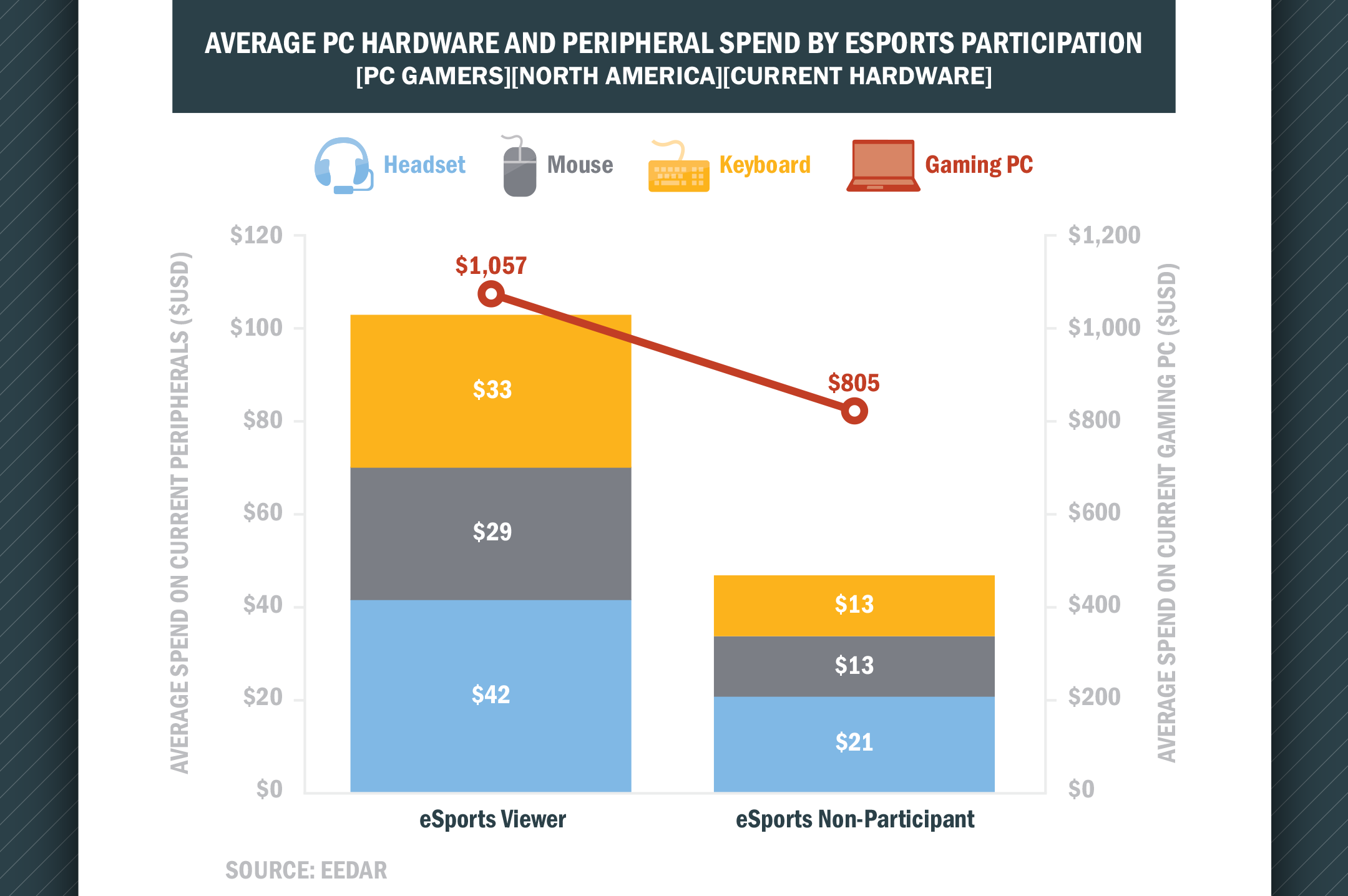
As you can see from the chart above, those who get more into eSports spend approximately $1,057 on gaming PC-related gear, compared to the $805 that an average gamer will spend. A majority of that money goes towards high-end equipment like keyboards, mice and headsets, and quality definitely makes a difference, especially with online rounds of games like Call of Duty and League of Legends.

Compared to average gamers, eSports fans spend more than twice as much on peripherals, and approximately 30 percent more on their system. Their overall spending reaches more than $100 for current peripherals, indicating that they’re fine with maximizing the performance of their rig.

The second chart shows that the market size of eSports viewers has managed to grow into a big chunk of the overall PC gaming population, and while it’s not yet at the halfway point of the overall count, it’s certainly getting there, taking up approximately 33 percent.

In addition to spending more money on their PC-related gear, eSports fans also spend more time across different gaming experiences, including various titles across platforms and genres alike, according to the above chart. PC games take a good chunk of their sending, approximately $50 more on PC games than most gamers, and $20 more on console games. Handheld and mobile games, however, are about steady across both groups.

The report also shows that major players in eSports, including game publishers, leagues and content distribution channels, have done a great job thus far keeping players involved with tournaments. Team-based tournament betting, in-game items created with team support in mind, merchandise and microtransactions to increase prize pools have also driven engagement to new heights as well. This, in turn, helps out tournament sponsors, building an audience that spends a great deal of money on these goods, as well as the hardware that makes them feel like they’re right there with the pros.

Look for this trend to roll on, as eSports continues to build popularity and eventually become a force to be reckoned with — maybe even compared to actual sports.

Streaming Video Predicted To Triple Viewership By 2019

Streaming video services are beginning to show a bigger impact on mass media, with millions of consumers flocking to Netflix, Hulu Plus and other channels to deliver their entertainment needs. For good measure, Twitch is also growing strongly, with its various game tournaments, devoted broadcaster channels and other services that are helping it see an increase in numbers as well.

So it shouldn’t be a surprise that a new study from Juniper Research, as reported by TechCrunch, indicates that subscriber numbers for these services, including Netflix and Amazon Prime, could rise from 92.1 million for this past year to 333.2 million global subscriptions by 2019 – an impressive growth for a five year span.

Devices like Amazon’s Fire TV Stick, Roku and Chromecast make it easy for users to connect to streaming services, as do game consoles and set-top boxes that provide access to streaming video with just the push of a button. Users can gain access to on-demand content, live streams and other special events with ease, instead of having to go through a pre-set channel lineup through a cable box.

While smart TV’s are also delivering streaming video, the firm believes that they don’t contribute as much as expected. These are based upon “poor operating systems and user interfaces,” according to the report.

Meanwhile, set-top boxes and other devices like the ones described above enable viewing on all television sets – even older models – with a great deal of convenience. This makes even older, obsolete televisions (rendered as “dumb” in the report) into modern-day connected devices.

As a result, some cable companies, in the hopes of preventing consumers from “cutting the cord” as it were, are offering packages, such as Verizon’s new a la carte programming package where consumers can pick and choose their bundles – although that’s leaving a few particular cable channels steamed over the matter.

Regarding the growth of on-demand entertainment, Juniper states that the United States will easily lead the way, followed closely behind by the Far East, which has its own set of programming that’s garnering a bigger audience. Netflix recently noted interest in expanding its service to China, through partners like Was Media Holding. (However, at this time, a deal hasn’t been confirmed yet.)

Even though some services don’t use ads, like Netflix and Amazon Prime, there are those, like Hulu and Twitch, that do, and according to the report, ad spend on video-on-demand will increase by almost four times by 2019, with the Far East and China showing the most gain according to the forecast.

‘Mortal Kombat’ Cracks Top 20 Game Franchises On YouTube

The numbers from YouTube don’t lie — when it comes to gameplay videos, WB Games’ Mortal Kombat X is a hit.

The latest entry in the bloody (and popular) fighting game series managed to handily crack the top 20 game franchises on YouTube, according to numbers reported by Octoly and Newzoo. Although it wasn’t successful enough to knock mainstay MineCraft out of the number one slot, it still fared very well since its mid-month debut, jumping nine places for the month with an overall growth rate in views by 170 percent.

The chart, posted below, highlights the 20 most popular games for the month. Gaming videos made by fans comprised 98.2 percent of overall views in the top 20, with some drawing into the billions of views for the month.

Leading the pack is Microsoft’s MineCraft, which continues to dominate with nearly four billion views and a 34 percent overall take of the top 20. However, close behind in second place is Rockstar’s Grand Theft Auto series, which saw a boost in popularity with its video editor tool, introduced in the PC version of Grand Theft Auto V. It maintained a steady count of 1.3 billion videos, or approximately 12 percent of overall views for the month.

Other games, like Five Nights At Freddy’s, Call of Duty and League of Legends rounded out the top five, with League taking a two-notch rise over the previous month. However, the real surprise here is Mortal Kombat, which gained 332 million views for the month, or three percent overall. With the release of X, the game franchise jumped nine places from the previous month, with 97.5 percent of fan videos overall.

In addition, franchises like Game of War, Assassin’s Creed and Pokémon debuted in the top 20 for April, while familiar favorites like Battlefield, Team Fortress and World of Tanks dropped a few notches — even though all the franchises have well over 100 million views with their fan videos, indicating that they aren’t dying down in popularity anytime soon.

It just goes to show that there’s always room for “new” blood to enter the picture in the top 20 — and this week’s forthcoming release of The Witcher III: Wild Hunt could catapult that franchise into May 2015’s list easily, considering its pre-release hype.

The full top 20 is below.


NPD: April 2015 US Retail Sales Up

The latest figures are in for US retail video game sales, and in a surprising result April 2015 (at $595.7 million) actually improved on April 2014 (at $579.5 million), albeit by only 3 percent overall. “Overall sales across hardware, new physical software, and accessories in April 2015 grew by 3 percent over April 2014 due to the strength of new physical software sales, which offset losses from hardware and accessories,” said NPD’s Liam Callahan.

Hardware was not having a particularly good month, particularly in last-generation consoles. ” April 2015 hardware sales decreased by 4 percent due to the 55 percent decline in sales of seventh-generation console hardware. Eighth-generation console hardware sales were stable, and portable hardware increased by 36 percent,” said Callahan. “On a unit basis, hardware sales grew by 12 percent. Declines in hardware dollar sales were due to a decrease in average price of 4 percent, due to a drop in console hardware pricing.”

The change in pricing is helping Microsoft’s Xbox One, which led in sales for April in the US retail stores. “As the best-selling console in the U.S. in April, fans set record April sales and engagement for Xbox One last month. Xbox One console sales in the U.S. increased 63 percent in April 2015 compared to April 2014 and Xbox Live comparisons showed the number of active global users (Xbox One and Xbox 360) grew 24 percent. We are grateful to our fans for their passion and support and are looking forward to sharing more on the best game lineup in Xbox history at E3,” said Mike Nichols, Corporate Vice President, Xbox Marketing, Microsoft.

For its part, Sony reminded everyone that PS4 of course still has the cumulative sales lead. “We would like to thank fans around the world for their continued support of the PS4. According to NPD, PlayStation continues to lead software sales for April 2015 and PS4 remains the cumulative sales leader in the US. We are looking forward to an amazing E3,” an SCEA representative noted.

There was no comment from Nintendo, but it’s a good bet that the increased portable hardware sales are due to the New 3DS XL hardware.

Meanwhile, software had an excellent month. “For new physical console software, eighth-generation consoles sales grew by 200 percent in revenue, which offset declines from seventh-generation consoles of 62 percent, and portable declines of 32 percent,” Callahan said. “Overall, console software increased by 20 percent, leading to overall video game software growth of 13 percent.” The leading title for the month was Mortal Kombat X, followed by the release of Grand Theft Auto V (the PC version no doubt drove a lot of those sales).

April 2015 Top 10 Games (USA new physical retail only)

1. Mortal Kombat X (PS4, XBO)** Warner Bros. Interactive
2. Grand Theft Auto V (PS4, XBO, PC, 360, PS3)** Take 2 Interactive
3. Battlefield Hardline (XBO, PS4, 360, PS3, PC)** Electronic Arts
4. MLB 15: The Show (PS4, PS3)** Sony
5. Minecraft (360, PS3, XBO, PS4) Microsoft / Sony
6. NBA 2K15 (XBO, PS4, 360, PS3, PC) Take 2 Interactive
7. Call of Duty: Advanced Warfare (XBO, PS4, 360, PS3, PC)** Activision Blizzard
8. Dark Souls II: Scholar of the First Sin (PS4, XBO, 360, PS3) Bandai Namco Games
9. Super Smash Bros. (3DS, NWU)** Nintendo
10. Borderlands: The Handsome Collection (PS4, XBO)** Take 2 Interactive
**(includes CE, GOTY editions, bundles, etc. but not those bundled with hardware)

Oculus Rift PC Specs Revealed

Earlier this month, we reported that the Oculus Rift, at last, has a release date for the consumer market, set to arrive early next year with pre-orders going live later this year. Today, the team behind the device, Oculus VR, announced the first PC specs for the device, as reported by TechCrunch.

The company posted the specs on its blog page today, indicating just what kind of hardware PC owners will need to get it running efficiently. They’re fairly high compared to the standard PC, so some upgrades may be acquired. They are as follows:

Recommended


  • NVIDIA GTX 970/AMD 290 equivalent or greater
  • Intel i5-4590 equivalent or greater
  • 8GB+ RAM


Required


  • Windows 7 SP1 or newer
  • 2x USB 3.0 ports
  • HDMI 1.3 video output supporting a 297MHz clock via a direct output architecture


Oculus’ Chief Architect Atman Binstock explained how these specs are necessary to get the unit running to full efficiency, since there’s such as reliance on GPU performance, especially running two 2160 x 1200 displays at 90hz at once to recreate the 3D effect. (That’s three times the normal GPU power required for 1080p rendering, he says.) It needs to be consistently running with frame rate, as drops can distort the effect that the Oculus is trying to deliver.

A desktop computer is recommended over laptops, and it appears that the team is pointing its development strictly towards the PC format at the moment. Binstock stated that the team still wants to develop the Oculus for Mac and Linux, but, at the present moment, it doesn’t “have a timeline.”

That may turn off some players, especially considering the accessibility of the Google Cardboard, not to mention Sony’s Project Morpheus, which will work alongside the PlayStation 4 console whenever it’s released to market. (We should know more next month at the Electronic Entertainment Expo next month.) It also doesn’t help that Oculus hasn’t released a price for the unit yet, although it’s likely to be around the $300 range – maybe more, maybe less.

While the prices for the required hardware will probably drop between now and the release date of the Oculus Rift, it’s still going to require a rather beefy PC. The Recommended level is going to probably put you in the $1000 category, as the graphics cards mentioned run around $350 alone. And, as usual, gamers will probably want to go higher than the recommended specs to make sure all the games will run smoothly. If you haven’t upgraded your PC in a while, you may want to start saving up.

Regardless, Oculus’ virtual reality is coming – and now it’s just a matter of seeing who reaches out and grabs onto it.

Tencent Rules The World As The Largest Game Company

The gaming industry continues to grow substantially on its way to $100 billion a year in global sales, largely on the strength of mobile games. While a number of mobile game companies have risen to join the $1 billion in annual sales club, it’s still the diversified game publishers that are the world’s largest game companies. Leading that list, once again, is China’s Tencent.

VentureBeat recently posted an article that explains how the Chinese company has taken over the industry, with a number of facts to back up that claim. Tencent owns the most popular social media and messaging services in China, but derives the majority of its revenue from games. The company has also invested heavily in Western game companies; it’s the majority investor in Riot Games, and it owns large stakes in Epic Games and Activision Blizzard, among others.

Tencent’s revenues managed to reach a whopping $3.65 billion in the first quarter for 2015, ending March 31. That’s a 22 percent increase from a year before, with a non-GAAP profit of $1.16 billion – a 37 percent increase from 2014. By comparison that quarterly revenue is only slightly below what Electronic Arts or Activision Blizzard took in during their entire last year.

“During the first quarter of 2015, we continued to expand our mobile user base and improve our engagement with users while delivering solid financial results,” said Ma Huateng, chairman and CEO for Tencent. “Our key mobile properties extended their leadership in China and continued to broaden user activities from social and communications to gaming, entertainment, media content, payment and beyond.

“Driven by mobile-social and video advertisements, our total advertising revenue more than doubled year-on-year,” Hauteng continued. “Our Red Envelope gifting initiative spurred increased adoption of our payment solutions and boosted total payment volume. Looking ahead, we aim to bring further technology benefits to users through our ‘Internet +’ strategy of connecting users with services in various vertical industries through collaboration with a broad range of partners.”

Going into further detail with the “value-added services,” Tencent stated that they rose in revenue by 29 percent, up to $3 billion. Online game revenue also saw a heavy increase, to $2.14 billion, over the year, through a number of its popular smartphone games.

Revenue from PC client games also showed no signs of slowing, contributing to the increase alongside social network revenues, which grew by 32 percent to $856 million.

In-game item sales in mobile platforms and higher subscription revenues from the company’s QQ membership also added up, with an increase by 131 percent to $439 million. Total cash overall equaled $4.08 billion, although that number was a 26 percent decrease from the previous year, mainly due to strategic investments.

Tencent reported that its monthly smartphone users for the QQ service reached 603 million, a 23 percent increase from a year ago, and the combined monthly active users for its Weixin and WeChat services grew to 549 million – a 39 percent increase.

As far as the most popular games, both FIFA Online 3 and Riot Games’ League of Legends (in which Tencent has a healthy investment) were revenue leaders.

Revenues from smartphone games reached over $700 million, an 82 percent increase from the previous year, making Tencent the largest publisher of mobile games in China. This includes a number of licensed titles, including Infinity Blade Saga and Naruto games.

Of course, a lot of this success comes from key partnerships, as Tencent has investments in Riot Games, as well as Activision Blizzard and Epic Games, the makers of the popular Unreal Engine technology.

In addition, it recently invested a whopping $60 million for a 20 percent stake in Pocket Gems, a popular mobile company that produced the hit War Dragons. It’s a key investment, as its releases have seen more than 200 million downloads since its release, according to TechCrunch.

“We’re thrilled to be partnering with Tencent, whose unparalleled strength in games publishing and operations in China will help us create great mobile games and entertainment for players globally,” said Pocket Gems CEO Ben Liu.

Indeed, there’s no stopping Tencent’s momentum now, as its dominance is sure to continue in the gaming industry for years to come.
Netflix Is Talking To Chinese Media Companies

By Jessica Klein

Netflix is making a concrete effort to enter the Chinese digital video market. The streaming giant’s been in talks with Chinese media companies such as Wasu Media Holdings about partnering on the expansion, as first reported by Bloomberg.

Wasu’s not the only media company in China Netflix has been in talks with, according to the report, though no others were named. Coming to China wouldn’t exactly be a smooth move for Netflix, hence the need for a partnership with a local media company, especially one that can license content for various devices, from mobile phones to connected TVs.

Keep reading...

This article was originally posted on VideoInk and is reposted on [a]listdaily via a partnership with the news publication, which is the online video industry’s go-to source for breaking news, features, and industry analysis. Follow VideoInk on Twitter @VideoInkNews, or subscribe via thevideoink.com for the latest news and stories, delivered right to your inbox.

SuperData April 2015 US Digital Game Sales: ‘GTA V’ Driving Sales

Analysis from SuperData CEO, Joost van Dreunen, follows:

  • The US digital games market grows to $1.1 billion in April.
  • Legacy publishers report $2 billion in combined digital revenues.
  • Top mobile publishers consolidate and raise barriers to entry.
  • League of Legends’ mid season invitational marks eSports growth momentum.
  • WEBINAR: Join our state-of-the-industry discussion as preparation for E3.


The US digital games market grows from $0.96B to $1.1B in April.
Overall, the digital games market in the United States performed well, growing well over 15 percent in April compared to the same month last year. In line with earlier expectations, the social games market further declined as the average spending per paying user dropped below $40 for the first time in over six months. Mobile broke a new record with more than 147 million Americans playing games on their smartphones or tablets in April, allowing monthly revenue to reach $380 million, up 13% from the same month last year. Pay-to-play MMO games showed a decline, too, as the overall US subscriber base dropped 18 percent since its peak late last year. Finally, the long-awaited release of the PC version for Grand Theft Auto V (NASDAQ: TTWO) improved the overall PC DLC market, selling 441k copies in the United States.

Top publishers consolidate and raise barriers to entry for mobile game development.
Following the announcement that Chinese gaming behemoth Tencent (OTCMKTS: TCEHY) had purchased a 15 percent stake in Glu Mobile (NASDAQ: GLUU) for $126 million, the latter’s shares jumped 23 percent. The news came just a few weeks after Glu Mobile signed an agreement with several new starlets, including Katy Perry. In particular, a celebrity’s ability to funnel traffic to the games has proven effective in offsetting user acquisition costs and improving retention by regularly posting updates on their Twitter feeds. To that end, it appears that the social media presence of singers, actors and other famous folk plays an increasingly important role in obtaining the lucrative agreements with content developers. Kim Kardashian, for example, receives 47.5 percent of earnings generated by Glu’s Kim Kardashian: Hollywood, according to company filings. The partnership with Tencent provides Glu Mobile the necessary capital as mobile game development has become more expensive. But it also gives it access to the growing mobile games market in China, which is on course to grow 19 percent year-over-year to $3.6 billion (2015E) and expected to soon reach 800 million monthly active users.

League of Legends’ mid season invitational marks eSports’ growth momentum.
Competitive gaming continues to be a flourishing marketing tool for publishers like Riot Games and Valve as a growing audience of eSports enthusiasts watches the matches online or attends them in real life. Following the success of its worldwide championship last year, Riot Games added a mid-season invitational this year, hosted in Tallahassee, Florida. The victory by Chinese team EDward Gaming over the powerful Koreans from SKTelecom T1 deserves mention as it meant a defeat for the long-standing favorites. As watching competitive gaming becomes a more common activity among consumers, participating teams are starting to build up a reputation and add a layer of friendly rivalry in and outside the game. In response, a growing number of other publishers have started to organize tournaments around their own games to increase their visibility and improve audience retention. Currently, the global market for eSports attracts 134 million viewers, and totals $612 million in spending across corporate sponsorships, advertising, publisher investments and direct consumer monetization.

Legacy publishers report $2 billion in combined digital revenues.
Judging from earnings reports released by several of the publicly-traded publishers, it is clear that their transition to digital is well underway and, in some cases, is keeping their traditional publishing business afloat. Activision (NASDAQ: ATVI) reported $538 million in digital revenue for the quarter, about 77 percent of the total, despite a disappointing slide in subscribership for World of Warcraft from 10 million to 7.1 million. The announcement of a June release date for its hotly-anticipated Heroes of the Storm leading to 11 million signups, the progress of its China-focused Call of Duty Online, and the announced stand-alone StarCraft expansion pack indicate that the publisher is looking to expand its current digital earnings. For Electronic Arts (NASDAQ: EA), digital grew 9 percent year-over-year and accounted for 67 percent of overall revenue, for a total of $602 million. Its most recent title, Battlefield: Hardline, performed well across platforms. As part of one of EA’s strongest franchises, the game presents an unproven innovation on the shooter game genre, but the initial signs are promising with well over $51 million in digital revenue in the first month of its release. It perhaps presents a first answer to the question of how Electronic Arts will offset its increasing reliance on licensed games, like the upcoming Star Wars title, which are financially far less interesting from a profit standpoint.

Square Enix (TYO: 9684) generated $933 million in digital revenues, representing roughly two-third of earnings for the quarter. Titles of note for Square Enix include Tomb Raider, Just Cause 3 and Deus Ex: Mankind Divided, each of which are expected to feature additional digital content. For Ubisoft (EPA: UBI), around 65 percent of Q4 earnings come from digital, for a total of $124 million. (At time of writing Take-Two Interactive (NASDAQ: TTWO) had not yet reported its earnings.)

WEBINAR: Join us as we preview this year’s E3 conference in Los Angeles.
On May 29th, SuperData CEO Joost van Dreunen will present his view on the current games market. Topics will include: digital console adoption, competitive gaming, mobile user acquisition, diversity, and East vs. West. Yes, it’s free, but seats are limited. Sign up is now open: http://eepurl.com/bmWcF9

www.superdataresearch.com