Director Patrick Creadon Talks eSports In ‘All Work All Play’

eSports have come a long way over the past few years, generating millions of dollars through tournaments, gaining more viewers online than most popular sporting events, and even making their way to television with Heroes of the Dorm on ESPN 2. Later this month, they’ll be headed to the big-screen with the movie All Work All Play, which follows a number of popular players around the world.

The movie, which will show in select theaters on July 21, will feature the film, along with a first look at a new mode in Activision Blizzard’s StarCraft II: Legacy of the Void, as well as a Q & A with the film’s director, Patrick Creadon, along with the head of the ESL gaming league and several popular players.

However, we were able to sit down with Creadon before the event to discuss a number of topics surrounding the film, as well as how far eSports has come.

First off, what do you think about the state of eSports in general It’s certainly come a long way over the past few years, hasn’t it?

When we started this project 18 months ago, in early 2014, I knew very little about eSports. I had a vague understanding that some people played video games professionally, but beyond that I knew very little. What we quickly came to appreciate was that eSports was very much a mainstream industry throughout much of the world, especially South Korea, China, and Europe. What’s been most exciting for us as we made the film was to see that eSports is finally having its moment here in America. It’s poised to become every bit as mainstream as golf, NASCAR, the NHL…you name it. With All Work All Play, what kind of focus did you want to take in terms of eSports The players, the vibe

As we were making the film, I started thinking of eSports as an entire galaxy, and inside that galaxy, there are hundreds of planets. These planets consist of various video games, different tournaments, different video game leagues, etc… and instead of making a film about this whole galaxy that is eSports, we decided early on to focus on one planet, so to speak. In other words, we made the movie about one tournament, several different teams, one primary video game, (League of Legends) and by doing so we got to know a small group of characters very, very well. The main “star” of the film is a tournament called the Intel Extreme Masters, which is the longest running international video game tournament in the world.

What kind of players do you follow in All Work All Play?

We shot the film on three different continents, Asia, Europe, and North America. And along the way, we captured a behind-the-scenes look at some of the best professional League of Legends teams in the world. We fell in love with the GE Tigers from South Korea — and who wouldn’t, they are easily one of the most charismatic and popular professional teams in the eSports world. They also happen to be extremely good at League of Legends. In fact, at the time we were following them, they were considered by most to be the best League of Legends team in the world. We also spent quite a bit of time with Fnatic outside of Cologne, Germany. Fnatic and their team leader xPeke, are considered by many to be the first real League of Legends superstars. xPeke and his teammates were very welcoming and gave us unrestricted access to their world. And it was during this shoot that we met one of the brightest young standouts on the League of Legends scene — Rekkles. But perhaps more than anyone, we really got to know Cloud9 and Team Solomid (TSM), the two top North American teams in League of Legends. These two teams offered a great storyline for us, because not only were they fighting to prove themselves on the international stage, they very much wanted to prove that the North American region is every bit as good as teams from the rest of the world.

What was probably the biggest challenge in putting the film together?

This was a very challenging film to make for several reasons. First of all, we shot the movie literally all around the world including stops in Seoul, South Korea; Shenzhen, China; Taipei, Taiwan; several trips to Cologne, Germany; Toronto, and San Jose. We’ve never made a film on such a grand scale before, and it was really fun and really exhilarating to do so. But boy was it a lot of work!

Another challenge for us was we decided early on that we wanted to release the film and to do so quickly. Let me explain: typically for our other films we shoot for a year, we edit for a year, and we do the festival and release over the third year. For this film we condensed all of that into 18 months. The reason we chose an accelerated release schedule is simple – the story is very timely, our target audience (gamers) is growing rapidly, and our distributor wanted this to be a big theatrical release over the summer. So from the time we shot the final tournament in Poland on March 15 to the time we locked picture on June 15, it was only 90 days. Yet when I watch the film now, I can’t believe how quickly and how thoroughly we were able to tell the story. We wouldn’t have been able to do all of this without our excellent edit team — editors Daniel Clark and Nick Andert and our assistant editor, Tiffany Dixon.

The final challenge was maybe the hardest one, which was trying to tell a story about eSports that on the one hand gamers would love and embrace, and at the same time the non-gamers could also enjoy when they see it. It was challenging to do so, largely because the game we feature in our film (League of Legends) is an extremely complex and fast-moving game. For those of you who have never played League of Legends, imagine combining the teamwork that exists within the NBA, the strategy of chess, and the speed of NASCAR, and you’ll begin to understand what it’s like to play. Translating that story to a general audience was very challenging, but also very fun and rewarding for our team.

What do you think will be the most exciting factor that fans will see in All Work All Play when it makes its debut in theaters later this month?

I think what never ceases to amaze me and what I think is one of the best things about the movie is just the sheer size and intensity of the fan base surrounding eSports. We’ve grown accustomed to walking into an arena and seeing 15,000 fans screaming their lungs out at a hockey game. What we see in the film are audiences just as big and just as intense, rooting for their favorite eSports teams. I have no doubt that eSports will become a mainstream pursuit in America over the course of the next few years if it hasn’t done so already.

Tell us the process of putting a film like All Work All Play together. You worked with a lot of talent in this film.

For All Work All Play, we used the same process that we do for any of our films. You look for a great story, then you look for great characters within that story, and you slowly, day by day, earn their trust. By the time you’ve been working together for awhile, the people in front of the camera start to forget about the cameras and the microphones and they just continue to live their lives like they always do. That’s when we do our best work: when we can become a fly on the wall in the lives of really interesting people doing really cool things. That’s when we know that we’ll be able to tell a really good story, and that’s what we did in this film. We’re really excited to share this with audiences later this summer.

Do you think that eSports is big enough that a number of documentaries could cover it? Like films based on certain events, or perhaps even certain teams?

As I mentioned before, eSports is really a whole galaxy of games and personalities and tournaments and sponsors and fans. In a way, eSports is very much like traditional sports. It’s just that the games that these people play are on computers. And I think we’re going to start to see a lot more storytelling about this community and about the people who live in it. In fact, it’s interesting to note that while we were making the film, eSports appeared on the cover of the Sunday New York Times on three different occasions. That’s a lot of mainstream press coverage for something that most people in our country had never heard of before this year.

How great was it working alongside Michal Blicharz and a number of eSports talents?

Following Michal Blicharz for a year was really a blast. He’s a very funny, very passionate guy from Poland who loves to prank people. He pushes his team very hard, striving for excellence, and he cries all the time when he gets tired or emotionally drained. He’s a big pussycat wrapped in the shell of a lion. And he was a wonderful character to provide the backbone to our story.

Finally, now that All Work All Play is headed to theaters, do you have another project lined up? Would you like to make another eSports-related movie as a follow-up?

There are several projects that we’re looking at right now — nothing that we’re quite ready to announce at the moment, but I would love to tell another story about this group of people. I grew up in a family that loved games. My father especially was a big fan of games and friendly competitions. In fact, the first movie that we made, a movie called Wordplay, which is about the New York Times crossword puzzle and people who are really good at solving it, was largely inspired by my father and my family.

All Work All Play is absolutely cut from the same cloth. It’s a story, at its core, about a group of people who have a passion for something — in this case video games. They took their passion and they created a community around it by hosting tournaments, giving away prizes, and attracting more and more people to this love of theirs. This whole idea of eSports has only been around for 15 years now. A lot of the people in our film were there at the beginning when eSports started. I’m fascinated to see where this is going to go down the road, and I’m quite certain that I’ll be spending time with this group of people in the future.

Tickets for the event can be found here. The trailer is below.

Report: Nintendo Could Be Releasing Its NX System Next Summer

Hints about Nintendo’s next piece of gaming hardware have been dropping since earlier this year, indicating everything from the company transitioning to an Android-based platform to a mobile tie-in with its partnered titles with DeNA. But a new report indicates that the system could be making its way to market as soon as next year.

Taiwanese site DigiTimes has reported that the console, code named NX, could be making its way to release as soon as July 2016. The site reports that Foxconn has already obtained the manufacturing rights for the machine (with Pegatron pitching for some of the work), and pilot production could begin as soon as October.

According to the report, orders could be finalized as soon as February or March, meaning that full production could push forward during May or June, so that everything is prepped for the July 2016 release date.

The report also states that Nintendo has high hopes for the console, hoping to ship 20 million units in the first year alone. That’s a pretty high number to reach, given that previously released consoles like the PlayStation 4 took 17 months to sell 22.3 million units, and that’s the best-selling console launch of this last generation by far. Achieving that level of success would mean Nintendo has to have great hardware at a great price, with great software and terrific marketing — and plenty of units produced in a timely fashion, as well. That’s a tough order, but Nintendo is one of the few companies capable of succeeding at all of those things.

Considering that Nintendo hasn’t confirmed any of these details, they’re best taken as rumors at this point. Also, there are a few things worth pointing out regarding the “quick” production of the NX.

First, Nintendo is still providing a healthy push behind the Wii U, with games like StarFox Zero and Yoshi’s Woolly World coming in time for the holidays. Secondly, Nintendo has stated it will first announce plans for the NX well ahead of announcing any sort of release date – and the 2016 Electronic Entertainment Expo, which takes place in June, seems to be the right time for such an announcement. “We’ll talk more about our next system, code named Nintendo NX, more in 2016,” said Reggie Fils-Aime, president of Nintendo of America.

There’s also the question of rushing a console to market, as it doesn’t always produce the most effective results. Back in 1995, Sega rushed its Sega Saturn game console to market, shipping it to retailers the very same day that it was announced. Unfortunately, it backfired, not only with poor communication with retailers, but also with Sony announcing a lower price on its competing game console, the Sony PlayStation. Since that time, no game company has “rushed” a system release to market, instead taking its time and putting months of planning into the launch.

Nintendo’s CEO seems to be fully aware of what Nintendo needs to do in order to make the NX a success. “The platform business can sometimes be referred to as a ‘momentum business’,” Iwata said to an investor. “Thus, it is ideal to have a jump start and drive momentum. Looking back at some of Nintendo’s past platforms, this ideal launch has been achieved 100 per cent by perhaps only Wii. Even the Nintendo DS launch had areas in which we could have done better. I cannot disagree with your indication that Wii U is experiencing the most unfavorable situation.” Clearly Nintendo will need to have some solid games available at launch — could the next Zelda game see a launch on both the Wii U and the NX Whatever the case for that title, Nintendo will no doubt strive to have one or more of its key brands appearing on the NX platform from the start.

Whatever Nintendo has planned, it should represent an improvement in Nintendo’s performance in the game market, given the Wii U’s struggles. And it appears that a build for the system is already in place, as it was demoed to a number of the company’s partners last month, according to MCV UK. That would lend credence to the idea of a 2016 launch of the NX, as the hardware would need to be quite far along in order to launch in quantity next year.

We’ll see what Nintendo has planned soon enough.

‘Minecraft’ Continues To Be A Best-Seller

Who would’ve thought that a game consisting of 8-bit style blocks in an open world would become such a huge phenomenon

Per a report from the official game page, more than 20 million copies of the hit game Minecraft have been sold for Mac and Windows PC. In fact, 10,456 copies of the game have been sold in the last 24 hours – that beats a large number of PC games on the market, including juggernauts like Grand Theft Auto V.

With that, the game now has a total sales count of well over 70 million copies worldwide. The mobile game, Minecraft: Pocket Edition, has managed to sell over 30 million copies in itself, while 20 million copies have been sold on Xbox consoles, including the Xbox One and Xbox 360. Sales haven’t been revealed just yet for the PlayStation versions of the game, but considering their popularity, they’re bound to be right up there as well.

To celebrate the occasion, Daniel Kaplan, business developer for Mojang, tweeted the following message to fans:

https://twitter.com/Kappische/status/615944752329027584

Minecraft has become quite a massive hit in the game industry since its initial release in 2011. It’s created such a successful business model that Microsoft jumped into a full acquisition of Mojang last year, to the tune of $2.5 billion. It’s a business model that has certainly paid off though, with a number of promotions that have seen popular character crossovers, such as Halo and The Simpsons.

And those crossovers aren’t going to stop anytime soon. Kaplan recently confirmed the launch of a new mash-up pack for Minecraft on PlayStation consoles that features elements from the popular LittleBigPlanet series. That update is expected to go live in the U.S. later today. That’s big news, seeing a Sony property cross over with a game clearly owned by Microsoft.

Minecraft will more than likely continue building on this massive success – Creepers, you’ve been warned.

Now Hiring This Week: July 1st

[a]listdaily is your source for the hottest job openings for senior management and marketing in games, entertainment and social media. Check here every Wednesday for the latest openings.

Read a case for and against job hopping before you find your next position.

  • Marvel – Manager, TV Marketing (San Francisco, Calif.)
  • Disney Interactive – Manager, Mobile Product Marketing (Palo Alto, Calif.)
  • Hulu – Associate Content Marketing Manager (Santa Monica, Calif.)
  • PlayStation Now – Marketing Director (San Mateo, Calif.)
  • Ayzenberg – Marketing & Communications Director (Pasadena, Calif.)
  • Ayzenberg – Director, ION Business Development (Pasadena, Calif.)
  • Ayzenberg – Account Executive (Pasadena, Calif.)

For last week’s [a]list jobs postings, click here. Have a position you’d like to place with us Email us at pr@ayzenberg.com.

Media, Entertainment Ads To Pass $6 Billion

With streaming media starting to take a major hold in the entertainment market — and television still playing its part — spending for digital ads on the medium are set to reach an all-time high, according to eMarketer.

The site reports that both the media and entertainment industries will see tremendous growth through year’s end, leading to an even higher number by 2019. The report, titled “The U.S. Media and Entertainment Industries 2015: Digital Ad Spending Forecast and Trends,” points out that the two industries will spend $6.19 billion for this year alone, up 18.8 percent from the previous year. Broken down separately, media will make up 5.8 percent of total U.S. digital ad spending, while the entertainment industry will account for 4.8 percent of the total.

What’s more, the numbers are expected to grow in double-digits over the next few years, leading into 2019. However, even with these high numbers, both media and entertainment still account for the lower end of digital ad spending overall, with only health care and pharmaceuticals below them.

When it comes to the focus of digital ad spending, entertainment seems to focus more on branding (accounting for 60 percent of spending overall), while media works more towards direct response (with 55 percent). Entertainment-wise, films and video gaming seem to get the most dollars, with some getting promotion even months before their release. For example, Activision released a trailer for Call of Duty: Black Ops III last month, well before the game’s November release date. One of this summer’s biggest films, San Andreas, also got a major digital push before its release today.

Meanwhile, advertising across mobile devices will make up for 53.5 percent of overall digital ad spending in the entertainment industry. Advertising for desktop and laptop devices will be close behind at 46.5 percent. Media brands will also devote its focus to digital advertising spending on mobile, by 51 percent.

“Media and entertainment industries have been pretty aggressive with mobile,” said Chad Gallagher, director of mobile for AOL. “They’re realized that consumers are on mobile devices more and more, especially at home.”

On the other side of the spectrum, programmatic advertising has been slow compared to digital ad growth. An estimated $780 million will be spent by entertainment industry marketers, or 41 percent of their overall digital display advertising budget. Meanwhile, media brands are likely to spend less than that, around $620 million, or 38 percent of its overall budget.

More details on the report can be found here.

Tablets And Smartphones Have Separate Budgets

With the variety of smartphones and tablets on the market nowadays, some newcomers may think that there’s one general advertising system that works for them all. However, the truth is, with the size of certain devices like the Samsung Galaxy and iPhone 6 changing, there are other factors that need to be considered.

This article by AdWeek explains that consumer habits are changing with the introduction of these new devices, and, as a result, both smartphones and tablets have needed their own separate ad budgets, so that they can cater to these specific audiences.

“I’d say at least 80 percent, maybe higher, of clients today are creating separate budget lines for smartphones and tablets,” said Jeremy Lockhorn, vice president of emerging media and mobile lead for Razorfish North America, speaking with AdWeek. “Generally speaking, when this generation of tablets first launched, they got bucketed in with mobile. But as we’ve gotten a better sense of how people use tablets, it’s clear that it is a different and distinct use case from smartphones. Now, nearly all of our clients are treating them separately.”

Aaron Shapiro, CEO of Huge, added that tablets actually get more grouped nowadays with spending on desktop devices, “more often than not.”

“The most sophisticated clients will have separate mobile and desktop budgets that will include advertising work for tablet,” he explained. “But this work will usually fall under the desktop budget.”

Another agency, speaking under anonymity, also stated that less than ten percent of its clients create separate budget lines for tablet versus mobile. That said, most of them do optimize for digital spending as they see fit, which also leads to separation of the devices.

Device size plays a part with these statistics as well, as the lines with “mobile” can be blurred depending on that. “Perhaps if we said ‘handset’, that might make it easier to think about,” said David Eastman, managing partner for MCD Partners. “A smartphone is a handset, a tablet isn’t.”

That said, some believe that the tablet is losing popularity to larger mobile devices. “The primary device for the traveler is moving to the newer, larger phones…because their bigger screens now deliver the experience consumers only previously expected from laptops or tablets,” said Dan Swartz, senior vice president of digital marketing, media and analytics for Upshot. “You no longer need to juggle two devices.”

Ari Brandt, CEO of MediaBrix, also added, “Marketers should definitely consider tablets a separate and discreet platform from smartphones because the user experience is different and the type of activities being conducted and content consumed are also very different.”

A lot of researchers seem to be on board with this train of thought, including eMarketer and Nielsen. “We already separate smartphones and tablets in as many of our figures as possible,” said Dan Marcec with eMarketer. “For basically all of our (mobile-commerce) and time-spent media usage stats, we have smartphone and tablet breakouts, at least in the U.S. Ad spending is the main example where we don’t because the two are still lumped together in ‘mobile’ by most advertisers and publishers in terms of budgeting and selling, respectively.”

Recategorization may be in need, although tablets still need to be considered in some cases. “I see the lines blurring,” said Rye Clifton, product strategy director for GSD&M. “Tablets are becoming more like laptops, but I don’t see them as ‘home devices’. I see tablets more as travel devices for consuming content – an easier device to take on planes than a laptop, though not quite as great if you need to do a bunch of typing and editing.”

More information on the report can be found here.

Fiksu Explains April 2015 Mobile Numbers

A lot of mobile companies are profiting these days from free-to-play games, but what’s really the measure in terms of what it costs to earn a loyal user for a game Fiksu recently measured these numbers in its latest report, explaining the Cost per Loyal User Index for the month of April.

As defined by Fiksu, the Cost per Loyal User Index measures the cost of acquiring a loyal user for brands that actively markets their apps. For the purpose of the Index, loyal users are defined as people who open an app three times or more.

According to its latest report, the CPLU Index managed to drop down to $2.74 cents in April, which was an 11 percent decrease from the previous month (which had reached a high of over $3) but still showed a whopping 80 percent rise year-over-year.

Meanwhile, the team also broke down the App Store Competitive Index, which breaks down the aggregate volume of downloads per day achieved by the top 200 ranked free iPhone apps in the United States. According to Fiksu, this number held steady for the month of April, with 8.1 million daily downloads. Although this is a drop from the previous number of 10.3 million back in January, it’s still very steady.

The next agenda on Fiksu’s report was the Cost Per Install, which measures the cost per app install directly attributed to advertising. For iOS, the number rose to $2.13 — a 39 percent increase over the previous month, and 54 percent rise year-over-year. Meanwhile, Android also showed an increase of its own, up to $2.08 for April, over 30 cents past March’s numbers. That also marks a 59 percent increase year-over-year.

Next up is Cost per App Launch, tracking the cost of each repeat app launch over time, focusing on engagement and lifetime value of mobile users. The Android index rose ten cents to $.34 from the previous month, a 169 percent increase from last year. As for iOS, it also rose 34 percent to $.41, a 75 percent increase from last year.

To conclude the report, Fiksu had a simple message for marketers: “While April represented another expensive month for mobile, it’s also an example of the heightened focus on strategic mobile spending by leading brands. As advertisers employ higher-value targeting and more precise audience segmentation data, the loyalty rates of app users will improve.

It continued, “In the coming months, marketers and advertisers should aim to employ higher-value sources, such as Facebook and video ads, which cost more on a per-install basis but lead to higher-quality results. As demonstrated this month, the cost per install (CPI) and the cost to acquire a loyal user (CPLU) will move closer together as targeting capabilities continue to improve, and each install is more likely to become a loyal user. In addition, marketers should focus on retargeting as a way to retain users and covert them into loyal users.”

Interested marketers can find the full report here.

New Report Shows The Growth of Google Play

For those of you wondering how the Android platform has grown so significantly over the past few years, there’s a key factor to consider — Google Play.

The store has provided a number of apps and games for Android users to download with ease, and, according to a new report from App Annie, its worldwide growth is bigger than anyone could’ve expected. The mobile-measuring company released its latest stats through various Intelligence researches, coming up with some strong results.

According to the report, quarterly app downloads on Google Play have grown about 30 percent from the first quarter of last year, mainly due to emerging markets such as Brazil and India seeing bigger exposure. These numbers are likely to continue growing into next year.

In addition, revenue has grown faster than ever with downloads at 40 percent, mainly due to growth in various markets that have already been established. These include the United States, Japan and South Korea.

Emerging markets overall showed major growth for the start of this year, with the five largest countries experiencing increases all around, with Brazil showing the most at 1.9 times the previous year. With continued economic growth, investment in telecom infrastructure and falling device prices contributing, this isn’t likely to change anytime soon.

The top five countries by revenue show increases across the board as well, with Japan showing a 1.4 times growth overall, and United States with 1.5 times last year’s numbers. Germany and United Kingdom are on the lower ends, but still showed boosts from last year’s numbers.

As far as overall ranking, here’s the standings in terms of overall App Downloads and App Revenue:

App Downloads: The United States has a firm lead in first place, followed by Brazil in second and India in third, moving up two spots from last year. Russia dropped to fourth place but still shows substantial growth, while Mexico rounds out the top five.

App Revenue: Japan leads the charge at number one, which is no surprise given the popularity of apps like Puzzle & Dragons. The United States is close behind in second place, while South Korea, Germany and Taiwan round out the top five.

Other little facts have been reported as well, including the following:

  • Games revenue soared, increasing roughly 50 percent year-over-year
  • The proportion of total time spent in games is vastly higher for Japan and South Korea than the US, Germany and the UK
  • In all countries, however, most time is spent outside of games. Especially in Western countries, Social and Communication apps account for a large portion of user’s time
  • Eight or more of the top 10 most-used apps in the UK, Germany and India are also published by either Google or Facebook
  • Both Candy Crush and Clash of Clans appear in the top 10 of all 6 countries (US, UK, Germany, Japan, South Korea and India)
  • Quarterly app downloads on Google Play grew about 30 percent from Q1 2014 to Q1 2015 largely due to growth in emerging markets such as Brazil and India
  • Revenue grew even faster than downloads at 40 percent, largely due to growth in established markets (especially the US, South Korea and Japan)
  • Brazil is the fastest growing country in app downloads

By revenue, the top five countries in order are: Japan, United States, South Korea, Germany and the UK

And with Google’s I/O event taking place today, we’re likely to see more Google Play news pop up as well. It’s a good time to be an Android-based gamer.

E3 2015 To Explode With Gaming Greatness

We’re just weeks away from the 2015 Electronic Entertainment Expo, which is considered by many to be one of the biggest gaming events in the world. It’s certainly gotten a lot of attention over the past few years, and, judging by what companies will be bringing to the show, this year will be no exception.

But exactly how will E3 be shaking up the landscape this year We looked at some of the key companies in the analysis below:

Oculus Rift: Considering that the device is finally confirmed for an early 2016 launch, the Oculus Rift should have a major presence at this year’s event, with a number of games being prepared and the possibility of a price point being revealed. CEO Brendan Iribe has also teased even more details about the device, according to a story from Re/Code, indicating that information about the controllers and other tech would be revealed. “Long term, there’s not going to be a single input device,” Iribe explained. “In VR, it’s going to be several different devices.” It’ll need to bring everything it’s got, because Sony is likely to have Project Morpheus on hand. Speaking of which…

Sony: Sony has a lot to prove with this E3, as its 2015 line-up, at this point in time, is pretty barren, especially with the delay of Uncharted 4: A Thief’s End into early 2016. Fortunately, it’s got a few surprises in store, including a possible release date and price for its Project Morpheus virtual headset, which is likely to be a major competitor to Oculus’ headset. The focus, however, will remain on games – and possibly even a price drop for the PS4, although that hasn’t confirmed yet. One thing’s for sure – Sony will bring its A-game to the show. And for those that aren’t attending, there are tickets available for the PlayStation E3 Experience, with more details here.

Microsoft: Microsoft won’t slow down its momentum with the Xbox One at E3, as it has a number of reveals set to go at its press conference. We’re likely to see the first gameplay footage for Halo 5: Guardians, which will be a big-seller this fall; Gears of War Remastered should finally get a public unveiling; and other third party titles will take focus, such as Call of Duty: Black Ops III and Assassin’s Creed Syndicate, among other games. It should have a great showcase, and may also show off a new controller design, something that more “hardcore” fans of the system will fully appreciate.

Nintendo: Although the company won’t have an official press conference at the event (it’s since taken a shift to Digital Events shown online), Nintendo should have an impressive booth on the show floor this year, between games like StarFox, Mario Maker (which will also make an appearance at Best Buy retail stores that week) and others. Expect plenty of surprise reveals from the company, as well as a new trailer for its forthcoming Legend of Zelda sequel. However, don’t expect any information on the company’s new NX console – that isn’t likely coming until at least next year.

Other companies: A variety of other publishers will bring their “big guns” to the show next month. Electronic Arts should get some attention with Star Wars: Battlefront, as well as its sports properties; Activision will have plenty to show between Call of Duty: Black Ops III, Guitar Hero Live, Tony Hawk’s Pro Skater 5 and a new Skylanders game; Ubisoft will have sequels aplenty with Rainbow Six: Siege, Assassin’s Creed: Syndicate and Just Dance 2015; and other games, like Rock Band 4, a remake of the classic Doom and the debuting cyberpunk role-playing game Technomancer should get some attention as well.

There’s no question that E3 2015 could be one of the biggest to date in the history of the event. It takes place June 16-18 in Los Angeles, California.

Tech Reigns In BrandZ’s Top 100 Most Valuable Global Brands List

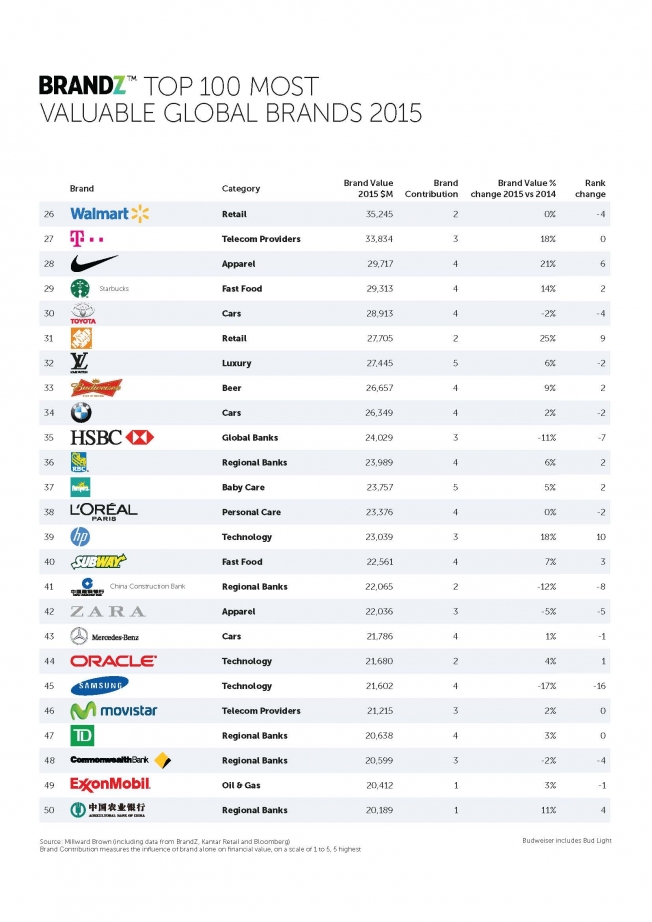
BrandZ has once again released their yearly study of the Top 100 Most Valuable Brands, showing exactly how much can happen within just a year. The trend continues from last year of tech brands getting increasingly high rankings on the list. Of note, the 4 most valuable brands are all tech, with Apple reclaiming it’s #1 spot.

Tencent, who in the past year has been investing heavily in the mobile games business, has moved from #14 in 2014 to #11 this year, getting dangerously close to cracking the top 10.

Both CocaCola and McDonald’s have remained in the top 10 but have fallen a few steps in favor of telecom companies AT&T and Verizon. Rounding out the top 10 is mainstay Marlboro, whose brand value has jumped 19 percent in the past year alone. Alibaba Group is a new entry to the list and already at the #13 spot, as they recently claimed the title of being the largest global IPO ever.

See the full list of this year’s most valuable brands below.