Google Still Dominates Global Media; Facebook Ups The Ante

Google and Facebook continue to fight over a number of social categories these days, including general media posts and video, but when it comes to a defined leader, it appears that Google continues to hold the lead.

That’s according to a new Top 30 Global Media Owners report, posted by Publicis’ ZenithOptimedia. The report indicates that the company is the best major media supplier, despite Facebook’s rapid growth, according to Mediapost.

Google holds a sharp lead in the top spot, with a 136 percent growth over the previous year. Meanwhile, Disney is in second place, holding a 115 percent increase. Comcast is in third place with an unreported percentage, but all three appear to be ahead of Facebook, despite its increase in video business and users. (It’s in the number ten position.)

The top 30 are reported below, and a number of companies have presence on the list, including Time Warner, CBS Corporation, iHeartMedia and Discovery.

“Google has benefited from the rising sales of smartphones and tablets, making its central search function available to consumers on the move — especially useful for shoppers looking for price comparison — and allowed consumers to view content at times and places most convenient to them,” said the report. It also added in regards to Google, “This has created new opportunities to target them with display ads, another important component of Google’s business. But the main beneficiary of the transition to mobile has been Facebook, which is the fastest growing of our top 30 media owners. Facebook’s media revenues grew 63 percent over the past year.”

Will these numbers stay the same next year Disney continues to show dominance in the retail and producing front, and with Star Wars gaining more ground, it could easily take the lead. Meanwhile, Facebook’s video division continues to grow, and could move it up the top ten rather handily. That said, Google still has a large grip, and isn’t likely to loosen it anytime soon. Next year’s numbers could certainly be interesting.

BRIC Mobile Gaming Market Reaching New Heights

The mobile market continues to boom, as a new report from OneSky and Newzoo shows that growth of the market has skyrocketed.

Speaking specifically about the BRIC mobile gaming market — which covers Brazil, Russia, India and China — the companies report that the market will reach a year-over-year growth of the market will rise 91.7 percent over the coming year, with a total of $9.4 billion reported for 2016, according to Newzoo’s site. The regions involved — and the mobile growth within each — are in the infographic below.

“We are very excited to team up with OneSky for this eBook and infographic on the BRIC market. BRIC already represents the largest mobile games market globally, driven, of course, by the huge revenues in China,” said Peter Warman, CEO for Newzoo, about the report. “The data presented aims to offer valuable high-level insights into this market, and the growth potential of the individual countries involved.”

The infographic, titled The BRIC Mobile Gaming Opportunities of 2015, covers quite a bit of data for each region, including English proficiency, mobile gamers population, revenue forecast and mobile gamers forecast. A number of facts came up with the report, including the following:

-The BRIC mobile gaming market obtained $5.1 billion revenue in 2014, a year-over-year growth of 91.7 percent, hugely exceeded global YoY average which is 38.9 percent.

-This revenue growth is backed by an increase in the number of gamers, payers as well as a higher average spent per gamer.

-Ranked first in the Latin America mobile gaming market, Brazil expects $415.5 million in mobile games revenue for the next year.

-Despite the currency risk, the Russia mobile gaming market still managed to reach 49 percent growth for 2014, year-over-year. Major setbacks are expected this year, with only a growth of 0.6 percent, but the market is expected to bounce back with $379.1 million earned in 2016.

-With 135.7 CAGR towards the coming year, India shows a great deal of rapid expansion with higher mobile gamer penetration. Improvement of its basic infrastructure will help the nation reach $571.6 million by next year, behind 208.2 million mobile gamers.

-China has managed to contribute 87.9 percent of BRIC’s overall mobile gaming revenue for last year. Continuous growth is expected, with next year’s numbers rounding $8.1 billion – six times the sum of other BRIC markets.

-The uniqueness of each BRIC market requires game publishers to have separate localization strategies in order to reach the potential growth with their products.

Greg Sung, CEO and co-found for OneSky, added, “BRIC is definitely the highlight of the mobile gaming industry in the next five years. In order to catch this terrific opportunity, it is important for publishers to understand not only overall development of BRIC, but also the in-depth knowledge of each market, that ultimately leads to revenue growth. This is where our co-operation with Newzoo, our eBook on BRIC trends, prospects and strategies plays an important role.”

The eBook can be downloaded here, and the infographic is below.

The Pros and Cons Of The Major Online Video Platforms

by Jean-Charles Lacoste

The power of online video is huge. According to comScore, a provider of user engagement statistics, 45.4% of internet users view at least one video per month, with average users viewing approximately 32.2 videos per month.

As a business, you have to make the most of the growth in online video in order to expose your brand to the maximum number of potential customers. There are several online video providers (OVPs) you can do this with. The question is, which one offers the best provision for you In order to make a decision, it’s important to look at the pros and cons of each provider.

What are the attributes of end user platforms such as YouTube, Vimeo, and DailyMotion?

The major positive of using YouTube as a platform for your brand’s videos is that it’s free, making it appeal to small and medium-size businesses. This free video hosting includes a limited amount of customization. Of course, YouTube is the largest OVP, with approximately 450 million unique global visitors each month, meaning it offers a huge potential audience. It’s also easy to use. Uploading content to the site is a simple process, as is sharing the content across your social media platforms.

Keep reading…

This article was originally posted on VideoInk and is reposted on [a]listdaily via a partnership with the news publication, which is the online video industry’s go-to source for breaking news, features, and industry analysis. Follow VideoInk on Twitter @VideoInkNews, or subscribe via thevideoink.com for the latest news and stories, delivered right to your inbox.


GTA V, Others Shake Up PC Gaming Chart

It’s hard to believe that Grand Theft Auto V is nearly two years old, as it initially released for the Xbox 360 and PlayStation 3 back in September 2013. It continues to flourish, though, mainly due to its advanced re-releases on Xbox One, PlayStation 4, and, most recently PC. We recently reported on the game’s initial impact on the PC front, but now Newzoo has supplied new numbers that indicate just what kind of strength it really has, with some help from overlay platform Overwolf.

According to the chart above, Riot Games’ League of Legends continues to be a dominant champion, while Mojang’s Minecraft, now under the ownership of Microsoft, continues to be a popular favorite. However, Grand Theft Auto V made a notable debut in the top ten for April 2015, comfortable slotted in the seventh position. That’s a pretty good position to be in, although most of that success is attributed to GTA V’s advanced features for PC, including 60 frames per second animation and the inclusion of a new video editor.

Surprisingly enough, another game, Grand Theft Auto: San Andreas, had been building in popularity leading up to GTA V’s release on PC. “As we pointed out in both March and February 2015, we predicted that the steady increase in Grand Theft Auto: San Andreas Multiplayer was due in part to the eager anticipation of GTA V‘s release,” says the report. It’s since dropped back down since the arrival of the new game, although it still remains in the top 20 – an impressive feat for a title that’s well over a decade old.

Other games have made some major moves on the chart as well. Counter-Strike: Global Offensive continues to be a big hit for Valve in the third place spot; Blizzard’s forthcoming Heroes of the Storm has built enough momentum to jump up seven spots to number 12, mainly due to the success of its recent stint on ESPN 2; and other games like DOTA 2, Star Wars: The Old Republic and World of Tanks continue to shift around, while remaining high in popularity.

So what does this mean in the long-term for popular PC games Well, League of Legends isn’t likely to go anywhere, despite ongoing pressure from Valve’s DOTA 2, which continues to be a hit during International tournaments. Minecraft is likely to be the same way, since Microsoft isn’t set to remove any of that game’s momentum anytime soon. As for GTA V, it’ll probably get better from here, moving up the chart as more and more creative gamers post videos from their gaming sessions, drawing in additional players as a result.

Nintendo Set For Big Turn-Around

Nintendo has seen a woeful past few years, mostly due to the problematic performance of its latest game console, the Wii U. However, it appears that, after struggling for a while, the company has finally come back to profitable days.

Following our previous report on Nintendo’s slow but steady turnaround, The Verge has followed up with even more good news for the company. It has made a slim operating profit of 24.8 billion yen ($207 million) and a net profit of 41.8 billion yen ($350 million). Sales were reported down 3.8 percent year over year, but the bottom line shows a 39.5 percent increase over what was initially forecasted. While that’s far from what Nintendo was making years ago with the original Wii, it’s still good news, considering the rough few years it’s had beforehand.

The Wii U continues to show struggles at retail, with only 340,000 units sold over the last three months, just under 10 million units sold overall. While that’s 10 percent up from the previous year, and although great new software like Super Smash Bros. and Bayonetta 2 has brought more gamers on board, it can’t quite keep up with the likes of Xbox One and PlayStation 4. That won’t stop the company from posting a profit, where it expects to make 50 billion yen in operating profit and 35 billion yen in net profit over the next year, with 3.4 million Wii U units sold.

Nintendo may be able to reach that goal, based on recent business decisions that could work in its favor. Its recent mobile deal with DeNA, which will bring popular favorites like Mario and Yoshi to handheld devices (outside of the company’s 3DS line-up), should gain momentum as the first games prepare for release in 2017; and, most recently, the company launched a new promotion-heavy campaign for its upcoming shooter Splatoon, which looks to be a big hit for shooter fans of all ages.

The Wii U will also get a heavy focus next month during the Electronic Entertainment Expo, and even though Nintendo’s highly anticipated Legend of Zelda sequel won’t be present, several other titles, like StarFox and Mario Maker, will be. In addition, surprise announcements could come in the form of a new Nintendo Direct special.

https://youtube.com/watch?v=DBmdEtaqePw

Speaking of Nintendo Direct, a new one arrived earlier this week, posted above, which highlights a number of events for the forthcoming Splatoon, including a timed beta test, called the Global Testfire, which will take place during certain hours this weekend, as well as free post-launch content, gifts with purchase of the game, and upcoming “Splatfest” events, where gamers can let loose with their creative paint-spraying skills. Other promotional events are being planned over the summer as well, leading up to the game’s release later this month, on May 29.

Last but not least, the company will soon have theme park presence, bringing its iconic characters – and game franchises – to life. Quartz has reported that the company has signed a deal with Universal Studios, which will put its many franchises into theme park related rides in its parks all over the world. Nintendo states that “this is an exciting project that will be unlike any other either of our companies have ever done.”

It’s still got some work to do, but it’s safe to say Nintendo finally has things going its way again.


Activision Blizzard Prepares For A Strong 2015

One major presence in the game industry that isn’t losing any of its stature is Activision Blizzard – and that’s not likely to change anytime soon.

The company announced its first quarter earnings through a report earlier this week, indicating that it’s earned $1.28 billion in revenue for the period ending March 31, 2015, with “over 150 million active users around the world,” according to CEO Bobby Kotick.

He added, “Our talented teams around the world continue to create experiences that inspire our audiences. In the last 12 months, we had over 150 million active users around the world who played our games for more than 12 billion hours and spectators who watched over a billion hours of linear programming based on our games. In the past year, Activision Blizzard’s communities grew by more than 25 percent.”

Combined, both Hearthstone: Heroes of Warcraft and Destiny have attained over 50 million registered players, and a lifetime revenue of over $1 billion.

However, that doesn’t mean the company’s year is done yet. In fact, it’s just getting started, and a big marketing push is expected from all corners.

One major player in the game is Skylanders, the company’s interactive toy game line. It’s become the number one kids game and console franchise in the world, despite competition from Disney with its Infinity series and other games, like Warner Bros. Lego Dimensions, entering the fray. Activision Blizzard should announce a new Skylanders product next month around E3, if not sooner – and will pour big money into spreading the word about it.

Call of Duty has sold significantly well over the years, with last year’s Advanced Warfare performing up to company expectations. That trend should continue this year with Black Ops III, which will launch on November 6th. The game is already getting a healthy marketing push, with the first gameplay trailer already making the rounds and pre-orders live through both digital means and stores. The trailer is below.

https://youtube.com/watch?v=58Pspqx0XGs

In addition, Destiny will continue to have a steady focus, as the developers at Bungie are not only preparing a highly anticipated House of Wolves expansion (set to release sometime this summer), but an even bigger add-on coming in the months ahead. It hasn’t been fully disclosed yet, but Activision should have more details on this around E3.If that’s not enough, the publisher is also putting some reliance into older, more popular franchises from a few years back. The company formally announced the return of the Tony Hawk’s Pro Skater franchise earlier this week, taking on more of a “classic” feel from the series instead of motion-sensitive based games like Tony Hawk Ride. Pro Skater 5 will arrive later this year for Xbox One and PS4, with a release planned for older consoles afterward. It sold very well for several years, and with the right marketing push, Activision could definitely bring it back to form.The Guitar Hero franchise, which set sales records years ago with its popular Guitar Hero III: Warriors of Rock, will be reborn with Guitar Hero Live later this year. It will be packaged with a newly designed (but easily accessible) guitar controller, as well as two ways to play. Guitar Hero Live will feature “live” crowds, while Guitar Hero TV introduces a new competitive angle, where players can challenge one another and switch “channels” depending on what they’re in the mood to play. A variety of bands will also be introduced in the game, with new songs being added regularly as downloadable content. Expect a big push behind this one as well, with a general focus on being able to play with popular music. The trailer is below.

https://youtube.com/watch?v=6SnIZgESm4c

That’s not to mention Blizzard’s plans on the PC front. The company’s first-person shooter, Overwatch, is making the rounds, set to enter beta test this fall; Heroes of the Storm, which was recently featured on an ESPN2 broadcast, will make its way to beta this month; and a new StarCraft II expansion is in the works, set to launch later this year. All three of these games should get a tremendous push, especially on the eSports front, where they’re expected to be popular favorites.

Activision Blizzard has a lot of work ahead of it with all its franchises, but considering its sales success thus far for the year, it should have no problem pulling ahead for a big year.

Oculus Has A Lot To Prove With Its Launch

Since its inception following a successful KickStarter campaign years ago, the Oculus Rift has been gaining some big buzz. Whether it was Oculus VR’s acquisition by Facebook or the presence of the device at events like the Sundance Film Festival, it has been slowly but surely showing that virtual reality could have a future in the consumer market – that is, if it could ever get a release date.

Finally, though, it appears that the Oculus will see the light, as the team behind the device have confirmed that it will hit retail during the first quarter of 2016. However, some details are still being kept in the dark at the moment, such as when the pre-order campaign will kick off (sometime later this year) and, more importantly, the price.

The Oculus Rift has proven in the past that it’s a virtual reality device to be contended with, as several big-name companies have shown with their tech demos. This includes last year’s San Diego Comic-Con, where 20th Century Fox, Warner Bros. and Legendary Pictures all had interactive demos focusing on VR, featuring the likes of X-Men: Days of Future Past, Into the Storm and Pacific Rim, respectively.

And Oculus itself has been ramping up a decent consumer scale in terms of what it intends to offer for those who purchase the device. Several games will be readily available once it launches, and there are even dedicated marketplaces where videos and other applications can be used with Oculus VR, with a convenient downloading solution in place.

But now comes the big question – how accepted will the device be on the consumer market There’s no word on a price point yet, so we don’t know just how expensive it will be to step into these virtual worlds. It’s likely that Oculus VR will come up with a competitive price point, but even then, there’s no question that cheaper alternatives, like Google Cardboard, will continue to flourish.

There’s also a question in terms of health. The last major VR unit to hit retail, the Virtual Boy, launched back in the 90’s, and turned into a real problem for Nintendo. Despite an offering of interesting games, the display caused some people to become ill after playing for a few minutes – a problem that those who have motion sickness issues could possibly go through with the Oculus.

Last but not least, there’s the competition. Sony hasn’t announced plans for its Project Morpheus headset as of yet, nor has HTC with its Valve-powered VR device, but the Electronic Entertainment Expo is just around the corner, and both companies could be primed to run a sooner launch date than the Oculus – and possibly even at a lower price. The competition is mounting, and companies like Samsung and Google have already made a lot of headway when it comes to virtual reality. Needless to say, Oculus has its work cut out for it.

Regardless, the technology is impressive; the support from major gaming and film companies appears to be in place; and with Facebook as its main investor, there’s definitely going to be some form of social push for it. All Oculus needs to do now is reveal the final details and begin building hype for the device. From there, who knows The future could be virtually theirs. Perhaps.

GamesBeat Summit 2015 Highlights

The GamesBeat Summit just concluded, and as expected there was plenty of good information, insights, and networking to be found there. Some of the key info from the first day included industry projections and some veterans of the game industry looking ahead at the next few years.

Tim Merel of Digi-Capital led off the GamesBeat Summit with some facts and figures from his latest reports about mobile games and the emerging AR/VR market. Mobile will become largest game software segment, according to Merel, climbing from $29 billion this year to $45 billion by 2018. The rise in mobile gaming is global, but is clearly driven by China. Merel says that Asia in 2018 will equal US and Europe mobile game sales combined, and China will be the largest mobile game market.

As to which platform is commanding, Merel looked at both iOS and Android. “Traditional logic and research would tell you that iOS has already been exceeded by Google Play in number of downloads, and nobody would argue with that,” Merel said. “But when you start to think about iOS versus Android and the number of different Android stores in China, you get a different picture. If you look at it in revenue terms, this year iOS is going to be the largest single app store in terms of revenue. Going forward, we expect Google Play and Android app stores to have over half of all mobile games revenue. But it isn’t all about raw numbers. Even though Android will overtake iOS in terms of revenue, iOS remains far and away the best app store for monetization for games.”

Merel believes that augmented reality (AR) and virtual reality (VR) have big potential for games in the next few years. He sees the total AR/VR market will hit $150 billion by 2020, though games are only a part of that. AR will be by far the biggest market, and in Merel’s view “AR can not only outgrow VR, but also has the potential to cannibalize the mobile market.” Merel believes that AR looks like smartphone market, wth the potential for hundreds of millions of users, versus tens of millions of users for VR. Breaking down that $150 billion, Merel projects the total VR market at $30 billion by 2020, and AR $120 billion. The biggest chunk of that AR revenue is hardware, though, and games are just a small part of the revenue potential with many other categories providing significant revenue. Even though the overall market for AR is bigger than VR, games on AR will not be as big as games on VR.
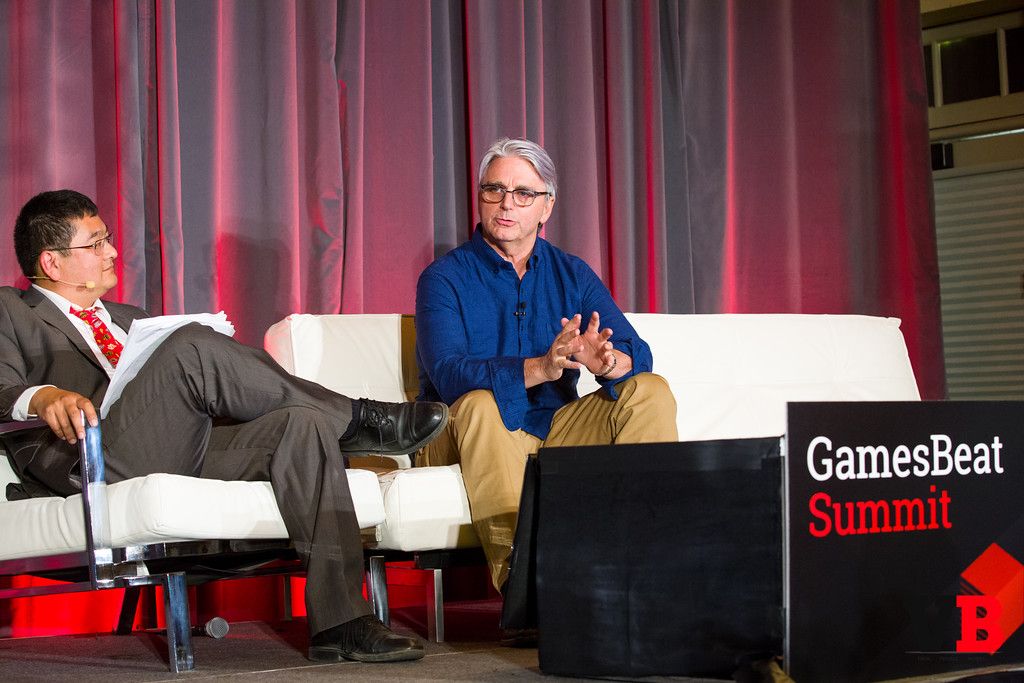
John Riccitiello

Video game pioneer Nolan Bushnell followed Merel, sitting down with VentureBeat’s Dean Takahashi for a conversation about games and the future. He’s often approached by people who have games they want to show him.” I’m always looking for destructive innovation, not evolutionary,” Bushnell said. “Most of what I see is evolutionary, pedestrian, sophomoric. I tend to not like that. I like to get involved with things that are truly revolutionary and look like they’re going to be important.” Still, Bushnell made the point that even great games don’t usually have a long life span. “The half life of a typical game, a really good game, is six months to a year,” Bushnell said. “What you want to do is find the threads that have sustainability.”

Bushnell’s vision for the future of games is clear. “The mobile space to me right now is very, very noisy, so I’m always looking for the next reset,” Bushnell opined. “The next reset is clearly AR or VR, and I have a little wager on each one. My gut says AR is going to be more important.”

The CEO of Unity, John Riccitiello, followed Bushnell with some pointed commentary on the state of the games business, informed not only by his current position but by his many years as the CEO of Electronic Arts. Riccitiello discussed Unity and how it’s become a huge platform. “In a given month 1.1 million developers are creating content on Unity,” Riccitiello noted. “We see 700 or 800 million Unity games being downloaded every month.”

While Riccitiello is working to improve Unity on many levels, including its technical performance, he’s also looking to give Unity developers help with their business. “One of the bigger problems developers have today is monetizing their game,” Riccitello said. “Finding an audience for it, getting paid for it, whether it’s advertising or virtual goods. We have a huge team of people working on the simple thesis that game developers are probably collecting 30 cents on the dollar of what the potential is for their game. We want to get them 100 cents on the dollar. We’re going to put a suite of programs together that will help developers get that extra 70 cents they’re not getting now.”

Riccitiello believes that marketing, analytics, and audience building are all subjects that need more effort in the games industry. “The vast majority of independent developers today lose money,” Riccitiello said. “Frankly, many major publishers on too many of their titles lose money because they aren’t able to get the monetization they want. If someone doesn’t solve that problem, our ecosystem isn’t going to fill rooms like this someday. We need to solve monetization.”

Images courtesy of VentureBeat

Mobile Game Highlights: ‘Broken Age’, ‘Jurassic World’

Welcome back to another round of Mobile Game Highlights, where we look at the best mobile game releases of the week. Here are five titles that shouldn’t be missed:

Broken Age (Double Fine, $9.99, available for iOS and Android)

Due to the immense success of its KickStarter campaign years ago, the developers at Double Fine were able to return to the “golden age” of point and click adventures with its PC release Broken Age. Now, that experience comes to mobile devices, completely intact. Featuring an all-star cast (including Jack Black and Elijah Wood) and plenty of brain-tickling puzzles, Broken Age returns to a simpler time of gaming. Its price may be steep in mobile terms, but the value players get back is immense. It’s definitely worth checking out.

Jurassic World: The Game (Ludia, free-to-play, available for iOS)

With the soon-to-be blockbuster film due for release next month, Universal Pictures and Ludia decided to build the hype behind Jurassic World with a coordinating mobile release. In the game, players will build their own theme park, meddling around with dinosaur DNA (at their own risk, of course) and earning collector’s cards to earn new goods. A battle arena is also available, in case players are curious to see who the king of the dinosaurs is. It’s a free-to-play title with optional purchases available, so it’s certainly worth a look. And yes, Chris Pratt (or at least his likeness) is in it.

Marvel Future Fight (Netmarble Games, free-to-play, available for iOS and Android)

With Marvel’s Avengers: Age of Ultron cleaning up at the summer box office ($200 million and rising domestically), it’s no surprise that there’s already another free-to-play Marvel game available for mobile devices. In Future Fight, players assemble their team of dream Marvel characters (including Hulk and Iron Man) and face off against a number of enemies across the universe. Special boosts can be acquired either as bonus items or in-game purchases, and new characters can join the fray at any time, heroes and villains alike. Comic book fans will want to assemble for this game.

Bears vs. Art (Halfbrick Studios, free-to-play, available for iOS and Android)

The creators of popular mobile hits Fruit Ninja and Jetpack Joyride are back, and this time they’re pitting bears against art! In this entertaining puzzle game, players will take on a series of puzzles, getting past sneaky security measures as they send a bear in to destroy priceless works of art. Featuring plenty of challenges and unlockable goodies, this free-to-play title is a joy for all ages. Art lovers be warned, a lot of work gets destroyed here.

Ys Chronicles 1 (DotEmu, $4.99, available for iOS and Android)

Finally, fans of old-school role-playing games will find a lot to like with Ys Chronicles 1, an adventure that offers hours of gameplay for a meager $4.99 price tag. Originally titled Ancient Ys Vanished: Omen, this adventure features a vast cast of characters, heroic and evil alike, as Adol Christin sets out to save the world. Featuring a beautiful art style, groundbreaking soundtrack and deep story, Ys Chronicles will fit the bill for those looking to get sucked into a grand quest.

On Demand Entertainment Has Come a Long Way

Over the past few years, on-demand entertainment has become even bigger than anyone has expected, with channels like Netflix, HBO Now and Hulu flourishing with a number of offerings — even more than cable television could provide.

AdWeek recently posted a large infographic detailing just how popular on-demand entertainment has become, even though some aspects — like downloads — have dropped a bit. Ninja Metrics compiled the numbers, which include the following statistics:

  • Streaming services cost 39 percent less than a bundle of expanded basic cable channels, which could explain some of the “cord cutting” that consumers have gone through.
  • Music downloads have dropped, while streaming services like Pandora and Spotify have increased in popularity
  • Over 40 percent of homes in the United States have some form of access to a subscription-based video-on-demand service, with 36 percent having Netflix, followed by Amazon Home Video (13 percent) and Hulu Plus (6.5 percent)
  • Homes with video-on-demand watch almost one hour more of TV per day versus traditional cable TV households, with nearly two hours and 45 minutes compared to one hour and 57 minutes
  • There are 41.3 million Netflix subscribers, compared to 95.2 million subscribers to cable/satellite TV subscribers, nearly accounting for half
  • The average monthly cost of video-on-demand versus cable is startling, with $39.22 for VOD services compared to $64.41 for expanded basic cable, even though the channel count is higher
  • In the streaming music department, over 164 billion songs were streamed last year, equaling 8.2 billion hours of songs
  • 67 percent of people in the U.S. use streaming services on a weekly basis
  • As for general revenue for music, streaming revenue saw an increase of $1.9 billion last year, while downloads dropped $2.6 billion

The full infographic can be found below, and it points the way for streaming services to become even more popular over the next few years.