‘Storied Myth’ Provides Augmented Reality For Kids

Making applications and games for children can be a tricky business, as some parents believe a few of these merely exist to sap money out of their bank accounts, through a free-to-play business model. Kabir Seth and Rubina Singh, however, have something different in mind.

PSFK recently reported on a new tablet game called Storied Myth, which takes a very different approach to children’s entertainment. It’s based around a storytelling platform sold as a subscription service, one that enables children of all ages to explore the magical world of Pangea, through a series of puzzles and clues that are mailed to them. In addition, chapters of the story can be explored, and they can partake in digital activities as well.

“Parents today are conflicted” about the convenience of “guiltily (using) tablets as babysitters,” according to co-founder Singh, and letting the amount of “screen time” increase over time.

“We believe that active screen time is not enough,” continued Singh. “To truly spark a child’s imagination and create an immersive world, great storytelling needs to be combined with tangible activities. Storied Myth was brought to life to address this problem.”

In addition to involving kids in an interactive world, Singh explained that the service also helps improve vital developmental areas around its activities, including growing a child’s motor skills, logical reasoning and imaginative capabilities.

Storied Myth centers around the Pendant of Gyges, which itself has been involved in mythic lore. In an effort to save the world of Pangea after the head of the East Pangea Youth Games disappears, eight heroes emerge to hunt down the pendant, solving imaginative puzzles along the way.

The digital adventure consists of 12 different chapters that make up the first story (a second is currently in the works), and provides a series of puzzles sent through a monthly mailed package within the app. To solve them, creative thinking must be used, so missing elements can be found and the quest can continue. Singh added that readers will also “use the physical puzzles and activities to unlock augmented reality content that advances the story and creates an all-encompassing adventure.”

Both Singh and Seth grew up as “avid readers” of adventure novels, including Harry Potter and The Hardy Boys, but “were (also) exposed to many mythology stories that focused on universal values, too, like humility, trust and integrity.” This helped shape the story’s motto, “Be Truthful, Gentle and Fearless.”

The story “(captures) a child’s sense of adventure and then creates a connection between the e-story and a corresponding adventure kit they get in the mail,” according to Singh.

Those interested in learning more about Storied Myth – and how it differs from the usual downloadable fare – can check out the official page.

Ubisoft Talks Value Exchange With F2P Games

Getting value from a free-to-play game is everything for a gamer, as they want to make sure they get the most from their purchases. But it’s also equally beneficial to a developer, because an app needs to produce a good profit in order to be considered successful. So what goes into value exchange

Chris Early, vice president of digital publishing at Ubisoft, recently brought this topic up during his Apps World 2015 panel this week in San Francisco, asking the question, “What kind of value exchange is there when we talk about game devs and game players ”

Pocket Gamer broke down a number of valid points from the presentation, as Early talked about how gamers wish to be entertained, and how it’s the developer’s key role to make sure that entertainment is delivered.

There are a number of resources that come into play, according to Early. Gamers have a good amount of resources to spend, and creating the right kind of game experiences means giving them a chance to invest in the experience overall – something to keep them driven.

Time also plays a part when it comes to value exchange. “The more time (players) spend playing our games, the more they’ll like it, and away it goes from there,” said Early.

Keeping attention is also a big plus, and works oppositely from time, as a long-term benefit instead of short-term. Playing a game now is one thing, but returning to the game later is completely another.

Early explained that a benefit to a good game is allowing players to use one or more resource to personalize their overall experience, while extending play time, enhancing the gameplay so that it offers more reward; or accelerating progression so it makes the player feel like they’re getting somewhere.

An example was brought up, with players having a lot of money, but not much time. Early believes that they might be more willing to spend on gear that could take weeks or months at a time to earn within the game itself.

But what about the opposite The game should provide ways for players to really get into the game, rather than punishing them if they don’t make a purchase. “We have to consider whether or not the player has the resources to complete the game that we’ve made, and if they don’t, how can we change our design to let them expend the resources that they do have to play the game,” said Early.

To conclude his presentation, Early brought up some interesting bullet points for developers to take under advisement:


  • Consider if the player has the resources to “play” your mechanic
  • Consider different ways to categorize players and design for their “player resource index”
  • Consider designing for both archetypes and resources
  • Consider implementing needs and mechanics that allow players to spend the resources they have in abundance


It’s certainly food for thought when it comes to the development of a free-to-play game – and one that doesn’t require a hefty purchase fee to continue onward.

Marriott Debuts Second Short Film, ‘French Kiss’

“When you delve deeper into the film, you discover the characters are taking you through a brilliant travel story as they navigate through the streets of the city through magical realism that can only happen in Paris,” said David Beebe, VP of Creative and Content Marketing at Marriott International, about their newest effort, French Kiss.

The short film takes viewers on a wild chase through the City of Lights for the main character’s laptop. On a business trip, he learns there’s more to life than work as he’s forced to enjoy the city’s charms.

https://youtube.com/watch?v=J3XVcuO1bx0

French Kiss is now the content studio’s second short film, after Two Bellmen, which had featured another of Marriott’s hotels, the JW Marriott Los Angeles L.A. LIVE.

Measuring The Effect Of Social Media Sales

Social media presence in business can be a big deal, as the ability to communicate with consumers and spread a message effectively can make all the difference in sales numbers. Recently, IAmWire posted an infographic, which can be found below, that breaks down which social media platforms are taking off when it comes to eCommerce sales.

According to the numbers, Facebook has the highest conversion rate and majority of orders emerging from sales. This is something the company predicted a while back, when Mark Zuckerberg had stated, “If I had to guess, social commerce is next to blow up.”

Facebook also has the biggest market share, with 63 percent based upon 23.3 million visits, followed by Pinterest and Twitter with smaller percentages. Reddit has the smallest count, although 4.5 percent is still nothing to scoff at.

As far as what kind of orders are placed on the Facebook site, a majority seem to come from photography with 98 percent, followed by sports and recreation with 94 percent, pet supplies with 94 percent, and dropshipping with 93 percent. Other categories that are high on the list include jewelry and watches (92 percent), clothing and apparel (87 percent) and food and beverage (86 percent).

The average order value seems to be highest on Polyvare, with $66.75 on average, across 436 orders. Meanwhile, close behind are sites like Pinterest ($58.95), Facebook ($55 even) and Reddit ($52.96).

Conversion rate plays a big part, and Facebook has the biggest out there with 1.85 percent, followed by Vimeo and YouTube with 1.16 percent each. Coming up low on the list, again, is Reddit, although it doesn’t have as big a video division as the other sites — though that is likely to change over the next year.

However, Facebook doesn’t dominate every single industry. YouTube has a strong hand with digital products, services, merchandise and automotive; Reddit has a good lead with electronics and appliances; and Twitter has home and office furnishings, home and garden, and gifts and specialty leads over its main social rival.

The full infographic is below, and also breaks down the top products that are big sellers across the board.


SuperData Posts Big Numbers For Global Games Market

SuperData recently posted a report titled Global Games Market Report 2015, which breaks down just how much video games are making — and the numbers are quite staggering.

The firm has valued the worldwide market for “interactive entertainment,” as it deems it, at $74.2 billion for 2015, with an expected growth of ten percent over the next three years. That places gaming as the third largest category in the overall entertainment market.

“Over the past decade, interactive entertainment has almost tripled in size as a result of a range of innovations. As the industry has changed, so, too has the audience,” said SuperData CEO Joost van Dreunen.

He added, “People don’t just consume entertainment but increasingly play an active part in it. Ranging from modding to streaming, from cosplay to competitive gaming, the market for gaming presents a much broader and more diverse mix of opportunities than ever before.”

The market has been broken down into various groups, but mobile leads the charge with $22.3 billion. Closely behind is the retail market with $19.7 billion; free-to-play MMO’s with $8.7 billion; social with $7.9 billion and PC with $7.5 billion. Meanwhile, the digital market continues to grow with $3.1 billion, while eSports is slowly but surely crawling forward, nearly at $1 billion in itself.

Other key findings from the report are as follows:

  • Digital game categories like mobile and free-to-play MMO’s are driving industry growth, while virtual reality and gaming video content continue to emerge.
  • Asia has the largest global games market for the near future, although the North American market remains quite strong. Free-to-play MMO’s and mobile are helping Asia keep the lead for now.
  • New devices and platforms are driving growth for interactive entertainment, although the retail-based business could decline once the current hardware cycle matures in early 2017.
  • Games claim a growing share (13 percent) of total revenue in key entertainment markets. In the United States, gaming has managed to triple its share of the total market over the last 30 years.
  • Interactive entertainment is ready to enter its next era with users in control. Physical and digital distribution will provide more user control with ownership and content creation.


The full report can be found here.

‘Candy Crush’ Developer Leaves King for Startup

The extraordinary success of Candy Crush Saga for King Digital has generated many consequences. King Digital had a successful IPO based in large part on how well Candy Crush Saga performed, and the company has made hundreds of millions of dollars from the title. It’s also led to game designer Tommy Palm leaving King to found a startup to make VR games, and now one of the other brains behind Candy Crush Saga is leaving King. According to a report in Dagens Industri, Alexander Ekvall has left the company to found a new firm to make mobile games. “There are two giants in the mobile market. King is one, Supercell the other. We want to be the third,” Ekvall said.

Ekvall has recruited six others to work in his new company which is still nameless as yet. Two of those are former developers for King Digital, and others have come from the Unity office in Stockholm. “I have sold some of my holdings in King to afford this,” says Ekvall. “It attracted me a lot to get to work in a small, tight team again. It is fast-paced and can break new ground. That’s how it started for me.”

The company is already working on its first title, which is aimed at the mobile, free-to-play segment. “I think we have found a niche and a genre that we can make to our own, like the other giants are not appropriated yet,” said Ekvall.

Now Hiring This Week: May 20th

[a]listdaily is your source for the hottest job openings for senior management and marketing in games, entertainment and social media. Check here every Wednesday for the latest openings.

  • Riot Games – Brand Manager (Santa Monica, Calif.)
  • WWE – Director of International Social Media (Stamford, CT)
  • Disney Interactive – Branded Content Strategist (Glendale, Calif.)
  • Sony Computer Entertainment – Marketing Director (San Mateo, Calif.)
  • Ayzenberg – Summer Internships (Pasadena, Calif.)
  • Ayzenberg – Director, ION Business Development (Pasadena, Calif.)
  • Ayzenberg – Account Executive (Pasadena, Calif.)

For last week’s [a]list jobs postings, click here. Have a position you’d like to place with us Email us at pr@ayzenberg.com.

5 Game Companies Taking The Mobile Jump

Last week, we reported that game company Konami was showing an interest in giving the mobile gaming market a try, and possibly abandoning the traditional console market – although that hasn’t been fully confirmed just yet. It’s a bold new entry for the company, who have been thriving for over 30 years with franchises like Contra, Metal Gear and Castlevania.

We briefly touched upon other companies that were giving mobile a gamble, but decided to cover it more thoroughly with this story, talking about what chances were taken by each company, and what future they could possibly see in the market…

Konami

Konami has spent years producing blockbuster hits for consoles, including Castlevania: Symphony of the Night and Metal Gear Solid games, among other titles. However, as of late, it’s been leaning more towards mobile business, in which it’s dabbled with titles like Pro Evolution Soccer Collection and its popular Swords & Poker releases. It could easily continue this trend, building on the strength of its many franchises to gain a big audience. Its pick-up of the Star Wars Force Collection card game has paid off with its tie-in to the popular franchise, and other titles like Contra Evolution and Yu-Gi-Oh! have done well in their own right. Konami could easily establish a mobile following from its avid fans, even though some feel they’re being “burned” by receiving less console releases in the future – even with Metal Gear Solid V: The Phantom Pain set to arrive this September.

Nintendo

Even though it resisted for the longest time (opting to instead produce games for its own systems), Nintendo finally relented earlier this year and announced that it was entering the mobile market, through a partnership with DeNA. The first game from that partnership will arrive later this year, and although titles haven’t been provided yet, it’s expected to be a wholly original game that focuses on one of the company’s popular characters, like Mario or Link from the Legend of Zelda series. There’s a lot of buzz going into Nintendo’s arrival on mobile, although it hasn’t revealed what its full plans are just yet, outside of releasing five titles between now and early 2017. One thing’s for sure – the fans are sure to love the games, especially if they’re original properties and not just ports of older titles like Super Mario Bros. 3. (However, that game would likely do well if it ever was released, based on nostalgia alone.) Nintendo’s CEO has noted that he plans to avoid the usual types of monetization seen in mobile gaming, aiming to find a much broader audience that will provide small amounts of money. Nintendo has re-affirmed its support for dedicated consoles, and announced that it’s working on a new console (the NX), though no details will be forthcoming until 2016.

Square Enix

Square continues to show support for game consoles, with titles like Deus Ex: Mankind Divided and Rise of the Tomb Raider releasing later this year. However, it’s gained a tremendous following since it started in the mobile market a couple of years ago, releasing a number of its older Final Fantasy titles on tablets and smartphones, along with original games like Theatrhythm and Mini Ninjas. It’s done pretty well with its mobile releases, despite some of them being in the upper tier of pricing, around $10 to $20. It’s likely to continue this trend as the year goes along, with a number of new titles to be announced next month during its E3 showcase. Square Enix is here to stay.

Electronic Arts

Although EA hasn’t been as steadfast with its mobile releases as it was a couple of years ago, it continues to produce top-notch titles, grasping onto the “quality, not quantity” logic with its games. The Simpsons: Tapped Out, the Real Racing series and its Madden and FIFA sports games are huge draws on the mobile market, with millions of players worldwide – and that’s not likely to slow down anytime soon. Its push will likely continue with a plethora of new titles to be announced over the next few months, as well as new entries in its football and soccer fans to keep fans entertained. EA has experienced strong growth in its mobile titles, and that seems likely to continue as the company has a strong lineup of new mobile titles ahead. The company also sees a strong marketing synergy between its console, PC, and mobile titles, with mobile sports games being a particular strength in keeping audiences engaged during the off-season.

Ubisoft

The publisher behind the Assassin’s Creed and Far Cry franchises has done extremely well between its console and mobile games, and that’s a business logic that’s likely to continue for years to come. It’s currently riding high on free-to-play titles like Assassin’s Creed Pirates, Trials Frontier and Driver: Speedboat Paradise, and the platformer Rayman: Fiesta Run is selling moderately well as a premium release. Its release canon will likely continue into the New Year, with more titles based on its popular brands, including a new Assassin’s Creed game to accompany its forthcoming sequel Syndicate.

The Industries Creating YouTube’s Most Effective Ads

Having a good outreach with video ads is one thing, but keeping that engagement going with creative ads is another, as word of mouth about such ads can spread like wildfire across social media. And there are a number of companies that are quite good at it.

Adweek recently posted a story based on numbers reported by Networked Insights, measuring which industries were producing the most effective ads on YouTube. The report shows that tech, automotive and fashion industries are the most successful on the channel, based on data pulled from the first three months of 2015 (as well as other demographic data.).

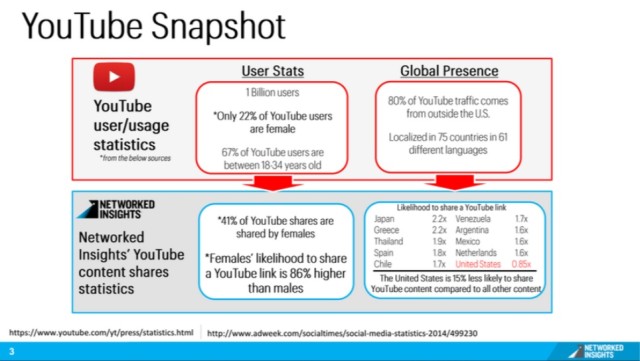
Most of YouTube’s audience are made up of global and mainly male viewers, with less than a quarter overall reported to be female. However, despite lower numbers, female have a far more effective sharing input with other users than males.

As you can see from the first chart above, 80 percent of overall YouTube traffic comes from outside the U.S., across 75 countries in 61 different languages. It seems that, in the United States at least, sharing isn’t as popular as in other countries, where Japan shows a 2.2 times likely ratio of sharing videos.

That doesn’t mean companies aren’t thriving with video content, though. Gaming and mobile tech brands show dominance in the top ten shared brands across the world, with Microsoft’s Xbox division leading with 10.6 percent when it comes to branded conversation. Closely behind is Nintendo with 6.7 percent, followed by Apple, Android and Sony. Rounding out the list are the PlayStation brand, Ford, Wal-Mart, Aeropostale and SeaWorld.

Why is Microsoft dominating on the list with Xbox According to Networked Insights analyst David Porche, it’s a matter of understanding the audience. “Xbox content on YouTube focuses on forthcoming games and content users want to share. By selectively sharing trailers, Xbox capitalizes on existing excitement about new games and systems. While there are roundtables, how-to video and other types of videos, Xbox sticks with what works.”

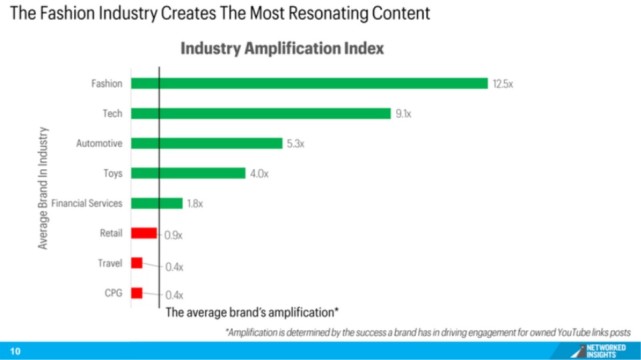
Out of the brands that create the most resonating content, however, fashion is king, with 12.5 times the industry amplification. Tech is closely behind with 9.5 times sharing, followed by automotive (5.3 times), toys (4 times) and financial services (1.8 times). Meanwhile, retail, travel and CPG don’t show much growth at all.

How do fashion brands dominate According to the report, there are three bullet points.

-Create content that’s surprising but not necessarily funny

-Use envy to create interest and fuel desire

-Create a “cult of personality” among their target audience.

Said Porche, “Fashion brands create video content that shows the desired lifestyle of their audience and viewers connect and try to mirror that behavior. Sharing the fashion brand’s content on Twitter solidifies a viewer’s allegiance to a brand they see as desirable. Fashion video content that is surprising makes the viewer feel like they are in on a secret once they have finished the video.

“This type of content speaks to personality traits and beliefs with which their target audience identifies. The viewers then see the brand and feel a sense of belonging to it and want to show that connection to their social circle as a result.”