Season 2 Of The ‘Hunt The Truth’ Podcast Is Coming In September

At San Diego Comic-Con on July 10, the Halo 5 panel, “Hunt For the Truth: Following the Trail of the Halo 5: Guardians Story” featured 343 Industries’ Kiki Wolfkill moderating, panelists Ian Kirby, Morgan Lockhart, Frank O’Connor, and Ayzenberg’s Creative Director Noah Eichen. The panel examined the storytelling in and around Halo 5: Guardians, bringing new insight into the mysteries surrounding the Master Chief and sneak peeks of what’s yet to come.

The ending of Halo 4 and Master Chief’s questioning what it means to be a Spartan were among the first topics covered during the panel. This led the discussion into the story for Halo 5 – the most epic game 343 has created in terms of scale. The levels are larger and the story is more layered and intricate. Halo 5 is also the first game where co-op is built not only into the gameplay but into the narrative fiction. Attendees got sneak peeks of upcoming content and also got to hear an excerpt from the Hunt the Truth podcast.

Frank O’Connor and team have built an extended fiction for the Halo universe, allowing them to delve deeper into the characters. This includes stories, New Blood, Last Light, Hunters in the Dark, a three part animated series called Halo: The Fall of Reach, and the Hunt the Truth podcast. With such an intricate story spanning different media, Frank mentioned the importance of communication and working on the fly. Producing a podcast was new for 343 but Frank mentioned that they were “excited to explore the podcast space” with a cool story. Since even Noah Eichen and the Hunt the Truth podcast team were un-spoiled for Halo 5, they created an “everyman” main character in Benjamin Giraud who would ask the same questions the audience would have.

As the panel closed, 343 teased that there are more mysteries to unravel before the game’s launch on Oct 27 and announced that season two of the Hunt the Truth podcast will launch in September. While they wouldn’t give much away, fans were promised that they would see a different side of ONI.

Comedy Central Brings Fun Experience To All At Comic-Con

Comic-Con 2015 is happening all weekend long, and fans from all over the world are flocking the halls of the San Diego Convention Center to check out star-studded panels and buy all the latest “geek” gear for their home. However, considering the event sold out in a matter of an hour earlier this year, there are those attendees that simply can’t get in and enjoy what it’s all about. Don’t worry, fans — Comedy Central has you covered.

The popular Comedy Central announced today that it is holding its own special ComedyCentralCon, which will be help today and tomorrow at the San Diego Wine and Culinary Center (200 Harbor Dr. #120). The event is open to both badge holders and the public alike, who can drop by and check out a number of activities based on popular and upcoming shows.

Shawn Silverman, Comedy Central Vice President, Brand Marketing spoke to [a]listdaily about the #ComedyCentralCon event.

First off, what gave you guys the idea to hold an event outside of San Diego Comic-Con Did you want to give something back to the fans that couldn’t get into the show, or . . . 

Fans are always our top priority and main focus so we wanted to create an event that would be free and open to the public as a big thank you to them for all of their support and passion. We always aim to create experiences that allow fans to get up close and personal with their favorite Comedy Central franchises and we strive for our events that are fun, interactive, sharable, and showcase Comedy Central’s sense of humor.

What kind of attendance are you expecting for the show today? It looks like there’s a lot going on.

Last year’s event was a huge success. There was a line to get in from before we even opened and it only grew as the day went on. A few thousand people played in our Moonbeam City laser tag arena last year which is even more impressive when you factor in that each game was about 10 minutes long and only eight people could play at a time. Based on the demand from last year we decided to extend the hours of #ComedyCentralCon this year and we will now be open from 11am-8pm on Friday and Saturday. We also focused on creating an experience that would allow more people to play all at the same time. Mini-Golf offered the perfect opportunity to have multiple teams playing simultaneously with a constant flow of people cycling through from hole-to-hole so no one will have to wait idly in line for very long.

How does this year’s event compare with previous events your team has held outside of SDCC

We launched #ComedyCentralCon a few years ago at SDCC as just a small daytime party where fans could come meet and hang out with some of the stars on our shows. We quickly found ourselves in a situation where we had to expand the event in order to accommodate all of the fans showing up, so we decided to turn it into a 2 day experience at a much bigger venue with lots of fan activities. Last year was our first year to do an immersive all-day event that included celebrity autograph sessions, a GIF booth and it was anchored by an incredibly cool black light laser tag arena that recreated the city from one of our new animated franchises, Moonbeam City, which premieres September 16th.

This year we are doubling down on #ComedyCentralCon. With so many amazing CC franchises on the air right now, we really strove to create an experience that could showcase many of them while still celebrating each of brands individually. Mini Golf felt like a great way to tie everything together to accomplish all of our marketing and promotional goals, spotlight our incredible talent, and create a free interactive event for fans to experience. Each hole represents a different CC franchise and we focused on bringing key elements from the show or the marketing campaigns to life and using them as obstacles within the course.

  • Broad City — The city of New York plays such a big role in the show so we wanted to bring a piece of home to SD with us. The subway entrance doubles as a great obstacle and upon getting the ball in the hole, a bong will blow out smoke.
  • Review — In Review, Forrest MacNeil reviews life experiences, even if it kills him. We used stars from Forrest’s patented Five Star rating system as obstacles for our course. Getting a hole in 1 will get you a 5 star rating on this hole! Review is back for Season 2 starting on Thursday, July 30 at 10/9c.
  • Another Period — The Bellacourts were heavily involved in designing this hole ,but they ended up getting drunk on Cocaine Wine and sent one of their Butlers to work it for them. The course is littered with “Cocaine Wine” bottles and there are actually 2 holes on this hole, 1 huge hole for the Bellacourts to ensure they get a hole in one (at which point their butler will lift the tray off the hole) and another standard size hole for the help and peasants.
  • Why With Hannibal Buress — The key art for this campaign features Hannibal’s face wrapping an entire building with Hannibal himself is walking out of the building through a small door at the bottom, so using that door as the passageway to the hole was a no brainer. Hannibal will be stopping by our event to play a few rounds and might even heckle a few fans as they try to get a hole in one.
  • Key & Peele — The K&P hole features a motorized revolving door — just like the one featured in all of their Valet Sketches. The ball must pass through it and will then be shot out and down a ramp towards the hole.
  • Workaholics — We recreated the roof of their house where the guys spend lots of time smoking and drinking as our obstacle. The hole is also littered w/beer pong cups, just like their front yard.
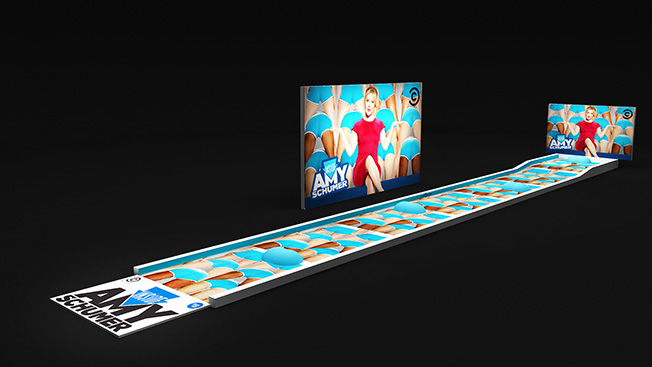
  • Inside Amy Schumer — As Amy said, “2015 is the year of the ass” so we brought our key art for this season to life and created 3D “butts” as obstacles that players will have to navigate around to get the ball in the hole.
  • Moonbeam City — After the success of our Moonbeam City laser tag arena at COMEDYCENTRALCON last year, we had to find a way to bring Moonbeam back to SDCC for year two. We worked closely with the show creators to design this hole and re-create the city itself.

Beyond Mini-Golf, we also have a GIF booth where fans can step into a scene with the stars of their favorite Comedy Central franchise and make it look like they are up close and personal with the stars of each show.

We also have an incredibly cool 360 degree Drunk History booth that we think the fans are going to love. The custom built boothrotates 360 degrees while someone stands inside and tries to stay on their feet. It’s more challenging than it sounds and can make even the most coordinated person look like a drunken mess. Personal videos are captured of each participant which they can they share on their desired social platform.

On top of all that we’ve added a prize wheel this year where fans will have the chance to win prizes from virtually every Comedy Central show on the air.

And last but certainly not least, stars of multiple shows including Workaholics, Drunk History, Another Period, The Meltdown, WHY with Hannibal Buress and Moonbeam City will be stopping by to meet fans, sign autographs, and compete against fans on our mini-golf course.

We’re very excited to bring all of this to life this year and can’t wait to celebrate with the fans!

More Details
People who drop by for the con will be able to take part in a nine-hole miniature golf course, featuring holes based on shows like Moonbeam City, @midnight, Inside Amy Schumer and Key & Peele, along with a photo booth that allows attendees to get pics with their favorite stars from shows like Broad City and Another Period. There will also be a prize wheel offering fun little collectibles, as well as stars from shows dropping by for autographs, although a specific schedule wasn’t given.

The channel will also host a special episode of The Meltdown With Jonah and Kumail later this evening at the American Comedy Co., featuring the best in live comedy entertainment.

Although Comedy Central will also be hosting panels at the event — announcing its new animated series Moonbeam City with Rob Lowe and discussing other shows like Another Period and Drunk History — it set up this exhibit for fans not fortunate enough to get into Comic-Con — and they’re likely to drop by and have fun. More examples of the holes in the mini-golf course can be found below — and the Workaholics hole definitely looks like fun.

This is just one of the many events taking place outside Comic-Con for non-badge holders to enjoy. Ubisoft opened up an Assassin’s Creed Experience right across the street from the Convention Center, where fans can check out the game and try their luck at an obstacle course; and Nerdist Industries has teamed up with Legendary Networks to host a Conival, featuring a number of stars and activities, including a special laser tag arena that ties in with the forthcoming game Battleborn from 2K Games. More details on that event can be found here.

How Facebook’s New Pricing Model Is Changing Things

Facebook is ready to take its advertising model to the next level with a new business plan.

Introduced earlier this week via the company’s official blog page, the Cost-Per-Click program is intent on helping advertisers get a better idea of how ads perform against their pre-set objectives.

In the blog entry, Facebook explained a number of reasons for the change, explaining that its “ad offerings have become increasingly tailored to helping advertisers meet their objectives.” Once it goes into effects, “advertisers who care about link clicks are likely to see better return on advertising spend, since they’ll be paying for only the most valuable outcome,” said the post.

But what effect will this have on companies in the long run Many feel that it will help increased Facebook’s ad sales, as well as the creative side of the site, especially when it comes to marketers that have branding on their minds.

Adweek recently reported that Keywee CEO Yaniv Makover, among others, feel that this will be a change for the better. Spending increases “will be significant,” according to Makover, especially with packaged goods-based companies and automotive brands. “Now that Facebook CPC actually refers to cost per website click, brands will feel like they are comparing apples to apples,” added Makover. “They are going to be spending more money on Facebook.”

In addition, he added that “the new CPC rates are going to be a lot higher compared to the old CPC. So if you were paying five cents for a click, now you will be paying around 16 cents.”

There’s more to the business model, though, at least according to Chicago-based digital marketing consultant David Deal. “Focusing on click-throughs will make Facebook more valuable so long as Facebook can deliver targeted audiences to brands. It’s not enough for Facebook to drive more traffic to a website. Facebook needs to consistently deliver well-defined and desirable audiences.

“The change in Facebook’s pricing configuration is further evidence that social media is morphing into a direct-response play for brands,” he continued. “We’ve already seen Facebook, Instagram, and Pinterest introduce buy buttons recently. Likes and shares are less important than commerce.”

Omer Shai, chief operating officer for Wix.com, also added to the conversation. “This change will help draw even more direct-response marketers to Facebook since it purifies the traffic-acquisition process and guarantees that every dollar spent on (the platform) will now lead the user to the funnel marketers are promoting,” he said.

However, this will bring about more ad creativity, which is just what the doctor ordered for some companies. “Think about it, if you’re trying to lead users into the funnel and avoid paying for social actions, you’ll probably use very clear-cut creative now with this change,” said Shai. “I’m sure we’ll start seeing ads that are really pushing the boundaries.”

Deal also added, “The focus on click-throughs will pressure brands to make more effective creative ads on Facebook. Compelling people to visit you or buy from you is more challenging than convincing someone to simply like your ad. Brands will need to work harder to benefit from direct-response ads.”

Here’s hoping that the CPC will be a beneficial program to advertisers and creative types alike.

Web Video Is Blurring Lines For Business and Editorial

Television and print have their usual restrictions when it comes to news reporting, but web video doesn’t. That may sound like a less restrictive practice, but, in fact, certain sites can run into problems with this, based on who ends up calling the shots for what goes up, according to Digiday.

The New York Times has seen its struggles in the video department, recently shaking up staffing with the departure of managing editor Bruce Headlam and general manager of video Rebecca Howard, to pursue other roles. This leads to the question – who should be taking charge in video production, editorial or business

Digiday went on to talk to three different outlets, including The New York Times, about examples on how to get around this.

First off, there’s The New York Times. While video business was on the rise with 15 channels in a production slate and a number of new original series, there was consistent tension. It seems that an executive should have been placed in charge to oversee all aspect of the video business. Said the executive (who spoke on anonymity), “Video has a marriage to the (editorial) experience but has a standalone opportunity beyond that. There very well may be editorial folks out there who can do it, but threading that needle between issues like production costs, distribution and even managing the balance between text and video, and still being able to run a fully scaled operation is, I think, beyond what I’ve typically seen coming out of editorial.”

Next up is Meredith’s National Media Group, which has seen its fair share of business as well. Its video division is headed up by vice president of video production Laura Rowley, who said, “You have to have somebody who understands editorial, advertising and the dynamics between the two – of what the revenue picture looks like and how that translates into the kind of production costs you can put into place.”

Meanwhile, video ad sales run separately to Meredith senior vice president Marc Rothschild, though Rowley also oversees branded and native video content. “Every media organization has that tension,” Rowley said. “One of our strengths is that our culture is very collaborative. Editorial understands where the line is and pushes back when they need to.” At the end of the day, editorial dictates the video that is produced because each magazine brand’s editors know their audience best.

“I’ve also never had a conversation where the advertising side said, ‘Hey, can we run a feature on this advertiser ‘” For that, Rowley said, there’s a separate branded-content unit on hand to assist.

Overall, this business structure works well, as Meredith draws 60 million views per month from the United States alone.

Finally, there’s the Huffington Post, which is led by general manager Nathan Brown with some assistance from editorial director Danny Shea. Both agree that there’s a need to include both editorial and business on the video side.

“The way to make it work is to have a true partnership and not just say it’s a partnership,” said Brown. “What skills and knowledge I don’t have, Danny does, and vice versa.”

“It’s a hybrid role,” added Shea. “If we were just running it from the editorial department, it wouldn’t succeed. If Nathan were running it without the editorial department, it wouldn’t succeed.”

Brown ultimately runs the division, but Shea keeps in contact to make sure that business and editorial continue to be balanced within it. “Business’ job is to look at the big picture – how do we explore new formats, distribution of content, etc. – not the granular, day-to-day operations of video,” added Brown. “You just have to be open to a really fluid model. You can’t be inflexible. I’m saying buzzwords, I realize that, but being protective of the past will always get in the way of the future.”

Added Rowley, “It’s like Ghostbusters – you don’t want to cross the streams.”

Certainly food for thought for those looking to grow their video and editorial business…

Apple’s About to Revolutionize Mobile Gaming

Apple introduced its new Force Touch technology earlier this year with its new Macbook, and this technology is about to make its way into the new iPhones and iPads, according to reports in the Wall Street Journal (as reported by The Verge) and elsewhere. While this rumored development hasn’t attracted much attention, the long-term implications for gaming and the game industry as a whole are profound. When iPhones and iPads with Force Touch become the standard, mobile gaming can really make inroads on many genres currently limited to PCs and consoles.

What is Apple’s Force Touch technology Essentially, it adds two key elements to touch pads (and soon, to touch screens): pressure-sensing and haptic feedback. Right now touchscreens only detect where you’re touching it, and how long you maintain that touch. Yes, you can also have multiple fingers touching the screen, and the screen can also track movement (like those swipes you use in Fruit Ninja, or how you pull back the slingshot in Angry Birds). What current touchscreens can’t do is sense how hard you are pressing, but Force Touch adds that extra dimension by placing pressure sensors under the screen.

Force Touch adds more than just pressure-sensing, though — the haptic feedback uses precise vibration to give a convincing illusion that you have clicked the screen. The Taptic Engine (also used in the Apple Watch) can simulate other sensations as well, and can fool you into thinking the trackpad is moving. The combination of the pressure-sensing and the haptic feedback opens up immense possibilities for game designers.

Why is Force Touch so important for gaming Because one of the criticisms of touchscreen games has been the lack of feedback in the controls, which makes it very difficult to create certain game genres on touchscreens (like fisrt-person shooters). Keyboards, mice, and videogame console controllers let you input commands to a game without the need to take your eyes of the screen. You quickly learn where the right buttons are, and thus games like Call of Duty or League of Legends can keep your attention focused on the screen. If you need glance down to see where a button is, you’re probably dead in that instant.

Now imagine an iPad or an iPhone where you can have touchpoints on the screen (even user-defined or adjusted) where the haptic feedback can keep you aware of where your fingers are. Moreover, you can use the pressure sensitivity to alter your game input — switching from burst to autofire, for instance, or engaging an afterburner for extra movement. You could be playing fast action games without having to pay close attention to your fingers, which would make popular game genres (sports, FPS, simulations) much better on mobile than they currently are.

The marketing implications are equally important. First off, Apple is reportedly asking suppliers to build 90 million new iPhones before the end of the year — if they sell that many the new iPhone instantly becomes one of the most popular game devices of all time, with an installed base about the same size as the Xbox 360 or PS3. In three short months. Throw in another 15-20 million iPads on top of that, and by the end of the year there are over 100 million mobile devices with this capability. By the end of 2016, it would be more than double that number.

Don’t forget that these new iPhones and iPads will have even more powerful CPUs and GPUs, giving them gaming power greater than the Xbox 360 and PS3, and in some ways more powerful than the Xbox One and PS4 (producing higher resolution images, for one thing, like CSR Racing 2). Imagine a Mario Kart that’s just as fast, and prettier, than what you can play on a 3DS. Or a FIFA Soccer or Madden Football with the fast action you enjoy on consoles.

Now take the implications one step further. It’s clear Apple is very interested in bringing out a new Apple TV with much more powerful graphics and a full App Store, along with its music streaming service and an array of video viewing options. The missing part, for game companies, is the controller. That’s typically a $50 item for a Bluetooth controller, which would drive the Apple TV well past that sweet $99 price point they are aiming at. And why would Apple do that if a significant part of the audience wouldn’t be immediately interested in a controller

Ah, but what if Apple could give you a very good game experience with your iPhone or iPad as your game controller, used with the Apple TV If you didn’t have to look down at the iPhone or iPad, the Apple TV could deliver any console game genre you like. Yes, a full regular controller would be better, and of course the hard-core gamers could buy one. But even hardcore gamers would enjoy being able to play multiplayer games with a group of friends without having to buy extra controllers.

Force Touch technology holds the potential to turn mobile devices into full-range gaming devices, with no need to say “well, but there are certain genres you can’t really do well” any more. Moreover, with Force Touch in place on iPhones and iPads, the new Apple TV becomes an impressive challenger indeed to the existing console market. No, it won’t be able to touch the number of polygons an Xbox One or a PS4 can deliver, but then again it would only be $99.

So brace yourselves for a revolution in the gaming market, as Apple bids to make mobile a strong competitor to to most of the leading game genres, if not all of them. And, in the process, creating an even bigger market for core gaming. It’s going to be an interesting year ahead.

Trailers Lead On YouTube, But Do They Lead To Ticket Sales?

by Evan DeSimone

A new study released on Google’s public insights portal “Think With Google” reveals that, like everything else on the web, movie info is moving to mobile. Over 35 million hours of trailer footage were consumed on YouTube’s mobile app over the second quarter of 2015, which amounted to an 88 percent increase over the previous year. The study also found that over 74 percent of all moviegoers research showtimes and 54 percent of searches for movie times and tickets are conducted on mobile devices.

While the number of movie goers utilizing the internet is climbing, it’s not entirely clear if all that digital engagement is really leading to ticket sales. Terminator Genisys currently occupies the number 4 spot on YouTube’s summer movie trailer leaderboard. However, when the film opened last weekend, it filled fewer seats than either month-old Jurassic World or three-week old Inside Out, which didn’t even make it into YouTube’s top 5.

Terminator Genisys isn’t the only recent film with a box office debut that didn’t match its YouTube. The trailer for Disney’s Tomorrowland hit big with over 11 million views, but the movie itself made only made $41 million when it opened over Memorial Day weekend, which was disappointing given the film’s $190 million budget. Similarly, the 2014 Godzilla reboot narrowly outpaced X-men: Days of Future Past in views, but took in $80 million less at the box office than the mutant heroes in its opening weekend.

Check out all 5 trailers here

This article was originally posted on VideoInk and is reposted on [a]listdaily via a partnership with the news publication, which is the online video industry’s go-to source for breaking news, features, and industry analysis. Follow VideoInk on Twitter @VideoInkNews, or subscribe via thevideoink.com for the latest news and stories, delivered right to your inbox.

Lionsgate Shifts Into Mobile Games With ‘Expendables’

Lionsgate is no stranger to film success, having produced a number of blockbusters like The Hunger Games films and Now You See Me amongst others. Now, it’s ready to take on the gaming world.

The Hollywood studio has announced that it will partner with Millennium Films producer Avi Lerner and game developer Fifth Journey to produce its first mobile game, based on the Expendables series. The films, which feature Sylvester Stallone, Arnold Schwarzenegger and other action stars kicking butt and taking names, have managed to gross nearly $800 million worldwide across three theatrical releases – so there’s definitely some appeal there for a mobile action game.

Per VentureBeat, this marks the newest investment by Lionsgate outside the film world, as it previously dabbled in virtual reality, as well as advertising via live streaming on Twitch.

Lionsgate president of interactive ventures and games Peter Levin stated that the team is hoping “to expand the universe of The Expendables” with the release.

Games are a great way to spread the message with action-based film releases, according to Levin, and the outreach of a popular franchise is a great way to hook fans into the mobile world. Previous games like The Hunger Games: Panem Rising have proven that, through a key partnership with Kabam. But now, it appears Lionsgate is ready to tackle the mobile world head-on.

Fifth Journey will bring its “development and publishing savvy” to The Expendables game, with Gameloft veteran Eric Tan heading up the team. He’s very familiar with bringing film franchises to the mobile front, having worked on games based on Iron Man 3, Ice Age and Despicable Me. He believes the team has “all the ingredients” needed to find success with the Expendables mobile game.

There’s no word yet on when the game will release, but it’s likely to arrive sometime next year for iOS and Android devices alike.

Minion Madness Gets Biggest Promo Push In Universal’s History

After making over $1.35 billion at the box office (and $565 million of that is from the U.S. alone), one would think that Jurassic World would be getting the biggest promotional push from Universal Pictures. But, in actuality, the studio is putting all its promotional strength behind the forthcoming Minions, a Despicable Me prequel that will be launching this weekend in theaters.

Deadline reports that the film studio has launched a number of promotions for the upcoming animated comedy, which features the gibberish-talking assistants looking for a new boss to serve — and finding it in a character voiced by Academy Award winning actress Sandra Bullock.

The campaign is, in fact, the largest one in the studios’ history, even considering the likes of films like Back To the Future and Furious 7. Many companies are on board with Minions-based promotions. McDonald’s, for instance, is a huge key partner, with Happy Meals and other promotions pointed at adults — not to mention Minions plastered on the walls, greeting customers as they come in (as seen above).

In addition, the Minions are making their impact in other markets. There are plush dolls and other toys that are sure to get a lot of sales going; Tic-Tacs and other food promotions feature Minions-like design; and Electronic Arts will soon launch Minions Paradise, a game that will no doubt see a huge push in the mobile division.

“The Minions have permeated pop culture so it has such a broad appeal from ages 3 to 84. We started hearing from brands (around the world), so it was a very coordinated global effort; we worked with all the local offices around the globe,” said David O’Connor Universal’s executive vice president of global brand marketing and partnerships.

The film was originally intended to release around the holidays last year, but Universal held off the release to summer 2015, in an effort to get more promotions for the film rolling in — and it’s a move that appears to be paying off. Everywhere consumers turn — even online — the Minions certainly can’t be missed.

O’Connor and his team spent a great deal of time putting together the campaign to promote the Minions, with a lot of work and planning going into choosing the right partners for the little guys. But it’s paid off with just the right level of advertising, and plenty of Minion-mania, as it were, appealing to consumers. Projections for the film indicate that it will have no trouble clearing out a $100 million-plus weekend — even with continuing attention going into Universal’s Jurassic blockbuster.

And the promotions kicked off well before the film’s release. Last month, Amazon teamed with Universal and Illumination Entertainment (the creators of Minions) to ship packages with special packaging featuring the characters from the film — a promotion that saw great success.

Other products — Twinkies shaped like Minions, cereals with special Minions goodies inside — guarantee that the little guys won’t be going away anytime soon. In fact, promotions like this could easily continue into the home release of the film later this year.

Some might see it as oversaturation — a few online users have expressed bitterness over Minion overkill — but the truth is, Universal has effectively put together a campaign that covers all forms of products, from toys to popular adult items (including men’s ties and sleepwear) to an appearance in an NBA Final-related ad, where a Minion went toe to toe with the Golden State Warriors’ Stephen Curry. That ad can be seen below.

https://youtube.com/watch?v=dwCpv7ii1Ws

There’s just no stopping the Minions. They arrive in theaters tonight with special 6 PM showings, before the film opens in wide release this weekend.

AMC, Paramount Shrink Release Window For Upcoming Films

Right now, the cycle in which films go from theaters to home video is a pretty healthy one, with about a three-to-four month gap between the two – sometimes longer, like with blockbuster films Marvel’s Avengers: Age of Ultron and Furious 7, which won’t debut until at least September.

However, a new pact could shorten that window significantly, if it goes into a full-on practice. The Hollywood Reporter recently posted a story that noted a pairing between Paramount Pictures and AMC Theaters to make two upcoming films available digitally just 17 days after their original theatrical run. That’s not to say we’ll be seeing Mission Impossible: Rogue Nation on our screens by August, though, as the deal only pertains to two smaller films from the studio.

Paranormal Activity: The Ghost Dimension and Scout’s Guide to the Zombie Apocalypse are the two films in question, and users will be able to check these films out at home just two weeks over when they conclude their theatrical run at the chains, according to the deal. Canadian chain Cineplex is also taking part as well, with a deal to show the films at its locations before they head home.

With this deal, a Hollywood studio would have less frustration with organizing a home release for a film. As stated above, the usual practice requires a three-to-four month wait before a film can be released on home video. Could this change things in the long run Only time will tell.

“Exhibition for the first time was open-minded about evolving our business instead of sticking their heads in the sand and ignoring what is happening around us,” said Paramount vice chair Rob Moore, speaking with the Reporter. “This is all about changing the definition of theatrical windows. Instead of starting the countdown from when a movie opens, we are starting from when it ends.”

Only the two movie chains are on board at the moment, and, again, this won’t apply to bigger releases, like Rogue Nation, which opens at the end of the month.

AMC CEO and president Gerry Lopez added, “Consumers know theatrical movies from their ‘gotta see it now’ exclusive releases in theaters, but every movie is different, and a one-size-fits-all business model has never made sense. This model aligns the interests of consumers, filmmakers and exhibitors to maximize the theatrical experience first and then enable legitimate digital access.”

Keep in mind, though, that some independent studios have already taken the video-on-demand route for most of their films. Samuel L. Jackson’s action/thriller Big Game, for instance, is making the rounds on channels like iTunes and other on-demand services, along with a limited theatrical release. It seems to be a fairly good business practice – at least, for smaller films.