The Continued Evolution of ‘Street Fighter’

Capcom’s Street Fighter fighting game series continues to be a huge draw for fans around the world. Ever since its introduction back in 1989, it has evolved with a number of sequels, including Ultra Street Fighter IV, which has become a phenomenon at tournaments everywhere.

Now, the series is about to enter its next evolution for PlayStation 4 and PC, and that new version gained a lot of exposure this past weekend at the EVO fighting tournament in Las Vegas. At the tournament, live viewers and online streamers via Twitch got a chance to see the next big step in the Street Fighter franchise.

Street Fighter V, which was initially announced late last year at Sony’s PlayStation Experience, gained even more buzz at the Electronic Entertainment Expo last month with the introduction of two new fighters – Cammy and Birdie – alongside a better explanation of its changing battle system, which players can adapt to on the fly as they fight with one another.

This past weekend at EVO, Capcom added yet another piece to the fighting puzzle, introducing a new combatant named Necalli. This big-haired brawler will add a new fighting style for players to adapt to in the game, whether they’re playing as him or taking him on in battle.

“Players who enjoy a straightforward, hard-hitting character will feel right at home with Necalli, as he possesses a wide variety of savage, close-range attacks, as well as a command grab, all with the goal of demolishing his foes,” Capcom’s Peter Rosas stated in a blog post.

“We want to change the way that players interact with the series, and create an ever-evolving environment for players to enjoy. By releasing new characters on a regular basis, it will ensure that there is always new content to look forward to in the short term, and it prevents the competitive environment from ever becoming stale.”

The debut trailer directed and produced by Ayzenberg for Necalli is below.

In addition to revealing a new character – and hinting at more to come before the game’s release next year – Capcom also broke down its business plan for Street Fighter V, and it’s quite different from the usual plan game developers follow these days.

Instead of having to pay extra money to unlock new combatants in the game, players can actually earn all the content by playing through it. This marks a changing of the guard for usual development from Capcom, a move that a number of fans have come to appreciate since its announcement yesterday.

Balancing will also be kept in check, according to Rosas. “Players can take a break from the game, but then come back at any time and continue to play with the characters they already own, with the newest gameplay balance,” he said.

This will be good news for avid fans who have stuck with Street Fighter over the years, and ones that keep coming for a number of profitable pro tournaments. Capcom has even devoted itself to marketing a Pro Tour to hype the games in the series, with a number of popular players competing for prizes.

And these fighting tournaments are definitely a big draw with consumers. GamesIndustry International reports that over 250,000 people tuned into the final Ultra Street Fighter IV competition, marking a huge record for a fighting tournament. The entire event was streamed all weekend, with thousands tuning in to see the best of the best compete in a number of games, including Mortal Kombat X and Super Smash Bros. Melee, an older favorite for Nintendo’s GameCube console.

With these records continuing to rise – and Street Fighter V looming in the distance for a 2016 release on PlayStation 4 and PC – there’s no doubt that the fight will continue.
 

Some Stats About YouTube’s Branded Content

With more and more branded content making its way to the YouTube video channel, Google has decided to get a better idea of what marketers and content producers want from the channel with a new analytical program, working alongside Pixability to get a better idea of how effective it truly is.

Per this story from MediaPost, Google is doing more than just looking at the “likes” and “dislikes” for videos, even though they can tell quite a story when it comes to the acceptance or criticizing of a branded video. A deeper analysis can provide a better idea of how effective a video campaign is for a company, depending on how many viewers drop off or stick around to see more videos in the overall campaign.

By teaming up with Pixability, Google hopes to get a better idea of viewership and publishing trends for these videos, across the Top 100 brands defined through the Interbrand 2014 Best Global Brands ranking. There’s a lot of interest within this ranking, with over 40 billion views across content on all of their channels, half of them calculated from this past year alone.

The number of monthly views through these brands managed to rise a whopping 55 percent over the past year, and the number of videos across these brands have expanded greatly, with those garnering one million views increasing by 29 percent from 2014 to 2015.

With the data emerging from this research, Google is able to get a better idea of what industries are thriving through likes and dislikes. Out of the ones with the least approval, financial services seem to lead the charge, while media companies like Disney have the most likes. Pixability CTO Andreas Goeldi said, “Viewers clearly express when they’re not happy. There are examples of videos where there are more thumbs down than thumbs up because people don’t believe the message.”

The analysis managed to tally 90 million likes from videos in the top 100 brands, compared to only 8.9 million dislikes – a nearly 90 to 10 percent ratio. With 16 million comments on videos and 73 million total subscribers to take into account, there’s a lot to study.

Subscribers have also increased with popular video campaigns, increasing by 47 percent compared to the previous year. That indicates that consumers will stick with certain brands for the long haul, rather than just one video – and that’s good news for certain businesses.

Research also depends on which engines are used for finding videos. YouTube focuses more on tutorial content and reviews in general, while Google is more on a transactional basis, according to the report. Black Friday in particular had an abundant amount of searches on YouTube for certain tablets, whereas Google focused more on where to find “cheap tablets” or “tablet discounts”.

It also depends on the effectiveness of the brand, even though there’s sometimes not a direct mention. For instance, Red Bull has thrived with its sports content, even though sometimes the company isn’t mentioned. Meanwhile, Western Union worked on videos that ran across the U.S., asking people what their idea of the American Dream is like – again, without heavily going into mention, and instead focusing more on the content itself.

Collaborations also play a key part, like L’oreal working alongside independent YouTube personalities with one million (or more) subscribers. They’re not alone, as electronics manufacturers are looking to do the same thing with specific partners, as well as luxury brands and financial services. By doing this, companies know they have an assured following, provided that the content is just right.

The top 100 brands have managed to upload 611,000 videos to YouTube thus far, with a new video posted every 18.5 minutes for this year alone. Each of these brands don’t stick with just one channel either – the general average is 24.3 per company, totally 2,434 in all.

YouTube business continues to boom, and it looks like companies are adapting to what kind of content viewers want to see. Here’s hoping it stays on the upswing.

More information on this report can be found here.

Programmatic Ads Reach All-Time High

Internet advertising reached an all-time high last year, around $50 billion, and a good amount of that actually went towards programmatic ad revenue – even at a time when companies are still trying to get a better understanding of how it works.

AdAge recently reported that programmatic ad revenue makes up over one-fifth of overall Internet advertising, with a total of $10.1 billion for 2014. This comes from a survey conducted by PricewaterhouseCoopers, on behalf of the Interactive Advertising Bureau. That makes up for nearly half of all revenue from online display advertising, a whopping number when you consider that some companies are putting up with inconsistencies from it.

Some companies define programmatic in different ways, while also dealing with pratfalls in ad formats and media marketplaces, according to the research. Programmatic seems to refer to display and video ads on desktop and mobile that were bought and sold through automated channels – a practice some companies are still getting used to.

“I wasn’t surprised by the findings so much as the challenge it took to get clean numbers,” said Sherrill Mane, senior vice president of research, analytics and measurement for the IAB. The company went to great lengths to avoid double-counting revenue, according to her. “We need more consistency and clarity around what we’re talking about, and the value of automation and targeting and efficiency will come through.”

According to the report, only ten companies account for 66 percent of the $10.1 billion programmatic revenue, with 25 percent accounting for 75 percent overall. A lot of these industry leaders make money through programmatic buying and selling before the revenue even makes its way to publishers, including a variety of technology companies that facilitate sales for publishers and buys for marketers.

With the charge-up for fees regarding these platforms or ad servers, tech companies can charge a markup from 15 to 50 percent for the cost of the ad space. One example of this includes ad networks, facilitating the purchase and sale of online ad inventory, typically charging 30 to 50 percent in value-add mark-up fees, with certain networks possibly charging even more, according to the report. The IAB also noted that, by contrast, feels for demand-side platforms, agency trading desks and exchange marketplaces can fall below 30 percent.

Meanwhile, display banner ads for desktop and mobile devices made up a good portion of programmatic revenue, 80 percent per the report. Although these ads are popular, there are still challenges when it comes to tracking and targeting audiences across devices. The study notes, “For example, behavioral data available in apps may not be available outside of those apps,” making it hard to track overall engagement across both desktop and mobile devices to see which is more effective.

So where exactly is programmatic bought and sold The report notes that open auction marketplaces make up 70 percent of programmatic revenue for the past year, while invitation-only auctions and automated- guaranteed markets make up the other 30.

But there are still questions being raised about buying and selling in the programmatic market. “In its current state, the open auction market is perceived as a big black box for advertisers, and demand from advertisers for greater control over brand safety, ad verification and performance measurement will require better solutions,” said the report.

ROI also remains difficult to calculate overall, and ad fraud and server ads continue to be a problem when it comes to viewable inventory. “With our estimate of approximately 45 percent of programmatic revenues reaching publishers, understanding where dollars are distributed across the ad-stack from advertiser to publisher can be quite disorienting in the current programmatic landscape,” says the report. “Are the added costs of programmatic buying and selling resulting in stronger overall revenues than traditional direct sales ”

More information on the report can be found here.

NPD June 2015 US Retail Sales Up 18%

June was a good start to the summer at retail for video games, with overall US retail store revenue at $869.4 million, up 18 percent over June 2014’s $734.7 million. Hardware sales rose 8 percent to $313.1 million, software rose 21 percent to $345.5 million, and accessories jumped 34 percent to $210.7 million. The big winner for the month was clearly Warner Bros. Interactive, which captured the #1, #3, #4, and #8 positions with Batman: Arkham Knight, LEGO: Jurassic World, The Witcher 3: Wild Hunt, and Mortal Kombat X, respectively.

“Due to the strong launch lineup and favorable comps to last year, new physical software rose 19 percent over June 2014,” said NPD’s Liam Callahan. “This is the fourth month of year-over-year increases so far in 2015; through the first half of the year, software is up 3 percent. With a strong lineup of games for the remainder of the year, there is the potential for a positive growth in the second half of the year as well.” Callahan also noted that “A major factor for the rise in overall software sales was the success of June launches, which collectively rose close to 300 percent in dollar sales compared to June 2014 launches.”

NPD confirmed just how well Warner Bros. Interactive is doing for 2015. “With hits like Batman: Arkham Knight, The Witcher 3, Mortal Kombat X, and Dying Light, Warner Bros. Interactive is the top Corporate Publisher so far in 2015, with dollar sales growing 217 percent versus the first half of 2014,” Callahan stated.

As for hardware, the newest console are doing well. “Eighth-generation consoles are leading the way with 15 percent growth over June 2014, offsetting declines in seventh-generation and portable hardware sales,” Callahan said. “Hardware bundles gained share of overall hardware sales with 35 percent of sales in June 2014 rising to 82 percent of sales in June 2015. June 2015 was especially strong for hardware bundle sales as the 82 percent share of hardware attributed to bundles in June 2015 is above the YTD total of 67 percent share.”

Sony once again took the lead in console sales for the month, despite Microsoft doing very well during the week of E3. “PlayStation 4 was the top selling console in the United States in June due to the overwhelming popularity of the Batman: Arkham Knight PS4 bundles. PlayStation 4 also led software sales in June,” Sony said in a statement.”PS4 continues to lead console sales in the U.S. and globally and we would like to thank gamers worldwide for their continued dedication to the PlayStation platform.”

Accessories had a very strong June, and that points the way towards strong holiday sales for all kinds of accessories, particularly the toy/game hybrid category. “June 2015 accessory sales rose as video game point/subscription cards, gamepads, headsets/headphones, and interactive gaming toys all increased over June 2014,” Callahan said. “Video game point/subscription cards was the highest-selling accessory type and had the largest volumetric growth, totaling $31 million. Interactive gaming toys continue to sell well, up 44 percent over June 2014. Year-to-date sales are also positive, increasing by 23 percent.”

June 2015 Top 10 Games (New Physical Retail only)
1. Batman: Arkham Knight
(PS4, XBO, PC)** Warner Bros. Interactive
2. The Elder Scrolls Online: Tamriel Unlimited (XBO, PS4, PC)** Bethesda Softworks
3. LEGO: Jurassic World (360, XBO, PS4, PS3, 3DS, NWU, PSV) Warner Bros. Interactive
4. The Witcher 3: Wild Hunt (PS4, XBO, PC)** Warner Bros. Interactive
5. Splatoon (NWU) Nintendo
6. Minecraft (360, PS3, XBO, PS4) Microsoft / Sony
7. Grand Theft Auto V (XBO, PS4, 360, PS3, PC) Take 2 Interactive
8. Mortal Kombat X (PS4, XBO)** Warner Bros. Interactive
9. NBA 2K15 (360, PS4, XBO, PS3, PC) Take 2 Interactive
10. Call of Duty: Advanced Warfare (XBO, PS4, 360, PS3, PC)** Activision Blizzard
**(includes CE, GOTY editions, bundles, etc. but not those bundled with hardware)

‘Shenmue III’ Makes Kickstarter History

It wasn’t long ago that Kickstarter saw a best-seller make a new record, as Koji Igarashi’s Bloodstained: Ritual of the Damned, inspired by his previous Castlevania games, cleaned up with an astonishing $5.5 million raised. However, there’s a new king in town – and his name is Yu Suzuki.

Last month, during the Sony press conference at the Electronic Entertainment Expo, game producer Suzuki announced a new campaign for the long-awaited third chapter in his Shenmue saga through Kickstarter. It started off very well, clearing its $2 million goal in just under 24 hours. And now, with the campaign coming to a close today, it’s reaching a record for the crowdfunding site, around $6.3 million.

Shenmue has been the stuff of fandom legend for years, with the original game making its debut on the Sega Dreamcast console, followed by the sequel, which came to Microsoft’s Xbox platform. Since then, Sega lost interest in the series, but Suzuki always felt it needed a proper conclusion – and it seems that the fans agree.

While Shenmue holds a record in terms of video game funding, Exploding Kittens, a hilarious board game, continues to be the top funded game with $8.78 million raised overall. Still, there’s no denying that Suzuki’s project has a lot of buzz going behind it – even though it’s short of the producer’s originally intended $10 million goal.

Still, Suzuki was very shocked with the Kickstarter success, according to his recent interview with Game Informer. “The thing that really surprised me first about the Kickstarter was the crash that happened. Kickstarter broke — that was a big surprise. I couldn’t believe that! The second one was how fast it went to $1 million. Apparently, it is the fastest game or entertainment project on Kickstarter to reach that number,” he said.

Still, there are slight concerns about the game, regarding a few areas. First, it didn’t reach Suzuki’s desired funding of $10 million, leaving some wondering if corners will be cut. Secondly, Ys Net, the holders to the rights to Shenmue, didn’t know if it would be getting a retail release, according to IGN. “Whether Shenmue III will be available for retail or not is current unconfirmed,” said the company. (However, backers can still acquire a retail copy for themselves through the Kickstarter campaign, provided they hurry and pay today.)

Whatever the case, the return of Ryo Hazuki and company should be quite a pleasant one for fans of the series. Shenmue III is projected to arrive in December 2017, though with games it’s likely that we won’t see it until 2018. A new trailer can be found below.

More Money Is Heading To YouTube

Even with heated competition from Facebook, it doesn’t look like YouTube is about to slow down its momentum anytime soon. If at all.

Adweek has reported that Google has just revealed its second quarter earnings report, and, from the information provided, viewership has never been greater…and, for that matter, the same goes for advertiser money.

Mobile users on the site have averaged around 40 minutes per viewing session for the second quarter of this year, a 50 percent increase from the previous year. In addition, the number of advertisers for the site have risen 40 percent from last year as well, and the average spend across YouTube’s top 100 advertisers managed to rise 60 percent overall.

As a result, the site has generated $17.3 billion for the quarter, with a $3.9 billion profit. That resulted in a $60+ leap in the company’s stock price at the time of the report.

“Our strong Q2 results reflect continued growth across the breadth of our products, most notably core search, where mobile stood out, as well as YouTube and programmatic advertising,” said the company’s CFO, Ruth Porat, in the earnings release. “We are focused every day on developing big, new opportunities across a wide range of businesses. We will do so with great care regarding resource allocation.”

Between its variety of advertising – programmatic, video, display and search – the company’s revenue has increased by 13 percent to $12.4 billion across all Google-owned sites. In addition, paid clicks on these sites increased by 30 percent, and cost per clicks dropped 16 percent.

Who’s the core audience for these numbers It looks like 18 to 49 year olds. Said Porat, “Advertisers want to reach these audiences, and our focus is on the opportunity to get larger budgets moved to YouTube.”

Other numbers released in the report include:

  • YouTube has more than one billion users.
  • The number of users who visited the site directly via its homepage tripled compared to last year.
  • The number of YouTube stars – including Michelle Phan and Grace Helbig – earning six figures or more has risen 50 percent.

Taryn Southern On Teaming with ‘Today’ and Advice for the Digital Generation

by Evan DeSimone

In the digital media world, Taryn Southern has more or less done it all.The YouTube star has conquered the video sharing site with her comedic vlogs and music videos, created a  feature length film for Vimeo, and will soon be hosting her very own web talk show “Between The Sheets” in partnership with Moxy Hotels. It’s hard to imagine anyone who would be better qualified to dole out life advice to the connected generation. Fortunately, Southern now has a platform to do just that through a partnership with NBC’s “Today.”


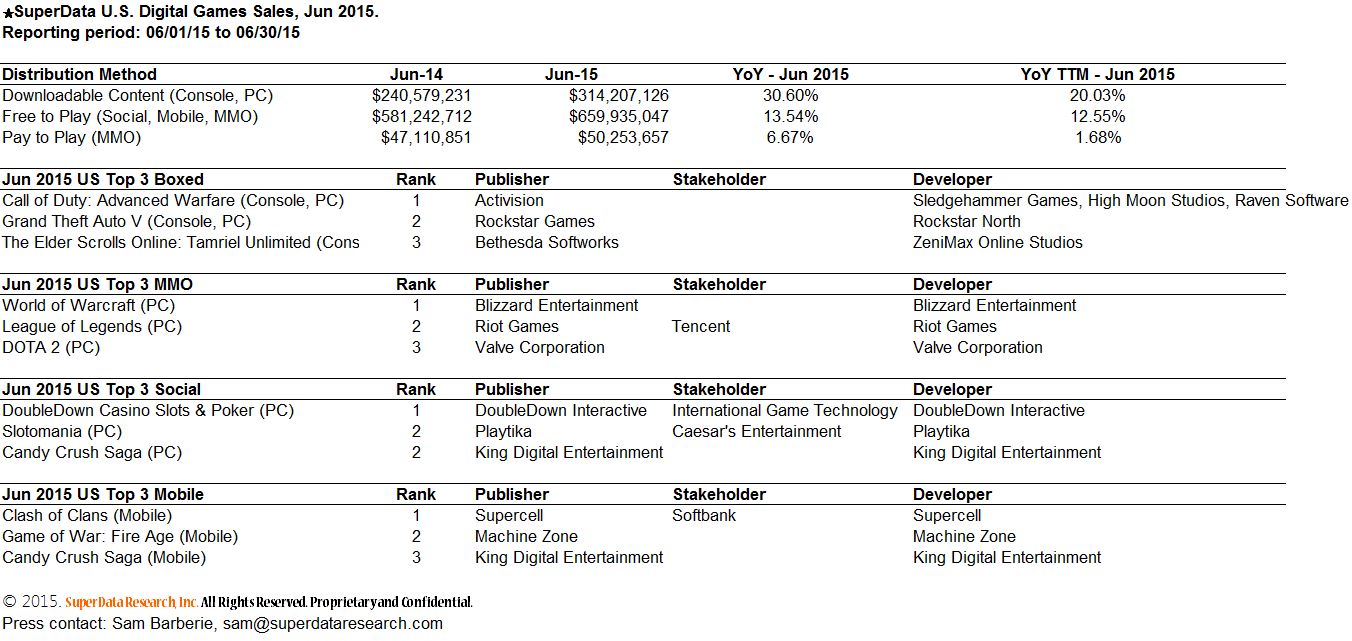
SuperData: June 2015 US Digital Game Sales

Analysis from SuperData CEO Joost van Dreunen, follows:

  • Fallout Shelter delivers critical hit, earning $5.1M in first two weeks.
  • The $86M acquisition of ESL validates eSports as investments heat up.
  • AAA publishers copy indie release strategies to avoid botched releases.
  • Meet the SuperData Analysts at Casual Connect SF and Gamescom. 

June is packed with surprises as digital games grow 18 percent to $1.02 billion. Following one of the best editions of E3 in years, the overall market proved robust as digital game sales were up. Generally speaking, western engagement with mobile games often falls during the summer, but last month’s mobile revenue was up 4 percent over May. Mobile revenues were up 20 percent compared to June 2014 and reached $367 million. Digital console and PC sales reached a combined $314 million, up 30 percent year-over-year. The big winner this month was Bethesda, which managed to do well both on console and mobile. Previously only available on PC and Mac, its newly-released console version of The Elder Scrolls Online sold 138,000 digital copies. Pent-up demand and the removal of its mandatory subscription fee propelled the game to the top of the charts for total units sold. Sales of the game were enough to temporarily buoy the contracting pay-to-play MMO market, which rose 7 percent year-over-year to $50 million.

Fallout Shelter delivers a critical hit, earning $5.1 million in its first two weeks. In a stroke of marketing brilliance, Bethesda managed to win E3 early by delivering a superb press conference and launching a top-grossing mobile game in its wake. Originally developed as a marketing tool for the release of its upcoming Fallout 4, the mobile game is a hit in its own right, passing King’s (NYSE: KING) Candy Crush Saga on the iOS top-grossing charts. While we’ve seen mobile spin-offs based on AAA game franchises before – Call of Duty: Heroes, Halo: Spartan Assault and Heroes of Dragon Age — Bethesda managed to maximize exposure and reap the benefits. More significant than the publisher’s success is the notion that core gaming fans proved to be willing customers for a free-to-play mobile game. By emphasizing unobtrusive monetization and offline playability, Bethesda managed to earn the respect of a consumer group that is otherwise highly critical of free-to-play monetization. The game’s success further underscores the value of a strong franchise in the otherwise crowded mobile games market.

The $86 million acquisition of ESL validates eSports as investments heat up. Swedish broadcaster MTG (OMX: MTG) has purchased a controlling stake in Germany’s Turtle Entertainment, the parent company of ESL. As one of the world’s largest organizers of eSports leagues and tournaments, top-tier ESL events can draw up to a million concurrent online viewers and 100,000 in-person attendees. Competitive gaming has been a long-standing practice in Asian markets and has slowly gained popularity in Europe and North America. Allowing advertisers access to a tech-savvy, affluent audience that defies traditional viewing behaviors has proven key to the recent success of eSports. The acquisition by MTG is evidence that old school media firms are seeking to maintain their relevance as a generation of digitally literate consumers emerges as an important demographic. In 2015, the global eSports market will see 134 million viewers and $612 million in revenue. The next frontier in competitive gaming will likely be sports-betting and fantasy leagues, as companies like AlphaDraft, Unikrn and Vulcun have all recently received investments to the tune of $5 million, $7 million and $12 million, respectively.

AAA publishers copy indie release strategies to avoid botched releases. The increasing complexity of AAA game development continues to haunt publishers as the industry transitions to digital distribution. Warner Bros. Interactive Entertainment (NYSE: TWX) made the unprecedented step of pulling the PC version of its hotly anticipated Batman: Arkham Knight — the latest in a series of buggy releases — from both digital and physical shelves. A continued emphasis on cross-platform development and the emergence of a more fragmented market has raised the stakes for blockbuster launches, leading to a growing list of ramshackle releases. Previously, DriveClub by Sony (NYSE: SNE), Assassin’s Creed: Unity by Ubisoft (EPA: UBI) and Halo: The Master Chief Collection by Microsoft saw the light of day despite severe technical problems. In response to these difficulties, which tend to sour consumer sentiment toward both game titles and publishers, game companies are starting to experiment with the lessons learned from the indie scene. Releasing games that are still in active development, a model popularized by Mojang’s Minecraft and Steam Early Access, is proving to be a reliable way to identify problems early on and mitigate risk. In December, Square Enix (TYO: 9684) will release its upcoming Hitman game in chunks, and Xbox One owners can now buy in-development games through the Xbox Game Preview program.

www.superdataresearch.com

Video Now Accounts for 22% of Facebook Ad Spend

Still think Facebook video isn’t taking off We’ve reported in the past on how it’s becoming quite the competition to YouTube, and how partners have jumped on board to take advantage of its format. Now Video ads are speaking volumes.

A new report from DigiDay shows that Facebook’s video ad initiative is taking off, with 22 percent of total ad spending for the past month of June going towards video ads. That’s the highest share ever for the format, according to ad-tech firm Nanigans. And it’s slowly on the rise, as the firm also reports that, between the first and second quarter of 2015, video ad spend has increased from 13 to 16 percent. A small increase, sure, but an increase nevertheless.

On top of that, mobile has played a big part in this success, with a 21 percent boost for the second quarter alone, up from 15 percent the quarter before. This is mainly through gaming advertisers who doubled its total ad spend over the quarters, pushing up to 36 percent, up from 19 percent in Q1.

This also adds more depth to the idea that Facebook can compete with YouTube, with four billion video streams a day.

As you can see from the chart, video share on ad spending for both global and mobile has seen quite a boost — and judging by popularity, it’s bound to continue.

Nanigans also reported that click-through rates have reached new heights for the second quarter, going up 0.9 percent. That may seem small, but that’s a 187 percent increase from Q2 2014. Meanwhile, costs per click have dropped $.46 for the second quarter.

“This may be in part due to non-U.S. Facebook advertising, which is often less expensive than U.S. inventory and constituted a larger share of advertising activity among Nanigans customers in second quarter 2015 as opposed to the previous quarter,” said the firm.

It appears that Facebook’s video business will continue rolling onward, and the advertisers will roll right along with it.

Now We Know How Recall On Mobile and Desktop Really Differ


Undertone has teamed up with Ipsos ASI for a study that takes a close look at how takeover “high-impact” desktop ads, along with mobile ads, have an effect on brand recall. Four different brand-agency teams were used in the study, each running a campaign across all devices, desktop and mobile, between a panel of 3,600 US adults between the ages of 18 and 64.

First up was a standard display ad, featuring mobile banners and rectangular promos that most companies usually turn to. From there, an ad featuring the Interactive Advertising Bureau’s Rising Stars format – think a slideshow ad or a YouTube masthead set-up. Finally, a full-page takeover was shown, which appears when users load new Web pages or refresh them.

While Undertone didn’t disclose pricing for these ads, it did produce the results from which ones were remembered the best. 38 percent of those polled recalled seeing the ad on a desktop device when it came to full-page ads, while 43 percent across all devices remembered the ad.

As for the least effective ad format, that appears to be banners. Only 33 percent of people who saw these ads recall seeing them at a later time, and the same percentage remember seeing them on multiple devices. That indicates they’re effective across the board with the same audience, no matter what is paid extra for utilizing the ads on mobile.

Midsize ads were a little higher, with 35 percent of people on desktop remembering it, and the same percentage for all devices.

“There’s challenges with ad recall on desktop right now—which I think makes intuitive sense, because there are so many things to look at on a desktop versus a mobile device,” said Undertone co-founder Eric Franchi. “Because [mobile] is more of a focused screen and a more intimate experience with consumers, engagement levels are going to be higher.”

As for mobile-only ad viewers, over on tablet devices, 45 percent remembered full-page ads; 35 percent remembered banner ads; and 27 percent recalled midsize promos. However, smartphones saw even smaller numbers, with 23 percent remembering banners; 25 percent recalling midsize ads; and 44 percent favoring the larger takeover ads (probably due to their size).

“Sometimes people get concerned that because of screen size or the consumer engagement, brands aren’t able to deliver complex messaging as effectively on smartphone as PC,” Franchi said. “This states that it’s pretty consistent across the board.”

Meanwhile, eMarketer posted its own ad recall measurements, with the Media Rating Council hosting its own viewable-impression reconciliation testing. It focused more on desktop than mobile, but the numbers it produced, based on those polled, indicate that 54 percent of differences in how viewability is measured were attributable to differing treatments of mobile viewable impressions in vendors’ reporting.