Taco Bell Launches Gold PS4 Promotion

There’s been some pretty cool versions of the PlayStation 4 that Sony has produced, from the 20th Anniversary PlayStation 4 to the Metal Gear Solid V Phantom Pain Edition to the new Star Wars Limited Edition PlayStation 4. Now there’s a limited edition that you can only get if you’re very lucky and you like tacos. Meet the limited edition gold PlayStation 4 bundle, being given away every 10 minutes at Taco Bell from September 24 to November 4.

The bundle comes with a gold PlayStation 4 and a gold DualShock controller, both with black accents, along with a copy of Uncharted: The Nathan Drake Collection (which launches October 9). How do you get a chance at one of these beauties Gamers must “stop by [their] local Taco Bell and purchase any Big Box, and receive a unique code.” You then text that code to a special number, which will reveal whether or not you are a winner. If you don’t want to buy a $5 Big Box, though, you can mail in a request for codes, and after the first month of the promotion you can request a single code online.

Or, of course, you can plan on eating at Taco Bell regularly to get more chances to win a gold PlayStation 4. Which, of course, is exactly what the clever marketers at Taco Bell want you to do. Hasn’t it been a while since you’ve tried the Taco Bell menu Wouldn’t a gold PS4 look great under your TV Oh, yeah, it’s starting to work.

Facebook To Sell 100% In-View Ads

The voice of the advertiser has been heard by Facebook, as the social media giant is changing to a 100 percent viewability standard for Facebook ads, according to the latest report from Ad Age. The change will take place sometime later this year, but there’s no minimum requirement for how long an ad has to be on-screen before the advertiser is charged, according to a Facebook spokesman.

The 100 percent in-view buying option only applies to ads running in Facebook’s News Feed (the only place ads appear on mobile). The lack of a minimum time requirement means that someone could be scrolling swiftly through Facebook on their mobile phone (which seems to happen often) and then the advertiser would still get charged. The issue isn’t that important for some advertisers, though, who feel the viewability percentage is a much more important issue.

Facebook’s move brings it some kudos, though, as it does exceed the 50 percent viewability standard set by the Media Rating Council. Unilever, for one, was happy with the news. “It is very encouraging to see Facebook joining the ranks of digital media partners who are setting themselves apart — and this commitment continues the momentum,” said Keith Weed, Unilver’s chief marketing and communications officer, in a statement. “Our hope is that these steps will lead ultimately to 100 percent viewability through third party verification across the industry.”

Android Phones Can Soon Stream On YouTube

The battle between Twitch and YouTube for streaming supremacy is heating up, as YouTube aims to show that as the underdog it’s going to be aggressive at introducing new features. At the Tokyo Game Show, YouTube announced that Android phones will soon be able to stream live video onto YouTube. No date was provided, but the update is expected “soon.”

YouTube Gaming will be introduced in Japan soon via a YouTube Gaming app release for the country. This will take advantage of the huge and enthusiastic following for mobile games in Japan. “Japan’s mobile games define its gaming culture, far more so than in other countries,” says YouTube’s global gaming head Ryan Wyatt in a statement. “This trend shows there’s a real need for gamers to easily share what’s on their screen with the gaming community, as it happens.”

Android is a step ahead of iOS when it comes to game streaming, which is as yet not available for Apple devices. Meanwhile, YouTube is taking advantage of the popularity of mobile gaming in Japan to gain some mind share ahead of Twitch. We can expect YouTube Gaming to appear in other countries in the future, too. As mobile game streaming becomes more popular, this is going to become a very interesting area to watch. How will Twitch respond.

Newzoo eSports Q3 Report: Revenue, Audience Growth Continue

Newzoo has released the Q3 update to the “Global Growth of eSports Report,” the first ever comprehensive eSports report launched in January. Newzoo is publishing quarterly updates to keep its clients and the industry up to date on the latest trends and developments in the eSports economy. Based on recent research and analysis, Newzoo estimates a higher year-on-year growth rate for eSports revenues than previously anticipated. Revenues are now expected to reach $278 million in 2015, up 43.1 percent from 2014. The number of eSports Enthusiasts worldwide has also grown slightly more than anticipated, from 89.7 million last year to 116.0 million in 2015. The eSports economy’s growth is fueled by a stack of KPIs: growing global connectivity, awareness, audience, engagement and revenues per Enthusiast. Newzoo’s Global eSports Audience and Revenues Model combines a variety of data sources and validation methods to track all these KPIs to come to a realistic and clear understanding of why and how fast eSports is growing on a regional and global scale.

Online Advertising is Fastest Growing Revenue Segment

ESports revenues for 2015 are anticipated to grow by 43.1 percent to reach $271 million (compared to the previously expected growth rate of 29.6 percent). As mentioned in a previous post, Newzoo’s revenue estimates take into account the eSports crisis in Korea in the period 2008-2012, which impacted the global eSports economy as a whole and has been overlooked by other research companies. Online advertising is the fastest growing revenue segment, up 64.2 percent on a global scale compared to 2014. The North American eSports online advertising business is expected to almost double this year as more and more brands benefit from the enormous video content generated by eSports and the competitive gaming scene. Media rights will continue to take a higher share of revenues as the economy matures, pushing overall eSports revenues up to $765 million in 2018. The 2014-2018 Compound Annual Growth Rate (CAGR) of eSports revenues is 40.9 percent.

Occasional Viewers Evolving into eSports Enthusiasts

In 2015, the number of eSports Enthusiasts worldwide is expected to reach 116.0 million, a year-on-year growth of 29.3 percent. Of these Enthusiasts, 18.5 million are in North America, 16.8 million in Europe and 53.9 million in China. The majority of consumers that now engage with eSports more than once a month (eSports Enthusiasts) have migrated from the Occasional Viewer audience. In turn, Occasional Viewers show a 3% decline. Combined, this results in a 12.4 percent growth of the total global eSports audience. In 2018, the number of eSports Enthusiasts is expected to grow to 165.1 million.

Newzoo’s Global Esports Audience and Revenue Model

The methodology for Newzoo’s eSports data consists of three levels: 1) Data Input, 2) Predictive Modeling and 3) Result Validation. For Data Input, extensive primary consumer research across the globe sizes and profiles eSports awareness and engagement. Newzoo also continuously tracks and analyses company revenues, live event audience figures, prize money, and video content viewer data. In the graph below, for example, Newzoo’s Twitch data and Steam API data were used to track viewership and players during Valve’s multimillion dollar DotA2 event ‘The International’. Predictive Modeling uses parts of Newzoo’s Global Games Market predictive model, which consists of several complex databases combining numerous data streams, financial analysis, primary research, as well as population and economic census data. Result Validation is done in two ways: through additional research and by discussing findings with companies including game publishers, eSports teams, global streaming companies and local media companies.

‘Rocket League’ May Head to Movies, TV

Well, that didn’t take long. It was just in July of this year that Rocket League launched on PC and PS4, and the game notched five million downloads by the end of that month. In August, we found out the game had sold one million copies on Steam. The game has been a hit on Twitch, becoming the fifth-most-watched game on the streaming service. Now Psyonix is looking at offers to make the game into a film or possibly a television show, according to MCV.

Psyonix marketing and communications V.P. Jeremy Dunham told MCV that Psyonix has been approached by a number of companies and individuals about the possibility of bringing the excitement of Rocket League to a different sort of screen. There’s also talk about toys based on the game, which seems like a natural extension.

“We’ve had discussions with various people and studios in Hollywood about making movies based on Rocket League, or a TV show,” Dunham said. “We’ve had people come our way with possible toy deals and lots of cross-promotions outside of our game, some of which we have already done. Now we are getting to the point where the people who want to work with us are much much more famous. It’s crazy. The meetings that I have with new companies who I didn’t realize were Rocket League players it blows my mind. They’re still playing the game and are still interested in it. It makes us almost speechless, we’re wondering when it’s going to end.”

He continued: “There are many studios, agencies, creative people, directors and writers all from different places and saying this is something that could be really cool. Part of that process is wading through those kinds of things, finding out how many of them are legitimate or have the passion and then also weighing the idea of the game itself, about whether doing something like that would make the game better or worse. Right now it’s just at the discussion phase.”

It certainly seems like Rocket League is racing forward, and this expression of interest is another strong sign. Psyonix should take advantage of all the attention to keep the game’s momentum high as it. . . rockets upward in popularity. Will it come down to earth any time soon With luck and some savvy deals, Rocket League may well reach a sustainable orbit as a very successful game.

Survey Shows Strong Interest in VR

There’s plenty of anticipation for virtual reality products, now that the PlayStation VR has an official consumer name, Oculus Rift is holding a convention next week, and HTC/Valve’s Vive gear is getting closer. And let’s not forget more than million Google Cardboard VR viewers are already in place, and Samsung’s Gear is hitting stores before the holidays. Still, it’s good to see that there are actual survey numbers to back up the excitement many are feeling about the impending arrival of VR.

Virtual travel firm YouVisit surveyed 1,000 adults in the US through Google Consumer Surveys, reported Ars Technica. The results showed 11 percent of the respondents had tried VR, representing approximately 23 million people in the USA. There’s another 30 percent on top of that who said they are interested in trying VR at some point, making for 41 percent of the population. That’s pretty good, considering there’s no particular marketing effort behind VR yet.

Other interesting demographics revealed by the survey include the fact that VR interest skews younger, as you might expect 18 percent of the 18-24 age group has experienced VR directly, and 46 percent said they wanted to try VR. On the flip side of the age spectrum, only 14 percent of people over the age of 65 said they would like to try VR. Interest in VR is not as high among women, with 15 percent of men having tried VR and 36 percent more wanting to try it, while only 8 percent of women had tried VR and only 21 percent were interested in trying the technology.

That 41 percent having tried VR or being interested in VR represents a potential market of 86 million people in the US. That’s good news for the companies getting into VR hardware, and the far larger array of companies looking to create or utilize VR experiences. We’ll be watching carefully to see if that VR market turns out to be as real as the survey indicates.

2015 Global Ad Spend Slows

While global ad spending is still massive, the latest numbers show that earlier expectations for the year won’t be met, according to eMarketer. Back in March of this year, eMarketer had forecast $577.79 billion for the total worldwide spend in 2015, but now has revised that figure down to $569.65 billion. The cause, it seems, is “lower-than-expected ad spending in Latin America, North America, and Western Europe,” according to eMarketer.

Still, there are plenty of bright spots in the ad spending landscape. Paid media spend worldwide will grow 5.7 percent worldwide, largely from an increase in digital media spend. Global digital ad spend is projected to rise 18 percent for the year, hitting $170.17 billion — that’s almost 30 percent of the total advertising spend, a new high mark for digital.

Overall, the outlook through 2019 still appears good, with worldwide ad spend projected to reach $719.2 billion by the end of that year. Right now North America has the highest ad sepnding, but Asia-Pacific is projected to overtake North America (by $1.35 billion) in 2019.

“Advertising investments in traditional media like TV, newspapers and magazines have been negatively affected by increased spending in digital formats, such as online editions for magazines and newspapers, and digital video replacing traditional TV,” said eMarketer analyst Shelleen Shum.

While slower growth in China and the continuing slowness in Europe and Latin America may hold back some of the pace of ad spending, it’s still going to be a hot market in digital, particularly mobile. The audience is spending more and more time on mobile devices, so advertising dollars are sure to follow.

Michelle Phan’s Ipsy Startup Raises $100 Million

Michelle Phan has found such great success with her beauty-based YouTube videos that she’s managed to create a start-up company called Ipsy, which concentrates on beauty-related products. Today, Ipsy got a big boost by announcing an immense round of funding.

Variety reports that Phan’s company has managed to raise a staggering $100 million through Series B funding from TPG Growth and Sherpa Capital. This is on top of the three million dollars that was previously raised from investors like 500 Startups and Crosscut Ventures, as well as the recently reported $150 million in revenue it’s gotten from its 1.5 million subscribers across the U.S. and Canada. It s a silent little company that grew aggressively off the back of YouTube influencers, said one anonymous investor, speaking with Fortune.

This is a strong indication that investors believe the site will see strong, continuing profits down the road. 

“Ipsy’s goal has always been to create a community that inspires women around the world to express their own unique beauty,” said Phan. “This investment is key to our continued commitment to the next generation of storytellers and creators everywhere it’s going to be a beautiful future.”

TPG partner David Trujillo also spoke on the funding, stating, “We see consumer preferences shifting dynamically across industries and Ipsy embodies this trend for beauty. Ipsy has created a platform through which brands can be more easily access customers, creators can connect with and expand their audiences, and consumers can discover new products and share these experiences via social media.”

Phan had a chance to speak at the recent [a]list Daily Summit in Hollywood a few weeks back, alongside CEO and co-founder of Ipsy, Marcelo Camberos. When we were developing Ipsy, we knew how important content was,” she explained during the interview. That video can be found below.


For further context, be sure to check out our interview with Phan, straight from the [a]list Daily Summit, at this link.


ESL Exec On The Evolution Of ESports Stadium Events

ESL One has grown exponentially in just over a year. At the first event at the Commerzbank Arena soccer stadium in Frankfurt, Germany there was only a handful of press as top DotA 2 teams battles for over $200,000 in cash prizes. Fast forward to August 2015 and the LanXess Arena hockey arena in Cologne, Germany and 180 media members were on hand to cover the Counter-Strike: Global Offensive tournament with over $250,000 in cash prizes. The stadium was also nearly sold out with over 11,000 spectators in attendance from around the world.

With ESL One coming to the U.S. Oct. 3-4 at The Theater in Madison Square Garden for a $250,000 DotA 2 tournament, Ulrich Schulze, vice president of Pro Gaming at Turtle Entertainment (which owns ESL One) talks about the place for stadium events in eSports today in this exclusive interview.

What separates ESL One events from anything else that Turtle Entertainment does in eSports?

ESL One is about big stadiums, big arenas, and big crowds. We go to the biggest venues. We have tens of thousands of people there and we always have the biggest teams in the world. We have it for DotA 2 and Counter Strike Global Offensive.

What role does LanXess Arena play in Germany?

It’s the biggest arena in Germany. They have 180 events every year. It’s home to the Cologne ice hockey team and then they have lots of concerts here and festivals. It’s one of the biggest venues in Germany that you can get when it comes to entertainment, and now we’re having eSports here. As a company located in Cologne, it was something we always wanted to do, and this year we saw a perfect opportunity to finally get it going.

How many people attended ESL One at LanXess?

We have 11,000 people here. We’re almost sold out and that’s great for us in the first year of this event. It’s something that we’re always a little nervous about how many people are actually going to show up, and it turned out pretty well for us.

How far away do fans travel to attend ESL One events?

We have a few people that travel really far from the USA, from South Africa, from New Zealand. There are not a lot of events of this size, so it’s natural that if you want to experience something like this you might be ready to travel for a very long distance. We typically have about 70 percent of the people from Germany and lots of people from Europe, but we always see people that take long distance flights just to get a glimpse of this atmosphere.

What is it about CS:GO that it’s seen this explosion on eSports recently?

The game has been around forever in different versions. CS:GO had a difficult start, but it’s turned around pretty well. The devs [at Valve] have done a lot of things right and allowed the scene to grow, establishing the majors as the focus points for the entire community and enabling a good system that motivates people to stay in the game. If you look at it from a point of view of how interesting is it to watch, then there’s always this constant flow and excitement around it, and then it stops for a moment, and then the excitement comes back again. The players have been playing this for years. They’re real characters. They’re stars. They know how to interact with the audience. And that’s the package that makes CS:GO so great for an event like this.

How do you go about choosing which games will be able to sell out a stadium?

The biggest games are the ones that we look at in terms of viewer and player numbers. CS:GO was obviously big enough when it comes to that. We look at the international calendar as well, and we also look at the venue. Germany has traditionally been a big country for Counter Strike, so we knew that we would attract a lot of fans here. At the end of the day I would say 30 to 40 percent is just guess work where we think,”Okay, this might work,”and the rest is looking at overall player and viewer numbers and where a certain game is big and then choosing a venue and a date based on the international calendar for that game.

Can you explain how the pro teams share revenue with Turtle Entertainment at ESL One events?

There’s a base prize pool of $250,000. That’s a lot of money. The winning team takes home $100,000. But there are stickers that are sold where the teams share in the revenue. For ESL One Cologne, the in-game autographs allow the players to directly benefit from that revenue as well. The players obviously get money if they perform well, but they also have an incentive to position themselves as stars that people look up to because that’s the opportunity for them where they can make additional money. It’s millions of dollars that are being put out there, not just the prize money, but at ESL One in Frankfurt this year there was $1.5 million in sticker revenue being shared across the teams and those numbers are larger for Cologne. It’s really a lot of money that is being channeled into the player base through the game.

How are you expanding into the U.S. market with these stadium events this year?

The next event we have for ESL One is at Madison Square Garden. We were there last year with a DotA 2 event, which was pretty good for us. It’s an iconic venue. Obviously, now League of Legends had an event there as well. So it’s a big name, and the East Coast doesn’t really have a lot of high-scale eSports tournaments. We’re pretty happy to go back there for DotA 2. It will be the first big event DotA 2 after Valve’s The International (TI5), so for a lot of the new line-ups it will be a proving grounds of how well they can perform. Were these teams’ TI5 performances something that was just one time, or is it something that they can maintain long-term. And we’re looking forward to seeing that being tested.

And then you also will be heading to California?

With Intel Extreme Masters we go into San Jose and SAS Arena (home of the NHL’s San Jose Sharks hockey team). We were there last year and had a good event. It’s the home of Intel, so it’s a pretty special place for them. We’ll be there again this year with League of Legends and Counter Strike for the first time. It will be the first huge event in North America for Counter Strike and we’re looking forward to it. North American fans have suffered a little bit when it comes to how many events they were able to attend for Counter Strike, but there’s a big community there so we’re hoping that they will travel to San Jose with several other thousands of fans to experience the same thing that people saw in Cologne.

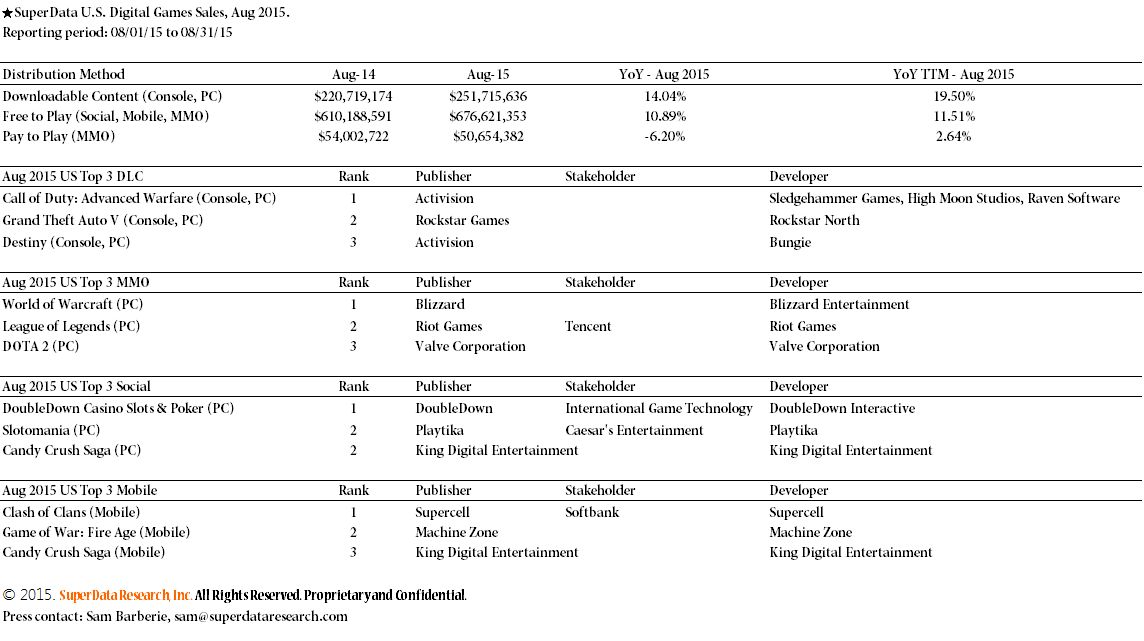
SuperData August 2015 US Digital Game Sales

Analysis from SuperData CEO, Joost van Dreunen, follows:


  1. PC gamers carry digital games market through summer period.
  2. Apple TV limited as a gaming platform despite content exclusives.
  3. Growing pains pester $3.8 billion market for game streaming.
  4. Guild Wars 2 embraces free-to-play to boost additional content sales.
  5. Get a job! SuperData is looking to fill two positions.

PC gamers carry digital games market through summer period. Consistent with a historical dip in sales during the month of August, this year, too, sales proved to be more sluggish than usual. Monthly earnings total in the US digital games market totaled $979 million, an 11 percent increase compared to the same month last year. Especially the PC gamer segment proved resilient, as the combined sales of downloadable content (PC + console) reached $250 million last month. With many of the major title releases only a few weeks out, we anticipate a strong resurgence in the coming months, as consumers ready themselves. Early estimates indicate that the upcoming holiday season may prove to be the industry’s biggest yet, due to the momentum from mainstream consumers adoption interactive entertainment in combination with the console cycle reaching its zenith.

Renewed Apple TV limited as a gaming platform despite content exclusives. Following the usual fanfare from its major press conferences, Apple’s announcement of a more game-focused Apple TV sent a surge of optimism through the games industry. Critical to the success of the renewed Apple TV is the availability of new, innovative content. With both industry-heavyweights Harmonix and Disney preparing titles for the device, Apple is, at least initially, banking on a more mainstream gamer audience. This is not surprising, given its massive success with mobile games on the iPhone. But mobile gamers are just that: they prefer to play on their smartphone or tablet and are ultimately much less likely to switch to a large screen in their livingroom.

Similarly, the notion that the Apple TV poses a threat to the console market is poorly informed, as the market for dedicated gaming devices is currently at its peak. With an action-packed holiday season ahead, newly minted owners of the PS4 and Xbox One will be keen on building out their library rather than playing mobile games on their television sets. Meanwhile, its startup darling from yesteryear, Angry Birds, which at the time showcased the unique features of the iPhone has since fallen from grace. With its long-awaited sequel underperforming, publisher Rovio recently announced its plans to lay off another 260 people, less than a year after it had already let go of another 130 people last October. Despite another slick delivery, the current potential of the Apple TV as a gaming platform remains limited.

Growing pains pester digital channels as $3.8 billion market for gaming video content matures. With the gloves officially off, Google (NASDAQ: GOOG) recently took aim at Amazon-subsidiary Twitch (NASDAQ: AMZN) with the launch of YouTube Gaming. The company is seeking to claim king of the hill in the $3.8 billion market for gaming video content. The importance of interactive entertainment for Google can not be overstated as YouTube celebrity PewDiePie announced the threshold of 10 billion views earlier this week. Despite its higher volume, however, it lags behind Twitch when it comes to revenue, earning 36 percent of global gaming video content revenue compared to 43 percent for Twitch. Despite YouTube Gaming’s sleek UI and higher video quality, Twitch’s focus has been on cultivating a strong community. Later this month, the company is scheduled to host its first annual TwitchCon in San Francisco. Overall, gaming video content has become an important market in the games industry. Consumers use digital channels to find out more about new and upcoming titles, look for advice on what to buy and find tips on how to beat difficult levels. Different from news publications, however, is the absence of a clear ethical code of conduct, and the industry is currently going through a series of growing pains with regards to copyright infringements and paid product endorsements. Multi-channel network Machinima recently settled with the Federal Trade Commission after several of its members posted positive videos about the Xbox One without disclosing that they were being paid to do so.

Guild Wars 2 embraces free-to-play to boost additional content sales. Another major title just went free-to-play. ArenaNet’s (KRX: 036570) MMO has never required a subscription fee since its launch in 2012, and now players will no longer need to buy the game upfront either. Currently, 14 percent of monthly earnings come from the sale of new copies of Guild Wars 2 and the rest from in-game content. With the game’s first paid expansion, Heart of Thorns, launching next month, ArenaNet stands to benefit greatly from an influx of new potential customers. So far, 2015 has seen two other major MMOs (The Elder Scrolls Online and WildStar) change their revenue model, dropping mandatory subscription fees to focus on selling in-game items. Category-leader Blizzard (NASDAQ: ATVI) is taking a different path with World of Warcraft as the game’s subscriber numbers slide to 5.6 million, the lowest subscriber count since 2005. It is one one of the only publishers to stick to a subscription model as players increasingly opt for free-to-play equivalents and MOBAs. To combat its falling user base, Blizzard is upping the frequency of expansions, like the recently-announced World of WarCraft: Legion, to entice lapsed players to re-subscribe.

Get a job. SuperData is hiring! We’re currently looking to fill two positions: Junior Market Research Analyst and Data Analyst. It’s been a super-busy year for us and we’d love to add a few more rockstars to the team to help us round out the year. More information available here on the SuperData site.

www.superdataresearch.com