Mobile Game Highlights: Week of 9/4

Welcome back to another edition of the Mobile Game Highlights. We’ve got five new titles that are ripe for downloading, so let’s get started!

Pokémon Shuffle (The Pokémon Company, free-to-play, available for iOS and Google Play)


After debuting on the Nintendo 3DS a little while ago (as its first free-to-play title), Pokémon Shuffle has finally made its way to mobile devices. Players will attempt to capture hundreds of unique Pokémon characters through traditional match-three battles, while at the same time exploring amazing new locales. The game does require in-game purchases from time-to-time, particularly with upgrades to equipment, but it’s still worth a try for those who just gotta catch em’ all.

Don’t Starve: Pocket Edition (Klei Entertainment, $4.99, available for iOS)

The independent darling Don’t Starve has been making the rounds on consoles for several months now, and Klei has finally brought the experience to mobile with the Pocket Edition. In Starve, you portray Wilson, a scientist forced to survive in the deep wilderness by using the environment to his advantage, whether it’s keeping his health from dwindling or facing off against sinister forces that may show up. The game definitely requires a great deal of thought, but it’s good fun for those who prefer a bit of scientific strategy.

Plum’s Creaturizer (PBS Kids, free-to-play, available for iOS)

Parents that are looking for an experience that will bring out the creative side of their children will want to check out PBS’ Plum’s Creaturizer. In it, players can build up to a billion different creations, using over 100 different unique parts. From there, they can take their creatures anywhere in the outdoors and take pictures with them, adding to the fun! There are also photo missions available, daring young players to take particular shots with their new creations. It’s a unique and enjoyable experience that everyone can enjoy.

Unkilled (Madfinger Games, free-to-play, available for iOS and Google Play)

Fans that can’t get enough of killing zombies in video games will love Unkilled, an adventure that puts them right into the heart of New York City, where a plague of the undead has emerged. As a member of the military-driven Wolfpack, it’s up to players to save the day, using a variety of weapons that are available. With beautiful visuals and non-stop action, Unkilled promises to change the zombie game as most players know it — even if some secondary purchases may be required to get the most out of the game.

Power Ping Pong (Chillingo, $3.99, available for iOS and Android)


Players have experienced the classic Ping-Pong game before, but Chillingo provides a new spin on the game that makes it much more exciting with Power Ping Pong. In it, players will face off against a number of adversaries while mastering a number of amazing trick shots, and unlocking a horde of new paddles and opponents to face off against. With a sweet arcade style gameplay system and plenty of challenges, this one will challenge even the most zen-like of Ping-Pong masters!

See you next time for more mobile game picks!

Mobile Games Are Officially Outspending Consoles On TV

Some big dollars are being spent on TV advertisements, especially when it comes to video games. What may surprise some of you, however, is that mobile game publishers are actually spending more than the likes of Sony and Microsoft.

A new report published by VentureBeat (in conjunction with iSpot.tv) indicates that game companies spent nearly $30 million for TV advertising last month, with 33 different brands airing nearly 90 spots nationwide over 18,000 times. The total is about the same as last month’s, with overall spending for the year reaching $430 million thus far.

Mobile actually accounts for a big chunk of that, with three of the top five advertisers being from that field. That includes Machine Zone, which accounted for over 22 percent of TV spending, along with King.com (nine percent) and InnoGames (seven percent). The other two companies in the top five Disney Interactive, advertising the latest Disney Infinity, and Nintendo.

As for the top five ads for the month, only one was made for consoles a spot for Madden NFL 16 that featured a five-minute mini-film. The rest belonged to mobile games like Game of War and Candy Crush Soda Saga.

Here’s a top five breakdown of the commercials that got the most spending for the month:

1. Game of War: Fire Age ($5.1 million)

2. Candy Crush Soda Saga ($2.3 million)

3. Madden NFL 16 ($1.5 million)

4. Forge of Empires ($1.4 million)

5. Splatoon ($1.4 million)

Two of the most noteworthy ads are included below, including Machine Zone’s Game of War: Fire Age ad and Madden: The Movie from EA Sports.

https://youtube.com/watch?v=3eVF9uBbuqc

Even with the Christmas push behind some key titles (like Assassin’s Creed Syndicate and Skylanders Superchargers), this is a trend that’s likely to continue in the months ahead, especially with the success of titles like Game of War and Clash of Clans. We’ll see where the next few months lead in terms of numbers.

Chinese Mobile Market Will Eclipse U.S. This Year, Be Worth $11.1 Billion By 2019

The mobile game market is definitely booming especially in China, with free-to-play games and other titles getting plenty of attention.

A new report from GamesIndustry International suggests that the popularity of mobile games may be bigger than expected, as domestic revenue is set to eclipse similar numbers in the United States.

Based on numbers provided by Niko Partners, domestic mobile game revenue in China will reach $5.5 billion this year. That’s a $2.2 billion increase from numbers reported last year, indicating that the mobile market is bigger than ever overseas.

SuperData also chimed in with its own numbers, stating that revenue from the U.S. mobile game market will reach $4.5 billion for this year. That’s still big, but obviously the USA is not the leading country anymore. That gap could continue to grow, especially with China’s large population.

Niko indicates that the number of Chinese mobile gamers will reach a whopping 420 million by year’s end, a jump over the 366 million reported for the first half of the year. In addition, revenue could reach an even higher stat in just a few years’ time, estimated to reach $11.1 billion by 2019.

Tencent seems to be the leading source of mobile entertainment in China, with a 50 percent market share of the overall mobile outreach for last year. While more foreign companies are hopping on board (including a few Western developers), Niko Partners suggests using a little caution. “It is important to evaluate what voids there are in Chinese culture, and then match game development to those as well as to the gamer behavior and characteristics of a good mobile game in a popular genre,” said Lisa Cosmas Hanson, managing partner and founder of Niko Partners, in a statement.

“With that mobile game developers may find their way to the next big Chinese hit game, because hoping to make it big with an international title lobbed to a Chinese publisher for localization is not an effective path to success.”

Mobcrush Gets $11 Million For Mobile Streaming

Mobcrush is about to change the way people stream their mobile gaming sessions, with a forthcoming app that will make it easy to show off game sessions with just the push of a button. Now, it’s secured $11 million in funding that will help assure its success.

The Santa Monica-based company has raised $11 million in funding from a variety of investors, led by Kleiner, Perkins, Caufield & Byers, according to VentureBeat. The full fundraising details are here, including other partners like Advancit Capital, First Round Capital, Lowercase Capital, Rincon Venture Partners and Crosscut Ventures as Venture Capital investors, along with Raine Ventures LLC as a Private Equity & Venture Capital.

With these funds, Mobcrush hopes that its app will provide some serious competition on the streaming front, where Twitch currently has a large user base, and YouTube is knocking on the door with its own gaming service.

KPCB shares our vision for how the mobile landscape is evolving, and sees the massive demand for an easy, accessible streaming solution for gamers on the platform, said Royce Disini, CEO for Mobcrush, in a statement. As our company grows and we get closer to officially launching our product, we re humbled to see the tremendous support from our investors, but also our partners, community and players.

Mobcrush is currently in beta for iOS and Mac OSX, and set to release for Android and Windows very soon.

We spent some time in the Santa Monica area and came across them, and [we] also met them through our seed investor partners, said Mike Abbott, a general partner at KPCB, speaking with VentureBeat. We have an increasing conviction in the popularity of eSports and how it is intersecting with mobile.

Mobcrush has several key members on its team to help with the app, including Google Play games lead Koh Kim, as well as Apple App Store game lead Greg Essig and former Xbox community veteran Eric Doty.

The competition is tough, but finding success isn’t out of reach. The key is what does the community want to do with the content, and these founders have a good understanding of the services and community, Abbott added.

We’ll see just how effective the Mobcrush app is when it launches sometime this year.

Video Length Matters To Millennials

The popularity of streaming video is as strong as ever, whether users prefer something that runs in a span of minutes, or watching their favorite show on a “binge” basis for hours on end. It’s also picking up quite a bit with millennials, especially on Tumblr, where autoplay looping videos have picked up in popularity.

Max Sebela, Tumblr’s creative strategy manager, recently spoke with eMarketer about the effectiveness of this video, and how millennials are staying engaged.

“We’re seeing two different sides,” said Sebela, when it came to audience. “On one side, Tumblr is a curation tool for discovering the best of the best in user-generated digital video. On the other side, as we’ve relaunched and began thinking about the way users can make video on Tumblr, we are increasingly seeing users make original content with our player, which creates videos that loop.

“We’re also seeing people take advantage of silent autoplay. The video might be designed to be consumed with sound eventually, but the first experience with it is likely going to be silent, so that requires drawing people in with a silent animation that’s going to make them want to go deeper, hit that unmute button and watch.”

Sebela also broke down what key behaviors advertisers should watch for when it comes to millennials’ video habits. “One of the most interesting habits that hasn’t fully been cracked yet is what it means to be silent, first and foremost. All of a sudden, the initial experience of viewing a video is more like seeing a GIF or a silent loop.

“As always, you want to design video consistent with where it’s going to be seen. Instead of someone actually clicking ‘play’ and opting in to watch, you’re talking about a big vertical feed that has all kinds of content — standing out in that native experience is 100 percent key. How do you do that You burst out of that feed with something different that stops a user in their scroll. This is definitely a challenge, but it’s also a real opportunity,” he explained.

Sebela also broke down how video is broadening for millennials as a whole. ” We’re moving away from the concept of video being important and instead thinking more about how much time there is to be entertained by content. Consumers have a certain amount of time over the course of their day to experience leisure, and all digital video — still content and animated content —competes for millennials’ time.

“Millennials are not thinking about medium or format — they’re thinking about where they want to spend time discovering things, being entertained and ultimately seeing video.”

But what about effective advertising formats on the site ” [It’s a new] era of video being either very short-form, meaning less than 15 seconds, or much longer. We see really rich engagement with video posts that are designed to be looped. These are being shared in the same way as GIFs, which are familiar to both advertisers and consumers.”

Sebela continued, “We’ve also seen a lot of success with pieces of long-form content. These are less likely to be shared, but they receive a lot of “likes” and a lot of positive affirmation. If you’re designing to be shared, short form is amazing. If you’re looking to get a story out that is going to resonate with a user and send a complete message from your brand, long form is the way to go.”

The full interview can be found here.

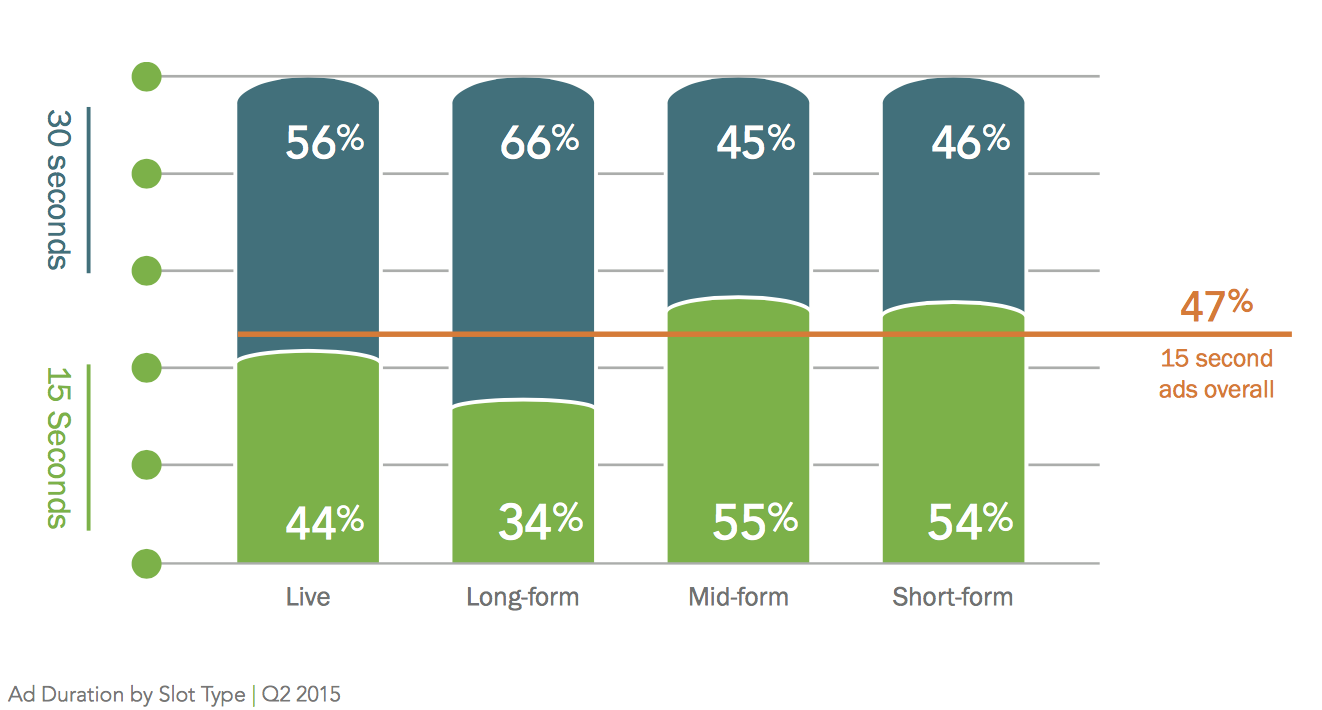
On a related note, Freewheel just released its full Video Monetization Report for the second quarter for 2015, and it can be found here. It’s a lengthy read, but here are a couple of highlights worth noting from the report.

As you can see from the chart, long-form, short-form and live streaming video all have strengths on the programmer front, running just about even (long-form has a slight advantage at 35 percent). When it comes to digital pure-play, however, short form video has the strong advantage with 80 percent, followed by long-form, mid-form and live.

This second chart shows how popular live, long form, short form and mid form videos are in terms of length, and live has a much bigger strength with 30 seconds, while long-form has an even greater percentage. Mid form and short form, however, show a preference in the 15 second mark.


Mobile And Video To Reach New Heights In 2016

YouTube. Facebook. Snapchat. Vine. Meerkat. Periscope. Twitch. Has your brand mastered them all Get the insights and knowledge you need to succeed at [a]list Video Summit Aug. 19. Get tix: http://alist.ly/1EVLyyz

Mobile and video already go great together as it is, enabling millions of consumers to watch streaming videos and other content with ease from their smartphones and tablets. But according to a new report from Publicis’ ZenithOptimedia unit, both are going to get even bigger next year.

As reported by Mediapost, the company indicates that 2016 will be “the year” for both these mediums, where more people will watch video on a mobile device compared to a non-mobile device.

What makes this statement so significant, according to the company, is online video becoming one of the fastest-growing media outlets, on the verge of disrupting an even bigger platform: television. Of course, we’ve discussed earlier this week how streaming services are putting a dent in television’s considerable audience, but ZenithOptimedia sees an even more accelerated adoption of digital video consumption that will start to show a negative impact on traditional television next year.

“We forecast that the number of regular linear TV viewers will rise 3.1 percent in 2015, but then shrink by 1.9 percent in 2016 and 0.9 percent in 2017,” said the report, adding that “the amount of time people spent watching linear TV has been in slow decline for several years (and) we now predict that next year the number of viewers to start to decline as well.”

Spending from advertisers will also see a shift as well. “Advertising expenditures on online video will soon account for an eighth of total Internet ad spending,” said the report, with an estimate of $16.1 billion worldwide for this year, and an expansion to $23.7 billion by 2017.

Online video current represents about half the worldwide online video ad marketplace by $8.5 billion, according to the report. As far as how much time is spent watching these services, last year shows that nearly 60 percent preferred non-mobile devices, compared to just over 40 percent using mobile. These numbers, however, will shift over the next couple of years, seeing an increase in mobile and a drop in non-mobile.

It’ll be interesting to see where these numbers end up – and just where traditional television will be affected in the long run.