‘Hunt the Truth’ Campaign Takes Cinemagraphs A Step Further With Audio

If you haven’t noticed, cinemagraphs have been having a moment. Brands like Budweiser, Toyota and Netflix have utilised the format to draw eyes with the subtly animated images. It’s easy to see why these eye-catching visuals are hard to ignore in your stream. To draw in Halo fans to the Hunt the Truth podcast, Ayzenberg took cinemagraphs to the next level to convert more listeners: they added audio.


By pairing the most compelling audio moments from the podcast with these cinemagraphs, it created a new, unique medium that provided fans with a stand-alone experience to enjoy. Somewhere between the gif and a video, audio cinemagraphs have served as something of a trailer for the podcast’s second season. Check out our interview with Noah Eichen about creating the audio series and how it fits into the Halo universe.

How eSports Will Become A Billion Dollar Business

eSports has been on the rise for several years now, building up speed not only with big tournaments, but also with streaming on Twitch and even broadcasts on channels like ESPN and forthcoming coverage from TBS. But just how much money is it primed to make over the next few years

According to estimates from Newzoo, it has the potential to reach the billion-dollar mark by 2020 — yep, eSports are likely to become that popular.

Revenues have gained with tournaments, partnerships, players and other degrees of eSports, and have also reached mainstream audiences through its various broadcasts and other products. But it’s all about how eSports keeps this momentum going in the long run, if Newzoo’s numbers are correct.

The company broke down the success of eSports into five different factors, which can be found below, taken straight from the article:

Diversity of Game Genres?

The vast majority of eSports titles are PC games that fall into a few major genres, with MOBAs like League of Legends, Smite, Heroes of the Storm and DotA2 being some of the most popular in terms of participation. However, with their complex game play, MOBA games can be difficult for viewers who don’t play them to understand and for gamers to master. Would more accessible game genres and segments gain a wider audience and player base

Riding the wave of ESL One, Counter Strike: Global Offensive, Valve’s multiplayer first-person shooter, took over Twitch with the most hours watched for a game in one day, beating out even League of Legends. In August and September of this year, Philippines mobile operator Smart Communications held the Philippine Clash 2015, a Clash of Clans tournament that has set records as the largest prize pool for a mobile gaming competition in the country. US-based Super Evil Megacorp held its first World Invitational tournament in Korea last summer based on its mobile MOBA Vainglory. Last week, Blizzard announced the creation of a new worldwide eSports league for the popular console first-person shooter series Call of Duty. A wide variety of game publishers are boosting eSports activities for franchises around which competitive gaming already exists in some shape or form, organized by game enthusiasts themselves.

Geographic Expansion of Leagues?

For eSports leagues to tap into bigger advertising budgets, they need to exist on national, regional and global levels as traditional sports does. Few advertisers have a significant global advertising or sponsoring budget, as most marketing money is spent on a local level. Currently, only League of Legends has a structure that resembles this hierarchy, with regional league structures in North America, Europe, South-East Asia, Oceania and Latin America, and country-based league structures in China, South Korea and Turkey.
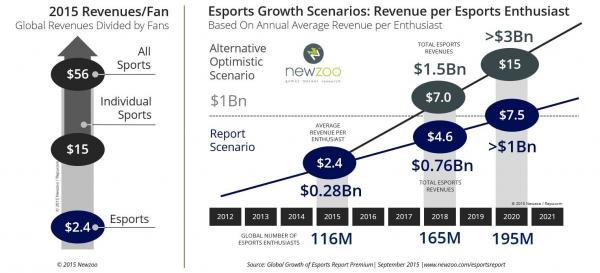
eSports Growth Scenarios

The chart above breaks down just what kind of revenues are divided by fans, as well as eSports growth scenarios per eSports enthusiast. It’s easy to see just what kind of growth is expected, and how far eSports have come.

Regulation of Competitions?

eSports has grown beyond the small grass roots venues where small groups of gamers were competing. More and more companies are seeing the potential to make money in eSports. Most recently, FanDuel purchased the daily-fantasy startup AlphaDraft, a day after competitor Draft Kings announced it was expanding into eSports with daily fantasy games for League of Legends. With multi-million dollar prize pools now at stake, and increasing amounts of money being bet on the outcome of these games, new rules and regulations are needed to combat cheating and match fixing.

In an attempt to prevent match fixing, software manipulation and use of performance-enhancing drugs, ESL and some betting companies such as Unikrn have become strong advocates of rules and regulations to prevent and/or detect fixing by tracking all in-game data and betting data and using software to detect any irregularities that indicate dubious activities. Other eSports organizations have implemented supportive measures for players themselves.

Wouter Sleijffers, CEO at FNatic, comments from an eSports team perspective: “A player’s career can involve the pressure of matches and fan expectations, frequent international travel, and in some cases living away from home in another country for long periods of time. An environment like that can place a strain on any person. At Fnatic, our goal is to offer our players the most secure and friendly environment in the industry, with the best supporting organization behind them to help them succeed as teams, grow as individuals, and to develop skills and experience they can use during and after their gaming careers.”

Ownership of Media Rights?

One of the larger regulation voids in eSports is the current structure around content rights. As of now, it is uncertain who owns the rights to eSports content. Games played during events are owned by publishers or the event organizers, while videos made by fans and streams that contain game content are owned by the fans and streamers themselves. Thus far, content rights have not really been a focus for publishers, as fan-generated content has served as free advertising for their games. As direct eSports revenues grow, this may change.

Alignment of Digital & Traditional Media?

While competitive gaming would surely benefit from broadcaster advertising and its budgets, eSports and traditional media have not yet aligned. Will the all-digital eSports world adapt to the traditional media ecosystem or vice versa Turner Broadcasting and WME/IMG just announced that they will form a Counter Strike: Global Offensive league that will be aired on TBS on Friday nights for 20 weeks in 2016. TBS isn’t the first cable network to show interest in eSports. ESPN has been increasingly recognizing the legitimacy of competitive gaming as a sport, covering more and more eSports events, including a collegiate-level Heroes of the Storm competition (“Heroes of the Dorm”), and Valve’s multimillion-dollar DotA2 tournament “The International.” Earlier this month, ESPN began its search for an eSports editor.

Hollywood media and entertainment veteran Rich Melcombe, CEO at Richmel Media & Entertainment, adds: “I’d argue that brands do not understand the value of games, most game companies do not know how to sell advertising, and game ad tech needs to be re-imagined. Where most ad tech companies fail is that they do not try to make an emotional connection with the players or create an environment conducive to advertisers or brands. Advertising has to work for both games and brands — each has a very different agenda. Games also need to take a more integrated media approach and own and connect the media surrounding their games to increase value.”

More information on these findings, including the particular challenges that lie within each of these categories, can be found here.

Image source

YouTube’s Subscription Service Moves Forward And Backward

There’s been quite a bit of talk in the past about YouTube looking into some form of subscription service, which would cut down on excessive ads and offer premium features for fans of the site. According to a story from Re/Code, it appears that this service may finally be ready to launch.

A blast email was sent from YouTube to a number of content owners that share ad revenue with the popular Google-owned video channel, indicating that new terms will have to be agreed to on October 22nd, or their “videos will no longer be available for public display or monetization in the United States.” The full email can be found here.

With that, sources indicate that the premium membership will offer two services for the price of one, including an update on its music service (which left a few creative artists a bit stifled) and the video service, which will be ad-free upon purchase of subscription.

YouTube didn’t confirm of the service just yet, but several video-oriented sources indicate that Google has a plan to charge $10 monthly for access to both of these options.

While this may be good news for some (particularly those who have been bothered with ads to the point that they purchased ad-blocking services), there is some cause for concern with creators. SocialTimes recently posted a story focusing on independent musician and composer Zoe Keating, who took exception to several of the terms noted in the email. She posted a list of these in her blog, but the sum-up can be found below in terms of what she takes biggest exception to:

  • All of my catalog must be included in both the free and premium music service.
  • All songs will be set to “monetize”, meaning there will be ads on them.
  • I will be required to release new music on YouTube at the same time I release it anywhere else.
  • The contract lasts for five years.

By not signing, Keating can lose quite a bit, and considering the amount of build-up she put into the channel, it can also result in a weaker contract.

David Holmes, East Coast editor for Pando Daily, noted, “Unless she signs, not only will Keating lose the free promotion and analytics that she currently receives as a YouTube partner, but she won’t be able to monetize through ContentID at all.” And refusal to sign the agreement at all could result in a total loss of funds, not partial.

Revenue sharing has gone a long way on the channel for its many partners, and while this subscription plan may seem like an ideal way for Google to “cash in” with its millions of fans, it could also put said creators into a bind, unless they enter a marketing partnership with another company to continue earning funds. (And some companies are doing that, but not all.)

Holmes was quick to note that, if this move enters into fruition and forces YouTube creators to make a decision, that “with (these contracts), YouTube has gone from the most artist-friendly major music platform on the planet to the least.”

Now all eyes are on YouTube to see what comes of the launch of its subscription service and if it will indeed stand firm with the many notations it made in its recent email.

Native Ads Face Challenge With Readers, Viewers

Native advertising has become a preferred choice for many companies, with better performance than traditional ads on a number of sites. Still, native ads are facing challenges that are shifting public opinion of the form into a negative direction.

Contently recently surveyed over 500 consumers using native ads across various sites, including BuzzFeed, The New York Times and the Wall Street Journal. The poll results showed that different publications had varying degrees of issues with distinguishing an article from paid content.

Chart

“On nearly every publication we tested, consumers tend to identify native advertising as an article, not an advertisement,” the study concluded.

62 percent of respondents also felt that a news site manages to lose credibility any time it publishes a native ad, since it’s intertwined with editorial content. “Consumers often have a difficult time identifying the brand associated with a piece of native advertising, but it varies greatly, from as low as 63 percent (on The Onion) to as high as 88 percent (on Forbes),” the study indicated.

Contently editor-in-chief Joe Lazauskas had plenty to say on the matter, telling IBTimes, “I question whether it’s valid that consumers won’t enjoy it if they know it comes from the brand. We do see Americans enjoy content from brands like Red Bull and American Express. They recognize it’s branded and enjoy it anyway.”

Sponsored content can go a long way as well, says Lazauskas, adding that it has “shown progress on brand lift metric, particularly for people repeatedly exposed to sponsored content.”

Chart2


“We are invested,” said Lazauskas. “We do want to see the media world come to a better place where instead of intrusive, deceiving advertising, there’s good storytelling going on.”

“At the same time we feel the responsibility to look into various issues that may not be helping to bring that world into fruition,” he added. “If we can help guide everyone into better practices, that’s a win. If this study does help publishers find better ways to present native advertising, we will have contributed good to the media world we work in.”

Chart3

Native advertising at present faces a big challenge with over 50 percent of those polled showing distrust in sponsored content.

Speaking with Mobile Marketing Watch, Ad Age‘s Matt Crenshaw had plenty to add on the matter. “When the concept of native advertising first gained widespread attention in 2012, it was expected to life publishers’ fortunes and rescue digital advertising from the perpetual downward slide of display ad rates,” he said. “Fast-forward three years, and native has largely delivered on that promise.

“When executed well, with time and care put into ensuring the content is in the right tone and has the right message, native formats blend into vertical streams in a manner that’s much less disruptive to users (while still marked as ‘sponsored’ so as not to be deceptive),” he said. “Meanwhile, publishers get ad inventory that users will actually look at and engage with, instead of reflexively ignoring, as many of us have trained ourselves to do with right-rail display ads.”

The solution in Crenshaw’s mind lies shifting the goal of brands to focus on quality and engagement rather than just views and scalability. “As native ads move toward real-time bidding and programmatic processes, they’re looking a bit like Frankenstein in some cases,” says Crenshaw. “I’m talking about display ads that have been broken down into component parts — an image, a headline, a snippet of content and a brand logo, for instance — and automatically reassembled and injected into a publisher’s content stream. As a result, they’re frequently clumsy and appear out of context.”

Quality of content can make a difference. “When executed well by traditional publishers, usually when they’re selling it directly and producing it in-house, native advertising can deliver quality storytelling and also be highly effective,” Crenshaw stated. “The crucial ingredient is content that people actually want to read, as opposed to a direct-response display ad that’s been shoehorned into a content module.”

‘Street Fighter V’ Ready To Take On eSports

Ever since its announcement late last year at Sony’s PlayStation Experience event, Capcom’s Street Fighter V has been building an incredible amount of anticipation among fans. The forthcoming fighting game promises to not only be the most impressive in the series to date, but also the most accessible. Fans and pros alike will be able to get into its many nuances, and the cross-compatibility of the PC and PlayStation 4 versions means the player base will be unified across the two platforms.

What’s more, the game is likely to be a hit during the Capcom Pro Tour, a special series of events where fans compete for big cash and prizes. It has already become a big mover-and-shaker in the eSports industry, and Street Fighter V should propel it even further when it makes its debut on PlayStation 4 and Steam early next year.

VentureBeat recently posted an article featuring an interview with Capcom’s director of marketing and eSports, Matt Dahlgren, about Street Fighter V‘s impact in the community, as well as what it can do for the eSports scene.

First off, Street Fighter plays a vital role in Capcom’s business model, since it’s one of its biggest franchises. “Street Fighter is actually unique because it is owned by Capcom USA,” said Dahlgren. “So we have a very large fighting team structure that is in place there that handles everything, from our product marketing to our licensing business. There are also some levels of development oversight as well, so if there is anything that has to do with Street Fighter as a brand, I am involved in it at some capacity.” This is unique, considering that Street Fighter V is being developed in Japan, but still being released as a U.S. property.

As far as getting a game involved with the Capcom Pro Tour (and thus competing for the Capcom Cup), Dahlgren explains, “It’s pretty much up to our discretion. We have a very strong team that is built from people who come from the fighting game community. So we look at various tournament organizers and the ones that we feel are really pushing the bar in terms of production capabilities and really trying to rise the fighting scene to new heights, we want to partner up with those.

“So when we created the Capcom Pro Tour, we didn’t want to come in and basically take over the competitive scene. We wanted to create a structure that provided opportunity for everyone that’s involved. So all of the tournaments, with the exception of Capcom Cup, are still run and are independent organizations, but we basically tried to band everyone together to tell a better story of what goes on (in the fighting game tournament scene) throughout the year.”

Dahlgren also talked about the structure of the tournament, which seems pretty detailed. “Basically what it is doing [is that] it takes the fighting game scene that has existed for many, many years and like, all it is doing is taking advantage of the structure and getting everyone to work together to tell a better narrative of what goes on throughout the year.

“So now the events are not necessarily competing with each other, they re more working together to tell a larger story. So the way the Capcom Pro Tour works is we have 32 spots up for grabs to qualify for the Capcom Cup. The Capcom Cup is our year-end finale. We ve got 16 premiere events. Anyone that wins a premiere event will automatically qualify for the Capcom Cup.

“Then we are partnered with 40 other tournaments on the side, which we call ranking events. They all get ranking points for the top eight placements and then we track those on our leaderboards. That determines our next 15 spots. Then we automatically invite the previous year s champion, which round up to 32.”

It’s worldwide, as well. “We put a lot of effort to make sure Capcom Pro Tour is a globally minded league. We split up the premiere events and ranking events evenly per territory, so North America, Europe, and Asia all have the same amount of points. Then for the remaining category we split those up into either emerging markets or events we consider to be global,” said Dahlgren. “Like EVO brings in talent from all over the world, so we consider that a part of our global structure.”

As for what role the next Street Fighter will play in all this, Dahlgren explained, “I would say, really the Capcom Pro Tour was built for Street Fighter V. We just wanted to launch it earlier [running the Street Fighter IV series] to make sure we got into a good rhythm before Street Fighter V came out.

“But Street Fighter V is the first Street Fighter that has been created with eSports in mind,” he continued. “We ll be balancing the game during the Capcom Pro Tour to show respect towards the competitive scene. We re also going to have some announcements in the near future as to how the game will tie in directly with the Capcom Pro Tour. But Street Fighter V is really the product that we believe is going to help Street Fighter rise as a competitive product and help the fighting game community grow over all.”

Online will play a huge part as well. “We have a lot of concepts that we re putting together. We know online play is going to be a really huge focus for Street Fighter, so we want to make sure there are online components to the Capcom Pro Tour,” Dahlgren added. “Things will make a lot more sense and layer together in the very near future.”

The full interview can be found here. Street Fighter V will release early next year.

Millennials Are Leading Mobile-First Lives According To Study

Reaching out to a millennial audience can be tricky, especially considering that a small portion of them don’t even utilize social media. With that said, a good handful of millennial college students are showing preference when it comes to mobile devices.

Per this story from MediaPost, smartphones seem to be the most preferred method for this young crowd when it comes to advertising, based on numbers provided by Qriously and the Interactive Advertising Bureau. “Today’s college students are leading mobile first lives and will surely take their mobile-first mindset with them into the world after graduation,” said Anna Bager, senior vice president and general manager for the Bureau, in the mobile and video division.

The results from the study show that six percent of students polled are more likely to use their mobile phone as a medium to view relevant ads, with male college students likely to utilize them more than females. Meanwhile, 19 percent of those polled felt the same way when it came to television ads.

In addition, around 49 percent of average smartphone owners indicate that they’ve interacted with an ad seen on their devices, while 55 percent of students stated that they have taken such an action with a mobile ad.

More numbers from the study indicate that college students are more likely to seek out additional details based on an advertisement, instead of the average user by a comparison of 13 percent to 9.5 percent. They also seem more likely to take a screenshot of an ad (13 percent versus seven percent), although less likely to tap on a mobile ad (12 percent versus 16 percent).

On top of that, roughly three in four college students admitted that they make purchases on their mobile devices.

Another report, GfK MRI’s “Survey of the American Consumer,” had its own side stats to report as well. Educated female millennials are more likely to make video calls than other demographics, according to their findings, and most of those calls would be done through a mobile phone, instead of a tablet or eReader device.

So what does this mean It indicates that some mobile ads are actually successful with a certain part of the younger demographic, although finding an appealing factor to them doesn’t hurt when it comes to expanding said audience. And phones seem to be the way to go over tablets and larger devices, since they’re far more accessible.

The full details of the study can be found here.

Social Media Isn’t Drawing In All Millennials

Social media has come a long way over the past few years, with millions of users reaching out via Twitter, Facebook, Instagram and Periscope to stay in touch with others. That said, it’s not entirely a hit with everyone. In fact, some millennials prefer the offline approach.

Social Times recently posted a story indicating, based on numbers provided by Battery Ventures, that not all millennials are finding a need to use social media. A large number of that group between the ages of 20 and 25 were polled, and the numbers produced some surprising results.

Out of those surveyed, 11 percent don’t have any kind of Facebook account, and 27 percent actually use that site less than once per week. Meanwhile, 39 percent don’t use Twitter or Instagram accounts in any way, and 54 percent don’t have a Snapchat account.

Chart

The chart above shows the stark differences between the two, though the number rises up quite a bit when it comes to other age groups, with 31-35 year olds indicating they don’t have Snapchat (73 percent) and Instagram (49 percent).

Meanwhile, when it comes to those that do have accounts, Facebook continues to have a dominant lead with three times as many users as Snapchat, and more than double the amount of active users as Pinterest and Twitter. It appears to be the best bet when it comes to reaching most millennials, if not all.

Newer networks seem to have the biggest setbacks with that age group, as indicated above.

Chart 2

This second chart also shows quite a divide with male and female millennials alike, with Snapchat showing the highest number for those that don’t have accounts. Males have the biggest disinterest in Snapchat, with 56 percent. Meanwhile, Facebook, again, has the advantage, with only 13 percent of males and nine percent of females not having an account.

Marketers may also want to look at engagement when it comes to this audience. 29 percent of millennials in the 20-35 age bracket have some form of Twitter account, and use it more than once a week. Meanwhile, 12 percent also have an account, but use it far less, and 19 percent “rarely use” their accounts at all.

The full survey results can be found here.

Virtual Reality Continues To Shift With Oculus

There’s been a lot of talk up to this point about the future of virtual reality, and how it will eventually become a $30 billion market, between such competitors as Oculus VR, PlayStation VR and HTC’s Vive device. Now, it appears Oculus has made some major moves, with some recent announcements made at this past weekend’s Oculus Connect 2 event.

The event has been recapped here in full on Oculus’ blog page, but here’s a breakdown of some of the announcements:

-A new Consumer Gear VR headset will be introduced this November for $99, a partnership between Oculus Mobile and Samsung. With it, owners of Samsung mobile devices will be able to make proper use of the affordable headset, getting the most out of their virtual experience.

-Several new games are in the works for the device, including original games like Smash Hit by Mediocre Games and Land’s End by UsTwo. The trailer for these games can be found here.

-Old-school games will be getting their due as well, as a number of favorites like Pac-Man, Sonic the Hedgehog and Gauntlet will make their debut in Oculus Arcade later this year.

-Oculus’ video division saw a number of new partnerships emerge, including Twitch, Fox, Lionsgate, Twitch and Facebook, and there’s also one more major partner worth noting. (More on that below.)

Perhaps the one big feature, however, is the debut of Netflix on the Oculus device, which Social Media Marketing Daily noted in its recent article. With it, users can use Netflix’s artificial environment for a different take on movie viewing, bypassing the screen altogether for a whole new experience.

Netflix explained that the new virtual channel was actually the work of chief technology officer for Oculus (and former id Software president) John Carmack. “Honestly, John did most of the development himself,” said Anthony Park, vice president of engineering for Netflix.

With this, Facebook could be moving forward with its “spherical” video approach with the Oculus gear, which Mark Zuckerberg hinted at earlier this year during an F8 developer conference. That’s not to say that all of Oculus’ plans have been laid out the main Oculus Rift gear still has yet to see a release next year but this is definitely a step in an innovative direction for the market.

No word yet on how this will advance augmented reality just yet but considering it’s set to get a push of around $120 billion in its own market, we’re likely to see examples of this sooner rather than later.

In These Mobile Times, Billboards See Opportunity

Digital advertising continues to see a huge boom these days, although there’s a small amount of danger emerging from ad-blocking services, which are seeing more and more use on a weekly basis. Fortunately, some ad campaigns continue to work including physical.

A report from the Wall Street Journal indicates that a new campaign from the Outdoor Advertising Association of America could open the door for many companies to embrace an old-school ad format billboards.

The campaign, titled “Feel the Real,” is meant to pitch these companies on out-of-home ad platforms, including billboards and transit shelters, which can’t be blocked by any kind of services. The above image shows just how effective an ad can be, even if people are passing by it at a moderate speed.

The campaign was launched alongside Advertising Week, and not only features the above billboard, but also other ads, such as rail posters that state, “You are consuming an advertisement. You are real” and telephone kiosks reading, “Media planners, do you have a reality problem ” The campaign as a whole will feature more than 1,600 advertising displays. It can also take a personal turn, such as with an ad agency’s boss getting a mention, along the lines of “Hey, Shelly, does this ad feel real to you ”

Traditional media has seen a slide over the past few years, although spending on outdoor ads continue to rise, with approximately $2 billion spent over the previous year a 2.7 percent increase from the previous time, according to Kantar Media.

But this new push by PNYC could bring back the forgotten era of billboards and transit ads, and provide companies with a new means to reach out to audiences even if it is just a curious glance. Let’s see the ad-blockers try to get around that.

Highlights From The First-Ever TwitchCon

On Friday and Saturday, thousands of streamers and their viewers descended on San Francisco’s Moscone Center to learn how to improve their craft, monetize and partner with brands at TwitchCon. For being the first-ever TwitchCon, 20,000 people attended and 1.9 million viewers enjoyed the fanfare from the comfort of their home. That’s nothing to sniff at.

During [a]listdaily’s stream, ION’s Steven Lai, Vincent Juarez and Chris Younger stopped by to share their own biggest takeaways from the event and how Twitch as a platform is evolving.