Rovio Aims To Fly High In 2015

At one point a few years ago, Rovio was the hottest company on the planet, thanks to its best-selling Angry Birds franchise that was seemingly everywhere. Between licensing, business deals and various releases in the bird-flinging series, Rovio saw a huge profit for the past few years. 2014, however, told a different story.

A report from Time showed that the publisher had a drop in revenue last year, down to $158.3 million ($169 million), with profits dropping to $10 million ($10.6 million). In addition, licensed merchandise sales also plummeted, dropping from $73.1 million ($75.7 million) to $41.4 million ($44 million) in just a year’s time.

Even with new releases from the company, including Angry Birds Transformers, it was clear that the franchise was losing steam, with the industry-wide move to free-to-play games leaving the original premium model of Angry Birds behind. Rovio made changes to the game, added more sequels and free-to-play versions, as well as reorganizing the company.

Now, according to Fast Company, the company’s new CEO, Pekka Rantala, has a plan to bring the company back to high profits. After spending 17 years at Nokia (where he was VP for marketing the company’s gaming handheld N-gage), Rantala brings heavy experience to the role. He has a big task ahead of him as the mobile game market continues to evolve rapidly.

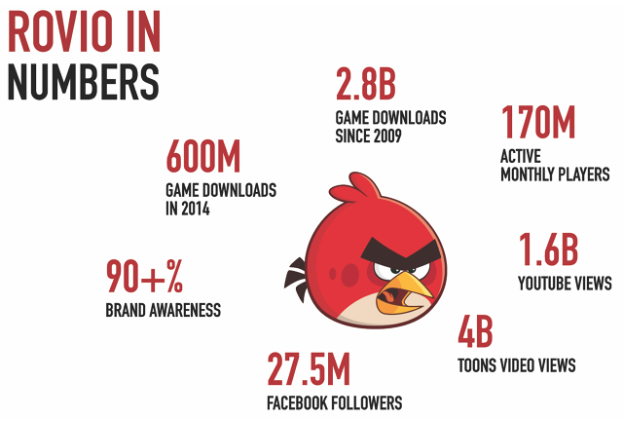
When asked if Angry Birds was a fading fad, he answered, “I understand the question. I definitely get it,” says Rantala. “But last year our Angry Birds games had more than half a billion downloads, so I think that’s just one data point to show that Angry Birds is not a fad.” In addition, he was quick to point out Angry Birds‘ popularity on social media, including a YouTube channel with 1.6 billion views and 27.5 million followers on Facebook. The chart below highlights these numbers.
So how does Rantala think the company will bounce back With a forthcoming big-screen adventure due next year. That may seems like a ways off, but Rantala says it ties in with the company’s return to form. “We envision ourselves as an entertainment company with mobile games at its heart,” he said, pointing out the fans behind the franchise. “We get tons of mail from our fans from all parts of the world. Many of them write their ideas about what we should be building, what kind of new levels our games should have—and we actually do take those ideas into account. When Angry Birds turned five years old in December, we launched 30 new levels in our game and all of them were based on drawings coming from our fans.”

As for the movie, “some years ago Rovio was approached by many studios who wanted to buy the rights to make a movie,” he said. “I am really proud that the company made a very bold decision not to sell the rights but instead to make the movie by themselves.

“It’s a huge investment for a company of our size. Some people might think we are crazy, but we are very excited, and we are very confident that this is the right move because when we decided to make it we decided to make it right.”

The company will continue releasing new games in the meantime, such as the free-to-play Stella Pop, a variation of the hit series Bust-a-Move, but formatted for the Angry Birds universe. Still, all eyes are on the franchise’s big-screen debut next year. “The business peaked very much during 2013,” Rantala says. “And now it’s normalized and the movie will create the next boost for the business.”

The only question now is how well it’ll fare until the movie releases.

More quotes from Rantala, including his vision of how to turn Rovio into a “Disney for the digital age,” can be found here.
VIDEO: Marketing The Next Big Party Game

[a]listdaily caught up with CEO of Chains Awesome Games JS Otis about how they want to position Knight Squad as the next big “party game,” along with how listening to community feedback has helped improve development of their new title.


Global Ad Spending To Reach $540 Billion

Global ad spending is increasing — and it appears digital ad spending is at the forefront.

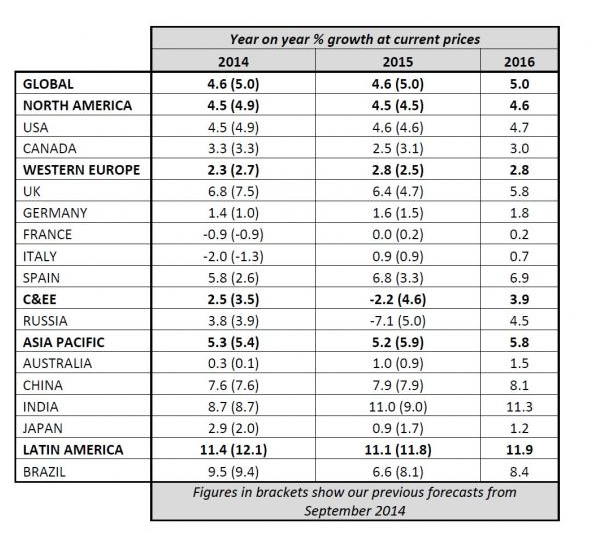
AdAge has reported that marketers will spend $540 billion globally on advertising this year, which is a 4.6 percent increase from the amount spent last year, according to a research report by media-agency Carat.

Even without tent-pole media events to hype products — including ones surrounding the popular Winter Olympics, FIFA World Cup and mid-term elections in the United States — the growth continues to spread like wildfire. Not only that, but it’s expected to rise even higher next year, by an estimated 5 percent.

“Carat’s latest advertising forecast gives us increased optimism for the outlook for global advertising spending,” Jerry Buhlmann, CEO of Carat’s parent company Dentsu Aegis Network, said in a statement. “With harder times behind us, negative growth markets are pleasingly now a minority, and collectively we can look ahead to 2016 with positive growth predicted for all key markets.”

As you can see by the chart above, key markets have shown impressive spurts in spending. Along with North America, Western Europe, Asia Pacific and Latin America, among others, showed a healthy increase, with even bigger numbers estimated for next year.

Digital media is the key component here, with companies intending to push its global spending by 15.7 percent this year, over last year. Meanwhile, traditional advertising, like with television, has shown a decrease, even though it still goes strong in some markets.

The chart above indicates just how much growth is expected with each group, and, as you can see, magazines and newspapers are looking at a tremendous drop-off, while television has only a slow and steady decline. Meanwhile, digital is healthier than ever, and a 13.8 percent boost is expected for next year as well.

The report also indicates a 50 percent increase in global mobile-ad spending — not a surprise considering the surging mobile market — and a 22 percent increase in global online video budgets, both of which are helping digital see a surge in spending. Still, some companies are skeptical due to where the ROI will end up. “Much of the early investment in mobile advertising has been amongst pure-play, app economy brands and business for whom there is an easily demonstrable ROI for investing in mobile,” the report said.

Regardless, it looks like ad spending is growing overall, despite the lag in some sectors. More details on the report can be found here.

Google Glass Poised To Return

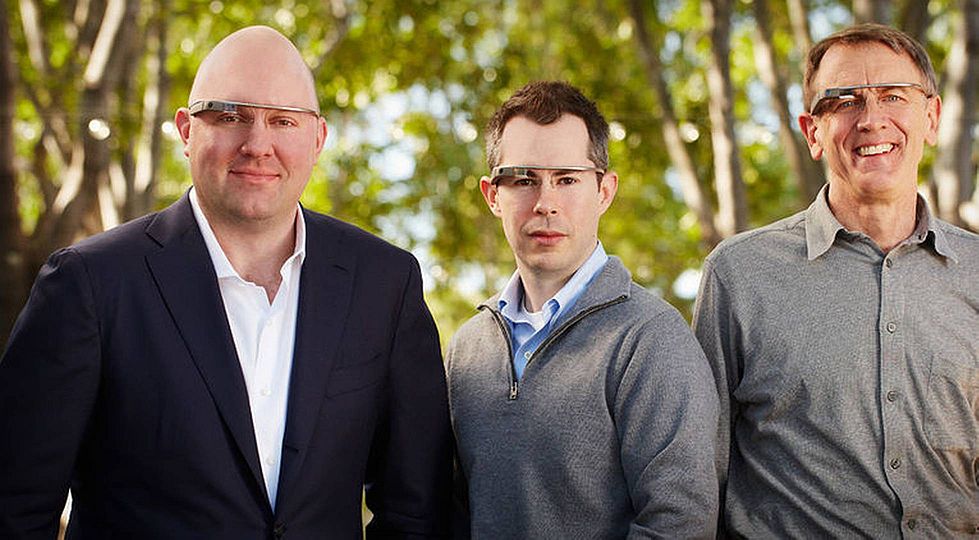
Google Glass attempted to make a splash on the market three years ago with an early developer’s version, but was met with its fair share of controversies, particularly with ease of use. The sales of $1500 developer versions of Google Glass got plenty of units in the hands of people, but the backlash that followed led to controversy and critics coining the term “glasshole” to describe Google Glass wearers. With that, the company opted to pull its current model of the headset, while at the same time contemplating what will become of it. Apparently, a new model is in the works, according to the Wall Street Journal.

After initially shutting down Glass and its coordinating Explorer program earlier this year, Google Executive Chairman Eric Schmidt has stated that the project is now under the watch of Tony Fadell, head of Google’s Nest connected home division, in an effort “to make it ready for users.”

“It is a big and very fundamental platform for Google,” he explained. “We ended the Explorer program and the press conflated this into us canceling the whole project, which isn’t true. Google is about taking risks and there’s nothing about adjusting Glass that suggests we’re ending it.”

That, alongside the company’s recently announced self-driving car, is intended to be made for the long term. “That’s like saying the self-driving car is a disappointment because it’s not driving me around now,” explained Schmidt. “These things take time.”

The failure of Google Glass to get a foothold in its first form was primarily a failure of marketing. Or, at least, that’s the essence of Google X director Astro Teller, who spoke at SXSW. “The great decision is that we did the Google Glass Explorer program—that was absolutely the right thing to do,” Teller said. “The thing that we did not do well—that was closer to a failure—was that we allowed and sometimes even encouraged too much attention for the program.”

The attention was intense, and Google provided little guidance in terms of how to view the product and its uses. Google Glass was not a product ready for release, yet Google didn’t make that clear enough to the world. “We could have done a better job communicating that and preventing it from becoming as loud of a conversation as it got,” Teller said.

According to the Wall Street Journal, the goals of the new product are for it to be more affordable to the mainstream market, along with having better battery capacity so that it will last longer. Improvements to the sound and display are also reportedly being planned, although Schmidt has yet to confirm any information on the newer Glass product.

Regardless, it’s got a tough uphill climb ahead of it when it debuts, thanks to the emergence of other popular technology that’s on the way, including the launch of the Apple Watch next month, the continuing efforts of Android Wear, and perhaps even Microsoft’s planned HoloLens technology. Perhaps Google may have plans to make its Glass technology more affordable — though it’s still likely to be met with similar controversy like the first product, especially when it comes to users complaining about invasion of privacy.

While the wrist is the next battleground for technology, Google’s not giving up on head-mounted devices. With the array of virtual reality and augmented reality devices announced, it’s clear that’s going to be an area of intense interest in the next few years. Google’s already gathered plenty of practical, field-tested information on user experience and user interface, something other devices have still to gather. A new Google Glass, featureing advances in technology, interface, and apps along with a friendlier price tag, could well claim a spot in the market. We’re just giving you a heads-up, as it were.

How Data-Driven Marketing Drives 2015

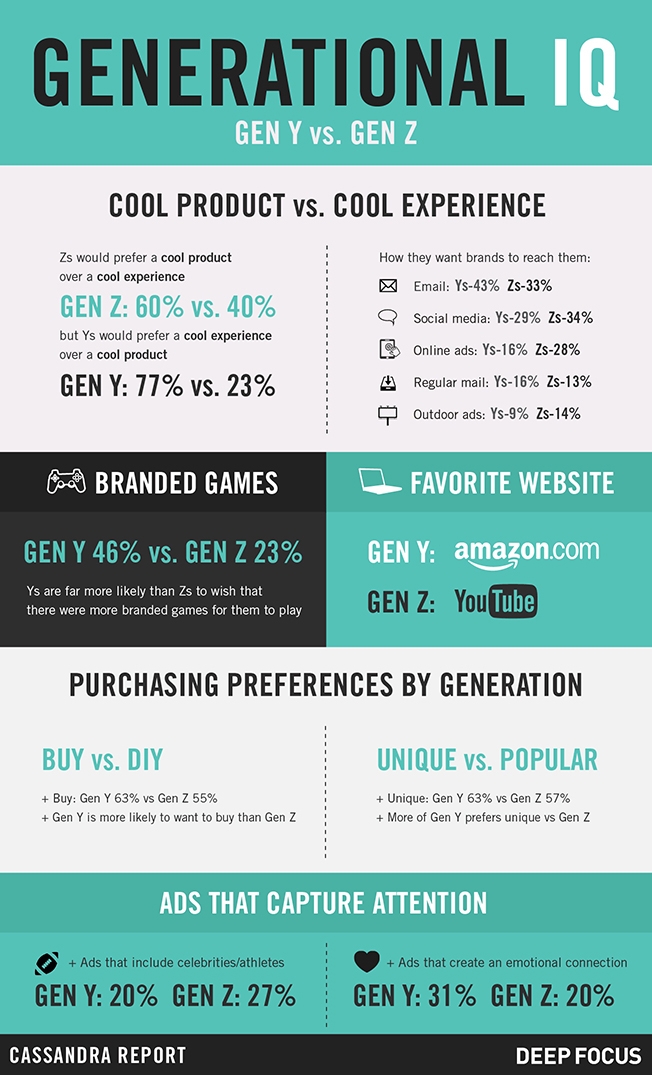
A study by analytic data platform Teradata indicates that data-driven marketing may be the key to success for future advertising campaigns and strategy, as it allows personalization for consumers and more information for companies, according to Adweek.

“Real-time relevance is moving to become table stakes, and the quickest to move will win,” said a Teradata rep regarding the 2015 analysis of the industry. “Customers today expect — and demand — a seamless and relevant experience. They have grown accustomed to marketers’ knowledge of their preferences and anticipation of their needs. Fractured or conflicting messages from a brand make marketers seem unorganized and annoy customers, sometimes even driving them away.”

But it seems that marketers may be listening. Teradata polled 1,500 different executives worldwide, and learned that many are moving forward with making improvements over data efforts. However, there are still hiccups with the system, particularly with security issues and how some are thrown off by the quick pace of the trend.

GlobalDMA and the Winterberry Group held its own survey across 3,000 marketing professionals, with most of the findings in the infographic below. 77 percent of those polls indicated confidence with the practice of data-driven marketing. Spending for the practice also showed growth, with 74 percent stating that growth will continue — a leap from the 63 percent back in 2013.

As far as where data efforts deserve the most focus, 69 percent feel that targeting of offers, messages and content is the true vital ingredient, while data-driven strategy or product development follows at 52 percent. Customer experience optimization, audience analytics/measurement and predictive analytics followed closely behind around the 40 percent range each.

But what truly drives increased data marketing Well, it turns out that a need to be more customer-centric led the charge with 53 percent, followed by the need to maximize effectiveness/efficiency of marketing investments closely behind with 49 percent.

Here’s hoping more companies pick up on the practice!

Twitch Continues To Expand Services And Reach

Twitch, the live streaming channel that continues to make waves heading into the thick of 2015, continues to expand in a number of ways – and that’s good news for both its user base and its owner Amazon.

The streaming channel has just announced that it will stream the Ultra Music Festival, a popular gathering of electronic music artists, when it kicks off from March 27 to the 29th. “Powered” by a partnership with 7UP, the festival will feature a hundred different artists taking the stage, including favorites like Royksopp and Knife Party.

“We are always pushing the envelope, working with the most innovative companies to stay ahead of the curve and offer our fans as much value as possible,” said Adam Russakoff, executive producer/director of business affairs/talent buyer for Ultra Music Festival and Ultra Worldwide. “We don’t tolerate mediocrity and our switch to Twitch is yet another step in the continuum.”

This continues the company’s delve into music support for streamers, as it previously announced that it acquired a library featuring several artists, which its users could utilize during streams.

However, that’s not all. Per Digiday, Discovery has announced that it will launch a new gaming-focused media property called Super Panic Frenzy on the streaming channel, along with YouTube. Obviously, Twitch will have the better part of the deal, thanks to an improved live streaming experience. “Our view on Twitch is it’s terribly exciting,” said Colin Decker, general manager of Discovery Digital Networks. “We’re always interested in increasing audience share anywhere we think there’s opportunity, so it’s natural we’d push heavily into a space like Twitch with our personalities, who are passionate about gaming.”

Perhaps it’s the interaction angle, as Discovery admitted with one of the show’s hosts. “Phil DeFranco’s fans love nothing more than to be able to continue their relationship with Phil DeFranco and play along with him live,” said Decker. “He’s a longtime pro and very accomplished about steering the audience through an experience with the games in a really fun, irreverent way.” (The trailer for the show is below.)

“One of the more interesting things about Twitch is, in an era where we’re talking about more and more video on demand, there is still a very compelling argument for linear video or appointment viewing,” said Decker. “At the end of the day, nothing beats great content at a great time of day when you can tune in and feel like you’re being part of something.”

With these recent business moves – and continued support for games like Clash of Clans and League of Legends among others — there’s no questioning the site’s impressive popularity. Earlier this year, we reported that Twitch doubled its monthly viewers to 100 million, along with other impressive stats. eMarketer also had its own numbers to report, indicating that there’s a huge outreach in male streamers, although female ones are certainly on the rise as well.

Indeed, when it comes to Twitch, the show is going on – and it’s got quite an audience with it.


Disney Games Clean Up On Mobile

Disney has largely shifted away from producing games for consoles and PCs in-house, preferring to license out titles like Star Wars Battlefront to Electronic Arts. The main effort in-house for Disney Interactive is Disney Infinity, which is seeing some good profits while supporting many of the company’s movies and long-time brands. However, Disney’s gaming strength really lies on mobile platforms, as VentureBeat has reported strong numbers for the company’s releases for iOS and Android.

With such titles as Where’s My Water, Star Wars: Commander and Marvel Avengers Alliance leading the charge, the company is seeing a huge turn-around on the mobile front.

VentureBeat sat down with Disney Mobile Games general manager Chris Heatherly regarding the turnaround in the division’s popularity. “We’re the no. 8 most downloaded publisher in the world on mobile,” said Heatherly. “We have about a million downloads a day and about 70 million monthly users in our network.”

The company boasted these numbers during the Game Developers Conference earlier this month, marking the first time it made full use of the show to talk about its success. “We’ve been sending people to GDC for years to do business development meetings and stuff,” he explained. “But we’ve never gotten up and really told our story.”

What sets Disney’s mobile approach apart from others “I think what Disney brings to the games business is this idea of storytelling. One of the thing we constantly – I don’t want to say struggle with, but one of the things we constantly push for is quality and storytelling and not just taking our characters and putting them in a game and calling it done, but telling an authentic Disney-quality story with heart.”

The company did have its hardships, laying off more than 700 people from its company last year. However, it’s providing a bigger outreach, according to Heatherly. “We’re broadening what we’re doing externally,” he stated. “We’re going to probably do about 15-to-20 titles across our brands a year. It’s not going to be a huge slate. We want to focus on quality.”

A third of these titles will be licensed to outside studios. This is a familiar practice, as Disney proved when it signed a deal with Electronic Arts to produce particular Star Wars games, including the forthcoming Battlefront, which will debut at the Star Wars Celebration next month. “When we talk about licensing, we have some pretty specific criteria,” said Heathery. “It’s not just about minimum guarantees and things like that. What we’re looking for is top-quality developers, first and foremost, folks who have network reach that we don’t. A good example of that is (mobile game company) Line.”

Line has been a proven success for Disney’s mobile games, particularly with the Disney Tsum Tsum puzzle release. “It’s done $300 million in revenue, and it couldn’t have done that without Line’s social network,” explained Heatherly. “That’s a great partnership for us because we’re able to reach into their social network with our IP.”

With the 70 million downloads, the company is in a “good starting place,” according to Heatherly. “We want to grow it. We think it’s a very strong position. We think there’s a lot of opportunity to grow beyond where we are today.”

More details on Disney’s mobile success can be found here.

ESRB Brings Ratings To Mobile Games

For years, the Entertainment Software Rating Board (or ESRB) has been providing rating services to a number of video game products, including digital releases and console games. But now, it appears that it’ll be taking its ratings to a whole new platform – mobile.

From a report in GamesIndustry International, the ESRB has announced that it has teamed up with the International Age Rating Coalition (IARC) with a new global rating system, one that would classify ratings for titles on both consoles and mobile devices across the world. Several ratings boards have jumped on the program, including PEGI in Europe, Classind in Brazil, USK in Germany and the Classification Board in Australia, with more expected to join the program in the future.

With the help of the IARC, the ratings authorities “agree on a unified process that simultaneously generates ratings for multiple territories while preserving each of their distinct cultural standards.” The system is expected to begin with such digital stores as Firefox Marketplace and Google Play, as well as digital storefronts like Xbox Live, PlayStation Network and Nintendo’s eShop, where ESRB ratings are already pretty common.

Patricia Vance, president of ESRB and chairperson of IARC, said about the new initiative, “The market for digital games and mobile apps is exploding across the globe. With a single click, developers can publish their games and apps on digital storefronts reaching a worldwide audience. These realities have created regulatory and cultural challenges that call for an innovative solution like IARC to help developers and storefronts provide consumers with culturally relevant, legally compliant and reliable guidance about the age appropriateness of the content in games and apps they may be considering for download. It is encouraging that digital storefronts recognize the benefits of this groundbreaking initiative.”

Vance also added that the Google Play Store “is deploying the system as we speak,” although other companies, like Valve’s Steam service and Apple’s App Store, have yet to be on board. When it comes to those companies, Vance said, “Discussions with other storefronts about adopting IARC have been held, but you’ll have to ask them directly about their plans.”

Apple currently has a ratings system that’s based on numbers, or user ages, ranging from four plus to 17 plus, depending on the content involved with the title. Developers are usually responsible for issuing such ratings – and it appears to be a system that will continue to be used. Meanwhile, Steam has no adoption for such a rating system, although it does warn developers that games “must not contain offensive material or violate copyright or intellectual property rights.”

Several company heads have spoken in support of the new partnership. Phil Spencer, Head of Xbox and vice chairman of the ESRB board, said “Microsoft has been a longtime supporter of ESRB ratings. Our users are familiar with them and, more importantly, trust them. We will continue to support IARC’s creation of a global ratings solution that makes it seamless for developers and producers to get their digitally delivered content rated globally to benefit consumers in their purchasing decisions.”

Reggie Fils-Aime, President and COO of Nintendo of America, added “Nintendo has always been a strong advocate of helping people make smart choices about the games they buy for themselves and for their children. More than 20 years ago, Nintendo was instrumental in supporting the creation of consumer-friendly rating systems, and now we’ve joined with other leaders in the video game industry to support the IARC initiative. As digital downloads continue to grow in popularity, it’s more important than ever for people to be educated about the content of the games they are buying.”

Strauss Zelnick, chairman and CEO of Take-Two Interactive Software and ESRB chairman of the board, chimed in “For more than 20 years, the ESRB has provided invaluable leadership to the interactive entertainment industry and played an integral role in protecting the creative freedom of today’s most innovative artists and storytellers. In addition, the ESRB has been lauded resoundingly as a highly effective resource for consumers, particularly parents, ensuring that gamers of any age can easily access trusted content rating information. Together with the other associations, the International Age Rating Coalition is poised to take a bold and important step forward with the Google Play Store and Mozilla Firefox Marketplace that will enhance further our industry’s standards of excellence and self-regulation.”

And finally, John Riccitiello, Unity CEO and former ESRB chairman of the board, said, “Having been an early supporter of IARC for years, I applaud Google and Mozilla for taking the initiative to deploy the IARC rating system. The IARC system presents a common-sense solution with a single standard, providing locally relevant age and content ratings that consumers recognize and trust. Obtaining IARC ratings is free to the app developer and incredibly easy to use.”

A unified global ratings system would be of use to marketers, providing a consistent way to label and categorize games. It would also make it easier to get the approrpiate labeling for each country, a process that can be complex and time-consuming.

A video showcasing what the IARC is about can be found below.

Just Another Day At Magic Leap

Magic Leap, a forthcoming “augmented reality” technology that promises to be a real game-changer, has been making quite a stir over the past few months, despite the fact that actual hardware (or any specs, or cost, or release date) has yet to be revealed. Investors like Google, Qualcomm, Legendary Entertainment and Andreessen Horowitz have already funded the project to the tune of over $500 million, but since that time, only bits and pieces of information have leaked out about it – and a new video leaves even more questions as to what can be expected from it.

Re/code has noted some instances surrounding what’s going on with Magic Leap. One such occurrence involved CEO Rony Abovitz, who insisted via Reddit that the technology would be good enough to not only act as a replacement to smartphones, but also all types of digital screens. However, before he was able to explain how this technology would take shape at a TED conference in Vancouver, Abovitz abruptly cancelled the appearance, with no given reason.

The questions continued to arise today with the arrival of this tech video, included below. Titled Victory, the tech demo features a player using high-tech weaponry to face off against robotic enemies from a first-person perspective. Aside from gaming, the video also shows some common applications using an augmented reality interface. There’s no doubt that the demo has some impressive visuals, and does manage to show augmented reality in a whole new light, but there’s a small problem – it may be too good to be true.

As you can see in the video, framed above, there’s a clear watermark for WETA Workshop, the special effects studio that previously worked on Peter Jackson’s The Lord of the Rings and Hobbit films. That makes the video come across more as a simulation of what the hardware can do, rather than a demonstration of the hardware itself. Re/code attempted to reach out to the company to clarify if it was a real demo, with no response.

On top of that, the company’s patent application illustrations appear to be based more on science fiction-oriented concept art rather than something created in-house by the team, as reported in this link by Gizmodo.

With multiple millions invested by high-end partners, there’s no question that Magic Leap has a lot on the line when it comes to living up to promises. And if the final hardware can produce similar results to what’s seen in the video above, then it’ll certainly be a game-changer. For now, though, the company’s “mum’s the word” approach seems to leave people wondering just what’s going to happen with Magic Leap – and the sooner those answers can emerge, the better.