This Week’s [a]list Jobs – September 3rd

[a]listdaily is now your source for the hottest job openings for senior management and marketing in games, entertainment and social media. Check here every Wednesday for the latest openings.

Here are this week’s [a]list jobs:

  • NBC Universal – Manager, Branded Entertainment (Los Angeles, Calif.)
  • Amazon – Brand Specialist, Toys and Games (Seattle, Wash.)
  • NAMCO BANDAI – Brand Manager (Santa Clara, Calif.)
  • Dolby – Associate Brand Manager (San Francisco, Calif.)

For last week’s [a]list jobs, click here.

Nintendo’s ‘New’ 3DS And 3DSXL Announced

Nintendo has announced new versions of its handheld gaming consoles, the 3DS and the 3DS XL, which will be available this October 11 in Japan. The new versions feature a number of improvements over the current versions of the handheld gaming consoles, but manage to keep the pricing about the same as the current consoles.

The handheld is slightly larger, in both its regular and XL configurations (called the LL version in Japan), and comes with some hardware improvements, including a faster processor, new buttons, and an improved 3D effect on the screen. The old SNES colour scheme has been adopted for the four face buttons, which are joined by a small ‘c-stick’, a nub-like analog controller reminiscent of the Gamecube’s. On the back of the device are two new triggers, ZL and ZR, which are accommodated by the cartridge slot shifting to the bottom of the lower screen. A built-in NFC (near field communications) chip is included as well, a feature that is already found in the Wii U’s gamepad controller.

The changes to the hardware have clearly been made in order to make new software possible. The extra analog controller is crucial to the gameplay of one of Japan’s leading games, Monster Hunter. Nintendo has shipped an add-on second controller for the existing 3DS in order to play Monster Hunter, but it’s a clunky solution at best. Building that in will enable not just Monster Hunter but potentially a number of other games. Similarly, the additional should buttons will provide more controls for game designers and make ports of other games easier. The addition of NFC is hugely important because Nintendo is about to launch its Amiibo line of figures, which will require NFC. These figures will be similar to Activision’s Skylanders series, which has resulted in over $2 billion in retail sales for Activision – something Nintendo would certainly like to see, and building this into the 3DS line will make it more likely.

More controversially, the CPU in the 3DS has been updated, and Nintendo has already announced a new Xenoblade Chronicles game which cannot be played on older 3DS devices. More games in the future may well require this additional processing power.

Sadly, these new 3DS models will not be making their way to Europe or North America until sometime in 2015. Oddly, the only name they have been given is “New;” the New 3DS and the New 3DS LL are the official names in Japan. Confused We still don’t know if these will replace the current models, or if they will continue to be sold at a lower price point. Perhaps Nintendo will clarify these issues before the new handhelds are up for sale elsewhere in the world.

Source: GamesIndustry.biz

Gaming Fights Nasty Troll Infestation

Gaming culture has been the province of teen-age boys of all ages for decades, and it’s only comparatively recently that gaming demographics have grown to include all ages and genders. Regrettably, there are still many repulsive cockroaches that scurry out of dark corners of the Internet to sully the good name of gaming. Recently these actions of risen to the level of criminal activity, and this is something that all gamers and members of the gaming industry need to take seriously.

Anita Sarkeesian, producer of the Feminist Frequency series of YouTube videos, has received threats deemed serious enough for her to leave home and stay with friends, she reported via Twitter yesterday. The tweets, from a throwaway account under the name @kdobbsz, made graphic threats of murder, rape and sexual violence against Sarkeesian and her family, as well as publishing her home address. Sarkeesian reprinted the threats via Twitter, with trigger warnings firmly in place. The video which drew the troll’s ire focused on the use of women as background decoration in games, and that they are often included only to suffer violence.

This occurred during a week in which we saw bomb threats from a hacker group made against Sony Online Entertainment head John Smedley, which caused his airplane flight to be diverted. Other game developers like Tim Schafer have been harassed for supporting Sarkeesian, and designer Phil Fish had his Twitter account and website hacked. A number of prominent game companies had their websites struck by DDOS attacks from hackers.

The recurring, repellent behavior of trolls has started shading into criminal acts that deserve prosecution and jail time. The behavior exhibited by this small group is hurting the entire industry, and it must be condemned in the strongest possible terms whenever it crops up. Criminal behavior like death threats needs to be reported and hopefully prosecuted to the full extent of the law. Those responsible for such commentary and behavior need to be made aware rapidly that they are not welcome and their views are not shared. Disagreement is fine, but it must be kept in bounds. Those crossing the lines should face the consequences.

Let’s not let the trolls ruin anyone’s fun. Companies and individuals alike need to spread the word to stop trolls in their tracks. Help make the game community a better place, please.

Source: Polygon


State Of The Graphics Market

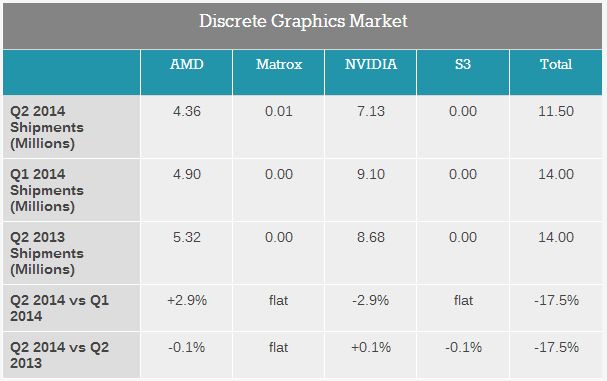
The latest data from Jon Peddie Research shows the status of the market for graphics cards and embedded graphics in personal computers. Looking at those numbers is an excellent way to gauge the healthy of the PC gaming business, because for the most part only gamers will be buying graphics cards for a PC. This year’s second quarter was, usual for graphics cards, weaker than the first quarter, with a drop of 17.5 percent.

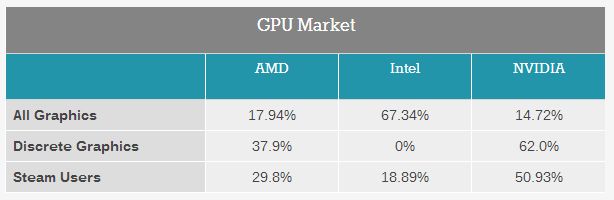
The total number of add-in graphics card shipped in the second quarter was 11.5 million, with both AMD and Nvidia losing ground compared to the previous quarter. AMD’s cards dropped 10.7 percent in sales from the previous quarter, and Nvidia’s cards lost 21 percent in sales — but Nvidia still holds a substantial lead in the market, with 62 percent market share compared to AMD’s 37.9 percent share.

The interesting part about the graphics card market for PCs is that most PCs ship with Intel integrated graphics, so add-in cards aren’t really necessary for many purposes. In fact, the attach rate of GPUs to PCs is 139 percent, reflecting the fact that many PCs have both integrated graphics and an add-in card. AMD also supplies integrated graphics with their processors, as well Intel, but Nvidia does not. Thus the market share numbers look different when integrated graphics are considered, with AMD reaching nearly 18 percent of PCs, Intel with 67.3 percent, and Nvidia with only 14.72 percent. When Steam members were surveyed, the numbers were different, reflecting the nature of the Steam audience as core gamers: For Steam users, AMD had 29.8 percent of the market, Intel had 18.85, and Nvidia had 50.93 percent, or just over half the market.

In general, Nvidia is more successful than AMD at selling add-in graphics card, with a more than two to one advantage over AMD. While Intel has improved its integrated graphics performance, any PC gamer will want to see the significant upgrade in graphics that comes with an add-in card, even with the additional cost. Compared to the latest Xbox One and PS4 graphics, a mid-range graphics card with a good CPU should be capable of producing better graphics, which is something many PC gamers will continue to desire.

Source: Anandtech

Oculus Leaps Into Controller-Free VR

While the Oculus VR headset continues to attract plenty of interest from game companies, there are still hurdles to overcome before the device can become a consumer product. One of the major difficulties is control. Using a standard game controller such as you might find on a console is difficult, because you can’t see the buttons. Moreover, using such a controller will tend to pop you out of the immersive fantasy that you’re in another world, which is exactly where the Oculus Rift would like you to remain. What’s the answer

While Oculus has already purchased a company that makes modified Xbox 360 controllers, other companies have proposed a variety of solutions in an effort to become the standard way to control a VR experience. Now Leap Motion has stepped forward with an inexpensive method that seems to solve many of the problems noted with control schemes.

Leap Motion makes a gesture-detecting sensor for the PC and Macintosh platforms, and they have created a mount that holds ther sensor on the front of any flat VR headset – such as the Oculus Rift, in either developer version so far – for only $20, while the sensor itself is $80.

The Leap Motion sensor is extremely precise, and can track all ten of your fingers in their position with the most recent version of their software. The current model uses infrared cameras, but the company is experimenting with a version that also has color cameras.

“With the infrared, we track the hands, and with the color, we’ll show you the rest of the world,” said CTO David Holz. “In the future, you can imagine a camera like this could track your position in the room.” Developers will be able to grab the sensor data coming from the Leap Motion and integrate it into their software, making your VR experience fully aware of your hand positions and head motions. Thus, if you wanted to swing a sword or fire a pistol, you’d merely make the appropriate gesture with your hands.

Will this be the interface technology that VR has been looking for What do you think

Source: Re/code


‘Gran Turismo’ Film Tracks 15 Years Of Racing

Sony is celebrating the 15 years of its epic racing game Gran Turismo with a documentary about the game’s creator Kazunori Yamauchi. The doucmentary was directed by Tamir Moscovic, and is entitled Kaz: Pushing the Virtual Divide. Sony is using the documentary to look at the process of creating the game franchise and how it evolved over the years.

The game franchise has been one of the best-sellers for the PlayStation consoles, selling more than 70 million copies since the game first launched in 1997. The series has been instrumental in bringing a more realistic level of racing to consoles, with features like being the first console game to show a 360-degree view of a 3D-rendered car, or letting players choose from a huge variety of cars rather than just a small set of cars on one type of track.

Sony said the documentary is “about drive,” on the “Gran Turismo TV” online channel, and how Yamauchi’s passion “forever changed the gaming and automotive landscape and in doing so, redefined how we perceive the relationship between art, entertainment and culture.” The movie first debuted on Hulu in January and is now available for free on YouTube, as you can see in the version embedded here.

Sony is also developing a movie treatment with producers Mike De Luca and Dana Brunetti, who are currently producing Fifty Shades of Grey.

The most recent version of the game, Gran Turismo 6, was released on December 5, 2013 for the PlayStation 3. Sony will be bringing the franchise to the PlayStation 4, as developer Polyphony Digital (Yamauchi’s company) has already announced Gran Turismo 7 will be arriving for the PlayStation 4 sometime in 2015. The addition of this documentary and a possible feature film will certainly serve as good marketing tactics, generating higher enthusiasm among current fans and helping a significant number of people become new fans of the game.

Source: Variety


Activision Leaves Mark With Destiny Beta

Activision is putting a lot of marketing dollars into its forthcoming release of Destiny, the latest science fiction-oriented shooter from the Halo developers over at Bungie. However, from the looks of the company’s recent playable beta, it’s got nothing to worry about.

The beta, which began on July 17th on PlayStation consoles before heading to the Xbox systems six days later, came to a conclusion this past Sunday, and, according to the publisher, it’s managed to draw a huge crowd. Over 4.6 million unique players participated in the beta during one point or another, a huge number for a pre-release.

“This is the biggest beta of this console generation by a wide margin and the largest console beta ever for a new video game IP to date,” said Eric Hirshberg, CEO of Activision Publishing. “Hosting a beta at this scale is an incredible feat, so we’re thrilled to see the phenomenal response. But the beta is just a taste of what’s to come. We’re counting down the days to our launch day, September 9th.”

“We were totally blown away by the number of people who played the beta,” said Pete Parsons, COO of Bungie. “We surpassed even our own goals and the feedback was invaluable. We cannot thank the community enough, the response was humbling and in the weeks ahead we’ll be working hard to ensure that Destiny lives up to the expectations at launch.”

Destiny tells a completely different tale than most shooters, revolving around a mysterious sphere and chosen warriors determined to save the galaxy by any means. It’s certainly one that Halo fans will be familiar with, while throwing in some new elements, including the ability to ride a powered jet bike (to get around levels faster) and being able to participate in simultaneous live multiplayer battles for additional rewards.

Destiny will release on September 9th for Xbox One, Xbox 360, PlayStation 4 and PlayStation 3.

Source: Activision

Harry Potter Global Development Team Formed

In an effort to expand its partnership with popular author J.K. Rowling, Warner Bros. has put together a new Harry Potter Global Franchise Development Team, based between London and Burbank, which will “develop and execute a high-level strategic vision for the Harry Potter brand and its ancillary businesses,” according to the company.

This follows last year’s renewal of an agreement with Rowling, in which led to the announcement of a new film series, Fantastic Beasts and Where To Find Them, as well as a Making of Harry Potter tour stop in London; the opening of The Wizarding World of Harry Potter at Universal Studios in both the U.S. and Japan; a suite of Harry Potter­-licensed digital devices, and products featuring Rowling’s Pottermore initiative. A future Harry Potter stage play is also in the works, set to open in London next year.

Josh Berger, president and managing director for Warner Bros. U.K., Ireland and Spain, will head up the team, working alongside Rowling’s team at The Blair Leadership. Polly Cochrane, based in London, and Paul Condolora, based in Burbank, will also be part of the initiative.

Said Berger, “With Harry Potter’s consumer touch-points continuing to grow and flourish, I am confident that this talented, cross-company global team will enable us to take full advantage of the many opportunities ahead — helping to bring Harry Potter in all its future incarnations to fans all over the world.”

Cochrane’s role will focus on the “optimization of the Harry Potter franchise globally through a cross-divisional marketing lens, upholding the brand’s premium values,” while Suzie Boavida, Xochitl Ruiz, Moira Squier, Angela Kato-Alvarez, Christine Kittelson, Cynthia Gonzalez and Rebecca Muh will head out the rest of the team in Burbank. Fiona Hickey, meanwhile, will correspond from London.

It looks like the magic hasn’t gone out of this franchise just yet. What do you think Are you ready for more Harry Potter

Source: Variety
Can Advertisers Keep Up With Television?

A new report from GigaOm shows that television ad spending, just crossing $75 billion 2013, is on the rise, but the general core business in itself is actually in flux. With audience ratings dwindling and secondary screens taking precedence in comparison to general TV viewing, changes need to be made in certain areas. However, not all the news is negative, as television viewership in itself remains at an all-time high.

How execs can keep up with this changing landscape is a tricky business, but the report shows that there are certain trends that indicate where things are going. For instance:

Online video spending is peanuts, and mobile is just getting started. Nonetheless, the Association of National Advertisers (ANA) estimates that multiscreen ad spending will grow from current level of 20 percent to 50 percent of budgets within three years.

Social media’s titans are achieving audience reach that may surpass that of U.S. TV networks’, and the social networks are emerging as sources of several TV-enhancing services including combination buys, increased audience engagement, and media metrics.

Lack of industry standards for cross-channel performance measurement is hindering broad adoption and market growth, and it is frustrating all constituents of the television supply chain. But multichannel video distributors are well-positioned and able to collect real-time click stream data analogous to web and online media channels.

The first-place digital-derived TV techniques will play out in any sort of volume is for addressable inventory on cable-owned local spots and video on demand.

Intelligent cross-platform media buying and planning is in a maturation phase. Key challenges still lie in the methodologies for data aggregation and standardization for things like de-duping viewership and the impact that has on impression valuation (for ad buyers) and viewership metrics (for buyers and sellers), but advertisers and program networks are moving quickly to adopt where they can.

The full report can be read here.

Source: GigaOm

Tags:

The Cost Of Indie Games On Xbox One

Microsoft has reversed its stance on indie game developers over the past few months, opening up its arms and inviting them to take part in its ID@Xbox program, which spotlights new titles from them and puts them smack dab in the middle of the Xbox Live Marketplace for the Xbox One system.

However, it appears that this process does come at a price — and it’s no small fee if you’re an indie developer on a shoestring budget. Jamie Fristrom, a developer at Happion Laboratories, recently released a game for the system called Sixty Second Shooter Prime, a twin-stick shooter reminiscent of the Xbox 360 downloadable classic Geometry Wars. Fristrom recently provided a full breakdown of costs in regards to how much it takes to publish a game on Microsoft’s console.

According to Fristrom, costs are around $5000, including sending another development kit to a partner, using hardware such as a video capture device, localization for different languages, and maintaining a URL. Perhaps the most costly steps involve earning foreign ratings from different boards like PEGI and USK, which ranges around $2,000, and getting insurance in case of errors or omissions, which is about the same amount.

According to Fristrom, errors and omissions insurance is required by Microsoft, as “it has to cover IP and copyright violations, so the cheap E & O insurance you can easily find online doesn’t qualify.”

Ratings board payment is also a requirement. “If you want to release in a given territory, you have to get your game rated by the official ratings boards of that territory. It’s sad but true, getting your game rated in some territories can be a lot more expensive than simply translating your game to that territory’s language!” said Fristrom.

But with all the expenses, the process isn’t heartbreaking, especially considering that Microsoft provides the development kits at no charge. “Although those costs were somewhat daunting for a shoestring developer like myself, it was absolutely worth it. Although we haven’t gotten our first sales report yet, there were at least ten thousand entries on the leaderboards last we checked, so we’ve certainly covered our costs and made a living wage to boot – which is kind of rare in the indie game development world, in my experience – so I’m really happy we jumped aboard the ID@Xbox wagon.”

Source: Videogamer