AMC Picks Up ‘Humans’ From Xbox Entertainment Studios

With the announcement that Xbox Entertainment Studios would cease operations (in favor of more game-oriented content for the Xbox consoles and other mediums), AMC Studios has taken an interest in one of the studios’ more interesting projects.

The channel behind such popular shows as Hell on Wheels, Breaking Bad and The Walking Dead is close to finalizing a deal to bring the series Humans to development, in conjunction with U.K. broadcaster Channel Four and Shine Group-owned group Kudos.

Although the studio hasn’t officially mentioned supporting the series, it already has stated that it’s involved with various cast members from the project, with a rumored start date of sometime next month, according to Variety. The series, which will span eight episodes, is likely to premiere sometime in 2015.

With Xbox Entertainment Studios somewhat in flux, AMC assures that a cast can finally be “nailed down” for the production, and that it can move forward into actually being made.

The show, based on the Swedish series Real Humans, deals with regular people who have robot servants, and how their reactions actually play an impact on day-to-day proceedings. As you might guess, the robots actually look a little human themselves.

The show is being produced by Jane Featherstone and Derek Wax, and Sam Vincent and Jonathan Brackley are on board to write it.

With its partnership with Microsoft, AMC can resume show-making duties from XES, while two other projects, the Halo series produced by Ridley Scott and another by Steven Spielberg and Showtime, remain in the works. Since they’re tying in with Microsoft forthcoming releases of Halo: The Master Chief Collection this year and Halo 5: Guardians next year, these shows shouldn’t run the risk of being cancelled.

What do you think Will Humans make a prime addition to AMC’s show line-up Do you think it’ll fit right in with the likes of The Walking Dead and Breaking Bad

Source: Variety
Marketers: More Brand Awareness Efforts, Please

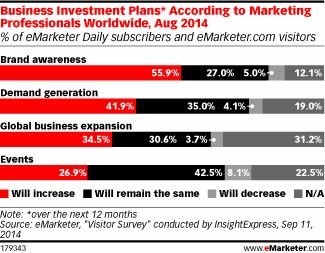
Brand awareness is one of the hottest new trends in marketing, mainly because, well, it’s making customers more aware of the power of said brand. A majority of marketing professionals is looking to boost their spending when it comes to said trend, somewhere over the next twelve months. At least, that’s according to a recent August 2014 poll from InsightExpress.

The poll indicates that nearly 56 percent of eMarketer daily newsletter readers and visitors have stated interest in spending more on branding-related activities over the next year, while another 27 percent feel that maintaining current spending levels is the right thing to do. That shows the effectiveness of brand awareness, as well as its demand with audiences, as well as global business expansion efforts and spending on events.

That’s just in the U.S. as well — those polled in Latin America and Asia-Pacific are even more compelled to spend more money on brand awareness, with 59 to 60 percent of respondents looking to utilize it. Demand generation was also quite high in both of those countries, as they indicated they would invest in that as well.

So who was the least likely group to use brand awareness to their advantage Surprising enough, it’s Canada. There’s still a majority there, with 51.1 percent of marketers that planned to spend more on it, but demand generation fell a bit with only 33.7 percent of those polled in support of it.

As a result of said poll, demand generation has fallen a bit, with only four in ten indicating they would spend more in that department.

But the focus here is on the growth of brand awareness, and over the next 12 months, consumers shouldn’t be surprised to see an increase in this regard for various companies.

What do you think Should brand awareness play a bigger part over demand generation

Source: eMarketer

Publisher Prepares For Cloud Gaming Future

Telltale Games is easily rising up in the ranks of the hottest game publishers right now, based on the strength of such episodic fare as The Wolf Among Us, the two seasons of The Walking Dead and its forthcoming adaptation of HBO’s Game of Thrones. But as big as these stories are now, the developer/publisher actually wants to make them bigger – and it could utilize cloud gaming to do so.

“We’ve thought about how we use the cloud and the future of our games using the cloud to tell bigger, greater stories,” said Telltale co-founder and chief executive officer Dan Connors, during a recent discussion at the Cloud Gaming USA conference in San Francisco.

Connors was quick to bring up Netflix’s model as an example, utilizing the power of choice based upon what subscribers were looking to experience. “Players have been asking for this for years,” he said. “The game is informed by the data, and the player feels like this is their personalized game experience.”

He doesn’t just want to expand the game itself, though, but rather the experience surrounding it. With the forthcoming Game of Thrones, for instance, he’s hoping that after watching an episode of the series on HBO, you can also check on your progress within the game, in a relatable manner. “The back end talks to the game, and the game talks to the show, and everything works in sync,” said Connors. “We could have entertainment experiences that are multimedia. We feel we can do this with the biggest stories in the world.”

When it comes to grasping the power of the cloud, Connors explained to Gamesbeat, “What we look at is, we’re now in a place where the cloud is where all media live. Since we work with franchises and work in universes, we can take advantage of that to inform our game. On the other side, as far as how players use the game and form the story creation, we feel like we’re on the cusp of an evolution of entertainment that’s bigger than games, but that brings interactivity to the forefront of entertainment as a critical piece.

“Even if it’s just regular linear entertainment, it’s going to be surrounded by interactivity anyway, just through the way you get it and experience it. When we look at it, that’s the way we think about it,” he concluded.

No word yet on when this new model will be grasped, as Telltale is busy enough between Game of Thrones and the forthcoming Tales From the Borderlands. It shouldn’t be too long, though – and other companies may just follow suit.

Source: GamesBeat

Defy Launches Break Media App For Xbox

By Sahil Patel

Defy Media has launched an Xbox app for its popular comedy hub Break Media. With the app, the team behind the humor site, which claims an audience of 8 million unique visitors per month, offer a curated selection of video content — from pranks to comedy sketches.

A slew of original series from Break Media are also available via the app, including “Honest Trailers,” “Man at Arms,” and the Paul F. Tompkins-hosted “Speakeasy.” Some content from other Defy Media brands will also be published to the app, which is available on both the Xbox One and Xbox 360 consoles, the company said.

This article was originally posted on VideoInk and is reposted on [a]listdaily via a partnership with the news publication, which is the online video industry’s go-to source for breaking news, features, and industry analysis. Follow VideoInk on Twitter @VideoInkNews, or subscribe via thevideoink.com for the latest news and stories, delivered right to your inbox.

New iPhones ‘On Par With Next-Gen’

Electronic Arts’ mobile division watched with great interest Apple’s reveal of the new iPhone 6 and iPhone 6 Plus. They were very excited to see the new capabilities unveiled, from the larger screen sizes to the more powerful A8 processor.

“It was a good Christmas morning,” said EA’s head of mobile Frank Gibeau after the conference had wrapped up. “We got a lot of the gifts we asked for. One key takeaway is that with the retina display and the improved processor, combined with the Metal [graphics] capabilities and 128 GB of memory, that gets you to a device that’s on part with next-generation consoles. That’s moving perfectly into our strike zone.”

The notion that mobile devices can be equivalent to the latest console generation will no doubt occasion a great deal of criticism, but it’s not all that far off. While the sheer horsepower of the devices in terms of polygons and clock speeds isn’t matched on smartphones, the capability of the smartphones is undeniable. The latest chips and GPU capabilities put many of the same functions found in desktop and console graphics chips in smartphones, albeit at lower overall power levels. Still, though, it means that games designed around desktop or console game engines can be more easily moved to mobile platforms with relatively high fidelity.

“In some combination of devices, we’re kind of there,” he says. “On others, it’s a little hard. The thing about mobile is there are 60,000 flavors of handsets each year. Some are extraordinarily high performance – and given that you’re looking at a small screen that’s right in front of you, pound for pound, it’s right there.” Gibeau points out the mobile prototype of Plants vs. Zombies: Garden Warfare as an example, which runs on mobile devices using EA’s Frostbite engine. That’s the same engine used in the Battlefield series of games. Gibeau expects playable mobile products using the Frostbite graphics engine “soon.”

Gibeau also noted that the mobile technology is improving each year, which allows it to catch up with the static target of consoles. “If you look at the market… mobile has a strong growth path in front of it,” he says. “Then you’ve got wearables on top of that. At EA, we look at it as an especially powerful strategic path for us . . .  We’ve been a premium business – and we’ve been changing the company from the ground up to become a services business. We have an optimistic and profoundly bright view of the future because of this platform expansion in mobile.”

Source: GamesIndustry International

Cord-Cutting Continues To Grow

One of the things that keeps cable-company execs awake at night is the increase in cord-cutting, where people give up entirely on cable TV service in favor of getting their video content from the Internet. While the numbers are small so far, those planning to cut the cord in the coming year are increasing – and that’s a worrisome sign for the cable industry.

The latest survey from Frank M. Magid Associates shows that about 2.9 percent of US pay-TV consumers are “very likely” to cancel cable TV service within the next year. That was up from last year’s survey, which showed 2.7 percent preparing to cut the cord, and in the year before, 2.2 percent.

“These are very small numbers in terms of future cord-cutting from American consumers,” said Mike Vorhaus, president of Magid Advisors. “But in mass media, very small numbers are very important, too.” The survey sampled 2,400 consumers aged 8 to 64 in June, 2014.

Perhaps scarier to cable companies, the demographic most likely to drop cable TV is the coveted 25-34 age range, where 4.9 percent said they are very likely to cut the cord.

This does not reflect the growing propensity of young consumers to never sign up for cable TV in the first place, preferring to focus on high-speed Internet service and get whatever video they want from that service.

The growth of cord-cutting also hints at the increasing interest in livestreaming, with Amazon’s recent purchase of Twitch and its 55 million+ monthly streamers. Thos people obsessively watching video streams of people playing games are in the same demographic range as the most likely cord-cutters, and it’s not coincidental. Advertisers are looking for ways to reach that demographic, and clearly cable is likely to be losing those eyeballs to streaming and other places in the years to come.

Source: Variety

Tags:

Facebook Getting User Input On Ads

Advertising on Facebook will soon have an additional hurdle to jump over: Are users are judging an ad to be offensive or inappropriate If so, Facebook will refrain from serving up that ad. It’s a big change that could make some advertisers unhappy. But not all of them: “We absolutely welcome this change,” Ben Winkler, chief digital officer at media agency OMD, said. “Crummy, irrelevant ads are bad for everybody, and they’re especially insidious in a social feed.”

As of last Thursday, Facebook users are being asked to provide feedback whenevr they “hide” an ad from their news feed. Facebook tested this program some weeks ago, with the findings (revealed in a blog post on Facebook) that many users were hiding ads because they deemed them to be “offensive or inappropriate.” Facebook clearly felt it was important to act on this finding.

The change will no doubt be well-received by users, but it could be problematic for agencies and advertisers. The pressure will be on to improve the quality of ads and to avoid lowest-common-denominator shock value advertising. While this might prevent some ads from reaching customers, Facebook said that in its tests this did not have a significant effect.

“Hiding ads isn’t a natural behavior for most Facebook users, so this isn’t likely to yield a significant amount of data,” according to Matt Wurst, general manager of social media at digital agency 360i. “On the flipside, this feedback should help marketers combine creative and media to create content experiences that people want to engage with.”

Facebook will take pains to assure that ads won’t be ruined by trolls looking to punish a particular brand. The feedback from users who rarely hide ads from their news feed will be weighed more heavily than those from serial ad hiders, the social network said.

“Facebook obviously has a long play here as well: The more relevant the ads are, the more ads a user is willing to see,” Winkler said. “Relevance equals revenue.”

Source: Digiday

Microsoft Tests Game Streaming

As cloud gaming becomes more accepted with services like Onlive and PlayStation Now, it’s not surprising that a report from technology news website Neowin says that Microsoft is experimenting with game streaming. According to the report, Microsoft is testing Xbox 360 and Xbox One games that would run on Microsoft’s Azure cloud and sent as a stream to your browser.

The game streams would run at 60 fps, and will full dashboard support, just like consoles. The games could be streamed not only to PCs, but to smartphones or tablets. The report claims that the service has progressed beyond the concept stage and is currently in testing, with highly positive reactions so far from users.

Microsoft has already shown off some streaming technology last year, demonstrating Halo 4 running from the cloud. The important thing about that demonstration is the low latency that was shown, which made the game very playable. Latency is noticed strongly in action games, where players can easily detect even very small amounts of lag between the time a controller button is pressed and the corresponding action appears on screen.

Such a service would likely build upon Outatime, a research project within the company made public last month, which used FPS Doom 3 and RPG Fable III to test a method of disguising network latency for “mobile cloud gaming”. Microsoft could use a streaming game service to compete directly with PlayStation Now, the Sony streaming service currently in Open Beta in the US and Canada.

As with PlayStation Now, though, solving the technical issues is merely part of the problem. Creating a viable business model is a challenging task. Consumers may expect a subscription model similar to Netflix, though that’s likely to return much less revenue to individual games. Would Microsoft see this as a separate profit center, or use it to provide an additional incentive to pay for Xbox Live service. One thing a streaming game service could also do: It would solve the problem of backwards compatibility, allowing Xbox One owners to play old Xbox 360 titles . . .  though again, the issue of how much this will cost the user is really going to determine how popular this technology might be. What do you think?

Source: Neowin

YouTube’s Ad Share Under Assault

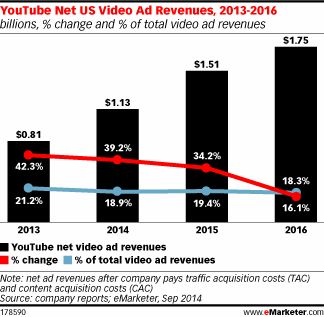
YouTube pioneered digital video ad revenue online, and in the most recent figures will bring in some $1.13 billion in digital video ad revenue for 2014, according to eMarketer. That pencils out to 18.9 percent of the total revenue for US digital video ads, which is not too shabby at all. The outlook that eMarketer sees is for YouTubes net video ad revenues to “grow in step with the video ad market overall, and the site won’t increase its market share significantly in the coming years.”

That’s not exactly what YouTube would like to see, but the market for digital video is increasingly competitive. Advertisers certainly like channels on YouTube that deliver nicely segmented audiences, such as beauty tips or gaming, but the reality is that such focused content is also becoming available elsewhere on the Internet. Those places can have more appeal for advertisers than YouTube, because much of YouTube’s content is either too short for advertisers (users won’t stick around long enough to view the ads) or the video is not brand friendly.

Thus, eMarketer’s projections show that AOL and Yahoo will be gaining in digital display revenues by placing ads next to premium video content, the kind of content where viewers will spend much more time. That includes full-length shows, digital shorts and other professionally produced programming.

According to eMarketer, AOL will see US ad display ad revenues grow nearly 20 percent this year, due to the success of AOL’s Adap.tv ad program. Yahoo is seeing its US display ad business drop this year by 3.6 percent, but with a strong push into premium video content this year, that segment is epxected to grow in 2015.

US digital video spending is booming, with 56 percent growth expected this year as the market reaches $5.96 billion. Growth is expected to slow in the next few years, though, dropping to only 13.9 percent in 2018 as the market hits $12.82 billion. Video’s share of digital display ads will continue to grow for the next few years, eMarketer projects, from 21.6 percent of all display ads last year to 30.1 percent in 2018.

Source: eMarketer

Amazon Appstore Could Rival Google Play

Amazon has shown an immense amount of growth with the applications and games available within its Appstore, according to numbers revealed by the company.

The Appstore realized revenue of about $2.5 billion in the last year, which is just about half of Google Play’s estimated $5 billion in earnings. That said, the Amazon Appstore is definitely picking up in popularity, to the point that it’s the most popular third-party one available.

Most of its growth came within the last year, as it showed a 200 percent increased in visitors and downloaders in the past year. With that steady pace, Amazon’s store could easily be on par with Google’s in about three years’ time.

A good deal of this is due to the growth of applications available for download. Amazon has confirmed that the number of available games and other programs have almost tripled over the past year, growing to 240,000. That’s still a ways to go when it comes to reaching Google Play’s 1.3 million and Apple’s 1.2 million, but it’s progress nonetheless.

While it may appear that Google Play is king, general numbers don’t quite equate revenue. Although Google Play did account for 75 percent of mobile app downloads over the past year, it only had $5 billion in revenue, compared to the 18 percent of downloads in the Apple App Store, and its gross revenue of $10 billion.

Amazon’s Appstore actually has larger revenue potential than both stores, according to Developer Economics. Most application developers have a cross-platform approach when it comes to publishing their work. While Amazon is at a lowly 16 percent (compared to Google Play’s 65 percent), its growth could see a shift in numbers in just a year’s time, or maybe a little longer.

Even though Amazon still has a bit of an upward struggle when competing against both Google and Apple, there’s no question that it has the tools and developer support to get the job done. The mobile market is definitely getting more interesting.

Source: Quibb