[a]listdaily is now your source for the hottest job openings for senior management and marketing in games, entertainment and social media. Check here every Wednesday for the latest openings.
Here are this week’s [a]list jobs:
Blizzard – Director, Partnerships and Promotions (Irvine, Calif.)
Nexon Mobile – Director of Marketing (Oakland, Calif.)
Nexon Mobile – Marketing Artist (Oakland, Calif.)
Warner Bros. – Director, Promotions (Burbank, Calif.)
Netflix – Originals Marketing Coordinator (Beverly Hills, Calif.)
The latest forecast from ZenithOptimedia shows that global ad spending is healthy again due in large part to increased adoption of digital media. Digital media is set to rake in over 28 percent of ad spending by 2016, a number that includes both mobile and desktop. This will have increased ad spending in this area by 7 percent since 2013, a large gain in just 3 years’ time.
Of course, the increased attention to digital means that things aren’t looking so hot for traditional media. Print is forecasted to be the hardest hit, dropping 5.2 percent to 19.6 percent of total ad spend. TV, still the largest category looks to lop off 1.3 percent of ad spend to bring it down to 38.3 percent share of ad spend.
In general, however, global ad spend is predicted to grow by 6 percent in just a few years.
With $2 billion in funding from Facebook behind it, the Oculus Rift virtual reality headset is picking up steam. And this past weekend at the Oculus Connect conference, the device made even more waves, not only with the debut of a new prototype, but also a marketplace that will make it easy for developers to sell their games and applications.
Titled the Oculus Platform store, the space will let developers distribute their virtual reality-related goods with ease, and will be released sometime this fall. The virtual site will be compatible with a number of devices, including iOS and Android, Windows Phone, Chrome, Firefox, Safari and Internet Explorer.
Through the Oculus Platform, developers can bypass the “middle man” and build up a suitable library for those who purchase the headset upon its release, providing one convenient stop to offer the best games and other programs.
Along with the debut of a new Crescent Bay prototype headset — which will replace the developmental DK2 headset that’s already been distributed — Oculus Platform is promising big things, allowing visitors to shop in a holodeck-based space with floating tiles featuring different applications. Utilizing a separate Gear VR touchpad, you can make your selections in this space, and then download once the selection is complete. The store won’t be based on any sort of currency system, as it will act as a portal for developers to “give things away for free,” according to Oculus co-founder and VP of Product Nate Mitchell.
“We want to offer developers a way to get feedback on their content as soon as possible,” he said. It will eventually tie into another marketplace where items can be purchased, though that hasn’t been given a release date just yet.
Oculus will utilize the Platform with its own programs, including the forthcoming Oculus Cinema and the photo-supported Oculus 360, but it will mainly be an open door for the community of developers slowly but surely building up for the device.
The Oculus Platform could, ahem, virtually be a dream come true when it debuts this fall.
You just can’t help but get hungry when you see particular food posted through Instagram. It happens all the time, whether it’s a friend showing you what they ate for lunch, or a new restaurant showing off one of its specialty dishes. Now, a new campaign titled #FoodPorn is generating a lot of views for various restaurants – and making people hungry in the process.
Applebee’s is just one of the many restaurants taking part in the campaign, using Fantographer to encourage diners to snap pictures of their meals, or of themselves eating said meals, and picking the best ones to post on its Instagram account, using the sub-label #FoodPorn. The campaign is turning out to be a success, as the restaurant chain has managed to gain 4,500 new followers. That’s a 32 percent increase, with 25 percent engagement.
“People continue to prove that they’re more into the stuff they create versus the stuff we create,” said Shannon Scott, executive director of marketing communications for Applebee’s.
770 images have been submitted thus far, with just under a tenth of them being used on the account. This will give Applebee’s plenty of fresh content to post to the account well into next summer.
Applebee’s isn’t the only company reveling in #FoodPorn success. Taco Bell has managed to reach out to 12.5 million 18-to-44 year olds over a four-week run with its Instagram ads, providing a 29-point incremental raise in the process. Chobani had a smaller yet still significant outreach, with 4 million 18-to-54 year olds interested in its Instagram campaign from mid-March to mid-April this year, with a 7-point incremental lift.
Though spending wasn’t revealed for the programs, they appear to be paying off when it comes to attracting hungry customers – and the trend isn’t dying down soon. McDonald’s Arabia is playing a huge part, even though it’s posting more about the chain’s iconic arched sign rather than actual food, and other restaurants could be playing a part soon as well.
When it comes to mobile gaming, there are millions of players out there playing every day, with the top games boasting hundreds of millions of monthly players. However, when it comes to actual spending in said games, there’s a steady decline that shows no signs of increasing.
A study across millions of gamers by mobile-marketing automation firm Swrve indicates that players who pay for items in mobile games are continuing to drop, down from 1.5 percent earlier in the year to 1.35 percent in July.
Speaking with GamesBeat, Swrve chief strategy officer Hugh Reynolds and Swrve CEO Christopher Dean explained that 62 percent of all mobile game revenues come from approximately 0.13 percent of all players. Considering the immense growth of the mobile gaming market in general, that’s a shocking number. And to some, maybe a harsh wake-up call, since most developers rely on purchases in free-to-play titles to make ends meet.
“This shows how game companies are dependent on a small group of people who are paying the bills,” said Reynolds. He also pointed out that more consideration should go the way of new users, especially considering that a great number of them don’t provide any given revenue to the game.
Within those numbers, approximately 18.4 percent of unit sales and 32.3 percent of revenue are split with the $10 to $20 that’s spent on a monthly basis. Those numbers are actually increased from earlier in the year, where they sat at 8.2 percent and 22.4 percent, respectively.
The monthly average spent on an app, for those who do invest, is $24.93, which is nearly a $3 increase from back in January. The average player does usually invest about three times a month, with each purchase around $8.35 a pop.
Out of all paying gamers, approximately 50 percent only make one key purchase a month, while a much lower 16 percent invest five times or higher in purchases.
“These findings stress once again just how important it is to consider retention and conversion — rather than simply acquisition — when it comes to building a successful mobile business,” said Dean. “With such a significant percentage of revenues coming from a small base, it is essential to both attempt to increase that number with smart in-game campaigns but also identify your most important players and personalize their experience.
“One interesting finding was the growth in ‘mid-tier’ SKUs [stock-keeping units]. The data suggest that users are more willing than ever before to make relatively significant one-off in-app purchases in mobile and that developers should start to consider this type of purchase as core to their business.”
Reynolds concluded, “You have to identify the people who generate revenues, understand those people, build a relationship with them, and give them the marketing campaigns and user experience that they expect.”
While the Xbox One has seen a successful launch in many regions around the world – including the U.S., where it continues to be a hot seller – there are some regions where it’s still running into trouble. The system is selling very slowly in Japan; less than 30,000 Xbox Ones were sold in the first week, compared to over 300,000 units for both the Wii U and the PS4 in their opening weeks. Now, a mere handful of days before the announced launch date for China, Microsoft has opted to move the launch of the console in China to the end of the month.
Originally due for release on September 23rd, the system was already reaching out to a large audience, as over 100,000 customers pre-ordered it in time for its release. The company confirmed the delay this past Saturday, indicating that it will release instead the following week, on September 30th.
However, Microsoft won’t leave those loyal gamers hanging, as it has promised that several bonuses will be offered for the delay. These could be in the form of various game releases, although it hasn’t confirmed just what it’s giving away yet. (In the past, both Sony and Nintendo have provided games for players who had trouble with their services, or felt “robbed” when a deal wasn’t quite worth what it was originally intended.
The progress towards the launch of the Xbox One has been “strong and steady,” according to Microsoft, but unspecified circumstances led to delay the launch, to sometime “by the end of this year.” The company still intends to hold a special event that ties in with the launch, where 100 attendees could win systems, but, sadly, they’ll have to wait about a week to pick up their prizes.
It seems as if Microsoft could miss a big opportunity with the launch on Chinese shelves, as Sony currently had no immediate plans to release the PlayStation 4 in that market. That’s not to say it’ll never release, but the company’s prior experience on the market – a poorly performing PlayStation 2 release back in 2004 – probably has the team acting a little more carefully this time around.
It’ll be interesting to see how the Xbox One performs overseas once it finally releases later in the year. And if Sony will try to take advantage of Microsoft’s delays in the Chinese market.
Showtime, the premium channel that airs an exclusive amount of programming, is no stranger to diverse ad campaigns. Last year, in an effort to push its original series Ray Donovan, the company introduced takeover ads that featured banner and full-page displays, which played video clips from the show. However, it’s about to outdo itself with an explosive new application – and boy, do we mean explosive.
Promoting the fourth season of the hit show Homeland (which will return to the channel on October 5), a new mobile ad campaign will premiere on Android devices today. With it, a new feature called tactile effects will be put in play, using the motors within Android devices to trigger physical vibrations during the playing of a video.
So, in other words, when a bomb goes off during the trailer, users will actually feel the effects of said bomb through a quick vibration. As you can see in the trailer below, this could have quite an effect when it comes to utilizing the right kind of advertising.
Sadly, the ad effects are only limited to Android devices at this time, as iPhones do not have the same built-in vibration technology as those devices.
Showtime has purchased the advertising inventory in Slate’s application to advertise the show over a four-week campaign, and is also offering the video presentation through its own Showtime application, which can be found under the “Coming Soon” tab.
This approach to advertising marks the first instance where actual mobile technology – in this case, the motors – are used on an interactive level with a trailer. And you can bet that, if it’s successful, it certainly won’t be the last.
What do you think Is the usage of mobile technology a boost for advertising, or do you believe it’ll come across more as an annoyance
The Tokyo Game Show is taking place this week, drawing thousands of attendees to see the latest and greatest to come out of the Land of the Rising Show. The event is of great interest to U.S. audiences as well, as a number of these releases will be making their way to our shores eventually.
So what were some of the better stories to emerge from the show this week
First up, Square Enix finally unveiled a new trailer for its forthcoming PS4/Xbox One title Final Fantasy XV. In the trailer, a new number of cast members are introduced, as well as a visionary new engine that looks to be the best yet for the series.
On top of that, another Final Fantasy project, Type-O, will be released in Japan this March, as well as other regions, and will also come with a playable demo for Final Fantasy XV. There’s word that it’ll have a price attached, although it hasn’t been finalized just yet.
Considering Final Fantasy‘s popularity with the role-playing community, this should be a big seller across the board when it finally releases sometime next year.
D4: Dark Dreams Don’t Die, the latest project from heralded Deadly Premonition producer Swery, has made its debut on Xbox One, a surprise coming out of left field from Microsoft Studios. The game is available for download now for $14.99 (which includes the prologue and two episodes) and includes support for both regular controllers and the Kinect device.
It’s a quirky game, to be sure, but one that shows Microsoft’s latest attempt to reach out to a Japanese audience, despite lackluster sales of the Xbox One in that region.
Bloodborne is the latest game from the Dark Souls developers at From Software, and during Tokyo Game Show, it was given an official release date of February 6 for all markets. In addition, a special edition of the game was introduced, featuring a Steelbook case, art book, and downloadable soundtrack for $79.99.
The Dark Souls franchise has had quite an appeal to the “hardcore” gaming audience, so there’s no question that Bloodborne should have similar results next year.
Finally, one of the Tokyo Game Show’s most popular games turned out to be Konami’s highly anticipated Metal Gear Solid V: The Phantom Pain. In addition to the game getting a 2015 release date for PlayStation 4 and Xbox One, Hideo Kojima, the series’ producer and director, also confirmed that a clothing line called the Metal Gear Collection 2014 would soon debut, featuring items for both men and women, as well as a new Solid Snake collectible figure and a special iDroid phone case.
Metal Gear Solid will also make its presence known in the forthcoming PlayStation 3/4 exclusive LittleBigPlanet 3, featuring a number of special costumes and missions based within the Konami series’ universe. That game is slated for release this November.
Everyone likes a good bundle deal when it comes to purchasing games. After all, Humble Bundle does them all the time, providing good deals while giving a good amount of money to charity. Now, Apple device owners can get in on the action with a special bundle service of their own.
With the debut of iOS8 yesterday, Apple has introduced a new section to the App Store called Bundles, which gives developers the chance to offer a multitude of apps with a single purchase.
These bundles feature a number of apps and/or games that can be purchased in one shot, such as a bundle for the Cut the Rope puzzle games going for a cheap $3.99 — nearly a $7 savings over buying the games individually. Some of the bundles are a bit more expensive than others — Square Enix’s Final Fantasy package is currently selling for $70 — but they still provide savings nevertheless.
The Bundles feature should enable publishers to boost sales (and overall installs) for a number of products in their lines, offering a discount in return for getting more titles. It’s classic marketing, now (finally) available in the App Store.
However, with the new service, according to GigaOm, there’s potential for developers to provide a new way to offer mobile software to someone’s device, enabling them to do multiple installs of programs instead of one big program. (Considering that the iOS8 update in itself takes 2.8 GB to install, some people can easily relate to that.)
Using mobile deep linking, the separate programs can easily install together into an operating system, and then join together into an application to run smoothly, just as it would with a singular download. This could be a nice alternative to those app makers that want to provide convenience to users downloading bigger games, such as Bioshock, which clocks in at over 1.5 GB — which could take a while to download depending on the strength of the user’s network.
What do you think Could bundling make it more convenient to download apps to your mobile device Or do you prefer the single, lengthy downloads as you prefer them now
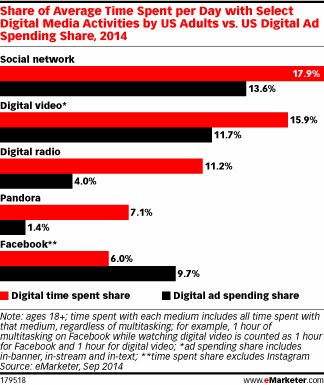
Facebook is really going all out to get advertising going in a good way on its site, between sponsored links and other ads appearing on the page. However, it appears that ad revenue is exceeding the time spent by users on the site, according to a report from eMarketer.
Figures report that US adults spent approximately 21 minutes each day on Facebook (averaged across all adults), which accounts for just one-third of the time they spent on social networks in general. Out of those, 6 percent use a digital device of some sort, with 2.8 percent have an overall average daily time spent with media. This is actually an increase, as eMarketer reports that the time spent with major media in general has seen an increase, to nearly 12 1/2 hours for this year alone.
As small a number as that seems, 52.8 percent of U.S. adults — nearly 130 million people — log in to Facebook at least once a month for the year, with the average time of 39 minutes being spent daily on it. That accounts for 38.1 percent time spent on social networks in general.
When it comes to the spending side of things, nearly 10 percent of U.S. digital ad spending goes directly to the sight. Considering that the average time of 5 hours and 46 minutes is spent on the site, some might see that as profitable. However, only 30.5 percent believe that major media ad spending should go towards digital channels.
With services used, 15.9 percent of adult digital time will be utilized by video, compared to 11.7 percent of advertisers’ spending. Online radio programming managed to maintain an 11.2 percentage of time spent, with a comparable 4 percent of digital advertising. Outside of Facebook, those numbers show a slight bit of change, with 11.9 percent of digital time spent and 3.9 percent of digital ad revenues.
These numbers have shown incredible growth over the past few years. Back in 2010, only 14 minutes were spent on a daily basis on YouTube, with 28.5 percent of the general social time space.
It’ll be interesting to see how these numbers increase (or decrease) in the months ahead.