SuperData Report: De-Risking Game Development

SuperData is a research firm for the games industry that’s doing more than just looking at sales numbers. The game industry has been evolving rapidly in the last few years, with new business models emerging in a virtual Cambrian Explosion of forms, building on the revolutions wrought by digital distribution and the rise of smartphones and tablets as the leading gaming platform.

All of this rapid change has been difficult for game companies to manage, and SuperData took a detailed look at the UK game development community in order to see how various companies are coping with the evolution of the games industry.

The introduction to the study noted this: “It is tempting to think that the emergence of new technologies and platforms has rendered useless all wisdom regarding markets and industries. Yet, in spite of the spectacular ascension of mobile games as a key entertainment market, valued at $21 billion in 2014E worldwide, many of the same principles apply. For instance, the increasingly crowded mobile and social games markets now demand a strong and properly-funded marketing strategy, much like the traditional retail-based games business. Similarly, audiences have come to expect more sophisticated game play even from relatively simple games. In total, this amounts to an increase in development costs and, consequently, risk.”

SuperData’s study found four key areas for game developers that together comprise the company’s business model. The four areas are customers, partners, platforms, and revenue models.
While the most well-known game companies are the ones that create games to sell to consumers (either directly or through distribution partners), many smaller developers subsist partially or wholly through developing games for hire. Large game publishers don’t necessarily have all the staff they need to create every game, so some projects are given to small developers. In the past this was the classic way development studios got started — a few people would break away from a big publisher, form a studio, and get contracts to (usually) create ports of a game from one platform to another. Eventually, having proven themselves over time, such a studio might be hired to produce an original title under contract. Some of the best studios eventually became publishers themselves, or more often were purchased by large publishers.

SuperData found that for the studios they spoke to, 36 percent had consumers as their main customer, 27 percent sold to businesses primarily, and 37 percent said both were an equal part of their business. Diversifying your revenue streams is a good way to reduce risk, though the danger is that the company may lose focus and be less effective at either or both types of business as a result.

Now, though, the model can be different. The advent of digital distribution means developers can market games directly to consumers without the need for a sales force or the capital to build inventory. Still, there’s plenty of risk in that undertaking.

Partners are a key strategic consideration, SuperData notes, and one that’s important in reducing risk. Building strong relationships with other businesses is crucial to success, and to reducing risk. Not surprisingly, studios focused on partners that provide access to markets as being very important to them. This might be platform holders (as in working with Steam or Apple’s App Store) or it might be publishers. In some cases it’s licensing partners or even media partners, as some studios have found that including media partners in sports games is a great way to help promote the games.
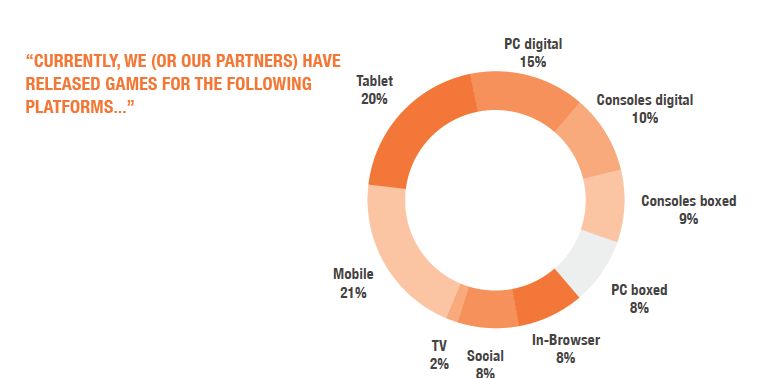
The platform mix is one area that’s changing rapidly for game studios. The massive growth of tablets, and the device’s suitability for games, is no doubt responsible for the 136 percent growth of that platform in the past two year’s for the survey respondents. Social grew 67 percent, which may surprise some given the drubbing social games have taken in the media (and some high-profile declines like Zynga). Yet social platforms like Facebook are still a good business, and a relatively easy platform to work with (as well as having low technical requirements). Mobile has gained 50 percent, and PC digital 46 percent, while browser-based games have grown 22 percent. Digital console games are flat, while boxed digital games have dropped 8 percent as a target platform, and PC boxed games have dropped 2 percent.

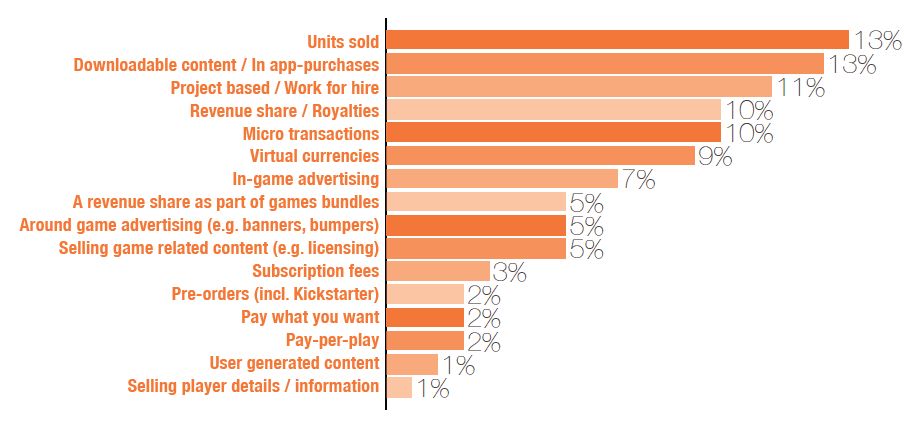
The revenue model, or monetization, is “where the game industry has really innovated over the last few years,” SuperData’s study proclaims. Indeed, the diversity in exactly how games make money these days is vast and often bewildering. Most firms are not relying on any single on revenue stream in particular, SuperData found. Quartic Llama, an independent developer, mentioned that in order “to reduce the risk, we operate using a number of models depending on the game.” While this approach is not appropriate for everyone, SuperData points out, “it highlights the adaptability required in an unpredictable marketplace.”

Interestingly, the most popular way to generate revenue among the UK companies surveyed is by selling boxed games. As the study notes, “Despite the emphasis in industry publications on the shift to digital, selling units is still the backbone of game revenue in the UK, in combination with selling downloadable content. This is, however, changing, with an AAA console studio positing that ‘the market is moving away from high price point console titles.'” As you might expect, the study found that for most independent developers the goal is to get out of the work-for-hire cycle and create their own original titles.

Summary

SuperData noted in its summation that “The advent of digital distribution channels is changing the gaming industry. Specifically, it is changing how UK games companies’ define and operationalize business models. Indeed, 63 percent of our respondents changed their business models in response to the changing landscape — a shift in power structure, a massive increase in competition and a decoupling of content from physical information carriers resulting in more possibilities to generate income and longer product life-cycles. The overall trend we are seeing is a greater emphasis on business model configurations that attempt to de-risk a company’s actions and outputs.”

It’s important to realize that there is no one correct answer for all companies. Different businesses have different strengths and weaknesses, and the essence of a good strategy is taking advantage of your strengths and minimizing your weaknesses. There are many more choices available to developers these days in all areas, from customers to partners, from platforms to revenue generation. That’s both good and bad, as it means the chance of finding a successful strategy is greater, but it’s also far more difficult because so many more variables are involved.

It’s important for game developers to stay on top of changes in the business and continually gather information — and that’s part of the reason that companies like SuperData, and for that matter [a]listdaily, are in this business.

Google Talks About Mobile Search Challenges

Mobile search plays a big part in today’s industry, and context is a vital part of it. eMarketer recently had a chance to speak with Jason Spero, vice president of performance media at Google, about just how much it weighs on the company, with the challenges that come from it.

The first thing Spero addressed is just how much mobile search has changed in the industry overall. “In the last 12 to 18 months, we’ve gotten smarter about the consumer,” he explained. “Before even talking about search, you have to talk about mobile behavior. Search isn’t just happening in your living room, your office or in the coffee shop. We’re connected when we’re in the mall, when we’re commuting or walking down the street looking for something, and that changes consumer behavior.

Jason Spero

“We spend a lot of time trying to understand, and frankly are still trying to understand, the changing consumer behavior and how we see that through the search lens. The first step is knowing the consumer is always connected. Location and context play a massive role in what creative they’re going to respond to, what types of problems they’re trying to solve and what types of things marketers need to think about when they engage them,” he continued.

Spero also explained how typed-in searches are far easier to perform than voice-activated ones, thanks to an easier input mechanism, although the company is making a big investment in making it easier to comprehend on mobile devices down the road.

“Right now most of our energy is going into understanding context and how we can serve better ads with context,” said Spero. “We have to get smarter about context, formats and about what touchscreens mean — that’s where the lion’s share of our energy is. Currently, Google Now is an add-on to search. It’s not something that has had a material impact that I’ve seen on search behavior. It’s highly complementary, and I expect that that’s where it will end up.”

As far as the biggest driving point of mobile search, Spero summed it up easily. “For all the voice search and fancy stuff that we can do with location targeting, and all the progress we’ve made with cross-device, the biggest driver of mobile search is customers getting smarter about the user experience. Marketers have largely been slow to understand what consumers want when they’re on these devices. However, we’re seeing a lot of good work going on now. It’s not necessarily sexy to talk about mobile websites and building great experiences, but that’s the biggest catalyst, and that’s where we’re putting a lot of our time,” he concluded.

PlayStation 4 Drops Price In U.K.

Microsoft has already made some big moves for the holiday season when it comes to its Xbox One. The company announced a $50 price drop that’s already started to take affect this week across its various bundles, although Sony has yet to retaliate. However, in the United Kingdom, it appears GameStop is already making moves.

MCVUK is reporting that the popular retail site has begun selling the special white edition of Sony’s PlayStation 4 console for under £300. This comes just days after Sony matched Microsoft’s price offer on its Xbox One systems overseas, dropping it to £329.99.

Sony does have a lot of third-party titles for the system this holiday season, including Assassin’s Creed: Unity, which will feature exclusive content, and Call of Duty: Advanced Warfare. However, when it comes to first-party titles, it’s a little shorthanded in comparison to Microsoft.

Where that company has such big exclusives as Sunset Overdrive and Halo: The Master Chief Collection (which arrives next week), Sony merely has DriveClub, a racing game that’s run into its fair share of online problems over the past few weeks, and LittleBigPlanet 3, which will feature a multiplayer twist and arrive later this month. Outside of that, the company’s bigger titles, like Bloodborne and The Order: 1886, aren’t slated to arrive until February this year.

With this in mind, GameStop is probably just looking to get more PS4 units into homes — and it’s a move that could very well be a console pricing war here to the States. Although Sony Computer Entertainment of America hasn’t made a matching offer with its PlayStation 4 in this market just yet, there’s still time within the holiday season for it to announce its own price drop, or perhaps even a special bundle to even the odds — like the Destiny one it introduced a couple of months ago.

It’ll be interesting to see where the pricing battle goes from here, especially now that we’re in the thick of the holiday game releases.

Media And Tech Brands Rule YouTube

Data from Pixability shows what overall brand activity on YouTube is looking like. Media and technology are strongly a part of the growth of branded content on YouTube, while other verticals are now catching up, seeing leaps in content growth to be where the action is.

It’s clear that home supplies, financial services, transportation and energy are very interested in growing their cache on YouTube, while existing brand leaders on YouTube are not slowing down content growth.

Videos published growth

When taking a look at the top performing brands on YouTube, it is interesting to note how many YouTube channels they command. While Apple only has 1 channel, brands like Disney and Nike each have 41.

Top brand view gains

Monthly video views for these top 100 global brands as delineated by Interbrand also show immense growth in branded video viewership.

Top 100 brands total monthly views

YouTuber SeaNanners Forms New Type Of MCN

By Sahil Patel

Adam Montoya, a prominent gaming creator on YouTube who goes by the name of SeaNanners (4.9 million subscribers), has formed a new multi-channel network that he claims will do things differently.

Called Jetpak, the focus of the MCN is to provide the same type of services to creators that other networks on YouTube claim to, but without all of the “one-sided” terms that favor the MCN more than the creator.

Specifically, Jetpak says it will be different in three ways: Instead of revenue-sharing arrangements based on the size of a creator’s audience, all deals with Jetpak will be based on the flat rates of any of the services the creator signs up for; all those deals will also be available on a non-exclusive, month-to-month basis, rather than exclusive multi-year contracts; and Jetpak promises to be fully transparent about the revenue a creator’s channel is generating, and the amount it collects.

Read more…

This article was originally posted on VideoInk and is reposted on [a]listdaily via a partnership with the news publication, which is the online video industry’s go-to source for breaking news, features, and industry analysis. Follow VideoInk on Twitter @VideoInkNews, or subscribe via thevideoink.com for the latest news and stories, delivered right to your inbox.

Facebook And Google Dominate U.S. Apps

Mobile applications are everywhere. They’re quite popular on both Android and iOS-powered devices, including smartphones and tablets. They provide a convenient way to reach out to others through social media, as well as engage in video and audio services with a few touches of the swipe screen. But which ones are the most popular in the United States

Statista has provided a top ten list of the most popular apps, and, to no surprise, Facebook and Google are certainly amongst the power players.

As you can see from the chart below, Facebook easily leads the charge, with approximately 72.6 percent of mobile users engaging with the site. That’s quite a percentage, considering there are millions and millions of devices available, both in smartphone and tablet form.

YouTube is a bit distant in second place, but still has more than 50 percent users on board with its services. Google Play, which serves as a key outlet to download popular games and apps, is in third with 45.6 percent.

From there, it’s a bit of a horse race amongst most of the other companies. Google Search has a comfy fourth place spot with 44.4 percent; Pandora Radio’s services reach out to 43.7 percent of users in fifth place; Facebook Messenger actually has a decent popularity rate (despite being what some users call a needless separation from the main site) with 41.6 percent in sixth; Google Maps’ seventh place slot with 40.6 percent is well over Apple Maps’ 27.7 tenth place position; Gmail continues to attract users in eighth place with 37.6 percent; and Instagram has a solid following in ninth place with 29.3 percent.

With prominent places on this list, Google and Facebook have had no problem cleaning up the cash amongst mobile users and advertisers alike, and it doesn’t appear that their presence in the top ten list will go away anytime soon, if at all. In fact, the only two companies that don’t have association with those two are Pandora Radio and Apple Maps.

Turtle Beach’s HyperSound Attacks Retail

The video game headphone accessory market is certainly picking up, with several players like Astro Gaming, SteelSeries and others offering a number of products for gamers to enjoy. However, Turtle Beach’s latest campaign may have taken the cake, as the company has launched a new program with HyperSound Virtual Reality Audio Zones that will truly involve those who give it a shot.

Tied in with retail displays for Activision’s recently released Call of Duty: Advanced Warfare, Turtle Beach has set these up at 987 various Best Buy locations across the United States. With it, users are able to experience a zone of audio created within the display, utilizing HyperSound audio backed by a sub-woofer – so that they can hear the experience along with feeling it as they play.

“This marquee implementation of HyperSound will change the way retailers think about retail audio,” said Rodney Schutt, SVP and General Manager of HyperSound. “This is the first, large-scale implementation of a new generation of retail audio that is unlike anything that has been done before.”

With HyperSound, Turtle Beach vows to deliver its most in-depth audio experience yet, with a three-dimensional experience created similar to that of surround sound headsets.

The displays promise to be the most prominent yet for a game accessory company, and it certainly helps that Turtle Beach has tied in one of the most popular releases of the year, Advanced Warfare, to demonstrate said technology.

With the program, Turtle Beach hopes that the displays provide a site-specific, targeted point-of-sale messaging for the retailer, according to the company’s press release. It can also provide increased engagement and dwell time amongst consumers, having them stick around to get the entire experience that only something like HyperSound could provide with said display. In addition, the way that the controlled sound zone is set up, it won’t distract other audio experiences within the store, like, say, in Best Buy’s car stereo department. But those within earshot will, obviously, get the gist of what the technology is about.

Those interested in HyperSound can learn more over at Turtle Beach’s website.

This Week’s [a]list Jobs – November 5th

[a]listdaily is now your source for the hottest job openings for senior management and marketing in games, entertainment and social media. Check here every Wednesday for the latest openings.

Sitting all day ruining your posture Here are 5 ways to incorporate yoga in the workplace and how to work at a desk without destroying your body.

Here are this week’s [a]list jobs:

  • Electronic Arts – Senior Director, Global Marketing (Orlando, Florida)
  • Google – Head of Industry, Media and Entertainment Vertical (Los Angeles, Calif.)
  • NBCUniversal – Director, Global Brand Marketing for TV (Universal City, Calif.)
  • Kabam – Director of User Acquisition Marketing (San Francisco, Calif.)

For last week’s [a]list jobs, click here.

Apps Often Ignored, Study Shows

It’s interesting how some applications work. They’re there to provide a service to consumers, but, in a surprising twist, many downloaders actually keep the apps on their devices without actually using them. That’s according to Nielsen research numbers.

The study, posted on Clickz, indicates that around 42 apps are available on an average smartphone device, downloaded by the user. However, out of the 3,700+ users that were polled for both smartphone and tablet usage over a 30-day period, 84 percent actually use less than 10 of these apps on a daily basis, while 55 percent stated that they only use between one and four on a daily basis.

In addition, paid apps aren’t nearly as popular as unpaid ones, as 47 percent of those polled indicated that they wouldn’t pay for social networking, discounting or coupon services, or any sort of payment-related programs.

Ben Leventhal, a co-founder and chief executive officer for restaurant reservation app Resy, explained that apps need to offer something unique and valuable for consumers to use them more often. “The only apps I use are the ones that feel like magic, whether that means getting me a car or an impossible restaurant reservation in 30 seconds or allowing me to watch a news event halfway around the world in real time,” he explained. “The apps that stay on my home screen are either profoundly useful or help me connect with the world.”

Leventhal also showed concern that a great number of these apps don’t show significant value. “Every app promises to do something amazing and show us the future, which sounds great,” he said. “But most are over-promising by a mile, so they disappoint us, and we forget about them.”

Meanwhile, Jason Levy, senior vice president of engagement strategy and innovation at Saatchi & Saatchi Wellness, expressed that “bad apps” aren’t helping the matter. “People are just making bad apps that just aren’t necessary or apps that are better served as a mobile website,” Levy says.

Such items, like a car’s instruction manual, wouldn’t exactly make for a “must-store” app on a phone, although Levy believes it can find value as a mobile site. “So rarely is that information needed that it’s just going to sit on a way back page if it doesn’t get deleted. Meanwhile if [the owner’s manual] is online for the very rare instance you need it, the information would make a lot of sense as a mobile website.

However, when it comes to building proper apps, Levy believes that it should be done the right way, and not necessarily a gimmick that tries to rip off, for instance, Angry Birds. “If you’re a consumer packaged good, and you’re trying to come up with a time-killing app, you’re going up against people whose core business and the way they’ve monetized themselves is creating time-killers, and you’re going to get crushed,” says Levy.

Oculus VR Headset Arriving In ‘Months’

For years, the Oculus VR kit has been in development, perfecting its 3D virtual reality technology and receiving some heavy backing from Facebook, which invested $2 billion to properly fund it. But the real question is, when can we expect to buy it Well, according to Oculus VR CEO Brendan iribe, not too much longer now.

The Next Web reports that Iribe, speaking at the Web Summit 2014 in Dublin, explained that the consumer-ready version of the headset is “close,” and while he didn’t give an accurate time frame of when to expect it, the latest version of the headset, dubbed Crescent Bay, is “largely finalized for a consumer product.”

However, the packaging still has a ways to go. “We’re all hungry for it to happen,” explained Iribe. “We’re getting very close. It’s months, not years, away, but many months.”

An effective input device is still being sought for the headset, and certain equipment, like keyboards and mice, aren’t quite up to snuff yet, according to iribe. But it’s definitely a work in progress.

Iribe also discussed the changes to the company since Facebook acquired it earlier this year, with over 200 employees working on the headset, and a separate R & D division also providing a great deal of effort.

When asked about rivaling VR products from Samsung and other companies, Iribe only showed concern in them effectively delivering the experience. “We’re a little worried about bigger companies putting out products that aren’t ready,” he explained. “Disorientation and motion sickness is the elephant in the room. We’re encouraging big companies not to put out a product before it’s ready.”

As far as readying the Oculus for consumer launch, Iribe simply concluded, “We’re gone out there and set this bar and said, ‘We want to get this right.’ We don’t want it to be four or five years. We’re eager for this to happen.”