Gatorade Pays Tribute To Derek Jeter

Baseball’s going to have an awfully big void to fill next year, as “The Captain,” Derek Jeter, is leaving the New York Yankees after this season. It’s an iconic career that’s worth celebrating – as Nike did earlier this year with its star-studded “Captain” ad – and now Gatorade has taken its turn in tributing the legendary player.

A new 90-second ad featuring Jeter taking a leisurely walk to the ballpark for the last time, and greeting various fans and others in the process, was released on YouTube before the weekend, and has already managed to garner over two million views in the process. You can watch it in its entirety below, set to the tune of Frank Sinatra’s “My Way.”

With over 10,000 likes (and a few dislikes from Boston Red Sox fans, obviously), the video has become a big hit – and a fine tribute to the departing Jeter.

What’s great about the ad is that, for a Gatorade ad, it focuses more on the player than the brand. In fact, save for the last two seconds of the commercial, it doesn’t even show any hint of Gatorade whatsoever.

Throughout the 90-second clip, Jeter greets a variety of people, including kids on the street, a general manager of a local bar called Stan’s (in which Jeter happily leaves an autograph on a nearby picture), an artist’s mural and more. Like always, he takes it in stride, with a smile on his face.

And of course, the ad concludes with him standing in Yankee Stadium, tipping his hat to the crowd for a final time.

YouTube won’t be the only spot it airs, either, as it aired this past weekend on the YES Network and Fox. As far as filming for it goes, Gatorade simply “roped off a few blocks before a home game in the Bronx this July and ‘just kind of let Jeter go’,” said Molly Carter, Gatorade’s senior director of consumer engagement. The video ads, combined with a print campaign, were a “true collaboration between Derek and Gatorade.”

At a time when sports sponsorships are in question, it’s good to see some companies can stay true to the topic.

Happy retirement, Mr. Jeter.

Source: Mediapost


The Fate of ‘Destiny’

It’s been a roller-coaster couple of weeks for Activision with Destiny, as the hotly-anticipated title shipped in record-setting numbers… then earned lackluster reviews from most reviewers. This has already had some heavy financial implications for Activision, and it may even affect the fortunes of Sony and Microsoft this fall. The fate of Destiny is still unclear, but the ripple effects may be even more important in the long run.

Let’s examine what happened with Destiny‘s launch. After the title was revealed, Activision CEO Bobby Kotick said in an earnings call that Activision is spending $500 million on Destiny. (He was referring to the total budget over time for development and marketing combined, and probably for the several ‘sequels’ that Activision has contracted for as well.) After months of laudatory coverage in the games media, Destiny was well received at E3, Gamescom, and PAX. Activision pulled out all the stops to promote the title, and even arranged for a special Destiny bundle edition of the PS4 in ‘glacier white’ along with some exclusive DLC to showcase the launch of the game. At the game’s launch on September 9, Activision proudly announced that Destiny had sold-in $500 million worth of Destiny to retailers. This was hailed as the largest sell-in of any new IP in history for the game industry.

Expectations met reality that week as the reviews began to be posted. By the weekend, all the major game sites had reviewed Destiny, with varying degrees of disappointment. The Metacritic score currently sits at 77, with a user rating of 6.6. Customers were also complaining about a distressing (and baffling) lack of customer service, and generally many were feeling disappointed because the content was not as rich as was expected. The end-game raids hadn’t yet appeared, and many finished the game and felt like there was little left to do.

These numbers were below expectations by analysts like Michael Pachter, who was expecting scores in the 80s or 90s. By Monday, Activision’s stock was taking a beating, and the share price finished down about 8.5 percent by Tuesday, losing over $1 billion in value from the company’s market capitalization. Ironically, that’s more than twice the retail value of the Destiny sell-in, and more than twice what Activision has been planning to spend on the franchise.

Activision announced on Monday that Destiny has sold through some $325 million worth of product to consumers, meaning that there’s still a considerable amount of inventory in the channel. Overall, Destiny sell-in exceeded Pachter’s expectations while sales where in-line with what he expected, meaning that the final quarter of the year may see a little lower sales than was predicted.

What does all this mean for Activision Probably not much in the long term, even though the game may not have performed at the high end of the hopes Activision entertained. The problems identified in the reviews and the customers mostly centered around lack of content, which will be readily solved as Bungie labors to build more content for the franchise. Tweaks in AI, and perhaps some better scripting on the story content, can also be readily made. The core game engine and combat controls are widely acclaimed, and that’s one of the most difficult parts to get right. Destiny has a firm foundation, by all reports, even if some of the rooms aren’t finished and the paint job needs some touchups. Long-term, the game will probably become the billion dollar franchise that Activision wants, but it’s going to require a lot of work.

The greater impact of Destiny‘s merely achieving low Earth orbit instead of escape velocity in its initial few months may be on the console battle between Sony and Microsoft. Short-term it puts Sony’s holiday success in doubt, and gives Microsoft an opening to reclaim the #1 selling console slot in the USA.

Destiny looked to many people like a Sony exclusive, due to the special PS4 Destiny edition, exclusive PS4 content, and a lot of marketing spending by both Sony and Activision. Activision’s strategy appeared all along to be to “give” Destiny to Sony and Call of Duty: Advanced Warfare to Microsoft. At least, that’s how it looked at E3, Gamescom and beyond, given which games Sony and Microsoft were featuring. There’s a special Xbox One edition coming out soon based around Call of Duty: Advanced Warfare. Sony was quite probably hoping that Destiny would drive PS4 sales more than Xbox One sales.

Now it’s a good possibility that Destiny will prove to be successful, yet not capable of driving hardware sales for Sony this holiday season the way it may have if the game were more enthusiastically received. The more standard success of Destiny won’t be pushing more PS4s, as word spreads among players that Destiny isn’t yet the universe-shattering hit they were looking for.

This leaves Microsoft looking better than ever for the holiday season, as Sony’s biggest potential system-sellers (top exclusive titles) have all moved into 2015. Microsoft has Sunset Overdrive coming soon, but the real driver for holiday sales of the Xbox One is going to be Halo: The Master Chief Collection. That title should do well, but according to Michael Pachter Microsoft isn’t leaving anything to chance. At GamesBeat, Pachter proclaimed that Microsoft has a killer promotion planned for the fall, and advised people to hold off on buying an Xbox One right now until that’s announced.

We’re likely to see at least some sort of free game offer from Microsoft, since that doesn’t add much to their costs, similar to the free game offered during the Destiny introduction week. Sony probably won’t be napping, either, and will no doubt respond with a promotion of their own if Microsoft looks to gain too much ground.

Ultimately, it really doesn’t make a difference to either Sony or Microsoft’s earnings if one company or the other is tops in sales. Both companies are doing very well with new console sales. The issue of which company is #1 in a given month is really one of those measurement contests that execs often indulge in, and you can bet the rulers are being readied at both companies to see who has the bigger sales this holiday season.

Destiny‘s eventual fate will most likely be a strong success, as it joins other key Activision franchises in the billion-dollar club. In the short term, though, Destiny may help Microsoft gain some ground in the console wars — an interesting side effect no one predicted six months ago.

Consumer Product Research Shifts From Tablet To Smartphone

A new report from mobile advertising platform NinthDecimal shows some interesting insights into how the mobile audience shops and engages with ads. In the space of just a year, consumers have changed how they research products, shifting from tablet to smartphone as their “window shopping” device of choice.

The Q2 report presents a number of findings that show consumers are carefully planning out shopping trips by making sure they research retail items beforehand at home and at work and just how effective mobile ads are when it comes to influencing product purchase.


Source: MarketingLand

Marriott Introducing Immersive 4D Travel Experience

While the physical idea of a transporter hasn’t been created yet (sorry, Star Trek fans), Marriott is prepared to offer the next best thing, with an announcement that will virtually take their guests places.

Marriott Hotels has announced that it has partnered with Academy Award-winning Framestore to create a new virtual travel experience, powered in a fully immersive 4D format supplied by Oculus Rift headsets. (Oculus Rift is considered the leader in the forthcoming virtual reality race, as Facebook has invested $2 billion in the technology.)

With the new program, travelers can step into the virtual Teleporter, a space that resembles a phone booth, and slip on an Oculus Rift headset to experience another location, creating an experience similar to “being there” – even when they’re not.

Framestore, experienced in the field of video effects and creative content, teamed up with marketing agency Relevent to create the virtual reality experience, working in conjunction with the Oculus Rift tech. To do so, it needed to create a technique for recapturing 3D live-action video in a 360-degree format, and then mixing imagery with CGI and 4D elements, including heat, wind and mist, to complete said experience. Users interested in learning more can visit the official Travel Brilliantly page, or watch the video below.

“Marriott Hotels is pioneering the use of innovative technologies that will transform the guest experience to heights unseen in the current reality experience in unprecedented ways, “said Michael Dail, vice president, Marriott Hotels Brand Marketing. “Marriott seized on virtual reality and teleportation to give the next generation of travelers the clear cut notion that more amazing travel experiences are coming and to encourage them to co-create the future of travel with us on TravelBrilliantly.com, where their best ideas enter Marriott’s innovation pipeline. Together, we are pushing the limits of what is possible.”

The Teleporter will tour eight different Marriott locations, ranging from New York to San Francisco, between September and November, before being rolled out as an official program.

What do you think Are you willing to give the Transporter a try You don’t even have to have Scotty beam you up!

Retail Apps Popular, But Not For Purchases

Mobile apps made by retailers are great to have on hand when users are seeking information and checking up other details that could lead to a purchase. However, when it comes to actually buying something, there’s a different story at play.

A new report from a March 2014 polling by Forrester Consulting (commissioned by Tapjoy) shows that more than one-third of US smartphone users like using a retail app on a weekly basis. However, according to a June 2014 poll by 451 Research, they’re not being used for purchases.

With the study, it’s been learned that only one-quarter of these phone users actually make a purchase through these retail applications.

Furthermore, the weight of those not interested in buying items through the apps compared to those who are is much greater. 54 percent of those polled have no interest in making purchases that way, while one-fifth believe that there is some interest.

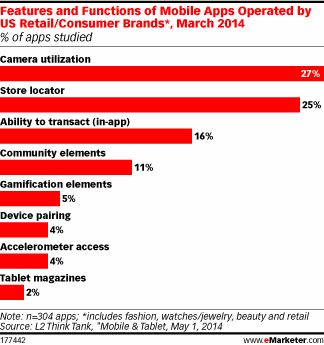
However, keep in mind that not all applications available provide the option of an online purchase. A March 2014 report by L2 Think Thank indicates that only 16 percent of the applications studied — amongst US retail and consumer brands — provide the option to make a purchase.

Another study by the e-tailing group looked at mobile features within these retail apps for further details. 31 percent offer some form of iPhone application, while 25 percent offer both an application for Android and iPad. Meanwhile, 14 percent utilize other resources, and 6 percent aim for the BlackBerry audience.

Security could have something to do with these findings, with recent data leaks by Target and Home Depot over the past few months that have left people wondering just what aspects of purchases are safe. That could lead them to making purchases in stores instead, even if they’re still using the same credit card information they could have over the app.

Again, not every retailer is grasping the process of utilizing in-app purchases for goods, even though some, like Best Buy, provide a local pick-up option out of convenience, rather than home delivery.

What do you think Would you make a purchase through an application if you had the chance, or stick with a good old-fashioned in-store purchase

Source: eMarketer

Image source

Zynga Shuffles Management Team

There’s a lot of shuffling going on over at Zynga, the publishers of such popular mobile efforts as Farmville 2: Country Escape and the recently launched Looney Tunes Dash.

Both senior vice president of games Tim LeTourneau and Steve Parkis have departed the company, after working on a number of Zynga’s Ville games over the past few years. This follows other recent departures from the company, including Social Slots chief Maytal Olsha, who left last month.

This is part of the changing landscape of the company, particularly with Alex Garden being recruited as president and seeking out certain roles to fill within it, such as visuals, narrative, community and game making.

With that, the company has shuffled around some old faces and hired a few new ones to keep management flowing. Jamie Davies, who served as a key leader on Farmville and Country Escape, has now expanded her role as the new vice president of games.

Meanwhile, Tony Leech, who directed and helped produce a number of movies over the last decade (including the animated Hoodwinked films), has been hired as creative director.

Jim Pearson has also jumped on board as a new art director for the Ville franchise, bringing his experience as an art director and production designer for Toy Story 2, as well as a sketch artist on Finding Nemo. His resume also includes Ironworks/Gazillion, Playdom, Kabam and Disney Interactive.

Two of the new hires come from entertainment start-up company Red Robot Labs, and Zynga has brought in the company’s co-founder, Pete Hawley, as general manager and vice president of creative, as well as senior director of network content John Davison.

The last two hires make it a well-rounded team overall, between Julian Widdows and Catherine Silvestre, both of whom will serve as general managers for the NaturalMotion engine. Both bring varied experience to their roles, including Widdows’ work at Codemasters Racing and Silvestre’s work at Warner Bros. and Glu Mobile.

Clearly, Zynga is intending to create a broad range of products, and is staffing up with talent to enable that vision. We certainly wish the new faces joining up the best of luck!

Source: VentureBeat

GX3 Convention Celebrates LGBT Gaming Community

There are various types of gamers out there, from hardcore Destiny players to casual Tetris fans. There’s also a large group of gamers that are either gay or lesbian, and the yearly Gaymer convention recognizes these folks, looking to celebrate the LGBT lifestyle within the gaming community.

It’s not always easy though, as GaymerX creator Matt Conn reflected. “It was really tough growing up as both geek and gay,” he said. “I remember growing up, being super geeky, and I had to leave schools because I was so bullied and it was just really bad. And that was when I was like 9 or 10. So when I came to terms with my sexuality, I was so afraid: My life was already kinda not great, if I have to deal with being gay on top of that, I feel like I’m condemning myself to a life of shittiness.”

Through communities like Gaygamer.net and Reddit’s r/gaymers, Conn noticed an outpouring for a convention of its own, thus his creating of GaymerX. The convention, since renamed GX: Everyone Games – is about inclusiveness in general, and not specifically about revolving LGBT issues. In other words, everyone is invited to come and play, even though it focuses primarily on a unique kind of community.

There’s a need for certain communities to feel safer,” said Mattie Brice, a game developer, media critic and former GaymerX panelist. “To feel explicitly welcome. And I think a lot of people don’t realize what is needed for people to feel welcome.

“There’s a lot of things baked into gamer culture that make it unwelcome for certain kinds of people, and because that’s what ‘gamer’ is, our mainstream conferences don’t address those types of qualities, traditions, and attitudes,” Brice said. “GaymerX does.”

For the next show in the convention series, GX3, Conn took to Kickstarter in an effort to raise funds for it. The community donated in droves, driving past the initial $80,000 goal and clearing nearly $90,000 in its final hours yesterday. This isn’t the first time that the convention has turned to Kickstarter for support, but this is easily its strongest yet.

As far as why the show exists, Conn kept it simple in terms of explanation. “The reason why GX exists is that a lot of people don’t feel safe,” Conn said. “Whether it be at other conventions, or online, or within the gaming community in general.” He compared recent incidents surrounding Zoe Quinn and Anita Sarkeesian, as well as certain security policies regarding the highly popular PAX events.

“Even if you completely disagree with everything someone says, they’re still human,” Conn said, “and these people treat them as if they’re not human. They set up these organized campaigns to discredit them or harass them—it’s just cruel, and I don’t get it. This isn’t slavery. We’re not talking about embezzling millions of dollars. We’re not killing people. This is videogames. We all have that commonality. I don’t understand why people can’t just treat people with respect.”

To learn more about GaymerX, check out the video above, or check out the KickStarter page.

Source: Wired

Double Fine Ready To Try Publishing

Sometimes, a partnership between a game developer and a publisher doesn’t quite come to fruition as some people believe. Many developers that have teamed up with a “big” publisher have seen small dividends as a result, or sometimes even gotten to the point that it had to shut down because the project was too big for its own good (like with Factor 5 and its doomed Lair PlayStation 3 game).

That may be part of the reason why Double Fine has opted to launch a new publishing arm to its company. The long-time developer, responsible for such games as Broken Age, Psychonauts and the forthcoming Costume Quest 2, is giving game publishing a shot under the name Double Fine Presents, even though that wasn’t really a part of the company’s original vision.

Most of the growth into a publishing company came from the company’s various team ups with other developers, shared booths at game conventions and the special “Game Jam” events that have drawn in hundreds of gamers, according to senior publishing manager Greg Rice. “The cool thing about Double Fine Presents is it doesn’t stem from any financial reason,” he said. “Having other people around is stimulating for our dev team, so it really stemmed from a desire to keep working with other developers, and we decided to formalize it a bit.”

Along with publishing its own wares, Double Fine Presents will also help out other independent developers with a variety of services, including feedback on game design, help with public relations, marketing, distribution and more. It can also lend its expertise on Kickstarter campaigns, since Broken Age stemmed from a highly popular one.

“It’s a totally piecemeal thing,” Rice said. “That’s the hard thing with a lot of publisher relationships — they’re offering you a set package. For us, I feel like it’s more about identifying games and teams that we’re excited about and working with them to figure out how we can be helpful based on the things we’ve done, the things we have expertise in, and the things they need.”

The company has already published a handful of games, including Escape Goat 2, Mountain and Gang Beasts, and intends to reach out to release several more, helping “indies” out in the process. “They were like, we don’t want to be a publisher. We want to help you with what you need, and we want to assist with the people we have,” says Ian Stoker, the creator of Escape Goat 2. “We were finishing the game and they offered a really good deal. They helped us with visibility, and we could leave at any time.”

With a 10 percent cut of a game’s earnings, Double Fine Presents hopes to be fair to publishers, as that’s a far lesser cut than the 60-70 percent most take in the industry. “Hopefully it’ll just mean more and more people start doing these kinds of things and helping each other out,” Rice says. “Ultimately, we want the power in the hands of developers so they can make the games they want to make.”

Source: Polygon

Music Apps Grabbing More Time

Spotify, Pandora, Rdio and Beats Music remain great to-go sources to listening to your favorite tunes on the go, but when it comes to earning profits, some wonder if the sites will have a long life ahead. After all, Spotify hasn’t really posted a profit in some time, and Pandora’s wavers from month-to-month.

However, there’s potential for huge growth, according to numbers provided by Localytics. Between the period of August 2013 and this month, the average time spent with music applications has increased dramatically, by 79 percent. That makes music apps the leader of the pack, especially compared to Health and Fitness (with 51 percent) and Social Networking (44.9 percent). Sitting at the bottom of the chart was News, with only a 14 percent increase.

This is mainly due to the increase in total music revenue generated via streaming, with apps everywhere attempting to include digital downloads from iTunes and other services.

As far as the time that apps are used, music also leads, with an estimated 8.9 minutes per session listened to, and applications being launched around 16.3 times per months. That brings a total of 145 minutes, which is ahead of other categories, including social networking, which sits at 63 minutes per month.

This overall growth not only means good news for such sites as Pandora and Spotify, but also the industry in general. That’s not to say artists will be rolling in the dough individually, but interest continues to grow in music apps and that has to be good for the industry. The difficult issue is still how musicians get fairly compensated for all of this time spent with their music, as many have publicly compained about getting very little in return for allowing their music to be streamed.

What do you think Will Spotify and Pandora lead the charge in a better audience for streaming music services, or do you think users will stick to “bigger boys” like iTunes and Amazon for its downloading services

Source: Pando

Amazon Tops List Of Google Search Advertisers

Search advertising is something that can certainly pay off, as millions of users go to Google on a daily basis to find information on something they need right away. So, of course, various retailers will boost said advertising in the hopes of drawing in more consumers – and it appears that online retailer Amazon is leading the pack.

Even though the Amazon site acts as a rival for online ad dollars against Google, it’s managed to spend nearly $158 million on Google U.S. search ads last year, according to a report from Ad Age DataCenter, based on data from AdGooroo, a Kantar Media company that deals with search marketing.

Amazon engages with other sites when it comes to selling search and display ads, which makes it a competitor to Google – thus making the investment of search advertising on its rival’s page a bit more interesting. However, it’s a small price to pay, as Amazon has managed to generate $750 million from worldwide advertising revenue, a number it plans to increase this year to just over $1 billion, according to eMarketer.

The top 25 U.S. search ad buyers alone spent $1.34 billion on generating ads through the Google site alone, including the likes of Priceline Group, AT&T, Expedia and Microsoft rounding out the top five, followed by other companies like Walmart, Comcast and Best Buy, each with values ranging from $38 million to $82.3 million.

Amazon spends quite a bit in general when it comes to search advertising, investing $19.5 million in search ads and $1.2 million in ads for Microsoft’s Bing service for July 2014 alone, according to AdGooroo.

Surprisingly not high on the list, however, are retailers. While mainstays like Wal-Mart, Best Buy and Sears are present, none of them get close to the top five. This is mainly due to the fact that search is the dominant digital-ad format for direct-response advertisers, such as retail brands. However, their costs for said ads is likely to double within the year, according to eMarketer.

Product-search service Google Shopping appears to be a big avenue for these retailers, according to AdGooroo CEO Rich Stokes. “Retailers are underrepresented (in the top-25-search-spenders ranking), but that makes sense because of PLA (or Product Listing Ads),” said Stokes. The company didn’t research spending in this department.

What do you think Is it a little strange that Amazon would spend money through its competitor to gain ad exposure, or is it a solid business practice

Source: AdAge