Amazon Incentivizes App Developers

Amazon, in an effort to increase its Appstore offerings, has announced a new plan that will entice developers to make programs and games specifically built for its marketplace, as well as ones that work with its FireOS operating system and, in turn, Kindle Fire devices.

Called the Appstore Developer Select {link no longer active}, the program provides a number of marketing and promotional tools and benefits for would-be developers, as well as discounts on various web services offered through Amazon. In addition, those who spend $2,000 or more on said services will receive a “cash back” incentive, with a 25 percent kick-back upon reaching that goal.

Any apps in this program will also be added to a new “Appstore Coins Rewards” program, where select programs will be able to return Amazon Coins to consumers who buy make purchases within them. It works as a virtual currency for consumers to make purchases with, in lieu of using a credit card.

In addition, “premium placement” will be a huge benefit in Developer Select, for both the general Appstore and Kindle devices. Ads could also be placed through Kindle lock screens, depending on the nature of it.

Source: TechCrunch

A Bleeping Bar Of Gold

Gold seems to be in for certain people, especially those who buy imitation gold colors on their latest models of the iPhone 5s and the Samsung Galaxy S4. However, only with the HTC One will you be able to get the real thing – yep, a phone made from actual gold.

The Gold HTC One is a limited edition model – we’re talking only five made overall – and they come with a price of 2,750 pounds, or $4,416. The specifications on the device are the same as the original HTC One, but the body is front and back plated with 18 ct gold – so it’s the real thing. Made in conjunction with Goldgenie founder Laban Roomes, it also features a MOBO 18 logo on the back.

So…who wants to buy us a gold phone?

Source: Mashable

‘Madden’ CoachGlass Detailed

The forthcoming Xbox one edition of Madden NFL 25 will introduce players to a new kind of second-screen experience, according to EA Sports.

Titled CoachGlass, the feature will allow players to connect their tablet device to the next-gen game system and utilize “offensive tendencies, personnel groupings, major weapons and suggest defensive plays designed to counter the offense’s biggest strengths,” according to the press release.

Data will also be pulled from various online match-ups, with regular updates to provide streaming content and recommendations to fellow players.

In addition, this data can also be used to “track tendencies at various downs and distances in order to help players predict the opposition’s tendencies, and call plays to defend the part of the field their opponent is likely to attack.”

Browsing through previous plays and taking advantage of co-op options – including a defensive coordinator position for the second player – will also be available.

Madden NFL 25 ships on November 19 for Xbox One, three days before the system’s launch. The CoachGlass service should be available once the system arrives.

Source: VG247

Mad Catz M.O.J.O. Console Slated

Originally unveiled at E3 this year, Mad Catz’ Android-powered M.O.J.O. console is about to make waves in the holiday market.

The company announced today that the game, a “keystone product” for the team, will release on December 10 “in limited quantities,” for the price of $249.99. The company is currently accepting pre-orders on its website.

“The M.O.J.O. Micro-Console for Android has attracted strong interest due to its high-performance hardware, open software platform and the ecosystem of accessories,” said Darren Richardson, the President and Chief Executive Officer of Mad Catz Interactive, Inc. “M.O.J.O. is the center piece of our GameSmart mobile initiative and brings core gaming experiences to the mobile platform.”

The specifications for M.O.J.O. are as follows:

an NVIDIA Tegra 4 T40S 1.8GHz Processor, 2GB RAM

16GB internal storage

HDMI out capabilities with full 1080p resolution

Bluetooth

microSD Flash Slot with Support for SDXC Cards up to 128GB

Wi-Fi 802.11 a/b/g/n

Android 4.2.2 operating system

It also comes with a controller, specifically built for gaming purposes.

Source: GamesIndustry International

Better Boost Your PC For Next ‘Call Of Duty’

Nvidia has released the necessary requirements to get a PC to run Activision’s  forthcoming first-person shooter Call of Duty: Ghosts – and it’s a whopper.

According to Nvidia’s specs, you’ll need the following to get the game up and running:

OS: Windows 7 64-Bit / Windows 8 64-Bit
CPU: Intel Core 2 Duo E8200 2.66 GHZ / AMD Phenom X3 8750 2.4 GHZ or better
RAM: 6GB RAM
HDD: 50GB Hard Drive space
Video: Nvidia GeForce GTX 550 Ti / ATI Radeon HD 5870 or better
Sound: DirectX Compatible Sound Card
DirectX 11
Internet: Broadband connection and service required for Multiplayer Connectivity. Internet connection required for activation.

Activision hasn’t commented on why the game requires 50 GB of hard drive space, but that’s enormous; a complete World of Warcraft installation (including all expansions) is around 35 GB, by way of comparison. Meanwhile, Nvidia has recommended a Nvidia GeForce GTX 780 as well. No word yet if the console versions of the game will require any sort of minimum install as well.

Call of Duty: Ghosts releases on November 5 for Xbox 360, PlayStation 3, Wii U and PC, and later in the month for PlayStation 4 and Xbox One.

Source: Gamespot

This Week’s [a]list Jobs – October 9

The world is full of willing people, some willing to work, the rest willing to let them. – Robert Frost

Here are this week’s [a]list jobs:

[a]list daily is your source for the hottest job openings for senior management and marketing in games, entertainment and social media.

To see last week’s jobs, click here.

The eSports Explosion

By Joost van Dreunen, Superdata

In the last few years, eSports have emerged as one of the fastest-growing segments of the digital games markets. Worldwide viewership has exploded from 8.4 million in 2010 to a projected 50 million this year, and tournament prize money has increased 2,200 percent since 1999.

Recently the U.S. government began granting visas to professional gamers, underlying the potential for this growing market. But the real opportunity in eSports is its tremendous audience engagement and unique user demographic of 18 to 34 year old males. We believe this is the best touchpoint for advertisers and marketers to reach the coveted gamer audience today.

Where social and mobile games have made interactive entertainment a mainstay for the casual audience, eSports provide a unique platform for hardcore gamers to play and compete together.


Rebel To ‘Storm The Gates’ Via Kickstarter

Rebel Entertainment is an online game studio in Burbank, California, comprised of veterans from Disney, Zynga, Atari, Insomniac, Electronic Arts and other companies. Rebel is a division of IAC, the media giant (2012 revenue: $2.8 billion) that owns sites ranging from Ask.com to CollegeHumor.com to Vimeo to The Daily Beast. Rebel’s first game, Dungeon Rampage, is an online action-RPG available of Facebook, Kongregate, and at DugeonRampage.com. Rebel’s newest project is Storm the Gates, and the company is turning to Kickstarter in order to launch the game.

Why should a division of a major company turn to crowdfunding to bring a game to market The [a]list daily spoke with Rebel CEO Mike Goslin to find out the answer.

“Storm the Gates is cross-platform and multiplayer,”said Goslin. “It’s a very ambitious game in terms of bringing new kinds of gameplay to tablet and cross-platform. It’s also targeting more of a core audience, although it’s pretty accessible, with a lot of depth and a lot of competitive play.” Goslin notes that the game is turn-based, but you don’t have to wait around for people to make their moves. “We’re really trying to accommodate people’s schedules,” Goslin noted. He added, “We do have a head-to-head strictly turn-based mode” which will appeal to people who want a more immediate sense of combat. The game is set in what Goslin calls a “rich fantasy world” with orcs and humans battling for control, and new races planned for expansions.

The game sounds like it’s got key features that players are looking for: mobile platforms, cross-platform, easy to pick up but with a lot of depth. So why does Rebel need to turn to Kickstarter to get the game on the market?

“A little bit of it is opportunistic,” said Goslin. “We were founded by IAC as our single large investor, and we did Dungeon Rampage under that circumstance. We started development on this game and got pretty far along, it was pretty close to being launched, when IAC decided it wanted to scaled down their investment in games, including us. We were left with a game that was mostly done, and although we could have gone out and done traditional funding for it, we thought that it was almost done and we’d like to find out how well the game does before we go out and raise more traditional kind of VC or other investment money.”

Goslin continued, “We thought we’d try Kickstarter because they give us more flexibility on what we’d do with the game. We’re also intrigued by by the idea of crowdfunding rather than going with a tradition publisher or investor. It’s not proven yet whether you can do a game like this for the platforms we’re doing it for, so it’s relatively high risk but also high reward. So we though we would benefit from having more control if we could essentially fund it through Kickstarter and our own means.”
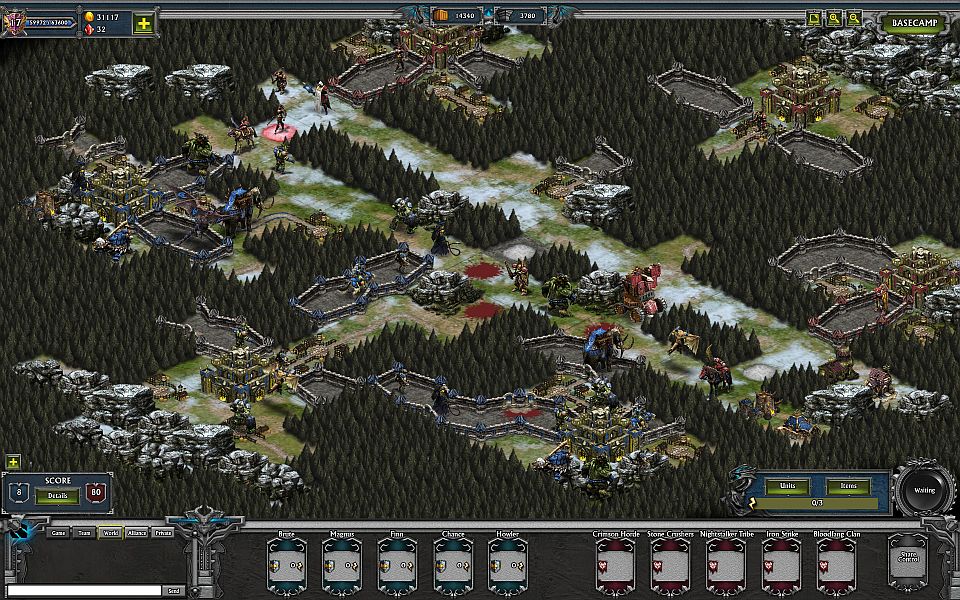
The game is targeted for Android and iOS tablets, then will arrive on PC and ultimately for Facebook as well. “It is playable on a smartphone, but it’s a better experience on a tablet,” said Goslin. “It’s nice to be able to access it from your phone too, because you might want to just send a message to your teammates or make a few moves. One of the things that sets this game apart from other strategy games is you can play team multiplayer, up to five versus five (against other players or against AI). This creates some amazing, epic confrontations when you’ve got teams going up against each other on a big board.”

Storm the Gates is designed as a free-to-play game, where you can use money to buy more moves — but only up to a point. “We wanted to balance it so it’s not a pay to win experience,” said Goslin. “You can only use a certain number of special items, and thatt won’t guarantee victory.” Most of the monetization is around collecting units, or ones that allow you to team up in a complementary way, Goslin explained.

The game is already far along in development, with testing having been ongoing for a year. “We’re prepared to launch within weeks after the Kickstarter closes,” said Goslin. “We’ll do the Kickstarter for 30 days and we probably need two to three weeks after that before we can launch. We’re thinking definitely fall.”

One of the things designers like Chris Roberts say they have gotten from crowdfunding is feedback on the design. “The core audience for this game is heavily represented in the Kickstarter community, so it’s a great vehicle for us to both gauge interest from that core audience and get feedback on what they want to see in the game,” said Goslin. “We have a lot of content that’s in advanced stages of production, but we can choose to focus on some or others based on feedback we’re getting during the Kickstarter.”

So far, the Storm the Gates Kickstarter is moving slowly. It’s still under $5,000 pledged towards a goal of $400,000 after nearly a week, which does not exhibit the kind of early enthusiasm needed to propel successful Kickstarters. It’s a tough audience there, with many games vying for attention and pledges. Rebel may need to seek alternative ways to bring its new game to market and build the audience for it. It seems these days a good Kickstarter campaign needs a good pre-campaign effort in order to hit the ground running, adding to the time, complexity, and difficulty of successful Kickstarters. There are no easy paths to getting a game to market.

Steam Machine Specs Will Vary

Those lucky 300 users who will participate in a beta test for Valve’s Steam Machines later this year won’t have to worry about the company “nailing down” a specific design for the platform. It appears that it’s playing around with various ideas, and sending out different models to each of the users.

Among these units, some will feature various components in a “mix and match” variety. Some will include a Nvidia GTX 660 processor, while others will have a GTX-760 and the new Titan. In addition, CPU’s will also be varied, between the Intel i7-4770, the i5-4570 and the 83. The specifics don’t always need to stay this way either, as users can swap out parts however they please.

“The prototype machine is a high-end, high-performance box, build out of off-the-shelf PC parts,” stated Valve about the equipment. “It is also fully upgradeable, allowing any user to swap out the GPU, hard drive, CPU, even the motherboard if you really want to.

“Apart from the custom enclosure, anyone can go and build exactly the same machine by shopping for components and assembling it themselves. And we expect that at least a few people will do just that. (We’ll also share the source CAD files for our enclosure, in case people want to replicate it as well.)

The full specs are as follows…

GPU: some units with NVidia Titan, some GTX780, some GTX760, and some GTX660
CPU: some boxes with Intel : i7-4770, some i5-4570, and some i3
RAM: 16GB DDR3-1600 (CPU), 3GB DDR5 (GPU)
Storage: 1TB/8GB Hybrid SSHD

Power Supply: Internal 450w 80Plus Gold

The Steam Machines beta test will begin later this year.

Source: MCV UK

3D Tactile Touch For Mobile Screens

Disney Research continues to work on innovative tools in the electronic age, and this week it unveiled yet another one that’s on the horizon.

The company is currently working on a new technology that enables a sense of friction that, in turn, creates an artificial sense of texture. As a result, users think they’re “feeling” an object that isn’t really there, like if they’re looking at an object on a mobile device.

It’s all based around algorithms, as users would generate levels of friction that match how a finger would feel on something if they were touching an object in real life.

“Our brain perceives the 3D bump on a surface mostly from information that it receives via skin stretching,” said Interaction Group director Ivan Poupyrev in a statement. “Therefore, if we can artificially stretch skin on a finger as it slides on the touch screen, the brain will be fooled into thinking an actual physical bump is on a touch screen even though the touch surface is completely smooth.”


Poupyrev continued, “Touch interaction has become the standard for smartphones, tablets and even desktop computers, so designing algorithms that can convert the visual content into believable tactile sensations has immense potential for enriching the user experience. We believe our algorithm will make it possible to render rich tactile information over visual content and that this will lead to new applications for tactile displays.”Source: GigaOm