South Korea’s Mobile Growth

South Korea is a huge market when it comes to mobile gaming, with over 33 million active smartphones and tablets. Keep in mind that’s only 2.8 percent of the entire worldwide connected device market — but still many devices and a savvy audience.

That’s mainly due to the approaching saturation of said market, and the fact that it’s close to home for Samsung, a company that’s thriving with its mobile devices. On top of that, it’s also the place where various domestic firms use connectivity with said devices, as well as a fair share of “phablet” (phone/tablet) fans.

The installed base of connected devices grew by 81 percent over the last twelve months, ending in August 2013, according to a Flurry report. By comparison, the South Korean market only shows a 17 percent growth, but it’s expanding in other ways. That particular country’s market has a more rapid growth in general, with Samsung controlling approximately two-thirds of its mobile market in itself. It sits at around 60 percent, compared to Apple having only 14 percent and LG just slightly above that with 15.

Games are the leading app category for both Android and iOS devices. Interestingly, iOS devices are often used for entertainment, while Android devices rarely are. Other interesting stats can be found at the Flurry blog.

Source: Flurry

Fight With Attitude

When most folks sit down to play fighting games like Street Fighter IV or Mortal Kombat, they use a conventional game controller to execute special moves and beat their opponents. However, for the Wii U, a development team has a new concept on how its fighting game will work with Fighter Attitude – through gestures.

Jorge Mijangos, a member of the Kaveluza team, explained that Nintendo has accepted the team for game development, and it’s hard at work on Attitude’s unconventional control style, which will use the system’s Gamepad to execute moves in certain ways.


Originally released for mobile devices, Attitude is similar in set-up to EA Sports’ Fight Night series, where players will use swipes and flicks to determine how on-screen actions work, instead of just hitting a button. This means swiping up for a punch or some other special attack, and moving a different way to try something else. This introduces a new kind of skill set that everyone – not just fighting masters – can get into.

There’s no word on release yet, but don’t be surprised if Fighter Attitude knocks its way to the eShop sometime in 2014.

Source: Cinema Blend

Games Hit New Peak In Middle East

The tremendous expansion of the gaming industry in the past decade has been a product of the increasing reach of the Internet, the explosion of mobile devices, and the global spread of these two factors. One of the strongest growth regions for games has been the Middle East and North Africa region (MENA), with a large population that has adopted social media and mobile technology rapidly. Despite political turmoil in some areas, mobile and social games have continued to grow strongly, and one of the leaders in this growth has been Peak Games.

Rina Onur, Peak Games co-founder and CSO

Commenting on Peak Games’ growth, investment bank Digi-Capital’s Founder Tim Merel said, “Peak’s management team continues to drive them from strength to strength, capitalising on deep cultural connections and understanding of their core Turkey/MENA markets. Our experience is that synchronous multiplayer and mobile are key growth drivers for leading games companies globally. Peak’s strength in these markets positions them as one of the most valuable players in Turkey/MENA.”

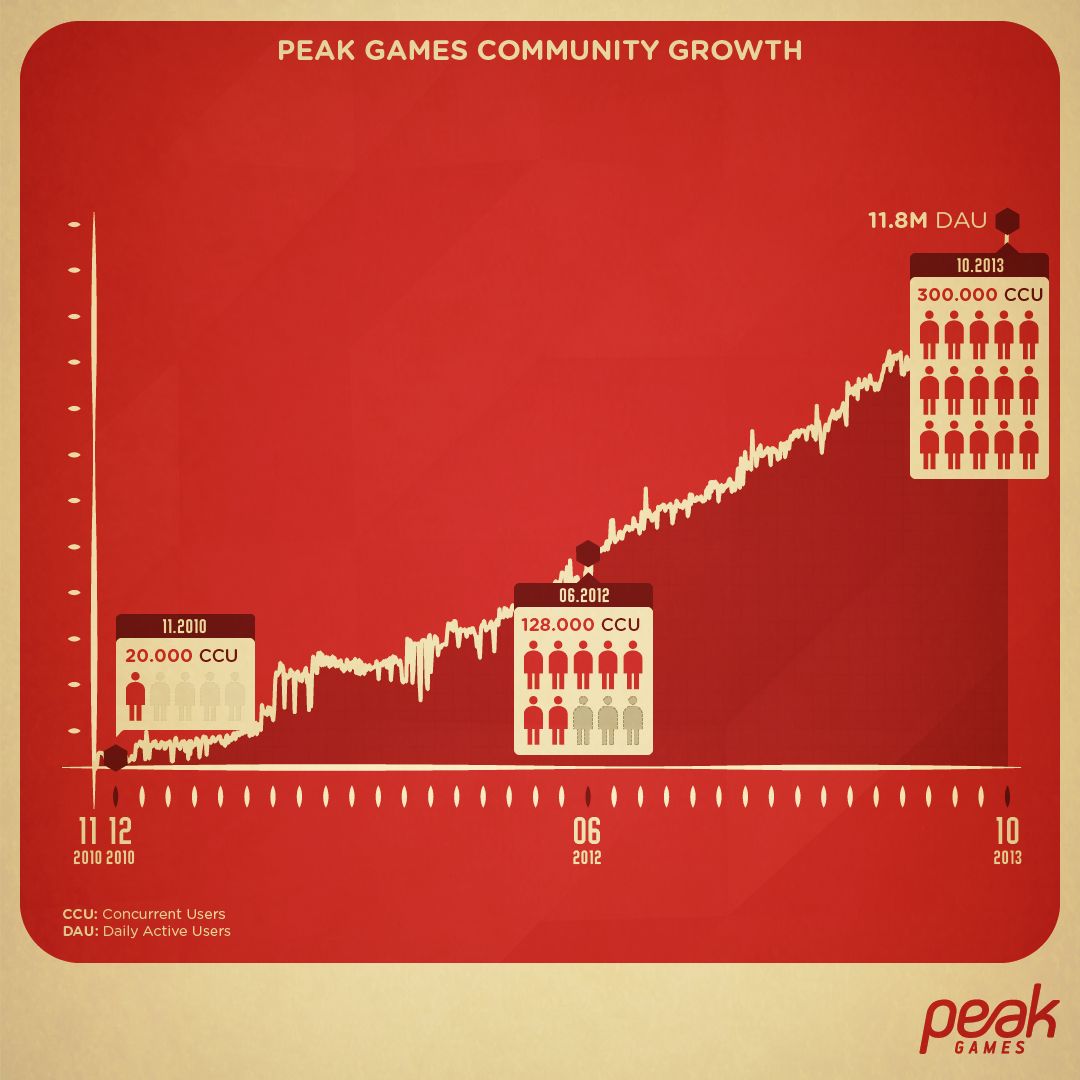
Peak is close to its three year anniversary, and the company is engaging a record setting 300,000 concurrent users (CCU)and 11.8 million daily active users (DAU) across Turkey and MENA. Revenues have grown by 300 percent per year with the huge growth of social and mobile games. Most of Peak’s games are what they term the parlor games genre — traditional and popular board, card and table-top games. These games are, as the company puts it, “focused on the community based, multiplayer and synchronous games that are part of everyday life.”

The [a]list daily spoke with Rina Onur, Peak Games co-founder and chief strategy officer, to find out more about Peak Games and the MENA marketplace. One of the key elements in Peak’s growth has been its choice of game genres. “As a company, we choose to focus on community driven games; games that require active and real-time participation of others to deliver a meaningful play experience,” explained Onur. “Our most popular games are those in the Plus Franchise. They are community driven, multiplayer, synchronous titles and are part of the everyday lifestyle in Turkey.”

The Plus Franchise is on of Peak’s game studios, and focuses on games which are digital renditions of traditional and popular board, card, and tabletop games. “Straight from the heart of local offline game culture, these games have been important parts of daily lives for generations,” said Onur. “The Plus Franchise alone has more than 300,000 concurrent users and includes six different games: Okey, Okey Plus, 101 Plus, Tavla Plus, Batak and Pool Plus. In addition; our flagship mid-core title War of Mercenaries thrives from a dedicated community that is interested in multiplayer combat and empire building.”

Peak sees mobile games making up an increasing share of the business, and they have integrated that into their strategy. “Our cross-platform strategy has been a key part of our growth,” agreed Onur. “As we release new games, they are cross-platform at launch on Facebook, iOS and Android. Mobile versions of some of the most successful games, including Okey Plus and 101 Plus, are consistently in top grossing lists, generating half their revenues from Android and iOS platforms. The strategy of building on communities that are generated around games, requires 24-hour and easy access. That is why a cross-platform strategy that initially started on Facebook, but is now also growing rapidly on smart phones and tablets, is key for us.”

The Middle East region is not, as you might think, dominated by Android devices. “The split between iOS and Android is fairly even with Android growing a bit more quickly and we’re starting to see greater market share in Android,” said Onur. “I think with this story, what we experience in Turkey and MENA is pretty similar to what a lot of Western players are experiencing in North America or Europe. Although the number of Androids are a bit larger, the conversion and ARPPU metrics on iOS are still better compared to Android.”
As is true elsewhere, tablets are becoming more important. “Tablets are increasing in volume rapidly in our region as well. The per user metrics we observe on tablets is extremely encouraging, which makes it an even more exciting opportunity and platform for us,” said Onur. “We have brought our flagship titles to both iOS and Android tablets, which are performing extremely well, so as we continue building community driven games, tablets as a platform, will be a major target for us. At the same time, we have very high hopes for the mobile versions of our mid-core games. We will be launching some exciting new games before the end of this year both for smart phones and tablets. Even though currently, smartphones are over-performing tablets overall — due to the sheer volume of devices that are lying around in the region — we believe tablets will become a significant strategic platform for game developers.”

Onur expects growth to continue in the future. “We consider Turkey a significant player in the MENA region,” said Onur. “Turkey will continue its rapid growth both in terms of Internet and smartphone/tablet penetration. The MENA region has the second highest rate of smartphone shipments out of Asia, so the region is growing like crazy. Following Turkey are Gulf region countries such as Saudi Arabia and Emirates. These countries will continue to grow both on PC and mobile; that’s why opportunities are almost limitless here.”

Facebook Gives ‘Call of Duty’ A Lift

Regardless of what people think about Activision milking the Call of Duty franchise, the publisher gets credit for not short shrifting any of the recent games in the series when it comes to high-profile marketing. For Call of Duty: Ghosts, which releases next month, Activision tapped into paid ads on Facebook mobile, and apparently the effort paid off.

Activision and Facebook released a case study brief highlighting results from the game’s paid ad campaign on Facebook, which they described as targeting users “primarily on mobile.”  According to the study, Facebook helped Activision’s Call of Duty: Ghosts campaign reach 37 percent of all U.S. males aged 18-44, and more than half of them in the 18-24 year old bracket.  The campaign reached 23 million people in total and generated 50 million impressions.  Impressively, more than 85 percent of that reach was on target, delivering the ads to about 20 million males aged 18-44.

The Call of Duty franchise is one of the most recognizable video game franchises.  Activision and Facebook’s statistics also show that the Call of Duty: Ghosts brand was able to get a 14 percent lift in awareness among its 18-44 year old target audience, and a 24 percent lift among 25-34 year olds.

Source: Facebook

Celebrating The Cosplay Holiday

Atlus, the game publisher behind such games as Dragon’s Crown and Shin Megami Tensei IV, has announced the latest iteration of its Atlus-O-Weenie competition, where fans can dress up as characters from its games for a chance to win Amazon gift cards.

Here’s how it works. Starting now and running through November 4, fans can dress up in costumes based on characters from general Atlus games or specific releases such as Etrian Odyssey Untold, Dragon’s Crown and Shin Megami Tensei IV. From there, participants should visit Atlus’ official Facebook page, download the Shortstack application {links no longer active}, and submit their info and pictures. Winners will be chosen through fan voting, which will take place from November 4-11.

The top winner for overall costume will receive a $200 gift card, while the leaders in the other three categories will win $100 gift cards. Four other random winners will also receive $50 gift cards.

Source: Atlus

Microsoft: Xbox-PC Cross-Platform ‘Makes Sense’

Though Microsoft is looking to spread Xbox One multiplayer support exclusively between systems, Phil Spencer, corporate vice president of Microsoft Studios, believes that PC shouldn’t be left out in the cold.

Speaking to AusGamers, Spencer didn’t quite confirm there would be Xbox One-to-PC cross platform play but said it “makes sense,” qualifying his statement with, “I’m not allowed to leak things.”

Microsoft tried the cross-over process before with the 2007 first-person shooter Shadowrun. Spencer painted that effort as a learning experience.

“We didn’t have tremendous success with that, but we learnt a lot from it,” he said.

More recent examples have fared better, including 17-Bit’s Skulls of the Shogun and the Windows 8-Windows Phone release Halo: Spartan Assault, which loosely ties into the Xbox 360 shooter Halo 4.

“This connected ecosystem across all the different devices is definitely where I think the future of gaming is going; you don’t have to do it as a developer, but you have the capability and I think a system like Xbox Live across all those screens where you know who someone is and who their friends are, what their Achievements are and their progression is really critical to that,” said Spencer.

The Xbox One releases on November 22.

Source: Polygon

Kickstarting Another VR Project

Virtual reality seems to be making some kind of comeback, as Oculus VR is currently hard at work on a new 3D headset that will immerse you in each gaming experience. Now, a pair of ex-Valve developers have set up a new company, Technical Illusions, that wants to produce its own virtual reality and augmented reality glasses.

Called the castAR glasses, the technology uses two micro-projectors placed right above each eye. It uses a system that reflects light off of a surface back through the lenses into the viewer’s eyes.  A shutter set-up ensures that each corresponding image matches with each eye, which then creates the virtual effect of seeing the images in 3D in real time.

The creators of the project, Jeri Ellsworth and Rick Johnson, are seeking $400,000 for the project. They have already shown off prototypes across the board, earning both Editor’s Choice and Educator’s Choice at both the New York and Bay Area Maker Fairs. One of their Kickstarter campaign’s bigger rewards, clocking in at $189, guarantees users their own starter kit, complete with glasses and reflective surface. The device is set to ship in September 2014.

The project is doing quite well, already halfway to its goal at $231,000 raised with 31 days to go. You can find more information on the castAR’s Kickstarter page.

Source: GamesIndustry International

Study: Gaming Helps Surgeons Relax

Surgery is tense business, where one person’s life is literally in someone else’s hands, and where even the slightest slip-up could have critical results. Fortunately, some surgeons in a Florida hospital have found a proven effective way to unwind before performing big procedures.

A recent study conducted by Celebration Health hospital in Florida shows that physicians and surgeons who played video games for six minutes prior to taking part in a virtual surgery managed better outcomes with fewer errors. This comes from the Orlando Sentinel {link no longer active}.

The study was conducted by general surgeon Dr. James “Butch” Rosser, who experimented with 300 surgeons and found that half fared better in their procedures after playing games, which included Sega’s Super Monkey Ball, compared to those who did not.

“Surgeons who had played video games in the past for more than three hours per week made 37-percent fewer errors, were 27-percent faster and scored 26-percent better overall than surgeons who never played video games,” the study found. “It is the error reduction that will have the most significant impact on patient safety.”

No word yet if the practice will be tried at other hospitals.

Source: Digital Trends

PC Game Control On Tablets

When users play PC-style games on tablets, they often find themselves held back due to the lack of a keyboard and mouse to control their actions. Sure, touch-screen controls can be useful, but if the experience is better suited to physical controls than the translation to a touch-screen can dampen it, usually adding some complexity to otherwise simple in-game actions. GestureWorks Gameplay thinks it may have a solution.

The company has announced a new virtual touch interface which allows users to recreate the experience of a keyboard and mouse combination using simple inputs. With this set-up, users can create controllers however they see fit with virtual joysticks, buttons, digital pads and swipe gestures, configuring their gameplay experience however they see fit.

The gameplay formats divide up through profiles that users can save for certain games, in addition to providing pre-programmed ones for others. From there, functions can be added and moved about however users please.

The full version of GestureWorks Gameplay is set to launch on November 5 for Windows 8 tablets, going for $14.99. Check out the official website for more information.

Source: Engadget

Google Launches ‘Designed For Tablets’ Apps

With more than 70 million Android tablets activated, the market is certainly thriving, and many of those are larger 7-inch and 10-inch models. Google Play has now launched a “designed for tablets” section to help tablet users better identify which apps have been developed with those more powerful devices and bigger screens in mind. A number of apps featured in the section have already grown in popularity as a result.  One in particular, Remember the Milk, has seen an increase in downloads by 83 percent since being listed there.

Starting next month, Google Play will make a number of changes that will allow users to find these apps with more ease. The update will take place on November 21.  First and foremost, the update will allow users to seek out apps and games made specifically for these larger tablets through a number of categories, including Top Paid, Top Free, Top Grossing, Top New Paid, Top New Free and Trending.

If preferred, users can still look up general apps and games without going into these categories. However, those apps that do not fit the “designed for tablets” criteria will instead be classified as “designed for phones.”

App developers can find the list of criteria to earn the “designed for tablets” moniker at this link.

Source: Android Developers