Google+ Growing Fast

According to a new study commissioned by Janrain, Google+ is now a commanding presence in social when it comes to website sharing and social log-ins. While Facebook is still the leader in social log-ins with 46 percent of traffic, Google+ is catching up quickly with 34 percent of log-ins now using Google+. The next largest players in terms of social log-ins trail well behind, with Yahoo responsible for seven percent of traffic, and Twitter next at six percent.

Google+ currently has more than 500 million registered users and 343 million active users, according to an independent study by GlobalWebIndex. Facebook still leads Google+ in users, but although both are seeing growth Google is growing at a much faster pace. Shares, or in Google’s case +1s, are also growing faster for Google, at a pace of 19 percent per month for Google+ compared to 10 percent for Facebook). Searchmetrics has estimated that by the year 2016, users will be sharing more often on Google+ than Facebook — almost 1.1 trillion +1’s per month compared to 849 billion shares on Facebook.

Source: VentureBeat

Sci-Fi Fan Favorites On Social Media

Recently, entertainment social data firm Starcount compiled an intriguing list of the most popular science-fiction films of all time on social media. From the classics such as the 1958 thriller The Blob and the Star Wars trilogies to this summer’s special effects frenzy Pacific Rim, Starcount is showing how the science-fiction genre has remained one of the most popular and fan-driven film genres.

While the firm’s methods are rooted in data, the subject matter inspired it to take a different approach with how their findings are presented.

“We took inspiration from the glitziest award shows in the world and sorted the films into categories, then worked out who was top in each — what we found was very interesting,” said the firm.

In a surprising finding, Starcount found that the most highly anticipated science-fiction release of this summer, director Guillermodel Toro’s Pacific Rim, is already more popular than the combined social audience for this past spring’s sci-fi blockbuster Oblivion, which starred Tom Cruise, as well as director Neill Blomkamp’s upcoming epic Elysium. Pacific Rim has managed to draw 200,000 more Facebook fans than the other two films combined.

Here’s the breakdown of Starcount’s ‘best sci-fi on social’ winners:

Best Animation

Monsters vs Aliens is the most popular sci-fi animation ever with nearly 2 million Facebook likes — that’s the same number as half of what the film made at the box office during its opening weekend in the UK.

Best TV Show

The most popular science-fiction television show of all-time is Doctor Who, which has over 3 million Facebook likes and 3.5 million YouTube views.

Outstanding Social Performance on an Asian Network

Although shadowed by the overwhelming success of Avatar in 2009, Moon has been a huge hit in China and leads all science-fiction films on Chinese networks with over 600,000 fans on Tencent Weibo.

Best Sequel

Talked about nearly 250,000 times on Facebook and with over 200,000 Twitter followers, Iron Man 3 is the most popular sci-fi sequel ever and the third most popular science-fiction film of all time.

Lifetime Achievement Award

The 1971 classic, A Clockwork Orange, is the 22nd most popular science-fiction film of all time with 2.3 million Facebook likes — astonishing considering that it is at least twenty years older than most of the other films we looked at.

Best Actor

47 million Facebook likes and 36 million YouTube views, the combined equivalent of The Independence Day budget, make Will Smith the most popular sci-fi actor of all time — it’s hard to imagine The Men in Black trilogy and Independence Day without him.

Best Actress

Known for her starring role in Transformers 1 and 2, Megan Fox is the most popular sci-fi actress ever to be on social media. Fox boasts 42 million Facebook likes and nearly 1 million Twitter followers, despite having only tweeted 29 times — that’s 34,482 followers per tweet.

Best of 2013

Having already made the list once, Iron Man 3 is back again. With 15 million Facebook likes and over 200,000 Twitter followers, the third installment of the Iron Man trilogy is the most popular science fiction film of 2013 so far.

Best Science-Fiction Film of All-Time

Winner of three Academy Awards, two BAFTAs and two Golden Globes — Avatar is the most popular sci-fi film so far this century, as well as all-time, with over 42 million Facebook likes and 14 million YouTube views.

Surprised by any of the winners Tell us which movies or actors you would add in the comments below! 

Source: SocialTimes

Brand Takes Advantage Of Jay-Z’s Twitter Frenzy

Yesterday Jay-Z broke the internet by spending an entire day responding to random questions on Twitter.  The influential rap star isn’t known to be active on Twitter, where goes by his real surname Mr. Carter. It was a Q&A that was as amusing as it was unexpected.

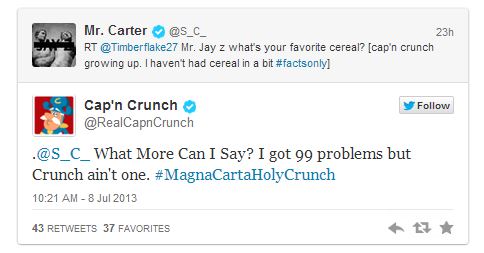
The rapper not only exploded the head of every person he responded to, but favorite brands of “Hova’s,” as he calls himself now and then, were getting shout outs as well. Turns out, Mr. Carter is a major fan of the Quaker Oats cereal Cap n’ Crunch. This tweet laid the foundation for a prime textbook example of a company getting social media right.

The breakfast brand reacted swiftly to the compliment with a witty response referencing one of Jay-Z’s biggest hits, and made a pun out of the new album title in an hashtag.


In fact, the Cap’n has been getting himself quite a bit of buzz lately. This past spring, the Quaker Oats cereal brand cast its mascot as the host of a YouTube talk show, “The Cap’n Crunch Show.” More recently, he came under fire for lying about his rank, since his cartoon uniform actually is that of a commander’s (oh, the internet). The controversy ended up on CNN, The Colbert Report, Late Night with Jimmy Fallon and The Tonight Show with Jay Leno.

Cap’n Crunch capitalized on the absurdity of the situation and released an “official statement” (see below video), poking fun at the fact that he is indeed just a cartoon, and that people are ridiculous for taking things so seriously.


For now, the Cap’n can rest assured that he is in good standing with Queen Bey’s (a.k.a. Beyonce’s) hubby, and for at least today, he has one less problem than he did at breakfast.

Source: Digiday

Vine Tweets Drop, Don’t Go To Instagram

According to new graphs from BuzzFeed, the number of links to Vine videos shared on Twitter has taken a significant dive over the course of the last couple of weeks. The likely culprit is Instagram entering the social video space with the launch of longer format and marketer friendly Instagram Videos. The graph shows that since June 19th in particular, the number of Vine links has taken a significant dive and isn’t beginning to recover.

On June 19th, the day before Instagram Video launched, the number of Vines on Twitter were up at 2.4 million shares. As of July 1st though, shares were only one third of what they were at 794,824 shares, denoting a huge drop off.

What’s odd about the data is that Instagram hasn’t gained any more shares as a result of the drop-off from Vine. It appears to be remaining steady with numbers consistent with its picture-sharing service, despite adding video. With Vine adding a number of features to its service later this year, this may not be the very end for Twitter’s video service, but it will have to act fast if it wants to maintain its user base.

Source: BuzzFeed

Facebook Rolls Out Improved Graph Search

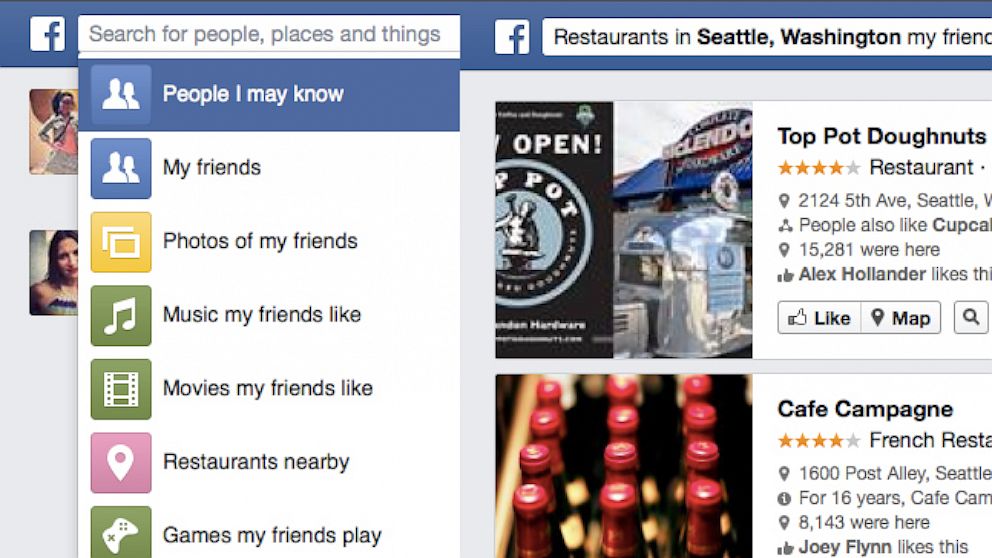
Users who may have grown frustrated with Facebook’s elementary search feature are getting an updated version designed to make it easier to find people, places and photos on the site. Starting today, Facebook is giving US users access to Graph Search, the advanced search feature it announced earlier this year.


Facebook launched beta testing for the new social search tool in the beginning of this year, which for a site with 1.1 billion users meant millions of them having the chance to try it. After more than six months of user testing and feedback, Facebook said it believes the product is ready for the masses. It will be a few weeks before everyone who uses Facebook with the “US English” setting will have the new feature, but several hundreds of millions of people will be getting it this week.

“Over the past few months, tens of millions of people have helped improve the product just by using it and giving feedback,” Facebook says in blog post, which will be published on Monday morning.

The improvements include speed and accuracy with searches. For instance, now when users begin typing in a search they get Google Instant-style suggestions. Unlike searches on Google, Facebook’s tool is most useful in unearthing information about your social circles. Graph Search isn’t for finding recipes or deals on running shoes. It’s to find friends who live in San Francisco who are vegan, friends of friends who live nearby and like hiking, nearby restaurants that your friends like, photos of your boyfriend taken before you met him in 2010, and so on.

“Graph Search isn’t Web search. We aren’t duplicating what Bing does and what Google does, but rather we are making things easier for people to find on Facebook,” Facebook COO Sheryl Sandberg said when asked about the new search function at the All Things D conference earlier this summer.

But making all of Facebook more easily searchable does have privacy repercussions. While user information is only searchable and visible to those they’ve shared it with in the first place, the new tool does make it much easier for your information to be resurfaced. In fact, the internet has already had a field day with exposing embarrassing queries, showing just how much information people reveal about themselves on the site, whether intentionally or not. Care to find out which brand of condoms your friends prefer Graph Search might tell you. The blog actualfacebookgraphsearches.tumblr.com posted a collection of searches ranging from “married people who like prostitutes” to “current employers of people who like racism.” Both produced more than 100 people.

“[Privacy] is something, of course, we care a lot about, and so from the very beginning we made it so that you can only search for the things that you can already see on Facebook,” lead Graph Search engineer Tom Stocky told ABC News when the tool was first previewed in January.

On the ad front, Facebook does not currently show users any ads based on what they are searching for, but the company may do that in the future. As Google has shown, it’s a lucrative business. Research firm eMarketer estimates that Google will take nearly 42 percent of all U.S. digital ad spending this year, well above Facebook’s share of less than seven percent. With its new search tool, the social network is clearly trying to divert traffic and ad spending from its rival. Whether this will work will become clearer as more people begin using it and giving Facebook feedback.

Source: ABC News

Twitter To Roll Out Retargeting Ads

Twitter is making another step toward making their site even more advertiser friendly by experimenting with retargeting technology. Among the technologies being looked at by Twitter is the use of browser cookies to match up Twitter accounts with businesses’ mailing lists to make targeting of ads easier. Twitter’s senior director of product and revenue said about the changes “Users won’t see more ads on Twitter, but they may see better ones.”

Facebook has already begun to use retargeting as a means of reaching out to customers through their in-feed advertising, which has seen a lot of success. By adding services like these to their recently announced location-based advertising and promoted tweets, Twitter is quickly becoming one of the foremost places for social media advertising. Having ads relevant to users, even ads that don’t come across as ads, gets advertisers one step closer to reaching users who may have an interest in a product or service instead of firing blindly in the dark.

These new features can be turned off if a user does not want cookies tracking their computer. Twitter users can opt out by clicking the box for ‘promoted content’ under account settings. By doing this, these features will be disabled. In addition, Twitter also supports Do Not Track, and Twitter’s implementation has been endorsed by the EFF.

Source: TechCrunch

Forbes Told Women What To Wear To E3, Users Tell Forbes Where To Go

Last week Forbes’ Style File section released an article offering fashion advice for women professionals attending E3 (Electronic Entertainment Expo) which has since received a flurry of backlash from females and males in social communities. With an ongoing struggle to fight sexism in the gaming industry still close at bay, contributing fashion writer Kristina Moore seemed to unknowingly feed into the problem which had many users thinking (and hoping) the article had to be satire, but alas, this was intended as no joke.

Users’ main qualms with the article were that the author seemed to completely miss the mark on the pulse of the industry.

“How do you convey credibility in promoting your game, your studio and yourself at the convention in a room full of guys gawking at larger-than-life, theme-park-like attractions and scantily clad ‘booth babes,’ “asked the Moore, which seemed to imply that appearance was the sure fire way to garner that validity. The intended rhetorical question was answered in two fold across social.

“Let me get this straight — not only are women being told that they need to dress a certain way to have any credibility at E3 (definitely not like one of those booth babes! nothing below a scoop neck!), they’re also being told to later dress themselves in a completely ridiculous outfit to fit in,” user Jessy Ellenberger said in the comment thread.

In fact, so many disgruntled users took to social media channels to vent, that Forbes social media manager Kashmir Hill took to the comment thread to offer an explanation. “This article is getting negative feedback in the comments and on social channels. (I manage Forbes social media team, and we’ve alerted the editor of this page.) I think part of the problem here is contextual. The Forbes Style File is a page on Forbes that offers fashion advice to women, mainly in professional settings. Given that filter, it’s on topic to provide clothing suggestions for women attending a male-dominated conference while acknowledging the continuing debate over ‘booth babes’ and the discomfort that results for women in attendance.”

But Hill’s #1reasonwhy the article was topical still could not make up for one commentary in the piece that sent users to vent on social. At one point in the text the author completely misses the mark on the post-apocalyptic term, steam punk, for the genre of style and music, punk. Although, the article has since been updated and that was the first faux pas edited out.

In her defense Moore took to the comment thread to offer her response to the community, “I am a staunch defender of women being all they can be in the professional and business world, and because I am passionate about style, I see it as a tool for empowerment for women. It should be totally their choice of whatever they wear, just as long as it lets them feel self-confident in every situation they find themselves. If they don’t need it as a tool, then that’s their choice. I just see style as a dynamic introductory tool for women (and men).”

All controversy aside, the [a]list daily attended the event (interviews to come!) and did not see too “many bright blazers and neon cross body bags” in attendance.


Source: Forbes

Brands’ Tacky Tactics On Twitter

Advertisers are on a constant pursuit to keep their audiences engaged and interacting on social media. Unfortunately, more often than not, their methods to garner that attention can be well, pretty lame. Recently, Digiday spoke with several brand executives, one who asked to remain anonymous, to weigh in on why the tacky tactics.

“It’s the price to play today,” said the brand anonymous brand exec. “Two years ago, when Twitter was still not a major player for brands, it was easier to be less gimmicky. Today, it’s more difficult.”

Marketers ask for likes, followers and retweets and to tweet out the most nonsensical, cheesy messages. The most disheartening part is that these seemingly desperate tactics actually work on some users.

The proof is in the pudding (see how bad that was ), recently Domino’s tweeted, “RT if you love pizza. No matter how you slice it.”

This tweet got an impressive 260 retweets.

According to Twitter, promoted tweets that ask for replies increase replies by an average of 334 percent, and promoted tweets with an ask to retweet increase retweets by an average of 311 percent. As difficult as it can be, marketers need to understand that it’s not just about the numbers.

Volvo’s CMO makes the point, “Impressions aren’t everything. The quality of the impact, the story you’re telling, and how impactful it is, deserves more attention than the impressions.”

But it’s difficult for brands to see Twitter in this way when they can just pay to have their tweets and hashtags promoted, or they can tell users to retweet and share. If enough people do, the brand trends – making Twitter more of a place where quantity surpasses quality, keeping brands in the realm of cheesy, mindless, self-promotional robots and not anything close to human. And the cycle continues.

But there’s a real concern to this strategy. Taking the cheese ball route can often reflect the type of audience a brand will acquire.

“Asking fans to like if they agree with something obvious is where some brands are falling short — ‘Like if you love sunlight!’ or ‘Like if you love eating!'” said Matt Wurst, director of digital communities at 360i. “If brands practice this behavior too often, they will appeal to the lowest quality of user. By seeking their engagement and ultimately tapping into their social graph (made up of individuals like them), brands may ultimately grow their pages with the wrong people.”

“It’s a tough line to walk [between human and cheesy],” said the brand exec. “Most brands have a tough time being human, because their job is to mitigate risk and deliver shareholder growth, but both of those are at odds with being human — that means it’s safer and easier to act like a company, not like a person.”

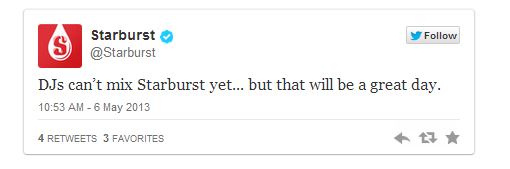
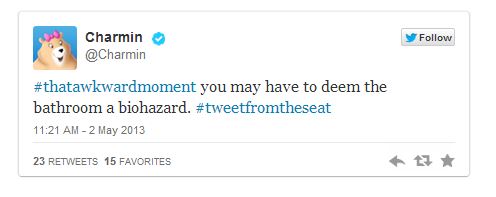
And now, enjoy some tacky tweets:


LOLOLOLOLOL. Not.

…What


Is anyone waiting for that day

This is just gross.


Source: DigidayÂ

Reddit Seeks To Thwart NSA’s Plans With Gifts

NSA has currently been in the news for their controversial, over-reaching efforts to collect data on U.S. citizens. In order to combat the cryptic intelligence agency, Reddit gift exchange has come up with a unique method utilizing keywords to throw off the organization.

One of the ways the NSA collects its data is by tracking a large list of flagged keywords that are common to everyday conversation. Sites like Motherboard.tv’s “Hello, NSA” are fighting back, taking the list of terms and automatically generating phrases using a few of them that users can then post all over the Internet. The goal is to skew data that NSA collects by making these terms less unique to terrorism (if they really were unique to terrorism in the first place.)

Now Reddit has created a social machine to thwart the NSA’s plans. The “front page of the internet’s” idea is to craft a gift exchange around this concept. When users sign up for the exchange, they are given an automatically generated phrase using words from the NSA’s list. They can then paste the phrase anywhere across the web, and they’re also asked to formulate a gift based on the phrase to send to another Redditer through the site’s gift exchange system.

For example, Venture Beat staff writer Tom Cheredar created his phrase which reads, “The world’s most popular condom brands is named after the Trojan army. Is there so-meth-ing sick about that ” From that, Cheredar says he “can expect to get a bag of army camo condoms, a handkerchief, or maybe a bag of blue Breaking Bad crystal meth rock candy.”

“I would probably talk about these gifts in social network updates, blog comments, or maybe even an article,” says Cheredar. “Anyway this is by far one of the most unusual ways to fight back against the NSA. And I would expect nothing less from Reddit.”

Source: VentureBeat


Real World Crafting

If you know a Guild Wars 2 fanatic who has a tendency to tinker with low-level code, kiss that person goodbye for a while. Arenanet is taking a leap beyond the standard player-generated MMO game events to let players actually create tools and apps using data from the game server. That includes mobile apps for iOS and Android.

“We have a team working on exposing some of the code to the player base,” said Arenanet content designer Mike Zadorojny, speaking to MMO game site PC GamesN. “We have APIs the players can tie into. The fans are already working on a Google Maps for Tyria that lets you zoom in and see what’s going on at the individual map level.”

According to the game’s official Wiki, the API allows access to server data that goes well beyond maps and matches. There are ways to access and document world events including those that are still active or about to take place. If the event’s completed, there’s a way to see if it was a success or failure. There’s also data for mapping and documenting what’s been discovered by players in the games, things such as hidden items and recipes for crafting.

Zadorojny has hinted that the effort takes some burden off of Arenanet, letting them see what players can do with the reams of data on hand while their team focuses on real game updates. The developer has been quickening updates from initially once a month to twice monthly content drops. Zadorojny said it’s part of Arenanet’s strategy to make Guild Wars 2 a living MMO world.

“Now we’re seriously looking at how the world changes based on player interaction. That’s why we’ve been moving towards this more frequent build structure,” said Zadorojny. “We’ve got four teams building content that will be coming out every two weeks, because we want to create a true living world that reacts to what the players are doing as much as possible. That’s kind of been the holy grail for MMOs. If you can have enough engaging content, you keep the player excited and challenged. They’re always going to have something new every time they log in. That’s really the impetus behind what we’re doing.”