LinkedIn Revamps Group Pages

LinkedIn Group Pages are getting a complete overhaul, bringing the popular product into line with its redesigned profile and company pages. That means a more streamlined look, with an oversized image at the top above a group’s stream of updates, almost mimicking Facebook’s cover photo reality.

Yesterday in their blog, the company noted that now the right column will feature “top influencers” in a given group and a link to see all members – a functionality that could improve engagement within a group. It also shows a snapshot of the latest activity (another page from Facebook), like someone starting a new discussion or posting a comment, as well as listing any subgroups.

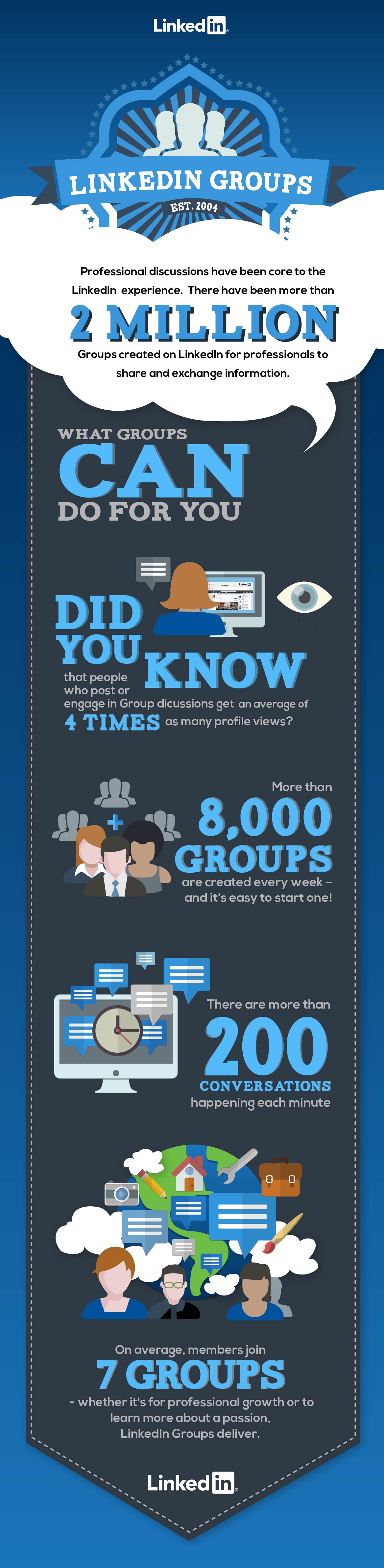
Mashable reporter Kurt Wagner made a solid point on why the change will affect almost everyone who uses the site, “Redesigning LinkedIn Groups is a noticeable change for the platform {link no longer active}, considering how many users utilize the feature,” he wrote. ‘The average user belongs to seven Groups on the site, and those who post or engage in group conversations receive four times as many profile views as those who don’t.”

While the redesign is an impactful one, others, like The Next Web’s Ken Yeung argues that there is still room for change.

“Hopping around from group to group trying to keep themselves up-to-date could be a difficult thing.” LinkedIn needs to make it so that when you arrive, you know what’s going on and in a more efficient manner,” he wrote.

LinkedIn’s blog states that there have been more than 2 million Groups created around almost every topic imaginable,  from entrepreneurship, philanthropy and careers to social and digital marketing. And that today, more than 200 conversations are happening each minute across and more than 8,000 Groups are created each week.

The revamped pages will initially roll out to English-speaking members before extending to other languages.

On another note, LinkedIn this week also rolled out an update of the Pulse newsreader app  {link no longer active} (on iOS and Android) that it acquired earlier this year for $90 million. The redesign is aimed at making easier to find new publications, categories and Linkedin “Influencers” to read as well as speeding up its search tool. Users can now also search by interest, as well as source title, to pull up relevant material.

New to LinkedIn Groups? The company has created a visual to help you learn more about Groups and what they can offer, whether you’re thinking about starting your own or joining ours today  {link no longer active}. See below:


I Share, Therefore I Am

How can a vehicle that drives constant conversation and connectivity actually make us lonelier A recent animated video from Shimi Cohen called The Innovation of Loneliness illustrates points from author Sherry Turkle’s Alone Together and Dr. Yair Amichai-Hamburgers Hebrew article The Invention of Being Lonely into a lively commentary on the parallels between loneliness and increase usage of social media.

The video plays out like a moving infographic (it’s quite pretty), slowly building momentum to suggest how social networks have increasingly made us less connected and more, self-promotional, self-indulgent, delusional, depressed and ultimately, lonely.

Upworthy writer Ray Flores describes his reaction to the short film, “At 0:40, my jaw hits the floor when creator Shimi Cohen outlines the capacity of our social circles. And when at 2:20 he gets into the mind-blowing reason hitting delete is a crutch…Yup, my brains were pretty much leaking out my ears.”

Elite Daily says, “We, as human beings, think that through social networks, we’ve somehow become more social creatures. The problem with this theory is, the more we ‘connect’ online, the less actual human interactions we have, making us actually fairly unsocial.”

The video escalates into borderline preachy, but does possess some undeniable points –  like, “presenting the best self to peers” and “withholding information that is less attractive” or meticulously “choosing the best possible profile picture” to put out into the wild.

Cohen might not show “exactly what’s wrong with our social structure now, and how we manipulate how we want to be presented to peers, family members, and potential mates on social media, rather than having vulnerable and genuine conversations in real time” like Elite Daily suggests, but the video is something to think about over the weekend.

The short is so beautiful, you’ll want to tell someone. And while you’re at it, give us your gut reaction in the comments below!


Facebook CEO Wants To #ConnectTheWorld

The World Wide Web may be finally living up to its name. Facebook founder and CEO Mark Zuckerberg announced Tuesday that the social giant and six other tech and mobile companies will partner on a new project to try and connect two-thirds of the world’s population to the Internet.

Internet.org is the ambitious new project that will use the power of compression technology and cheap, high-quality smartphones to make the web more frugal, ultimately giving access to 5 billion more people. This endeavor follows a similar thrust by Facebook rival Google, which uses everything from balloons to fiber connections to expand connectivity with Project Loon.

In a press release posted to Facebook, Zuckerberg argued that the motivation for helping widen global access was not simply in the best interest of the companies’ pockets involved. In fact, they will probably lose money in this pursuit.

What Zuck is troubled by are completely different numbers, ones not attached to dollar signs. If you can believe it, the group says that just 2.7 billion people on the planet have access to the Internet, and that number is growing by less than 9 percent each year.

“There are huge barriers in developing countries to connecting and joining the knowledge economy. Internet.org brings together a global partnership that will work to overcome these challenges, including making Internet access available to those who cannot currently afford it,” said Zuckerberg in an official statement.

Zuckerberg’s mission statement also addresses some of the road blocks that Internet.org will have to face – a major one being no return on investment, yet.

“The unfair economic reality is that those already on Facebook have way more money than the rest of the world combined, so it may not actually be profitable for us to serve the next few billion people for a very long time, if ever. But we believe everyone deserves to be connected,” he writes.

The actual website currently provides an overview of the project and its goals as well as a full list of partners. In the coming weeks, it should also provide news on Internet.org’s activities as well as interviews with technology leaders and experts. In the meantime, check out the video that seems to aim at pulling major heart strings.Â

{video link no longer active}

Source: Reuters 

People Rally For Facebook Hacker

A man who hacked into Mark Zuckerberg’s Facebook page to expose a privacy bug is now getting donations from hackers around the world after the giant company refused to pay him under a program that normally rewards people who report bugs.

Hacker and developer Khalil Shreateh discovered and reported the flaw but was repeatedly dismissed by the company’s security team until he posted a message on the billionaire’s Timeline to prove the flaw’s existence.

Now cyber software firm BeyondTrust’s chief technology officer Marc Maiffret is making sure the developer doesn’t leave his experience empty-handed.

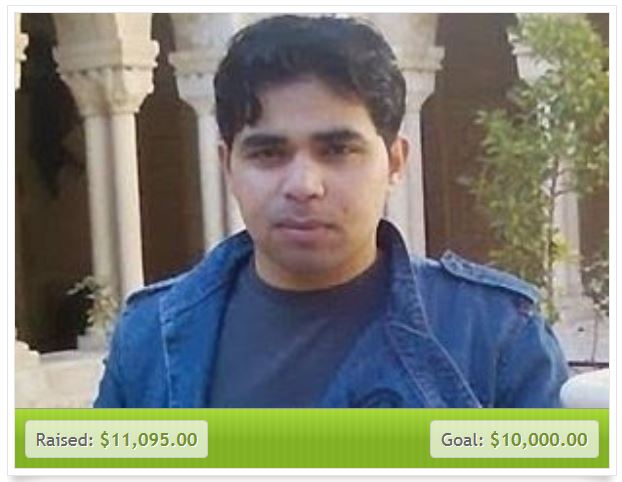
Maiffret launched a fundraising campaign Monday on GoFundMe with a hopeful goal of $10,000. In solidarity for the dev, hackers worldwide opened their pockets, and at the time of this writing the goal has been achieved and then some – tallying to an impressive $11,305.

Maiffret initially wrote on the GoFundMe page:

“Khalil Shreateh found a vulnerability in Facebook.com and, due to miscommunication, was not awarded a bounty for his work. Let us all send a message to security researchers across the world and say that we appreciate the efforts they make for the good of everyone.”

After the $10,000 mark was reached, he added:

“Thank you so much to everyone who helped make this happen for Khalil. I am leaving this active while I work with GoFundMe to transfer the funds to Khalil, whom I am now in contact with. I hope this has raised awareness of the importance of independent researchers. I equally hope it has reminded other researchers that while working with technology companies can sometimes be frustrating, we can never forget the greater goal; to help the Internet community at large, just as that community has helped donate over $10,000 to Khalil within a day.”

It’s clear Facebook made a PR blunder in this scenario, what do you think the company will do to remedy its mistake?

Source: GoFundMe

Massive Twitter Hack

Someone really wanted to take a jab at Twitter this week.

A hacker going by the name Mauritania Attacker – from the country of the same name in West Africa – shared information from 15,000 Twitter accounts through a file-sharing site called Zippyshare, featuring name, ID and authentication tokens associated through third-party apps like HootSuite and Instagram. However, it appears passwords were kept safe.

“We have investigated the situation and can confirm that no Twitter accounts were compromised,” said a Twitter spokesperson speaking with Mashable.

This news follows an email that Twitter sent to its users, making sure to authenticate their accounts and keep their information safe. “With a highly visible account like yours, it’s a good idea to be extra careful,” stated the email. “Login verification is a simple way to add more protection to your account.”

Source: Mashable

‘Seinfeld’ Parody Tweets Score Comedian TV Gig

Did you hear about the former BuzzFeed writer whose parody Seinfeld Twitter feed got him staffed on Fox’s upcoming Alexis Bledel/Jason Ritter sitcom Us & Them?

This isn’t build up for a joke, this really happened. Since its debut in December 2012, Jack Moore’s comedic account @seinfeldtoday — which has over 630,000 followers laughing, including Jason Alexander (you might remember him better as George from the show) – has become an industry favorite for its perfectly pitched contemporary storylines for the ’90s sitcom.

Seriously, his mix of relevant Internet culture, paired with his well-executed depictions of the ’90s characters makes it a sensation. Here are a few samples:

“Jerry discovers Newman is secretly an Internet-famous fan fiction writer. George gets aroused reading 50 Shades of Grey, questions self.”

“George is briefly implicated in the latest Anthony Weiner scandal because his OKCupid handle is Carlos Danger.”

“Jerry’s vacation’s ruined by the stress of avoiding Breaking Bad spoilers. Elaine’s never seen the show, ruins a viewing party w/ questions.”

The attention that the account garnered the New York University grad, also an aspiring playwright and comedian in Hollywood, led to calls from managers and agents, ultimately, landing him the position on the Fox sitcom which appropriately revolves abound a romantic online relationship.

Given the content of @modernseinfeld, this shouldn’t be much of a surprise and didn’t seem so to Moore himself: “I was basically pitching storylines, which is a huge part of being on a writing staff,” he told The Hollywood Reporter.

Moore isn’t the first young writer to secure a sitcom job via Twitter.

Twenty-something Megan Amram joined the staffs of Disney Channel’s A.N.T. Farm, and, later, NBC;s Parks and Recreation after her popular feed got her noticed. Justin Halpern of Sh— My Dad Says actually secured a CBS sitcom based on his Twitter feed in 2010.

Us & Them isn’t expected to hit the schedule until midseason, but you can check out the trailer while you wait.


Source: The Daily Beast


Hacker Hijacks Zuckerberg’s Facebook

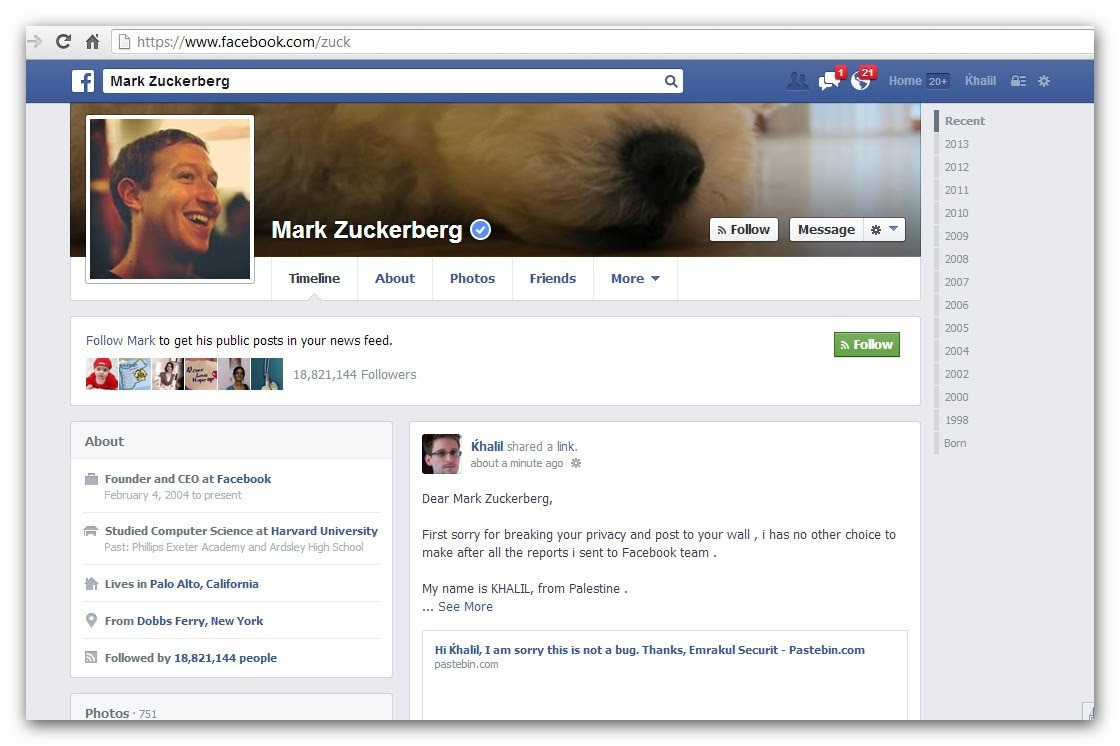
Facebook user Khalil Shreateh has pulled off the kind of heist that fans of the film The Social Network might appreciate.  The Palestinian Facebook user apologized to Mark Zuckerberg over the weekend for gaining access to his Timeline – get this, on the founder’s Timeline — following countless attempts to submit a security flaw to the company’s white hat disclosure program, which encourages users to hack the network to expose bugs.

“Sorry for breaking your privacy… I had no other choice… after all the reports I sent to Facebook team.”

Shreateh accessed Zuck’s page by taking advantage of the exact glitch that he was reporting, a glitch that would allow any Facebook user to post on a stranger’s wall despite security settings designed to help users keep their pages private. As part of its white hat program, Facebook has a reward for hackers who manage to bypass their security system, hoping this will act as an incentive to report glitches rather than exploit them.

It doesn’t look like Shreateh will be getting rewarded though.

Before even officially reporting the bug, Shreateh successfully tested it by posting on the wall of Sarah Goodin, Zuckerberg’s former college classmate. He included a link to this post in the email, but a Facebook security employee who goes by Emrakul couldn’t see the post, since he wasn’t friends with Goodin.

Shreateh tried to explain in a follow up email to Emrakul that he could very well post to Zuckerberg’s wall if he wanted. He added that he wouldn’t, allegedly stating, “‘Cause I do respect people privacy.” His second email, however, received more crickets from the social site. So he proved his point in memorable fashion.

The exploited post got the attention of Ola Okelola, another Facebook security engineer. Okelola commented on the post, asking for more information on the bug. After a brief discussion, Shreateh’s Facebook account got suspended in what Facebook labeled “a precaution.” Shreateh then got an email explanation from another Facebook security engineer named Joshua on why he got the runaround, and why he wouldn’t get a $500 reward for his effort.

“Unfortunately your report to our Whitehat system did not have enough technical information for us to take action on it,” Joshua wrote. “We cannot respond to reports which do not contain enough detail to allow us to reproduce an issue.” He added that Facebook would “unfortunately not able to pay you for this vulnerability because your actions violated our Terms of Service.”

By posting on Zuckerberg’s wall, Shreateh also violated Facebook’s responsible disclosure policy which prohibits people who discover bugs to take advantage of them and demonstrate the bugs on people’s accounts without their permission.

“The more important issue here is with how the bug was demonstrated using the accounts of real people without their permission,” explained Facebook’s Matt Jones on the site Hacker News.

“Exploiting bugs to impact real users is not acceptable behavior for a white hat. We allow researchers to create test accounts here to help facilitate responsible research and testing. In this case, the researcher used the bug he discovered to post on the timelines of multiple users without their consent,” Jones said.

Facebook declined to comment further. And according to Jones, the hoopla may have been all for not, the bug was apparently fixed on Thursday.

Oh, and here’s how he did it.

{video link no longer active}

Source: Mashable

Fans Empower Brands On YouTube

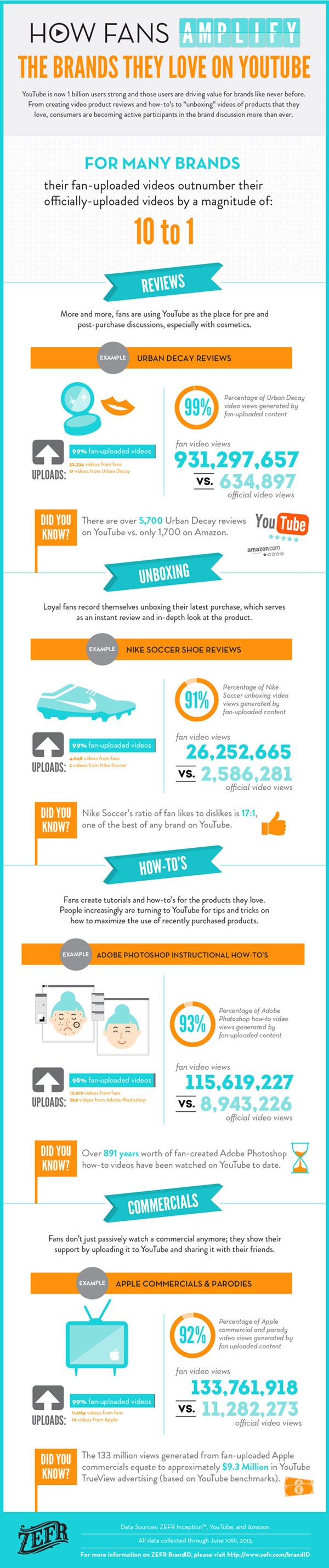
The struggle to increase brand engagement and sell products through online and digital marketing can make for a murky pursuit. A recent infographic from ZEFR illustrates how user-generated content {link no longer active} is as good an asset for some brands as the slick ads and video content produced by marketers.

The logic is simple: While branded content is capable of making an impact (shout out to Oreo), the power of YouTube trends is much stronger. For instance, makeup tutorials are a common video type for beauty channels, and the thousands of videos in that category featuring specific products gets a brand’s name mentioned more than the brand itself could ever get away with in a clever ad.

Genres like product unboxing videos, how-to videos, and fan versions of popular commercials also easily outpace official branded efforts. Just take a look at the stats below:


Xbox Makes A Follower A King

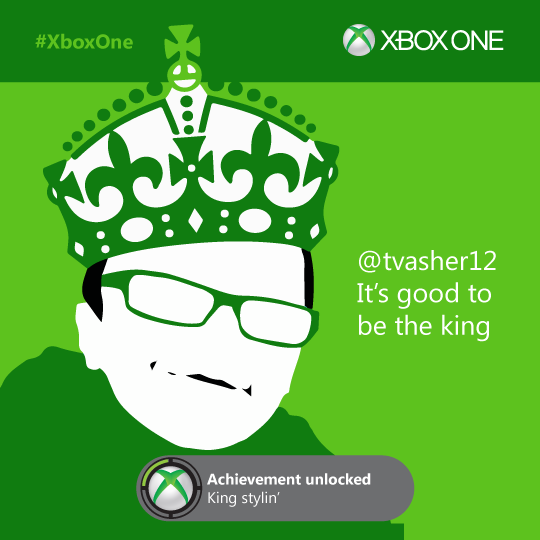
How does your favorite brand show you love on social They may say it with words and swag (nothing wrong with that), but yesterday Xbox illustrated that fan appreciation to one follower in a picture (which is worth about a thousand words they say, so roughly 333.3333… “I love yous”).

In a tweet to promote their recent piece of creative #PlayStyles featuring six popular gaming positions with comedic recommendations, the company asked its followers to tweet their favorite way to game.  Enter Travis Vasher. A gamer with a disease called osteogenesis imperfecta (O.I.). The disease causes extremely fragile bones, and because of his condition Vasher lives life seated in a wheel chair – which he seems to deem the perfect throne for late night gaming sessions.

Vasher responded to Xbox, “For me my #PlayStyle is the king! #Xbox360 in my wheelchair but soon it will be #XboxOne.”

The company returned the love with a customized graphic featuring Vasher’s face coupled with a slogan, “@tvasher12, It’s good to be king.”

The resemblance is pretty spot on too. Nice move, Microsoft. Game on, Travis.


Thanks to Rachel Weinstein for tipping us off.


Brands That ‘Womp, Womped’ On Instagram

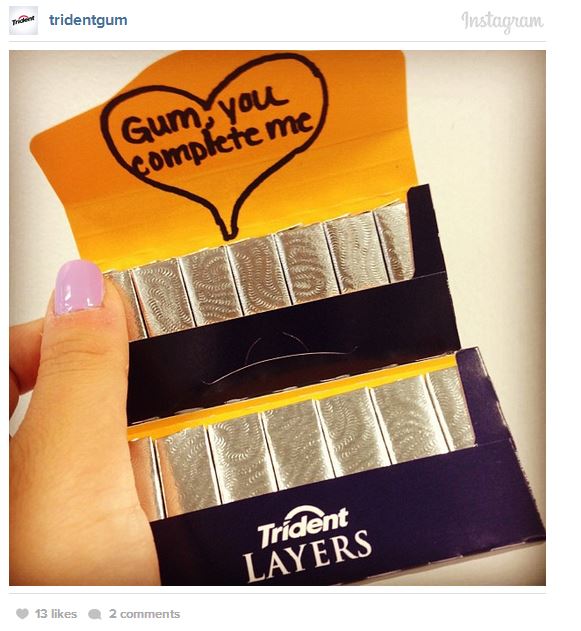
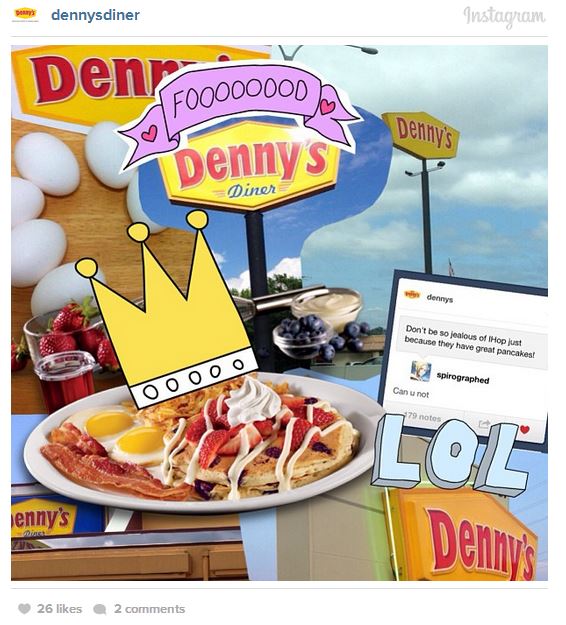
The pressure for marketers to be on every social platform in order to reach their consumers is indeed ever-increasing, but users can usually smell a shortcut from miles away. Recently, Digiday extended their regular round-up of brand fails beyond Twitter and Facebook, and revealed the corny tactics of brands on Instagram.

Here are the five lackluster posts that reeked the most:

Trident

Dentists even think this was lame.  


Denny’s

Can you spot the passive-aggressive IHOP mention


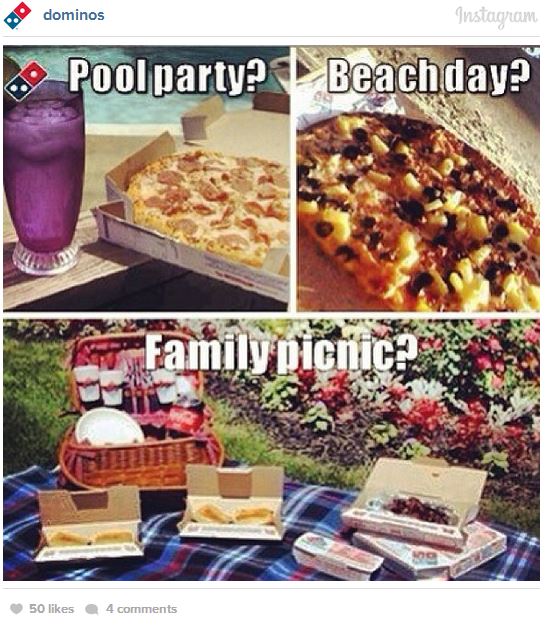
Domino’s 

Instagram is cringing at this blurry GIF mess.


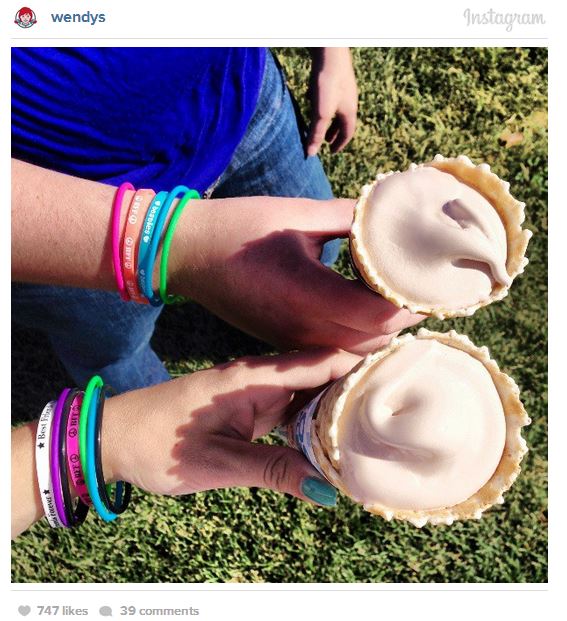
Wendy’s

Neither.


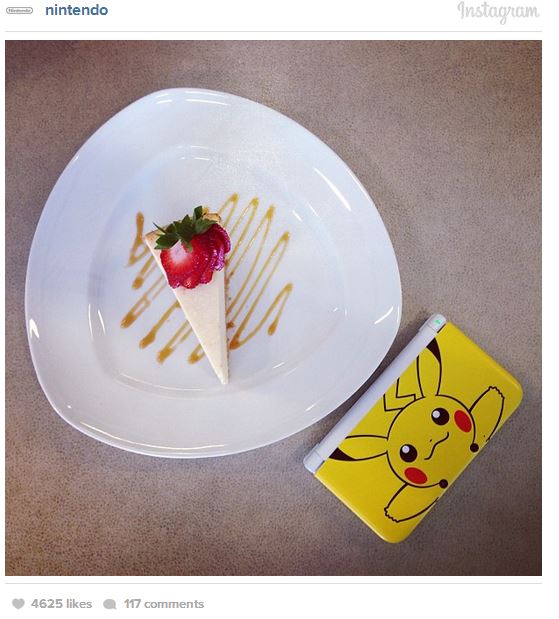
Nintendo

Huh.


Source: Digiday