PS4 Mobile App Is Console’s Second Screen

By Lauren Arevalo and Robert Workman

Sony has hinted about bringing the PlayStation experience to mobile before, but the specifics for this project were only recently released. Last week, Sony detailed plans for enabling “second screen” functions that will be available for free on iOS and Android devices, competing with Microsoft’s SmartGlass and of course, the Wii U.

Some functions that the PlayStation 4 mobile app will have is the ability to download and purchase content on mobile, send text and voice messages through the app, invite friends to games, and watch recorded or live-streamed gameplay.

Of special importance to Sony is enabling smaller developers to use the platform to create their own apps, too. Larger game companies with more resources have benefited from being able to build their apps from the bottom up. Developers for the system can also look into more extensive “second screen” functionality for their games, similar to what they’ve done with the SmartGlass technology on the Xbox 360.

“There are many big publishers creating their own apps for their games, like Watch Dogs or Battlefield, and that’s great,” said Sony Worldwide Studios president Shuhei Yoshida. “But smaller developers can use PlayStation App to connect to PlayStation 4 and load an application, like drawing software for example, so that you don’t have to download and install a specific app on your smartphone. It’s open for all PS4 developers to use.”

Source: GamesIndustry International
Adobe Hit Hard By Hackers

If you were involved in the massive hack into Adobe’s customer database, you should expect to see an email to reset your password. Hackers gained access to millions of customer IDs including passwords and credit card information, but that’s not all.  Adobe says the hackers also gained access to source code for several of their popular digital publishing and web design products.

Adobe said in a statement on Thursday: “Attackers removed from our systems certain information relating to 2.9 million Adobe customers, including customer names, encrypted credit or debit card numbers, expiration dates, and other information relating to customer orders.”

It appears the hackers only targeted encrypted information.  Adobe said that decrypted credit and debit card information it had stored was not compromised.  The company is exercising precaution and resetting customer’s passwords and notifying Federal law enforcement as well as banks.

It wasn’t just the customers of Adobe that were the target of this hack. Adobe revealed in a blog post that the source code for products such as Acrobat, Cold Fusion, Cold Fusion Builder and others were also accessed.

Adobe has received help from journalist Brian Krebs and researcher Alex Holden of internet security firm Hold Security in responding to the attack. Adobe believes the first break occurred in mid-August, and another might have happened since September 17.

Hold Security said that they found 40 GB of encrypted archives containing the source codes of well-known Adobe products.  It also says the repercussions of this breach may be far-reaching.

“Effectively, this breach may have opened a gateway for new generation of viruses, malware, and exploits,” the firm said.

Adobe says they are not yet aware of exploits from the attack being used on their products.

Source: The Register

Clutter A Honda, Get Sucked

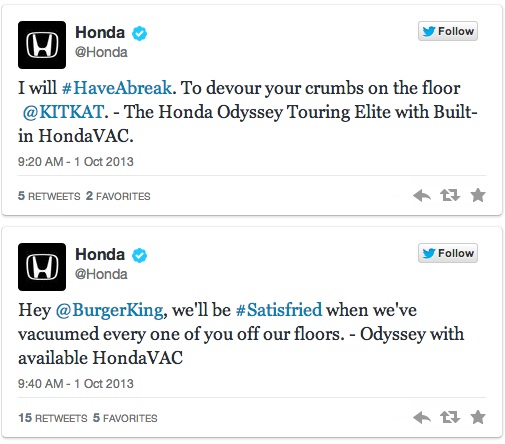
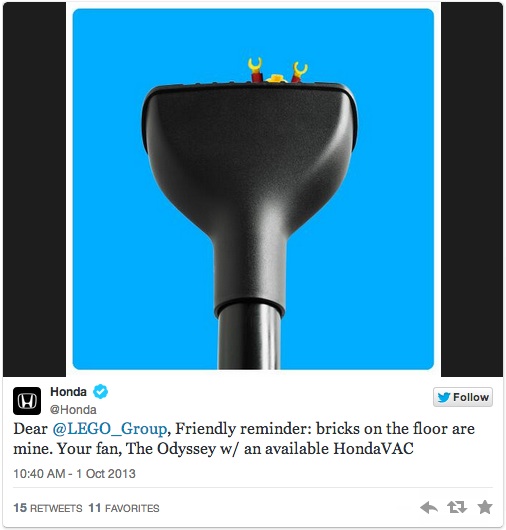
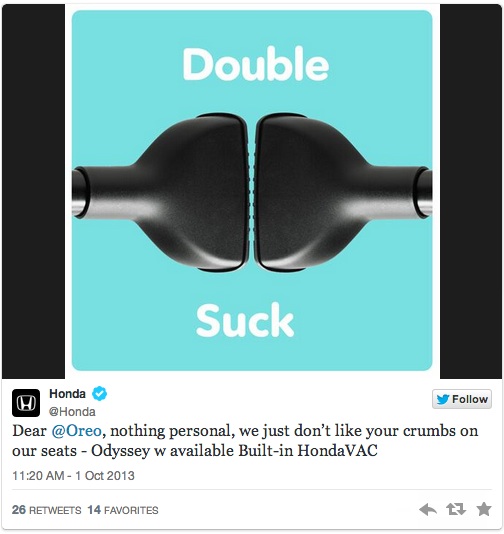
Honda has been calling a lot of attention to the available built-in vacuum featured in the 2014 Honda Odyssey, billing it as the first of its kind in a minivan. Now, the company has found a unique way to highlight the feature, taking the opportunity to send tweets aimed at popular brands whose products tend to clutter car interiors.  Honda sent tweets tagged with KitKat, Lego, Burger King and others to let them know they are no match for the family van’s new feature.

Honda has been unafraid to incorporate brand-speak in these hilarious tweets, and as a result they have been getting retweets and responses. This smart campaign increased the audience of the tweets beyond Honda’s 176,000 followers. It’s easy to see why other brands would want to get in on the action:


The Twitter campaign syncs perfectly with Honda’s new TV spots. Watch as fated leftover snack items chat about Honda features before they get sucked away by the power of the Odyssey’s vacuum:


{video link no longer active}


Source: Adweek

Big Update For Facebook Graph Search

A slow rollout for Facebook’s amped-up Graph Search will have you finding new ways to fritter away your time on the site. The ability to search for post content is available in beta for users only in the U.S, for now. Especially convenient for marketers are new ways to identify potential fans and compare with competitors.

At first debut, Graph Search was an ambitious undertaking but failed to make sense of the data you could search for. Now you can search for more than just post topics, but also places and times unless specifically blocked by privacy settings. Using conversational queries like “Restaurants in Portland, Oregon my friends have been to” can pull up amusing results.

The information your friends and fans post can now be used to your advantage. Finding people with niche interests or building your professional network are just a few of the ways Graph Search can be mined for useful information.

Source: Venture Beat

With Online Privacy, Youth Finds A Way

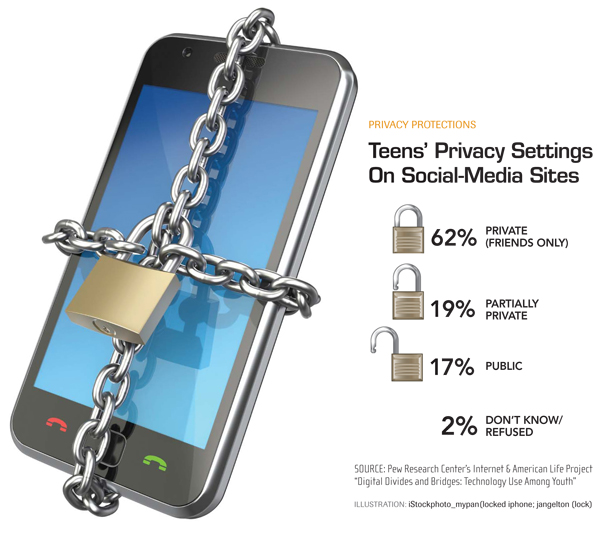
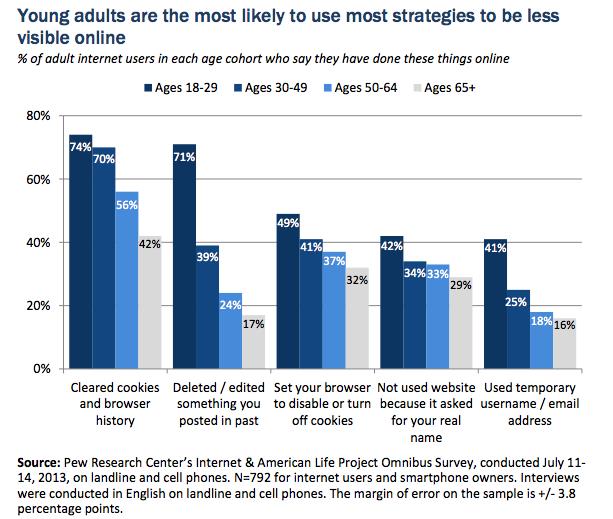
Children of every generation have learned to operate under the watchful eyes of their parents and guardians. These days, considering that everyone including their grandparents are online, they’ve adapted to doing the same on the internet. According to recent Pew studies, the younger the internet user, the more likely they are going to use privacy settings on social media.

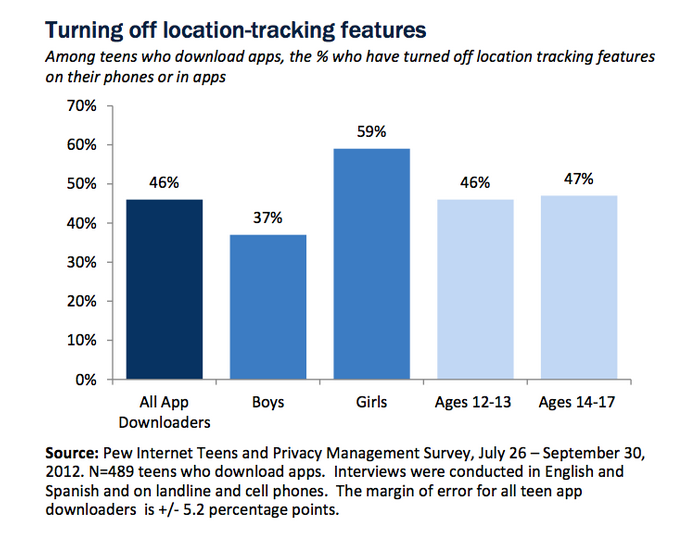
From turning off location-tracking features to clearing cookies and browser histories, children have caught on that learning how to use these features is part of growing up online. In one survey, Pew found that nearly half of teens turn of location tracking when they download apps, and the number skews much higher for girls.

It’s more evidence that children are going to incredible lengths with some ingenious tactics for staying below the radar and some adults are fumbling with the most basic of privacy settings, if they are aware of them at all. That’s what Ars Technica editor Jacqui Cheng found while teaching at a six-week summer program to expose kids to technology. Cheng observed that young adults in her class had not only learned how to use privacy settings for online browsing but also discovered tricks to doing it, including one where they deleted their Facebook accounts then reactivated it between every session.

“They’re taking advantage of the fact that Facebook actually keeps much of your account information on its servers when you decide to ‘leave’ the service,” Cheng wrote in a piece about her experience. “[It allows] them to stay under the radar from nosy friend, parent, or public searches while they’re not online. Their photos disappear and their status updates go on the down-low “” at least until the next time they log back in by re-activating their accounts.”

Misdeeds by and protection of youth online is now a fixture in US society, and outside of Cheng’s insightful piece we had a couple more reminders this past week. On one side of the country there was California governor Jerry Brown signing a law last week that is being called the “Eraser Bill.” It allows minors to permanently delete posts on social media in an effort to protect them from sharing anything that could compromise future academic and career prospects. On the other side, dozens of teenagers implicated themselves in the ransacking of ex-NFL star Brian Holloway’s upstate New York home. The teens broke into the unoccupied house to throw a massive party and posted pictures on social media highlighting their misdeeds, which included causing $20,000 to Holloway’s home. Holloway’s son alerted his father to the incident as it was happening after coming across posts from the party on Twitter.

Sources: Medium

Twitter Snags NFL For Multi-Screen Program

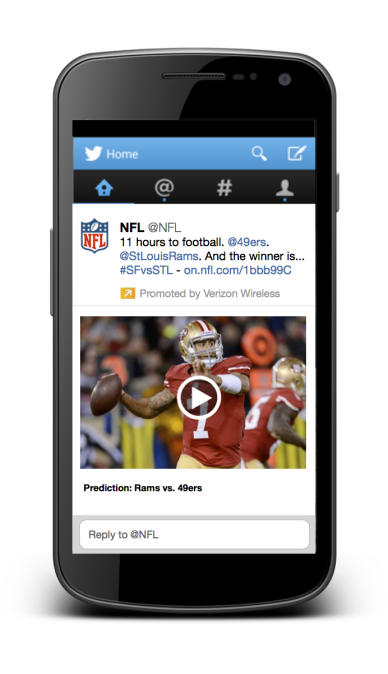
Twitter has reeled in one of the biggest content providers imaginable for its Amplify multi-screen program aimed at live TV viewers, partnering with the NFL for the remainder of the 2013-2014 season. The deal provides Twitter with NFL content from live games, including in-game highlights from NFL Network’s Thursday Night Football, that’s custom packaged and accessible to users around the world. The exclusive partnership with a social network is the first of its kind for the NFL.

Twitter announced Amplify this past spring, aiming to leverage how it’s now the social platform of choice for live TV viewers who want to communicate online about what they’re watching. Many popular TV events end up trending as hashtags on Twitter. The social net’s own analytics provider Bluefin estimates that 95 percent of online conversation around live TV happens on Twitter.

Amplify is meant to monetize that traffic more effectively. It creates formal partnerships with live content providers and draws advertisers to sponsor those streams as they take place. Sports are a major draw for the program, with the NBA, Major League Baseball, PGA, and NCAA college football and basketball listed as Amplify partners when it was announced. The deal with NFL is the first to involve content distribution over the course of an entire season, which includes the postseason and Super Bowl XLVIII.

NFL and Twitter are now said to be arranging sponsors for their program. Verizon Wireless, already an exclusive mobile partner to the NFL, has signed on. Adweek has reported that McDonald’s is expected to announce its participation in the coming days.

“With consumption habits shifting to mobile devices and companion experiences alongside broadcasts of our games, this partnership will provide us an additional channel to reach those users which is completely complementary to our flagship mobile product, NFL Mobile from Verizon,” NFL Media COO Brian Rolapp said in a press release.

With statements like that, and now its first social network deal, the NFL just might be getting closer to providing live games online. Prior to the start of this season, Google chief Larry Page and NFL commissioner Roger Goodell were said to have held an informal meeting. On the agenda was the possibility of airing live out-of-market games online, presumably on YouTube, once the league’s exclusivity deal with DirecTV expires after next season. While nothing came of it publicly, the signs point to recognition in the league that future growth may lie outside of the confines of broadcast television, and that may be especially true for its aspirations to reach a global audience.

Source: NFL

California Gives Minors Reprieve For Online Blunders

Thanks to social media, embarrassing blunders can now become global affairs, and with little recourse to remove something once it’s posted. A California bill signed into law by Governor Jerry Brown this week provides a reprieve, at least for minors. It allows those under the age of 18 to permanently delete any online posts they wish, providing they weren’t uploaded by a third party or subpoenaed.

The idea behind the bill SB-568 was that young people have experienced instances where something posted online can haunt them for years to come, potentially hurting their employability or even their chance of getting into college. Many employers and colleges now consider it routine to check the social media activities of their applicants. With Brown’s signature, the bill will now provide some protection for minors when it becomes law in 2015.

The law also includes new stipulations for marketers, barring the targeting of minors for products and services they would not legally be able to purchase, things like alcohol and tobacco of course but also tanning salons, diet pills and firearms. Additionally, the law prevents web sites from distributing information on minors to third parties, including marketers and advertisers.

The law has garnered some criticism in being unclear about what can be deleted, for instance statements posted on a comment thread. Some are even saying it’s potentially unnecessary, as many websites already provide the ability to delete posts. Those griping about the latter are conveniently overlooking that the behemoth of social sites, Facebook, doesn’t have that functionality.

If anything, the law might serve to make minors, and maybe some adults, recognize the permanence of what they post online and think before they share. As some of the earliest adopters of social media have discovered, those ‘on a whim’ moments can live on long past the whim.

Sources: Slate and San Jose Mercury News

Tencent Rolls Out WeChat Service

China’s giant game and technology firm Tencent is making a few moves to add to its growing stockpile of cash.

Tencent, whose recent stock market evaluation placed its worth at over $100 billion, is looking to provide new services for its 300 million users. Not only is it working to become a social network along the lines of Facebook and Twitter, but WeChat also plans celebrity wake-up calls and the ability to buy items through app-enabled vending machines.

A service allows users to pay 18 yuan ($2.94) a month to receive pre-recorded wake-up calls from celebrities, including Chinese actor Chen Kun, pictured above. Users will also have access to greetings, diary entries, photos and more. Of course, games are also part of WeChat, and one that’s expected to expand substantially.

In addition, users can download a special chat app to pay for bottled drinks, paying only a small fee of 1 yuan ($0.16) on top of the drink price. Hundreds of these machines are already available through Beijing’s massive subway stations.

Anyone interested in these services, however, will need to link their bank accounts to WeChat’s online payment system, Tenpay. There’s no word if they’re likely to see their way to the U.S. market, but it doesn’t look likely at the moment.

Source: Quartz

Study Shows Anger Spreads Easily On Social Nets

Using the popular Chinese social network Weibo, scientists from Beihang University have honed in on how emotions spread from person to person in online communities. They found that anger was the most influential emotion.

Scientists collected a whopping 70 million tweets from 200,000 users over the course of six months. They analyzed the emoticons contained within the tweets and categorized them into joy, sadness, anger or disgust.

Users with angry missives tended to interact with each other more, and that proactivity resulted in spreading their sentiment more effectively. It’s not a shocking discovery, considering users sending angry messages to one another would prompt others to become angry. On the upside, joy was the next sentiment most likely to be shared. Sadness and disgust did not catch on as easily as joy and anger.

The study is similar to one conducted in 2001 at the Wharton School at the University of Pennsylvania titled “Facebook Therapy: Why People Share Self-Relevant Content Online.”  That study also found that users were more likely to share ‘powerful’ emotions such as anger.

While it isn’t surprising that a study proves the timeless proverb ‘one rotten apple can spoil the bunch’, the implications from these findings are far-reaching for social media. It’s where the tone of communication from a small but vocal segment can affect entire communities, something marketers and brands have discovered in some not so pleasant ways.

Sources: MIT Technology Review

‘Saints Row’ Trolls ‘GTA’

Imitation is the sincerest form of flattery, but it’s not clear if Deep Silver was flattering or just busting on Grand Theft Auto V when it started sending tweets tagged with #GATV earlier this week. If you had to read that twice, it’s understandable – it says “GAT.” The Saints Row IV publisher took advantage of internet traffic on the day of GTA V’s launch gravitating to #GTAV on Twitter. And it had the angle to do it, drawing its hashtag from Saints Row IV character Johnny Gat.

In a way, Deep Silver is flattering GTA’s dominance of gamer mindshare when it comes to open world action games. It’s a category where Deep Silver is now competing after acquiring Saints Row from THQ. As a testament to just how big a blip the GTA V launch was on everyone’s radar yesterday, Ubisoft tried its own stunt on social sites, where it gave the game a nod while reminding people about its own next-gen open world game, Watch Dogs.

Deep Silver’s social stunt falls in line with what it has said about marketing Saints Row and how it wants to put its own stamp on the franchise by really drilling down on its zaniness. Yesterday’s #GATV madness started with a series of promoted tweets, including posts from Deep Silver head of marketing and PR, Aubrey Norris:

https://twitter.com/Chupacaubrey/statuses/379996931491000321

Plenty of people were calling Deep Silver’s tweets one of the most genius trolling moves ever.

One person on the thread shared this point of view:

Truth or troll, it’s hard to tell. That went for a lot of the thread, where tweets like these next two made you wonder just how much of what was going on was tongue in cheek, real typos, or just the diehard Saints Row community trolling the rest of us.