Product reviews and unboxing videos are on rise on YouTube, and it’s easy to see why. Viewers get a better look at the products being reviewed, while unboxing videos provide a look at special edition of packages (such as Lootcrate or Japan Crate) from the unique user’s perspective. Now, YouTube wants to use these to help draw in more brands with shoppable ads.
Digiday reports that Google’s video channel has begun using these videos as a means of setting up potential ad spots, particularly with the holidays coming up. The company launched a special Awesome Stuff Week promotion in October that pointed out how click-to-buy content could be paired with relevant videos.
“There’s a growing opportunity for brands to engage with consumers through this type of content,” said Vikram Tank, one of Google’s product marketing managers. “Whether it’s through their own content creation, collaboration with creators or being present in the shopping moments on YouTube.”
By “being present,” Tank means having a click-to-buy ad combined with the product that the YouTube user is presenting. By providing an easy option, consumers may be more likely to purchase goods while they are persuaded by the video.
During Awesome Stuff Week, YouTube made a theme each day, such as Must-Have Mondays, Reviewsday Tuesday and Under-100 Wednesday, which showcases items that cost less than $100. With each video, the YouTube host indicated that the videos have shoppable ads, and that YouTube provided them funding to make the video.
The video above provides an example of how these ads work. YouTube star Jim Chapman talks about items he recommends, including a River Island scarf, H by Hudson boots and Dior cologne. As the video goes on, ads appear that enable swift purchases of these items. It’s up to the brands where they want ads to appear.
Blending online purchases with social content is a practice that’s really picking up. Citi Retail Services recently conducted a survey that indicates that 60 percent of consumers have no trouble making purchases through social media. As far as platforms go, YouTube came in as one of the top influencers with 25 percent. Only Facebook had a stronger response with 35 percent.
The Citi Retail Services survey notes that the biggest takeaway for retailers is that they must be where the shopper is for social commerce to take full effect. That’s where product reviews and unboxing videos can come into play. Influencers have a great reach with their audience, and brands can easily latch on to that success with the right partnership.
The findings of the report can be found here, but it’s clear that partnering YouTube-based content with brands could easily drive up sales.
Apple recently launched the Apple TV, which features Siri-enabled search, and the ability to play games using a specially designed touch sensor controller. With the set-top device comes more opportunities to take advantage of “appisodes,” which are apps that show an interactive animated cartoon episode. Some are made from actual broadcast TV episodes from popular series, remade to include interactive elements, making it a great time for a brand like the Care Bears to shine.
Variety reports that American Greetings has released a new interactive video application that kids of all ages can enjoy. Titled Care Bear-A-Thon, the app enables users to guide their favorite Care Bear from the popular television and toy series across various stories, using the remote control as a motion controller.
Available now free of charge, the app will draw kids into the world of the lovable bears, based on a series of interactive experiences. These include working with the main star, Funshine Bear, through different scenarios, like riding a bicycle or writing on a notepad. Other characters, like Tenderheart Bear, are also featured.
The app was co-developed by start-up team Plumzi, a company that specializes in creating appisodes based on animated TV shows, with more offerings sure to be on the way. Care Bears, which were created by American Greetings in the 80s, became a popular TV show, and has seen multiple resurgences. One of the most recent being a Netflix show called Care Bears & Cousins that will premiere in the fall.
“The Care Bear-A-Thon appisode for Apple TV is an exciting and immersive experience for Care Bears fans of all ages,” said Sean Gorman, president for American Greetings Entertainment. “Plumzi is a premier appisode technology platform, and we are very proud of our collaboration on this first-to-market innovation starring the Care Bears.”
“The linear TV format as we know it was invented for what television sets could do 80 years ago play images and sound only,” said Plumzi CEO Guillaume Cohen. “With the emergence of new viewing platforms like the new Apple TV, viewers have many more ways to experience a story and take part in the narrative.”
American Greetings is no stranger to providing Care Bears fans with various products, including greeting cards, consumer products and a new Netflix series, Care Bears & Cousins, set to premiere on Netflix in the months ahead.
This isn’t the first time that a company catered to an all-ages group using a motion-sensitive device, as Nintendo returned to top-form in the market back in 2006 with its Nintendo Wii, entertaining players of all ages with various games with motion-based controls. However, that platform never really got a Care Bears game to cater to that audience, where Apple TV has Care Bear-A-Thon to turn to.
Many animated kids shows are picking up the appisode format, so fans should look forward to plenty more Care Bears adventures to come. For those who don’t own an Apple TV, there’s also an iOS version available.
Virtual reality technology has become more commonly used with certain promotions, whether it’s a tie-in with a film like The Hunger Games or Paranormal Activity, or a more involving vacation-based platform for the likes of Marriott, whisking attendees away to an ideal utopia. Not content with limiting its virtual outdoors adventure to Google Cardboard or in-store virtual mountain climbing, the outerwear company The North Face sweeps some of its Korean customers away on a wild virtual reality ride… followed shortly by a real one.
The promotion (via Adweek), launched in South Korea, enabled consumers to take part in a “#SuddenExploration” adventure, in which they put on an Oculus Rift headset to get swept away to a winter wonderland, where a pack of huskies pulled them through the snowy landscape.
Then things take a turn for the wacky, as the consumers have their headset removed, and thrust into a real racing adventure where an actual dog team through an real life shopping location, complete with a rider hanging on the back. From virtual to actual, the incredible experience is shown in the video above.
This isn’t the first time that The North Face has used an “extreme” advertising program, as it launched something last year in which consumers experienced a “Never Stop Exploring” campaign in which consumers found themselves in a room with a disappearing floor, forcing them to hop onto a nearby climbing wall. By doing so, they have the opportunity to grab onto a jacket hanging on a nearby hook or drop down to the safety mat below.
Are these videos a bit on the “extreme” side Yes, but The North Face has been known for its extensive outdoor gear, so these videos seem to be right up its alley when it comes to advertising. It looks like these VR-to-Life experiences are limited The North Face stores in in S. Korea, with no indication that a similar campaign is coming to the U.S.
Regardless, the videos are fun to watch, and can help to promote the clothing line in other parts of the world.
With the launch of headsets like Sony’s PlayStation VR, the Oculus Rift and the HTC Vive just over the horizon, 2016 will be a landmark year for virtual reality. We can expect to see a huge push for VR, as more companies look to take advantage of the emerging technology, but the big question is whether it’s better to jump in or wait.
HTC’s chief content officer Phil Chen spoke during a TechCrunch Beijing summit panel, alongside Dillon Seo, co-founder of Oculus. He addressed what kind of future the virtual reality market holds, and it might not be the overnight success as some may think it will be.
“It will take some time for it to go to the masses,” said Chen, talking about how the equipment will need to be refined to get the most performance out of it, and content needs to be produced. However, he remained optimistic about the market, and expects a billion virtual reality headset devices to be sold over the next seven to eight years.
Chen also expressed how the devices should be marketed. Most companies will push them as game devices (especially the PlayStation VR), but HTC is being “bullish” when it comes to pushing the technology towards other markets, such as education or health care, in addition to interactive storytelling.
There’s also a question of price. So far, none of the companies, including HTC, have revealed how much the consumer version of the VR headset will be, although there have been hints that they will be somewhere in the $400 range. The price point could turn out to be a major barrier to mass adoption, so that content needs to make the cost worthwhile. Global reach is of vital importance, according to Chen, and finding potential content partners is key to this success. “Japan and China are very pro-VR and we are starting to talk to everyone you can imagine who is in gaming or animation,” he said.
Popular movies may also provide an ideal gateway for the technology. Lionsgate’s popular The Hunger Games movie series recently got a push into the virtual realm, and familiar games could find a new perspective, like Minecraft,which will also debut on virtual reality down the road.
However, some companies relish the challenge VR presents. Epic Games founder Tim Sweeney, speaking with IGN, is excited for it. “I think it’s going to be (the) most revolutionary change that’s happened in the history of computing.”
Sweeney also expresses a similar sentiment to Chen’s. It will take time, as we’ll see the start of the first five years of virtual reality go through “utter churn and chaos. And it’s gonna be awesome, with the quality of the hardware doubling every year, you’re gonna want a new headset every year if you’re a serious early adopter.”
He continued, “By the time this hardware is able to reach a quarter billion users, at that point we’ll be on a more reasonable upgrade cycle. You might buy a new device every two or three years like a smartphone and not at the frenetic rate we’re at right now.”
However, don’t expect everything to go the way of VR. “You can’t just take a game like Unreal Tournament, where you’re running around the world at 30 miles an hour, and stick it in VR,” said Sweeney. “You barf really quickly.” Thus, the need for optimization and games that would make a difference with the technology (like Minecraft, for instance).
Sweeney concluded, “I think we are years away from the point where you’re going to build a AAA, hundred million dollar budget game for VR. But every year the market is going to more than double in size and the budgets will more than double, and I think everyone’s going to be working their hardest to keep up with what’s possible.”
As with adopting any new technology, there are high risks, challenges, and rewards to taking advantage of virtual reality as it grows and develops.
Advertising to consumers can be a tricky business, especially with a new venture that doesn’t know how to reach out to them. But according to a new statistics from marketing research firm MarketingSherpa, they have a good idea of what they want from advertising, and companies should take notice.
AdWeekcompiled the marketing data into an infographic that indicates that people don’t really hate advertising as much as companies think. The report shows that only eight percent of respondents didn’t want to receive any sort of marketing, while more than one-third of those polled indicate that they prefer emails from brands through their smartphones when it comes to getting offers.
“This may be somewhat surprising to some, as when mobile marketing is talked about, email is sometimes not included,” said Daniel Burstein, director of editorial content for MarketingSherpa. “Buzzier topics like location-based marketing — iOS iBeacon, for example — and apps tend to get the most attention.”
The full infographic can be found below, but here are a few facts taken from it to sum up the report.
When it comes to preferred ways of receiving updates and promotions from companies:
54 percent of those polled prefer to receive emails they can access on their smartphones.
49 percent would subscribe to receive emails at a preset frequency.
38 percent would be open to visiting the company’s website for updates and promotions.
20 percent don’t mind following certain brands on social media for specials.
On the lower end of the spectrum:
9 percent would attend local events held by companies
17 percent would be open to getting text messages
15 percent stated they would download a mobile app offered by a company.
When it comes to discovering new products:
59 percent of those polled said that they would stick with in-store browsing,
57 percent would rely on word-of-mouth from friends, family and colleagues.
47 percent rely on search engines and offline advertising.
34 percent prefer offline advertising.
On the lower end, talking with a customer service representative at an eCommerce site (6 percent) and automated personalized product recommendations (10 percent) were less recommended.
When it comes to preferred methods of communication when away from a desktop/laptop computer:
47 percent preferred print ads.
37 percent said they liked emails through their smartphones.
24 percent listening to radio ads.
Only 6 percent wanted a push notification from a company’s app.
The gaming market continues to thrive, especially when it comes to the top 25 public companies.
A new report from Newzoo provided these numbers today, indicating revenues for the top 25 game companies have grown to $28.7 billion dollars for the first half of 2015. That’s a 16 percent ($4 billion) year-over-year increase from 2014’s numbers.
In addition, the company had individual stats to report as well, including the following:
Tencent, one of the world’s largest game companies, increased revenues by 23 percent to earn $4.2 billion on its own for the first half of 2015. This is mainly due to its library of popular smartphone titles, and monetization from its core PC audience.
Sony saw strong revenues, increasing 12 percent from the previous year to $2.4 billion. This enabled the company to overtake EA and find a place in the top three best sellers, very close to Microsoft. This is mainly due to the success of the PlayStation 4, and the popularity of the PlayStation Plus program, which offers free games on a monthly basis to subscribers.
Apple continued to see a rise in its own game sales, by 28 percent over the first half of the year. This is mainly attributed to the popularity of its products in China.
Google also saw a boost in Android device sales around the world, moving to a seventh place on the top 25 chart.
Out of the top 25 companies listed in Newzoo’s report, only six saw decreasing revenues for the year, mainly in the mobile market. These companies include King (which is still in the top 10) and GungHo, which rely on popular titles like Candy Crush Soda Saga and Puzzle & Dragons, respectively.
DeNA, which is currently developing Nintendo’s first mobile game, also saw an 18 percent drop.
Asian companies saw a total of 48 percent of all revenues in the top 25, which is a one percent increase from the previous year.
NetEase has fared very well with its mobile and PC games, including titles like Fantasy Westward Journey. The company made a total of $1.1 billion for the year, an increase of 55 percent over the previous year.
Take Two Interactive saw a great year, moving to number 15 on the list with a 79 percent increase over the previous year. This is mainly attributed to hit games like Grand Theft Auto Online (part of the multi-million selling Grand Theft Auto V) and very successful sports like NBA 2K16. The strong growth should continue well into 2016 with the upcoming action game Battleborn.
Mixi debuted at #13 with the success of its mobile game Monster Strike, making $754 million for the first half of the year. That’s a 586 percent increase from the previous year, and marks earnings for the company with each successive quarter since late 2013.
Meanwhile, Warner Bros. jumped straight to the the top 10, thanks to the success of such games as Batman: Arkham Knight and Mortal Kombat X.
Not every company saw a hefty increase. Ubisoft, famed publisher of games like Assassin’s Creed, saw a 60 percent decrease, down to $267 million. GREE, likewise, also saw a 27 percent drop, down to $351 million for the first half of the year.
Here are the top 25, as listed by Newzoo:
Tencent
Microsoft
Sony
EA
Activision Blizzard
Apple
Google
NetEase
Warner Bros.
King
Nexon
Nintendo
Mixi Inc.
GungHo Entertainment
Take Two Interactive
DeNA
Square Enix
Disney
Facebook
Konami
Changyou
Zynga
Bandai Namco
NCSoft
Sega
The full report, complete with specific numbers for each of the top 25, can be found here.
In the spirit of Halloween, this week’s ION Top 10 showcases YouTube’s biggest DIY’ers. They’re showing viewers how to master Game of Thrones cosplay, how to scare the living daylights out of your friends, and of course, there’s the edible wizardry. You’ll find that some of YouTube’s most recognizable faces are killing it with DIY.
Last week, YouTube raised more than an eyebrow for many users when it came to its subscription-based Red service. While this would certainly be good news for those looking to watch videos without dealing with ads, it’s also posed bad news for long-time content creators, who felt limited when it came to signing on with the company’s newest label.
Felix “PewDiePie” Kjellberg, one of the most popular YouTube streamers out there (he made over $4 million last year alone), expressed his thoughts on the new service through his blog, where he spoke mainly in defense of the service, which aims to charge consumers $10 a month to access exclusive content and skip over advertisements in favor of getting to their content.
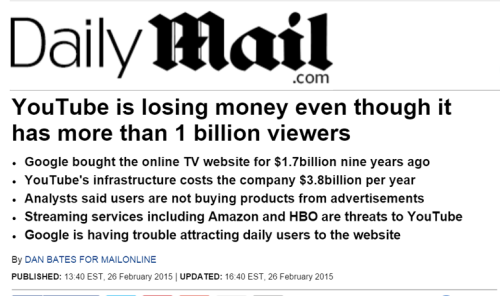
He noted that, despite the channel having over one billion users, it’s losing a significant amount of money, with the infrastructure alone costing $3.8 billion a year. He also noted that, per the included image from the Daily Mail below, analysts indicated that users aren’t buying as much products from advertisements as companies hoped. Streaming services like Amazon and HBO pose serious threats as well.
But perhaps the biggest nuisance is ad-blocking software. He posted a poll to his fans asking them if they use it, and 40 percent of the 8,000 who answered back state they do. “It’s a number that has grown a lot over the years, from roughly 15-20 percent when I started,” he said. “And it’s not unlikely that it will keep growing. What this means is that YouTubers lose about 40 percent of their ad income. Personally, I’m ok with if you use adblock on my videos. Ads are annoying, I get it, I’m here to complain about that. But for smaller channels, this number can be devastating.”
He added, “Using Adblock doesn’t mean you’re clever and above the system. YouTube Red exist(s) because using Adblock has actual consequences.”
Ad-blocking software has been a hindrance on companies over the past few months, and it’s a practice that isn’t going away with users anytime soon.
With that, Kjellberg did note that there are still questions about YouTube Red, like “How much of YouTube Red’s $10 actually goes to it’s creators ” and “Will YouTube Red be beneficial for smaller channels Is the $10 price actually justified ”
While these remained unanswered, Kjellberg concluded his blog by simply stating, “These are all important questions about YouTube Red. But right now, it’s more important that we understand what the actual problem is here.”
The full post is available here, and also posts various Tweets in regards to users’ preference to ad-blocking services.
ESports competitions are set to hit the big time, estimated to make $1.9 billion by 2018. However, they’re not just limited to the PC market.
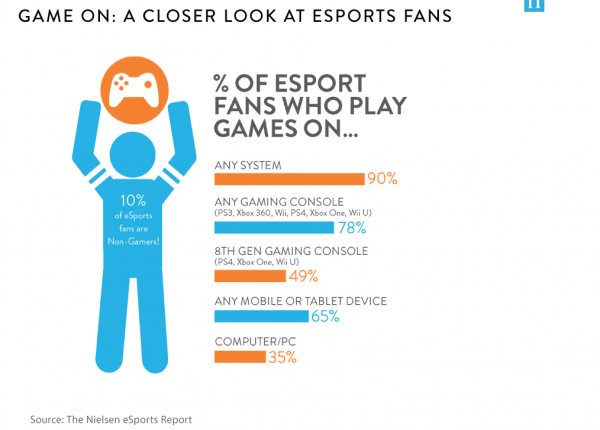
A new study from Nielsen indicates that consoles are also playing a big part in the eSports scene, with games like Halo 5: Guardians and Call of Duty: Black Ops III set to get huge attention between devoted tournaments and online sessions. The report indicates that only 35 percent of the U.S. eSports audience plays on a PC. That leaves 65 percent that prefers the likes of the Xbox One, the PlayStation 4, and, in some cases, the Wii U, where games like Splatoon have thriving popularity in the competitive market.
In addition, the report also states that 10 percent of eSports fans actually don’t play games at all, showing a draw to seeing other players compete rather than taking part themselves.
The study, dubbed the Nielsen eSports report, broke down the stats when it comes to what platform players prefer to game on. As you can see, 90 percent would be fine playing a game on any system, while 78 percent actually prefer a console over playing on a PC, and 49 percent of today’s gamers prefer playing on a newer console like the PlayStation 4 and Xbox One.
Mobile also has a startling standout number here, with 65 percent of those polled indicating that they would happily compete using a smartphone or tablet device.
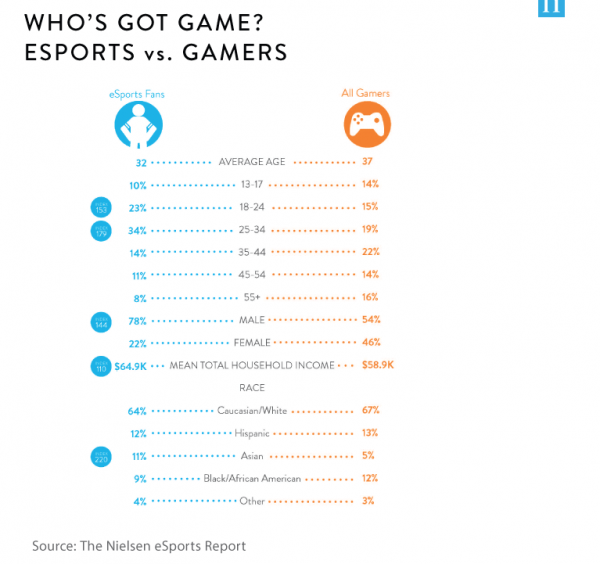
Breaking down numbers even further, Nielsen reported that 57 percent of U.S. eSports fans are in the millennial (18-34 age bracket), while 34 percent are actually millennials. In addition, eSports fans that live in households have a higher household income, by about 10 percent higher than most gamers overall.
A secondary chart breaks down the specifics of eSports fans versus actual gamers, breaking down everything from average age (32 vs. 37), Total Household Income ($64,900 against $58,900) and other brackets. It’s included at the bottom of the article.
Speaking with [a]listdaily, Nicole Pike, director of Nielsen Games, had plenty to say about the report. “With popular PC franchises like League of Legends, Counter-Strike, and Dota dominating the current eSports landscape, it’s easy to assume players of these games are the same people watching eSports competitions. However, knowing the strength of the U.S. console gaming market, the heavy skew toward console gamers our survey shows isn’t surprising. The implications of this will be interesting to watch in the near future, with leagues for top console franchises like Call of Duty, Halo, and more picking up steam; the console fan base is already there, and hopefully the leagues can peak their interest in the same way PC-focused competitions have already succeeded.”
With more tournaments taking place over the next few months and more competitive games like Black Ops III and Star Wars: Battlefront arriving next month, the eSports scene will be stronger than ever. Who knows where it will go from here.
Some big video game releases have come out this year already, and with several more to come into the holiday season, we’re likely to see various promotions surrounding these games. Fallout 4 by itself has several in the pipeline, including a specialty beer created by a U.K. brewery for sale in Europe.
Here are some specific game industry brand partnerships that have stood out this year, in one form or another.
Alongside the beer mentioned above, Fallout fans will have another way to quench their thirst. Starting on November 10th, fans of the Fallout series will be able to buy a real-life Nuka Cola Quantum, a soda brand featured prominently in the video game franchise. Produced by Jones Soda, the blue colored Nuka Cola Quantum will be available for purchase exclusively at Target retailers, as part of a promotion for the forthcoming Fallout 4, which releases on the same day. The partnership was announced with the above tweet, and Fallout fans are sure to make a run for them.
Skylanders Superchargers Revs Up With Max Chilton
Considering how Skylanders Superchargers, has a focus on vehicular mayhem, it only makes sense for Activision to make an impact on the real racing world. Earlier this year, the publisher teamed up with Max Chilton to promote the family-friendly game on his vehicle during the season finale of the Indy Lights racing tournament.
“The Skylanders Superchargers game is all about speed, reaction and, of course, winning, so there are obvious parallels to real-life racing, albeit I can’t grab powerups or slow other drivers down with a laser cannon!” Chilton said in a press release.
Carl’s Jr. Introduces a Special Call of Duty: Black Ops 3 Meal
As part of its promotion for its newly introduced Tex Mex Bacon Thickburger, the Carl’s Jr. chain has teamed up with Activision to create the Ultimate Care Package, which includes the burger, fries and a drink, along with the opportunity to win limited edition items for Call of Duty: Black Ops III, which releases next week.
The commercial for the promotion features plenty of action and promises of some great giveaways, including custom in-game weapons. On top of that, Black Ops III will also be joining the brewery game, like Fallout. Activision announced a team-up with Australia-based Black Hops Brewing to produce a special Black Ops Midnight Pale Ale. Sadly, it too will be sold overseas only, made for the Australian beer market.
Transformers Team Up With Splatoon
Back in August, Nintendo continued its promotional push behind its colorful shooting game Splatoon by teaming up with Hasbro for a special Splatfest event, which involved the best-selling Transformers franchise. The competition enabled players to choose the t-shirt for their Autobot/Decepticon team of choice, then defend them in the best way possible, all while trying to win Super Sea Snails to purchase in-game gear.
Although it was only a one-time event, the Transformers-themed Splatfest was quite popular, and surely helped push Splatoon‘s surprising sales into the fall season.
Madden NFL 16 Scores a Touchdown With Doritos
As part of its big push into the fall season, EA Sports gave quite a promotional push behind Madden NFL 16. Part of that push involved a team-up with Frito Lay to produce special Madden Ultimate Team codes in bags of Doritos. Fans would be able to find a code inside specially marked bags and redeem them for special players on their fantasy team in the game, including San Diego Chargers veteran LaDainian Tomlinson.
Frito Lay is no stranger to video game promotion, as the Doritos brand has been associated with top games franchises like Halo and Call of Duty in the past. However, this new one enabled a strong connection with the virtual football community.
Amusement Parks Get In On the Game Action
Digital games are becoming more of a real-life attractions with various amusement parks teaming up with video game publishers.
First up, Capcom teamed up with Six Flags Entertainment to promote its 3DS game release Monster Hunter 4 Ultimate, temporarily transforming the Goliath coaster in the Magic Mountain theme park into a Monster Hunter-based theme ride. The company also held a special Caravan Tour to promote the game, complete with playable kiosks and, of course, monsters.
Secondly, in an attempt to expand its Mass Effect universe before the release of the long-awaited Andromeda sequel (announced at E3 earlier this year), Electronic Arts paired up with Great America to create a fun new attraction that stems from the popular sci-fi universe. This will include a 4D holographic theater that brings the game’s world to life using the fully renovated Action Theater. The ride is set to be unveiled in early 2016 in the Santa Clara park.
“Having a partner who shares our commitment to thrilling our fans is extremely important to us and we look forward to building an attraction that will appeal to the Mass Effect fan base and introduce it to many more.” said Patrick O’Brien, Vice President of Entertainment and Licensing for the Redwood City-based EA, in a statement.
In related, EA teamed up with the theme park Carowinds to develop a “3Z” competitive interactive attraction based on the Plants vs Zombies: Garden Warfare game. The attraction is expected to launch in Spring 2016, which is around when Plants vs Zombies: Garden Warfare 2 is expected to release.
Last but certainly not least, Nintendo is also getting in on the theme park fun. The publisher announced a team-up with Universal Parks & Resorts earlier this year that will bring characters like Mario, Link and Samus to Universal theme parks. There’s no word yet on when these attractions will launch, but we’re likely to see more details emerge next year.
Halo 5: Guardians Gears Up With Hot Pockets
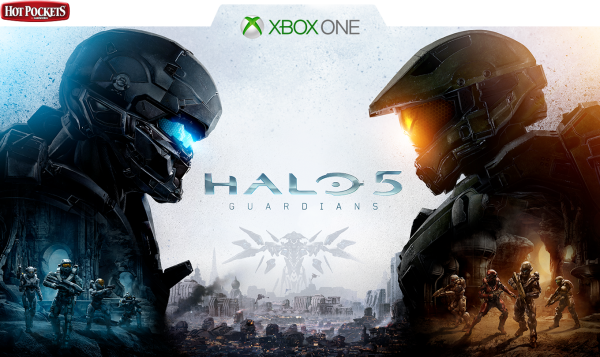
Finally, for those who prefer a quick snack during their Warzone multiplayer sessions, the microwavable Hot Pockets snacks and Halo 5: Guardians have a fun promotion where players can redeem codes to gain additional REQ in-game currency points, which are used for in-game gear packs that feature extra weapons and other goodies.
While not as in-depth as other fast-food based promotions, this is a fun and simple way for gamers to get what they need, sometimes simple is the way to go.