Newzoo Breaks Down Key Trends In The Games Industry

Video games have come a long way, with billions of dollars are spent on new titles each year, and eSports exploding into a global phenomenon.

To further explain just how video gaming has changed over the years, Newzoo has put together a detailed report titled Putting the Video Back Into Video Games: How Games Are Shaping the Future of Media, that breaks down the six key industry trends across three key categories: business innovation, broadcasting technology and community creation. Furthermore, it discusses topics such as looking at games not just as a commodity, but also a service that appeals to hardcore and casual communities alike, and emphasizes the importance of online outreach.

The Business Trends: Games As a Service and Cross-Screen Entertainment

Both games that sell at a retail price or use a free-to-play model have the opportunity to appeal to a large audience where monetization is concerned. The addition of new content, either via DLC or through regular updates, encourages gamers to stick around and see what new items or experiences they can get. Additionally, seasonal content can also be a huge draw, as it has been with the mobile hit Clash of Clans. Opportunistic promotional tie-ins can play a part as well, like the Force Awakens-themed Battle of Jakku map that will be available to Star Wars: Battlefront players starting next week.

“This approach has also moved into the paid game space on console and PC. For example, the recent introduction of silver (a premium currency purchased with real money) into the game Destiny has opened up a revenue stream for Bungie based on cosmetic items that don t affect gameplay,” says the report.

Season passes have also played a part in keeping gamers around, including ones like Batman: Arkham Knight. This not only guarantees long-term commitment to a game, but also promises of fresh content. “The principle driver of games as a service has been the emergence of a fan base that is desperate to play its favorite games. This has resulted in the convergence of the service model between mobile, PC and console games to create truly innovative cross-platform experiences,” the report explains.

Cross-overs can also be beneficial, such as with Bethesda, which launched its mobile hit, the free-to-play Fallout Shelter, as a tie-in for its big holiday moneymaker Fallout 4. “With the former released on mobile in June this year to help tide players over until the latter s release on PC and console in November, it was interesting to see Fallout Shelter s base creation gameplay was closely mirrored in Fallout 4 s sanctuary creator. 

The report continued, “Rather than tying players down to one platform, game developers are leading the way by allowing consumers to access content on demand across platforms, which is essential in today s digital environment.”

The Technology Trends: Creator and Live Streaming Tools, Video Channels and Communities

Online video has become a driving factor in the world of video games, with channels like YouTube and Twitch devoted to programming. Since most broadcasters don’t lean too heavily on content provided by gamers, online serves as an inexpensive avenue for them to create an outlet.

“This has happened in two ways. The first has been the rise of the YouTuber. Releasing edited videos that match the personality and interests of the creator, Youtubers like PewDiePie, NerdCubed and Squid Gaming have tapped into the desire for gaming content among fans (even when they don t play) and offered them short gaming videos on the go,” the report noted. “The second way has been the rise of streaming services such as Twitch for all games and Mobcrush specifically for mobile titles. These services, which allow people to broadcast what is on their devices without specialist technology, have opened up live broadcasting to millions of people and businesses across the world. Viewable on mobile devices, smart TVs, game consoles and PCs, the reach and regularity of livestreams far surpasses television shows, in terms of frequency and availability on a global scale.”

As a result, a new type of consumable media has been created, and many channels, including the ESL Gaming Network, have emerged to grasp such media. It has since become a multi-million dollar business that’s done well without much media coverage, allowing creators to make careers out of what they love in the process. It’s also become lucrative to business partners, since said creators can hype games and earn thousands of dollars from the promotions as a result.

The Consumer Trends: Creation and Involvement, and Consumers Entertaining Consumers

“Rather then relying on companies to create communities for them, fans are growing and perpetuating their own groups, which happen to promote games as a side effect,” says the report. “Minecraft is the best example of this. While Mojang supports the community with the Minecon convention, the legions of guides, the millions of YouTube videos and the high-profile content creators like Stampycat have transformed Minecraft from a game into a global cultural standpoint.”

eSports players have also benefited from creating their own communities, being able to generate strong revenue through both sales of items and promotions of games they play in tournaments. This also changes the game when it comes to community efforts in management, as “the emergence of these communities signals a change from top-down maintenance of control over a brand to a consensual bottom-up conversation among the thousands of fans of a game.”

“As a result, we expect to see brands across digital and broadcast media loosening control of their brands. By creating content based on consumer feedback, working with leading creators to inspire new directions, and supporting fan work with community management, the likes of record labels and license holders will have much to learn from gaming’s organic communities.”

These six trends in all tie in with how digital media companies access and interact with the change of content, the report concluded. “The fact that anyone can, with the help of Twitch or even Periscope, become a broadcaster means that older models need to adapt to retain consumer interest. For the gaming industry, that has meant creating cross-screen content, encouraging creators to film their games in action, and lightly moderating organic communities to grow. And we believe that’s an excellent starting point for other sectors.”
The Immense Growth of Video, Music and Game Streaming Entertainment

If there’s one market that’s managed to rise above expectations for 2015, it’s streaming. From Netflix and its original series (including the vastly popular Jessica Jones) to Twitch and its majority of programming, companies have capitalized on audiences with its programming. 

With that, App Annie said that a number of channels have seen growth not only in the United States, but overseas in China as well, per Ooyala. The overall revenue growth for video streaming has reached more than three times in the U.S. That’s impressive, but it’s risen more than 10 times in China. (The United Kingdom also reports double the growth as well.)

App Annie added that U.S. revenue growth midway through the year was driven by two specific apps: HBO Now and Hulu. As far as what programming is leading the markets, the U.S. benefits highly from movies and TV episodes, while the U.K. relies more on sports leagues. In fact, almost 75 percent of the overall market comes from sports.

Ooyala believes that broadcasters may have to seek new ways to keep traditional viewers around, to prevent the “cord cutting’ that many consumers go through in an attempt to save money.

Also backing up these statistics are numbers from The NPD Group, per IPTV News. Research indicates that by 2018 we’ll see a huge upswing in installed devices that are connected to the Internet, taking advantage of streaming services; 231 million is the estimated count, up from the 127 million reported in 2014, and the 153 million reported this year. That’s an estimated growth of 82 percent in just a few years’ time.

“The two largest drivers of growth will be the increased acceptance of connected televisions in the homes of US consumers, as well as the continued adoption of streaming media players such as those offered by Google, Apple, Roku, and Amazon,” said John Buffone, executive director for The NPD Group.

Out of these devices, connected TVs will show the biggest growth by 37 percent; streaming media players are at 33 percent growth. Netflix, YouTube, Amazon, Hulu and HBO Go are expected to stay as popular channels on this front, although, a new video-distribution channel could change how people look at streaming services through TV networks in this same time frame.

Music 

Video is just one part of streaming business as we see it today. Music also has a key role, as more subscribers are finding comfort in signing on to services like Pandora and Spotify instead of buying their music – and it’s a practice that isn’t likely to die down anytime soon, if at all.

IFPI reports that over the past year global digital revenues for music streaming channels rose to $6.85 billion, a 6.9 percent increase from the previous year. That includes a similar proportion of revenues from digital channels as physical (both at 46 percent). This is across four of the world’s top 10 markets overall, indicating that it’s found a strong place within the industry.

This could also change with new competitors, as Variety previously reported that Apple could be jumping into the video game with its own programming. It would make sense, considering the plethora of devices that would support it, including the new Apple TV model.

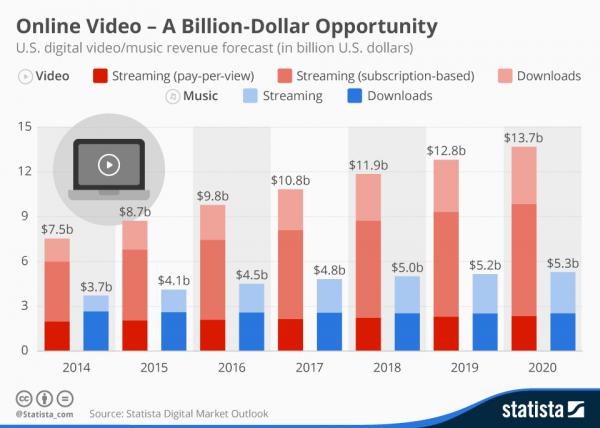
Statista’s chart below breaks down just how big a deal online video is set to become over the next few years, going from a $7.5 billion total in 2014 up to $13.7 billion. Although downloads are a little behind, they too are expected to grow, increasing from $3.7 billion to $5.3 billion.

Chart 1202

This year has changed the landscape quite a bit, with both Apple and YouTube launching devoted music services that have attracted millions of consumers. That should push the estimates of 41 million consumers last year to new heights, as soon as end-of-year numbers are reported.

As a result, record companies have changed a bit with the times, creating a model that provides access to music more than ownership. With that, the general industry now receives around 32 percent of digital revenues from subscription and streaming services, up from 27 percent back in 2013.

Along with new companies joining the fray, older ones are making moves to adapt to the times as well. Last month, Pandora acquired the tech and talent behind Rdio, while Spotify opted to create a new data model that would make it easier to track what artists audiences listen to regularly.

This is an even trickier business with “big dogs” in the industry like Apple, Google and Amazon getting involved, as questions regarding said rights could come into play. However, Pandora is confident that its new business model, build around Rdio’s services for an estimated $9.99 a month, will bring several new options to the table for its listeners.

Tidal has also become a key factor in streaming music. Despite its lack of immediate popularity, it’s winning some listeners over with the promise of exclusive concerts and other events, adding a personable side to the service. (Granted, Apple and other services have also reached out to artists to provide special features for its channels as well.)

Regardless, with so many options available, more listeners should be turning to digital music options, streaming instead of downloads, out of sheer convenience, and the market should continue to grow. Who will profit from it in the long run, however, has yet to be seen – but it looks like companies will be doing their best to keep people from dropping the beat.

Games

Finally, there are the game streaming channels, which have their own fair share of audience members. YouTube Gaming launched earlier this year to impressive numbers, although Twitch continues to be the big breadwinner for this year, as it drew in more than 100 million viewers monthly. Twitch has also diversified its programming, airing artistic-based content and teaming with companies like Old Spice for unique promotions, creating a new flux of viewable content.

Gaming will continue to be a big focus for the company, though, and with the introduction of several new features – all introduced at its first annual TwitchCon a couple of months back – it’s likely to continue expanding into the new year and beyond. 

Competitive eSports will play a big part in that as well, despite some programs taking to television to expand its audience. Speaking with [a]listdaily earlier in the year, Johnathan “Fatal1ty” Wendel explained, “eSports is always getting bigger every year. Five years from now, I believe that gaming will become more recreational, much like what you see with other sports. For example, I’m a tennis player and I play on a league. I believe we’ll have rec leagues for gaming. Gaming and eSports will become more recreational and competitive, event for the casual player who just wants to be a part of a team. It’s the evolution of what we do as eSports players. eSports really is the sport of the 21st century.”

Considering its popularity not only on mobile and desktop devices, but also game consoles like the PlayStation 4 and Xbox One, Twitch should continue to be a valuable asset as far as the streaming game is concerned. But what about YouTube Well, considering it’s drawing a pretty hefty audience, it’s not likely to lose ground either.

So what does this mean overall Well, there’s a substantial demand for streaming content across the board, whether it’s watching live tournaments, listening to music on the go (without needing to plug in a player or pop in a CD), or watching programming conveniently through a number of given devices. That demand will likely continue over the next few years, with companies “adapting to the times,” as it were, in an effort to get their own piece of the pie.

The answer definitely lies in the stream.


SuperData October 2015 U.S. Digital Game Sales

Worldwide digital games market has seen a significant increase, rising 7 percent year-over-year to a total of over $5.5 billion dollars.

Fallout 4, which managed to earn over $100 million in digital revenue within its first three days of release, is of the bigger success stories in the industry right now. That ties in with its overall sales numbers, which cleared over $750 million.

Although not everyone saw success over the month’s popular MMO DOTA 2 managed to drop out of the top five due to a number of bugs and a lack in tournament play — there were many interesting new venues that could lead to some shake-ups in 2016. These include Nintendo entering the mobile game market, as well as Tencent vowing to give the growing virtual reality market a try, which could lead to a $5.1 billion increase in 2016. Those are broken down into more detail by Van Dreunen below.

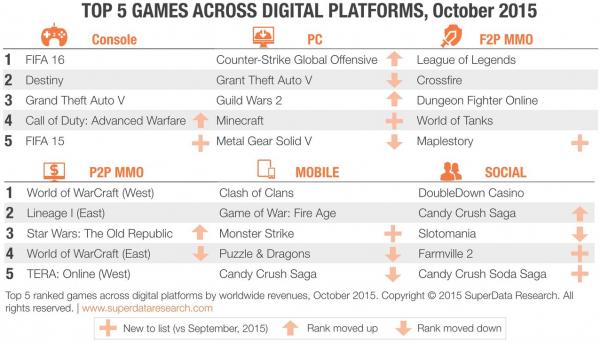
The top-selling digital titles by category for the month are as follows:

FIFA 16 continues to show dominance on consoles, while Grand Theft Auto V still has great presence even a year after its release on Xbox One, PlayStation 4 and PC. Meanwhile, League of Legends and World of Warcraft still have heavily popularity and DoubleDown Casino is still the top dog on the social front.

ResizedImage600343 Chart 1130Van Dreunen also provided a number of observances from the report:

The worldwide digital games market hits $5.5B, up 7 percent year-over-year

In the lead-up to the holiday season, total digital games sales hit their highest point for the year so far. With the exception of pay-to-play MMOs, all segments managed to grow their revenue. Digital console revenues rose 14 percent year-over-year to $375 million, driven in particular by a spending increase in North America. The growing install base for both the PlayStation 4 and Xbox One drove digital console earnings by 41 percent. Global digital PC earnings were up 6 percent, totaling $622 million, as gamers in Asia pushed sales by 53 percent, proving themselves more accustomed to purchasing full PC games upfront. The size of the global mobile gaming audience maintains its momentum: the total monthly active users was up 13 percent year-over-year, totaling 2.3 billion in October. As emerging economies like India open up to mobile gaming, the growth curve behind average spending is slowing, increasing only 7 percent to $2.1 billion.

Bugs and a tournament hangover cause Dota 2 to drop out of top 5. FIFA 16 dominates

Valve’s popular DOTA 2 saw a decline in revenue and player numbers fell for the second straight month. Bugs have been pestering the game since its latest update, cooling audience excitement together with a comedown following the all-time-high around The International 2015 tournament. This rare moment of weakness allowed Nexon’s Maplestory to take DOTA 2’s place, knocking itout of the five top-grossing free-to-play MMOs. Expansions for Guild Wars 2 and Star Wars: The Old Republic, allowing both games to move up in their respective segments. As publishers held off on major new releases until late October and early November, legacy tiles with strong additional content sales won out on PC and console. EA’s FIFA 16 earned 52 percent of its October digital revenue from additional content, and strong sales of FIFA Ultimate Team card packs also boosted the year-old FIFA 15, earning it a spot on the top-five digital console titles.

Fallout 4 earns $100 million in digital revenue its first three days on the market

Bethesda’s hotly anticipated game launched on Nov. 10, selling 1.87 million digital copies in three days, with 1.2 million of those copies were on PC. As Bethesda managed to cultivate enthusiasm among an enthusiastic community of modders, a slew of mods further drove the success of the title. On launch day, the game had 440,000 concurrent users on Steam, a record for any game not published by platform owner Valve. The game’s success is proof that PC gamers are willing to spend $60 on the right title and do not exclusively wait for deep discounts.

Nintendo places first bet in pursuit of $6.2 billion Japanese mobile games market

In Miitomo, launching in March 2016, players create a Mii avatar that answers friend’s questions and interacts with other’s Miis. Most expected the first game from the Nintendo and DeNA partnership to be a mobile version of one of Nintendo’s best-known franchises. Miis are in fact an extremely recognizable Nintendo IP for the audience the company most needs to win back: Casual Wii and DS users who later moved on to mobile games. Miitomo is a natural fit for Japan, where local messaging app LINE is ubiquitous. Japan’s mobile games market is the highest grossing in the world, making the territory an ideal place for focus before Nintendo develops mobile games with more international appeal.

Overwatch is coming to consoles but won’t be free-to-play

Blizzard’s upcoming first-person shooter will not follow in the footsteps of the publisher’s free-to-play Hearthstone: Heroes of WarCraft and Heroes of the Storm. Instead, the game will start at $40 on PC and $60 on PS4 and Xbox One when it launches next year. Free-to-play games on consoles are still few and far between, so rather than venture into uncharted territory, Blizzard is opting for guaranteed revenue by charging upfront. While the premium model will limit the game’s audience at launch, Overwatch still has the potential to be a top-tier eSport. Of the five games with the largest eSports prize pools, two (Call of Duty and Counter Strike: Global Offensive) are both premium-priced first person shooters.

Tencent enters the virtual reality void as the global market approaches $5.1 billion in 2016

Tencent has announced VR support for the miniStation, its upcoming Android-powered microconsole. The gaming and Internet giant, which owns League of Legends developer Riot Games, will likely control China’s largest non-mobile VR platform. Tencent owns stakes in Epic Games, whose Unreal Engine is being used to power many upcoming VR games, and AltspaceVR, which focuses on virtual gatherings. Tencent’s VR project also benefits from a lack of competition in China. The Playstation VR will not be a major platform in the market due to limited PS4 adoption, and the high-end PCs needed for the Oculus Rift and HTC Vive are out of reach for most Chinese consumers.

Digital TV Viewers Multi-Task While Watching Live TV

While the fight between TV and streaming services continues with a majority of advertising dollars leaning toward the latter it appears that there’s one definitive choice when it comes to what consumers utilize with multitasking.

According to TiVo research, more digital viewers multitask with live TV than any other given format. Per eMarketer, 53 percent of those polled indicate that live TV is the key choice to use while multitasking, followed by 28 percent with time-shifted TV and 19 percent with over-the-top or streamed content, including Hulu and Netflix.

The main reason for TV being the main choice is pretty simple: commercials. A majority of streamed content doesn’t utilize advertising (save for Hulu and other select channels), while regular TV still relies on it greatly in terms of revenue and sponsorship.

As far as how often these viewers multitask when it comes to TV programming, 44 percent stated that they do it nearly every time that a commercial comes on while 40 percent indicated that they do it sometimes; 12 percent do it every single time a commercial airs. Regarding what activities viewers take part in when it comes to multitasking, TiVo reports that the top choice was eating, as indicated by 76 percent of the audience, followed closely behind by sending text messages with 69 percent.

Because of its lack of commercials, Netflix has become a preferred choice for some viewers, since the current model of the service doesn’t use them (at least, for the time being). Of course, original programming like Jessica Jones certainly doesn’t hurt either.

So what can marketers and companies do to turn the tide? A big part of the solution lies in changing around how it caters to consumers with ads. Some companies go all out with catchy ad campaigns including some that get their start with big events, like the Super Bowl and avoiding the pitfalls of stale commercials. However, it’s hard to see what companies will take the initiative and try new things with their advertising.

Image source

Six Brands Already Leveraging VR With Apps

With the recent release of the Samsung Gear VR, coupled with the increasing promotion of Google Cardboard which both allow you to have virtual reality experiences by dropping your phone into display devices, we’re officially entering into the era of virtual reality technology. Although high-end headsets like the Oculus Rift, HTC Vive and PlayStation VR won’t be commercially available until next year, low-cost mobile powered devices can provide a taste of what’s to come. Here are some of the biggest promotional apps that are sure to pave the way for the months ahead.

Star Wars App

While there are dozens of mobile VR apps to choose from, none wield The Force like the Star Wars app will. Updating with VR content on Dec. 2, the adventure represents a partnership between Disney, Google and Verizon to promote Star Wars: The Force Awakens and will include a serialized experience that ties directly in with the movie. This, in addition to the bigger Google promotion, where users can choose the Light or Dark side, and their entire Google experience from Gmail to YouTube is customized accordingly. The Force is strong here.

The North Face

The outdoors clothing company fully embraced VR in a number of surprising ways, which is hardly surprising given how the company wants to gear you up for extreme experiences. In a partnership with Jaunt, its promotion is based on sharing experiences like rock climbing and visiting remote parts of the world from the comfort of home. Perhaps these experiences will inspire audiences to go out and have some real world adventures of their own. Other clothing brands have gotten the same idea, with companies like Tommy Hilfiger using the Samsung Gear VR at select retail locations to give viewers a front-row seat at the Hilfiger Collection fashion show.

Just Cause 3 Wingsuit Experience

Although video games and VR go hand-in-hand, the promotion of Just Cause 3 took a different view with its promotion. The open-world action game isn’t designed for virtual reality. Square Enix created The Wingsuit Experience, which uses Google Cardboard to give audiences a bird’s eye view of the world and explosive destruction while gliding around in a wingsuit. It’s a breathtaking experience that sets players up for the actual game, which releases on Dec. 1, and those lucky enough to pre-order the game from Tesco Direct got a custom Google Cardboard for free.

Mockingjay, Insurgent, Warcraft and Other Movies

Fantastic worlds, especially dystopian ones like seen in The Hunger Games and Divergent movies, are great to watch but you wouldn’t actually want to go there … unless it’s in virtual reality. That’s where apps like Mockingjay VR and Insurgent: Shattered Reality come in. Both promote their respective movies by taking audiences to these dangerous sci-fi worlds with 360-degree viewing experiences. Fans can visit iconic locations, and in the case of Insurgent, see the world through the eyes of a character as she goes through her own adventure. Other movie promotion VR apps include Insidious VR, which promoted last June’s horror movie, Insidious: Chapter 3. Then there’s Legendary VR, which showcases a number of inside-movie experiences, such as stepping into a Pacific Rim Jaeger (a giant robot), or riding a gryphon over Stormwind City to promote the upcoming Warcraft movie.

Netflix VR

The Netflix VR app takes meta to an all-new level. Using the app, viewers can watch movies and television streamed to their Samsung Gear VR from a luxurious virtual living room, complete with monster sized Netflix branding and a 110-inch television, all from the comfort of your (presumably) less impressive living room. Given time, perhaps more environments will become available for the app. In the meantime, other streaming services like Twitch, Hulu, Tivo and many more will be releasing their own Gear VR apps, all with varying features and functionality, ensuring that your home will always be the coolest place to be.

AltSpace VR

The online social meeting space is still in its beta testing phase, but it will soon become a virtual destination for likeminded people to come together, communicate and even get in a few games of Dungeons & Dragons. It’s being developed for a number of platforms, including the Samsung Gear VR, Oculus Rift, HTC Vive or plain old computer monitor screen. While it’s still a work in progress, there’s a great deal of marketing potential around this kind of virtual meeting space, including setting up themed rooms for movie and game promotions.

What Millennials Are Willing To Pay For Entertainment

Millennials are to digital marketers to what baby boomers are to geriatrics — they’ll forever be linked like mac and cheese.

The demographic is so prevalent, the White House released a 49-page report last year titled “15 Facts About Millennials.” You know you have staying power when the government produces a headline-optimized sermon targeted right at you.

Discovering unique methods to reach Generation “Netflix and Chill” with tactics that actually work is when marketing professionals earn pay dirt. After all, adults ages 18-through-34 total $1.3 trillion in annual buying power, yet, still rather rent, share and barter than buy. Use trumps ownership, and getting them to change their ways is proving to be a tall task as they largely ignore traditional and online advertisements. So how can marketers make the most and capitalize on the demographic?

For one, big brands such as Royal Caribbean (patrons riding zip lines/chefs cooking meals on its ships) and BMW (24-hour teaser of the M2 coupe) are livestreaming via Periscope. “There is an authenticity to this kind of campaign,” said Kara Wallace, the cruise operator’s vice president of North American marketing, per Reuters. “This is going to be the future of marketing.”

There are many brand-building ways to use Twitter’s video app, allowing marketers to share news, provide product demonstrations, conduct remote focus groups and building personal relationships. Plus, Periscope is free — and that’s a universal world everyone gravitates toward.

But that doesn’t mean premium content and entertainment can’t come with a dollar sign. Millennials living stateside are willing to pay for entertainment. According to a recent survey from the American Press Institute, between news and entertainment, 78 percent of Generation Y pay for at least one type of entertainment service (movie, video games, cable, music and TV downloads) compared to 40 percent who pay for news.

Screen Shot 2015 11 30 at 12.38.19 PM

Christine Barton, a senior partner at Boston Consulting Group, told Yale Insights that “millennials are not the primary spend or the primary customers of every sector.”

“If you think about the way that marketing used to work, it was much more of a linear relationship,” she said. “Today, it is much more of what I would describe as an ecosystem. You see over time the sectors they are impacting. You also see the sectors that see them coming and know that they have to foundationally change their product, or service, or value proposition — and they’re starting to prepare for that.”

Deciphering the code to break into the first digital generation’s coffers remains great. Authentic content and empowering products will only ease those efforts.

Snapchat Makes Live Events More Fun With Story Explorer

Snapchat has become an increasingly important platform for marketers with features like My Story, Geo-filters and Discover. This week, they had announced they are going all-in and expanding with new features in an effort to boost user-generated content for Live Stories with Story Explorer. While viewing a Live Story, users can now swipe to see different angles of the same exact moment. The recent American Music Awards show is a good example of this, making users almost feel like they were there.

“It s the first time you ll be able to experience that incredible game-winning dunk from thousands of perspectives throughout the stadium – or feel like you re right there on the scene when breaking news unfolds,” said Snapchat in a blog post {link no longer active}. By including content from multiple people at an event, users will be more incentivized to share on the platform while they are there.

This development may be key for marketers who have been using events like music festivals to get the word out for their brands and provide another interactive element for eSports events. Story Explorer has launched in New York and Los Angeles Live Stories this week, but Snapchat says there are plans to roll out the technology across more markets soon.

How Marketers Are Combating Challenges of Video Budgets

Video marketing has come a long way over the past few years, and now it appears that a number of companies are looking to increase their overall budgets.

Vidyard, in partnership with Ascend2, recently shared results from a study, via Reel SEO, where 200 respondents discussed the ability to reach objectives with video marketing, as well as where it needs to increase in the future.

The study touches on important objectives, like increasing overall web traffic, generating potential new leads and sales revenue. However, not all marketers feel these objectives should be of focus, while others take advantage of video consumption data to find new leads.

When it comes to obstacles, the biggest one seems to be lack of an effective strategy, leading with 44 percent. The list also includes inadequate video budget (41 percent), lack of compelling content (40 percent), lack of production resources (39 percent), lack of performance metrics (30 percent), inadequate video distribution (25 percent), limited organizational buy-in (17 percent), and, at the very bottom, inadequate video SEO (14 percent).

Often, one of the big things that marketers discover is how video can be “siloed” into its own separate component, away from other plans being made. However, it can be used in conjunction with marketing activities and integrated into other strategies, according to the report. One suggestion: invite another part of the marketing department to share a brown bag lunch to discuss potential opportunities for collaboration.

When it comes to marketing effectiveness, the survey stated that it will increase for 91 percent of the companies polled, with more than half believing that it’s a change for the better.

Demonstration videos like the iPhone 6 Plus “Will It Blend” (below) seem to be the easiest for companies to create, and it’s the second most effective on the list.

The report also explained that 93 percent of companies outsource all or part of their video content creation in an effort to reach out with specialized expertise and technology, while another 21 percent outsource it entirely. Only seven percent create it in-house but this could change over the next year, depending on effectiveness.

Image source

What Marketers Need To Know About The Virtual Reality Revolution

The world’s been fascinated with virtual reality since the good ole days of the View-Master. In recent months, the up-and-coming immersive viewing method is gaining traction by the minute. In fact, if you had VR gear strapped to your head right now, you d see promising, cutting-edge news coming at you from every angle.

By the end of 2016, Jupiter Research predicts three million VR units will be sold worldwide. Fast forward 10 years from today, and you can already see the field of greens. According to investment bank Piper Jaffray, the market for virtual reality content will be $5.4 billion by 2025, with 500 million headsets being sold.

Here’s a tip for marketers from Matt Bretz, vice president and creative director for Ayzenberg, a full-service advertising agency: jump on the bandwagon while there’s still some seats available. (Editor’s note: [a]listdaily is the media arm of the Ayzenberg Group.)

Bretz said that the first thing marketers need to realize about working with and for VR products is that there s actually at least three essential sub-categories to distinguish between.  (See bottom for breakdown)

It’s critical for marketers to start making the distinction between VR, augmented reality and mixed reality not just because it’s different mediums but also because it’s actually complementary emerging markets not competitive formats. So the good news is the revolution will be tripled.

David Cole, co-founder of NextVR, a purveyor of live and on-demand virtual reality programming with such credits as the NBA s first VR broadcast, and even the Democratic Presidential Debate, intimated on the popular notion: the VR revolution is coming.

Bretz said a second important insight for marketers is that VR, AR and MR marketing will roll out in two distinct phases.  “For the next five years before these devices saturate the market, we will have to make marketing assets that communicate the immersive, 3D experiences these devices deliver but do it on current gen-2D screens. This 2D marketing of 3D products will be a strategic and creative challenge that represents a relatively brief but lucrative opportunity to marketers. And at the same time, we ll be preparing to market VR, AR and MR on the devices themselves once the user base grows, presumably using native assets from the experiences built upon them.  So lots to do!”

The New York Times introduced their $5 Google Cardboard virtual reality viewer with hopes of kicking off the mass adoption of VR. Once Facebook acquired Oculus for $2 billion in 2014, championing advertisers with 360-degree virtual reality ads seemed like a foregone conclusion. Have you seen how brands and publishers are capitalizing on the new-found storytelling technique

But make no mistake about it VR is still in a nascent stage. Ted Schilowitz, a futurist at 20th Century Fox, told the NYT the industry is in the brick-size cellphone days only to add every few months, we’re reaching closer to the target.

“It’s the next big arms race for businesses to win,” said Jonathon Oliver, global head of innovation at Microsoft, per Campaign U.S. “One thing that you can say that is very telling, is the level of investment, and the level of motivation from a number of difference companies.”

Bretz advised anyone readying for a head-first dive in the industry to buy a 360-degree camera or, if you are so inclined, open a specialized production company like, right now.

“It seems obvious that whether you’re working with VR, AR or MR 360-degree assets will be a key component of marketing 3D on 2D screens,” said Bretz.

In the near term, VR likely most appeals to prodigal gamer-types. SuperData Research forecasts that by the end of 2016, mobile consumers will have purchased 18 million VR devices, and that over the next two years, VR gaming will reach $8.9 billion, growing more than 10 times its revenue in 2015.

But those footsteps you hear in the interim is the virtual reality industry in its entirety, strutting with swagger, ready to kick down tech’s doors. The best part: You can see them coming from the other side.

3 types of VR, as explained by Matt Bretz: 

Virtual reality: A VR device like Oculus Rift or Google Cardboard replaces your view of the real world entirely with a digitally created fantasy.

Augmented reality: An AR device like Google Glass overlays pre-baked digital elements on your real world which you can still see. This is a quick, low processing power way to put digital tools and information at your disposal think Iron Man s heads-up-display.

Mixed reality: A MR device like Magic Leap or Microsoft HoloLens also lets you see the real world but adds programmable objects made of light or holograms with which you can interact in real time and which behave according to most laws of physics.

Samsung Builds Buzz for Rihanna’s New Album with Mobile Tease

Rihanna fans can agree on one thing: the pop superstar is one helluva tease.

The bad-girl image has benefited the Barbados-born beauty and brands identify that. Her palpable aura allows for sponsors to think outside of the box every time they collaborate.

Enter Samsung, who’s taking full advantage of Ree’s mystique as they’ve created a series of cryptic clues and a game in a mobile-only, virtual trail teasing the release date of her forthcoming album ANTI. The immersive online experience offers fans clues to her eighth album; ads first launched during Sunday’s American Music Awards. The campaign contains more clues through the “iamthekeykolder” Instagram and Twitter accounts using the hashtag #ANTIdiaRy.

There are whispers hinting for a Black Friday release on Jay-Z’s music streaming service Tidal, with wider distribution taking place the following week.

If there’s any person on the planet who can pull off promotional play by keeping mum with a proverbial ball gag, it’s the sultry songstress.

Samsung’s mobile-only approach likely means it wants to use the 27-year-old’s drawing power to promote its Galaxy line of products. The Galaxy S7 is slated for a January release, and the South Korean tech titan reportedly is changing its strategy on smartphones, offering customers to contemplate a flagship phone earlier in the year.

Screen Shot 2015 11 24 at 12.07.13 PM

In a classic case of  “Bitch Better Have My Money'” Samsung reportedly paid a whopping $25 million for the Rihanna partnership to sponsor her album and tour, which kicks off in February. That kind of cash is a cold bill for brands and marketers to swallow, as most don’t have pockets deep enough to even join the bargaining table. And the bills will only get stiffer. Adele’s camp is pitching a $30 million sponsorship deal to Apple, the New York Post reports, a price tag 10 times the usual sponsorship deal.

Such are the scenarios when working with entertainment behemoths with worldwide reach. Rihanna is signed with Roc Nation, who previously profited with Samsung when they bought 1 million copies of Jay Z’s album Magna Carta: Holy Grail and distributed them for free through its Galaxy devices. Rihanna previously dabbled with VR via her very NSFW “Bitch Better Have My Money” music video.

“In today’s cluttered world, it’s important to break out and create unique, personal experiences that people are seeking in order to connect directly with consumers,” said Marc Mathieu, chief marketing officer of Samsung Electronics America, per AdWeek. “We know that one of our consumers’ passion points is music so we decided to join forces with Rihanna because she is an icon of originality and ingenuity and one of the most wildly creative voices in culture today.”

In the meantime, don’t be surprised if Rihanna’s posting more clues or salacious selfies with her new Samsung by the time the dessert cart comes around on Thanksgiving.