Vine has joined the leagues of social channels like Instagram and Facebook with their announcement today adding content discovery to the mix. In a blog posted by Vine API Engineer Luis Tandalla, the network is turning it up a notch with your own “personalized channel filled with Vines you won’t want to miss.”
“The world of entertainment on Vine extends far beyond our home feeds. There’s a ton of great content created by accounts you may not follow, and we’re bringing those posts to you.”
The functionality has been rolled out to iOS users today and the company says it will be available for Android users soon. You can navigate the content Vine thinks you’ll like by clicking on the “For You” section at the top of the app.
It doesn’t appear yet that Vine is using this recommended content feature to include branded content, but we did see some recommended content from some publications. Vine continues to be an interesting platform for marketers, but one that is tough to crack with its emphasis on extremely short-form content that loops. Just check out Vine’s top gaming brands.
In an update on its employment page, League of Legends developer Riot Games announced that it has sold its remaining equity to Tencent, which gives the popular online Chinese game company full ownership.
With the completed purchase, new incentives are opening up for Riot employees. “As a result of our continued growth and changing circumstances, we’re shifting to a new structure to recognize and reward Rioters’ contributions,” reads the post. “and that first involves a big change to our existing equity program. The company confirmed a “cash-based incentive program” for its workers, which leans on its overall success.
Tencent has been a majority stake holder in the company for several years, making its initial investment in 2011. It also invested money for stakes in game companies like Activision Blizzard and Epic Games, which have obviously paid off with a number of successful properties between them.
While some may see this as a surprise, others feel that it was expected of Tencent, in an effort to increase the exposure of games like League of Legends. Joost van Dreunen from SuperData Research, speaking with [a]listdaily, noted, “It’s not unexpected. Tencent operates in a rather transparent way: whenever it sees a particular game or genre rise in popularity on its networks, Tencent either builds its own version or buys itself a piece of the action. Moving to own Riot Games outright is merely an epilogue to Tencent’s earlier investment, and consistent with the company’s overall investment strategy.”
Joost discusses how the acquisition of Riot Games will help with Tencent’s overall growth. Ownership of Riot gives Tencent access to an enormous global audience. Our numbers indicate that League of Legends has around 100 million monthly active users, well beyond the 67 million they reported publicly over a year ago. I have no doubt that Riot s growth played a crucial part in completing the transaction. Beyond revenues, it allows Tencent to leverage Riot s audience for other games and services, thereby further expanding its global entertainment empire.
That said, changes to day-to-day business aren’t likely to be that jarring. I don t expect to see any changes. Tencent understands that it makes little sense to change a winning formula. Likely, Tencent will initiate an even more aggressive push behind LoL s eSports effort and a re-commitment to expanding the user experience,” Joost added.
Tencent’s buyout of Riot Games is just the latest acquisition to take place in the year, “Whereas Western publishers are trying to breach the Asian games markets by localizing existing games, Eastern publishers tend to acquire or invest in existing game companies. It s not immediately obvious whether the games market is changing in terms of available content, but certainly the list of top firms is getting smaller. Combined with Activision s recent acquisition of King and a slew of smaller mergers, the games industry is entering a phase of consolidation that typically follows a period of disruption.
Overall, this could mean a larger interest in consolidation between the U.S. and China, since games are incredibly popular in both markets. To operate on a global scale requires vast resources, and a disciplined approach to game development and publishing. This makes the group of companies that is equipped to do so is increasingly smaller, and raises the barriers to entry.”
Newzoo’s Peter Warman looked at the bigger picture when regarding the news. Speaking with [a]listdaily, he explained that Tencent owned 93 percent of Riot Games already, therefore, “Tencent acquiring the remaining 7 percent of Riot Games is not big news. It comes almost exactly five years after their biggest share increase in 2011. It most probably is the final buy-out of the founders who, as part of the 2011 deal, would keep (part of) their shares for a period of five years securing their leadership. Now that they have succeeded in building world s leading PC game and esports franchise, they deserve a good payday.
“More interesting is to look at it in a larger perspective. Tencent controls a significant share of Glu Mobile and has a considerable stake in worlds second largest company by game revenues: Activision Blizzard, (which) recently bought King, boosting their combined H1 2015 revenues to $3.4 billion, with Tencent at $4.2 billion,” Warman continued. “When Activision Blizzard broke loose from Vivendi back in July 2013 in a deal sized at $8.2 billion, a consortium called ASAC II, purchased $2.34 billion, or almost 25 percent worth of shares. Guess who was a large contributor to this consortium… indeed, Tencent.”
As for how the buyout might shake up the video game industry, Warman states that Tencent indirectly and partially “controls about a third of the revenues generated by the top 10 global companies by game revenues.” This could prompt Tencent’s chief rival, Netease, to take further action. “I would not be surprised if Netease makes an effort to acquire EA before the power of Tencent in the Western market is behind their horizon.”
Google has wasted no time breaking down some of the biggest trending topics for 2015, including top Searches, Movies, People and other topics, including offbeat interests like Celebrity Pregnancies and Celebrity Weddings. However, one list that should be of interest is Video Games, as the top spot doesn’t belong to an established franchise, but rather a surprising favorite.
The web browser based game Agar.io managed to take the number one spot when it came to trending video game topics. In the game, players compete against one another online, portraying circles that absorb smaller circles in a limited playfield, growing larger as a result. The game has amassed millions of players this year, thus making it an obvious favorite.
However, the rest of this year’s top trending games are quite familiar:
2. Fallout 4.Bethesda’s hit sequel benefitted from a huge marketing blitz this year, alongside its popular mobile tie-in, Fallout Shelter, which has become one of this year’s biggest free-to-play hits.
3. Mortal Kombat X. The blood-soaked fighting sequel didn’t disappoint, selling millions of copies across the Xbox One, PlayStation 4 and PC. Its success will continue in 2016 with the announcement of several new fighters, including the Xenomorph from the Alien films and Leatherface from the Texas Chainsaw Massacre franchise.
4. Call of Duty: Black Ops III. Activision’s latest entry in the fast-paced first-person shooting franchise has been a huge sales success, and has also seen a strong marketing push in its own right. 2016 will be big for it as well, between forthcoming downloadable content for the game and the introduction of an eSports-based World League.
5. Star Wars: Battlefront.Battlefront‘s success shouldn’t be that big a surprise, since the Star Wars-labeled shooter has tie-ins with the forthcoming The Force Awakens, as well as a large offering of multiplayer modes. It should no doubt be one of the most popular games for the overall holiday season.
6. Pokémon GO! A game that will no doubt take the mobile playing world by storm, Pokémon GO! ingeniously combines real-world terrain with in-game actions, as players attempt to “catch ’em all” across a number of places. With hundreds of Pokémon characters available, this should attract fans with ease.
7. Madden NFL 16. EA Sports’ officially licensed football game continues to draw in millions of fans around the world, and with various promotions happening this year, it continued to be a top trender on the Google front as well. Don’t be surprised if Madden NFL 17 follows suit next year.
8. NBA 2K16.2K Sports’ slam-dunk of a basketball franchise continued to be a best-seller this year, with millions of units sold throughout the holidays. The game has gained big buzz through a number of promotions as well, including a recent team-up with Twitch to reveal Kyrie Irving’s new Nike shoes. Look for this trend to continue well into next year’s NBA season as well, leading up to the release of NBA 2K17.
9. Bloodborne. Sony Computer Entertainment had big success this year, with over 30 million PlayStation 4 systems sold. Leading the charge was an array of strong original titles, including this brutal hack and slash game from the creators of the Dark Souls series, From Software. Bloodborne drew a large audience since its release earlier in the year, and its success continued on with additional downloadable content and new challenges.
10. Battlefield Hardline.Battlefront wasn’t the only big success for Electronic Arts this year, as its latest Battlefield game, set in the world of cops and robbers, also drew a big online crowd since its release earlier in the year. Featuring a number of multiplayer options that fans have become used to, along with an action-packed single player campaign, Hardline had no problem boosting its popularity on the social front.
With companies like Adblock Plus trying to change the future of advertising by encouraging better ad formats and innovation, the hands of agencies, publishers and brands are forced to re-think strategies to put the user experience first.
Of the over 198 million people globally who run ad blockers each month, gaming and entertainment segments are hit the hardest because they have more sophisticated, tech-savvy audiences, Rebecca Markarian, senior vice president of digital and social media for the Ayzenberg Group, a full-service advertising agency, tells [a]listdaily. (Editor’s note:[a]listdaily is the media arm of the Ayzenberg Group.)
This industry needs to aggressively push ourselves away from banner-type ads to content and native advertising to continue to reach our audiences. The fragmentation of the platforms these audiences are getting information from is also getting more diverse, adding to the complexity, Markarian said.
According to anti-ad blocking firm PageFair, ad blocking estimated to cost publishers nearly $22 billion during 2015. In the U.S., ad blocking grew by 48 percent to reach 45 million active users in 12 months up to June 2015 a growth of 41 percent globally.
IGN’s high-tech audience of 80 million users each month is running ad-block at a ballooning rate of 40 percent compared to 25 percent last year.
“We don’t have a lot of data on who an ad blocker is, but my guess is those are some of the most valuable people that advertisers want to reach the most,” said Todd Northcutt, IGN s vice president of Product Innovation, per Digiday. “How do you appeal to your audience in ways where they are not explicitly telling you ‘I don’t want this ‘ I do wonder if they are objecting to display ads and pre rolls ads with ad blocker and if reaching them through another vehicle will be effective.”
The trends don t lie and the message for marketers is as clear as day: it s time to make a change. Markarian says it s not enough just to think mobile and desktop anymore either.
We have to think about gaming consoles, home entertainment devices, social channels and customize all the content to that particular channel putting the user experience first and foremost. It s both exciting and challenging. In 2016 marketers will definitely have their work cut out for them.
While album sales may have been on a decline for certain artists, between the return of various breakout performers and the establishment of new services including Apple Music 2015 was still a big year for the music industry. Here’s a quick breakdown of some of the best music marketing stories we’ve seen this year.
Debut of New Music Services
While Pandora and Spotify continued to establish their audiences with streaming music channels, several competitors stepped up and introduced their own in an attempt to get a piece of the streaming pie that has entertained millions of listeners.
YouTube introduced a new music app that enabled listeners to choose from 50 million songs across both audio and video formats, under a plan that charges a small monthly fee. Although an exact listener count hasn’t been revealed yet, it’s been pretty popular since its introduction.
Likewise, Apple found itself jumping into the music game with its own devoted channel, including devoted stations, exclusive content from artists and live events, including the Taylor Swift 1989 concert that will take place this week. It’s been pretty popular as well, thanks to the three-month trial period that enables customers to give it a try without paying a cent.
Tidal also introduced its service this year, featuring a number of exclusive shows for members, including performances by Jay-Z and Deadmau5, partners in the music channel. There have been talks that it hasn’t been as popular as its competitors, but it’s still seeing a lot of exclusive content.
Even with the launch of these channels, however, Pandora and Spotify have continued to endure, and are potentially looking into new plans that could bring revenue to its channels as well. We’ll see just how effective these plans are when 2016 rolls around.
Music Finds Its Footing In Social
Another means for artists to reach out to their audience came in the form of social media, whether it was through sharing the debut of a music video, sharing a new song through the likes of Soundcloud, or, in the case of Drake, inadvertent popularity through memes.
Drake’s own “Hotline Bling” became a hit song in the top 40, but also managed to produce a video in which users could put their own creative touch with a repository of memes.
Most of these edited clips managed to go viral, helping generate interest in the original clip. Even if they were meant for laughs, they certainly assisted the artist with exposure and brought out some creativity in fans as well.
Taylor Swift also saw a huge push in social media with the hashtag “#SquadGoals,” driving up the force in girl power through a series of music videos, live shows and appearances at award events. The term has now become commonplace in social media, continuing to drive Swift’s strong success in the music business.
Just keep it simple
One of the biggest success stories in the music industry for 2015 was Adele, who made a monumental comeback with her new album 25. With it, she managed to sell 3.38 million copies in the first week, prior to announcing a world tour for 2016 that’s set to see record ticket sales.
That was just the beginning, though, as Adele’s simply produced “Hello” would see major exposure online as well. The music video generated a massive audience on Vevo, with more than 27.7 million views in the first 24 hours of its posting.
All of this, managed to be done with minimal marketing, indicating that, hey, sometimes you just have to be yourself and show what skills you’re capable of as an artist. Adele obviously has no problem doing this, and should see big sales once 2016 rolls around.
Meanwhile, Justin Bieber managed to see a turn-around for 2015 as well, foregoing all the reckless acts that made him such a controversy over the past few years and instead going with a simple approach for his latest album, Purpose. As a result, his Beliebers remain as strong as ever, and the album fared well, landing in the No. 1 spot his sixth in a row.
Innovation goes a long way
Finally, one trend that was hard to ignore in the music industry was the use of innovative means to promote your work, and some artists found this to be a pretty common practice.
For example, The Weeknd utilized virtual reality technology to promote its new music video, “The Hills.” Using 360-degree perspective so that the users can interact with the video, it’s created a trend that a lot of artists are beginning to adopt to.
Interlude has also done a fair share of interactive videos as of late, and collaborated with both Warner Music Group and S-Curve Recordsfor a special project involving AJR. This is the latest work by the company that utilizes this format, and it probably won’t be a surprise if it continues to flourish in 2016, keeping fans entertained in the process. This interactive take on Led Zeppelin’s “Trampled Under Foot” is also worth checking out.
Fresh perspectives pay off. Action Bronson recently partnered with GoPro to use their gear during special events, putting users in the “you are there” perspective whenever he performs. The video below demonstrates how effectively this technology can be used with such a performance.
Overall, the music industry has seen a lot of trends technology, social media, or even just going back to simple roots that have worked, and we’re certain to see more experimentation as the New Year rolls around.
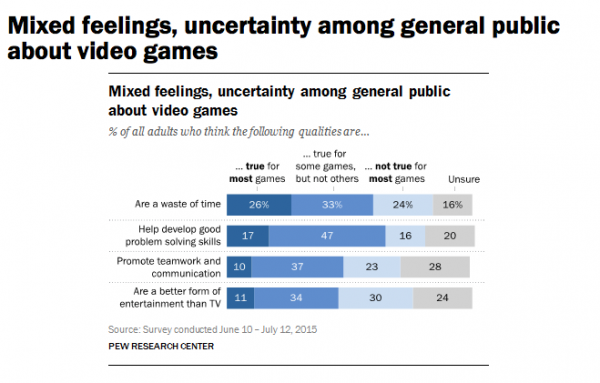
The Pew Research Center dug deep into the complicated attitudes toward video gaming, indicating that, while half of all American adults play video games, only ten percent identify themselves as “gamers” – indicating that it’s more of a casual approach with some players, instead of being “hardcore.”
In addition, the report also revealed that:
50 percent of men and 48 percent of women play games to some extent
Meanwhile, 60 percent of those surveyed indicated that they believe most people who play games are male.
15 percent of men and 6 percent of women refer to themselves with the “gamer” term.
In the 18-29 year old age group, 33 percent of men use the term “gamer,” while only 9 percent of women do.
Violence in video games was also a major factor.
53 percent of those polled feel that the statement “people who play violent video games are more likely to be violent themselves” as untrue.
However, 40 percent feel that there is some form of relationship between video game violence and violent behavior.
32 percent of the audience that do play games feel that there is some form of connection with games and violence, although women seem to be stronger to agree than men (47 percent versus 31 percent) that video games make people violent.Â
The general public appears to have mixed feelings when it comes to attitudes toward video games. Some people feel that games are a waste of time, while others believe they’s beneficial in helping to develop good problem solving skills, or promote teamwork and communication, which is something players often in multiplayer games like Ubisoft’s Tom Clancy’s Rainbow Six Siege.
As for opinions of how women are portrayed in games:
27 percent of those polled believe that women are portrayed badly in some games, but not all.
14 percent believe most games portray women poorly.
18 percent felt that this was not true for most games on the market.
When it comes to minorities:
33 percent felt that minorities are not portrayed poorly in games.
20 percent felt it was true in some cases.
9 percent believed it occurred often in games.
The full delves deep into the conflicted relationship between gaming and identifying as a “gamer.” Although a small percentage of people might see themselves as gamers, the video game market continues to surge, and should do so well into 2016.
Kyrie Irving and Nike decided on a different way to promote the new “Kyrie 2” kicks, as the athletic apparel company teamed up with NBA 2K16 publisher 2K Sports to endorse the Cleveland Cavaliers all star’s new shoe brand through a special live-streamed event hosted on Twitch.
With the event, fans tuned in and caught the Cavaliers star showcasing his new shoes. It also provided him the opportunity to answer questions regarding the product, as well as engaging with fans in a special challenge through the NBA2K16‘sMyPark mode. Anyone who could beat his team in a game would be eligible to win a pair of Kyrie 2 shoes, autographed by the star himself.
It turned out to be a huge success, with Alfie Brody, vice president of marketing for the NBA 2K brand, telling Fortune: “What Twitch enables us to do is not only highlight NBA 2K16, but create more impactful live events with special guests like Kyrie who can engage directly with fans while they’re playing,” he explained. “It is really a tremendous platform to better connect our fans with the stars and our community, which makes our game so special.”
Twitch senior manager of partnerships John Imah also expressed the effectiveness behind the campaign. “By broadcasting this on Twitch, the NBA, 2K and Nike can simultaneously reach multiple audiences, including media, gamers, kick collectors and basketball fans,” he explained, per Fortune.
For those that missed this weekend’s event, though, there’s still time to catch it. “There is always value to having a VOD (Video On Demand) available for those who missed the broadcast, which can then be socialized, but like the Super Bowl, people will want to see it when it happens,” Imah added.
Twitch has become a reliable source for viewership outside of the television realm for many companies and not just related to video games. The broadcaster, purchased by Amazon last year, has partnered with a number of companies for unique content, including Old Spice, to drive up numbers. Not only that, but it’s also diversified its content as well, introducing channels devoted to music and art (including a full marathon of The Joy of Painting episodes).
When it comes to movies, 2015 was no doubt a big year. We’ve already seen a number of blockbusters produce over a billion dollars in box office revenue worldwide, and Star Wars: The Force Awakens is likely to join the club with ease when it releases this Friday.
With that, let’s take a look back at some of the biggest and most effective movie marketing campaigns for the year.
Mad Max: Fury Road
Ever since the debut of its initial trailer last year at San Diego Comic-Con, Mad Max: Fury Road built up an incredible amount of steam in terms of social buzz. The high-octane action film, starring Charlize Theron and Tom Hardy, got even more popular with each new trailer release, featuring a heavy amount of explosive action and stylish direction that only series creator George Miller could deliver.
With over $9 million spent in advertising across a number of networks (including during the NBA playoffs and on MTV and Comedy Central), the buzz simply kept building. Even though the film released against the likes of Marvel’s Avengers: Age of Ultron in May, it held its own, grossing $375 million worldwide and assuring that we haven’t seen the last of the Road Warrior. On top of that, the Golden Globe nominations announced last week as well as rumors that the film could see a re-release in black-and-white form next year have buzz building for Max all over again.
Minions
“King Bobbbbbbb!” Considering the success of the first two Despicable Me films (2013’s film nearly cleared a billion dollars in box office growth), it was just a matter of time before Universal Pictures gave the gibberish-speaking Minions their own film. What no one expected, however, was the immense marketing blitz that came with it.
Universal partnered with many companies to promote the delightful little Minions, including Amazon, Electronic Arts (with its mobile game Minions Paradise) and other companies that, in turn, would create “Minion mania” for the studio, leading up to the prequel’s summer release.
It’s a release that paid off, as the film handily crossed the $1.1 billion dollar mark worldwide, affirming Universal’s place in the computer animation field (alongside the studio team at Illumination Entertainment). The film should also do quite well on the home video front, backed by a multi-million dollar television advertising campaign.
This all bodes well for the minions’ eventual return to the big-screen in 2017, when Despicable Me 3 is set to hit theaters.
Jurassic World
Considering we haven’t seen a new Jurassic film from Universal Pictures in over a decade (with the last one, Jurassic Park III, being an overall disappointment), the studio was wondering if it could jump-start it again with Jurassic World, from director Colin Trevorrow.
The film, featuring actor Chris Pratt and a lot of angry dinosaurs, got a huge promotional push from the company, including a massive amount of TV advertising and a number of partnerships with brands including Mercedes-Benz and Hilton Hotels. That gave it just the traction it needed to get big box-office records, including the top opening weekend of all time, making $208 million and eventually leading to a $1.6 billion haul worldwide.
It proved that the series still had legs, and that fans still had plenty of excitement in seeing dinosaurs hit the big screen. Of course, having the star power of Pratt didn’t hurt either, especially when it came to behind-the-scenes vignettes for the film, which drove up its social media as well.
Jurassic World also managed to score big on the home video front behind a lucrative campaign, selling three million copies in its first week on DVD and Blu-Ray as well. That bodes well for eventual sequels, which could start coming our way as soon as 2018.
The Avengers: Age of Ultron
Marvel Studios’ films have done quite well in the past, and considering that 2012’s The Avengers was the biggest moneymaker in the bunch (with $1.5 billion worldwide), the movie studio spared no expense in promoting the forthcoming Age of Ultron like crazy.
After a teaser trailer debuted in late 2014 (featuring a strong voiceover by actor James Spader), buzz began to build for the film, with many Marvel fans speculating what new additions we could see, including glimpses of newcomers like Scarlet Witch and Quicksilver.
Eventually, the buzz built to a fever pitch, with more trailer reveals and a number of marketing deals, including a tie-in with Gillette, which introduced The Hulk Razor an item that sold reasonably well in the shaving market. Toys also came out before the film’s release, opting fans to pick up everything Captain America and Iron Man-related.
The film was a modest success, grossing over $450 million in the U.S. and $1.4 billion worldwide, despite the fact that it didn’t quite reach the original’s gross. No matter, as home video sales for the film have been steady, indicating that Marvel is still all systems go with everything Avengers. Not only that, but the company’s off-shoot film Ant-Man fared rather well, grossing over $450 million worldwide and creating another niche character that we’ll see on the big-screen again in 2018.
As for Marvel’s continuing success into 2016, it’s likely to keep going. Last month, the first trailer for Captain America: Civil War made its debut, and racked up a record 61 million views in its first 24 hours. Needless to say, it’ll be a big hit when it arrives in May 2016.
Star Wars: The Force Awakens
When it comes to the biggest promotional campaign of the year for a film, nothing comes close to Star Wars. The Force Awakens is taking part in a huge program that includes a number of partners, ranging from Subway to Cover Girl to Duracell. Not only that, but promotional tie-ins for products have gone through the roof, with a number of toys, high-tech goodies (like the Sphero BB-8 droid) and video games (such as Star Wars: Battlefront) being offered to the public and selling quickly.
Social media buzz has been immense for the sequel, with new trailers getting millions of views within a matter of hours, and mentions of both the new film and older films using the #StarWars hashtag, amongst other special ones being offered via Twitter.
It’s too soon to tell what the film’s box office will look like, as it doesn’t arrive in theaters until Friday. However, reports indicate that it should no doubt clear the billion dollar mark within a matter of days, as the film has already generated $50 million in early ticket sales. Plus, considering the tremendous push Disney is putting behind the film, it should have no trouble keeping interest into the Christmas season and through early 2016.
This should bode well for the future of the franchise as well, as other films, like the forthcoming Rogue One spin-off due for release in late 2016 and Episode VIII coming in 2017, should fare just as well in terms of promotional push and success. For now, though, everything’s coming up Force Awakens and for good reason.
They make us laugh, they make us cry, they entertain us to no end and take us inside their everyday lives. They’re vloggers. This week’s ION Top 10 takes a look at the world’s best vloggers and the content they create that keeps millions coming back for more.
The mobile gaming market is booming right now, but some developers feel that their product could thrive if it could have a greater outreach to other markets. That only brings up one question: can it be done effectively
Chinese game platform operator 360 Game believes there’s a way for U.S. game developers to build a successful bridge into overseas and it lies in the company’s new tool, Qihoo360.
“Qihoo’s 360 Game is the biggest Android mobile game platform in China,” said the company in a statement, per Mobile Advertising Watch. “360 Game provides a wide selection of high quality free mobile games to hundreds of millions of users in China. Additionally, 360 Game provides a customized service for game developers to help them publish their games in China.”
The company has already proven its track record, having formed alliances with a number of big-name mobile developers to release their games in China, including Blizzard, Disney and Goodgame.
“360 Game is one of the most successful PC web-game publishing companies in China and publishes hundreds of popular web games and reaches over 200 million users,” the company noted. “(It) also aggregates two web game platforms (360 Game Center and Youxi.com) and 360 Game Lobby to provide high quality web games and services to gamers.”
Obviously it’s not an easy process, as some localization is involved in making sure the game caters to the right crowd, and success isn’t always guaranteed, continuing the stiff competition with other popular titles. Nevertheless, developers can still find motivation in trying something new, and potentially expanding its games so that new players can see what it’s all about.
 It doesn’t appear yet that Vine is using this recommended content feature to include branded content, but we did see some recommended content from some publications. Vine continues to be an interesting platform for marketers, but one that is tough to crack with its emphasis on extremely short-form content that loops. Just check out Vine’s top gaming brands.
 As for opinions of how women are portrayed in games:


