How Influencers Will Be Impacting This Holiday Season

With Halloween this week, the holidays are practically on our doorstep. For 25 percent of consumers, some holiday shopping has already happened. This year, influencers may have a special impact on purchase decisions as we head into the “most connected holiday shopping season ever” according to Google. As a majority of marketers are placing an increased importance on their influencer marketing efforts this year, the holidays are especially key. Now, 78 percent of consumers go online to research what gifts they’ll buy and vet them. Not surprisingly, a whole lot of them are ending up on YouTube.

Of those who watched online videos to help with online shopping, 80 percent watched product reviews and ratings where they are favoring videos featuring people most like themselves (68 percent) instead of experts (45 percent). Watching these product reviews is proving to be a strong influence in the end game: 45 percent of holiday shoppers cite product reviews as the most important influence in making holiday purchases.

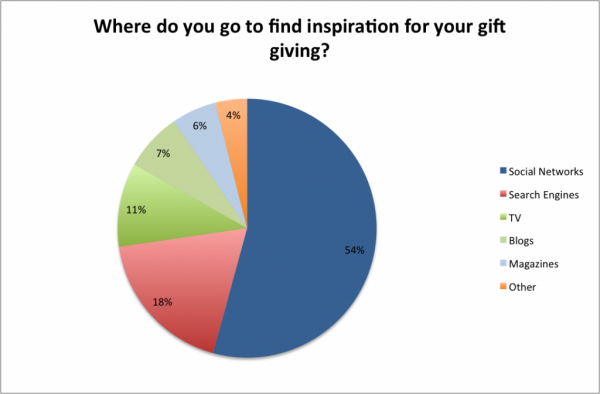
It’s also interesting to note that for influencers themselves, these stats are not all that different. In a survey of over 550 influencers, social networks and search engines (you could count YouTube in either of these categories) provide more inspiration for their gift-giving than TV, blogs and magazines combined.

inf gift giving

Â

Mobile Games Highlights 10/29: Octodad, Dust


Octodad: Dadliest Catch ($4.99, available for iOS)

Originally released for PC and consoles last year, Octodad: Dadliest Catch finally flip-flops its way to the mobile front with a release on iOS. In it, you play a squid who is actually disguised as the patriarch of a family of four, going through day-to-day adventures while flopping around with tentacles. This game is likely to cater to fans of the original game on consoles and PC, as well as those looking for something delightfully weird to play on the go.

Dust: An Elysian Tail ($5.99, available for iOS)

This compelling side-scrolling platforming adventure originally made waves on the Xbox 360 in 2012. Then it was brought to Windows PCs and Macs before popping up on the PlayStation 4 last year. Now, Dust has made its way to mobile, keeping all its beautiful visuals and exciting gameplay intact. You take the role of a powerful warrior, working alongside an enchanted weapon and a fairy-like creature as you work to cleanse the land of evil. For fans of old-school action games, Dust is a must. This aims for fans of side-scrolling action games like Rayman Fiesta Run and the Mikey Hooks series, although its price clearly shows a higher level of quality.

Templar Battleforce ($6.99, available for iOS and Android)

Fans of turn-based strategic combat games will like what Templar Battleforce has to offer. In it, you work alongside Leviathan mechs and battle against the evil Xenos with the help of the Templar Knights. You’ll divide up your army among a number of specialists within your Templar group, while creating new combat strategies. Although it is the most expensive game listed here , Templar Battleforce is certainly worth the investment. This will appeal to audiences looking for a good turn-based strategy game that don’t want to deal with in-app purchases that many free-to-play games have.

Evel Knievel ($1.99, available for iOS, coming soon to Android)

Stuntman Evel Knievel made quite a name for himself decades ago by performing breathtaking stunts atop his motorcycle. Now, players can relive his glorious stunts in this side-scrolling racing game. Featuring a number of campaigns to race across and obstacles to overcome, players of all ages will be able to marvel at Evel’s stunts, and cringe when things go wrong. Both fans of the stuntman and those learning about his name for the first time are in for quite a ride. This game hits on nostalgia, as well as racing games like Joe Danger Touch and Trials Frontier.

Zombie Match Defense ($1.99, available for iOS, coming soon to Android)

With Halloween nearly upon us, it never hurts to have a game packed with zombies. That’s exactly what Zombie Match Defense brings, with a combination of match-three games and Plants vs. Zombies-style lane defense gameplay. Your job is to clear away hordes of the undead before they can attack poor civilians. Despite the mishmash of two different styles of play, Zombie Match Defense works remarkably well, and the low price won’t take a big bite out of your wallet. Fans of match-three games like Candy Crush Soda Saga and Farm Heroes Rescue. Especially geared toward those looking for Halloween-themed entertainment.


ESports Revenues To Hit $1.9 Billion By 2018

ESports have rapidly flourished over the past few years, but we haven’t seen anything yet, according to SuperData numbers reported by a VentureBeat.

The article indicates that eSports current generates $748 million in revenue worldwide, showing how far tournaments for popular games like League of Legends and DOTA 2 have become over the past few years. This is based on statistics provided by SuperData Research, which also points out that video game competitions are equally appealing among North American and European fans alike, which makes up more than 52 percent of the overall market.

With rising star players, and plenty of sponsors set to devote cash, revenue numbers will continue to grow and may reach $1.9 billion by 2018.

Keep in mind that this number is purely from revenue, based purely on what pro competitions bring in through ticket sales, online ticket purchases, advertising and betting. It does not reflect the money made through in-game transactions, like purchasing costumes for League of Legends characters.

Brands have taken notice of eSports popularity and many have become sponsors quicker than projected, the report reads. By year s end, sponsorships of tournaments, players, and eSports-related sites will exceed $578 million, just 28 percent less than this year s NBA sponsorship total. That’s just 77 percent of total eSports revenues, while the remaining 23 consists of daily fantasy gaming sites, prize and tournament pools, and merchandising.

Out of all the money made, ticket sales seem to be lowest, which brings in $15.9 million. However, that number doesn’t account for what sponsors bring in through game broadcasts over Twitch and other networks.

Investors can’t help but get involved. Funding for various startups and platforms jumpstarted the eSports market, equaling an estimated $150 million year-to-date, reads the SuperData report. Multiple eSports and traditional sports betting platforms like Unikrn, Draftkings, and FanDuel have emerged this year. These platforms are receiving multimillion dollar investments from prominent figures like Ashton Kutcher and Mark Cuban.”

The sheer thrill of competition continues to be the key focus, and fans can’t get enough of their favorites. 76 percent of eSports fans have a favorite team and 69 percent have a favorite player, according to the SuperData report. Thirty-two percent of eSports fans watch tournaments for the players and teams. Fans have now become more acquainted with eSports superstars, increasing the celebrity of both teams and players.

To lend a little insight in regards to the appeal of eSports to brands, [a]listdaily posted an interview yesterday with EEDAR’s business analyst Ed Zhao, who explained the appeal to not only devoted brands, but also those considered non-endemic. “We researched a large number of non-endemic sponsors and their involvement of eSports. Generally, beverage companies have been some of the first to broach this. Companies like Red Bull and Coke have led the charge by really instilling themselves within the community. Red Bull hosts their own tournaments while Coke has sponsored League of Legends viewing parties in theatres. Many of these non-endemic sponsors have really worked to make themselves a part of the community rather than simply putting up advertisements and calling it a day.”

There are also lessons to be learned from devoted brands. “Non-endemic brands usually have to try a little harder,” said Zhao. “eSports viewers will already gravitate to a peripheral company like Razer due to that brand s great reputation among gamers. Razer simply has to remind the viewers about the brand and that can drive sales. In comparison, non-endemic brands have to prove they re really a partner and not simply there for the numbers.”

Opportunities will open up for broadcasters, and not just on Twitch. “We believe this can really act as a great proof of concept for many of the larger brands. Currently, it s only a few major brands that have really embraced eSports. It s something like a Coke sponsoring viewing parties or Intel with their tournaments. Many of the biggest brands are still watching, but they can see the massive upside. Today, eSports doesn t necessarily need TV to succeed but it will help to usher in greater widespread acceptance and advertisement opportunities,” said Zhao.

Mobile Video Ads Becoming More Popular Than Ever

More companies are investing in mobile video ads, now that cellular broadband networks can handle the content demands, and it’s only going to grow. A December 2014 Business Insider Intelligence report estimates that mobile video ad revenue in the U.S. will reach over $4.4 billion by 2018, which shows an increase over a five-year CAGR of 73 percent reported in 2013. Business Insider Intelligence also estimated that mobile video would grow five times faster than desktop video ads.Even if you go with eMarketer’s more conservative estimate of mobile video revenue will grow three times faster than desktop ads throughout 2020 (detailed in a June 2015 study), there’s no denying the momentum of video based advertising.

With that in mind, AppsFlyer and AppLovin have teamed to together and created a report that shows the full impact of mobile video ads.

The two companies measured data from over one billion devices worldwide, taking a close look at the growth of mobile video and data regarding app retention globally and across multiple platforms. Retention is crucial to publishers and marketers alike, mainly because of an app’s “stickiness” in terms of people using it more regularly.

The report also found that mobile video seems to be the fastest growing advertising format, with a 190% increase over the first three quarters of 2015. More importantly, video ads are 40 percent more effective for creating user retention than non-video ad formats. However, iOS video ads have a greater retention statistics than on Android.
Applovin AppsFlyer VideoTotalSpend 2015

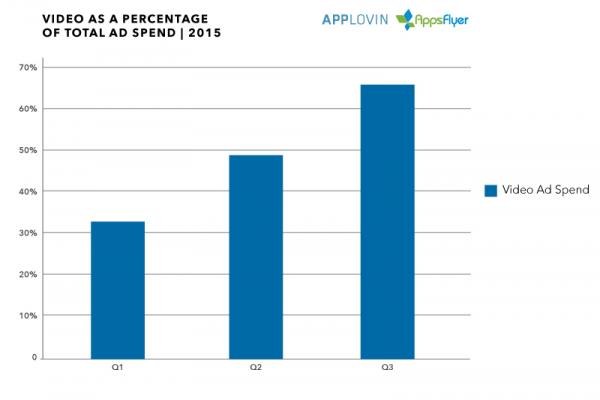
Charts indicate that video ad spending jumped quite a bit between the first and third quarters, going from just over 30 percent to 65 percent in 2015.

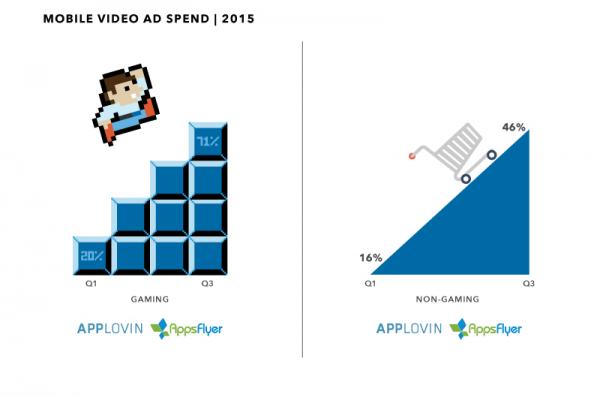
Global ad spend on video increased with non-gaming advertisers, going from 16 percent to 46 percent within the same time period. Meanwhile, those within the gaming market rose even higher, going from 20 percent to 71 percent from Q1 to Q3, as indicated in the chart below.
Applovin AppsFlyer GamingvsNonGaming Infographic Final1

As for retention, AppsFlyer emphasizes its importance, since the average Android app on Google Play manages to lose around 77 percent of daily active users within three days of its install. Video ad formats can normalize retention over non-video ads by about 34 percent. “If a player downloads a game after seeing a video ad, they are a third more likely to stick around than if they downloaded the game after seeing a non-video format ad,” says the report.

iOS outperforms Android in normalized retention, with 40 percent and 30 percent, respectively.

“Specifically, in regards to retention, mobile video ads let consumers know what to expect from an app or game, so they know what they are getting into before they download,” the report states. “It makes sense then that this self-selecting sample (those who watched the video then chose to download it) would stick around longer.

“In the early days of mobile advertising, video ads were impractical. Most phones couldn’t handle displaying them, and cellular networks certainly couldn’t either. But as this report suggests, the conditions right now are perfect for the success of mobile video ads.”

To add further input to this report, Ran Avrahamy, AppsFlyer’s head of marketing, answered a few questions regarding the effectiveness of mobile video ads and retention.

What is it about video ads that make them so effective at creating app retention?

Video ads show a user what an app is truly like way more effectively than any text ad or even any static display ad ever could, so the user has a pretty good sense of what to expect from the app before they install it. If a user gets to watch the app in motion and has the chance to actually see its graphical movements, its gameplay, or whatever its best features are in action, and then they choose to install it, it’s because they’ve already decided that they’re interested in the app and the chances are pretty good they’ll like it once they start using it. With other types of ads, the user is taking a bit more of a leap of faith that the app is something they might like, and once they start using it they might discover that it’s not quite what they thought it would be.

The report mentions that video ads on iOS outperform those on Android by 10 percent in terms of retention. What do you think accounts for the difference?

That’s a great question. One theory is that there are slightly more apps available on Google Play than the App Store (about 1.6 million to 1.5 million, respectively), so Android users have more options to choose from. In addition, iPhone users are a different demographic — younger and more affluent — than Android users and therefore use apps differently. Lastly, the variance of Android devices – some top of the line but others not – means the whole experience of watching videos may be impacted. iPhones are, on average, better devices than the average Android device, whether in relation to performance, sound, video quality, resolution etc. so an iOS user is more likely to expreinence the full potential of a video ad unit, leading to better engagement and ultimately driving action.

The report also notes that Android apps lose an average of 77 percent of its daily users within three days of install. Do video ads appear to make a significant impact in changing this trend?

Yes. The data in the report looks at retention on Days 1, 7 and 30 as these are the most common milestones measured by mobile marketers. Our data for Android video retention shows a drop of nearly 60% by Day 7, which is still far less than the 77 percent drop that occurred as early as Day 3.

What kind of difference in retention did you see between the best performing app that used a video ad compared to the best non-video ad app?

Most apps — especially the top performing ones that are highly savvy — always use a variety of ads, video and non video so it’s not really possible to isolate this kind of data. What we can say is that when looking at the top performing Android apps, video ads on Android had a nearly 38 percent higher retention than non-video ads.

Is average retention using video ads the same across both gaming and non-gaming apps, or is there a significant difference between the two?

Yes. It is well known that mobile video is a huge hit among gaming developers as it can best capture game play and cool graphics. So on Android we see a 33 percent higher retention on gaming apps using video ads, while on iOS the gap is even bigger reaching 47 percent.

Image source
Twitter Lays Out Plans To Attract More Users, Ad Dollars

In an attempt to regain some of its lost users, and a few more advertising dollars, Twitter confirmed a number of its new business plans shortly after revealing its third-quarter revenue for the year.

A report from Adage shows that the company’s revenue for the quarter was $569.2 million, which is a 58% increase from the previous year. Additionly, it also reported an advertising revenue increase by 60% over that same time period, with $513 million, 86% of that coming from mobile ads.

That said, the company has slowed a bit on adding new users, with 320 million people using its service each month, including 13 million who use it specifically via text messaging to people who don’t necessarily have Twitter accounts. While that’s an 11% increase from the previous year, it’s a 12% decrease in growth overall from the second quarter numbers.

With that, the company is planning an elaborate new ad campaign that will promote its newly launched Moments section, which chronicles live events and invites people to take part in them. These ads premiered during last night’s World Series game, and more are being planned, including digital video and search ads.

Twitter also intends to appeal more to people that aren’t signed on for the social network, including showcasing ads to people who use Twitter, but aren’t logged into a specific account. These ads can still generate revenue, despite people not using the site as a logged-in user. In addition, it’s also trying to advertise on other sites and apps through services such as TellApart, which it acquired back in April, as well as the Audience Platform mobile ad network it recently launched. The Audience Platform network alone managed to generate $66 million for the third quarter, a 931% increase over the previous year.

Twitter is also looking to appeal more to advertisers, especially since rival services like Facebook and Instagram attracting more of them.

Video also played a part in the company’s report, with Twitter COO Adam Bain explaining that cheaper video ads could be of greater value to advertisers. “After introducing autoplay video, marketers saw an 84% decrease in the cost-per-video-views on Twitter. Additionally our marketers saw a 7x increase in the amount of video completions,” said Bain.

With the launch of a new DoubleClick pilot at the end of the year, it should make “measurement and attribution available for a small number of our joint customers,” Bain added.

The Future Will Be Wild For Wearables

Even with some skepticism over devices like the Apple Watch upcoming Microsoft Band, it appears that wearable tech sales are on the rise based on a report by eMarketer.

An estimated 39.5 million U.S. adults age 18 and over will use some form of wearable tech in this year alone, including both fitness tracking devices and smart watches. That’s almost 58 percent more than last year, which is likely spurred by the release of the Apple Watch last April.

Penetration is a bit on the lower end with these numbers, coming in at just 16 percent, but eMarketer estimates 81.7 million people will be using these devices by 2018, which is double the number reported for this year.

Wearable tech seems to be most popular with U.S. adults in the 25-44 age bracket, who mainly use them for data and fitness tracking. 25.1 percent of Internet users between 25 and 34 years-old will use wearable tech this year, followed by 23.1 percent of those in the 35-44 year-old group. These numbers will rise by nearly 50 percent among 25-34 year-olds, and 47 percent of those between the ages of 35-44 in 2018.

Furthermore, there will be adoption growth across all age groups by 2019.

  • 18-24 will see an increase from 21.9 percent to 46.5 percent
  • 25-34 will rise from 25.1 percent to 51.6 percent
  • 35-44 will see a lift from 23.1 percent to 48.7 percent
  • 45-54 will go from 17.1 percent to 33.3 percent
  • Adults over the age of 65 see a slow but marked increase from 9.7 percent to 20.7  percent

Males and females alike seem to be getting into these devices, particularly FitBit fitness band. 19.3 percent of male Internet users will use one for this year, followed by 18.2 percent of females. 2017 is expected to look very different, with females dominating at 34.1 percent, while by males will be at 33.9percent.

Although some consumers may not see value in wearable devices at the moment, the fact that these devices can track fitness and health will likely make it more appealing. “The consensus among the experts we consulted was that advertising will not appear in volume on wearables until one or more of the devices attains significant market share, which makes sense considering scale is a critical aspect of digital advertising,” says eMarketer senior analyst Cathy Boyle.

The full report can be found here, while the elongated AdWeek infographic, which breaks down the wearable tech demographic numbers collected from the NPD Group Connected Intelligence can be seen below.

ResizedImage6002318 Infographic

Image source

Kabam: “Launch Is A Big Deal In Mobile Now”

As consumers look for more top-notch games compared to “quickie” titles that release on the market, it is clear that mobile is undergoing a sea change.

Kabam president Aaron Loeb recently spoke with GamesIndustry International about how the mobile market is changing, particularly with production, distribution, marketing and consumption of games in app stores. The idea of keeping momentum within the ever-changing mobile environment is key to survival, according to him.

“Five years ago, mobile could best be characterized as a market where the best attribute you could have as a developer was speed. Today, the best attribute you can have as a developer is reliability,” he said. “That requires different studios, that requires different leadership, and that requires different ways of thinking about steering development.”

For Kabam, launch has become an increasingly important factor in the success of a mobile game. “It is these launches that set the trajectory of a title. The launch if a big deal in mobile now, in a way that it wasn’t a few years ago. You had the sense that you could build a business over two years. You still can do that, by the way, but you don’t get two chances to make a first impression.

“We are certainly thinking about how to make a very compelling, very satisfying experience at launch, which then continues to grow after launch…we don’t agree with [MVP strategy] any more. We believe we can look at the market now, and see the tastes of the customer and the player, and we can determine at some root level what is a good game and what is a bad game. That doesn’t mean that if you release a good game it will succeed – it’s still an incredibly competitive market – but at the very least you can have more influence on the outcome than treating it all like a coin toss.”

Loeb is very familiar with the market, having previously worked for Electronic Arts before joining Kabam last year, and teaming with CEO Kevin Choi to make it a defining leader in mobile, behind such games as Marvel Contest of Champions and Spirit Lords. “The point is that we’re taking the best design elements of those traditional games that our team members have been building for years Diablo, Dragon Age, real classics and bring them truly into mobile,” said Loeb. “We’re not trying to recreate your love of Diablo in the 90’s. We’re trying to create a new language of games for mobile.”

And that means deepening the mobile experience from both a consumer and marketing perspective, and not necessarily just putting out games just to have them on the market. “Games that are purely versions of Solitaire minimal attention, brain-clearing exercises will always have their place in mobile, but more sophisticated mobile consumers want games they can have meaningful relationships with,” he continued. “So character they care about, and other players they can care about, in ways both good and ill.”

As far as the players are concerned, “[They] are demanding games with more compelling loops, a richer sense of gameplay satisfaction,” he said. “The historical notion of what that means from the console industry is deep immersion, 80 hours of gameplay, you can disappear into your man or woman cave and never come up for air. That is not great mobile gameplay.”


Lara Croft’s Adventures Chronicled On Instagram

Microsoft already off to a good start for the holiday season with the release of Forza Motorsport 6 and the forthcoming Halo 5: Guardians for Xbox One, but it’s also got another ace up its sleeve with the exclusive sequel Rise of the Tomb Raider set to arrive next month.

In anticipation for the return of Lara Croft, Microsoft is working alongside the developers at Crystal Dynamics to set up a pair of Instagram accounts that highlight her backstory, which will tie in with the forthcoming sequel.

Accounts include the Tomb Raider Journal, which shows doodlings from Croft in a special book, chronicles her many adventures. The page is currently set to private, but anyone who requests a follow should be able to access the account on Instagram and see the extraordinary amount of detail that has gone into these journal entries.

The second is Tomb Raider Research, which is a peek at Lara Croft’s virtual bulletin board. It features a number of items from her previous years, including a graduation picture, drawings from previous expeditions, a mysterious family photo and a number of newspaper and book clippings. Each one looks to also tie in with what’s happening in the world of Rise of the Tomb Raider, even if the general focus remains on adventure.

Lara’s previous “reboot” adventure, simply called Tomb Raider, released in 2013, introduced a tale of a younger Croft, experiencing her first adventure after crash-landing on an island filled with dangerous creatures and hunters alike. Throughout the game, players learned new skills with her, eventually making her into the rough-and-ready treasure hunter she’s grown up to become.

The game was a big success with both critics and audiences, selling millions of copies. That prompted Microsoft to sign a deal with Square Enix, giving it a one-year exclusivity window with the Xbox One, which was announced earlier this year.

It looks like these Instagram promotions may be the start of an bigger Rise of the Tomb Raider marketing campaign. Following the release of Halo 5, expect big TV and advertising exposure, and a big push for the special Xbox One bundle that will release this holiday season, which packs both the previous game and Rise of the Tomb Raider in with the Xbox One gaming  system for $399.

Kassi Horn, associate director of social media, for Ayzenberg, spoke about this new promotion.

How did the idea for the Instagram Tomb Raider Experience come about?

It was a very collaborative process between Microsoft global teams and agency partners to identify the best way to extend the Rise of the Tomb Raider narrative in social. Looking at audience research, broad appeal of the Tomb Raider franchise, and desire to execute on a global level, we landed on Instagram as the right place to bring this next chapter of Lara Croft’s story to life.

Why was Instagram an important platform to promote Rise of the Tomb Raider?

There are a number of reasons we selected Instagram to tell this story:

  • It s proven to be one of our most engaged channels for Xbox so we know there is a robust community of gamers with an appetite for visually immersive content.
  • Instagram is all about discovery. And so is Rise of the Tomb Raider. Creating this experience is largely about giving fans a new ways to discover Lara Croft as she ‘Discovers the Legend Within.
  • It s also an important channel for our global counterparts, allowing us to share this narrative on a much bigger scale and work with Crystal Dynamics to engage Tomb Raider enthusiasts around the world.

We re seeing more of an attitude shift towards Instagram as a robust storytelling platform. How did you work to incorporate the story of Rise of the Tomb Raider into this execution?  

Drawing on inspiration from other successful executions, for example Rick and Morty s Rickstaverse and Old Spice s Choose-Your-Own-Adventure story, we really took a step back and thought about what makes Lara who she is the harsh environments, the answers she seeks and the courage that keeps her going and how we could use Instagram functionality to connect the dots. We wanted to give fans a glimpse of the stunning gameplay visuals and what they can expect from Rise of the Tomb Raider, at the same time driving them to dig deeper into Lara s transformation and the journey she s about to embark on. It was also important that we create a truly integrated campaign that would align to the digital experience http://discover-the-legend.xbox.com and its Sky/Earth/Fire elements. For those who want more, we hid a Private channel within the experience, giving fans a reason to check back as new entries are added to Lara s Journal: https://instagram.com/tombraider_journal.

In what ways is this experience being promoted?

Promotion from Microsoft and Crystal Dynamics, paid social activation, amplification from Microsoft regional teams. We are also working with Microsoft PR to identify additional opportunities. This is one piece of a much larger machine, with more exciting news to come in the lead-up to launch!

Those anticipating Lara’s return and who isn’t, really won’t have to wait long, as Rise of the Tomb Raider debuts on November 10th.

James Bond Picks Up First Devoted Snapchat Discover Channel

James Bond’s newest big-screen spy adventure, Spectre, is just days away from its release, and Sony Pictures isn’t wasting any time in promoting the movie starring Daniel Craig, The company has poured some big money into Snapchat to advertise on its very own Discover channel.

AdWeek recently reported that Sony is the first company to pay the popular social site for an exclusive channel to advertise the film using “sponsored” content. By clicking on it, users will be able to access content from the film for the next 24 hours, including exclusive interviews, photos and behind-the-scenes vignettes with director Sam Mendes and the production crew.

This is a big change from Snapchat’s usual advertising model, which allows brands to advertise in Snapchat Discover within service’s pre-set stories as sponsored content, Live Stories or interstitial ads. By devoting an entire channel to Spectre, Sony is able to bypass those rules and provide promotional content directly to dedicated Bond fans.

Sony tweeted about the channel on its James Bond-devoted Twitter account, explaining, “Today only on Snapchat you can access #SPECTRE content on the first-ever Discover channel created for a film.”

So far, the Snapchat promotion seems to be working, with many users pleased with the results.

Screen Shot 2015 10 27 at 2.00.10 PM

While Snapchat isn’t confirming whether or not companies will take over full channels in the future, the experiment seems to be paying off for both sides. So, the possibility of seeing more channels like this in the future is very likely.

Meanwhile, the Snapchat promotion is the latest for Sony in its promotion for Spectre, which not only wraps the current storyline surrounding James Bond films, but could also be Daniel Craig’s final appearance as the super spy. It’s expected to be a big box-office hit, both in the U.S. and internationally, when it opens on November 6th.

Sony Introduces PlayStation Plus League

With the recent announcement that Activision Blizzard is forming a new eSports league headed by an Ex-ESPN CEO, and the recent release of Halo 5: Guardians (with deep eSports features), it shouldn’t be a surprise that more companies want in on the ever growing phenomenon. Now, with a new PlayStation Plus League website, it appears Sony wants its turn, introducing a new competition-based tournament.

Although Sony didn’t reveal any specific details about the tournament during its Paris Games Week presentation this morning during , the website reveals that the league will involve a number of popular PlayStation 4 games that include Ultra Street Fighter IV, Pro Evolution Soccer 2016, Rocket League, DriveClub and others. The tournament is advertising a cash prize of 20,000 euros, and is set to kick off later this week, with more to be held “throughout the year.”

Sony 1027

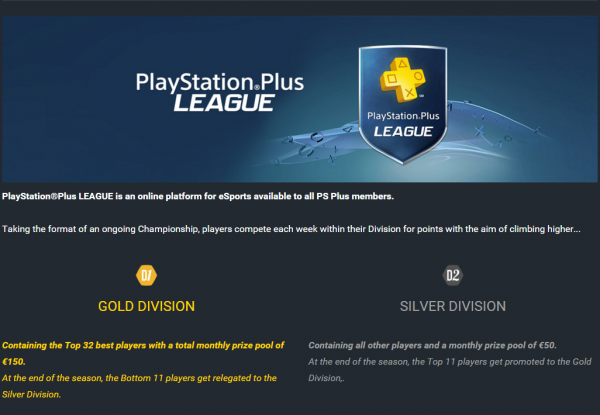
PlayStation Plus members will be able to participate in the tournament across Gold, Silver, and Bronze Divisions. Each Division has specific eSports-based challenges, with Gold featuring the top 32 players with a monthly prize pool of 150 pounds, with the bottom 11 being moved to the Silver Division.

The Silver division monthly includes a monthly prize of 50 euros, with the top 11 players moved up to the Gold. All those that don’t make it to Silver are lumped into Bronze, where there don’t appear to be any prizes of note.

The tournament is set to take part across several seasons of play, similar to what TBS is doing with its primetime Counter-Strike themed eSports show, which launches sometime next year.

Sony Computer Entertainment of America hasn’t revealed details on this competition coming to the United States just yet, but with all the popularity that surrounds eSports right now, it’s likely to come sooner rather than later. December would be the opportune time, when the company hosts its annual PlayStation Experience event in San Francisco.

In the meantime, Sony’s press conference today built up plenty of buzz with new footage of upcoming 2016 releases such as Uncharted 4: A Thief’s End and Horizon: Zero Dawn. Sony also announced development of a new Gran Turismo game for PlayStation 4 called GT Sport. It’s likely that these games could play a part in the tournament down the road, especially with both Uncharted and Gran Turismo featuring high action multiplayer support.