Medium, the digital publishing platform founded by Twitter co-founders Evan Williams and Biz Stone, has launched its first original series.
Dubbed “Foreword,” the weekly series will feature interviews with well-known authors and writers including screen talent like Jason Segel and John Cleese, as well as novelists like Margaret Atwood and Anne Lamott. Spanning 12 episodes, the series is hosted by New York Times bestselling author Kelly Corrigan, who describes the series as “akin to a late-night graduate school conversation with some of the most interesting and thoughtful people on the planet.”
This article was originally posted on VideoInk and is reposted on [a]listdaily via a partnership with the news publication, which is the online video industry’s go-to source for breaking news, features, and industry analysis. Follow VideoInk on Twitter @VideoInkNews, or subscribe via thevideoink.com for the latest news and stories, delivered right to your inbox.
Oculus, the well-known virtual reality startup recently acquired by Facebook, sees their field as a prime opportunity for entrepreneurs.
Oculus head of studios Jason Rubin, referencing public statements of reluctance to embrace virtual reality made by EA’s Blake Jorgensen and Take-Two’s Strauss Zelnick in recent months, delivered his remarks at a CES 2015 panel in Las Vegas.
“The early movers do really well in these situations because they fail, and they learn how to do the right thing on the second or third attempt,” Rubin said, pointing to a tradition of established corporations allowing smaller competitors to champion new — and, by extension, largely unproven — technologies. “And by the time the big companies that are looking at a number of assets they can deploy to make various games – and they say “there is a zero install base in VR right now, we need to focus on these other (things)” – they will miss it, they always do.”
Rubin, formerly of Crash Bandicoot creator THQ, thinks the untold riches virtual reality will surely produce are ripe for a startup’s taking. “One of these early teams will generate a billionaire or a group of splitting of a billion dollars, just as Rovio did and just as Zynga did.”
Pressed for specifics on what a Rovio or Zynga-esque VR company could look like, Rubin saw the future as being just as wide open and unpredictable as the sharing economy was when the iPhone came into existence.
“…we have no idea what the Uber is of VR. When they put the iPhone out, no one said “this is going to revolutionize taxi driving”… people will use VR for its inherent advantages over other past platforms, and it will become a future platform.”
Rubin praised Facebook CEO Mark Zuckerberg for his company’s acquisition of Oculus, saying the social visionary’s belief that a new platform rises roughly every decade points to virtual reality as the next great leap forward.
Though virtual reality might be a brave new world rife with uncertainty for the moment, it would appear from Rubin’s remarks that a host of startups are willing to step in to take the technology to soaring new heights, delivering previously unforeseen benefits for consumers and marketers alike.
Gaming content isn’t niche at all on YouTube. “Gaming has woven its way into all areas of pop culture — sports, music, television, and more,” says Google in their latest report on the matter.
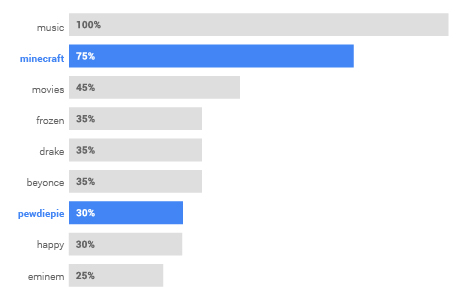
“Gaming content on YouTube is some of the stickiest. More than 20 of the top 100 YouTube channels with the most subscribers worldwide are gaming related,” the report goes on to say, pointing out that the most subscribed YouTuber is in fact the most ubiquitous gamer of all, Pewdiepie.
Of top gaming channels on the platform, 3 of them focus almost exclusively on one game: Minecraft. Minecraft is so big on YouTube, that it is actually the 2nd most-searched term on the video platform. It is second only to “music.” That’s pretty big.
With such a wide audience, consumers who are viewing this content don’t necessarily identify with the “gamer” title. According to a Google Consumer Survey, on 37 percent of users who watch gaming content would call themselves gamers and cite “reactions” and “commentary” as the appealing aspects of walkthrough videos.
Former Twitter CEO and current Medium CEO Ev Williams, in the news for a controversial quote about Instagram surpassing Twitter to become the second largest social network in the United States, is explaining his remarks with an essay posted to Medium today.
The essay, titled “A mile wide, an inch deep”, outlines Williams’ firm belief that sheer traffic — more important to websites than ever before in an age where everyone competes in a “war for attention” — is superficial when compared to time spent engaging with a website.
“We pay more attention to time spent reading than number of visitors at Medium,” Williams explains, “because, in a world of infinite content — where there are a million shiny attention-grabbing objects a touch away and notifications coming in constantly — it’s meaningful when someone is actually spending time.”
The way Williams sees it, it is important for content creators to stand out from an ever-growing pack of distractions by offering viewers a reason to stick around longer.
Medium focuses on their top-line metric, total time reading. Total time reading, according to Williams, is why he didn’t exactly greet their “biggest week ever” by traffic last week with excitement. Though total time reading was still up, it was off 50 percent from an all-time high in early October when traffic was 40 percent lower.
“The problem with time, though,” Williams takes care to point out, “is it’s not actually measuring value. It’s measuring cost as a proxy for value.”
Brevity, after all, is the soul of wit, a statement Williams concurs with by saying his goal as a writer — and the goal of Medium as a platform — is to leave an impression on a reader. “Taking people’s time isn’t really the goal,” he continues, agreeing with BuzzFeed co-founder Jonah Peretti’s opinion that there is no cohesive “God metric” for measuring the value of content.
All in all, Williams concludes, emotionless number-crunching does not produce sustainable success for marketers or businesses. “Trust your gut as much (or more) than the numbers,” he states, invoking unconventional tech giants Apple and Google’s brand-building strategies as examples. “Figure out what matters and build something good.”
Even though larger companies like Apple, Microsoft and Google may no longer be attending, the Consumer Electronics Show in Las Vegas continues to be a huge draw for a number of companies, with thousands of journalists, “tech heads” and others attending to see what the next big trends are in television, mobile technology and additional departments.
The CES Unveiled event, which took place last night, gave a taste of what’s in store for attendees, with a number of companies showing off some promising tech devices, as recapped by Fortune’s website.
These innovations included AcousticSheep, which includes a soft headband with speakers woven into the fabric of a pillow so people can comfortably listen to music without needing oversized headphones; Narrative, a company that makes a small square camera that clips onto clothing to record memories without the hassle of oversized equipment; and Drone Mobile, which allows people to use their smartphones to remotely control certain functions on their car, including starting up on a cold day and locking the doors.
Obviously bigger companies will have their own technology on hand, including LG, with a fleet of new 4K and 5K-based televisions; Ford, with new “smart car” models for the public to check out; and, of course, big names like Samsung and Sony, who will offer everything from virtual reality displays (like the Project Morpheus) to amazing new television models to the latest in mobile and online gaming.
The Consumer Electronics Association (CEA), who hosts the event every year, also highlighted some of the more promising tech at the show with this past evening’s 2015 CES Innovation Awards, which nominated both large and small companies for their forthcoming innovations. Among them was Samsung, whose forthcoming Galaxy Note Edge mobile phone stole the show, featuring a second screen that runs alongside the edge of the phone, providing additional information without needing to access the main screen. The company is expected to have the device front and center at their booth this week.
Indeed, CES continues to be quite the big deal – even for those who aren’t exactly “tech heads.”
Pinterest, the popular image sharing-focused social network long dogged by questions about its ability to generate revenue, is moving towards monetization with a site-wide rollout of its Promoted Pins program on January 1.
Promoted Pins, a Pinterest-flavored approach to sponsored content that allows brands to pay to boost their own brand-centric Pins to other Pinners’ feeds, was launched in beta form for select brands back in May.
The initiative, by Pinterest’s own estimation, has been a rousing success; an announcement on their official blog says Promoted Pins perform “just as good and sometimes better than organic Pins”, doing well enough to compel them to give the program a full launch. Furthermore, Pinterest says their own research gives brands participating in the Promoted Pins beta a thirty percent increase in earned media, the number of pinners saving a Promoted Pin to one of their own boards.
Pinterest is hoping a package of tools for brands — Promoted Pins amongst them — will convince marketers to embrace the fast-growing social network, eager to generate revenue a year on from a $225 million round of Series E funding and $3.8 billion valuation.
Other offerings in Pinterest’s marketing umbrella include a workshop for would-be Promoted Pin adoptees known as the Pinstitute and an analytic dashboard, launched in August, that allows marketers to stay in the loop on the performance of each of their Promoted Pins.
Kevin Winston loves mobile marketing. As the founder and CEO of DigitalLA and creator of the Silicon Beach Fest, he is one of Southern California’s foremost mobile marketing evangelists, attending and speaking at a wide variety of events in the region including [a]list summit.
We spoke with Kevin following his panel on The Future of Mobile Marketing to hear his thoughts on the importance of mobile-first marketing strategies.
The holiday season is in full swing, which means it’s time to deck the halls and load your stocking up with this year’s ten most popular festive ads. Running the gamut from conventional to downright avant-garde, these ads stood out from the rest of a crowded pack by embodying the holiday spirit while driving consumers to engage with the brands being advertised.
10. Kmart: “Not A Christmas Commercial”: 4,650,742 views
Honda’s Honda Days promotion, by now a modern-day Christmas marketing tradition, made a play for nostalgia this time around with a social campaign that saw Skeletor take over their Twitter feed as well as an ad featuring throwback toys like Stretch Armstrong. The campaign was a hit with consumers and marketers alike, earning Honda positive buzz from social media and industry publications.
Stella Artois made waves this year by becoming the first beer brand to buy advertisements on Instagram, indicating a desire to focus on the underserved millennial market. They made good on that promise with their Give Beautifully campaign, combining a run of food photos on Instagram with traditional commercials centered on one’s appreciation of the finer things in life.
Microsoft has pulled down double time with their marketing efforts this holiday season, experimenting with a wide variety of strategies to push the Xbox One to an ultimately successful Black Friday performance. Winter Wonderland is Microsoft’s attempt at bottling that magic up and using it for the benefit of their Surface line of tablets as they look to go toe-to-toe with Apple and Samsung.
6. Target: “Holiday 2014”: 6,264,542 views
Don’t let the unimaginative name fool you: this was no ordinary holiday season for Target. Determined to cut into Walmart’s longstanding market share lead amongst big-box stores, the Minneapolis, Minnesota-based chain launched an aggressive campaign headlined by a fun-to-play shopping game for mobile devices.
5. Poo-Pourri: “Even Santa Poops”: 10,344,783 views
Yes, Virginia, there really is a pooping Santa Claus, and he wants you to buy Poo-Pourri bathroom spray. Poo-Pourri’s unconventional product called for an off-kilter holiday ad campaign, and the company delivered to the tune of off-the-charts positive engagement on social channels.
4. Band Aid 30: “Do They Know It’s Christmas”: 15,063,530 views
Bob Geldof’s philanthropic Band Aid music collective came together thirty years following their benefit single for the 1983-85 Ethiopian famine, returning with a new stable of contemporary artists including Ed Sheeran and Rita Ora to fight western Africa’s Ebola crisis. Heavy promotion on major social channels pushed Do They Know It’s Christmas onto the charts in seventeen countries and spawned a German-language version.
British supermarket Sainsbury’s recalled a historic Christmas moment in 20th-century global affairs with their holiday ad campaign, depicting World War I’s “Christmas truce” of 1914 in which a large contingent of British and German soldiers left their trenches to lay down their arms and fraternize in No Man’s Land. Though the campaign — described by Sainsbury’s as a meditation on the importance of sharing — garnered mixed reactions online, it was still one of the most popular ads of the holiday season.
2. Samsung: “Home for the Holidays”: 21,013,232 views
Never ones to shy away from a golden opportunity, mobile leader Samsung brought Veronica Mars star Kristen Bell and husband Dax Shepard together for a humorous holiday ad about life made simpler with the help of Samsung’s gadgets and gizmos. A smart social campaign blasted Samsung into the stratosphere with 21,013,232 views, good for second on the season.
1. John Lewis: “Monty the Penguin”: 31,140,574 views
When we thought John Lewis’s marketing strategy was the real deal just after Monty the Penguin’s launch, we weren’t lying: this little guy has it all. The British luxury retailer pulled out all the stops for this heartwarming ad about a boy and his penguin in need of a companion, crafting a sentimental narrative sure to tug at hardened heartstrings and cause rivals to wish they’d thought of something similar first. Smart timing and a top-notch YouTube rollout propelled Monty the Penguin to over 31 million views, good for a far-and-away first place.
Surprised by the rankings Have a particular favorite Share your thoughts in our comments section below or on Twitter at @alistdaily.
Since what feels like the dawn of time, Google and YouTube have had a stranglehold on the online video market, dominating in volume and viewership by a mile. This year has been pretty remarkable in part because of the emergence of one legitimate competitor to YouTube, and a few potential ones.
Facebook and Vessel are just two of many companies looking to grab a larger share of the online video pie — and that’s in addition to existing “legacy” companies like AOL and Yahoo, which have significantly expanded their video businesses in the past few years.
This article was originally posted on VideoInk and is reposted on [a]listdaily via a partnership with the news publication, which is the online video industry’s go-to source for breaking news, features, and industry analysis. Follow VideoInk on Twitter @VideoInkNews, or subscribe via thevideoink.com for the latest news and stories, delivered right to your inbox.
While this year was no doubt a big year for the movie market, next year is likely to get even bigger, judging by some of the trailers we’ve seen, including The Avengers: Age of Ultron and Star Wars: The Force Awakens.
With that, Comingsoon.net has compiled a list of the top 12 trailers of 2014, as well as the viewership numbers for each one. All of these trailers have managed to get a great deal of attention, with the lowest one on the list – Transfomers: Age of Extinction, with 37 million views.
The real surprise, though, is what landed in the number one slot. Many thought that Star Wars: The Force Awakens would be a shoo-in with the fanatical Internet crowd, but – surprise! – it was actually beaten by another movie coming next year. Check out the full list below.
Transformers: Age of Extinction
The return of Jennifer Lawrence’s Katniss character was well received online, as Mockingjay Part 1 clocked in 38 million views.
Interstellar
Christopher Nolan’s return to the big screen was well met by audiences, who gave the initial trailer 39 million views. The star power of Matthew McConaughey certainly helped.
Dumb and Dumber To
The return of dimwits Harry and Lloyd turned out to be a welcome one for fans, as the trailer clocked in 44 million views. However, the movie has only performed moderately at the box office, sitting around $80 million thus far.
The Hobbit: The Battle of the Five Armies
Peter Jackson’s farewell chapter to The Hobbit saga garnered 45 million views upon its debut. The movie debuted in theaters yesterday and is expected to break several box office records.
Minions
Surprise! The Minions can actually do rather well without their buddy Gru, as their debut trailer received 54 million views.
Furious 7
The power of the Fast and Furious franchise hasn’t slowed, even with the loss of co-star Paul Walker. The newest trailer for the series debuted with 57.5 million views.
Teenage Mutant Ninja Turtles
Cowabunga! The return of the Ninja Turtles was well met with young and old fans alike, as the initial trailer received 58 million views.
Jurassic World
It’s been a few years since we’ve gotten a new Jurassic movie, but this new entry is highly anticipated, as the initial trailer has gotten 64 million views – and climbing.
The Avengers: Age of Ultron
{link no longer active}
The latest trailer from Marvel Studios certainly disappoint, as The Avengers: Age of Ultron should be a tremendous box office hit next year. The trailer has gotten 78 million views thus far.
Star Wars: The Force Awakens
Of course, the Force is still strong with Star Wars. With exactly a year to go before its release, the teaser trailer has received 81 million views. A new one should get an equal amount of attention next summer.
Fifty Shades of Grey
Surprisingly, Star Wars didn’t earn top honors for trailers this year, as the movie edition of Fifty Shades of Grey beat it with 93 million views. It should no doubt turn a few heads next year.