Marketing Black Friday

Black Friday is, on the surface, a big retail sales day in the United States based on the fact that most people in the USA have the Friday after Thanksgiving as a holiday. Thus, this day has become the traditional start of serious holiday shopping for most people. However, the Black Friday tradition has expanded in time and space, and it has become a key milestone in holiday marketing plans for game publishers. Given that the holiday quarter is traditionally the very best part of the year for selling games, it’s easy to see why Black Friday has become the most important event of the year for marketers. Let’s take a closer look at what this event means for game marketers.

Black Friday has expanded in many ways since its origins — the term itself began as a description of the heavy traffic caused by shoppers in Philadelphia. Later the term was said to describe the day that retailers first started turning a profit (being “in the black” in accounting parlance), though this is at best an apocryphal explanation. Since around 2003, the day has been the busiest shopping day of the year in the USA.

While originally Black Friday sales didn’t begin until 6 am Friday morning, stores have begun rolling back the start times. Now even a midnight start isn’t the earliest; some stores open at 8 pm on Thanksgiving. Many stores have even spread the event earlier, back into the previous week or two for some sale prices. The greatest discounts are usually reserved for a limited supply of “doorbuster” items, aimed at bringing people to a particular retailer under the theory that once people are in the door, they’ll do most of their holiday shopping at that store.

Why the ferocious marketing scramble to be the place where customers head to first for holiday shopping? The prevailing theory around Electronic Arts back in the 1980’s, held by then-head of sales Larry Probst, was that it was important to lock up those “open to buy” dollars” from retail chains. Probst always launched a “Buy Two, Get One Free” promotion for EA games in the fall, and he always wanted to get it under way before Activision or anyone else launched their promotions. He knew that retailers, and consumers, only have a certain amount to spend — and if you’re the first one with an attractive offer, you’re closing out some of the competition.

The same principle applies today, even though the battle has moved mostly to cyberspace for games. The retail store battle is still vital in many ways, but the Black Friday competition has spread rapidly at online retailers like Newegg and Amazon. The Cyber Monday phenomenon, invented to try and drag some attention away from physical retail, has in effect merged with Black Friday as the lines between online and physical retail have become ever hazier.

Black Friday has even begun to transcend the boundaries of the United States and spread to other countries, even though they don’t celebrate Thanksgiving. Canadian retailers have had to adopt sales on that day in self-defense, lest too many Canadian customers head over the border to spend their dollars in US retail stores. The increasing importance of online retailers like Amazon has lead to sales appearing in the UK and Europe as well. It makes perfect sense for marketers — you’re doing all this marketing work, why not get the best return on that investment by using the same promotions everywhere

Even for mobile games, the holiday quarter is important. The greatest number of app downloads occurs in the week from Christmas to New Year’s Day, as people get new smartphones and tablets for the holiday season — and have the time to download some apps and try them out for existing devices. Clever marketers push for the development of special holiday content for games, giving people an extra reason to try out a title while enjoying visual reminders of the season.

The challenge for game marketers is to create interest and drive sales without giving away all the profits in the process. Discounting old inventory, especially as digital downloads, is often a tactic used to drive interest and sales without increasing cost of goods. However, there is a long-term worry that GameStop president Tony Bartel noted. Lower prices for games, or game giveaways, can lead to consumers valuing games at a lower level — and perhaps being less inclined to pay full price.

Retail displays and promotional partnerships have an outsized importance on Black Friday. Sure, it’s great to have a solid shelf presence in stores, or a good endcap, or an interactive kiosk. But it’s not just about promoting the sales in the stores, even though that’s what the retailer is hoping to achieve. The savvy marketer knows that these displays make effective billboards for people coming into the stores for other goods. When all of those other shoppers start thinking about what gaming products to buy, they’ll likely remember the impressions that were made on them by that interesting display in the store.

Large store displays send a subliminal message that’s very similar to the flashy displays used by courting animals, like a peacock’s feathers. That tells a prospective partner of the health and importance of the item on display. After all, that game must be important and bestselling, and therefore of good quality, if it has a huge store display, right

Seriously: Brands Drive Mobile Games

Mobile games are evolving rapidly on multiple levels, from a technical perspective, marketing, graphics, and increasing sophistication of game design. One of the mobile entertainment startups that shows this evolution is Seriously, a startup packed with talent from Fox, Disney, Rovio and Natural Motion. The company’s mobile game Best Fiends is a visually stunning puzzle game that was selected by Apple as Best of October 2014.

Seriously has raised a total of $10 million dollars to help bring its vision of the future of mobile gaming to life. “We’ve been thrilled with the reaction to our first title,” said Andrew Stalbow, CEO of Seriously. “The additional funding gives us extra firepower to extend our talented team of 13 people as we take our strategy of creating global entertainment brands ‘mobile first’ to a new level.”

The [a]listdaily caught up with Stalbow prior to his appearance on a panel at the [a]list summit Mobile Marketing for Brands and Entertainment, taking place on December 3, so he could share with us some thoughts on the mobile games market and the importance of brands.

[a]listdaily: What led you to form Seriously

Andrew Stalbow

Andrew Stalbow: I saw the power of games as a platform for entertainment companies to really build their properties out. I worked at Rovio for a couple of years, where I was responsible for their biggest commerical deals with people like Lucasfilm for Angry Birds Star Wars. We treated the game as an entertainment IP, and we built it out. When I founded my new company, Seriously, we basically said to ourselves “Can we build the Pixar of mobile ” So we have our first game that just came out, Best Fiends, and it’s performing really well — it got 1 million downloads in its first 6 days — with a small but talented development team creating games that feel like one day they might be great big movies. They start their lives as fun things on mobile devices, and effectively what we do is build entertainment as a platform.

It’s very exciting to be in this business. Audiences migrate like crazy to mobile devices… not just for communication, but for content consumption as well. The average American spends an hour playing games on their smartphone and tablet. It’s a huge opportunity.

[a]listdaily: There are plenty of companies making mobile games these days, and some are saying the market is too crowded — while others say that mobile games are still in the early days. What do you think

Andrew Stalbow: I think we’re just at the beginning. That said, there are definitely some early winners emerging. The big guys are spending tens of millions of dollars on promoting their new launches. The biggest mobile game releases are going to get backed with movie marketing style budgets. The little guy, a developer from Vietnam, can create Flappy Bird and it can become a global phenomenon. But it’s also getting increasingly hard to cut through.

[a]listdaily: Where’s the opportunity for success in mobile games Is it geographic, or a particular genre, or quality Where do you focus your effort

Andrew Stalbow: I don’t know all the answers, but I know what we’re doing. I want to differentiate through quality. Our opportunity is to build games that feel like they’re taking the products to the next level.

[a]listdaily: Many companies have really stepped up their efforts, especially on graphics, but success is more than just about graphics, isn’t it

Andrew Stalbow: I think that’s right. For us it’s about producing something that’s visually stunning and trying to take a gameplay genre and use it as a way to introduce great big IP. We’ve been focused on story, great characters, a conflict, unique setting, amazing music and a really great back story, and combining that with a really fun game and seeing if we can build something that way.

[a]listdaily: Discoverability is a huge issue, though, regardless of the game, don’t you think

Andrew Stalbow: What we believe is great products do win through. The way we approached the market was by building something that has really great retention, great engagement, we can build a business on the back of that. Our view was, “Can you build something that takes a genre to the next level ” and then build a business around that. It’s not easy to cut through, but it’s a very democratized platform and there are some early winners emerging.

[a]listdaily: The rise of social media has meant great audience involvement, but some mobile game companies don’t seem to put much effort into connecting with the audience. Do you feel that’s important

Andrew Stalbow: I think that trick on great products, whether they be on mobile or whether they be on digital platforms or on consoles, the really successful stuff gets to a place where its audience becomes its CMO. That’s the opportunity that social media presents. If you can create something that’s compelling enough that people want to shout about it, and tell their friends, then you’ve got a product that can really connect.

I think there’s been a huge shift in the whole entertainment industry, whether it be games or TV or movies, any kind of content consumption. The content creator has this opportunity now, through mobile and other digital platforms, the content creator can be directly connected to his own audience. In days gone by that never happened. Now I believe there’s a transition you’re going to see over the next few years. The biggest brands are going to be directly connected to their own audience, they’re going to leverage the network effect They’ll get to see what the audience likes and what they don’t like. You’re building a service out and not a product, and its a huge opportunity for people to build their apps into platforms for their brands. I think it’s a super-exciting time.

[a]listdaily: I think building a great audience is as difficult as building a great game, and these days developers have to be as creative with their marketing as they are in developing games. Do you agree

Andrew Stalbow: Yes, that is exactly what I say as well. There are four things you can do as a game developer to really promote your product. Number one is build a great product. People will shout about it if they love it. Number two is communicate lots and lots and tell anybody that’s up for listening that you’ve got something pretty exciting. Number three is performance marketing, and that’s where you really come up against the big guys. That’s install, acquisition, on Facebook and plenty of other mobile app platforms. I think that’s a necessary place to be but it doesn’t build your brand and you’re competing with people that generally have very, very big budgets.

But the place where I think game developers, especially smaller and more independent developers, can compete is creative marketing. If you’re creative about how you communicate your game, you can do some amazing stuff. There’s a whole lot of options available to you.

In days gone by there were very traditional ways of marketing media products. Look at the formulaic way many movie studios have marketed their movies. There is no formula any more, but there’s also an amazing opportunity for even the smallest guy to find ways to reach an audience, whether it’s through places like YouTube or Facebook or Twitter. Twenty years ago the smallest guy couldn’t have afforded to market their game and needed to find a publisher to get distribution and marketing, now they have an opportunity to find their audience. The downside of having to find your audience is actually all upside. The power is in the content creator’s hands.

Here’s Apple’s Attempt to Attract Core Gaming Audiences

A new Apple ad featuring two of America’s biggest entertainers dropping stereotypically geeky “gamer” lingo is the electronics giant’s first major attempt at attracting gamers to their mobile devices.

The thirty-second commercial, designed to tout the new iPhone’s processing capabilities for mobile gaming, finds Tonight Show host Jimmy Fallon remarking that the iPhone’s A8 chip “brings gaming to the next level — I mean, if you’re into that kind of thing.” Friend and collaborator Justin Timberlake joins in on the fun, launching into a hard-fought session of new Super Evil Megacorp multiplayer offering Vainglory that sees Fallon demanding the Suit & Tie singer “stop playing like a noob”.

For Super Evil Megacorp’s part, they’ve made no bones about their desire to keep the mobile gaming revolution going; Vainglory, a self-described “unapologetically core” title, has its sights set on “core” gamers committed to console and PC offerings.

It would be easy to dismiss this an ill-advised attempt by a business to connect with younger audiences, were it not for Apple’s long and storied history of tongue-in-cheek and subversive advertising. This is, after all, the company that brought you 1984, Think Different, the Burn Baby Burn campaign, and Ellen Feiss’ Switch ad, just to name a few examples.

Regardless, it seems as if many have taken the ad to heart and reacted accordingly, as the spot has been upvoted by 95 percent of Redditors on sub-Reddit /r/fellowkids, a message board for poking fun at corporate attempts to connect with younger consumers. One Redditor, in his own words, “cringed [him]self into a black hole that destroyed the Earth.” The reaction on YouTube is markedly better, however.

Apple stands at a serious crossroads in the mobile market, as their long-held supremacy for tablets and smartphones is facing its greatest challenge to date from Android-aligned manufacturers led by Google. If Vainglory can replicate even a portion of chief inspiration League of Legendsrecord-busting revenues, Apple will have plenty to be thankful for this holiday season.


Asian Mobile Games Are 48% Of The Global Market

The mobile games market continues to thrive, and the region where it’s growing the fastest is Asia. A new overview of the rapidly growing Asian market was prepared by mobile game marketing firm Applift in conjunction with Newzoo, and the report offers a valuable look at some of the key statistics for mobile games in China, South Korea, and Japan.

The report sets the stage for its revelations early. “Asia Pacific is the world’s largest mobile games market with $12.2 billion total revenue in 2014. This amounts to 48 percent of the total global mobile games revenue.” noted the introduction. “Asia is a continent where Android is king, localization of Western games is of paramount importance, live in-game events and support are not only nice to have but expected, and local players sometimes take precedence over the status quo people are used to in Western markets.”

The three top Asian markets are (in order of total revenue) Japan, China, and South Korea. The countries have very different markets, yet there are some commonalities. For one thing, despite the outsized success of titles like Supercell’s Clash of Clans and King’s Candy Crush Saga, games from publishers of that country tend to populate most of the best-selling title lists. It’s clear that a strong understanding of the local markets and culture is important to success in each country. Publishers from other countries either need to get lucky with a title that happens to

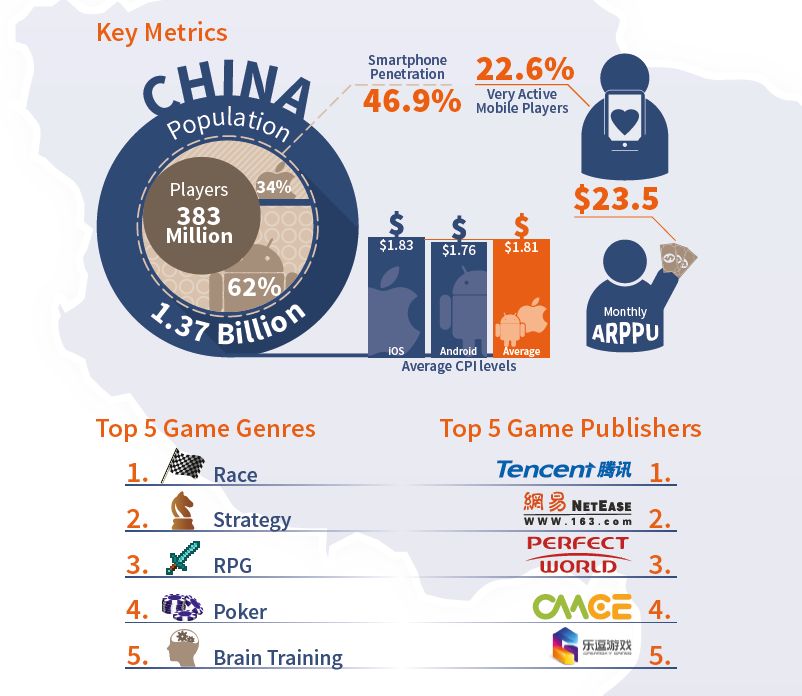
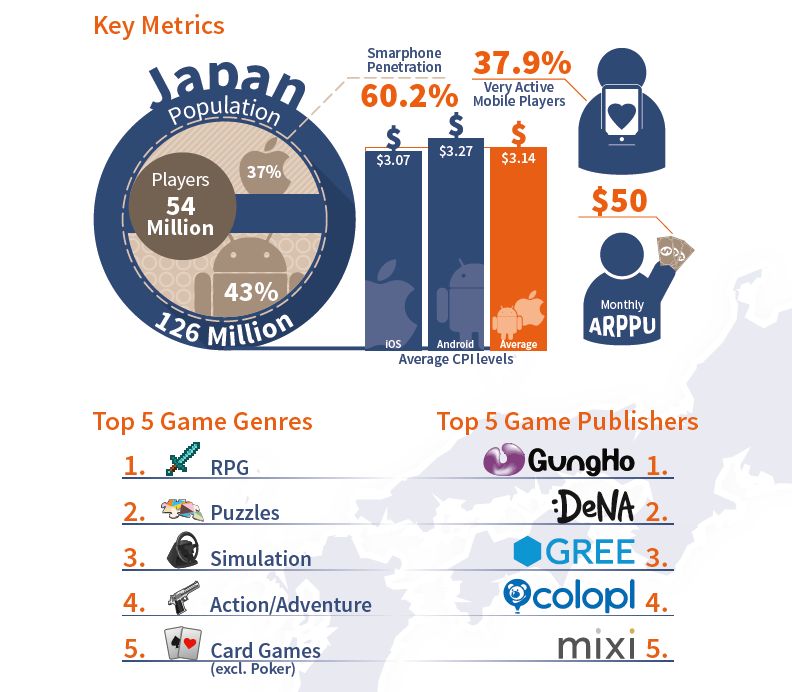
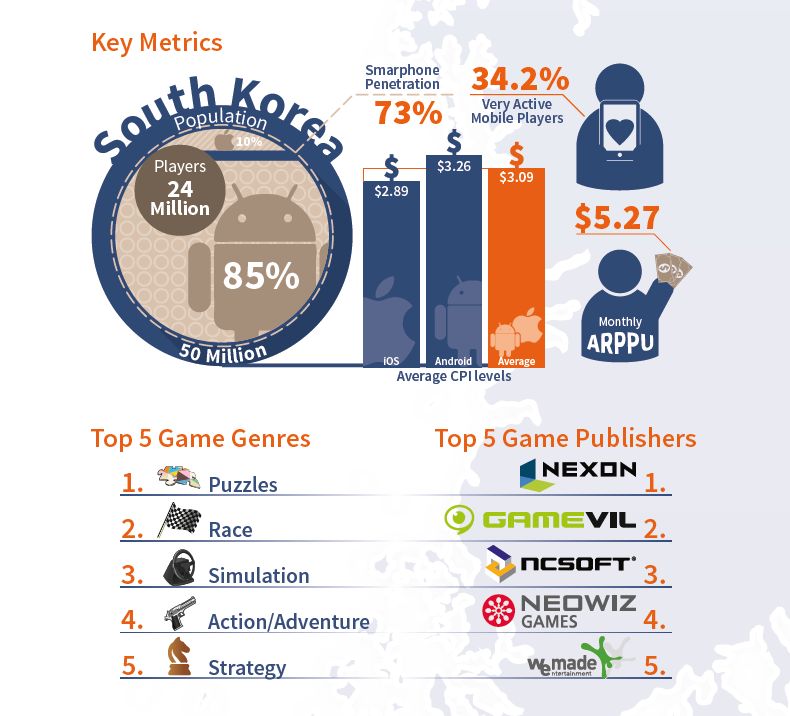
All three countries are dominated by Android smartphones, yet the breakdown of market share between iOS and Android is quite different in each country. South Korea is dominated by Android with 85 percent market share, which is due in part to the local presence of Samsung and its massive line of bestselling phones. Japan has a strong iOS market share with 37 percent of the market, while China is slightly behind with only 34 percent of the market owning an iOS device.

It would be a mistake to assume that the gamers in these three Asian countries are interesting in the same type of games to the same degree. The list of the most popular game genres are quite different for each country, though there is some overlap. The top game genres in China are Race, Strategy, RPG, Poker, and Brain Training. The lineup is quite different in Japan, with RPGs as the #1 genre of game, followed by Puzzles, Simulation, Action/Adventure, and Card Games (excluding Poker). South Korea has Puzzles as the #1 genre of game, followed by Race, Simulation, Action/Adventure, and Strategy.

Major differences are seen in the population and the prospects for these three countries. China already has 383 million active mobile gamers out of its 1.37 billion people, with smartphone penetration of the general population at 46.9 percent. The monthly average revenue per paying user (ARPPU) in China is $23.50, and the vast majority (73.6 percent) of payers spend only a small amount. Smartphones are by far the device of choice in China, with 94.4 percent of users employing smartphones to play games — but 51.7 percent also use tablets to play games.

China is poised to take the #2 position in the list of the world’s biggest mobile game markets, right behind Japan, passing up the US sometime in the next year. Clearly there is also plenty of upside expansion left in China, as the penetration of smartphones is still less than half the population. Average cost per install (CPI) levels are at $1.81, much less than Japan or Korea. One obstacle facing China, though, is the absence of the Google Play store (since China prevents Google from operating there) and the consequent fragmentation of the app stores, with dozens competing to be the place where gamers can find games.

Japan’s smartphone penetration is now over 60 percent, according to the report, and 37.9 percent are very active players with an average monhtly ARPPU of $50. That also helps explain the average CPI of $3.14, making it expensive to get your game established through buying installations. Japan has 54 million players out of its 126 million population, so there’s nowhere near as much upside as China posesses.

One of the interesting aspects of the Japanese market is the ‘live events’ that are popular in mobile games. “Live in-game events and gambling hooks are widely used and very successful in order to foster engagement, retention and above all high player revenue in Japan,” the report noted. “Live events are special happenings that show special graphics, characters, etc. for a limited period of time, thereby creating a feeling of urgency and excitement for users.”

One of the classic mechanisms in Japan for attracting users and elevating spending is the gatcha. “Gatcha are gambling mechanisms whereby users pay a certain amount to get an unknown, random virtual item (card, unit, coins, etc.) within a wide value range, for instance through a wheel of fortune. This technique creates a lot of excitement and provides a thrilling gaming experience,” the report stated. No doubt, any resemblance to the English term “gotcha!” is purely coincidental.

South Korea has only 50 million people, but almost half the population (24 million) are players of mobile games, and smartphone penetration is at 73 percent. The monthly ARPPU is a small fraction of Japan’s ARPPU at only $5.27, but the CPI is almost the same at $3.09. The unusual feature of South Korea’s market is the dominance of messaging app KakaoTalk, and its overwhelming power to market games. “Messaging app KakaoTalk is installed on 93 percent of smartphones in South Korea,” the report states. “Its dominance as a mobile games publishing and discoverability platform makes it difficult for publishers to shine through outside of it. Developers should consider publishing here for the viral potential. 9 out of the top 10 grossing apps on Google Play are Kakao published.”

The report concludes that China is the most appealing of the three markets right now. “China’s CPI levels are low in comparison to Japan’s and South Korea’s; one of the reasons behind us crowning it the most globally appealing market out of Asia’s big three,” the report concluded. All three of these markets are good targets for mobile game publishers, but the right approach — and the right partners — are vital to success in all of them.


Wargaming Exec Discusses ‘World Of Tanks’ ESports

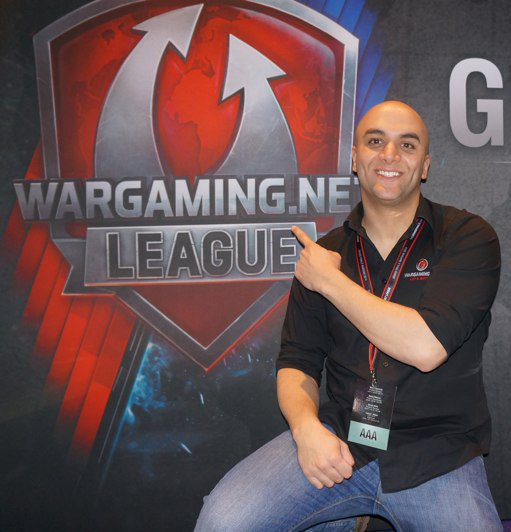
World of Tanks is one of the most popular games on the planet, and Wargaming has tweaked the free-to-play game to cater to the growing global eSports audience over the last two years. Thanks in part to the launches of World of Tanks on Xbox 360 and mobile devices, Wargaming has added 20 million new gamers over the past year to its collection of 90 million players. The company is entering its third year of eSports, seeing growth over the first two years of both teams and prize money. Mohamed Fadl, Wargaming Global Director of eSports, explains how important pro gaming is for the publisher’s future in this exclusive interview.

Mohamed Fadl, Wargaming Global Director of eSportsMohamed Fadl, Wargaming Global Director of eSports
What have you learned from your first forays into eSports with World of Tanks?

For me eSports is more than just sports or gaming, it’s a culture and the evolution of entertainment. We have no boundaries and we know no politics or borders. ESports brings people together from all over the world with one goal: to play, have fun and succeed.

How have the number of teams involved in eSports grown over the years?

When we initially started our eSports league 2 years ago we had nearly 4,000 players playing in our first tournament. Today hundreds of thousands of unique players compete in our tournaments each month to determine the top 12 pro teams in each region. Wargaming is very proud of what we have built together with our community so far and we can’t wait to see what the future holds for all of us.

How has the game evolved to make for a better eSports title?

World of Tanks is constantly being updated to improve gameplay and balance with a focus on eSports.  In the most recent update we introduced the new eSports format Attack/Defense with a 7/54 point system. This is the biggest and most important improvement that’s been added to Wargaming eSports in the past year. We worked closely with top World of Tanks pro teams to test and implement the Attack/Defense format to deliver more strategic, team oriented and action packed games to make eSports events even more exciting for both the players and spectators.

“For me eSports is more than just sports or gaming, it’s a culture and the evolution of entertainment.”

What are your plans for eSports in 2015?

We aim to create an ecosystem within our eSports world to guide players and teams from casual competition to top pro leagues. We will continue to focus heavily on the grassroots system for eSports and make overall improvements to the Wargaming League throughout the year. We have some major plans in place for 2015 that I can’t share just yet, but we are very excited for what this year will being and be prepared to see some incredible updates coming soon.

How will you be raising the stakes in terms of prizes?  

I can’t share too much about prizing yet, but we are looking into some possible changes to help pro teams invest more time and passion into playing the game they love. We have also nearly doubled the prize pool from the last season which was $100,000 up to $171,000. So there is definitely a lot on the line for our top teams.

What opportunities do you see for North America when it comes to World of Tanks, given its popularity in Europe?

I think North America is currently the region with the biggest potential for growth in eSports. North America is very open for the evolution of eSports into a main media platform.  This region is definitely a leader with this mindset to help eSports to grow and I expect to see a World of Tanks team from North America winning the Global Championship soon.

What impact do you feel having eSports events occur in NBA and World Cup stadiums is having on what fans expect when it comes to spectacle and events?

Those events are very important for the overall eSports scene. ESports is more than just gaming, it’s a culture and the evolution of entertainment. I foresee eSports being broadcast to households around the globe and it playing a huge role as part of major sports and entertainment events. I believe over time this will come naturally and I’m proud that we get to be part of this amazing new eSports culture.

How did hosting the Finals at PAX Prime help connect with gamers and eSports fans?

It’s crucial for the players and eSports itself that we bring tournaments like this to the core audience at events like PAX. Gaming events like PAX are extremely important for eSports and will be play a huge role as it continues to evolve.

We’ve seen sponsors like American Express and Coke connect with League of Legends gamers. What opportunities do you feel World of Tanks opens up for sponsors and brands?

We already have some very strong partners for our League, especially for the upcoming WGL Grand Finals. This however, is not our main focus. We want to focus more on encouraging our Wargaming League pros to find sponsors and partners for their teams. Many of them have already been very successful and have big partners, but there are many smaller and newer teams that we want to support to get to this level.

What potential do you see for World of Warplanes with eSports?

As soon the World of Warplanes eSports community reaches the critical mass and there is a real demand of having a professional WGL for World of Warplanes, we will be ready and waiting.

“ESports gives depth to gaming, it shows the world that there is team-play, skill, strategy, emotion and passion driving players to rise to new levels.”

How big a role does eSports play for Wargaming and its World of Tanks franchise

ESports plays a very big role, not only for Wargaming and World of Tanks, but for the overall gaming community. ESports definitely puts gamers in a different light. ESports gives depth to gaming, it shows the world that there is team-play, skill, strategy, emotion and passion driving players to rise to new levels. ESports brings people from all regions and backgrounds together and shows the world what is possible with the right mindset.

We’ve started to see some activity in mobile eSports. What potential does World of Tanks Blitz have for eSports?    

That’s very possible. We keep a very close eye on all our games to see if we have reached the critical mass of eSports players for that game.

GameStop Earnings Reveal Key Industry Trends

GameStop delivered its earnings report yesterday, which was slightly below the same quarter last year. Of course, this year didn’t have Grand Theft Auto V to boost results, so it’s not that surprising that overall sales are down. Total global sales for the third quarter of 2014 were $2.09 billion, a decline of 0.7 percent compared to $2.11 billion in the prior year quarter, GameStop said. An important indicator, consolidated comparable store sales, were down from last year by 2.3 percent. One major factor GameStop noted: “Topline and comparable store sales were negatively impacted by the delayed release of Assassin’s Creed Unity,” the company said in its press release.

Investors responded poorly to the earnings report, with GameStop shares dropping over 13 percent in after-hours trading. “Q3 results lagged expectations, accentuating concerns GameStop is losing significant market share to full game downloads,” noted Wedbush Securities managing director Michael Pachter. He added “We don’t expect digital downloads to absorb all of the growth in video game software sales in 2014 or 2015, and believe that by then, GameStop’s ancillary businesses will generate significant profits, fully offsetting any future declines in software profits.”

GameStop noted a number of statistics that showed promising signs for the retailer. “During the quarter, new hardware sales increased 147.4 percent, greatly outpacing industry growth of 102.4 percent. After the first 12 months since launch, the U.S. installed base of the Sony PlayStation 4 and Microsoft Xbox One is 73 percent greater than the PlayStation 3 and Xbox 360 base was over the same period,” GameStop said. “The company reached 47.3 percent new software market share during the quarter, its second highest ever, despite new software sales declining 34.4 percent. The decrease was primarily due to overlapping the company’s record market share of last year’s AAA titles, such as Grand Theft Auto V, Battlefield 4, Batman: Arkham Origins, Pokemon X/Y, and Assassin’s Creed IV: Black Flag.”

Reading between the lines, although the company said that sales of new AAA releases met its expectations, it seems that this year’s crop of AAA titles hasn’t lived up to last year’s sales. That’s not the only issue at retail, though. “The decline in prior-gen software sales due to the transition to next-gen console has been steeper than expected and titles that moved out of 2014 will both have an impact on our results this year,” said GameStop CFO Rob Lloyd.

Lloyd noted some positive trends for the retail giant. “Pre-owned sales increased 2.6 percent compared to the prior year quarter,” Lloyd said. “The U.S. was up 2.2 percent and international was up 5.2 percent or 9.8 percent, excluding FX impact. This marks the third consecutive quarter that the pre-owned business has grown and we expect this trend to continue.” This is a key element in GameStop’s multi-pronged strategy to thrive during the transition of the games industry to digital content being the largest part of game revenues. Keeping the pre-owned game business and the buy-sell-trade engine going will help GameStop capture ever-greater market share even as the overall market shrinks.

GameStop also made good progress on another part of its strategy, the digital business. “Our digital receipts were $210 million, a 52 percent increase over the third quarter of last year, with over 80 percent growth in international, driven by console digital sales associated with Destiny and FIFA,” Lloyd said. “Globally, we attach DLC subscriptions to over 30 percent of Destiny sales during its launch.” There’s the value of good sales associates — adding in those additional content sales when the customer is right there, ready to buy.

GameStop president Tony Bartel provided some numbers on GameStop’s market share with new consoles, and the company is thriving there. “We continue to successful execute against our goal of winning the new console launch,” said Bartel. “Our software market share on Xbox One and PS4 hit an all-time high at 56 percent for the quarter. In addition, our hardware share on Xbox One and PS4 is at all-time highs.” Bartel also gave a nod to Microsoft’s price cut on the Xbox One. “The recent price decrease on the Xbox One has really increased sales of that platform and we expect consoles to be in high demand this holiday season,” Bartel said. Will Microsoft finish the quarter with greater sales than Sony for the holidays It could happen, but it’s going to be a tough fight.

Bartel took the opportunity to crow a bit about GameStop’s digital business, comparing it to the rest of the industry. “Turning to digital, our 52 percent growth is higher than the growth reported in the most recent quarter by our four largest publishing partners,” said Bartel. “Year-to-date, our digital growth is also higher than this group. Our console digital growth alone is 72 percent as we continue to play a vital role in the discovery and affordability of digital content.”

The Kongregate business is a major part of this for GameStop. “In addition to console digital, we’re also continuing to grow in mobile publishing. Kongregate again doubled its business over last year, growing 98 percent during the quarter,” Bartel noted. “We remain a top 10 third-party mobile publisher with nearly 30 million installs of our 14 games on the App Store and 12 games in the Google Play Store.”

Some added detail on digital full game downloads came out during the earnings call, which showcased some particularly revealing numbers. “A couple of interesting data points taken from recent research with gamers indicates that the average price being paid by a customer rate full game AAA download is $22,” Bartel said. “When asked what price a game expected to pay for a recently released full game digital download, the answer in these surveys was approximately $35. It is important to note that like the industry, much of our full game digital content was given away at no cost to the consumer with the hardware bundle. In fact, year-to-date, we estimate that over $100 million worth of games have been digitally delivered for free in hardware bundles.”

Clearly the first stop for console makers seeking to boost the sales of consoles is to add in a free game or two, particularly as a digital download. That hardly changes the cost of goods, yet provides significant added value to the customer — without reducing the retail price. Yet Bartel is careful to note the long-term danger this represents to the business, especially the retail business. “We want to help ensure that our industry does not make the same mistake as other entertainment categories by driving the perceived value of digital goods significantly below that of a physical game,” Bartel said.

Yes, this is just one more reason why gamers are expecting a lower price for games on average. The ever-growing variety of free or low-cost online and mobile game options, combined with pre-owned software, continues to put downward pressure on retail prices. There doesn’t seem to be any overall solution to this — each publisher is finding its own answers. For that matter, while decrying the trend, GameStop is preparing for the inevitable future by broadening its revenue base across hardware and software, and continuing to increase its digital publishing efforts.

One more thing to worry about for GameStop: Sales of software for the last generation of consoles continues to underperform. “Year-to-date in the U.S., Xbox 360 and PS3 software and hardware are down 57.8 percent on a dollar basis,” Bartel said. “That’s clearly significantly more than we anticipated at the beginning of the year and so that’s what we factored into our fourth quarter forecast.”

App Annie October 2014 Mobile Games Report

Analytics firm App Annie released its October 2014 report yesterday, with plenty of interesting information about the top games on iOS and Android worldwide. App Annie compiles its information directly from Apple’s App Store and Google Play’s store, using access granted by participating publishers. So the firm’s numbers reflect direct information from the stores involved.

It’s worth noting, though, that the Google Play store is not as universal as Apple’s App Store. A significant amount of traffic and revenue flows through Amazon’s Appstore in the US (perhaps as much as 25 percent of the US total), and in China the revenue and traffic comes from literally dozens of different Android app stores. Also worth noting is that App Annie is tracking revenue from the stores, which covers in-app purchases. That does not track revenues from advertising or from licensing, which in some cases are quite significant. Rovio, for instance, derives close to half of its overall revenue from licensing by some estimates.

Ad revenues are significant for many mobile game companies. And let’s not forget the power of cross-promotion, either. A company could well be using a free title to draw in customers to download another title that has plenty of revenue opportunities and a much better monetization rate. Marketing strategies are getting more sophisticated as they become integral to the financial success of mobile titles, and thus analytics firms are always working to catch up to the latest wrinkles thought up by aggressively innovating mobile companies.

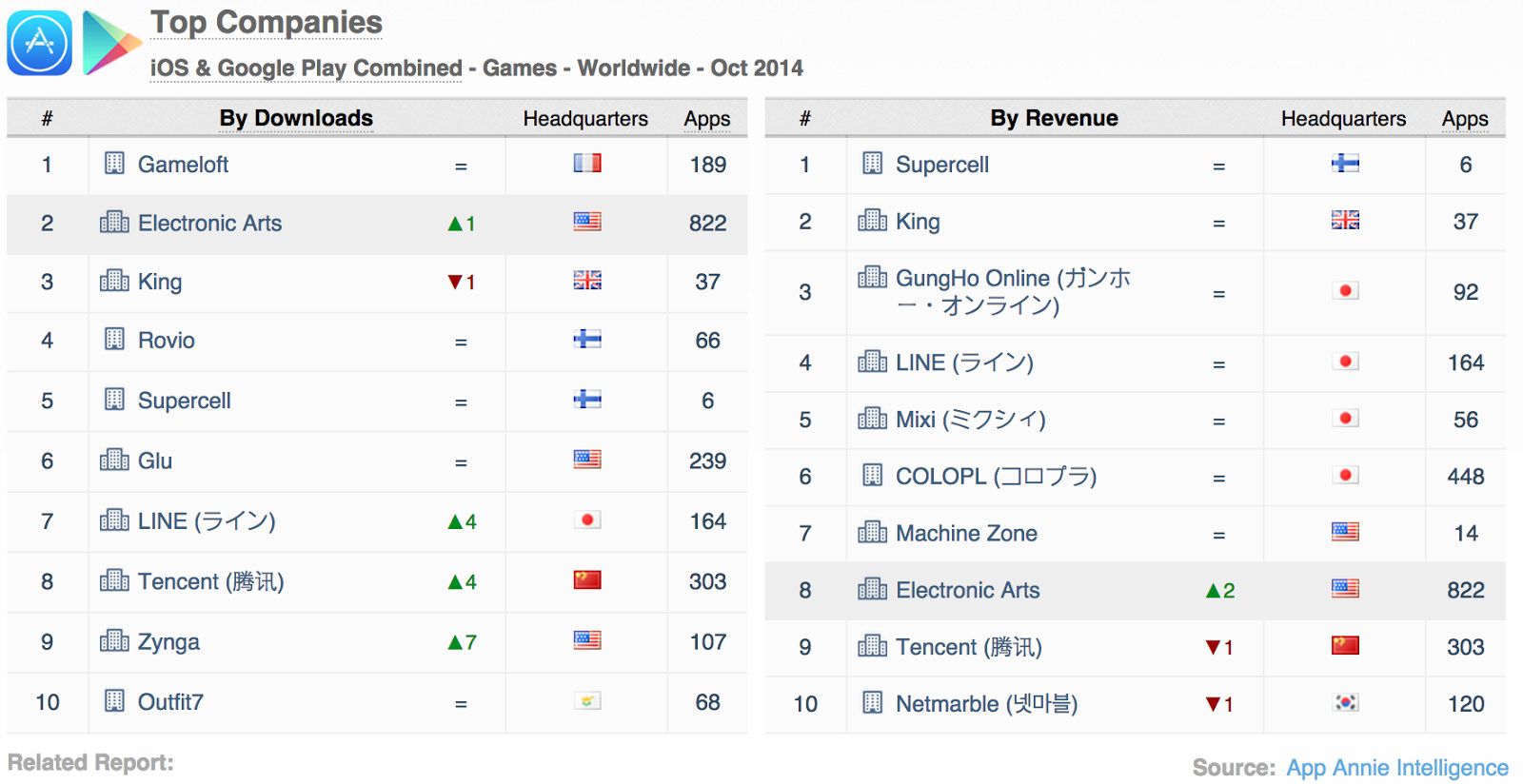
App Annie’s list of the top companies shows them combined for both iOS and Google Play, with a list both by downloads and by revenue. The massive differences between the two lists points up the strong differences in monetization of various titles. Supercell, for instance, is #1 by revenue but only #5 by download count. Clearly the company does better at monetizing its users than Gameloft, which doesn’t even appear in the top ten on the revenue list. Of course, Gameloft also has 189 apps compared to Supercell’s 6 apps.

Looking at the Downloads list, it’s interesting that Supercell is the only company with a single-digit number of apps; most companies are solidly in the hundreds of game apps. However, when you look over that the Revenue list, the companies with the lower number of apps are at the top of the list. A reasonable inference might be that fewer apps means more attention paid to each one, and thus a greater chance for success.

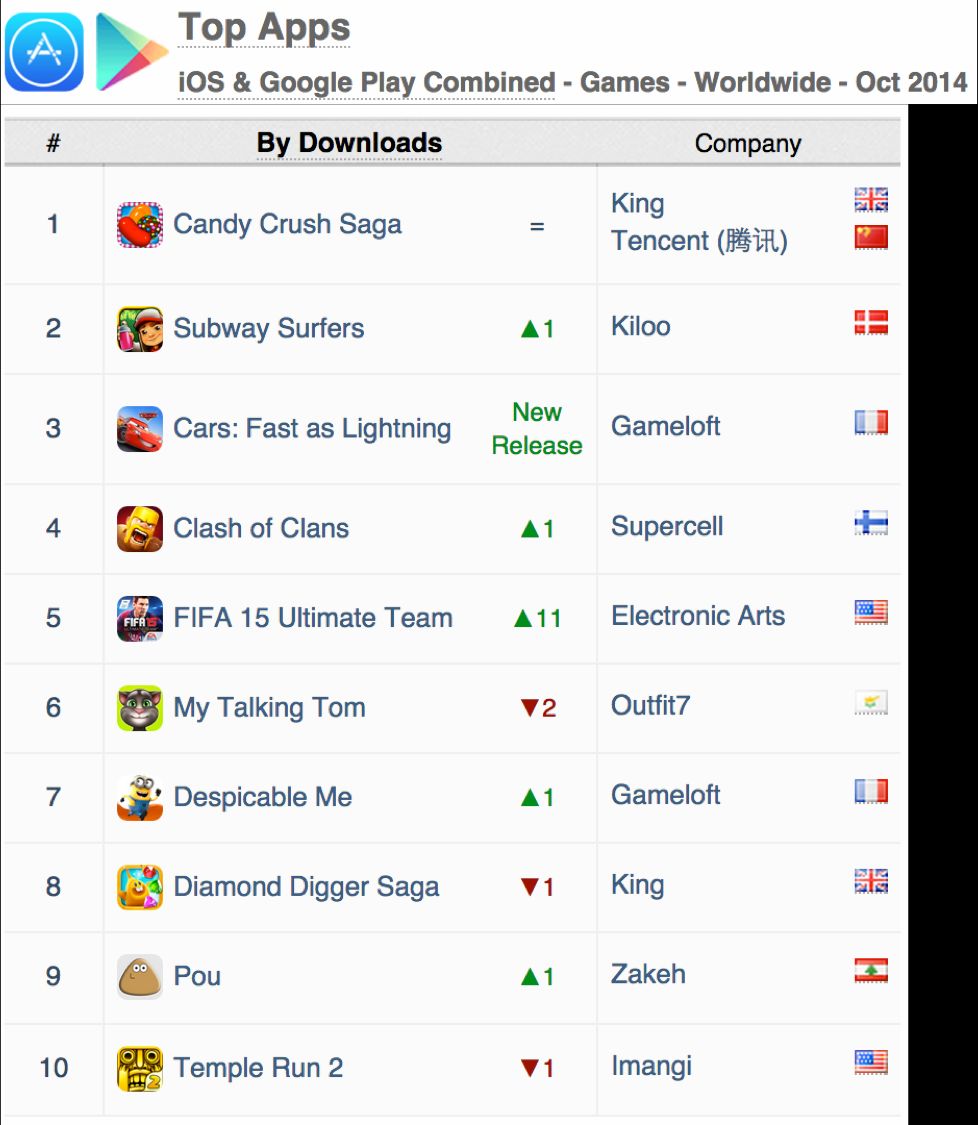
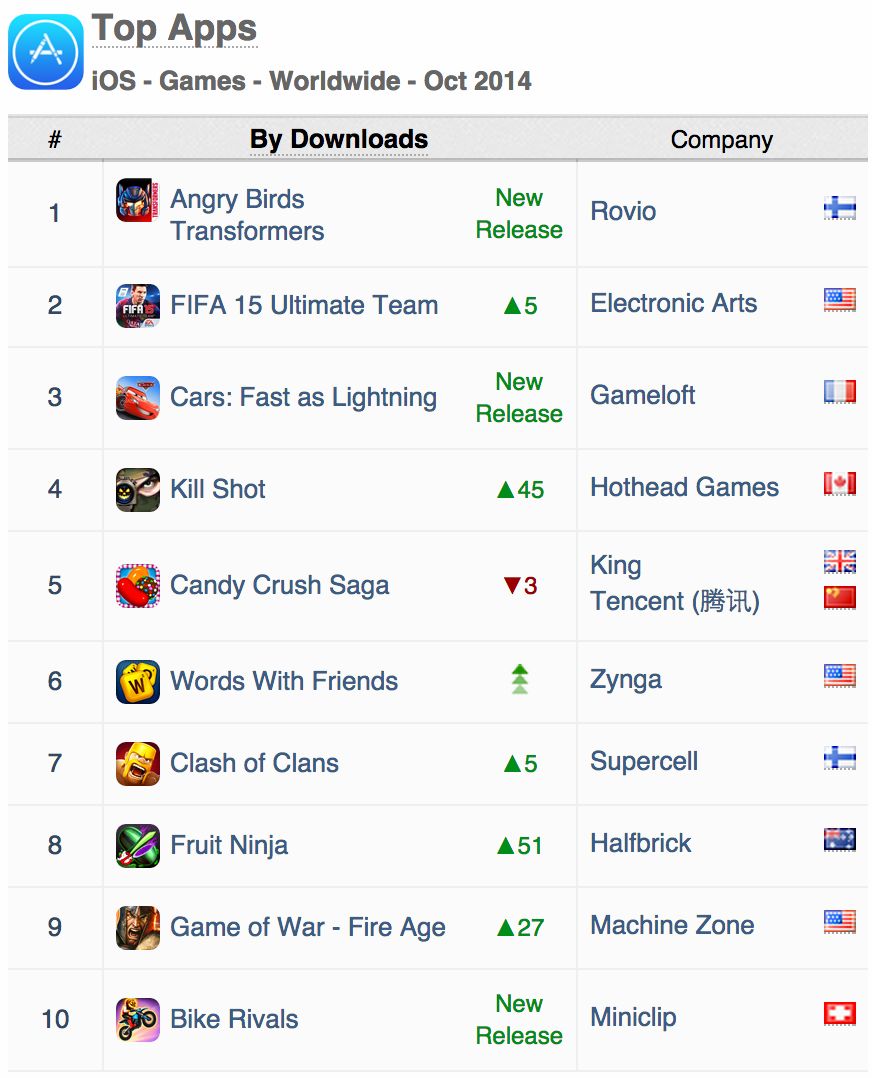
Turning to the top apps downloaded on iOS, App Annie noted that licensed games and well-known brands dominated the list. The list was headed by the introduction of Angry Birds Transformers, which is the third time Rovio has used a license with Angry Birds to good effect (after Angry Birds Rio and Angry Birds Star Wars). What’s interesting is that Rovio is continuing its attempts to broaden the Angry Birds brand into different genres by adding sidescrolling game elements to the basic physics-based gameplay. Certainly tying that in with a well-known movie and toy brand is helping, given the title’s debut position on the chart.

Electronic Arts moved up to second place with FIFA 15 Ultimate Team, showing the strength of the EA Sports brand on mobile. The company benefits from the mobile app not just in in-app purchases, but increased sales of the PC and console version of FIFA 15 must also be ascribed to the success of the mobile app to some degree. As App Annie noted, “Based on its latest earnings release, Electronic Arts’ mobile games averaged 155 million monthly active users (MAUs) during Q3 2014. Of this, its mobile sports games averaged 40 million MAUs during the same time period, a gain of 250 percent since last year. This steep growth coincides with Electronic Arts’ decision to move to a freemium business model, with last year’s FIFA 14 being a major beneficiary. Now, with FIFA 15 Ultimate Team, it seems to have another hit mobile sports title on its hands.”

Another notable event on the App Annie listings is the move of Zynga into the top ten, as the company’s introduction of the new Words With Friends boosted it into the #8 position for Downloads. This is part of Zynga’s continuing transition to a mobile game company from a Facebook-based social game company. Now 55 percent of Zynga’s revenue is coming from mobile titles, a significant milestone for a company that once derived 93 percent of its revenue from Facebook.

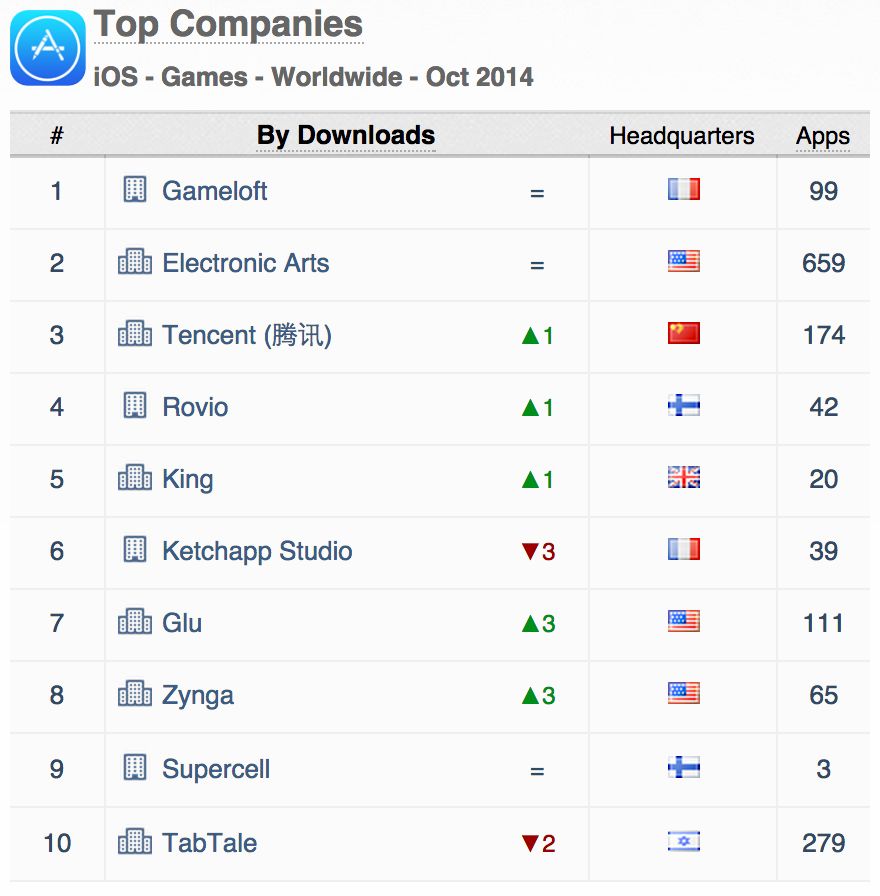
App Annie also noted that European publishers dominated the charts, with four out of the top five publishers by download being European: Supercell, King, Rovio, and Gameloft. On the revenue side US publishers only claimed two slots, with Machine Zone at #7 and Electronic Arts at #8. European companies Supercell and King took the top two slots, while Asian publishers held the remaining six positions in the top ten.

5 Questions With Marcus Gners, COO Of Lifesum

Whether you’ve used the app or have only just heard of it, Lifesum is making a name for itself in the quantified-self movement whose devoted followers are gamifying their health with each step and bite. Back in March, the app got $6.7 million Series A funding to grow its base beyond Europe. Now, Marcus Gners, COO of Lifesum will be speaking at [a]list summit on Dec. 3rd at the W Hotel in Hollywood about the role of apps in content marketing.

Marcus Gners, COO of LifesumMarcus Gners, COO of Lifesum

We were elated to ask Marcus some questions about the ever-interesting quantified-self movement, what wearables will mean to the future of his business and marketing at large as well as what he has gleaned from his background in gaming.

Is the quantified-self movement a fad?

The hard-core quantified self movement is a niche. Internet of Things and people taking responsibility for their health is becoming mainstream. Quantified self is small indie movies, connected devices and mobile are blockbusters.

Wearables are picking up serious steam right now with Apple and Microsoft entering the market. What opportunities do you see in wearables and the quantified-self movement in the next year?

We have only seen the tip of the iceberg within wearables. So far their value has been pretty much on the gadgety accessory level as a way to communicate tech savviness or healthiness. Now we are going to move fast into wearables that can do more than count steps, like for example real-time checking of blood sugar and stress hormones. That in combination with software that changes peoples’ habits will create wearables that can truly change people’s lives.

We are already seeing brands like Amtrak dipping a toe into wearables marketing. How do you see other brands tapping into this?

The Internet of Things movement and mobile development will have huge impact on products in general. I’m a bit intrigued by edible wearables, but scared. It feels like the world is becoming sci-fi reality.

“Gaming is the most competitive category in the market, so you learn to manage your product from a clinical metric perspective and at the same time listen to users to ensure that what you are building is as cool as you think it is.”

What are some of the difficulties involved in marketing an app?

Attribution tracking has been a huge hassle and thus being able to calculate ROI on ad spend. This has become a lot better in the last year and will keep improving. I have great expectations on Apple’s upcoming analytics tools.

Another issue is that access to media and good ad formats is a bit of a mess. Global ad pricing is being pushed up by a few games studios, making it difficult for new actors to enter the market. Also there is a great lack of good formats and Facebook’s prices have soared during the last year and most other channel alternatives are not as good.

How has your gaming background informed your approach with Lifesum?

Gaming is the most competitive category in the market, so you learn to manage your product from a clinical metric perspective and at the same time listen to users to ensure that what you are building is as cool as you think it is. I also learned to do professional user acquisition and that gives us greater control of our destiny.

Fingerprint Brings Top Kid’s Brands to Mobile

As the global market for mobile game powers to greater heights, one demographic has been harder to reach — preschoolers. Kids are naturally attracted to touchscreen devices, as anyone who’s watched a child with a smartphone or tablet can attest. Building and marketing apps to children, especially preschoolers, is no easy task, though. Parents are quite naturally concerned about the content of apps their kids might be playing, and the quality of the apps, and the educational value. Plus many countries have laws and regulations concerning apps for kids that publishers need to follow closely.

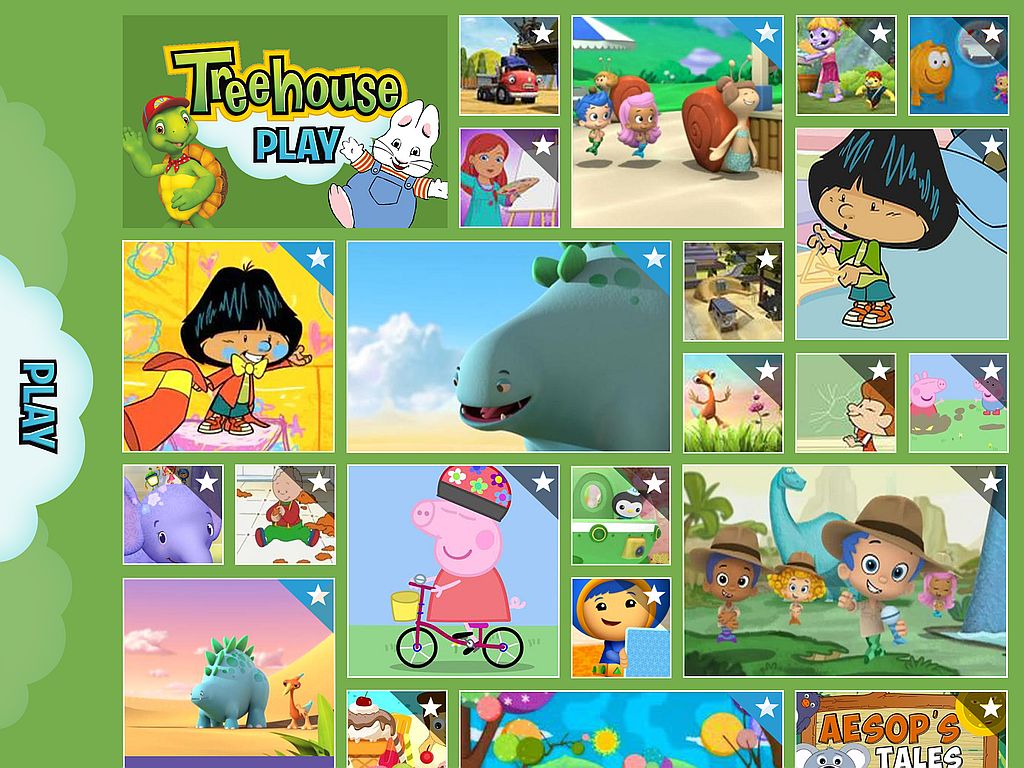
Yet the massive opportunity that kids represent for publishers has not gone unnoticed. Today Canadian-based media and entertainment company Corus Entertainment announced that it has partnered with Fingerprint, the San Francisco-based mobile technology company, to create a mobile entertainment platform for kids aged two to seven. Set to launch globally in 2015, the platform will offer preschoolers a safe, fun and branded environment to enjoy videos, games, music and eBooks featuring their favorite Nelvana characters Max & Ruby, Little Bear, Franklin, The Berenstain Bears and more.

“We’re thrilled to partner with Fingerprint to develop our first global digital offering for kids,” said Colin Bohm, Vice President, Television, Head of Corus Kids. “Leveraging Fingerprint’s expertise to create compelling and fun mobile applications for children will enable our Nelvana brands to be enjoyed by even more kids in multiple languages and territories around the world.” In 2012 and 2014 Corus invested in Fingerprint as part of Corus’ strategy to expand into new markets and unlock additional value in Nelvana’s rich library of branded content.

Fingerprint CEO Nancy MacIntyre

“It’s been our dream to bring Corus’ family of great brands to life on mobile devices,” said Nancy MacIntyre, CEO of Fingerprint. “By creating this new platform, families will have peace of mind as they encourage their children to experience favourite brands on the family’s personal mobile devices. After all, mobile is where people of all ages are spending their time. Corus will expand its brands via mobile and further grow its fans.”

The deal brought an approving nod from industry analysts. “Investing in mobile is imperative for media companies to expand their brands,” says Wedbush Securities digital media analyst, Michael Pachter. “71% of families with young children have smart phones according to the NPD, and children are using those phones for entertainment. By bringing the popular Corus brands to mobile with Fingerprint, the affinity children have to those brands will grow exponentially.”

The [a]listdaily reached out to Fingerprint CEO Nancy MacIntyre to talk to her about the growing business of bringing brands and education to kids on mobile devices.

[a]listdaily: The educational software market, focused on kids, rose to about a billion dollar segment in the 1990’s before it shrank. Are we finally seeing the rebirth of a significant software market for kids, this time on mobile platforms

Nancy MacIntyre: Yes, all the studies show we are in a place, especially in the US, where 2/3rd of kids have access to mobile devices and that six — 12 year olds often have their own. We don’t see that changing and it is dynamic and very natural for children these days. Digital media is what they know and how they learn and enjoy entertainment and educational fun.

[a]listdaily: Is there a sharp line between education and fun for kids on mobile platforms, or is it all blended together

Nancy MacIntyre: Mobile is not different, really, than any other gaming platform. Kids need to be engaged first, so it is about providing an experience that draws them in and holds their attention, and that can be in entertainment, education or a blend of the two. The guiding principle for mobile is that whatever the experience, it must be engaging first and foremost or the rest is moot and time won’t be spent to get the educational value of the product. This applies to adults and other content as well.

[a]listdaily: How can parents find the right software for their kids, and make sure they aren’t going to be surprised by purchases their kids make

Nancy MacIntyre: There are four basic recommendations that can help parents make the right software choices for their families and not be surprised by kids buying things they shouldn’t, or racking up bills.


  1. There are many resources available to parents, especially that come in the form of reviews providing a great perspective on a game or app. There are a lot of great blogs that cover kids software, but we also like the reliable and respected source Common Sense Media. They do a great job of recommending products of good quality, that are educational and have strong play value.
  2. Parents talking to other parents is huge. Tried and true recommendations are a great place to start.
  3. Trusted curated networks like what Fingerprint offers takes the guesswork out of the hunt and peck in other voluminous app stores. As we grow, many other networks we power are great resources whether through Sylvan, Samsung, and new efforts with companies like global Corus Entertainment, which has amazing and beloved characters and brands.
  4. It sounds basic but passwords are essential including keeping them private from your young kids who can unknowingly purchase items. Also, kids are smart. Make sure your household has clear guidelines on what they can and can’t purchase.

[a]listdaily: We’re starting to see full-on console games for kids coming to mobile with the same features, such as Skylanders: Trap Team and Disney Infinity 2.0. How will this affect the market for kid’s software on mobile

Nancy MacIntyre: I think having great, immersive mobile games for kids from big publishers that are comparable in quality to console is a huge positive. It not only expands the business but shows what kind of great experiences can be had on mobile today.

[a]listdaily: Minecraft has been a huge hit with kids. Will we be seeing more creative, build-your-own-thing type software on mobile designed for younger kids

Nancy MacIntyre: I think the build-your-own movement will grow, yes. In fact, Maker is very alive and well in empowering creativity. From encouraging Little Makers to take initiative, be confident inspired, to older kids showing them what is possible, it’s a whole lot of fun to see and be part of.

[a]listdaily: When you talk about Fingerprint becoming a Netflix for parents looking for kid’s apps, does that mean a subscription model rather than premium or freemium apps

Nancy MacIntyre: Three things:

  1. I liken Fingerprint to a Netflix for mobile content for kids in learning and play. It is an easy way to describe it and its value.
  2. Fingerprint and networks powered by us means curated and trusted products offered up and selected for you and your kids. Makes it really easy.
  3. Fingerprint products come in many models, subscription only being one.


Azubu Aims for Premium eSports

It’s been a banner year for eSports, as the revenues from various games like League of Legends, World of Tanks, and DOTA 2 rise into the billions, with over 100 million dedicated players globally and new titles on the horizon. We now have eSports events occurring in major sports stadiums, and even a special stadium being built just for eSports. Related to that, streaming game video continues to grow, and the sale of Twitch to Amazon for $2 billion underscores the value of game streaming and eSports.

In this rapidly growing space we have Azubu, which bill itself as a “global broadcast network, delivering premium live and on demand eSports action, programming, news and analysis.” The company is taking a different approach to eSports than the everyone-is-welcome-to-stream style Twitch employs. Azubu is focused on building a premium eSports network, the equivalent of ESPN. That means building superior technology for displaying high-quality streams on a variety of devices, and it also means top-quality content, analysis, and statistics.

Furthering that goal, Azubu has been busy signing top eSports players and teams to provide exclusive content, bringing more reasons for eSports fans to tune into Azubu as it builds out its network. The [a]listdaily caught up with Azubu CEO Ian Sharpe to ask about Azubu’s plans and the growth of eSports and streaming.

Ian Sharpe

[a]listdaily: Azubu has embarked on an ambitious journey to become the premiere eSports network. How would you assess your progress towards that goal so far

Ian Sharpe: There are two ways to answer that question. The first is very practical. At Azubu, I often say ‘you can’t improve unless you measure’. We keep track of every aspect of the business, and so, according to our development backlog, we are 40 percent through our planned feature set.

The second is more philosophical. Startups are tough and reboots are tougher still. I like to quote Bukowski, “What matters most is how you walk through the fire.” Not only are we still walking, but the team we have forged in this crucible is unparalleled in my experience in terms of dedication, passion and sheer derring-do.

[a]listdaily: Azubu has partnered with KeSPA (the Korean eSports Association), and pro players like Faker. How have they been received, and what has this meant for Azubu

Ian Sharpe: Partnering with KeSPA was like uncovering a lost treasure. Of course, KeSPA has been a staple of the eSports industry for years, but the players had never streamed — at least for League of Legends. The first night Flame was due to headline, I was sitting in a hotel room in Seoul, eagerly waiting the stream to start. Ten minutes passed and the suspense was so unbearable, I was phoning staff to make sure all was going to plan. Right then, all of a sudden, the site burst into life. It was a phenomenal shared experience and a real triumph as well as a definite first. Partnering with Azubu allows KeSPA players to reach a broader audience and interact with fans worldwide, and all of eSports wins. Of course, a couple of weeks later, Faker started streaming. The best player in the world, hands down, on our site. That’s the stuff dreams are made of. To say the least, we’re excited to expand that partnership and announce other projects we’ll be working on with them in the future. Partnering with these pros has been a step closer to having a platform with all the best pros and teams in the eSports scene. In addition, we’ll be announcing new teams and pros joining soon!

[a]listdaily: Now that the League Champions Series (for League of Legends) is over, what’s your assessment of the year eSports has had Will eSports continue to move forward at the same pace in 2015

Ian Sharpe: Competition is part of our DNA, this space is destined for continual evolution. Look at the massive changes happening in China, the growth of BlizzCon in LA, the new titles on the horizon. eSports is a wildfire, leaping over obstacles, sparking new ideas, blazing a trail. Momentum is always a friend, and I am enthralled to see how it surges forward.

[a]listdaily: When a professional League of Legends player retired and then signed a streaming agreement for $800K a year, that raised some eyebrows. Is this an anomaly, or is this where streaming is headed

Ian Sharpe: Streaming is as much a phenomena as eSports itself, and the two combined create a real force for change — potentially explosive change. High profile endorsements and contracts have been the norm in sports for years. Now, in eSports, money is helping fuel the fire, fanning the flames. However, there are many pros out there that have turned down large monetary opportunities from streaming companies because they just want to compete, so there is a balance, and I think there will continue to be.

[a]listdaily: Despite Electronic Arts giving up on their MOBA Dawngate, there are still high-profile entries coming like Heroes of the Storm, Overwatch, and even on tablets (Vainglory, for instance). Do you think there’s good reasons to work with upcoming titles for streaming

Ian Sharpe: Absolutely. The sheer inventiveness in and around videogaming is awe inspiring. I could show you a dozen new and compelling experiences being created right now, on every device imaginable, from my ex-EA colleagues alone. Streaming offers them an audience and advocates that can be influential in shaping a game and making it better. I’m personally excited for Overwatch (along with every other gamer out there). Our goal is to have content opportunities around every single one of these major titles to provide fans with the gameplay they want to watch, and provide broadcasters with the platform that delivers all the major titles that they want to play.

[a]listdaily: What do you think Amazon’s acquisition of Twitch means to the streaming business

Ian Sharpe: You know, looking back on my answers above, I’ve noticed a whole Fire motif, which perhaps shows the subliminal power of the Amazon platform! The acquisition was like setting a beacon ablaze for eSports. It proves what a major business eSports and livestreaming is. The world is watching, quite literally, to see where we go next. Exciting times.