Monetizing Mobile

Mike Vorhaus, president of Magid Advisors, moderated a panel about monetizing mobile. He was joined by panelists Corey Rosemond, business development director for Plantronics; Wally Nguyen, CEO of mNectar; Austin Murray, founder and chief business officer of TextPlus; and Vincent Juarez, principal and director of media for Ayzenberg.

Mike Vorhaus led off the panel by asking the panel to consider the role of games on mobile in the future, given that games are currently responsible for the overwhelming majority of mobile revenue. “Will games continue to be the dominant monetization in mobile ,” Vorhaus asked. “We get a lot of people approaching us to put games in our application,” said Murray, a veteran of the mobile gaming space before starting up his messaging app company. “You see games being put into messaging apps around the world. I’m not sure if it’s going to stay that way, or it’s just the low-hanging fruit right now. People are coming up with new ways to monetize them.”

“Games are certainly the most sexy part of mobile right now,” Juarez noted. “The burden is on developers to get people to cross that velvet rope to monetize.” An interesting perspective was brought by Nguyen, a self-confessed gaming fanatic. “I look at it from a consumer perspective. If you look at the East, the apps are built as multi-use,” Nguyen said. “There’s chat, messaging, there are games built in, and that’s how Easterners enjoy their experience. As Americans we like to have a specific app for each purpose. The Eastern method allows for higher LTV and ARPU, because it’s a long term relationship. The Western approach, when you’re done with Candy Crush you’re done with the relationship.”

“We have seen that free-to-play can benefit the end user, because it creates this bond between the developer and the end user,” said Rosemond. “That’s not something you always found with traditional products.”

Vorhaus asked the panel about the prospects for console games to benefit from mobile games, and vice versa. “The way to look at console games migrating to mobile is at core gaming,” said Nguyen. “There are some challenges, like retention – early retention is really tough with core games. You can’t just drop in and understand it. If they stick around until day 30, you can really make money from them.”

Other panelists had more optimistic views. “You could see it as a gateway to the console experience,” said Juarez. “You want to give them a bite-sized snack, but you want to do it in a way that allows them to migrate over.” Rosemond noted the popularity of companion apps to console games. “I think about mobile giving more value to the consumers without having to give up your revenue stream. Companion apps are a good example of that,” Rosemond said. “They enhance your ability to do things within the game.”

Talking about CPI and acquiring audience, Vorhaus noted that in many Asian countries, paid TV advertising is actually the number one source of installs for apps. Nguyen was much more direct in his response. “CPI is dead, CPI sucks, you should not buy on the basis of CPI,” Nguyen declared. “Why are people installing your app You don’t know, but that’s what you pay for. In a given month, people install ten apps, and at the end of the month they delete nine. Nine out of ten CPI campaigns are therefore wasted. I think product demonstration is the best way to go.”

2015 Is The Year Of Content Creation

According to David Hayes, Head of Creative Strategy on Tumblr, the popular blogging platform reaches a quarter of all gamers. Let that sink in a moment.

“People think that Tumblr is new,” Hayes said. “We’ve been around since 2007.”

For brands that haven’t yet taken advantage of Tumblr’s many unique commmunties and tapped into the reach on the platform, Hayes has some harsh words: “Brands that sit it out, that say ‘we don’t have the infrastructure yet’, if you’re not actually posting inside that stream, you don’t exist.”

While when many think of the kinds of content created on Tumblr, they might think of photos as being the principal way creators utilize the platform, that idea might be outdated. “Videos are our fastest growing post type. Especially micro, short-form, snackable video,” says Hayes. “We’ve had video as a post-type for 7 years.”

So what brands are doing it right Hayes waxes poetic about Denny’s Tumblr strategy, even going as far as hiring the creative behind forming the diner chain’s brand voice there. Hayes also notes that Xbox’s post on Tumblr was one of the top performing gaming post of all time.

If 2013 was the year of native advertising and 2014 the year of content marketing, 2015 will be the year of content creation, according to Hayes, and Tumblr is in a unique position to be part of it all– after all, Tumblr has 7 post types while many social platforms are playing with just one.

When asked if Tumblr would ever adopt pay-to-reach monetization as platforms like Facebook and LinkedIn have done, Hayes says “No way, never. Absolutely not,” saying it would be disruptive to the communtiies and fandoms that thrive on Tumblr. For brands, Hayes thinks “it’s demeaning to rent your own home,” with the communities brands work so hard to build on platforms.

“We would never mess with a brand’s community.”


The Future of Mobile Marketing

Kevin Winston, founder and CEO of Digital LA, moderated a panel about the future of mobile marketing, particularly in the area of ad buying on mobile. He was joined by panelists including Robert Brill, executive director [ion] and programmatic media for Ayzenberg; Ross McCray, CEO of VideoAmp; Christian Galvin, VP of sales for Fiksu; and Gladys Kong, president and CTO of UberMedia.

Winston asked the panelists what sort of placements they had available for their respective platforms. “We have a large inventory, as well as programmatic buying,” Kong said. “It’s mostly in-app, video pre-rolls and interstitials.” Fiksu provides a wide range of possibilities. “We buy through all the display channels, we buy programmatically, we have our own RTV and buy across Facebook and Twitter, as well as some of the incentivized players,” Galvin said, referring to Fiksu’s capabilities.

VideoAmp, is, as the name suggests, focused on video. “You can buy on the YouTube mobile app, and can focus on any video or channel,” McCray said. “You can buy on a mobile app, and the focus is with video exchange. Or you can buy mobile web, through the general exchanges.” The nature of the ad buy is different with [ion], as Brill pointed out. “We connect advertisers to influencers,” Brill said. “We are the strategy and the activation part of that business. We sell the content that the users chooses to watch, across mobile and desktop platforms.”

Winston asked the panelists about the nature of advances in targeting. “Let’s talk about targeting,” Winston said. “We’ve come a long way in the past year in our ability to target on mobile. What do you see is popular ”

“We’re at the very top of the funnel; most of what we do is content creation,” Brill noted in reply. “Advertisers come to us to reach influencers. We work to contextually connect the brand with the influencer.” The situation is different with UberMedia. “We specialize in social and location targeting,” Kong pointed out, providing an example. “If BMW comes to us and wants to reach people likely to buy BMWs, we geofence and look for people who have used a particular app and their locations. We have over a thousand data points about 5 million users.”

“There’s no question targeting is important, and it’s come a long way,” Galving agreed. “The big question is scale. Clients want good targeting, but they want scale to go along with it.”

‘Native Advertising Isn’t Going Away Anytime Soon’

CEO of SpinMedia, Stephen Blackwell gave an interview over a “Fireside Chat” at [a]list summit: Mobile Marketing today with Anthem Ventures’ Jon Bauch about key mobile trends they are seeing. First thing on their mind Native advertising.

The conversation over native advertising continues to shift, but Bauch maintains that it won’t be “going away anytime soon. Look at user experience.” User experience is key for mobile, because that is where change is happening on the platform, and arguably the ultimate user experience as it pertains to mobile is going to be wearables.

“Integrating wearable devices into your mobile marketing strategy is very important,” says Bauch.

Is the thumb-oriented mobile experience over

“How do people deal with mobile devices 4 billion years of evolution, thumbs reached their apex,” says Blackwell.


The Mobile Marketing Mix

Chris Younger, principal and director of strategy for Ayzenberg, moderated a panel discussion on the subject of being iconic. He was joined by panelists Maria Pacheco, senior director of marketing, mobile, for Dreamworks Animation; Bill Rehbock, general manager of content marketing for Nvidia; Marcus Gners, COO of Lifesum; and Fabien-Pierre Nicolas, senior marketing director for App Annie.

Starting off, Chris Younger queried the panelists on the rapid evolution of mobile devices and wearable tech, and where they thought it might be headed. “What is mobile ” Gners replied. “You have the rapid development of the Internet of Things. Everything is going really fast, it’s exponential not linear. The technology means you will have a much more intimate relationship with your users.” The smartphone and the wearable devices we’re seeing have tremendous computing power, but equally important are the fact that they are with us every day and that they contain sensors to track not only what we’re doing but important data on our physical status as well.

The technology changes have meant changes in marketing as well. “What we’re seeing that the key currency in mobile gaming is time,” said Nicolas. “We’re seeing three to five hours of usage – up to a quarter of a person’s time per day is with their phone. Yet the share of media dollars on mobile is still very small. The brands are losing the battle of engagement with the consumer, especially consumers who are under thirty years old.”

Younger followed up by wondering how well apps built by brands have performed. “Apps built for a brand generally haven’t reached their goals,” said Nicolas, if they are built primarily for promotional purposes rather than providing real utility or value to consumers. He cited the Starbucks app as one that people have responded well to because it’s useful. But we’ll see better results soon, Nicolas feels. “The future is coming from Japan,” Nicolas said. “Puzzle & Dragons did a billion dollars in revenue last year, and is on track to do more than that this year. You saw brands like DC Comics partnering with them to get access to the audience. I think that might be more the future than building stand-alone apps.”

Partnerships might be another way to pursue getting brands to audiences, Younger noted, and the panelists agreed. “When we’re trying to think of what kind of app might be relevant to the next movie we’re coming out with, we’ll think about the genre and go to the app store and look at the top titles,” said Pacheco. “We don’t just want to throw out a light app – we’re charged with revenue generation. We reach out to developers who have already made really successful games, and have a conversation with them. We launched Turbo in May of 2013, and we recently hit 50 million downloads. Before the movie even opened we had 12 million downloads.” Pacheco noted that they had a very productive marketing partnership with Verizon, including an eight week racing contest based around the app.

‘If You Make A Movie And There Aren’t Brands In It, It Doesn’t Look Real’ To Lorenzo Di Bonaventura

Lorenzo Di Bonaventura is a busy guy. The producer of one of the biggest branded entertainment franchise in Hollywood, Transformers, named a number of upcoming projects he’s now working on, from Kidnap with Halle Berry to GI Joe 3. His next challenge: creating content specifically for a mobile screen.

“Fundamentally, you’re working against what we do when you watch on a small screen,” says Di Bonaventura. “For a movie-maker, scale is the biggest issue.”

Lorenzo relates a personal anecdote echoed through [a]list summit: Mobile Marketing: when it comes to kids, the best and most-used screen is also incidentally the smallest one.

“I look at the consumption patterns of my children’s peer group,” said Di Bonaventura, as he joked that this tendency is frustrating from a movie maker’s perspective. He works to tell stories on a big screen, although he is currently working in the digital space, “experimenting with what sticks across the board.”

When it comes to working with brand placement in films and creating branded franchises, Di Bonaventura has tremendous experience having worked closely with numerous brands and creating well-known transmedia franchises.

“If you make a movie and there’s no brand names in it, it doesn’t look real to me,” he says. To Di Bonaventura, working with brands isn’t as antithetical to creating great movies as some working in movies may believe. “Look around the room. I see a lot of brand names,” he goes on to say. “Find a way to maximize the brand form.”

Recently, Di Bonaventura worked with ride-sharing service Uber to create a promotion for Transformers. What he observed happening is that the promotion, while inherently mobile and social, worked in a way to expand into a form of traditional display advertising too.

For the near future, Di Bonaventura sees leveraging major influencer audiences as a key move for traditional movie-makers in a mutually beneficial relationship: “These YouTube stars have real audiences and we would be foolish not to include them in our movies.”

The State Of Entertainment Marketing

Jim Louderback, managing director of Boomfeeder, moderated a panel of industry luminaries to discuss the state of entertainment marketing. He was joined by Kristian Segerstrale, COO of Super Evil Megacorp; Peter Levin, president of interactive ventures and games, Lionsgate; Andrew Stalbow, co-founder and CEO of Seriously; Andy Hess, evangelist for Epic Games; and T.J. Marchetti, CMO of Awesomeness TV.

Jim Louderback asked the panelists to define mobile – what is it “I think mobile is changing, it’s very rapidly becoming the primary consumption platform for gaming. It’s also shifting how we are thinking about marketing and our audiences,” said Segerstrale. “I do think it has migrated materially from a snackable item to a major part of our lives. The ability to have engagement with your audience is breathtaking,” Levin commented. “It used to be the fourth screen, but that’s not the case any more. It’s the first screen,” Stalbow said.

The question of mobile marketing versus marketing in general occasioned some interesting comments. “Yes, Gen Z is the core of our audience,” noted Marchetti. “When we think of creating content, 75 or 80% of all our views is on mobile.” Stalbow pointed out an important distinction. “What’s important is not whether it’s in your pocket, but the context of your use,” Stalbow said. “Are you truly mobile, waiting around your doctor’ office, or are you sitting on your couch That changes the nature of the content you create.”

“Yes, but is mobile marketing really different ,” Louderback queried the panelists. “It really bothered me when I worked at Disney that mobile was a separate group,” said Marchetti. “What is mobile marketing It’s marketing. It’s where your audience is.” Levin had an interesting perspective specifically on using mobile games as marketing tools. “It’s not separate,” said Levin. “One of the first edicts I ran internally was ‘No more promotional games.’ It’s basically spending a lot of money on your agency to create a sub-optimal gaming experience.”

Louderback pursued that topic with the panelists. “What do you think of advertisers that offer a product Stay away as far as gaming goes ,” Louderback asked. Segerstrale spoke from his experience with many game startups. “The amount of advergames that have really worked over 15 years is zero,” Segstrale declared.. “It simply does not work out. The best talent works on their own IP or a big project, and games are all about good talent.”

The nature of what customers expect from brands, especially entertainment brands, has changed, panelists noted, and thus marketing has to change along with that. “One clear expectation is interaction,” said Segerstrale, pointing out how game players expect replies when they ask a company questions about their game through various social media channels. “You have to be ready for that conversation, because those people will either be your biggest boosters or your biggest detractors. You can’t hide behind a web site, you have to be yourself.”

Stalbow made an important point about how the situation has changed for marketers. “The brand and the audience are suddenly connected,” Stalbow said. “If you think of the entertainment brands of the past they were never directly connected to their audience because they were always distributed by a third party.”

The New Core Of The Game Industry

Everyone in the game industry is aware of multiple massive changes sweeping through the business over the last ten years, changes that have been daunting in their speed and scope. But it’s difficult sometimes to see where change is headed, or how it is touching all aspects of the business. It’s especially difficult to recognize and accept changes to fundamental business process and products and markets when those very things are what’s paying your salary.

We’ve all seen the swift rise of mobile games, from an obscure beginning on feature phones in the 1990’s to the multi-billion dollar business built on the fast-growing global market of smartphones and tablets. This year marks the ascent of mobile games to become the single largest segment of the game industry in terms of revenues, outpacing the revenues from console games.

The trend has been obvious for years just from watching the conferences that feature the game industry. The E3 show continues to shrink in terms of floor space, while mobile shows are growing every year. The tracks devoted to mobile games are become more important, and more well-attended, at the Game Developers Conference. Perhaps more significant are the exhibitors at these conferences, because they are spending money to display there. More and more, these companies are serving the mobile game industry rather than the console or PC game business.

Another early indicator has been the flow of jobs — look at the high-profile game designers and executives with long histories in the console and PC game business who are now creating mobile games. Many of the best and the brightest in the game industry have turned their attention to mobile games. Mobile game companies are growing rapidly, and many new startups are still being created. When was the last time a new console game publisher arose Or even a big console game studio Even the companies that build tools for game developers are creating their software with mobile in mind. The quintessential console game engine, Unreal Engine, is now also a mobile game creation tool.

If you want to know where popular culture is headed, look to advertisers, marketers, and comedy. Those creative businesses all thrive on being in touch with popular tastes. The zeitgeist is shifting to mobile games. Where South Park once parodied World of Warcraft, now it’s making fun of free-to-play mobile games.

Another place to look is at what threatens our youth, at least in the eyes of those who worry about such things. Once the threat to our vulnerable youth was dime novels and pulp magazines… then it was comic books, then the “vast wasteland” of television, then rock music, and for a time it was Dungeons & Dragons, which was eventually supplanted by video games. Now the worry is that kids are spending too much time playing games on mobile devices.

Once the holiday television shows were awash in console game ads, both for hardware and for software. Now what we see are likely to be mobile game ads, like Game of War: Fire Age‘s $40 million campaign, or the similarly immense TV spend put forth by King Digital to promote Candy Crush Saga.

The growth of mobile games is changing the entire industry. Everything from game designs to marketing to product development to finance is being affected by this shift. It’s past time for everyone in the game industry to re-examine all their fundamental ideas of how and why we do things. The simple, halcyon times when all games were sold in the same way to a similar group of people are long gone. While some of the old models may still work and generate profits, those models may not be the most effective way to do things any more. The audience has changed, the way they think of games and how to pay for them has changed, even the way they play and the length of time they play has changed.

Mobile has finally realizing the long-sought goal of the game industry: Reaching every demographic, everywhere on the planet. It seems clear that the growth of smartphones will continue headlong into all corners of the globe, as ever-cheaper devices reach broader markets. You can bet games will be a significant part of those devices, wherever they end up.

Does this mean games on other platforms are less important Not at all. In fact, it’s important to remember that the broad audience of people who play games really don’t pay that much attention to platforms. That’s a technical detail that’s much less important than the fun they get with a particular game, or the thrill of interacting with a favorite setting, character, or personality. People want to play games wherever they are, and on the best device possible. Some of the most successful mobile games have a strong Facebook version as well. Or look at the success of FIFA on mobile and console, where the synergy between the two FIFA games has driven greater engagement (and more revenues) than previously possible.

While the future of games will have mobile as its most lucrative and popular core, the maximum revenues may be seen from brands that transcend the mobile platform to find expression online, through consoles, and on social platforms as well as new platforms that may emerge in the future, such as VR.

Games are increasingly being thought of as brands, or at least the companies that want to maximize the success and reach of their games are thinking that way. Even though a company’s game revenues may primarily come from a segment other than mobile games, the gravitational pull of mobile is affecting them. Most major console games released these days have some sort of mobile companion app, at least for the Xbox One and PlayStation 4. Even Nintendo has started to release some mobile companions, albeit in a limited fashion.

The mobile game train is leaving the station, and you can either be on it in some fashion — or you risk being under it. No one is sure of where this train will end up, or exactly what path the the train will take. All that’s certain is that things are changing and will continue to change. We all need to keep checking assumptions regularly, and keep looking at the data coming in — and most of all, listen to what your game players are telling you. The future is bright for the games industry if we can keep adapting to the changes and creating better experiences for game players.

Nintendo Exec Scott Moffitt Explains How eSports Buoyed ‘Super Smash Bros.’

Nintendo has seen an uptick in Wii U hardware sales thanks to the recent success of Super Smash Bros. on Wii U and Nintendo 3DS.  The franchise is closing in on 15 million copies sold to date.  Super Smash Bros. became the most successful Wii U launch in history, selling over 490,000 physical and digital copies in its first three days.

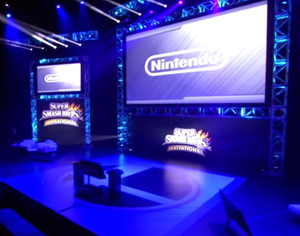
As part of its marketing plan to bolster awareness for the first new Super Smash Bros. game in six years, Nintendo embraced eSports.  The game company hosted a Super Smash Bros. tournament at E3 and utilized livestreaming to share the action with fans across the globe.  The game has become popular on the gaming circuit, including at EVO (Evolution Championship Series) and Intel Extreme Masters.  Scott Moffitt, executive vice president of sales and marketing at Nintendo of America, talks about the role eSports has played in the success of this super smash hit in this exclusive interview.

What role do you feel eSports has played in the success of Super Smash Bros.?

Super Smash Bros. Invitational at E3Super Smash Bros. Invitational at E3

{link no longer active}

There does seem to be a ton of pent-up demand for this franchise.  ESports has helped to rekindle gamers’ love for this franchise and really prepare the environment for a fantastic launch.  I do believe that the record sales are due to a lot of the pre-awareness activity that has gone on, including eSports.  The 3DS game also helped satisfy gamers’ demand temporarily before the Wii U game. ESports is one of the things that has helped drive the pre-launch excitement for this game to a fever pitch.

What marketing opportunities has eSports and livestreaming opened up for Super Smash Bros.?

The Smash Bros. franchise has been a favorite for eSports players over the years.  Given the nature of the game as one of the leading, if not the leading fighting franchise, it’s a natural for those kinds of competitions.  At E3 we wanted to try something different and host our own tournament.  We intentionally chose participants who were not the most experienced players.  We wanted a broad range of players there competing and having fun.  Those tournaments allow our fans to come and celebrate with one another to enjoy the game and to build their affinity for the franchise.  We’ve had great success with those.  The E3 tournament was one example.  We also recently did a national tailgate tour, where we took the tournaments to college campuses nationwide.  Those were local battles where people stepped into a battle arena at the tailgate before a college football game and allowed rival schools to compete against one another.  We tallied the results of those competitions just for fun.  We also had a national tournament through a partnership with GameStop for the launch of the 3DS version of the game.  We had over 15 cities compete for the right to come to the National 3DS Super Smash Bros. Tournament, which was held at the Nintendo World Store in New York.  We’ve used tournaments to help market and create some of this enthusiasm for the franchise.

How do you feel the Nintendo gaming audience differs from that of Sony and Microsoft?

There are some similarities and some differences.  For certain our fans appreciate the fact that we release quality titles and showcase innovation in everything that we do.  We try to be different.  Our owners are often times families with kids, but it’s much broader than that.  Our core, most passionate Nintendo fans certainly are much older than that and are in their 20’s and 30’s and they grew up with our games.  Our appeal is broad and quality is a big reason why. If you look across all titles launched on the new generation platforms, including Sony and Microsoft, as well as portable, there are 19 games that have at least an 85 Metacritic Score and a User Score of 8.5 or better.  Nintendo made 17 of those games.

“Our appeal is broad and quality is a big reason why. If you look across all titles launched on the new generation platforms, including Sony and Microsoft, as well as portable, there are 19 games that have at least an 85 Metacritic Score and a User Score of 8.5 or better.  Nintendo made 17 of those games.”

What role do you feel hardware bundles have played in allowing Nintendo to avoid a price cut and still see an increase in sales of the Nintendo Wii U hardware?

One of the four key pillars of our holiday campaign includes new value offerings like bundles.  Retailers have had a lot of Black Friday bundle offerings.  Bundles provide a great merchandizing tool and bring fresh product to the market and new value for parents who are considering a Nintendo gift for their kids this holiday.  Value offerings are always a part of our holiday plan, but it’s much broader than that.  We have new IP like Captain Toad Treasure Tracker and Fantasy Life.  We have a new platform in Amiibo and we have proven franchises like Pokémon and Super Smash Bros.

How early was Nintendo thinking about Amiibo given that the Wii U GamePad was built with NFC technology?

I don’t have a specific day for when it dates back to, but by including NFC functionality into the GamePad that afforded us a chance to get in this category fairly easily and in a way that doesn’t require a gamer to buy a separate portal or device.  It provides a great value for parents and gamers of all ages, where they don’t have to spend money on a portal and have another item to store underneath their TV set.  There may be other uses of NFC technology to come, but this has turned out to be a great use of it.

Given that that this technology was built in from the beginning, why did Nintendo wait until this fall to introduce Amiibo to consumers?

Amiibo functionality is really strong with Super Smash Bros., so tying it to a big powerful franchise launch made a lot of sense.  When you look at it, Super Smash Bros. is a perfect fit for character-based Amiibo product since there are so many characters in the game.  The development team has brought it to life in a way that shows an interesting new way to play toys-to-life in one of our strongest franchises.  You do have to have a great game as well as a great concept, and this has both.

“When you look at it, Super Smash Bros. is a perfect fit for character-based Amiibo product since there are so many characters in the game.  The development team has brought it to life in a way that shows an interesting new way to play toys-to-life in one of our strongest franchises.”

What would you consider a successful holiday for Nintendo this year?

I would consider a successful holiday a strong launch for Pokémon Omega Ruby and Alpha Sapphire.  A strong launch for Smash Brothers Wii U and a strong launch for Amiibo and then continued momentum on both of our hardware platforms — 3DS and Wii U.  We really have five key initiatives that we’re trying to accomplish and those are the five.  Certainly the rewards we like to see are smiles on people’s faces, happy kids and families having fun together on Christmas and during the holidays.

Console Wars Update: Xbox Rising

The massive marketing battle of Black Friday marks the beginning of the holiday marketing combat between the three console manufacturers, and based on reports from the front lines we have a winner: Microsoft’s Xbox One. Yet the battle is just beginning, and strategically Microsoft still has plenty of ground to cover in order to match Sony’s market share. Meanwhile, Nintendo has unleashed perhaps its biggest weapon yet to advance the Wii U in Super Smash Bros. For Wii U, but how has it performed so far The details of this opening battle tell us something of the console market and how it’s changing.

First of all, let’s look at where our data is coming from. InfoScout is a research firm using smartphone apps that reward users for uploading pictures of their store receipts. This gives the company a clear picture (pun, as always, intended) of what people are buying — and in the case of Black Friday, InfoScout collected more than 182,000 receipts showing actual purchases. That’s a respectably-sized data set. The data includes purchases at all major retailers carrying electronics including Walmart, Target, Best Buy, GameStop, RadioShack, and others (more specifics on InfoScout’s data collection can be found here).

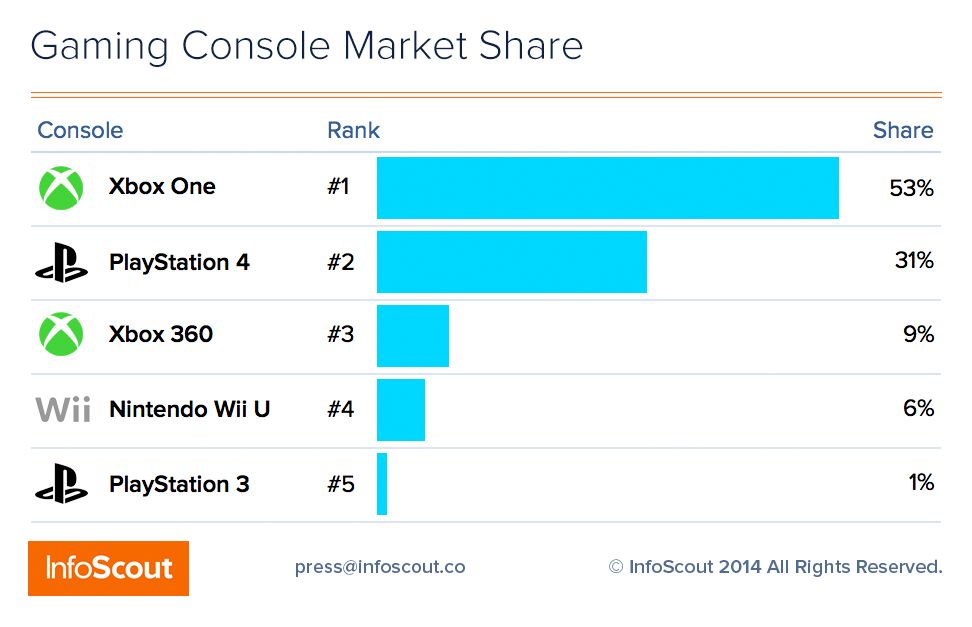
The Xbox One emerged as the clear winner, notching up 53 percent of the console sales. The PlayStation 4 came in second with 31 percent, trailed by the Xbox 360 (9 percent), the Wii U (6 percent), and the PlayStation 3 (1 percent). Interestingly, the data showed that 90 percent of all console purchases on Black Friday were of bundles, with some 75 percent of the panelists saying that the included game was a major influencer on their purchase.

Clearly, we can see that consumers have a strong price sensitivity, and that Microsoft’s price cut has given the Xbox One a strong boost. Last year, the PlayStation 4 lost out to the Xbox One as well (InfoScout reported {link no longer active} 31 percent Xbox One share and 15 percent PS4 share), but the cause last year was purely one of availability — Sony just could not make enough PS4 consoles to meet the tremendous demand. This year, the Xbox brand combined took a 62 percent share of the market.

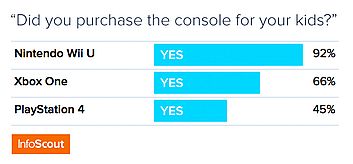
Buyers were mainly purchasing for their kids, but the breakdown was quite different for each console. While 92 percent of Wii U buyers said they were buying the console for their kids, only 66 percent of Xbox One buyers said that — and only 45 percent of PS4 buyers were buying that console for their kids. Most PS4 buyers were picking up the console for themselves. It would seem from this data that Nintendo still has its very strong association with kids, or at least it does so in the minds of the parents buying consoles.

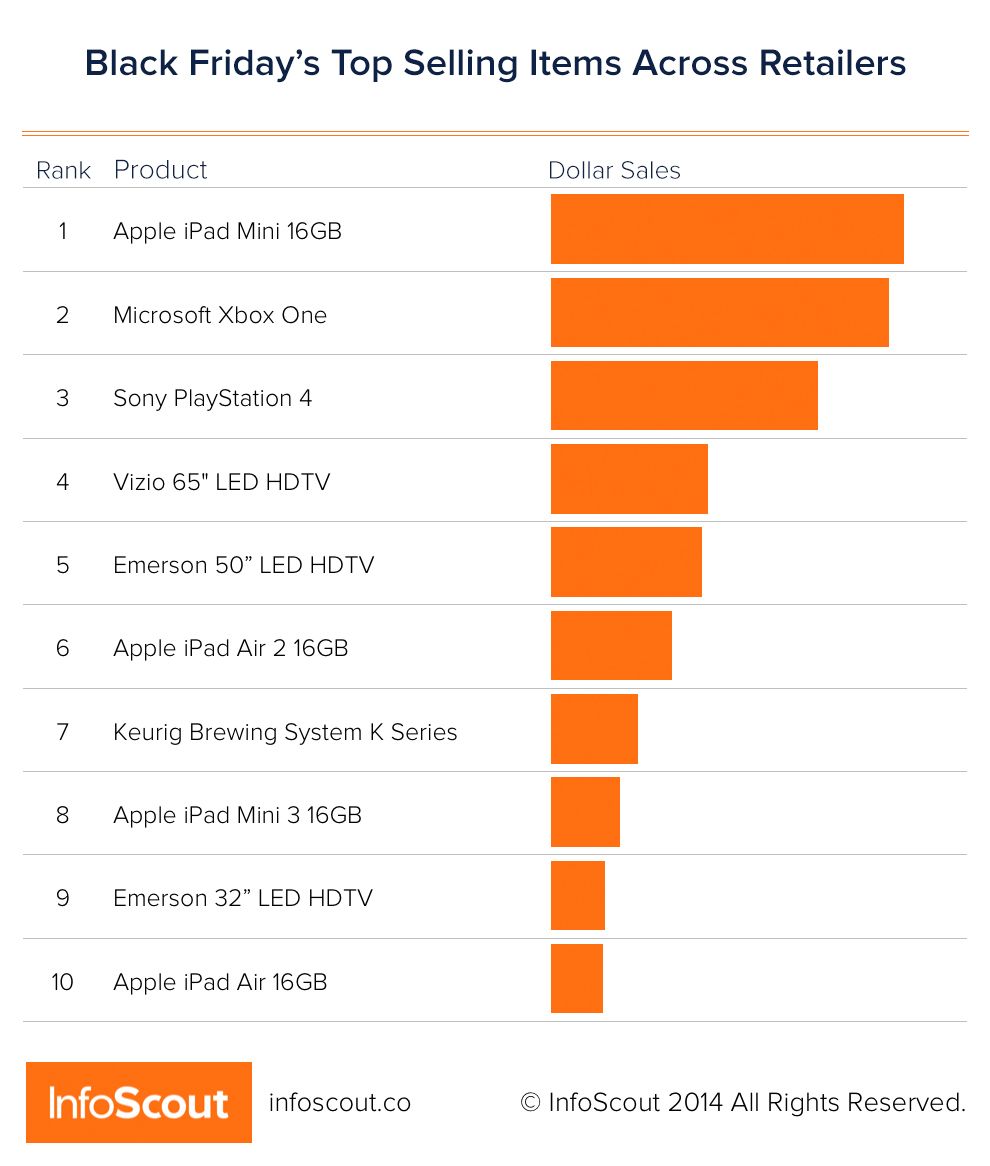
The success of consoles was not a limited thing, either. The Xbox One was the second most popular item being purchased across retailers, and the PlayStation 4 was the #3 choice. It was another game-playing device entirely, though, that claimed four out of the top ten spots among the top-selling items, including the #1 slot. That was, of course, Apple’s iPad. Looked at in that light, the majority of the top ten items being purchased were game-playing devices… and the iPad is clearly the winning console.

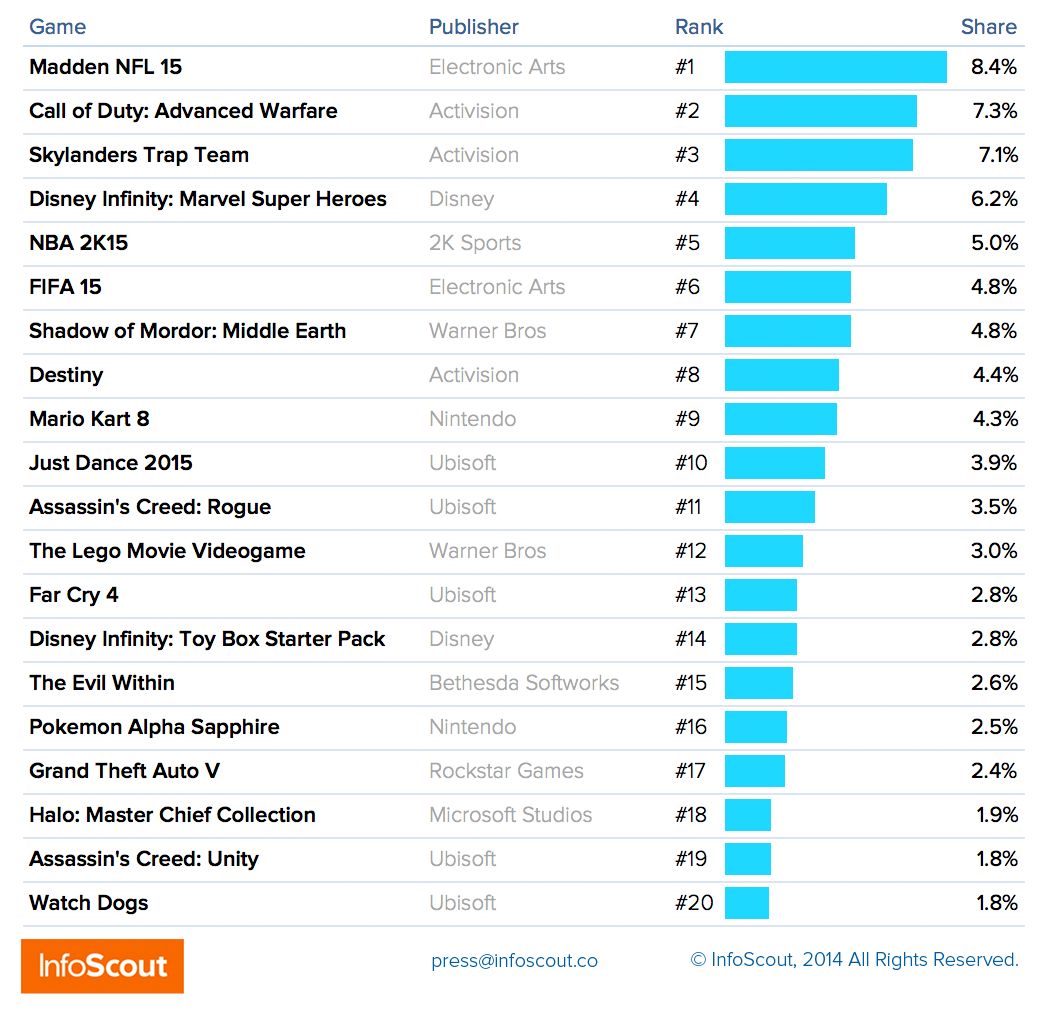
While we’re looking at the console hardware, it’s also instructive to take a look at the top-selling games over Black Friday. InfoScout also collected that information, and found that the top-selling game was Madden NFL 15, followed by Call of Duty: Advanced Warfare and Skylanders: Trap Team. What’s perhaps more interesting is what’s not on the list: Super Smash Bros.

Nintendo has been looking forward to Super Smash Bros. as a key part of the effort to boost Wii U sales, which it has undoubtedly done. Yet the question is also just how long-lasting that boost will be, and how high the Wii U’s sales can go. The effect of Mario Kart 8 on Wii U sales was powerful, but it seemed to diminish after a month or two. Will the same thing happen with Super Smash Bros. It’s too early to know, but not seeing it on the list of the top 20 games (and seeing Nintendo with a 6 percent share of console sales for Black Friday) is not a good early sign. Nintendo will have to ramp up its marketing efforts for the Wii U, and consider the magic weapon that Microsoft is using to good effect: pricing.

Microsoft has gotten down to basics here, and shown that when consoles are pretty much equal, consumers are definitely going to go with price. The Xbox One and the PlayStation 4 are more alike than any previous pair of rival consoles has ever been. What’s left to distinguish them, and help consumers make buying decisions, are price, exclusive games, and marketing. The evidence seems to be that while both consoles have some good exclusive games, and creative marketing, price is winning the battle here.

It’s more than price, though — it’s value. While bundling games may distress retailers like GameStop, it’s an easy way to boost the value of a console while not increasing the cost of good by much. Microsoft has combined that with a solid price cut, giving them a clear advantage in the eyes of low-information shoppers. “Hey, honey, which console should we get for the kids ” “Well, this Xbox One is only $329, and the PS4 is $399… let’s get the Xbox One.”

Sony’s going to have to decide how to respond to Microsoft’s surge. Will it be an increased marketing effort Is there a price cut in the PS4’s future At this point, Sony is likely to hold off on a price cut. After all, the company is still leading comfortably in units installed, and there are some powerful exclusives headed to the platform in 2015. No doubt the pricing will be re-evaluated on a regular basis… along with how well Microsoft is doing with the Xbox One. By E3 next year, we could well see some new initiatives by Sony.

For now, we’ll have to wait until we see earnings reports for the quarter, early next year, to get a better idea of where market shares have settled after the holiday shopping season is over. One thing is clear, though — game consoles are selling very well indeed, and that’s going to benefit all areas of the game industry.