‘Mario Kart 8’ Bundle U.S. Bound

Following the announcement of European related bundles, Nintendo of America has confirmed that it will launch its own system package for Mario Kart 8 next month.

The bundle will arrive on May 30th, the same day that the game releases in stores and on the Nintendo eShop, and will include a 32 GB Wii U system, a Mario Kart 8 game, and a special edition red Mario Wii Remote Plus controller, as well as a red Wii Wheel peripheral. The price is set for $329.99.

As a bonus, those who buy either the bundle or the game will be eligible to receive a free digital title, from a choice of four. Those customers who register their copy of Mario Kart 8 before July 31 will receive a free downloadable game, selecting from Wii Party U, The Legend of Zelda: Wind Waker HD, Pikmin 3 or New Super Mario Bros. U.

Source: Polygon

‘Assassin’s Creed’ Director Selected?

Assassin’s Creed has made quite a killing in the game industry, with over 73 million units sold. Now, Ubisoft may be prepared to do the same for the upcoming film adaptation.

A report from Deadline indicates that Justin Kurzel, who previously worked on Macbeth, may be in line to direct the movie. A solid deal hasn’t been reached yet, but it’s looking very likely, as Michael Fassbender (who will appear in the film, pictured above) has worked with Kurzel before on Macbeth.

More details on the film are expected over the next few months, possibly coinciding with the announcement of two new Assassin’s Creed games for later this year.

Source: Dualshockers

Inside ‘Watch Dogs’ Marketing

Ubisoft is one of the key players in the AAA game space, and they will be very much in the forefront of media and gamer attention for the next month as the highly anticipated new franchise Watch Dogs finally launches on May 27. The title was originally scheduled to be a launch title for the new console generation last fall, but Ubisoft decided the game needed more development time and pushed back the release. The [a]list daily spoke with Ubisoft senior vice president of sales and marketing Tony Key about Watch Dogs marketing and how the marketing landscape is changing.

Tony Key

Moving Watch Dogs out from its original launch date was a difficult and painful decision for Ubisoft. “Whenever we remove a chunk of revenue that size, it’s going to be a material impact on not only our earnings for that year but even our stock price,” said Key. “This is not an easy decision to make for any company. On the day we announced that, I think our stock dropped 40 percent or some ridiculous number. We’ve recovered since because people are seeing the rest of our lineup and it turns out maybe it was a good idea. We had no choice, despite the fact that it put us in a tough financial position in the short term. We’re a long-term company, with a long-term vision, and Watch Dogs for us is a long-term play. We had no choice. We knew it was the right thing to do, but it doesn’t make it hurt any less.”

“Games are tricky because they’re a mix between technology and art, and it’s sometimes very difficult to predict — especially a new brand with new technology — an end date,” Key continued. “The Assassin’s Creed team has gotten so much experience now in working on a schedule that they’ve found that delicate balance of being able to put their heart and soul into the game and still making a schedule work. But a new brand, as you’ve seen time and time again from publishers everywhere, it’s very difficult to make that work.”

Moving the launch date had a serious impact on marketing. “The decision was made very late, and we were rolling along in a lot of areas on the marketing side,” said Key. “Any time a game slips, there are marketing inefficiencies. We are still executing, for the most part, the plan that we had had. It was a lot of late nights and crazy reactions to putting everything on hold at the last minute. It’s the least of our problems to put marketing on hold, compared to getting the game right, but it’s a lot of work for a marketing team when something like that moves. You have to reallocate all your resources on a new schedule, you’ve got your retailers to deal with, who are already running marketing for your game in some cases. Slips like that are incredibly inefficient.”

While delaying Watch Dogs was painful in many ways, a t least there has been more time for people to become aware of the game. “On a new brand, more time usually benefits a game,” agreed Key. “Although there was halo around the launches of those new systems that would have certainly benefited Watch Dogs, and vice versa. But to your point, we’ve had almost seven extra months to get more pre-orders, which has been a really good story for us. One of the main positives is that pre-orders were very much rushed from E3 on when retailers started taking pre-orders on next-generation, because most retailers weren’t even taking pre-orders on next-generation games until June. I think all the games that launched had less pre-orders than they would have expected to have for such a large launch.”

“For us, we’ve had a chance to get closer to where we think we should be in a normal course of action,” Key continued. “It’s given our retail partners more confidence in the launch of the game, because they’re seeing the momentum at their own level as opposed to just seeing it in the press. We’ve been able to recapture that momentum, I should say, and even add to it.”

Shipping Watch Dogs in May means there’s a clear field as far as new AAA titles go. “One of the benefits of the move, and we didn’t know this when we moved it, is we have a very share of voice in the marketplace right now,” noted Key. “There are very few other titles shipping in our launch window. We’ve got just enough time before E3 when lots of new games, including Ubisoft, are going to be on display. We have our moment, and that’s something you really don’t always get at the holiday with your brands. Sometimes you have other giant AAA games shipping the same day as you.” There’s really not much in the way of major new console IP launching until Destiny arrives in September., and people are looking for new IP for next-generation consoles. “That’s for sure true with Watch Dogs, I think there’s a lot of people out there that see Watch Dogs as the face of a new generation of games,” said Key. “There are no preconceptions based on what it was before. Watch Dogs represents the next generation of gaming in a lot of people’s eyes.”

Of course, there will be plenty of games vying for attention at E3 and all through the holidays, including Ubisoft’s own new titles, but Key is ready for the challenge. “You don’t get to own the market for very long,” said Key. “Your job as a marketer is to make sure that when your game launches it is an entertainment event, and if you do that successfully you will have a longer tail no matter what else is shipping, because people buy more than one game. I don’t expect Watch Dogs to be the #1 selling game from May 27 until December 31 every week — I don’t think any title’s ever done something like that. But our goal is to do good business with Watch Dogs, establish it as a major game brand in this new generation. If we do that we’ll have great catalog sales at holiday time. We’re confident that Watch Dogs will stand up to all those other games, including our own, through the holiday season.

The sharing capability that’s built into next-generation consoles is already having an impact on game marketing. “Sharing is such a fantastic addition to what console gaming is all about,” said Key. “For me it’s one of the true next-components that’s in its infancy at this time. Nobody knows where that’s going to take us. That whole livestreaming, user-generated content built right into the console interface — they made it accessible to everyone now. Everybody can be a celebrity, everyone can create content, everyone can send gameplay to their friends. The fact that they’re making that more mainstream is going to open up a world of possibilities, especially on the marketing side. It’s going to allow us to amplify great content that our best gamers are creating for us. Some of the best marketing is not going to come from us going forward. It puts more pressure on the games to be good, but if the games are good this user-generated marketing is really going to take things to another level.”

“If the games are good this user-generated marketing is really going to take things to another level”

Key is amazed at the rapid pace of change in game marketing. “We’re getting used to a changing landscape,” said Key. “In the last two or three years things changed way more than they did the ten before. I’ve been here for 12 years, and the last couple have been really turbulent in terms of marketers trying to understand the best way to reach consumers — all these news platforms and tools coming into play. A few years ago it was all about how to manage the social channels, and while that’s still evolving along comes something like Twitch that’s been out there but suddenly is accessible to anyone that has a console. I really believe that’s going to have a transformational impact on marketing.”

“There’s still no better way to enjoy a game than having your friend sitting next to,” Key said. “Less and less that’s important, because you’re still hanging out together even when he’s not in the room. That social aspect of gaming in general in the next generation, it’s really what next-gen gaming is all about, it’s not just about the graphics or the speed and power of the machines, it’s also about the social aspects, all the things we’ve learned over the last few years about sharing and gaming together that are really executed well on the new hardware.”

These new sharing technologies underscore how important it is for marketing and game development and community and PR to work together on games. “You’re a hundred percent right,” Key said. “We’re having a lot of conversations globally, around the company with our customer organization and our development organization and our marketing organization about how we all need to be working more closely together much earlier in the process so that we understand the right tools games should offer their players for sharing, telling their stories, evangelizing your product in any way possible. All of that is becoming a big part of marketing and production now.”

The holiday ahead looks like another marketing battleground. “I think there’s still going to be a lot of aggressive behavior from first-party around their hardware systems,” said Key. “You’re still going to be saturated with those messages about which system is right for you. From a content perspective this is the holiday where the hardware starts to come of age, titles being made exclusively for next-generation system, games that are one level above in terms of tool kits and development ideas and game design, taking more and more advantage of the next-generation systems. Every year the games will get better. There’s a lot of really great product coming this holiday. We see the trend as less games, but bigger. There’s also a lot of great games being made at a smaller level like Child of Light. From a blockbuster perspective, it’s going to be a really strong holiday, and people are going to want to join the next-generation.”

Key sees the next-gen console advantage beginning to become more clear this holiday. “The gap will start to show itself as we go forward,” said Key. “There’s still going to be great games being made for current-gen systems, but as time goes by you’ll start to see the difference more and more.” Will Microsoft and Sony make some moves this year on current-gen console prices to try and expand that audience Key doesn’t have any knowledge of what they may be planning, but “anything they can do to keep them viable and keep that market healthy is welcomed by us,” he said.

Brand Viewership Picking Up On YouTube

YouTube continues to be a hot commodity for original video content from select brands, according to a new report from OpenSlate.

The data indicates that the average subscriber base has grown from 37,000 to more than 82,000 over the past 12 months, spread across 500 unique brands. In addition, they accumulate a collected 722 million views a month.

In addition, from a survey of over 300 online media buyers, 41 percent want to increase YouTube spending over the next year.

When it comes to the top 500 brand channel by industry, as you can see from the chart above, Tech leads the charge with 131 active brands, with retail coming in close second with 111 and the auto industry following with 60.Â

Out of those tech brands leading the charge, Google shows a leading 2.6 million subscribers, while Apple and GoPro are closely behind with approximately 1.8 million subscribers each.

It just goes to show that YouTube continues to be of huge interest to these companies.

Source: Digiday

Activision VP Asks: Will Medium Matter?

The rapidly changing environment for game marketers is nowhere more turbulent than in social media. We’ve seen companies large and small trying a variety of strategies in social media, and there’s certainly no standard template for success. The [a]list daily caught recently with Activision’s Jonathan Anastas, vice president of global brand marketing, the company’s head of digital and social media, to discuss Activision’s views on the subject of social media and brand marketing.

[a]list daily: What’s the biggest challenge for brand marketers in social media, and what’s the biggest opportunity?

Jonathan Anastas: There are several challenges, but they are more than offset by the huge opportunities.

Jonathan Anastas

I’d prefer to start with the opportunities.

For decades, brands have been dependent on various media gate-keepers, often bucketed into two types. First, there were the editors and reporters and producers that you had to convince to give your brand time/space/positive affirmation in the “earned media” space. You needed to get by them to have access to their audiences and you needed their support for the message to be brand positive. On the paid side, there were simply costs associated with generating reach. Be it a Super Bowl ad, a YouTube masthead, a homepage take-over, reach was pay to play. Now, brands can build, aggregate and engage their own audiences, often with greater reach than the old media third parties. Look at Redbull or DC shoes on YouTube, Starbucks, etc. on social media.

In terms of challenges, marketers are beholden to other’s platforms and their policies. In addition, their well being overshadows your brand’s well being. A perfect example is Facebook’s changes to the organic reach algorithm. Brands are reaching 20-40 percent fewer of their fans than this time last year with each post.

We’re also challenged with platform proliferation and fragmentation. Each with their own best practices. Brands are managing four to eight platforms or more. That’s a ton of content creation and a ton of time spent and a ton of best practice development.

Lastly, given the level of engagement with social media and the money that now needs to be spent, the C-suite is looking for sales attribution or brand value improvement metrics. It’s too big to be a “test bed now.

[a]list daily: How has social media changed game marketing over the past year, and what changes do you foresee in the next year or two?

Jonathan Anastas: One of he biggest changes is noted above, and it’s a big one. There’s a huge amount of platform proliferation and fragmentation. SnapChat and WhatsApp have more MAUs than Twitter. We also have to look at things like “Will Medium Matter?” as new players jump in.

The second piece that’s changed is the volume of these social interactions that take place on mobile devices. Well over 50 percent now. That changes the asset best practices and the way the platforms themselves are used to interact w/ brands.

[a]list daily: As more and more social channels become significant, such as Instagram, Tumblr, Pinterest, and others, does that make it more difficult to maintain a consistent brand across the channels?

Jonathan Anastas: Brand consistency is fairly easy. That’s style guide enforcement. What’s hard is the development of true effective uses for each platform — best practices — as well as normalizing reporting and metrics. Is a Re-tweet the same as a share? Is a re-pin better or worse?

[a]list daily: Will we see more emphasis on social media going forward Is game marketing shifting more to individual relationships rather than traditional broadcast marketing?

Jonathan Anastas: To me, it depends on the category of gaming, the genre of gaming, the target, the platform, etc. Not by accident, almost every platform has added a “cost per download” product. That’s great for apps. If you’re a kid’s product, you have some issues w COPPA and reporting against those under 13 and determining if you are reaching the kids directly or not, is it a parent play, or a blend?

If you want to sell 10 million or more copies of a console game, TV is not going away yet. At that point, you’re breaking into the “blockbuster” game buyer, who may only buy one or two games a year and is not a deep follower of the genre or your brand. They may buy Halo in 2012 and GTA in 2013 and play Words With Friends in-between the two when not watching Netflix or playing Minecraft. I’m not going to convert that buyer on my Twitter feed.

[a]list daily: How has the changing social media landscape affected your marketing spend and resource allocation?

Jonathan Anastas: Like most other marketers in the world, and most other publishers, we are always looking at our marketing mix and spend and trying to move the right money to the right medium against the right people at the right time. You’ve likely seen us move to both ends of the spectrum at the same time: bigger, longer, more cinematic linear video content that drives pop culture conversation with the music and the cameos and you’ve seen us double down on a YouTube channel that has 2 million subscribers and 500 million views or a Facebook community of 23 million fans. We’re also taking a “mobile first” approach to video distribution, social content and more. We design the websites knowing half the traffic will come from a non-desktop device.

[a]list daily: With Skylanders reaching a very young audience, how does the social media marketing change for that group They aren’t using social media like the Call of Duty players are, that’s for sure. Do you target parents directly or indirectly?

Jonathan Anastas: You’re asking about one of the marketing nuts we’re putting the most brain power behind. Being fully compliant in all marketing to kids rules, we’re limited in the consumer insights we can glean directly. So we have to reverse engineer models where Study A says “50 percent of kids under 13 have a Facebook account” and then you look at your own dashboard and say “if I were 11, would I say I was 15, or would I say I was 40.” And those numbers vary by platform. It’s unlikely there are may 6 year-olds on Twitter, but there are probably a ton of 11 year-olds on Facebook. Thus, we take a more parent-centric tone and content approach on one and a more dual audience approach on the other. We’re always paying attention to what’s required by the ESRB and COPPA.

Fashion Marketing With ‘Watch Dogs’

Menswear brand and e-tailer Frank & Oak has partnered with Ubisoft to cross-promote the new Watch Dogs game through an exclusive line of limited edition clothing and accessories. Taking cues from the Watch Dogs universe, the 12-piece capsule collection bears a dark and mysterious near-future aesthetic. The distressed v-neck pocket tees ($32), printed denim shirts ($55), waffle henley ($42), black canvas pant ($65), patterned sweater ($65), and French terry hoodie ($65) feature raw and worn details and textures; and the crew neck tees ($32), baseball cap ($35) and military canvas duffle ($115) boast subtle Watch Dogs graphic details for the growing number of hardcore and casual gamers.

Ethan Song

Ethan Song, co-founder and CEO of Frank & Oak, explains why video games offer a unique opportunity to connect fashion with digital consumers in this exclusive interview.

[a]list daily: Can you talk about your brand?

Ethan Song: Frank & Oak is the simplest way to shop the latest trends in menswear, with quality designs and integrated lifestyle content. As a vertically integrated brand, we design, manufacture, and sell a new curated collection of premium clothing and accessories each month.

[a]list daily: What’s your retail footprint in North America?

Ethan Song: We sell across North America through frankandoak.com, and recently opened Atelier Frank & Oak, a shop and community space in our native Montreal. We only sell directly to our customers in order to create a unique experience for each individual.

[a]list daily: How big is your online customer base?

Ethan Song: We have over 1 million members — and growing.

[a]list daily: Why did you decide to get involved with video games

Ethan Song: As a next-generation brand, we’re constantly inspired by the digital world. This collaboration was a chance to combine three things we’re passionate about — fashion, art, and technology — and speak to the interests of our technology- and gaming-focused customers.

[a]list daily: What is it about Watch Dogs that appealed to your brand?

Ethan Song: We found the themes tackled in Watch Dogs — the importance of information and the digital world in near-future society — really interesting and relevant to the now. Our brand is, in part, about innovation, and we’re always interested in working on projects that don’t follow typical convention. 

[a]list daily: How have you worked with Ubisoft on this clothing line?

Ethan Song: We worked with Ubisoft’s creative directors early on in the project, and viewed initial versions of the game to fully understand the themes and aesthetic of the Watch Dogs universe. When it came to actually designing and producing the clothing, we had full creative freedom.

[a]list daily: How does the design connect with the video game world of Chicago?

Ethan Song: The Capsule Collection — like the chaotic game metropolis that is Chicago — has a dark and mysterious near-future aesthetic. Dark shades, and worn, faded, and functional details captured that feeling.

[a]list daily: Do you have a sense of how many of your customers are gamers?

Ethan Song: Through research and ongoing conversations with our customers, we know that many of them are interested in technology, and gaming specifically. Today, gaming isn’t only for a younger audience — it connects across all ages, genders, and generations.

[a]list daily: Why do you think we don’t see more clothing deals like this around big video game launches?

Ethan Song: Fashion trends are often inspired by relatable or aspirational pop culture icons — The Beatles, Mick Jagger, James Dean. As video games move in this direction, I think we’ll see a shift toward clothing inspired by the digital world.

[a]list daily: What role do you see this game playing in generating new customers?

Ethan Song: Many of our existing customers share a deep-rooted interest in technology and gaming, and as a next-generation digital brand, we’re sure our approach to e-commerce will resonate with Watch Dogs fans.

Brave New Game Marketing

Marinating for a day in viewpoints of the top game marketing executives and thought leaders at the Game Marketing Summit gives you some interesting insights into the state of game marketing. We all know the game industry has been changing rapidly in the past few years as it grows explosively. We’ve seen mobile games grow into an enormous business (in Japan, mobile game revenues are passing up console game revenues), indies become a major force (that’s where Minecraft started, for instance), free-to-play games becoming billion-dollar businesses, and the game industry heading for $100 billion in revenue in short order.

What hasn’t been as generally acknowledged is that game marketing has been changing as much or more than the rest of the game business. Game marketing used to be pretty sedate compared to the frenetic dash of product development, where they would be forever stressed in trying to adapt to new platforms or squeeze out more performance while trying to meet an impossible shipping date with code that had to be near-perfect because you’d never be able to update it. Meanwhile, game marketers would be busily copying their marketing plans for the last game and substituting the new game title before languidly preparing some new copy for the magazine ad. No wonder product development hated marketing.

Now it’s the marketing team that’s frantically responding to rapid changes in the market. Last year’s marketing plan? Tear that up, it’s not relevant to the latest social media outlets and livestreaming reality. A marketing plan from a couple of years ago? How quaint, it still called for TV advertising! Marketing plans from when the Madden franchise first launched? Yes, it was written in cuneiform on clay tablets, why do you ask?

Now game marketing is a vast array of choices, and many of them haven’t been around long enough to develop a predictable outcome. Social media has become a mainstay, yet even the nature of which outlets to use and how to use them is in flux. Facebook is fading among teens, while Instagram is surging. How much does Twitter matter among your gamers Where does Tumblr fit in Wait, Facebook changed the way its News Feed works again this week, so we have to rethink what we post…It’s tough to be a marketer when you can go into work in the morning and find out last week’s carefully made marketing plan is obviated by an algorithm change some social media company made late at night without telling anyone.

One theme that became clear during the GMS is that companies aren’t in control of their brands any more — it’s the customers. Their voices will be heard loud and clear, and woe betide those marketers who try to shout them down. If the game has problems, you’re going to hear about them — and so will the rest of the customers. The development team has to be responsive and the marketers have to be honest; stonewalling and denial and taking months to fix things just won’t fly.

Just as user-generated content (UGC) has become an important game feature (see, again, Minecraft), user-generated marketing (UGM) is becoming an important factor for game marketers. Look at the thousands of YouTube channels and blogs devoted to gaming, with passionate fans providing countless hours of game streaming, commentary, analysis and strategy for other fascinated fans. This can’t be shut down or controlled by the game developers. At best, you can hope to influence it a little, but certainly you should try to amplify the best of it and try to channel its power into helping your other marketing efforts. In the end, though, the game had better be damn good and continuing to get better, or else the crowd will turn on you.

Streaming has become immense, and the easy sharing capabilities of the PS4 and Xbox One are only going to accelerate this trend. Marketers are just beginning to figure out how to use this fast-growing technology as part of marketing efforts. Don’t take too long to think about it, though, because the competition isn’t. You’d better just jump in and start doing stuff, course-correcting along the way as you get feedback. It’s fast-moving, seat-of-the-pants flying in shifting terrain, and that will terrify some people. Find somebody on your team who’s an adrenaline junkie that can be exhilarated by this opportunity, and push them out to go hurtling through space and see if they soar or hit the ground. You may get a big crater, but you can always share the video of the crash.

The lines are blurring between game genres, between platforms and brands, between marketing and community and PR and product development. Getting products to market and continuing to get great revenue from them for years is the goal big companies (or those that hope to become big) are shooting for. To reach that goal, you can’t have different departments that don’t talk to one another. Product development is becoming one discipline that includes marketing, community, PR, design, programming, art, sound, and support.

Are there dangers in this brave new marketing world Of course. Social media is seductive because it’s so great at engaging fans, but you can end up preaching to much to the choir and risk not attracting a broader audience. Gaming is going global, and the demographic is also expanding to include nearly everyone as a possible gamer. Game marketing has to be able to reach a broad array of possible gamers as well as going deeper to engage committed fans better.

New technologies may be hard to master and you may waste a great deal of time and money on a technology that turns out to be not terribly effective at generating revenue. We are deluged by massive amounts of data, but that makes it harder than ever to find the important data amidst the flood. Then you have to analyze it properly, and ask the right questions, and draw the right conclusions, and make the right decisions. This requires a team of savvy people with a wide array of skills, and leadership that can bring them together for maximum effectiveness. And the skills needed will be evolving and changing as the market continues to change, so marketing leaders have to be on top of that as well.

Game marketing today means no complacency. The market is moving fast, and marketers must move faster or risk being overrun. It’s an exciting time, and marketers should be energized by the creative challenges ahead. Let’s see some game marketing that’s as creative as the great games coming out!

Game Marketing Summit Dazzles

The game industry’s marketers gathered at the 2014 Game Marketing Summit in San Francisco yesterday for a day packed with interesting speakers and networking, capped with the Game Marketing Awards. The event was focused on the changing landscape of game marketing, and some of the top marketers in the game business explored what’s changing and how marketers can take advantage of the opportunities afforded by these changes.

Carolyn Feinstein, SVP Global Consumer Marketing for Electronic Arts, and the co-chair of the GMS board of governors, started off by saying “I’m pretty sure I’ve never been on a stage with this many women at a gaming event.” At least in one area of the game industry there’s a good gender balance. Feinstein went on to note that the massive changes in the game industry from digital ,mobile, livestreaming and more, requires changing tactics and strategies to engage consumers and drive business.

Brian Cooley, CNet’s editor at large, used his keynote address to present a series of technologies to watch for the near future: Wearable tech, connected cars, connected home, the next billion mobile customers, and television. Cooley noted that smartwatches, fitness devices, and what he called “glassware” are all likely to be major categories, driven by a growing array of inexpensive sensors. The smartphone will be an important hub device for all of these wearables, and thus games may be able to take advantage of some of these platforms and their capabilities.

While connected cars and connected homes don’t hold much potential for game makers, the drive to get the next billion people on mobile devices does, as the $25-$50 smartphone arrives with tremendous impact around the globe. Finally, while 4K TV just represents an image quality upgrade (similar to the difference between DVD and Blu-ray), the potential for TV content to be delivered “over-the-top” instead of bundling into cable packages is already affecting the Xbox One and the PS4, as Microsoft and Sony begin producing original content.

Next up was a panel on Livestreaming: Your Next Generation Marketing Platform, with SOE president John Smedley, Marcus “djWheat” Graham of Twitch, and Bart Koenigsberg of Hi-Rez Studios discussing the vast impact livestreaming has had. ” It’s nothing short of a revolution,” proclaimed Smedley, noting that SOE is investing heavily in livestreaming. Graham talked about the impact of Twitch Plays Pokemon, and how the developers of Daylight were inspired by that to include some crowdplay features in their upcoming game. Streaming continues to expand, and as Graham points out, “It really is easy — the fact that we’ve had 5,000 to 10,000 streamers shows that.” The panelists agreed marketers should jump on livestreaming. “Embrace it, and embrace it now,” advised Smedley. “Where else are you going to find this concentration of qualified and interested buyers ,” Koenigsberg asked rhetorically.

The keynote address on creating contagious content was fascinating, given by Wharton Business School marketing professor Jonah Berger. He gave an overview of the ten years of research that went into his book Contagious: Why Things Catch On, and discussed the science behind creating viral content. He boiled down his findings to six key STEPPS: Social currency, Triggered, Emotion, Public, Practical value, and Stories. As he put it, the goal should not be getting 10 million views on a viral video, but getting ten to twenty percent new customers. He noted that word of mouth can be up to ten times more effective than advertising, and gave examples of how this works in practice. It’s important to note that while we often focus on online channels, most of our actual communication with others is offline — only about 7 percent is online (perhaps 10 percent in younger people). More info can be found at his web site, and it’s well worth a look.

The panel on Gaming Evolved: The Changing Landscape went right to the heart of what this year’s Game Marketing Summit was all about. Panelists Tony Key, SVP of sales and marketing for Ubisoft, Guy Longworth, SVP of PlayStation brand marketing for SCEA, and Albert Penello, head of product planning for Xbox, discussed the topic with Greg Short, the chairman and cofounder of EEDAR. The panelists noted that despite the increasing importance of digital distribution, retail continues to be primary. “I still have to create demand for that product,” said Key. “The distribution mechanism is not changing that, and it’s not helping me make cheaper games.” The panelists agreed that blockbusters will still drive sales in the future, though indies are of increasing importance — it’s the mid-range publishers that have disappeared. “There are no AA publishers any more,” said Key.

The next keynote, Marketing Worth Sharing, was delivered by marketer/cartoonist Tom Fishburne, CEO of Marketoon Studios. Naturally, his talk was copiously illustrated by cartoons, and he talked about why it’s never been a better time to be a marketer. The technology available is fantastic, Fishburne pointed out, but “we get excited about technology and sometimes forget about the big idea.” He noted some important things to keep in mind while crafting marketing strategy and tactics: Technology can’t save a boring idea, but it can amplify a remarkable one, Fishburne said. Preach to the choir, and don’t try to appeal to everyone. He also said that these days, “Everyone works in marketing.” Get ideas from all parts of the company, and you may find some surprising successes.

The panel on Influencing with Intent: Building Your Social Strategy included EA VP of media and marketing Chris Thorne, 2K’s director of PR Ryan Jones, Revolt’s VP of audience insights and strategy Jake Katz, and Treyarch’s direcotr of communications John Rafacz, moderated by Rogers & Cowan’s SVP Wendy Zaas. “Marketing is going to change more in the next five years than it has in the last 100,” said Zaas, leading off. The environment has changed the relationship between customers and companies, and it’s still shifting fast. How do you create strategies in that context “Most of the time we don’t have a strategy, we just have a conversation,” said Katz. “We don’t have the luxury of enough time.”

The final panel was The Persistent Dialogue, about communicating with gamers 24/7. Mike Lu, VP of product for Gree, was joined by John Heinecke, senior director of global brand management for Blizzard, and Lincoln Hershberger, VP of product marketing for Electronic Arts. Hershberger pointed out how they have integrated the messaging approach for both the community and PR teams. While Gree is new to building community teams, they have some special customers to pay attention to. ” We have guys who have formed groups of twenty or thirty who have spent more than $1 million in our games,” said Lu.

The importance of streaming is growing. “Hearthstone became the #2 game stream on Twitch because beta keys were so rare,” Heinecke said. “It’s a way to learn the game. Major crowdswell happened because of that.” Heinecke talked about the importance of the community and the company’s responses. “We look at marketing as inviting people into the Blizzard family,” Heinecke said. “You have different types of people in the family. You have to listen to all of them because there’s passion behind everything, they wouldn’t be posting if there wasn’t. You have to listen but not necessarily respond.”

The Game Marketing Summit for 2014 was an important and useful day for game marketers. Key takeaways from the sessions are that massive changes have occurred in game marketing and will continue to occur. Livestreaming is not just a consumer phenomenon, it’s becoming an important marketing tool as well. User-generated content is not just something that occurs in games, but we’re seeing it occur in marketing as well — those livestreams of game playing, or YouTube videos discussing game strategies, those are marketing that’s arising from the community. The pace of marketing is picking up so much you can think of it as real-time marketing, without the leisure time to plan out long campaigns you have to jump in and make things happen. As with games, marketing not just one shot — marketing needs to be a continuing process, just as games have become a service in many cases. You can’t count on just one thing — keep marketing!

‘Watch Dogs’ Ready To Run

Ubisoft is nearing the launch of Watch Dogs, just a bit more than a month from now. The game is highly anticipated, and Ubisoft believes it will become a major franchise as important to the company as Assassin’s Creed is. To that end, Ubisoft brought groups of journalists in to their SF offices to spend some quality time playing Watch Dogs.

Ubisoft’s usual demo space is in its San Francisco offices, with the large room outfitted with PlayStation 4’s at multiple stations with 42″ monitors. There was room for dozens of journalists, and the event was spread over two days to make sure many could be accomodated. Since the demo was set up to give journalists plenty of time to play through a mission, breakfast was served early on , with a buffet lunch (featuring, of course, Chicago-style pizza) as the day wore on. Everything was designed to focus attention on the game, and a number of key developers were there to help explain the game.

The game itself is an open world experience set in a near-future Chicago with hacking, driving, combat… a wide variety of possible activities. There’s certainly a Grand Theft Auto V feel in Watch Dogs, but the game allows you a greater range of activity and moral choices. You’re a vigilante hacker who can use his abilities for good or evil, and the moral arc of the character is up to you. The campaign story is one of trying to find justice for your murdered relatives, though, and not creating a crime empire.

While you can follow the main story, there are plenty of other activities to distract you. Minigames, AR games, many side missions beckon as you wander through the streets of Chicago. Your activities combine driving, or stealth, or combat, and hacking is layered on top of all the possibilities. The gameplay you experience will be based on your choices. If you like driving, then there’s plenty of that available, for instance. There are lots of collectible items, interesting minigames that test your free-running skills or metal agility. You can find adventure just walking down the street and scoping out the people you pass, delving into their online dossiers and hacking them if you choose. You can even go on “digital trips” – a wild break from the narrative that gives you some very different scenarios, like driving a mechanical spider-bot.

It turns out the the delay in Watch Dogs has worked out well for the launch, in that the game is arriving in an uncrowded period. So there’s plenty of attention to be paid among the press and the consumers. The game is compelling enough to command attention for quite a while, and it looks like it will do very well. Some key questions remain, though, and the answers won’t be known for a while. While Ubisoft has a pretty clear field right now, what will things be like in the fall when many high-profile titles (both new IP and important sequels) arrive Can Watch Dogs maintain mind share during the crowded holiday period Ubisoft will need to have some serious DLC and some serious marketing in the holiday market to make this a solid title for the fall.

One interesting part of the Watch Dogs release is the platform strategy. Will this game boost next-gen console sales, being released on current gen as well as next-gen Since the play experience is not significantly different, the answer is no. Watch Dogs becomes one more next-gen game to help persuade you to make the investment, but not a reason to buy a next-gen console in itself since you can still play Watch Dogs on current-gen consoles.

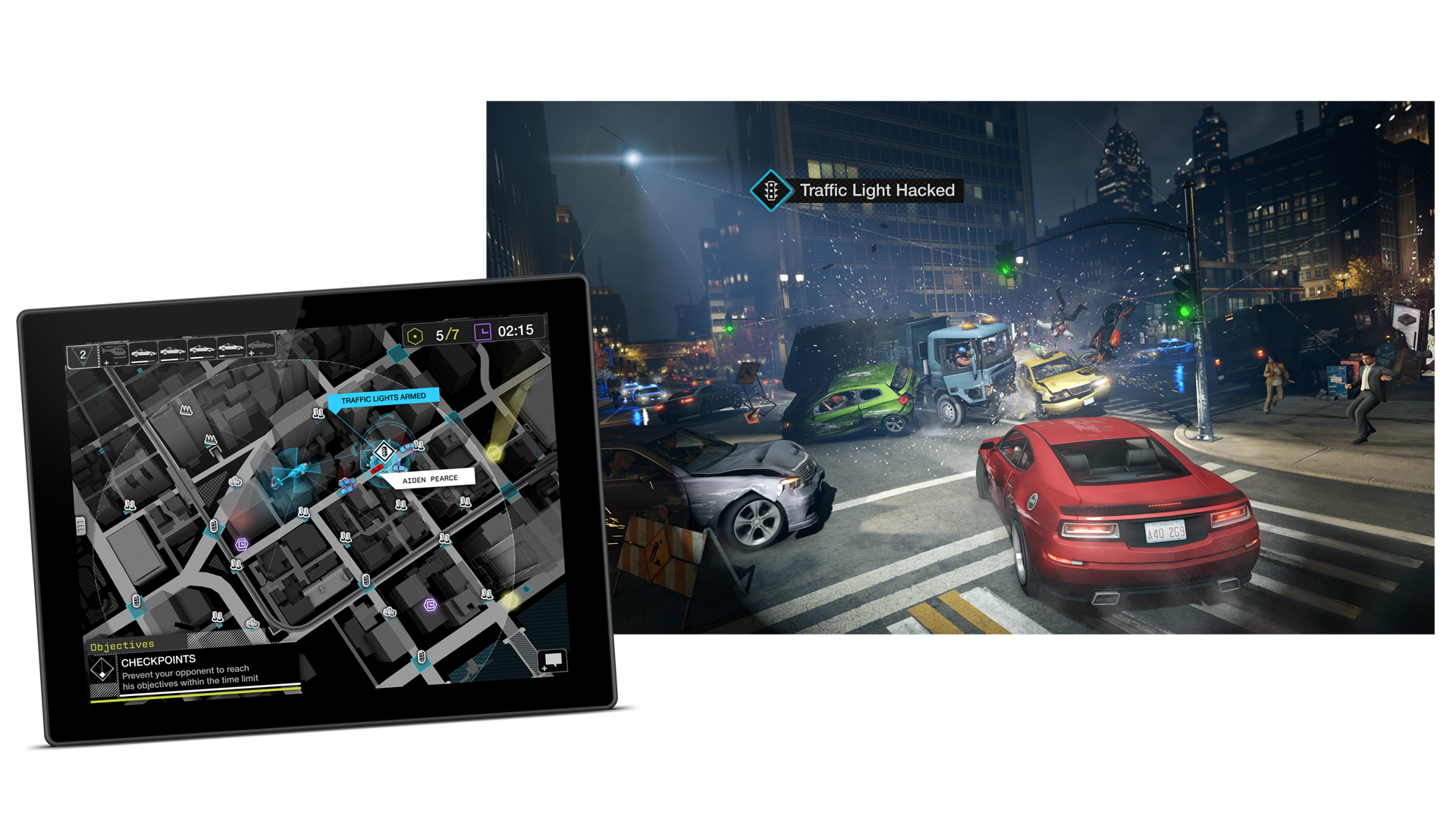
Watch Dogs has a serious companion app on iOS and Android, ctOS Mobile, which will enable mobile players to go head-to-head against console players. On your mobile device you’ll control city resources trying to stop console players from achieving their missions. It should be a great way to add enjoyment to the game and help get new players into the console or PC version.

Watch Dogs releases May 27 on Xbox 360, Xbox One, PS3, PS4, and PC, with a Wii U version promised for the fall. There will be DLC released for the game, and you can expect some serious marketing effort from Ubisoft. Will the game reach the sales heights Ubisoft is hoping for That remains to be seen, but the sheer scope and depth of the game, and the level of polish applied is impressive, and the gameplay is appealing. Introducing a new hit franchise is a daunting task these days, but if any game is up to the challenge Watch Dogs certainly is.

The Current-Gen Console Crisis

While the excitement and media attention has been focused on the next-gen consoles for the last six months, a crisis has been developing. Software sales for the PS3 and the Xbox 360 have been losing steam across the board for publishers. The arrival of Grand Theft Auto V and holiday releases masked the symptoms somewhat, but the numbers are clear enough. We’ve heard EA and Activision and Ubisoft say that current-gen sales haven’t met expectations over the last two quarters.

The usual course of events in the console business has been for older consoles to see prices reduced while new consoles move in at the high end. This entire console cycle, however, has been lengthened well beyond the usual five years to more than seven. As part of this stretch, and perhaps because the last console generation started out at fairly high prices, price reductions have been slow to arrive.

We did see a number of bundles over the holidays for the PS3 and the Xbox 360, but the focus seemed to be more about adding software than reducing the overall price. Generally $249 seems to be best pricing for an Xbox 360 or a PS3 with a hard drive (the flash-memory only versions can be found for $199), and there are still bundles at $299 and even $349. When the PS4 can be had for $399 and the Xbox One for $449, it’s no surprise that sales of older hardware haven’t been great.

Publishers have been pushing for price reductions on the Xbox 360 and the PS3, but Microsoft and Sony haven’t listened so far. Certainly there’s a reluctance to lower prices and give up profits for as long as possible, but the trend lines should have been clear enough by now. The larger consideration was probably the desire to make sure the next-gen consoles got off to a good start by pushing hardware purchasers toward them. Johnny or Janey wants a game console Well, this older one is $299, but for $399 or $449 we can get the latest on everybody is talking about. This logic drives the desire to keep current-gen console prices high.

However, the last few months of next-gen sales have demonstrated that there’s momentum for these new high-priced consoles. (Maybe not as much for Microsoft as the company would like, but that’s a separate issue.) As we get closer to the holidays, and more highly anticipated next-gen titles come out, sales should remain strong. Lower-priced current-gen consoles shouldn’t affect that, but can hopefully be used to expand the market.

Microsoft and Sony can’t afford to be leisurely about reducing prices on the Xbox 360 and the PS3. In previous console cycles, the competition came only from the Big Three console makers. Their pricing closely tracked each other. The competitive picture is rapidly changing, though.

The $99 console threat has already arrived in the form of the Amazon FireTV. Yes, it’s not going to appeal to people who already have consoles, but that’s not who it’s aimed at. Think of people who haven’t wanted to drop $300 on a console and $60 each for games. The FireTV offers gaming for $99 (OK, $139 with the controller) and games that are free or only a few dollars. This device is likely to be joined before the holidays by an Apple TV with games, and a Google Android TV box with games, in that same price range. Even Roku offers some games, and is likely to expand that list.

These are not undercapitalized competitors we’re talking about, either. Apple, Google and Amazon have huge clout, mountains of cash, and content ecosystems already up and well-populated with games and developers. When they get serious about $99 gaming boxes, they will be a formidable threat. The next-gen consoles will have a significant technical advancement to keep them selling, but already Amazon FireTV games look pretty much like Xbox 360 or PS3 games to a casual observer (which is the definition of the likely buyers in this price range). The Xbox 360 and the PS3 risk get squeezed out of the market.

The answer is simple: Drop the price of the Xbox 360 and the PS3. Put the digital memory versions at $99 or $129, and the 250GB hard drive versions at $199. Bundle in some games, too, to make it compelling and demonstrate the fun right away. Prepare a marketing campaign worthy of these devices, and one big enough to get into a slugging match with Amazon, Apple and Google.

If Sony and Microsoft are going to do something like this, E3 is the perfect time to announce it. Sure, they could wait until later in the summer, but major retail chains will be setting out their buying strategies based on what they see and hear at E3. If the PS3 and Xbox 360 don’t look competitive for the holidays, you won’t see a lot of shelf space allocated to them. It’s always harder to get retail attention the later it gets towards the holidays, so last-minute pushes by Sony or Microsoft will be less effective.

Winter is coming, and the $99 wildlings will try to come over the wall. Will the warring console houses be able to meet the threat from an unexpected direction This will be one of the things to watch at E3.