From Marketing Disaster To Success

Developing a multiplayer online game is a difficult task for a developer of any size, with many technical challenges to overcome. The marketing and PR task is also difficult, and many smaller developers don’t appreciate the difficulties involved — and often don’t have the necessary skills to handle the task. Hammerpoint Interactive encountered many of these marketing difficulties and more problems in the long process of turning a multiplayer game into a successful business.

Executive producer Sergey Titov

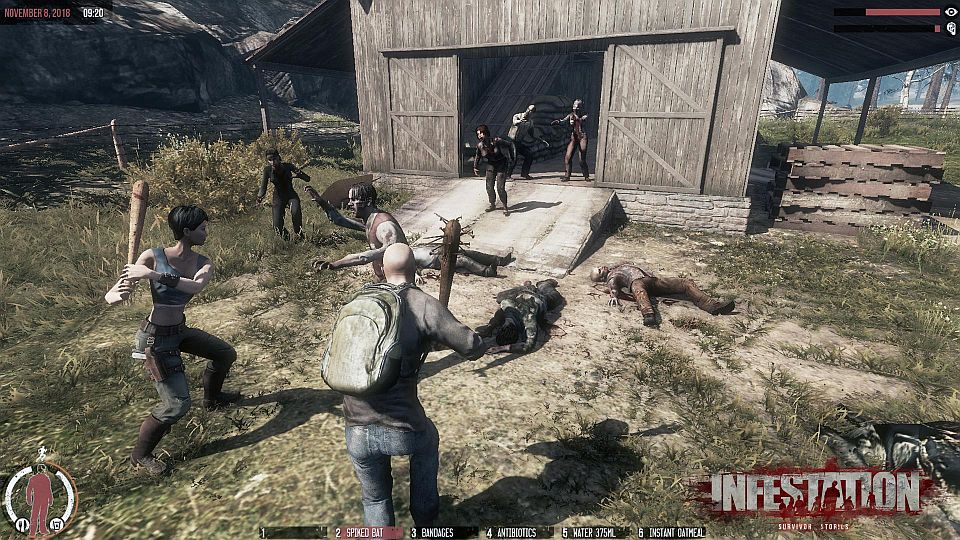
The [a]list daily spoke with executive producer Sergey Titov about the development of Infestation: Survivor Stories (formerly The War Z) and some of the lessons learned in the last two years. While the game had a rocky start, the picture looks pretty good at this point. “We have slightly over 2.5 million users in the game, I think it’s quite a good achievement for a small indie game,” said Titov. ” We have about 400,000 players every month, and 100,000 daily. The game is pretty healthy right now.” Getting there was not easy, Titov admits. “We had a weird ride which we didn’t anticipate,” he said.

Development of the game began in the second half of 2011, and Titov admits the design changed substantially along the way. “The game we planned back there wasn’t what we launched,” Titov said. In mid 2012 Day Z launched for Arma 2 and became hugely popular, and this inspired the Hammerpoint team. “What we did was the same thing Riot Games did with DOTA,” Titov said. “Riot took the MOBA and made it more accessible, more appealing to a broader audience.”

“While we didn’t exactly take the Day Z model for ours, our game was hugely inspired by it,” Titov said. But it wasn’t the same game by any means. “We had our own vision of what the game should be and how it should play. In some ways what we did was improved version of Day Z.” The big mistake Hammerpoint made was in naming the game, both from a legal standpoint and a marketing standpoint. “The name was one of the first mistakes, it was terribly chosen,” Titov admits. “We set up ourselves in the minds of consumers as Day Z copycat.”

Titov said the team was surprised by the excitement that the game generated. “When we announced the game, the response was huge. We never expected that level of response from press and consumers,” Titov said. They launched a closed alpha in mid-October of 2012, and by the time the game launched in mid-December they were already close to 800,000 copies sold. Then they ran into a problem with Steam. “What happened with Steam was totally our mistake. We took our description of the game from our web site, which was our road map, and put that on Steam. So the Steam store description was half features in the game and half the features that were going to be in the game,” said Titov. There was an uproar from fans who purchased the game based on the description and then found many of the features described weren’t implemented in the game, and the game was pulled from Steam as a consequence.

“From our perspective it wasn’t a big deal because Steam sales were about 20 percent of our sales, but for the media perspective it was ‘the game is launched, the game is pulled, the game is dead,” Titov said. Steam offered a conditional refund, and usually Steam doesn’t do that, Titov noted. He added that only a very small percentage of people actually requested the refund. In the end, after a few months of fixes and added features, the game was returned to Steam where it does well, but still less than half of the game’s overall revenue.

Early reviews of the game were caustic and critical, with reviewers who were enthusiastic about early alpha versions savaging the game upon its release. The controversy on Steam no doubt contributed to the reviewer’s impressions, and the lack of many promised features colored their outlook. The game also had a name change, when Hammerpoint’s trademark application for The War Z was determined by the USPTo to be too close to Paramount’s movie title World War Z. Hence the name change to Infestation: Survivor Stories, which Titov says is a better representation of the game anyway.
The entire process left Titov with some lessons learned. “I thought about that a lot, and there are lots of things I would do differently now,” Titov said. “I really don’t have that many regrets. If lots of those mistakes didn’t happened, we wouldn’t have learned.”

Titove has some advice for developers: Manage expectations, listen to the community, and build a robust infrastructure. “Manage the expectations of your communities. Don’t promise anything that’s not in your product right now,” Titvo said. “Even if you know that you will deliver the feature in six months, there will be lots of broken hearts in a month or two or three. Features that you promised even if you promise at a future date, they will be there tomorrow. If you promise you need to be very very clear.”

The second lesson is the importance of community.”We really had a very vocal and very harsh community towards us. If our community felt something was wrong, they never held back,” Titov said. “For us it’s a blessing. Listen to your community, because they are your biggest ally and your biggest marketing tool. We spent almost no dollars advertising the game, and hardly any money on PR. Most of our players are gained by word of mouth. Most of our players came to the game way after we got bad reviews, shitty Metacritic and after everybody hated us in the press. If people like what they see they will bring their friends.”

Last but not least, acknowledge your capabilities. “When we launched the game we had about 40,000 concurrent users in real time. That’s a pretty big number even for a larger company,” Titov noted. “During all that time we didn’t have any major downtime. We had little setbacks and we survived them. But the game was essentially up 24/7. Our whole infrastructure was managed by one IT guy.”

NPD: Hardware Strong, Software Down

Once again NPD has good news and bad news for the traditional video game business. Next-gen hardware sales continue to be strong, with hardware sales increasing 78 percent over March 2013. At the same time, software revenue dropped 27 percent over last year. If you add in PC software sales to portable and console software, the decline was even greater – 28 percent. Accessories climbed a mere 4 percent, leading to an overall rise in revenue of only 3 percent over last year for the combination of hardware, software, and accessories.

The PlayStation 4 and Xbox One drove the hardware sales increases. “Sales increases were driven completely by consoles sales, which were up over 100 percent, due mainly to continued success from the PS4 and Xbox One,” said NPD’s Liam Callahan. Despite the launch of Titanfall, the Xbox One was not the best-selling console. “In March 2014, Sony’s PS4 led hardware sales for the third month in a row,” said Callahan. Still, next-gen consoles continued to do better than their predecessors at a similar time from launch. “PS4 and Xbox One continue to see success with cumulative sales of the two consoles through the first five month currently totaling more than double that of their predecessors, the PS3 and Xbox 360,” noted Callahan.

The software side of the business showed continuing weakness, apparent merely by glancing at the list of the top ten best-selling software titles. Titanfall was #1, followed by InFamous: Second Son at #2, with both being next-gen software titles. The message is that current-gen software continues to lag. NPD puts the finger on a slow release schedule. “Software declines in March 2014 stemmed from poor comparisons to new launches from last March,” Callahan said. “Collectively, March 2014 launches sold 42 percent less than March 2013 launches. Last March we saw eight of the top ten games were new launches. This March saw six of the top ten games as new launches.” Still, Callahan noted this:“Year-over-year sales of every platform declined from March 2013, with the exception of the PS Vita which saw sales grow due to the release of Final Fantasy X/X-2 HD Remaster.”

There’s no sign of any revival in the Wii U’s fortunes, and the 3DS didn’t have much impact at retail either. Nintendo’s lower pricing for its top five 3DS titles surely must be taken as an indication that sales aren’t exactly breaking records. There’s no sign in general of any revival in current-gen software sales. Perhaps at E3 we will see some reasons to believe current-gen consoles might revive flagging sales, but for now it looks like consumers are squarely focused on the PS4 and the Xbox One when it comes to consoles.

March 2014 Top 10 Games (New Physical Retail only; across all platforms incl. PC)
1. Titanfall (XBO, PC)** Electronic Arts
2. inFAMOUS Second Son (PS4)** Sony
3. South Park: The Stick Of Truth (360, PS3, PC)** Ubisoft
4. Call Of Duty: Ghosts (360, PS4, PS3, XBO, NWU, PC)** Activision Blizzard
5. Dark Souls II (PS3, 360)** Namco Bandai Games
6. Metal Gear Solid V: Ground Zeroes (PS4, XBO, PS3, 360)Konami Digital Ent.
7. NBA 2K14 (360, PS4, PS3, XBO, PC)** Take 2 Interactive
8. Final Fantasy X/X-2 HD Remaster (PS3, PSV) Square Enix Inc
9. The LEGO Movie Videogame (360, PS3, 3DS, NWU, XBO, PS4, PSV) Warner Bros. Interactive
10. Minecraft (360) Microsoft

**(includes CE, GOTY editions, bundles, etc. but not those bundled with hardware)


Millennials Mixed On Ads

When it comes to digital ads in preference of traditional advertising, there is some preference, but not always the same effectiveness — at least, according to a poll from Adroit Digital.

The poll indicates that millennials have certain preferences when it comes to ads. With the January 2014 study, smartphone users were asked about what they like more — digital or traditional. 36 percent believe that digital ads are more effective, but 28 percent stated that they believe that they were both quite effective.

A different study from Goo Technologies (conducted by Harris Interactive) digs a little deeper, stating that, while digital ads are more influential, 18 to 34 year olds are more likely to ignore online ads, including banners and search engines, in favor of more traditional TV, radio and newspaper ads.

A majority of these users ignore banner ads altogether, while around two in five males and half of females don’t bother with social media or search engine ads.

Source: Emarketer

Core Gamers Take The March Spotlight

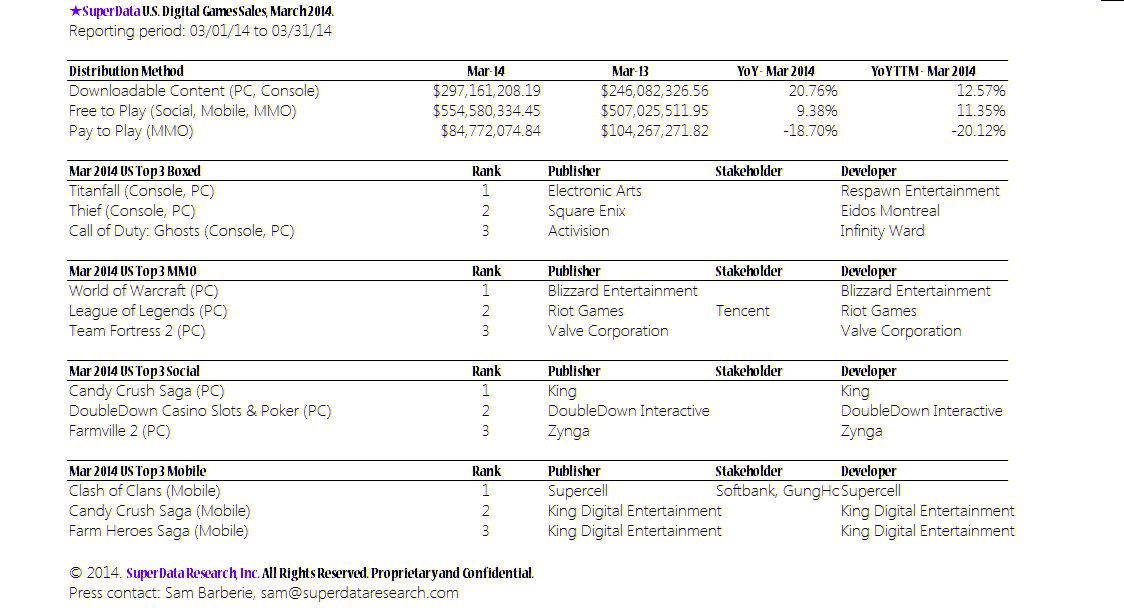
Core gamers are back in favor as publishers roll out next-gen titles for $936 million digital games market. This analysis comes from SuperData CEO, Joost van Dreunen:

Core gamers are once again becoming the industry focus as social and mobile game platforms soften and saturate.
Several key releases on digital console and in the free-to-play category suggests a re-engagement of publishers with traditional core gamers. After a period in which casual gamers on social and mobile platforms were all that mattered, the traditional gaming experience returns with publishers seeking to stake their claim at the beginning of the new console cycle.

The digital games market continues to grow, reaching $936 million in total sales in March, up 9 percent year-over-year. Saturation and increasing marketing expense on mobile and social platforms level the digital playing field for incumbent publishers. Titles like Titanfall, Hearthstone and Heroes of the Storm target traditional gamer audiences, as Zynga and King struggle to repeat their initial success with casual audiences.

Activision/Blizzard readies a new volley of branded blockbusters.
After a successful launch on PC and Mac, Activision released Hearthstone in select markets on iPad. In Australia, Canada and New Zealand, all three key test markets before its release in the U.S., the game quickly managed to break into the top fifteen of grossing titles. Overall, the digital collectible card market shows both strong adoption and retention among gamers, with a 12 percent conversion to spending and an average revenue per paying player around $27 in the United States. As its second card game spin-off of its World of Warcraft franchise, Hearthstone is in a much better position to both appeal to existing and new players on digital platforms.

At the same time, Blizzard Entertainment is building the buzz around Heroes of the Storm, its much-anticipated MOBA title featuring characters from across its various franchises. The game is not out yet (and is, in fact, becoming notorious for its tardiness), but the announcement of its Tech Alpha to test out the game’s infrastructure suggests it is getting ready for showtime. Provided its release date falls within 2014 or even early 2015, Heroes of the Storm might prove a capable contender, competing with incumbents DotA2 (Valve) and League of Legends (Riot), and claim a piece of the global $2 billion dollar worldwide market for MOBA games.

Zynga is starting to fall behind, struggling to monetize on par with the big boys.
Earlier we observed an improvement in user spending as a result of the user shake out on social gaming platforms. Consistent with this, we recorded another month-over-month increase in conversion, reaching 2.3 percent in March, up from 1.9 percent just six months ago. Despite this market improvement category leader Zynga has yet to show comparable results, and reported a conversion rate of 1.7 percent in its most recent earnings reports. Efforts to stem the tide by focusing more aggressively on the highly-monetizing social casino category has so far failed to deliver. Across its social casino titles Zynga currently earns about $0.13 per daily active user, compared to the $0.17 minimum of its closest competitors in the space.

King’s second act is under close scrutiny, as their key franchise tops out.
After a souring IPO, King continues to be under close watch by shareholders and publishers alike. Despite heavy scrutiny, the company’s core franchise Candy Crush Saga showed a 1.2 percent improvement in overall spending month-over-month. In terms of monthly active users the game shows signs of saturation: after a period of continued growth, its mobile audience held steady in March with marginal growth (+0.3 percent) and a 2.1 percent decline among social players. Likely, the firm is preparing a takeover bid to maintain its momentum and reduce imminent churn. Meanwhile, King’s rival Supercell released Boom Beach late-March and managed to shoot up in the rankings, driven largely by the company’s strong cross-promotion among its Clash of Clans player base.

Titanfall refreshes digital PC and console offerings.
After several months of Call of Duty (Activision), Assassin’s Creed: Black Flag (Ubisoft) and Grand Theft Auto V (TakeTwo Interactive) dominating the charts, EA’s innovative first-person shooter breaks the chain. Launching on both PC and Xbox One, Titanfall (Respawn Entertainment/Electronic Arts) offers a fast-paced sci-fi shooter experience where players alternate between agile game play as soldiers or powerful titans pilots. Seated precisely between the traditional first person shooter genre and the recently emerged “mech” genre, Titanfall is exclusive to Microsoft platforms (the Xbox One, Xbox 360 and Windows PC). In the U.S., one in four gamers who also regularly purchase additional digital content prefer first person shooters, making it the top ranked genre on digital console. Overall, the digital console and PC category increased two percent, month-over-month.

‘World of Tanks’ Reinvents For Growth

Wargaming’s World of Tanks MMO is already immensely popular, with over 75 million users registered worldwide and concurrent players peaking at over 1 million. The company is not resting on its laurels, though, and it plans a series of significant updates to the game this year, with far-reaching implications for the players. The [a]list daily spoke with North American World of Tanks producer Joshua Morris about the changes.

The first and most obvious change, being introduced this week through the 9.0 patch, will be new, higher polygon count tank models. The game has over 200 tanks available, so this won’t happen all at once, said Morris. This first patch will introduce a dozen of the most popular tanks in higher resolution models. “You’ll be able to see the rifling inside the gun barrels,” said Morris. There will also be improvements to the texture maps both for the new high-polygon models and the old models. The game will also see the addition of weather that will significantly impact gameplay. “Wait until you try to fight a battle in a snowstorm, at night,” said Morris.

The improvement in appearance is coupled with the addition of the Havok physics engine, which will make destruction of buildings and tanks much more precise. Tank turrets are separate objects, for instance, and when you blow up a tank you’ll see the turret spinning skywards sometimes. In one test match, Morris recounts, they watched a turret fly up and land on another tank, destroying it.

The physics modeling changes the impact of terrain on the game. Previously a building was either whole or wrecked, but now buildings can be completely destroyed — which removes them as cover. High explosive rounds can blow up buildings, while armor-piercing rounds will probably go right through. Even the shells themselves are modeled with the physics engine.

While the introduction of the physics model will certainly change the game play, the biggest changes Wargaming has planned this year are new game modes. First up is a historical battle mode, where players can experience the pivotal tank battle of Kursk or the Ardennes. Adding in historical battles wasn’t easy, Morris observed. “The main problem was good vehicle matchmaking” and finding the right balance between historical facts and fun game play. Wargaming had to change vehicle specs for this mode, including things like hit points, in order to provide a good game balance. Historically, air power, artillery and infantry were major factors in tank battles, and of course World of Tanks has none of those factors. Hence the need to change tank specs and add in respawning to the historical battle mode.

Update 9.0 will have three historical battles included, and subsequent updates will have new historical battles added. These will be phased in and out of the rotation in order to keep the game fresh, so you’re not endlessly re-fighting the battle at Kursk. Aside from historical battles, team battle will also be improved to support long-term teams, with many rule tweaks and updates. “We’re going to soften some of the edges to make it more appealing to the U.S. market,” said Morris. That includes interface changes and things like respawns in historical battle mode and the new garage battle mode.

The most important new mode coming this year is what Morris calls “‘Clash of Clans‘ for World of Tanks.” As Morris explains it, clans can stake out an area of territory and fortify it (what they call Strongholds). There’s a new currency of resources, which you use to build up an area. You get resources from developing an area, and also from fighting other clans — and scavenging from their territory. Players will be able to do things like call in air strikes or artillery, create pillboxes or lay down minefields. There’s going to be a lot of revenge going on as clans build up their Strongholds and watch them get trashed by opponents.

Most importantly, players will be able to join clans and begin this process right away, without having to wait until they get to high rank. This will get players into group play more quickly and help them stay engaged longer, Morris believes. Clans will be able to set up specific times when they will be available for battle, making scheduling easier for the members. Of course, you’ll be able to spend real money to help improve Strongholds, as well as using the resources you earn or acquire within the game.

Wargaming understands that there’s competition for players. “We welcome that competition,” said Morris. Adding new features to make the game more social (such as full Twitch integration) will be a critical part of the outreach effort. Marketing a massively multiplayer online game isn’t just about reaching a single player — you need to convince groups of friends to leave their current online games and try out yours collectively. The new features for World of Tanks, especially the Clan battles, look like they will be an effective marketing tool for the game.

Mobile Games Make Money For Many

Investors and game companies alike regularly question whether the mobile games space is dominated by one hit wonders. SuperCell, King and Kabam are proving this is certainly not the case. With a series of new games launched by these games-as-a-service specialists, the top 10 grossing games ranking in most countries is increasingly dominated by the big three.

Candy Crush Saga seems not to be cannibalized by King’s other titles as its revenues continue to rise while their latest games added tens of millions of dollars last March alone. This is quite surprising, considering the fact that 48 percent of mobile Candy Crush Saga players has also played at least one of Kings’ other mobile titles in the past few months. King’s strategy has always been to perfect their titles and gather huge communities on social and casual platforms before releasing to mobile. Using our latest franchise product, we can see that the PC remains the most popular platform on which the majority of King’s title are played, with only Candy Crush Saga being played more on the smartphone. This is likely because Candy Crush Saga has been available on mobile for a longer period of time, and we expect the other titles to follow the same trend in the coming months.

Farm Heroes Saga is King’s second best performing game, taking 6th and 7th place in the global grossing iOS and GooglePlay charts respectively. If this game continues to perform well it could add another $250 million to King’s revenues this year. Slightly more than half of mobile Farm Heroes Saga players, 53 percent, also play Candy Crush Saga.

SuperCell’s Boom Beach, launched globally mid-March, is expected to join Clash of Clans and Hay Day in the top 10 grossing list of many countries in our next monthly report. Its revenues are currently ramping up to more than half a million dollars a day.

Mobile gaming has the longest tail of any game platform
Even with such dominant players, the long tail remains the most attractive of any platform for game developers. Based on revenues generated in US appstores alone, 247 different game publishers made more than $1,000,000 last year, after deduction of the appstore fee of 30 percent. Of course, it is fair to mention the fact that the total number of developers targeting smartphones and tablets is much larger than relatively closed platforms such as consoles.

In the US, the top 10 grossing games take 25 percent (iPhone) to 36 percent (iPad) of revenues grossed by the top 1,000 games. For GooglePlay this share is 27 percent. In general, the U.S. has a relatively long tail while on the high side are the iPhone in Spain (59 percent), Brazil (55 percent), China (54 percent) and Korea (54 percent).

Empire: Four Kingdoms conquers Europe, Bingo games take the U.S. by storm
One of the most notable newcomers in the games rankings is Empire: Four Kingdoms from German publisher GoodGames. Their latest title entered the top 10 in most European countries last month across the iOS and GooglePlay stores. Actually, the majority of its several million dollars generated in March were through GooglePlay. The launch of Empire: Four Kingdoms was supported by an impressive TV campaign in key European territories with March revenues placing the German publisher in the global top 20 grossing publishers. Empire: Four Kingdoms is another example of a “mid-core” game that monetizes very well.

At the same time, social casino games are performing better than ever, particularly on the iPad in the U.S. Four out of ten top grossing games are bingo and social casino games published by DoubleDown, BigFish, GSN and BitRhymes. This likely relates to the changing demographic profile of typical iOS versus GooglePlay players, as more and more Android devices are attracting early adopters with a younger demographic that is not drawn to social casino style games as much. 

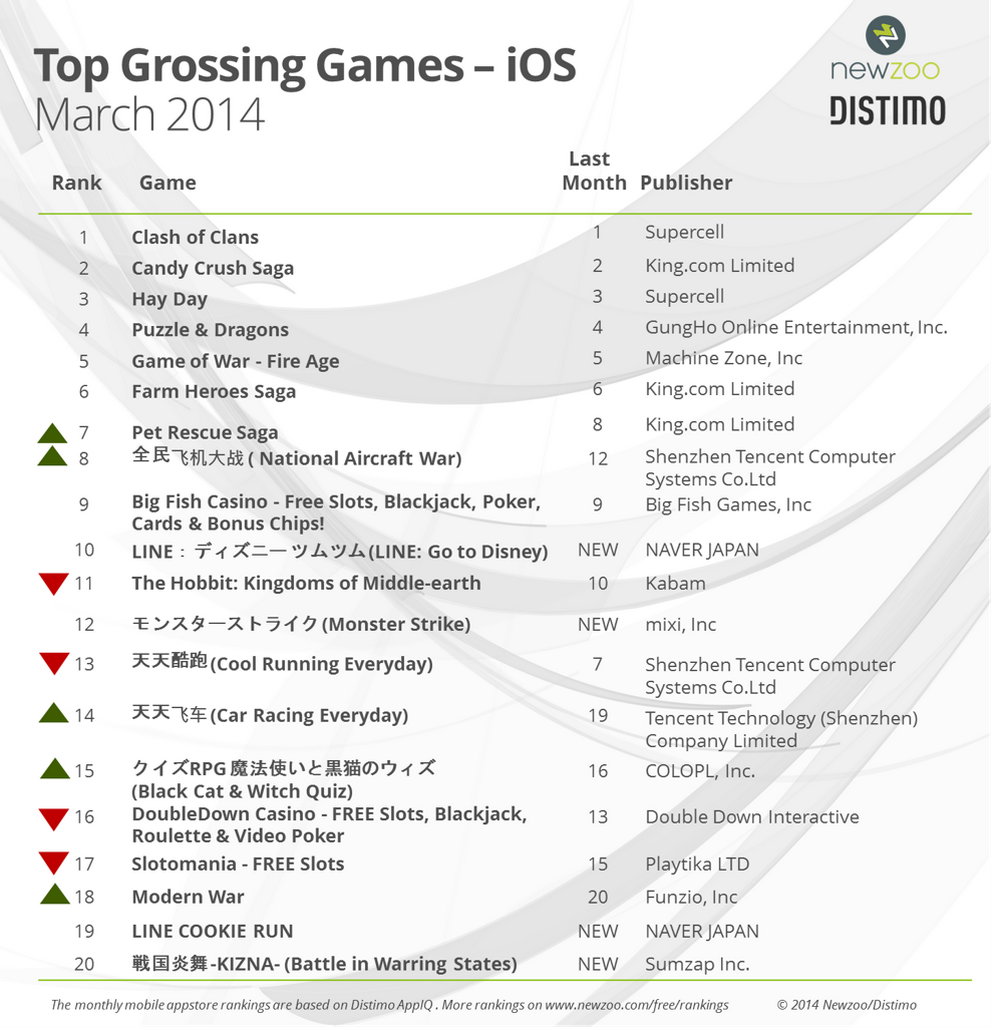
Monthly Top 20 Mobile Games — iOS
The top 6 games remained unchanged this month with Clash of Clans, Candy Crush Saga and Hay Day still topping the charts. Both King.com, with three of their Saga tiles, and Supercell have three games in the top 20 grossing iOS games.

This month there are four new entries: Line: Go to Disney by Naver Japan at position number 10, Monster Strike by mixi, Inc at position number 12, Line Cookie Run by Naver Japan at position number 19 and Battle in Warring States by Sumzap Inc. at position number 20. Notably, Minecraft – Pocket Edition (Mojang ) and The Simpsons: Tapped Out (Electronic Arts) dropped out of the top 20.  

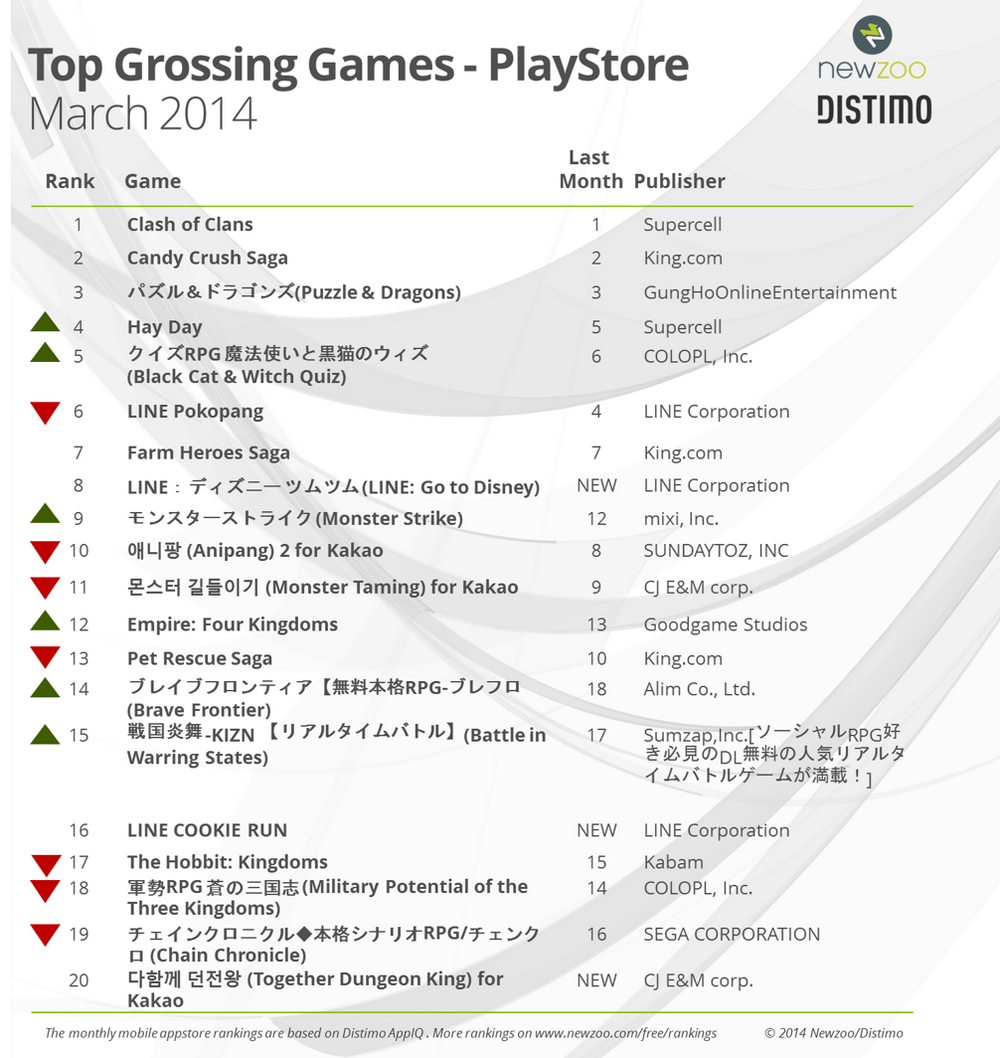
Monthly Top 20 Mobile Games — Playstore
The top 3 games remained unchanged this month with Clash of Clans, Candy Crush Saga and Puzzle & Dragons holding onto the top spots. Both Hay Day and Black Cat & Witch Quiz jumped a spot in the ranking to numbers 4 and 5 respectively — at the expense of Line Pokopang which dropped from position number 4 to 6.

There are four new entries this month including Line: Go to Disney which debuted at number 10 and Monster Strike which debuted at position 12. The following games dropped out of the top 20: Dragon Quest Monsters Castle Clash and Professional Baseball Pride. 

Monthly Top 20 Mobile Publishers — iOS
The top 10 publishers hardly changed this month with the first 9 positions remaining the same. Colopl, Inc. climbed one place to number 10 pushing Gameloft down a spot. King.com is still topping the charts and Supercell is taking second place followed by EA. There are no new publishers entering the top 20 this month.

Namco Bandai Games Inc. made the biggest jump in the chart climbing 6 spots to number 12. Zynga climbed two spots and is now at number 17. Square Enix Inc. made the biggest drop in the chart, falling 8 places to number 20. Due to the continuing success of Game of War — Fire Age, Machine Zone, Inc kept the number 7 position despite having no other games in top 1,000 grossing games. 

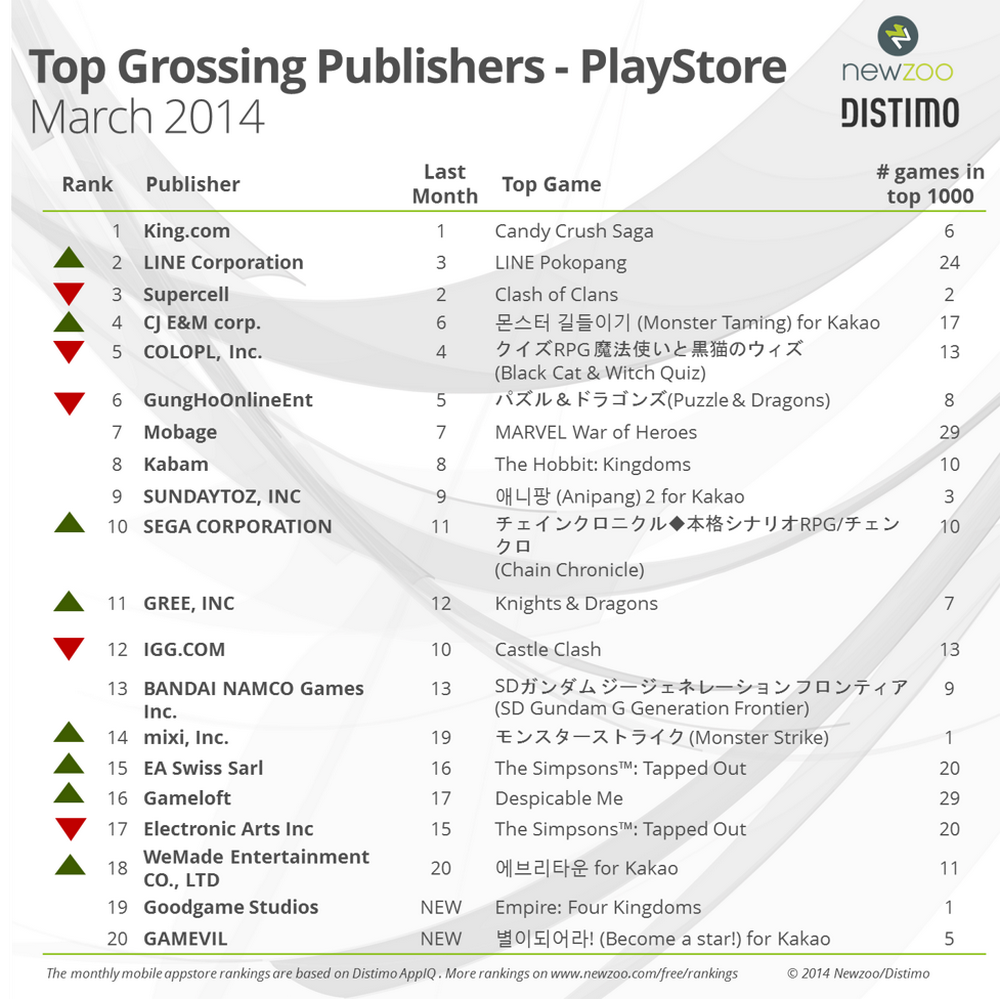
Monthly Top 20 Mobile Publishers — Playstore
Compared to the iOS store a lot changed in the Playstore top 20 publishers this month — but King.com remain at number 1. Line Corporation and Supercell swapped positions with the latter now at number 3 in the charts.

CJ E&M corp. climbed two spots to number 4 while mixi, Inc climbed 5 spots to number 9. The success of mixi, Inc can largely be contributed to Monster Strike which entered the top 20 grossing Playstore games at position number 12.

There are two new entries this month, Goodgame studios at position 19 due to the success of their only game in the top 1,000 grossing games Empire: Four Kingdoms and Gamevil at number 20. Square Enix (14th last month) and Social Quantum (18th last month) dropped out of the top 20 publishers.

Azubu Reborn For Premium eSports

Azubu is a global broadcast network that focuses on streaming eSports action, programming, news and analysis. The network was founded in 2012 to capitalize on the rapid growth of eSports, and earlier this year Azubu announced a $34.5 million funding round from Sapinda Group, an international investment firm. Azubu has embarked on a total transformation of the site, its technology and the company with that investment, and the [a]list daily caught up with Azubu CEO Ian Sharpe to discuss Azubu’s progress. The new version of Azubu’s web site is relaunching soon with a new interface, new technology and new talent, and Sharpe gives us some insight into Azubu’s vision for eSports.

Azubu CEO Ian Sharpe

Azubu’s transformation results from a recognition of eSports’ potential by investors outside of the gaming market. “The starting point is Sapinda Investment Group,” said Sharpe. “They’re involved in agriculture, mining, they’re involved anywhere they think there is investment to be placed in something that has a huge potential to change people’s lives. There is a keen belief and a generational commitment to the future of eSports. The reason I was excited to helm this project is that they recognize that eSports has reached a tipping point.”

That tipping point has been fueled by many things, Sharpe believes. The technology for streaming, the trail blazed by Twitch and others, the changing attitudes of publishers towards eSports, and of course it was all “accelerated by the fantastic success of Riot Games,” Sharpe notes. “Much more than any other publisher they have willed this space into existence.”

Azubu is headquartered in Los Angeles, and has established offices in Vancouver, Seoul, and Berlin. Sharpe feels that Azubu needs a worldwide presence to capitalize on the worldwide popularity of eSports as it transitions into a huge industry. The pattern is akin to the way professional sports became huge on the strength of broadcast TV starting in the 1960’s, according to Sharpe. “We all think we’re about to see that in eSports,” said Sharpe. “eSports has been middling along for 10 years now. The technology, the attitude of publishers, the catapulting to stardom enhanced by Riot, all of those things have set up eSports for pre-eminence of the world stage. We now have an opportunity with Azubu 2.0 to create a premium eSports platform, a network that broadcasts the very best talent, leagues, competitive gaming activity to a global audience.”

Azubu plans to set itself apart from other ways to stream eSports with technology and premium content. On the technology side, Azubu has teamed up with a leading company experienced with providing content. “We have a strategic alliance with Brightcove,” Sharpe said. “They power all sorts of solutions like ESPN’s mobile solution, Rogers, Time-Warner, Macys and provision of video around those big brands. They really are a global powerhouse with 400 engineers devoted to making the best possible video experience that there is. They see as well that there is a phenomenon here, and they have a strategic alliance with us to build out a technology road map and a feature set that is custom designed to our broadcast.”

The talent side is just as important as the technology. “We are a premium network that is talent first,” said Sharpe. “We have designed our road map hand-in-hand with the broadcasters and the eSports talent that are going to be using it and watching it. We know what Riot Games wants for their perfect player for their fans and the huge fan base that they have.” Sharpe also notes the global reach of their streaming. “We don’t lag outside of North America,” Sharpe said. “We can broadcast effectively into Australia, Brazil, China and more places. In effect, we can create the modern version of the medieval Silk Road where the cross-fertilization and trade between East and West was lucrative, we can recreate that on a global eSports basis.”

Azubu plans to work with brands. “It’s important to recognize we want to create an experience with our brand partners,” said Sharpe. “If you think about the life journey of the young Tiger Woods, his upward trajectory from a young age was such that ‘if I attach my brand to this guy I’m attaching my brand to his triumph, his emotional highs.’ That’s a great thing for brands to be associated with. If you want to attach yourself to a role model who is winning, who is showing what good competition looks like, Azubu can help with that and deliver a window to that world. We can broadcast that triumph and associate your brand with it.”

The comprehensive offering by Azubu provides a great value to brands, in Sharpe’s view. “If you get an endorsement by a talented member of the community, that endorsement resonates with the captive audience that we have,” Sharpe noted. “If you think about Azubu providing the streaming platform, when you go to an ad break the very same guys who are winning the trophies are endorsing your particular product straight to an audience that is lapping up all of this activity. Not only that, the way our technology works there’s all manner of calls to action within the video player, you can not only capitalize on awareness but deliver more than intent to purchase, deliver actual purchase. All of those things come together very well within Azubu. We can deliver a unique combination of talent, brand and platform that will really help our brand partners have effective campaigns.”

The future looks like a broad landscape to Azubu, not only in terms of its global reach but in the breadth of platforms for streaming eSports. Sharpe wants to make eSports accessible to everyone. “We talk about leaving no screen behind,” said Sharpe. “People watch things at all times and places, and it’s very important that we can deliver whatever they are passionate about straight to their eyeballs.”

“One of the things we’re seeing universally is people playing on a variety of different devices,” Sharpe said. “We hear huge amounts of buzz on Blizzard’s Hearthstone game coming out on PC and coming to iPad soon. That’s an exciting thing. There’s an explosion of MOBAs and related games with everyone attempting to capitalize on the success of League of Legends, there are a range of games and IPs that are coming into this space.”

“Not all of those will succeed,” Sharpe continued. “Some of them will be classics, some of them will last for a long time, and some of them will fizzle without an audience. Some of them will be undiscovered games. I’d like to find some of those undiscovered gems, shine a spotlight on them and help give them the plaudits that they deserve. There’s a lot of great potential here, there’s a lot of people are interested in the scene. Talent is helping make or break new games with their endorsement or with their pure enthusiasm. If you can get the right talent, the right broadcaster, the right format of content and get that working in favor of your game, then you can build an audience on the back of that advocacy.”

The Next Billion Dollar Game

Game publishers large and small have a dream of creating the next billion-dollar game franchise. There have been a few in the industry’s history, and it’s still a rare achievement despite the overall growth (it’s becoming a $100 billion annual business). While many of the factors that created billion-dollar game franchises in the past are still true, the changes in the industry have made some significant changes. If you’re hoping to create a new billion-dollar game franchise, here’s some of the key issues to consider.

Find a broad concept, or core elements of the game that can be extended, enhanced, and iterated easily. Sure, maybe your game is a simple platformer with a running and jumping character, but if the character is interesting enough the future could be bright. See Mario for inspiration, as he’s been in dozens of games and responsible for billions in revenues. Most game concepts can be extended if there’s an enthusiastic audience, but a little thought about line extension when you’re designing the core may pay off big later.

Go global with your concept, and choose something that can be appealing around the world. A dating sim may do well in Japan, but it won’t sell in North America. Word games are popular in English, but good luck getting traction in Asia. FIFA is ultimately a game franchise with more potential than Madden because soccer is popular around the world. The potential audience for a game is now the entire world, not just a narrow demographic in one country. How broad is the audience potential for your game Can you expand it

Put your game on as many platforms as possible— ‘no screen left behind’ should be your battle cry. This is much more possible today than it was ten or twenty years ago, as the overall power of PCs, consoles, online and mobile hardware has increased tremendously. Most styles of game play and graphics are perfectly doable on any platform, though the interface may be an issue. Stop thinking of your game in terms of one platform, because the era of proprietary hardware is over. Yes, it’s possible to be a huge hit on one platform, but if your game isn’t tied to a unique set of hardware characteristics your revenue possibilities are much greater. Angry Birds continues to be a strong moneymaker even though it’s not in the top ten mobile games, partly because it’s available so broadly.

Not all billions are the same. This one’s worth a few cents.

Don’t limit your revenue possibilities by having just one fixed price. Make sure there are virtual goods for sale, as seamlessly as possible, to maximize revenue. If someone becomes a devoted fan of your game, give them plenty of ways to spend more money. League of Legends shows you can do this without getting people annoyed. Whether or not the game is free to start with, selling virtual items is becoming a common game feature on every platform.

Strive to provide continuous content for the game, whether it’s new items appearing, DLC for sale, or entirely new games based on the core concept. Fans that aren’t being given new stuff will look elsewhere for gaming enjoyment, and your franchise may not get them back.

Make sure you have massive community involvement, and you provide strong support from the company. Consumers want to be engaged at all levels, not just during game play. You’ll also find some great suggestions and ideas for new directions amongst an active community.

Don’t be afraid to make significant changes if it seems necessary. Fearless re-invention can revive a languishing franchise. Take some chances, go in an unexpected direction, surprise the players —especially if you see the business slowing down or the audience diminishing.

The best games are more than just a game, so comprehensive brand management should include other products, goods and services. Some companies are making a substantial amount of revenue from licensing game characters. Other games are benefiting from strong promotional tie-ins with major consumer brands eager to get the attention of devoted gamers. Look for that television series, the novels, the comic books, the action figures, apparel and accessories. Sure, many of these opportunities will only appear after the game is already a hit, but the right tie-ins can help propel a game farther and higher at any stage in its life cycle.

Persistence is the foundation of success. Rovio had fifty-two games that didn’t do all that well before they created Angry Birds. Both Wargaming and King were in business for ten years before they had a massive hit game. Call of Duty started out as just another console game from Activision, but over time they built it into a juggernaut. The biggest franchises in the game industry sometimes start small, and sometimes they are a hit from the beginning, but if they succeed over many years it’s because someone kept pushing to make the game better, come out with new games, or extend the brand in many ways. Don’t stop believing in the power of your game!

Extending Mobile Game Success

Mobile games are continuing their astonishing growth, but the paths to success are getting harder to navigate. One of the ways is to extend an existing brand, but how Swedish game developer MAG Interactive is trying just that, and the [a]list daily caught up with CEO and founder Daniel Hasselberg to talk about how the company will grow by extension.

MAG Interactive starting developing apps when the App Store opened, but was doing it under contract to other companies. It wasn’t until 2012 that MAG released its own game, Ruzzle, to great success. Ruzzle is a word game where players compete against each other to form words under a time limit. Ruzzle was a smash hit, and eventually rose to the top ten list in 148 countries, and now has 50 million users. MAG Interactive also launched a quiz game, Quizcross, which has been on the top ten list for trivia games in over 50 countries.

CEO Daniel Hasselberg

MAG Interactive decided that while playing against your friends is fun, it’s also limiting. You have to have friends available and willing to play and be connected, and sometimes that’s just not possible. “Sometimes you want to play against your friends, but sometimes you just want that single-player experience,” said Hasselberg. The answer is Ruzzle Adventure, a level-based game with several worlds where you need to succeed to make progress in the game. “Some are more strategic, you need to find the right words at the right time, and some are similar to the classic Ruzzle which is time based,” Hasselberg noted. Social aspects are kept active through leaderboards, so you can compete with your firends.Â

Creating Ruzzle Adventure was a bigger project than Ruzzle for MAG Interactive. “The scope of this game is much more ambitious,” Hasselberg explained. “When we started out Ruzzle we were seven guys and now we’re 30. You need to produce much more content when it’s a single-player game, so the scope is much more ambitious.”

The reason MAG Interactive was willing to go to the additional effort is simple: Brand. “We try to work with the same brand, and build really strong brands. It’s a challenge to make some kind of hit machine,” said Hasselberg. “We want to build a really strong brand around Ruzzle, and associate really great games with the Ruzzle brand. We have already more than 50 million people who have played Ruzzle and enjoy it. Our strategy is to have all the existing players discover this game and enjoy it, because it’s a similar game.” Ruzzle Adventure is currently undergoing a soft launch in Sweden, and the early results are encouraging. “What we’ve seen in Sweden is people keep playing Ruzzle, it’s a complement rather than a supplement,” said Hasselberg.

Ruzzle stands out from other word games because it’s not just in English. “Supporting different languages makes people hesitate when they think about doing word games internationally,” said Hasselberg. “Not only finding good dictionaries, but in making the board fun to play. Currently in Ruzzle we support 13 different languages. That’s a continuous process, we’re going to be adding more languages.”

Ruzzle Adventure

“I think that’s been one of the major keys to our success with Ruzzle,” Hasselberg continued. “There are not too many great word games in languages other than English. We built up a player base that was almost entirely European, 10 million in the first, year, and then it took off in the U.S. We got over 25 million downloads in the U.S. last year.”

The monetization differs between the two titles. “Ruzzle is a combo of purchase and advertising. The free version is ad-supported, and the paid version you can see your statistics,” said Hasselberg. Ruzzle Adventure is not ad-supported, instead it’s a classic F2P game. “It’s easier to offer boosters in a single-player game,” noted Hasselberg.

Hasselberg continues to see strong market opportunities ahead for mobile games. “In the Western world it’s more saturated when it comes to smartphones, but there are big upsides still in many countries,” Hasselberg said. He does acknowledge that most of the growth in smartphones is in Asia, “which doesn’t make much sense for us” given the nature of Asian languages and the difficulties of word games. “Our focus is still in the Americas and Europe,” said Hasselberg. That’s been very good to MAG Interactive, especially with their willingness to translate Ruzzle into many languages. “We reached over 40% of the smartphones in Italy, with 10 million downloads,” Hasselberg said “There are enough smartphones out there to be a fantastic market.”

So far with Ruzzle Adventure‘s soft launch in Sweden the game has been helping the original Ruzzle as well. “We’ve seen some pickup on the download side but even more on the engagement side,” Hasselberg noted. “Awareness is increasing. That’s the beautiful thing around building a brand, you can strengthen several products.”

Warming Up To Amazon FireTV

The Amazon FireTV is device for streaming movies, TV shows and music to your TV, functions that devices like the Roku products, AppleTV, and every game console can do. Unlike the AppleTV, and to a much greater extent than the Roku devices, the FireTV also has a substantial and growing game library. While the $99 FireTV doesn’t come with a game controller, the Fire Gaming Controller is only $39.99, which includes the $6.99 value Sev Zero exclusive game and $10 worth of Amazon credits to buy other games.

The hardware is beautifully simple, and the presentation is top-notch, from the packaging to the look and feel of the hardware to the polish and speed of the interface. Amazon was clearly trying to be premium in every phase, and succeeded. The interface is simple and fast, and the instant play feature seems almost magical. You see a movie you want to watch, select it and it’s playing (at least if it’s on Amazon). Eliminating the buffering time isn’t a huge thing, but it’s the kind of detail that makes you more satisfied with your purchase.

“We write the press release first, then design the hardware.”

The [a]list daily sat down with the FireTV and Amazon’s VP of games Mike Frazzini, as well as senior game design manager Ian Vogel, to discuss the FireTV and Amazon’s commitment to games.

Mike Frazzini has been at Amazon almost ten years, and with games since 2009. He’s proud of the device they’ve created. “There’s no other product that gives you all of that entertainment at that price point,” Frazzini said. “You can use the analogy of a smartphone or a tablet because they wanted to do email or read, and lo and behold they play a lot of games, too. We expect some customers to end up playing games even though that might not have been the primary reason they bought it, and we think a lot of other customers will buy it to play games and then do some of those other things too.”

The FireTV has a number of compelling features, like the voice search, the array of streaming services from Netflix to Pandora and more, Amazon FreeTime for parental controls, and integration with Amazon Cloud Drive for acess to your photos and home movies. “We write the press release first, then design the hardware,” said Frazzini. In other words, Amazon looked at the competition and picked out some key features to include with the FireTV, and made sure those features were solid.

While Amazon is producing its own games through Amazon Game Studios, the company is also working with major publishers and independent developers to bring games to the FireTV. “We also have Game Services, where we’re building cloud infrastructure services for game developers. Through AWS those services work across platforms,” Frazzini noted. “We’ve had the game studios for a couple of years, and just within the last year or so we’ve significantly increased our investment. Double Helix you saw, and we’ve hired people from the game industry who’ve bult some of the best games ever made. Ian worked on BioShock and Age of Empires, Clint [Hocking] and Kim [Swift] have done some great games, we’ve also got people who worked on games like Left 4 Dead and Forza. We certainly take games seriously within Amazon.”

Vogel believes the FireTV has something special that other devices don’t have. “We’ve got games from Telltale, Double Fine, from Mojang, from Frogmind, and they’re great games,” Vogel noted. Amazon Game Studios is organizing developments teams in smaller groups, they’re fifteen to thirty people. They might work for less than a year to up to eighteen months on a game. “We can do something really special at Amazon when you think about the cloud infrastructure and the devices,” Vogel said. Frazzini sees this as filling the big gap in the middle of the game market between simple mobile games and AAA console games, where “games are artistic, have a lot of soul and character, and that’s the type of game we’re working on.”

Who is the target audience Amazon is happy to get anyone on board, though anyone who already has a steaming device (which of course includes game consoles) is going to replace that device with a FireTV. What Amazon has done, though is provide a compelling device for anyone who’s interesting in streaming content (movies, music, TV shows) and/or playing games for a low cost with high quality.

Parents with kids are going to be an important market. The FireTV is likely the least expensive way to get a Minecraft experience for your kids, if you already have a TV. Kids will recognize and enjoy many of the games already on the FireTV, and the price of the games (averaging $1.85 for paid ones, and over a thousand free ones).

When parents go shopping this fall for that Christmas hardware purchase, the FireTV should be a strong consideration. The FireTV is a real threat to low-end consoles, and as time passes and the game library increases in size this will only be more true. Sure, an Xbox 360 or a PS3 or a Wii has plenty of great games, but they all cost at least $10 or $20 even when you buy them used, much less the new games for $60. High quality free games or games that only cost a few dollars will be tempting. Exclusive games of the quality that Sev Zero brings (an interesting cross between tower defense and third-person shooter) will be strong selling points.

Right now, the FireTV’s game offerings give it a clear advantage over the Roku’s mere handful of games and the AppleTV’s complete lack. The situation may change later this year, as Google is rumored to be releasing an Android TV device that will certainly have games, and Apple is supposedly prepping a new AppleTV that will include an App Store (and therefore games). So the FireTV may not be alone in having a strong game lineup for long.

However, Amazon is investing heavily in games, and any time Amazon gets before direct competition arrives will be well spent in improving the game library and additional services. Amazon’s got a big enough presence that it can attract major game developers, as has already been demonstrated. The $99 end of the console market is going to get far more interesting this year, and if Sony, Microsoft and Nintendo intend to compete there they will have to put in significant effort.

The FireTV is a competitive entry in the streaming device market as well as a solid low-end gaming console. As Amazon gets more exclusive games on the FireTV, and a broad array of games arrive from both major publishers and independents, the gaming value of the device will only improve. This fire is only beginning to burn, and we have yet to see how hot it can get.