Can Steam Consoles Succeed?

Last week Valve revealed its grand plan for putting Steam into the living room, and in the process raised many questions. Is Gabe Newell crazy, or crazy like a fox? Will Valve’s new controller really allow keyboard and mouse games to work in the living room? Can the ‘GabeCube’ take business away from video game consoles by Nintendo, Sony, or Microsoft? What’s the real potential for profit here?

Valve’s announcement, presented in three parts, puts forth an interesting picture. Valve is creating its own Linux-based operating system, SteamOS, centered around running games. This OS will be free, and people are encouraged to install it on any computer. Valve already has many games running on SteamOS and plans to get many more on the OS. Games can also be streamed within your home from a PC or Mac to a device running SteamOS.

The intent is to have an easy-to-use way to run PC-style games in the living room/family room on your big-screen TV, and for the hardware part of it Valve is creating a specification for Steam machines. Valve is making a prototype Steam machine to test, but will apparently leave it open to a number of manufacturers to build these boxes in a variety of configurations and prices. Finally, Valve introduced a new controller which is designed to replace a keyboard-mouse combo for games, in most cases.

It’s an ambitious vision that has many observers thinking Valve is nuts. How can they hope to compete against the video game console business, especially when some are even questioning whether the market for dedicated game consoles can survive Valve’s concept is a good strategic move for a number of reasons, though there are there are many risks and obstacles ahead . Still, it’s important to realize that Valve won’t be measuring success the same way that Sony or Microsoft or Nintendo will.
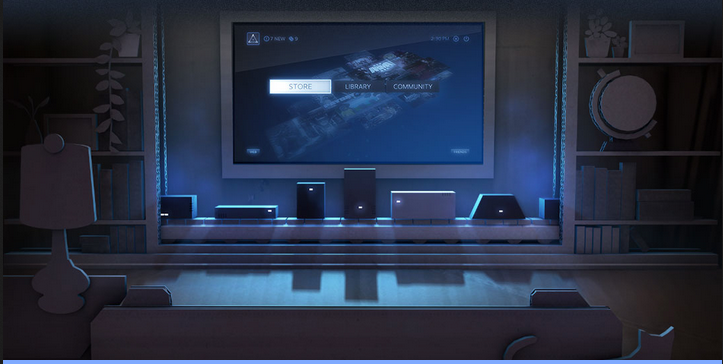
Look at Valve’s position. It’s created the leading digital distribution system for PC games and has benefited tremendously from the interest in PC gaming over the last few years (and the lack of retail space for PC games). However, PC sales are sinking, and desktop systems (the core of the PC gaming market) are suffering worst of all as tablets begin to take the lead for most home computing needs. Steam’s potential for growth is not great in the PC market alone, especially globally as emerging markets preferentially adopt smartphones and tablets over PCs. There’s no room for Steam to appear on tablets or smartphones. What does Valve do

As market leader in digital distribution, Valve logically looks to expand the size of the market. The next battleground for large companies like Google, Apple, Amazon, Intel, Sony, and Microsoft is the living room, where everyone is trying to take control of the giant screen. Valve naturally wants to compete there, and of course seeks to minimize the risk and maximize the benefit. While Valve is well off compared to most developers, it’s not anywhere near the league of giant hardware manufacturers when it comes to piles of cash. Valve has to do an end run around this obstacle.

Valve is cleverly offloading the riskiest part of the concept by ceding hardware manufacturing to others. There’s huge inventory risk if you build a lot of devices and no one buys them — just ask Blackberry or Microsoft with their recent write-offs of nearly a billion dollars each over unsold hardware. Valve is probably asking for some payment for each device that bears an official Steam label, so Valve wins no matter how many devices are sold.

Meanwhile, Valve has the potential to expand its Steam audience (and sales of software) if new buyers can be persuaded to try out the Steam hardware. The market potential depends on the Steam machine prices and features, of course, but any market growth is a benefit for Valve.

Let’s not kid ourselves about the difficulties of this venture. These Steam machines are very likely to be more expensive than equivalent consoles, due to smaller manufacturing volumes if nothing else. (Some Steam machines may be extra quiet, or extra small, or upgradable, or expandable, all of which adds cost.) Moreover, the manufacturers of Steam machines need to make a profit on the hardware since they won’t be getting any piece of the software revenue, unlike a console maker (who gets around $7 for each piece of software sold). If you want a Steam machine that produces graphics on par with a $399 PS4, it’s certainly not going to cost any less than that, and will likely cost $100 or $200 more.

The controller that Valve has come up with has interesting potential, but at this point it’s still potential. There’s a lot of refinement needed, and until we can actually see how well classic PC mouse-and-keyboard games can play on it we don’t know if it will work well enough to attract a sizable market. An important point here is the price. Valve has yet to say how much this controller will cost, but based on the components included (touchpads, a high-resolution touchscreen, advanced haptics) it’s not going to be any less than the $60 a console controller goes for now. A $99 price would not be a surprise given fairly low volumes and Valve’s probably desire to avoid a loss on each one. Priced at $99 the Valve controller may be a tough sell.

Who’s the target audience for Steam Machines The most obvious market is existing Steam owners, who already know about the service and appreciate it. However, those owners already have a PC that plays games pretty well (or very well). Why would they want to spend hundreds of dollars on a new box just so they can play a PC game in the family room… with a controller that may or may not work as well as the keyboard-and-mouse that they’re used to Yeah, that seems unlikely.

The best bet in the near term for the Steam machines lies in the possibility of a low-cost streaming device that you can plug into your TV, similar to Google’s ChromeCast. Valve has already talked about being able to stream games from your Mac or PC to the living room TV with the right hardware. Here’s where there could be a significant market among current Steam users — a $100 bundle of a dongle and a new Valve Controller that allows you to play your favorite PC game on a big screen would be a hit. It might even work at $125 or $150, if the games you can play work well enough. Get something enormously popular like DOTA 2 on there and you may well have a winner.

That’s all speculation, though. We won’t find out more about the GabeCube until next year, when the initial fervor over Sony and Microsoft’s new machines has died down a bit. Valve would no doubt like to roll out machines for sale before the summer Steam Sale, when the value proposition of the new device can be clearly underlined. There is some potential there, but Microsoft and Sony execs probably aren’t losing any sleep over this.

Yet.

‘The Croods’ Creators Embrace Games

DreamWorks Animation’s The Croods is currently the top animated movie of 2013 with over $568 million at the global box office. Fox Home Entertainment brings the prehistoric picture home on Blu-ray and DVD October 1, just in time for the busy holiday season.

Writers and directors Kirk DeMicco and Chris Sanders are already hard at work on the theatrical sequel, which will bring back actors Nicolas Cage, Emma Stone, Ryan Reynolds and the gang for another adventure. That opens up more gaming opportunities.

As part of its licensing deal with DreamWorks, D3 Publisher, a division of Square Enix, released The Croods: Prehistoric Party on Nintendo platforms this summer. DreamWorks partnered with Angry Birds developer Rovio Entertainment on The Croods free-to-play mobile game. Video games play an important role in Hollywood, where it can take three to four years to develop a CGI feature.

“One of the cool things about these games is they’re not going to really further the characters as part of the story,” said Sanders. “They’re based on the movie that was already made, but because these films take quite a long time to make, you want to keep them alive in people’s memory and imaginations while you’re off making the second film. So anything like a TV show or a video game that’s out there is great. There are a lot of kids out there that, by the time we make the second film, are going to be old enough to see it that are either not born yet or are just very, very young right now.  So you want them to learn about it and know about it by the time the second one comes out so they want to go see it.”


Apple Dethrones Coca-Cola

For years, Interbrand has reported on the “Best Global Brands,” and for the past 14 years Coke has dominated with their line of Coca-Cola products. However, this year brings a rather interesting change.

According to this year’s report, Apple has managed to overtake the soda manufacturer as the best brand, thanks to an increase in worth of nearly 30 percent and $98.3 billion in sales. This is a huge jump from its eighth place position in 2011.

Meanwhile, Google has also gotten a jump over Coke, with $93.2 billion compared to its $79.2 billion standings.

The top ten in all are:

1. Apple ($98.3 billion)
2. Google ($93.2 billion)
3. Coca-Cola ($79.2 billion)
4. IBM ($78.8 billion)
5. Microsoft ($59.5 billion)
6. General Electric ($46.9 billion)
7. McDonald’s ($41.9 billion)
8. Samsung ($39.6 billion)
9. Intel ($37.2 billion)
10. Toyota ($35.3 billion)

Source: Adweek

Big Update For Facebook Graph Search

A slow rollout for Facebook’s amped-up Graph Search will have you finding new ways to fritter away your time on the site. The ability to search for post content is available in beta for users only in the U.S, for now. Especially convenient for marketers are new ways to identify potential fans and compare with competitors.

At first debut, Graph Search was an ambitious undertaking but failed to make sense of the data you could search for. Now you can search for more than just post topics, but also places and times unless specifically blocked by privacy settings. Using conversational queries like “Restaurants in Portland, Oregon my friends have been to” can pull up amusing results.

The information your friends and fans post can now be used to your advantage. Finding people with niche interests or building your professional network are just a few of the ways Graph Search can be mined for useful information.

Source: Venture Beat

Sean Bean Is A Rail Fan

In what we can easily say is the most epic train simulation trailer of all time, Train Simulator 2014 gives every thing the rail fan could want. Anyone secretly hoping the game makers would find and involve excited train guy might be disappointed.  Then again narration by Sean Bean is nothing to shake a stick at.  (Peter Dinklage may be in the running for next year’s trailer.)


Twitch.tv Gets $20 Million Investment

Twitch.tv has had no problem becoming the broadcasting channel of choice with video games, with an estimated 45 million visitors using its service each month, whether for viewing or broadcasting. That said, it’s got a lot of preparation ahead as the Xbox One and PlayStation 4 game consoles launching next month will use Twitch services to some extent.

Consider its future secured, though. The company has managed to secure a $20 million Series C investment through Thrive Capital and Wet Summit Capital, as well as a partnership with video game company Take-Two Interactive Software, who recently reported record sales of Grand Theft Auto V.

“Gamers today have a healthy appetite for both producing and consuming live video game content, so it’s vital that we’re not only keeping pace with them, but staying one step ahead,” said Twitch COO Kevin Lin. “With the investments from Thrive Capital, WestSummit Capital, and Take-Two Interactive, it ensures we can more effectively grow and tap into new markets.”

“Given the excitement surrounding Microsoft and Sony’s upcoming video game consoles, Twitch will be in a lot of living rooms this holiday season,” added Lin. “Their intuitive and accessible integration of Twitch removes the barriers to entry which casual broadcasters currently face, so we expect traffic numbers to soar when these consoles launch. The trend of video game based content as entertainment is not only here to stay, it’s becoming a critical part of the holistic gaming experience.”

“Twitch is a company that we see riding multiple waves both in gaming and online video,” said Thrive Capital partner Chris Paik. “By providing gamers a new way to express themselves, Twitch has built a strong, passionate and fast growing community around itself.”

Source: GamesIndustry International

Xbox One Gets Fit

Microsoft really wants to extend the use of its forthcoming Xbox One console outside of just games, and this weekend it introduced another component of that plan – Xbox Fitness.

The program will be offered free of charge to all Xbox Live Gold subscribers, and features a number of trainers with specific programs, including Jillian Michaels, Tracy Anderson, P90X, Insanity and many others.

Xbox Fitness works with the system’s Kinect device, tracking not only the player’s movement, but also their heart rate, to see if they’re working too fast too soon. The video below highlights some of the workouts that will be available on the first day of the program, November 22nd – the same day that the Xbox One hits stores.

The program will be free under December 2014. After that, it’s likely to be accessible via a subscription fee.

Source: Xbox


PSN Ready For 50 GB Downloads

Killzone: Shadow Fall is clearly one of Sony’s biggest games. Not only is it bound to be a huge hit during the company’s PlayStation 4 launch in November, but it’s literally huge in size – approximately 50 GB worth of data are being used for storing it through a digital library. That could take some time to download, but Sony’s UK chief Fergal Gara explained that the PlayStation Network will be ready for a game of that capacity.

This follows reports that the PlayStation Network version of Grand Theft Auto V, which released last month, ran into problems with its massive 18 GB size. However, Gara stated that a number of improvements are being made to the service, and they’ll be ready to go day one.

“There are big innovations in the PS4 to make it more attractive and more easy gamer wise to want to download,” he stated. “The Play As You Download functionality, for example, means you don’t need the whole file before you go.

“This is a little bit counterbalanced by the fact the files themselves are getting bloody big. Killzone: Shadow Fall is an uber file – I think it’s cracking on for 50GB. It looks it, too, when you see it.

“It is still a relatively tedious process. We’ve done a lot of work on pre-delivering files. It’s not perfect. It’s not seamless. But it’s a major area of focus. It’s a major area of investment. The network will perform better on multiple levels, because it becomes not just a sales or gaming delivery but increasingly it becomes a social network.

“It’s going to be for no lack of investment, for no lack of effort and no lack of intention that things might fall a bit short. But we’re definitely moving in the right direction, and I’m confident when step on and understand its importance.”

Killzone: Shadow Fall is set for release on November 15, the same day the PlayStation 4 arrives in the United States.

Source: MCV UK