Build-Your-Own-Phone

Usually, when you buy a phone, it comes pre-built in a particular case, or modified with special equipment to make it work better. But Motorola has begun work on a new phone that you can actually put together – like a connector set.

The company announced progress on the customizable hardware platform, where each of the components can be switched out depending on the user’s preferences. It would make repair a lot easier, for if one item breaks on the phone, they can simply replace that individual unit, rather than the whole phone.

The design is similar to that of a Phonebloks modular smartphone introduced by Dutch designer Dave Hakkens. He has actually come on board to help the project, dubbed Project Ara, come to life.

“We want to do for hardware what the Android platform has done for software: create a vibrant third-party developer ecosystem, lower the barriers to entry, increase the pace of innovation, and substantially compress development timelines,” said Motorola in its latest blog post.

No word yet on when Project Ara will come to market, but more details could come in January at the Consumer Electronics Show in Las Vegas.

Source: PSFK

Game Industry Snapshot Reveals Strengths, Weaknesses

This is that magical time that occurs every three months, when publicly traded companies disclose their revenue and earnings. So far there have been winners and losers among the companies reporting, as everyone gets ready for the launch of new console hardware in a few weeks. The last three months of the year will no doubt be good for the traditional game publishers, as the holidays always are.

No one’s quite sure what to expect next year, though, once the excitement over new consoles begins to fade. Will console gaming experience a large, sustainable boom that rivals the last generation, or will the continued growth of mobile and online gaming (and rivals on the horizon) sap the strength of this resurgence. No one knows the answer at this point, but we can look at this financial snapshot to see how some of the major players stand. Most are poised to do well in the months ahead, with one glaring exception.

Electronic Arts reported a strong second quarter that exceeded the company’s previous guidance, and anticipates a solid performance during the holidays. Still, the company continues to lose money on a GAAP basis, though the loss is narrowing from last year’s (a loss of $273 million last quarter versus a loss of $381 in the same quarter last year). When the company uses their non-GAAP accounting, though, the picture flips to a profitable one, showing a profit of $105 million. Digital revenues grew from $324 million in last year’s Q2 to $450 million this year on a GAAP basis, driven by strong performances by The Simpsons: Tapped Out, Plants Vs. Zombies 2, Real Racing 3 and FIFA. “EA’s strong second quarter was driven by great title launches, continued digital growth, and financial discipline,” said CEO Andrew Wilson. “While we have made good progress in the first half of the year, we remain focused on executing our FY14 plan and delivering a full slate of amazing games and services to players on current and next-generation consoles, mobile, and PC.”

TakeTwo recorded a record Q2 with $1.27 billion in revenue (on a non-GAAP basis), of course, led by the record-setting strength of Grand Theft Auto V. TakeTwo’s GAAP performance was actually only $148.8 million, down 45 percent from last year, because under GAAP rules the company couldn’t record the sales of GTA V in the quarter since the multiplayer component didn’t launch until one day after the quarter ended. We’ll take the non-GAAP results as more reflective of the company’s reality, though, as they bask in the glow from selling 29 million units of GTA V in just a couple of weeks. The company expects revenues for the full year of $2.2 billion to $2.3 billion on a non-GAAP basis. Other titles like BioShock Infinite and Borderlands 2 have also been outperforming expectations.

Microsoft posted record results for the overall company with $18.35 billion in sales for the quarter, even as Xbox 360 sales slid 29 percent from last year’s quarter. The company did see first-party game sales and Xbox Live transactions go up, with a 17 percent rise for the overall division (with a 25 percent rise just for Xbox Live transactions). In a post-release conference call, Microsoft’s executive VP and CFO Amy Hood has faith in next month’s big hardware release, saying, “We expect the launch of Xbox One to be the biggest in Xbox history.”

Sony’s game revenues rose slightly compared to last year, mostly due to the change in value of the yen versus other currencies. Although revenues rose to $1.58 billion for the game division, Sony posted a loss of $8 million (compare to a gain last year of nearly $24 million). “The decrease in sales on a constant currency basis was primarily due to a decrease in unit sales of PlayStation 2, PlayStation 3 and PSP hardware, partially offset by increased PS3 software unit sales compared to the same quarter of the previous fiscal year,” Sony said in its report. Projections for the rest of the year remain unchanged for the games division, but Sony revised its projections for the overall company to reflect lower profits than previously expected for the entire year.

Nintendo provided the big disappointment among hardware makers, as we reported here. The company’s sales were below what analysts expected, driven by weak hardware sales. Analysts had expected the company to show a profit for the quarter, but Nintendo turned in a loss. The price cut on the Wii U, while it boosted sales, also made it more difficult for the company to show a profit. Sales were very slow for the Wii U, and even the 3DS hardware (with a strong software lineup) sold less than expected.

Analyst Michael Pachter pointed out that the Wii U’s hardware and software sales so far (the first six months of Nintendo’s fiscal year) have actually been lower than the Wii hardware and software in the same time period, despite the fact that the Wii is seven years old (and now production is ceasing in Japan and Europe). Here’s the grim fact about the Wii U: lifetime sales of the console have been 3.91 million units so far, and this fiscal year (the last six months) we have only seen 460,000 Wii U units sell worldwide.

Yet Nintendo has not changed its guidance for the full year, which ends on March 30, 2014, projecting the company will sell a total of 9 million Wii U’s in this fiscal year. To meet that goal, somehow Nintendo will have to sell 8.54 million Wii U units between now and March 30th. With Donkey Kong Country: Tropical Freeze moving into next year, and other hot Wii U titles like Mario Kart 8 and Super Smash Bros. not given a specific launch date in 2014, that seems unachievable – perhaps “hallucinatory†would be a more accurate term. This holiday season will be an important one for Nintendo, and if the results aren’t exceptionally good the company will need to make some serious decisions about its strategy for 2014 and beyond.

Meanwhile, blithely unconcerned by all of the hullabaloo over new consoles, mobile and online games continue to grow. The holidays mostly don’t affect digitally distributed titles that much, although we do see record new device activations on Christmas Day and a flood of downloads immediately thereafter. Still, it’s unlikely that mobile or online games will be affected much no matter how well new consoles perform.

PlayStation 4 Launch Titles Revealed

Even though the PlayStation 4 launch had its fair share of delays – including DriveClub and Ubisoft’s Watch Dogs – there’s still an impressive amount of games just waiting to be played on the console in just a couple weeks’ time. Today, the company revealed its full line-up of titles that will be available, between retail and digital releases.

The following games will be released as Sony first-party titles:

Killzone: Shadow Fall
Flower (downloadable)
Knack
Resogun (downloadable)
Sound Shapes (downloadable)

Third-party games that will be available for the system’s launch include:

Angry Birds: Star Wars
Assassin’s Creed IV: Black Flag
Call of Duty: Ghosts
FIFA 14
Battlefield 4
Just Dance 2014
Injustice: Gods Among Us Ultimate Edition
Lego Marvel Super Heroes
Madden NFL 25
NBA 2K14
Contrast (downloadable)
The Pinball Arcade (downloadable)

Sony has also indicated that a number of games will be available during the system’s “launch window,” though specific titles haven’t been mentioned yet. Hits like Bungie’s Destiny and the upcoming Watch Dogs should definitely lead the charge next year.

Source: NBC News

Steam Reaches 65 Million Users

Even though it has a huge year coming up with Steam Machines and a controller enabled by a peculiar touchpad design, Valve’s original Steam service continues to grow in its tenth year of operation.

The company has confirmed that it now has 65 million active accounts, a number that has grown 30 percent since this point in the previous year. This includes veteran accounts as well as new sign-ups.

Approximately six million users are on the service simultaneously per day, according to the company, with the most popular title as of late being Valve’s own MMO adventure Dota 2.

A number of services have contributed to Steam’s success over the years, including the TV-compatible Big Picture Mode, as well as the introduction of a trading card system and the ability to share games across multiple accounts with Family Sharing.

Source: Game Informer

Jumbo Xbox One Invades Vancouver

Microsoft seems to have a thing for making its advertising campaign larger than most of its competitors. And we mean that literally.

Following stunts where enormous Windows Phone and Surface tablets were made for public events, Microsoft has now made a giant sized Xbox One, which was placed in a parking lot in Vancouver as part of a promotional push for the system.

First spotted by a Reddit user named Soupyhands, the system sets at 40 feet long and 20 feet wide, and contains “an unnamed surprise” of some sorts. Once people “pledge” enough Gamertags as part of the campaign, it will “unlock,” though it appears that the “pledges” need to be made in person.

The Xbox One hits retail shelves on November 22. No word yet on when the plus-size Xbox One might be available.

Source: The Verge

PlayStation 4 FAQ Answers All

With the PlayStation 4 just a few weeks away from release, many potential buyers still have questions in regards to how the system – and its various services – works. Today, Sony finally answered a variety of those questions – over 150, to be exact – in a Q & A posted on its PlayStation Blog yesterday.

A number of topics are discussed, including what services require Internet activation in order to work, what types of media are supported, physical items with the system, the included hard drive (and replacement information – you can put in your own larger hard drive if you want), technical aspects and a lot more. For instance, PS4 games will not be region locked, and Sony will not be imposing any restrictions on used games. Prospective PS4 buyers will find this FAQ should answer most of their questions – but if you haven’t pre-ordered a PS4, you’re probably going to have a hard time finding one for a while.

The PlayStation 4 launches in stores November 15 here in the United States.

Source: PlayStation Blog

Microsoft Snags BBC Personality

Microsoft has done a lot these past few months to push its Xbox One console, but it’s just made an interesting new hire that could change its perspective.

The company has announced that it has hired TV presenter and pop culture master Jonathan Ross to work as a consultant for the company, advising a number of Microsoft’s teams in the United Kingdom. Though specific details weren’t revealed about the partnership, the company is thrilled to have him on board.

“We wanted to change our thinking,” said Microsoft corporate vice president Phil Harrison, after the announcement was made at an Xbox One event in London earlier in the week. “What we wanted to do was to bring in new talent that would challenge the way we build games and the way we think about what an audience is, to think about what is entertainment, and broaden the concept of gaming to maybe blur the distinctions about what a traditional game is and what a traditional television program or what is a traditional linear media.”

Ross isn’t working for the company full-time, as he’s working on other projects as well, including the upcoming Hotsauce iOS game Catcha Catcha Aliens.

Source: IGN

Nintendo Loses Money

Even with a price drop on its troubled Wii U game console – which has led to an increase in sales – Nintendo has once again failed to show a profit.

The company has reported an operating loss of 18.4 billion yen ($187 million) on sales of 115 billion yen ($1.17 billion) for this current sales quarter. For the time frame between July and September, the company has only managed to sell 300,000 Wii U systems. Though that’s an increase over the previous quarter, it’s still generally losing money on the system. Net profit for the year only showed to be about 600 million yen, or $6 million.

Software showed better signs of life, with 5.27 million units sold over the previous quarter, an increase of 400 percent over the previous period. Titles such as Pikmin 3 and The Legend of Zelda: Wind Waker HD have done quite well on the Wii U front.

Over on the 3DS, Nintendo shuffled 2.49 million systems out during the period, a small loss of about 20 percent. Game sales, however, are on the rise, with 16.37 million units sold, a 40 percent increase. One of the leading sellers is Animal Crossing: New Leaf, a town simulator featuring various animal characters.

Nintendo has several titles that are leading the charge with this quarter, including Pokemon X & Y and the forthcoming Super Mario 3D World, along with a promotional campaign for a free trial period of Wii Fit U. That may turn sales around sooner rather than later. The company still expects to sell nine million Wii U systems this fiscal year (ending March 30, 2014), though the current total sold is less than 500,000 for the fiscal year (3.91 million since the Wii U launch).

Source: The Verge

Majesco, Mobile As Ever

If Majesco has a knack for one thing, it’s reinventing itself to pursue potentially profitable niches in the game market.  Remember its line of Sega Genesis and Sega Game Gear hardware in the late 1990’s and early 2000’s?  At one point the company looked to be on track to become a publisher of big budget console games, putting stake in the ground with a pair of high-profile if not ultimately blockbuster franchises with BloodRayne and Advent Rising.  Today, it’s perhaps best known for a couple of hit game series under its belt with Cooking Mama and the Zumba line of fitness games.

It’s no surprise then that Majesco, with its opportunistic business philosophy, has turned focus to digital, mobile and social games.  Earlier this month, the company made a move towards entering social casino games by acquiring Pariplay, which has expertise in real money social games.  With mobile, Majesco has made fruitful first steps into the category. It seems to understand the mechanics of audience building for mobile games, where it’s all about player acquisition through the most efficient means possible then cross-pollination of that audience across other titles as a company grows its mobile game portfolio.

To that end, the way Majesco has approached mobile is to leverage popular licenses it controls, such as Zumba and Disney’s Phineas and Ferb.  At the same time, it’s partnering with outside developers on original IP, working on a series of free-to-play titles like tower defense game Romans from Mars and action-RPG Sci-Fi Heroes that have a cartoonish art style, but with game play aimed at core mobile gamers.

Vince Vanasin, head of marketing at Majesco’s mobile game division, talked with us about the company’s mobile strategy.  According to him, it started with building the right team.

“Majesco has been around for a long time, more than 20 years. When they decided they wanted to get in the mobile space, they started by building a team based out of L.A. from the ground up.  They felt there was a lot of talent in L.A. that could help them be successful in the mobile space,” Vanasin told us.

The company’s first foray into mobile was with its strongest property, the Zumba license.  Vanasin calls Majesco Zumba’s “shepherd” in games, having released a string of successful titles for console and handheld systems.  Zumba Dance was the first mobile title, a premium priced $5 app available for iOS and Android.  Majesco released it into the app store wild in July of this year, then watched as it hit the coveted iOS storefront as a featured app.  It ultimately became a number one hit in the health-fitness iOS app category in 90 countries.

“It was the power of the Zumba brand – Zumba is so global and so widely loved,” Vanasin said. “When we do a licensed product it’s very different than original IP product. Licensed products have a built-in audience so what we try to do is leverage the work that the brand has already put in.”

“The other side as well is media and user acquisition,” he added.  “We found a lot of success there, both because of the brand recognition, but also because the game is good. Zumba Dance has a four star rating and was featured by Apple. We think the combination of a high quality game and a really strong brand is what has led to the product’s success.”

Majesco is following the same formula with its upcoming game based on Phineas and Ferb, a popular youth-skewed — and arguably adult-adored — animated comedy that’s become a hit franchise for Disney.  Majesco plans to tap into Disney’s marketing for the series wherever possible, including social media presence.  It’s also making sure the game lives up the quality standard that Disney and fans are going to expect in a game based on the series, including being mindful of how parents will perceive it.

“[With] Agent P DoofenDASH, we’ve definitely worked closely with Disney to make a fun product that is in line with Disney’s brand priorities and guidelines. Since it’s based on Disney Channel’s hit franchise Phineas and Ferb, we wanted parents to feel comfortable giving this game over to their kids. From a monetization perspective we’re going to take all of the best practices from games in its genre and align those with Disney’s consumer guidelines to ensure a fun and safe gaming environment,” said Vanasin.

He added how while a lot of youth-skewed apps tend to offer pricey packs that seem to bait children and their parents with big one-time purchases, Majesco won’t be following that formula.
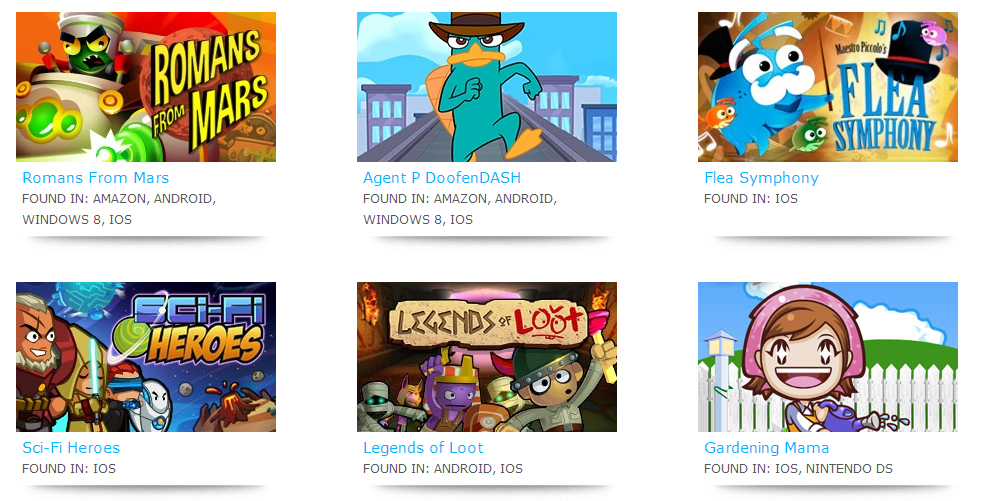
Part of Majesco’s mobile game line-up

During our conversation, Vanasin seemed most excited about his division’s newest title, Romans from Mars.  The free-to-play game based on original IP had a limited beta release, and has so far been well-received by beta users posting reviews on Google Play Store.  Call outs for its unique visual style and production value are what jumped out after a quick glance of what user reviews seemed to like the most about the game.  Vanasin said those are attributes that Majesco has been highlighting in its marketing.

“We think the game lends itself really well to a really casual, fun, and humorous voice.  We have a great art style — it’s quirky and it’s funny. We’re definitely going to highlight that with a lot of compelling assets through social media, and hopefully consumers and players will gravitate towards it.”

As these games help Majesco get a foothold in mobile, we asked Vanasin what his strategy is in not only building but keeping an active player community around its mobile portfolio.

“For us these aren’t fire and forget games,” he said.  “We want to put them out and continue to support players with robust updates. We want to build the Majesco mobile community, our beta tester community, and our overall audience. The phrase ‘games as a service’ gets thrown around a lot, but for us, it’s all about supporting the player, supporting our communities, and supporting our games by focusing on the player experience first.”

EA Expects Huge Next-Gen Sales

Though some may question just how quickly the Xbox One and PlayStation 4 will sell when they launch next month, game publisher Electronic Arts doesn’t have a doubt – they’ll be huge.

The company has stated during its most recent second quarter 2014 earnings call that the systems should have huge sales. Chief operating officer Peter Moore stated that both Microsoft and Sony have suggested that a collective total of ten million consoles will be sold by March 2014 – just about four months after their initial release.

EA also believe that launch attach rates will be three games per console on average, as part of a determination of how many next-gen titles it will sell between the system launches and the end of the fiscal year.

No word yet from Sony or Microsoft on these estimates, but considering the decent volume of games due for each one, they may not be far off.

Source: Game Informer