E-Cigarette Ads End Up In Kid’s Game

Ads are commonplace in a lot of game apps these days, including apps aimed at kids. Not all ads are equal, though, and controversy has arisen over an e-cigarette company’s particular advertisement in an iPad kids’ game.

As you can see in the picture below, an ad for the electronic Vype cigarette by British American Tobacco ended up clearly seen in a pet game simulation that’s aimed at kids. As a result, Vype has pulled all advertising from apps at the moment, and apologized through its Twitter account.

In addition, a rep gave the following statement to Mashable.

“We apologise that an advert has ended up on an channel that it clearly wasn’t intended or appropriate for. As soon as this was brought to our attention, we pulled all our online advertising whilst we look into this matter further and establish how it happened.

Vype is an e-cigarette brand marketed and sold by Nicoventures, a subsidiary of British American Tobacco. Children are not, and will never be, the target audience for Vype, which is a product aimed at adult consumers who are able to make an informed choice regarding which brand they choose.”

No word yet on when the advertisements will run again.

Source: Mashable

Zynga News Boosts Stock

Zynga was busy making news yesterday, and not just with a positive earnings call. Zynga announced the hiring of veteran gaming industry executive Clive Downie as the company’s new COO, which is another hiring coup following the acquisition of EA and Microsoft veteran Don Mattrick as CEO. Downie comes to Zynga after being a VP of marketing at EA, and most recently he just left his role as CEO of DeNA West to take the position at Zynga.

“I am pleased with our Q3 performance which exceeded our guidance both in terms of bookings and adjusted EBITDA. We are encouraged to see sightlines to growth and expect to be profitable for the full year on an adjusted EBITDA basis,” said Don Mattrick, Chief Executive Officer, Zynga. “Our teams are working hard to compete more aggressively on the web, move to mobile and develop new hits, and I am happy with the early progress we have made. We believe our top franchises, Zynga Poker, FarmVille and Words With Friends can be evergreen in terms of consumer interest and we are focused on growing these franchises in fiscal year 2014. I am confident that Zynga is rewiring itself in a meaningful way that will strengthen the core of our business and put us back on track to achieve significant long term growth and profits.”

Downie and Mattrick worked together at Electronic Arts, and Mattrick values Downie’s experience and knowledge, especially with mobile games and international markets. Those qualities will be valuable to Zynga as it strives to derive more and more of its revenue from mobile games.

Zynga’s earnings showed a slight loss of $68,000 for the quarter, far better than the loss last year of $53 million in the same quarter, or the loss of $16 million last quarter. Revenue came in at $203 million for the third quarter, a 36 percent decline over last year’s third quarter. The company is losing users, though – daily average users (DAU) were 30 million this quarter compared to 60 million in the same quarter last year.

Investors generally liked the news, boosting the company’s share price to $4 in after hours trading last night, a gain of over 13 percent. The stock is still up today, but only by about 8 percent at the time of this writing. Analyst Michael Pachter revised his long-term target for the stock upwards to $5 per share, as he believes the numbers show Zynga is likely to return to profitability sooner than expected.

We’ll have a more extensive analysis of Zynga’s situation and prospects, and what this means for the game industry in general, on Monday.

Brazil Emerges As Gaming Powerhouse

By Joost van Dreunen, Ph.D.

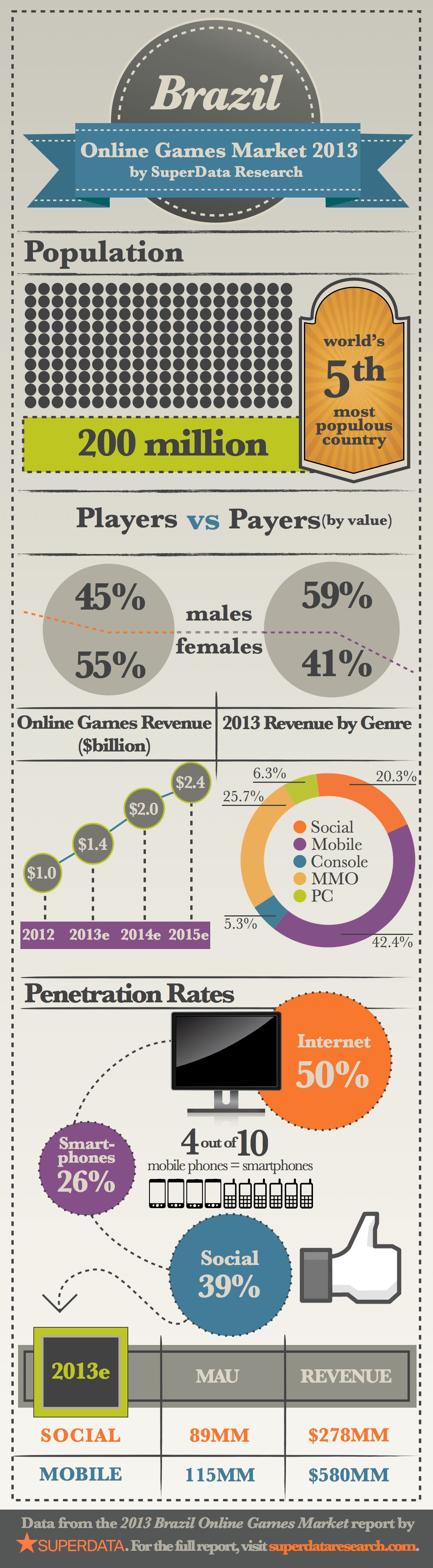
Brazil, the world’s fifth most populous country, is a Latin American goliath of interactive entertainment. According to our most recent analysis, digital games revenue in Latin America will grow from $1.4 billion in 2013e to $2.4 billion 2015e. This makes the Brazil games market the fifth largest in the world.

The Brazil games market accounts for 62 percent of the Latin American market. Counting almost 200 million people, Brazil’s Internet penetration is growing at a rapid pace. Where the worldwide Internet penetration currently stands at 32 percent, Brazil’s Internet penetration recently reached 50 percent making the country a perfect market for digital games.

For more on this story, see the full article.

Â

Â

Next-Gen Systems ‘Almost Identical’

Many are wondering about the difference in specifications between Microsoft’s Xbox One console and Sony’s PlayStation 4 system, curious about which console is the most powerful. A couple of select Japanese game developers believe they’re not so far apart.

Japanese game developers Shinji Mikami of Resident Evil fame and Mega Man creator Keiji Inafune both believe that the processing power of both systems is almost a mirror image.

“There’s no real difference between them,” said Mikami as he spoke to Edge magazine. “When Xbox One was first announced it had lower specs than PS4, but now they’re almost identical.”

Meanwhile, Inafune added, “I don’t think there’s a major difference between them. If you get down to the tiny details then maybe each is better at one thing than the other, but it doesn’t really impact the way you make a game.”

He added, “It’s not like PS4 or Xbox One are particularly hard to develop for. Quite the opposite: you can make whatever you want on either one, and that should be enough for anyone.”

Both systems will be released in U.S. retail next month, with the PlayStation 4 arriving on November 15 and the Xbox One releasing a week later, on November 22. No doubt we’ll see some head-to-head comparisons of different games soon after that.

Source: Computer and Video Games

Wii Discontinued In Europe

In conjunction with our previous news story on Nintendo of Japan discontinuing the best-selling Wii game console, it appears that Nintendo of Europe is following suit.

The company confirmed this week that the motion-based game console, which sold over 100 million units in its lifespan, has been discontinued.

“Wii imports to Europe have been discontinued,” confirmed a Nintendo rep, speaking with MCV. “However, there are still a variety of options for consumers to enjoy Wii games and the Wii gameplay experience. Wii U, which is Nintendo’s latest home console, is backwards compatible with nearly all existing Wii games and accessories…when you switch to Wii Mode on Wii U.”

However, the production shutdown will not affect the Wii Mini model, which is a smaller system for $99.99 only available in Canada right now, according to Nintendo. The Wii Mini has no Internet connectivity, download capability, SD card capability or backwards compatibility with the GameCube.

Meanwhile, the decision on the U.S. market still stands, as Nintendo of America will continue to stock the Wii throughout the holidays. It’s a not unreasonable speculation that the Wii may cease to be available in the U.S. in the near future, once inventory runs out. The Wii Mini may be tapped to replace the Wii, but Nintendo has yet to make any announcements about that.

Source: Computer and Video Games

OUYA Hitting Shelves At Target

Even though OUYA has had some rough patches in its transition from KickStarter wonder to full retail console, the company is confident that it’ll find new business revenue for it. Today, Julie Uhrman, founder of OUYA, announced that the system has made its way to Target stores nationwide, and that demo units are being planned as well. That way, people can try before they buy.

“What is the most exciting is how we’ve been embraced by retail,” said Uhrman, speaking with Polygon. “When we launched in June, we were live in the U.S., Canada and the U.K.  We launched with GameStop, Target, Best Buy and GAME. This month, we are going full chain with Target.”

The retail chain helped guide the decision to bring the system to all 1,800 of its locations. “That allows us to do national campaigns and have a national footprint,” said Uhrman.

In addition to the system’s rollout in stores and the demo units, OUYA is also planning a box redesign to “highlight and promote more games and new content.” The retailer will also offer a $10 bonus gift card for anyone who purchases the system.

“We have been building out demo stations,” said Uhrman. “The reality is they are incredibly expensive and you have to man them.”

Wal-Mart could be the next interested chain as well. “I would expect something, us to announce something with them soon,” Uhrman concluded

Source: Polygon

Amazon Set-Top Box Delayed

Amazon was hoping to have a set-top box model to compete with the likes of Apple TV and Roku in time for the holiday season. Unfortunately, it doesn’t look like it’s going to happen.

The company has recently delayed the release of the device, maybe even outside of the Christmas window. Though a specific reason wasn’t given, it appears more time is being put into its development, just as the Wall Street Journal previously reported.

Sources close to the project stated that the box would be based on an Android-like set-up similar to the Kindle Fire tablets, with the option to let third-party apps provide their own programming for it. The big feature, though, obviously would’ve been the focus on Amazon’s own Prime programming, between both movies and TV shows.

No new release information has been given as of yet — the device’s existence has not even been acknowledged by Amazon so far.

Source: The Verge

PBS Debuts Xbox 360 App

A lot of network and cable-based services provide viewing apps through game consoles as of late, particularly the Xbox 360. Now, public broadcasting has joined the party.

PBS, America’s Public Broadcasting Service, has announced that it has launched an application that allows for viewing of its programming on Microsoft’s game console. These include programs like Frontline, Nova, American Experience and Downton Abbey. Users will be able to identify their local PBS station, which will also give them access to local programming as well.

The catch You need to be an Xbox Live Gold subscriber in order to take part.

“This launch is an important next step in our strategy to make PBS content available through a variety of platforms, while maintaining the connection between the viewer and their local PBS station,” said Jon Brendsel, Vice President of Product Development, PBS Digital. “While PBS member stations will always be the first place to find high-quality PBS programming, the launch of our Xbox 360 offering recognizes that viewers are looking to engage with their local station in the time and manner they choose.”

“As one of America’s favorite destinations for high-quality content on television and online, PBS is a great addition to our expansive lineup of entertainment experiences on Xbox 360,” said Kathy Styponias, General Manager, Interactive Entertainment Business. “The addition of PBS is another example of how we’re continuing to expand our catalog of entertainment so that Xbox Live members can find all of their favorite experiences in one place.”

No word yet if the services will come to the Xbox One, but that seems like a logical step.

Source: PBS

Instagram Ads Unveiled

Instagram, in an effort to kick off its sponsored ad campaign, has revealed the first teaser image today. It can be viewed below.

In the ad, “sponsored” by Levis, a couple is riding along in a train, on their way to San Francisco to, as the hashtag puts it, “#maketheirmark.” The ad features a mention of a service called Station To Station, which features a Twitter account of @StnToStn.

This ties in with the company’s previous announcement to feature sponsored photos and videos, which would appear in people’s feeds from brands they normally don’t follow. Users have the option to “hide” the ads with the press of a button, however.

This sample Levis ad is just the first of many to come with the service. Instagram made a note of it recently in its blog…

“Our focus with every product we build is to make Instagram a place where people come to connect and be inspired. Building Instagram as a business will help us better serve the global —and ever growing — Instagram community, while maintaining the simplicity you know and love.”

Source: Instagram


Gaming Insiders Call For Innovation

At the Gaming Insiders Summit last week over 200 senior game industry people gathered to listen to talks about the state of the game industry and it’s future, as well as to network and make important business connections. The insights presented were interesting and sometimes controversial – Oculus is trying to create what it believes will be the next big technology in gaming, and Natural Motion strives for risky innovation. The [a]list daily was there to capture the details of this quest for the future of gaming.

Brendan Iribe, CEO of Oculus VR, took to the stage to talk about the progression of technology in the game industry and where it’s going next. “If you look at gaming, it’s usually hardware that drives content innovation,” said Iribe. He cited the advance of display hardware over time, from the Atari 2600 to the next-gen consoles coming to market soon, and noted the relentless improvement of game display from text to 2D sprites to 2.5D in Doom and finally full 3D, which has been refined over time with ever-increasing polygon counts and better rendering.

“In my mind we have really maximized what we can do with 3D graphics on today’s hardware,” said Iribe. “Mobile is a new piece of hardware, and it’s something that game developers have been able to jump on and make incredible content,” said Iribe. “But as far as immersion, it’s pretty small. We’re going from screens that are 20 or 30 inches, or TV screens that are 50 or 60 inches, and suddenly the most popular computing device out there is back down to five inches. The immersion level is lost. There’s a new level of content that’s about social, and sharing, and connectivity. It’s all important, but where do we go next with immersion ” As you would expect, he feels that VR is the Next Big Thing.

The challenges facing VR and the Oculus in particular are not trivial, and Iribe noted the obstacles they must overcome. “There are a lot of challenges,” Iribe acknowledged. “There are challenges on the hardware platform side, and there are challenges on the content side.” He noted user interface issues that need to be dealt with in the virtual world. “It has to be much more of a motion-picture style interface than what we’re used to in games,” Iribe said.

He noted that resolution of the screens is improving, as the Oculus VR has gone from 800×600 to 960×1020. “You can’t imagine what it’s gonna look like when it’s 4K resolution, and it’s not far away,” Iribe promised. Latency is now at 50 milliseconds, and he wants to get it down to 10 milliseconds or less.

Iribe did report progress on the important issue of simulator sickness. “I’ve gotten sick every time I’ve ever tried it,” revealed Iribe. “That’s a little challenging” for the CEO of the company. “Every time until recently. In the last couple of weeks I’ve tried a prototype internally where I did not get sick for the first time and I stayed in there for forty-five minutes,” Iribe said.

The CEO of mobile developer Natural Motion, Torsten Reil, talked about his company’s ascent to the top of the mobile game charts with titles like My Horse and CSR Racing. “We believe there’s an incredible opportunity to build the next big entertainment company in this industry,” said Reil. “There’s probably about a billion addressable devices and people that play games on them, and we feel that creates an amazing opportunity.”

Certainly Natural Motion has done well with its previous titles, making $12 million in the first month of CSR Racing, the #1 top-grossing mobile game of 2012. Reil’s company has learned some important lessons from their experiences. “The first thing is to invest in the product,” said Reil. “It’s something that’s really obvious to do but in many ways is non-trivial. We believe that on mobile devices, your product is your distribution strategy. The product is everything, and it drives absolutely everything, because this market is extremely competitive. Particularly with free-to-play, you have very little time to convince your audience that your product is the product they should download and they should keep playing.”

“You want to create an emotional connection between you and the player,” said Reil. “With CSR Racing, what that entails is to create cars that are so beautiful you almost could touch them. We obsessed about this, because we always imagined someone just taking out their phone and looking at their Audi R8. It needed to feel like owning the real thing. CSR Racing is a racing gaming, but actually it’s about car ownership.”

“The other thing that’s important is polish,” said Reil. “We polished the hell out of this game. CSR Racing was done in nine months, and we spent the next four months just polishing.” As an example, Reil described how Natural Motion went through 95 different icons for the game, testing them on millions of people, before settling on one icon that got the most clicks.

Polish is one of Natural Motion’s “guiding lights,” but that’s not all the company uses to chart its course. “The other guiding light is finding blue oceans,” said Reil. “We believe there is a big opportunity right now to find genres that have been under-exploited, or to entirely re-define genres. If you’re first into a market, you have that market to yourself. We felt that was the case with CSR Racing, in the very simple drag-racing genre. We’re now at 70 million downloads, and the large majority of them – about 90 percent – are all organic, and that’s something you have as an advantage as a first mover in a market.”

Reil feels that companies should take risks in innovation. “We really believe in taking risks,” said Reil. “We try and do the really hard stuff, because if you can do the hard stuff that creates real competitive advantage. Because when you take risks and go to blue oceans it creates an opportunity to create brands and franchises.”