The Year In Gaming: Nintendo

By the time business had concluded in 2013, Nintendo found itself in a distant third-place position in video game consoles. Although its Wii U was performing slightly better with such releases as Super Mario 3D World and The Wind Waker HD, it was still lagging behind the likes of Microsoft and Sony in terms of popularity. This year, however, told a different story.

Nintendo was losing money big time at the start of 2014, as well as the confidence of various third party developers, who dropped most of their projects on the system, including Assassin’s Creed and the new Call of Duty. That said, Nintendo managed to thrive by the end of 2014, mostly due to its first-party releases.

The Wii U, for example, saw an upswing in sales beginning at the end of May when Mario Kart 8 was released, and continuing during the holiday season. Original game releases like Hyrule Warriors and Bayonetta 2 earned critical acclaim, while new entries in the Mario Kart and Super Smash Bros. franchises ended up being big sellers, leading the way for Nintendo’s return to profitability. Also helping out the company were the new Amiibo toys, featuring a number of popular and obscure Nintendo characters. They’ve become  hot commodity in themselves, leading to an estimated $1 billion in retail sales – a number that continues to rise with new waves releasing over the next few months. Nintendo reported that its Wii U sales for Black Friday were up 10 percent over last year, which is good but not enough to catch up to the Xbox One or the PlayStation 4.

As a result of improved hardware and software sales, Nintendo has managed to emerge with a profit of ¥36.8 billion for the year so far, a huge leap from the ¥23.2 billion it was losing the year before. Not only that, but it also has a promising 2015 in the works for both the 3DS and Wii U systems, with such games as The Legend of Zelda Wii U, Majora’s Mask 3D and StarFox in the works, along with original titles like Mario Maker (where players can create their own levels and share them with the community) and the innovative multiplayer shooter Splatoon.

Nintendo also cleaned up in the public eye, not only winning over fans with its tremendous game line-up, but also with winning several awards on this year’s Game Awards presentation, and pleasing them with surprising game footage from Zelda and other projects.

Although it still has a ways to go to win back most third party publishers, Nintendo has certainly improved over what it’s been doing the previous year, and it’s going into 2015 with plenty of new titles in the works. There are also hints of new hardware, including a more stable 3DS model and a possible new system coming in 2016 (or perhaps sooner), with revolutionary technical specs in tow.
Facebook’s Year For Video Dominance

After announcing its recent deal with the National Football League, Facebook seems more than ready to take on YouTube when it comes to video supremacy in 2015. However, there still may be a few strategies in play when it comes to improving the site’s format and outreach to its user base.

“Facebook is already a place where you consume content, and now they are dialing up video,” said Ezra Cooperstein, president of Fullscreen, which is a partner of YouTube video producers co-owned by AT&T and The Chemin Group. “This is a year where YouTube is still the dominant platform for emerging talent. It’s going to be challenged (in 2015), and Facebook has to crack (ads). It could be pretty dangerous for YouTube if Facebook does crack that.”

The advertising plan is still being put in place, according to the Wall Street Journal, and the NFL/Verizon Wireless deal is just part of that, a way to test out “post-roll” video ads on the service. The final plan hasn’t been ironed out just yet, as the team still needs to figure out a way to produce video ads that don’t get in the way of the site’s experience when it comes to the consumer.

Jesse Redniss, co-founder of the digital media consultant team Brave Ventures, stated that he’s not confident in “post roll” ads having that much appeal in the way of gathering new advertiser. He believes that, instead, Facebook will work more on working directly with marketers to integrate brands into content or perhaps produce videos that are more specific with company advertising, allowing their content to be seen more by the consumer as a result. “Facebook is poised to become the next big MCN,” he explained.

Jordan Bitterman, chief strategy officer of Mindshare North America, had something to say as well. “If you are a purveyor of video you pay like brands and everyone else on Facebook pays to get their content seen,” said Bitterman. “It becomes a distribution cost.”

Facebook could easily shape how online video advertising could change, with a shorter video standard. Said Ran Harnevo, AOL’s head of video, “The main advantage of the online video space in the last few years was the fact that it basically had the same ad product the TV industry had.

“But the next evolution of this space has to include a better ad experience,” he continued. “30-second ads were created for a different medium and are not a good service for digital consumers. Video pre-rolls would be super effective if they would last five to seven seconds. If Facebook, with over a billion users under their belt, would stick to that format, I have no doubt everyone would play along.”

A standalone video section would also be a considerable idea for the time. “I wouldn’t put that past them,” added Bitterman.

Meanwhile, Vik Kathuria, global chief media officer for Razorfish, had his own say on the matter, with an interesting theory. “The first thing that pops into my mind is Instagram,” he explained. “I think the video opportunity for Facebook is with this inherently visual sharing platform. If they could figure out in-stream ad delivery, they may have a solution that could rival YouTube.”

Important Metrics Marketers Should Be Watching

Keeping an eye on marketing trends and how effective they can be on the market can be a vital tool for some companies, to the point that specialists have been hired to keep an eye on such trends and create new ideas that could be effective with building a new customer base.

That said, The Next Web has come up with a key list of metrics that such companies and marketers should keep in mind, especially with the New Year coming and plenty of new ideas being passed around.

The full lowdown can be found here, but we’ve provided each of the basic points, as you can see below:

Reach and Engagement
With each social platform providing its own set of metrics, reach and engagement are critical for consumers. “I’d still argue that it’s useful to monitor how your social media activity is faring since for so many organizations, effective social media activity provides a platform for actual business impact,” the article explains. “This metric is not to be touted as evidence of ultimate success – but rather a step on the way there.”

With the familiar elements of reach and management in place, social media profiles should be kept in check as far as “health” is concerned. The article suggests measuring accordingly, like with Facebook at a 28 days post reach and engagement rate.

Total Conversions
Google Analytics continues to be a vital tool when it comes to measuring statistics. However, it’s vital to keep goals in place, along with watching overall site averages. Without them, the article states, “you can’t see whether visitors to your site are taking the actions you want them to take i.e. buy something, subscribe to a service, download a brochure or sign-up to a newsletter.”

Looking at total conversions or breaking them down by audience segment type are effective ways to measure customer behaviors.

Conversion rate by channel
Keeping an eye on certain activities making an impact is a must. By measuring conversion rate by channel, you’ll be able to calculate your Return on Investment (ROI) much better.

Google’s campaign tracking tool goes a long way with helping with that, but you’ll need to make sure you’re consistent, according to the article.

Cost per sale/acquisition
Using campaign tracking is a mart move when keeping an eye on cost per sale or acquisition (CPA). “Sometimes this is used interchangeably with cost per conversion but whereas a conversion can be non-revenue based i.e. sign up to newsletter, an acquisition is about a customer spending money,” reads the article.

“A simple way to start out with this is to work out the average revenue per customer and from that you can see how much you’re spending (on average) to obtain a customer.”

Return on investment
Return On Investment is a huge part of the process, expressed as a percentage, according to the article. “While a high ROI is good, it should always be considered alongside other metrics, such as cost per sale and overall conversions.”

Specific goals and objectives of your business should play vital parts, as most people can be blinded by numbers and feel that they’re somehow useful. Closer attention needs to be given in these certain areas, without being overlooked. “It’s only useful if it helps to tell you and others within the business that your activity is contributing genuine value.”

The full article can be found here.

What 2015 Holds For Advertising

We saw a lot of different advertising trends this year that were highly effective, but, as posted by TechCrunch, a new article by Jonathan Sillis points out more specific trends that could be highlights for the New Year.

Sills provided a number of forecasts for the coming year, with a particular focus on native advertising, as well as the effects of television and email campaigns. Here are some of Sills’ predictions from the article:

Google to introduce “custom audiences” solution
“One of Facebook’s most successful ad-product developments has been the ability to upload ‘custom audiences’ that marry advertisers’ customer lists with those individuals’ social profiles (subject to various privacy policies, of course), enabling advertisers to reach these targeted groups (and those who look like them) specifically,” explained Sills.

“So a company selling widgets online could upload a data file of their most loyal customers and communicate directly with them about the latest product releases and developments. Google has continued to inch toward this approach, building ‘similar audiences’ off remarketing lists. But with the massive success Facebook is seeing here, it’s hard to imagine they won’t follow suit in a more specific and compelling way.”

TV ads to be bought “linearly”
“Television advertising, despite the growth of online video, continues to play a role in marketing budgets for traditional and emerging businesses. For those wishing to target households more finely at the subscriber level, online, or through people’s tablets and smartphones as they’re watching video, there’s certainly a long line of partners waiting to take that money,” said Sills on this particular subject.

“A variety of interesting opportunities continue to surface from the cable/satellite/fiber providers here as well. But despite these efforts, we still seem a few years away from a fundamental disruption in the way television advertising is purchased — namely, in a non-interactive, linear way, with ads being paired with specific broadcasts at set times — be it a football game at night or the History Channel during the day.”

Native ads switch from third party to in-house
Sills stated, “May the line between editorial and advertising rest in peace. Native advertising, or ads that match the form and function of a particular website, e.g. they look and act a lot like the regular story placements on a site like CNN or Business Insider, has become a rule rather than the exception on a wide variety of independent content sites. So it seems likely that some of the largest publishers may choose to take a crack at keeping 100 percent of the margins in-house rather than outsourcing the work to a third party – despite the requirement for more work on their end. AOL buying web-personalization engine Gravity provides one example.”

In addition, Sills also touched on the forthcoming Apple Watch and its impact on the market when it comes to being the “Internet of everything”. “While I haven’t had an opportunity to demo the Apple Watch, I’m intrigued by the new interaction models Apple has laid out: sending ‘touch’ and ‘tap’ messages, quick doodles, and further abbreviation of messages and intention. Siri seemed to have this potential but fell short. Anything on-demand and easy that facilitates communication and commerce has the potential to reshape how we reach new customers and more intelligently play a value-added role in their daily lives. It seems like a better platform for marketers with more likelihood for quick consumer adoption than Google Glass,” Sills concluded.

The full set of predictions for the New Year can be found here.

Have Yourself A Very Apple Christmas

What did you find in your stocking this Christmas For a majority of consumers, an Apple would be their answer.

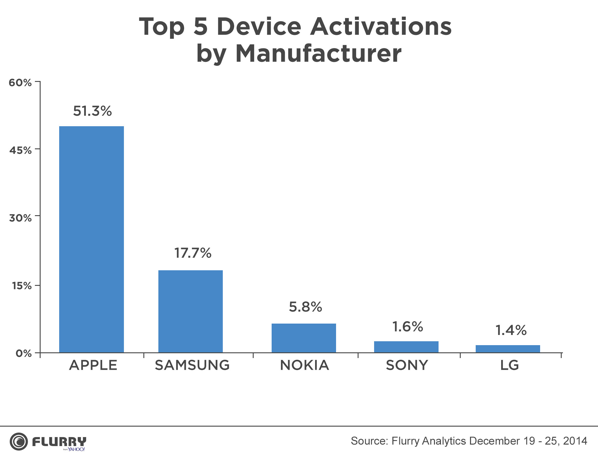
Digital analytics firm Flurry’s yearly Christmas-time study of device activations by manufacturer — based on over 600,000 apps tracked for installation — found mobile pioneer Apple in a commanding first place amongst all device manufacturers with 51.3 percent of activations; rival Samsung took a distant second with 17.7 percent, while Nokia, Sony, and LG rounded out the top five with 5.8 percent, 1.6 percent, and 1.4 percent, respectively.


Marketers and app developers looking for takeaways from Flurry‘s report should note that iOS still rules the roost despite its decline from stratospheric heights of market share a few years ago.

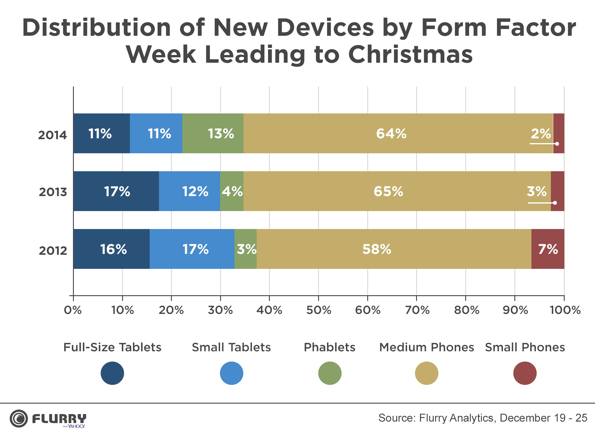
Though Android remains a strong competitor, consumers still flock to Apple’s new products in droves; the iPhone 6 Plus’s release coincided with an increase in the popularity of phablets, mobile devices with screen sizes and capabilities between those of a smartphone and a tablet.


If this Christmas’s activation figures should serve as a guide for 2015, Apple’s dominance will remain as phablets continue their march into the mainstream. As time spent on mobile now outpaces time spent watching television, marketers and developers would be wise to adapt mobile-first strategies with iOS and larger screen sizes in mind.

The Year In Gaming: Microsoft

When 2013 came to a close, Microsoft found a contender in the game industry with its Xbox One console, but couldn’t quite keep up with Sony in terms of pricing, availability and accessibility, since most consumers were “stuck” needing to purchase a motion-sensitive Kinect device with their console – even if they didn’t need it. But by the end of 2014, Microsoft turned around its success, and is now giving Sony a run for its money heading into the New Year.

After providing the option to purchase bundles that didn’t include the Kinect device – and also came with an alluring set of pack-in games including Sunset Overdrive and Call of Duty: Advanced Warfare – Microsoft’s slump in sales quickly went away. People began buying the special bundles in droves, and, as a result, the system has now sold over 10 million units, almost caught up with Sony’s system.

Not only that, but Microsoft showed its fans that it truly cares about them with a number of key exclusives. Sunset Overdrive turned out to be one of the year’s biggest surprises, a colorful action romp that has received universal acclaim with both critics and fans. Forza Horizon 2 easily topped the original in terms of both quality and control, becoming a hot-seller for the Xbox One in no time flat. And the multiplayer shooter Titanfall was an immense success, as there’s word that EA is already considering ideas for a sequel, although it hasn’t been confirmed yet.

That said, Microsoft’s year hasn’t quite been as easy as it was hoping. The company still struggles to make an impact in the Japanese game market, as the Xbox One sold fewer than 100,000 units with its debut there. And some games have run into their fair share of problems, including the key release Halo: The Master Chief Collection, which launched with a number of online issues – and considering how popular that game’s multiplayer components are, many fans were let down as a result.

Regardless, Microsoft managed to bounce back and retain its piece of the video game industry, and, heading into 2015, it has its own fair share of promise coming up, including a forthcoming beta for Halo 5: Guardians (which starts today) and various exclusives sure to be announced at this year’s Electronic Entertainment Expo – including a game streaming service that could be better structured than Sony’s PlayStation Now.

Microsoft has definitely come out ahead in 2014, and this coming year could be its best one yet – provided it stays on task with big hits like Halo 5 and keeps showing its love for its gaming fans.

The Year In Gaming: Sony

Going into 2014, Sony was showing a dominant lead in video game console sales, with the PlayStation 4 clearing millions of units sold worldwide and preparing to debut in other markets, including Japan, where video game sales were quite popular.

However, the following twelve months would prove to be a bumpy ride for the company, with both a series of highs and lows. The highs came with the introduction of killer software, including games like The Last of Us Remastered (which originally released on the PlayStation 3 a year prior) and LittleBigPlanet 3. The PlayStation 4 also managed to make big sales moves over the year, with 13.5 million units sold worldwide before the holiday season, since the console’s debut last year.

The company faced its hardships as well, though. The introduction of its streaming PlayStation Now service was innovative, but met with harsh criticism due to an uneven pricing model, with most games costing quite a bit of money to rent. (Sony has insisted that it will continue working on it in the months ahead, however.) The PlayStation consoles also saw some heavy outages over the holiday season, with PlayStation Network being down over the course of the Christmas holiday. Finally, certain titles, like DriveClub, had their own problems, resulting in less-than-stellar sales.

Still, the company is primed for a very successful 2015. Various games are promising to be huge sellers in the new year, including the action-packed The Order: 1886 and Bloodborne. The return of hero Nathan Drake in Uncharted 4: A Thief’s End should also be quite promising, and several “indie” titles should help bolster the company’s line-up as well.

Finally, the debut of the PlayStation Experience showed just how devoted Sony was to its fanbase, with three days full of events, exclusive announcements and other surprises. It ended up being a tremendous success, and with Sony booking Las Vegas space over the next four years, it looks like it’ll be around for quite a while.

Yeah, Sony hasn’t exactly had the smoothest of years, but it still impressed with its line-up of games, and managed to work its way through errors to still surface as a winner in the industry for 2014. And chances are things will just get bigger and better the next year around…

PlayStation Now Debuts On Other Platforms

Up until this point, Sony’s streaming PlayStation Now game service has been exclusive to PlayStation consoles and select Sony TVs, providing a number of PlayStation 3 games that could be played anywhere using the patented Cloud-based service. However, it appears the service is now expanding to a new set of devices.

Sony has confirmed that it will launch the service on “select Samsung smart TV’s in the first half of 2015,” marking the first time that PlayStation-based games will be available without the need of Sony hardware to play them on. The service will be introduced as an application for these televisions, although customers will still need a DualShock 4 controller in order to play them.

The service will include “the ability to earn in-game trophies, play games online with friends, and save your game progress in the cloud.”

There has been mixed criticism with the Now service up to this point, with a great selection of games marred somewhat by high rental prices. However, Sony has indicated that it’s working on pricing as the service continues forward, and, by the time it launches for Samsung televisions, it could easily have lower rates in place so that it catches on quicker with a mainstream audience.

Various games are available on the service, including such big hits as God of War Ascension, The Sly Collection and Ultra Street Fighter IV, but, again, it’s likely that it should be expanded even further by the time it hits Samsung TV’s, with even more first-party exclusives and other popular third-party titles, so players will have a better selection to choose from.

It’s expected that Samsung will have these televisions on display in just a few days’ time at the Consumer Electronics Show in Las Vegas, which takes place from January 6 through the 9. As part of the deal, the company should have demonstrations of how smoothly PlayStation Now works on them, although that isn’t completely confirmed. Still, if there’s any place to show off the service, CES seems like the most likely event…

Game Ads Thrive On Japanese TV

A number of advertisers are always looking for an effective way to sell mobile games and apps, but one method that appears to be working its magic overseas is television commercials. Yep, you heard that right.

A report from Tech In Asia indicates that the rise of popularity with TV ads for mobile games is quite easy to notice. Numbers provided by Mobile Marketing Data Labo (MMDL) indicate that, through a poll of 562 men and women over the age of 20, 52.7 percent of respondents have noticed Gungho’s recent advertisement for the puzzle/RPG Puzzle & Dragons. Meanwhile, 34.5 percent of those polled have also seen a commercial for Mixi’s Monster Strike, a game that managed to overtake Puzzle & Dragons on the top of the app charts last month in Japan. 30.2 percent have also seen an advertisement for the role-playing game White Cat Project.

Out of those polled, 22.4 percent of respondents said that they downloaded a mobile game after viewing a TV ad. While that’s not as great a reach as other means of advertising, it’s still hard to ignore. 35.9 percent indicated that they downloaded an app after seeing an ad on their smartphone, which continues to be the most effective method. (In third place, friend or co-worker suggestions earned 15.3 percent out of the poll.)

MMDL also provided a number of other statistics in their findings, including:

-The top three game genres in Japan are puzzle, simulation and farming

–Puzzle and Dragons (Gungho), Disney’s Tsum Tsum (Line) and Puyo Puyo Quest (Sega) are considered the year’s biggest mobile hits in Japan

-46.1 percent of respondents confirmed they play smartphone games daily (with 40.4 percent consisting of men and 52.1 percent of women)

-72.9 percent of respondents own between one and four games on their device

-4.5 percent of respondents actually have more than 11 games on their device

Some interesting food for thought leading into 2015, that’s for sure. Maybe a few more companies ought to consider making more game commercials – that’s certainly the route King took with its Candy Crush Soda Saga ad…


Pardo: Olympics Should Include Video Games

With the Olympics, athletes around the world have the opportunity to prove their skills for their country, whether it’s with running the hurdles, throwing a discus or some other form of activity where they prove their strength. That said, a prominent figure in the game industry believes that video games could easily have their place in the official games, as players will be able to prove their strength in a different way.

Rob Pardo, former chief creative officer for Blizzard Entertainment, believes that games have a place in the Olympics, per his conversation with BBC 5live. “Video games are well positioned to be a spectator sport,” he explained.

He pointed out that League of Legends World Championships in Seoul, South Korea had no problem filling a stadium full of 40,000 people, and eSports had gained enough of a following over the past few years to be considered the next great competitive event. “There’s a very good argument for eSports being in the Olympics,” explained Pardo. “I think the way that you look at eSports is that it’s a very competitive skillset and you look at these professional gamers and the reflexes are lightning quick and they’re having to make very quick decisions on the fly. When you look at their ‘actions per minute,’ they’re clearing over 300.”

That said, the climb to eSports glory hasn’t always been easy. “That starts getting into how you define sport,” he explained. “If you want to define sport as something that takes a lot of physical exertion, then it’s hard to argue that video games should be a sport, but at the same time, when I’m looking at things that are already in the Olympics, I start questioning the definition.”

That said, Pardo believes that while gaming can’t quite be recognized as an official Olympic sport, there’s still enough of a case to show the International Olympic Committee (IOC) to plead the case, as a “mind sport.”

Pardo still believes there’s a great deal of appeal for a broad audience. “You can do whatever you want with the graphics, you can make it be really exciting and competitive.”

With millions of dollars up for grab and a growing audience, it wouldn’t be a surprise if we saw eSports make some sort of impact in the event in the years ahead. Still, it could be a while…