Twitter Adds Niche To Its Growing Stable

Twitter is always looking for new ways to expand its reach in the social media world, as indicated by its recent business moves it’s taken, including several revenue-generating measures. This week, it continued to expand on those horizons, adding another agency to the fold.

The company announced earlier this week, via CNET, that it has acquired a New York start-up called Niche, which provides connection with social media superstars and brands in an effort to create a new wealth of sponsored content. It works along the same lines of Tumblr’s Creators project, working as a talent agency that provides better outreach for certain talents that know their stuff on the social media front.

Although Twitter didn’t disclose just how much it invested in the company (it’s rumored to be worth about $30 million), it did explain its interest in it, as “a provider of software, community and monetization services for the growing creative community.”

More and more advertisers are dipping into deals with social media superstars, and this deal with Niche will help Twitter make the most out of said business proposition. “The talent and creativity across the entire media landscape is incredible, and we hope this acquisition continues to inspire people to create great content,” the company explained in a recent blog post.

With the boost in social media, the deal with Niche could also create new revenue circles for Twitter, in an effort to get it back to profitability. This could easily push it past its previously reported quarter of profit, and provide a possibility of getting new consumers in the fold as well.

Niche had previously worked with Twitter on a Vine video, one that was inspired enough to create a full-length commercial featuring several of them interconnected together. You can check out that commercial below, which has plenty of pop, especially Zach King, who creates a glass of orange juice with his tablet. (Don’t try this at home, kids.)
 

‘World of Warcraft’ Goat Raises Good Money

When special pets are offered through popular PC games, it seems players have no problem buying them in droves. That’s certainly the case for Argi, an intergalactic goat pet that was offered in Blizzard’s World of Warcraft, which avid fans snapped up in a heartbeat, while at the same time helping out the Red Cross’ Ebola relief fund.

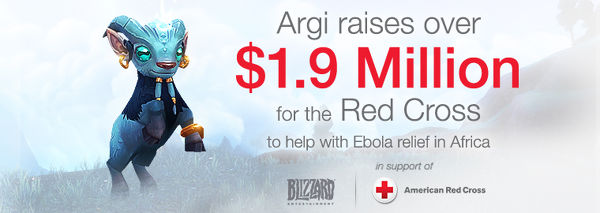
Eurogamer has reported that the pet, which was offered for virtual purchase a while back for $10, has sold like crazy, with 100 percent of sales proceeds going to benefit the Red Cross. In all, Argi (the goat in question) has managed to raise a whopping $1.9 million for the fund, indicating that, once again, gamers have no problem giving back to a good cause.

The virtual animal has no limitations either, as players can utilize Argi with any given player in Warcraft, whether it’s a current character that’s leveled up or a new character that’s just getting started on his or her quest. So it really pays off for players as well.

“Thanks to the overwhelming generosity of World of Warcraft players around the world who purchased the Argi pet, we’ve raised a total of more than 1.9 million USD to support the ongoing Ebola relief efforts in Africa by the Red Cross,” said the company in a post. “In December, we announced that for every Argi purchased by December 31, 2014, 100 percent of the adoption fee would be going to assist in aiding in the fight against this deadly disease — and the community embraced this cute little intergalactic nibbler, helping out a great cause in the process. Thanks again to everyone who helped make a difference.”

Who knew that a magical goat would be able to make such an impact And for the players that missed out on Argi initially, don’t worry — it’s still available for purchase in World of Warcraft now.

Chinese Mobile Gaming Sees Big Boost

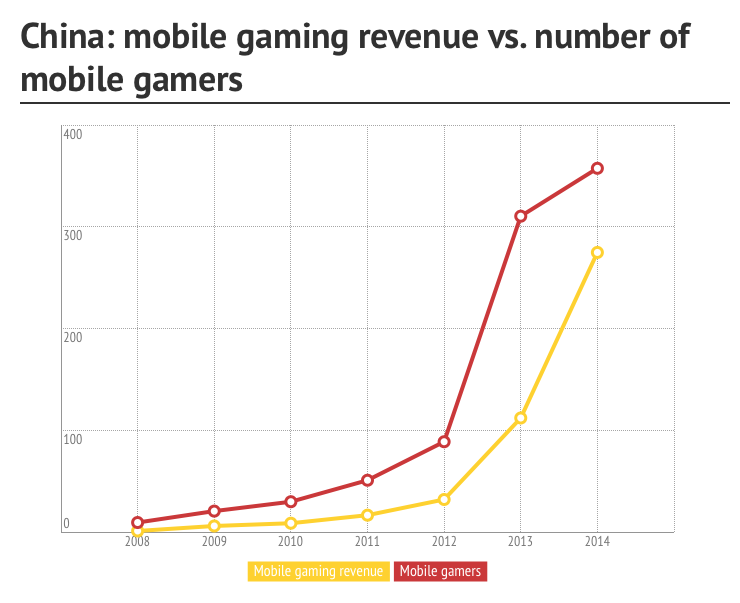
When it comes to mobile gaming, China audience is growing fast, but the revenue from mobile gaming is growing even faster.

While some games still don’t make too much in terms of profit, the general market saw a huge increase in revenue over the past year, according to the chart below. TechInAsia reports that even though the general audience of gamers remained the same, the games have managed to make more money. Mobile gamers rounded out to nearly 360 million, while the revenue has seen a significant jump, up from just over $100 million in 2013 to nearly $300 million this past year.

Most of this revenue is coming from popular intellectual property, games that have worldwide appeal. And this would indicate that more Western developers are entering the Chinese game market, even if that means making a few changes to their products along the way.

The Verge has a huge article on this, explaining how a game such as Clash of Clans generated over 200,000 in its first month on the Chinese market, despite the fact that it didn’t generate too much revenue due to the fact that it utilized a Google payment service for in-game items, which most Chinese gamers couldn’t use at the time.

According to Henry Fong, CEO of publisher Yodo1, “the market has evolved to become very, very crowded and competitive.” The games are easy to adapt to the Chinese market, even if some certain changes have to be made, such as art or characters that adapt more to general Chinese culture.

Finding the right partner can play a huge part as well. For the Android launch of Monument Valley, developer Ustwo had to seek out the right partner for the game’s distribution, unlike what it did when it released the game on the iOS front. “We really wanted to partner up with someone who understood the market and the players within it,” said the company’s executive producer, Dan Gray. So, it partnered with iDreamsky, which previously produced Temple Run and Fruit Ninja for the market.

Needless to say, the results paid off. “Downloads and purchases surged following the launch of the game’s first expansion pack in November 2014,” said iDreamsky CEO Michael Chen, “demonstrating the enormous appeal this game has to a very broad demographic which we are confident we can replicate in China.”

Rob Segal, co-founder of Get Set Games, explained that the process of moving into a new market can be a little easier with the right partner in tow. “We had games there before we had a partner,” he explained, “and I don’t think you have any chance of success without working with a partner.”

Still, Gray believes there’s potential to reach a bigger audience by going overseas with a familiar product. “Knowing there’s over a billion people who’ve never heard of Monument Valley is a great reason to want to release over there,” he explained.

Here’s to more U.S. companies making a reach for a bigger market — and succeeding as a result.

Awesome Games Done Quick Raises Big Awareness

Gamers taking part in charitable foundations is nothing new, as many participate in the yearly Extra Life event, raising millions of dollars to help sick kids at children’s hospitals nationwide. However, the team over at Awesome Games Done Quick have done some impressive work themselves, managing to get millions of views — and dollars — out of “speed running” through their favorite games.

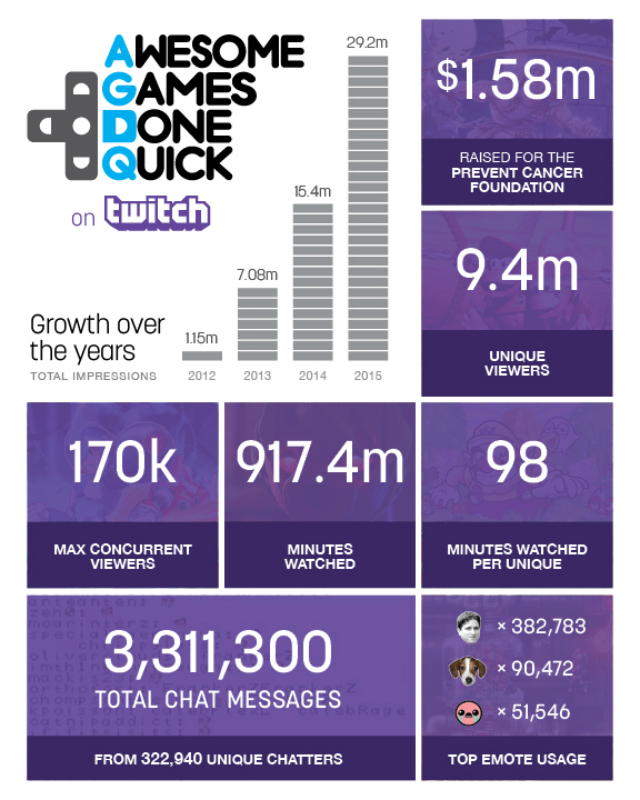
For those unfamiliar with the term, “speed running” of games means blasting through them as quickly as possible, and can range from 8-bit classics like Mega Man and Super Mario Bros. to more modern titles like The Elder Scrolls V: Skyrim. With this year’s broadcast, the Awesome Games Done Quick (AGDQ for short) team ran through 160 hours of live streaming this past January, in the hopes of raising money for the Prevent Cancer Foundation. Needless to say, it was quite successful.

Twitch.tv recently put together a chart showing just how successful AGDQ was with its broadcast, which drew in 9.4 million viewers and raised $1.58 million dollars for the Foundation. In addition, the chart also shows that the AGDQ channel has grown impressively over the last couple of years. In 2012, it had 1.15 million viewers. This year, it rose up to 29.2 million — and should be even larger next year.

As you can see by the chart, many other statistics were also revealed for individual viewers. The average unique viewer tuned in for an estimated 98 minutes, while the maximum concurrent viewers reached 170,000 in the channel at one point — pretty impressive for a Twitch broadcast that didn’t revolve around a tournament.

The social front was also huge within the channel, with a total of over 3.3 million chat messages, across over 300,000 unique chatters. Many of them also used “emotes,” or images to express certain things happening in the game, such as a puppy dog face.

It just goes to show that gamers definitely care about raising money for a good cause — all while having a good time as they “speed run” through Super Metroid.

Making Songs Out Of Selfies

Who would’ve thought that a car company would make “selfie” photos into something more innovative

The Lincoln Motor Company has created a website where users can upload their best “selfie” photos (or worst, if they prefer) to put together a custom song on the fly.

Here’s how it works. The song is put together using certain elements from each photo, with each instrument representing certain parts of the body. Here’s the breakdown:

-The arrangement of eyes puts together the keyboard harmony

-The person’s jawline helps create the bassline

-The formation of lips helps put together the tonality of the guitar

-The rhythmic percussion is formed around the shape of the person’s nose

-The eyebrows help set the ambient tone for the song

The goal of the site is to “celebrate your individuality by turning your selfie into sound, as personal and unique as your own thumbprint,” according to the description on the website.

Lincoln Motor Company has already put together an impressive gallery, showcasing all the different music styles that incorporate with the “selfies” of many users. However, that shouldn’t stop visitors from putting in their own and seeing what kind of creation their photo comes up with.

It’s a unique approach for would-be consumers, as it allows them to integrate with a tool that isn’t usually associated with automobile sellers, providing a distinctive touch that still ties in with Lincoln’s main website.

This isn’t Lincoln’s first attempt at tying in its brand with music genius. A couple of years ago, it hosted an event {link no longer active} where Emmy-winning recording artist Beck performed a cover of David Bowie’s “Sound and Vision” using a 157-piece orchestra, with artists from around the world. The video’s outreach did good business for the company, while at the same time providing Beck more room to stretch his musical creativity.

Indeed, Lincoln is on a roll every time it connects with music. Don’t be surprised if it launches future campaigns that keep things in tune.

Now Hiring This Week: Feb 11

[a]listdaily is your source for the hottest job openings for senior management and marketing in games, entertainment and social media. Check here every Wednesday for the latest openings.

$11,607. That’s how much 47 percent of workers are losing every year in earnings due to the gender pay gap. Here’s how to vanquish it.

For last week’s [a]list jobs postings, click here. Have a position you’d like to place with us Email us at pr@ayzenberg.com.

These Are The Digital Trends Poised To Take Off

Sometimes a digital trend can be hard to predict. Hot one minute, and then completely cold the next, a trend is only as good as the buzz that’s behind it — and even then, it can be hard to predict.

Adweek recently posted an infographic, located below, that discusses the various digital trends that have gained some big buzz — mainly across social media. The infographic, compiled by Bell Pottinger Digital, was put together using its online listening tool, the Crimson Hexagon, to find all publicly available data from the Internet around certain topics, which are identified as digital trends. They’re ranked below in the infographic.

“While technology will be one of the biggest drivers of marketing change in the new year, the key focus for brands will be on delivering truly integrated strategies, said James Thomlinson, partner and managing director of Bell Pottinger Digital. “Every year new hardware and software appears, but the most successful brands in 2015 will be those that harness new technology to deliver a single experience to consumers wherever they are in their journey.”

The infographic covers 15 topics in all, including the following: Near-Field Communication, The Internet of Things, Wearable Tech, Internal Communications, Storytelling, Branded Content, Beacons, Personalization, Big Data, Content Marketing, Augmented Reality, 3D Printing, Real-Time Marketing, Mobile and Gamification. Each one is broken down with certain stats and numbers, such as mobile’s outreach with over 1.4 million mentions, and gamifications’s projected market of $2.8 billion by 2016 — a huge rise from the $242 million reported back in 2012.

Out of all of these, near-field communication takes the top spot, with a 358 percent increase in conversation, thanks to 42,530 mentions throughout 2014 in news articles. By 2017, the article indicates, half of today’s smartphone users will use mobile wallets as a preferred payment method, compared to credit cards or cash.

Check out the details below, and take note. These could be the next big trends we’re looking at.


The Game Industry Opens Up To Women

It’s sad but true – some guys believe that video games are clearly their dominion, and that there’s no place for girls in said dominion. But the truth is, there is a place for them – and they’re surely finding their spot within it.

Over the past few years, there’s been an upswing in more women getting involved in the video game community, not only as players, but also as developers and executives who have some say within the industry. It shows balance within said industry, as women clearly have as many good ideas and skills as men – and in some cases, even more.

A report from The Guardian indicates that 52 percent of overall gamers are women – more than half of the industry out there. Granted, a big chunk of them come from the mobile market, where games like Clash of Clans and Candy Crush Soda Saga are just as easily accepted by females as they are males. Still, it’s a staggering sign that females do make a difference in the industry as far as playing is concerned.

That’s not all. More professional players are entering the scene, and even though some male gamers still aren’t quite accepting of them as equals, that isn’t stopping companies from opening the doors to them. But there are still limitations, like with certain tournaments holding special events for both males and female without intersecting them, as explained by PC Gamer.

And, of course, some women have prominent roles as developers within the community. Jade Raymond worked as a producer on Ubisoft’s Assassin’s Creed series for years, helping the series prosper before eventually departing the company last year to strike out on her own. And creative director Amy Hennig made a name for herself working on Sony’s Uncharted series, before eventually moving on over to Visceral Games, where she’s hard at work on a top-secret Star Wars game project.

What we’re seeing here is a shift, one that provides a welcome mat to females within the video game industry instead of the usual scornful eye. That’s not to say that everyone is willing to accept them – there are still those skeptics out there – but it seems the industry is becoming more integrated as they find their place within it. And it’s a welcome sight, as many of them provide the kind of ideas and skills that can help the industry move forward.

It’s still an ongoing fight, as some tournaments still refuse to let females compete with males, but slowly but surely, women are finding their place with games. So make room for a player two, guys. They’re here to stay.

Say Hello To Facebook’s New Ad Format

Facebook is always looking for new ways to catch its social base’s attention with new advertising, and it may have just struck gold with a new format it intends to introduce in spades – the cinemagraph.

Adweek is reporting that Facebook, through both its own site and its wholly-owned Instagram page, will encourage brands to try out the new format, which works like an eye-catching advertisement that stands out from the usual norm, utilizing a half-video, half-photograph style.

“You’re going to start seeing a ton of these on Facebook,” said an advertising executive who has seen Facebook’s guide on the new format, which has been named Hacking Facebook Autoplay.

This isn’t the first time that cinemagraphs have been seen, as they’ve been made famous for the past few years by a pair of artists, Kevin Burg and Jamie Beck, who have spent a good amount of time in the advertising world. It utilizes a similar format to a GIF, but meant to run in an ad format, instead of as a separate video set-up.

Burg and Beck have already perfected using this format on other sites (like Tumblr), and now it appears Facebook wants to give it a try to see how effective it is for both users and advertisers.

“Because of autoplay, brands need to be doing more with this stuff,” said the ad exec. “This is something that plays out with motion in the feed that’s cool.”

Stouffer’s and Coca-Cola have already signed on to give the program a try, with their own advertisements put into play. The video ads would play in motion on a user’s feed without having to click a button. “Advertisers buy it just like video,” said the ad exec.

The ads would run on repeat, and in a non-obtrusive fashion, so it may catch users’ eyes while they scroll down their page.

When it comes to the idea of the cinemagraph, Burg explained that he and Beck were just playing around with “isolated motion” when they came up with the format. They believe it’s ideal when it comes to advertising. “People can’t stop staring at them,” he explained. “Isn’t that what advertisers want ”

And it’s a format that’s beginning to pick up in popularity. “We’ve had all kinds of new inquiries (from brands),” he explained. “They don’t want video that’s so noisy; they want a cinemagraph because it has more elegance.”

No word yet on when Facebook will introduce the program on a wide scale, but it shouldn’t be too long.

You can check out examples of cinemagraphs in action here.

Behind Millennials’ Mobile Obsession

The relationship that millennials have with their phones is affecting broader media consumption habits, a fact which has been clear to publishers for some time, and marketers are eager to tap into it all. But before we address these habits, what does the picture of millennial mobile use look like now

Perhaps some numbers can help put things into perspective…

First, according to Entrepreneur, four out of five millennials own smartphones, compared to only 40 percent of people age 55 and over. Seventy-seven percent of these millennials are using their smartphone daily, which far exceeds that of Generation Xers, who clock in at 60 percent daily usage.

Furthermore, millennials don’t seem to be hopping around from one device to another. Millennials appear to be spending significantly less time with their TVs and computers. Seventy-seven percent of millennials watch TV daily, compared to Generation Xers at 86 percent, and Baby Boomers at 91 percent – a substantial margin of difference.

Going off this, 18 percent of millennials aged 18 to 34 are “mobile-only” web users, compared to only 5 percent of people aged 35 to 54.

Being a brand perceived as tech-savvy is a big deal, too. Thirty-three percent of millennials agreed they would be more likely to recommend a brand if they appear to be tech-savvy.

Worldwide, advertisers will spend $64.25 billion on mobile this year — up 60 percent compared with 2014. By 2018, advertisers will dish out $158.5 billion on mobile, or about 22 percent of all ad spending.

Now more than ever, marketers need to be cognizant of the importance of mobile marketing to millennials. The millennial generation is driving the biggest changes in how companies develop and market products and services in industries across the board.