Telltale Games Has A New Story To Tell

Over the years, the team at Telltale Games has really made a name for itself through a series of episodic game releases, including ones based on hot properties like Jurassic Park, Back To the Future, The Walking Dead, The Wolf Among Us, Borderlands and, most recently, HBO’s Game of Thrones, which is gaining huge accolades from fans. Now, it’s made a couple of moves behind-the-scenes that could mean even bigger business in the future.

According to IGN, the studio has added former Electronic Arts CEO John Riccitiello to the company’s board of directors, bringing years of experience within the industry to the team. But that’s not all. Lionsgate CEO Jon Feltheimer has also joined the board of directors.

“I’m thrilled to have these industry giants join us as we continue to define exceptional interactive scripted entertainment,” said Telltale CEO and co-founder Kevin Bruner.

Riccitiello was thrilled to join the team. “Telltale has created something entirely new. Their games combine linear storytelling and gameplay in an entirely new way that is fresh, unique and compelling,” he said.

While Riccitiello’s return to the video game industry is big news, Telltale’s partnership with Lionsgate could be even bigger, as the two are hard at work on a “Super Show” project that is part television, part video game. As a vote of confidence, Lionsgate has already announced a “significant investment” in the studio.

Speaking with Entertainment Weekly, Bruner explained how the concept of the “Super Show” works. “A ‘Super Show’ episode combines one part of interactive playable content with one part of scripted television style content. Both pieces, when combined together, are what make an actual ‘Super Show’ episode. As we’ve been developing the series, we’re using both mediums in concert to deliver our story. Developing both aspects simultaneously is key to utilizing this new medium. Both parts are first-class citizens during the writing and design process. It’s not an interactive series with a show, or a TV show with a game, but a story integrated in a way that only Telltale can do. For us, it’s a very natural evolution of the interactive storytelling expertise we’ve pioneered.”

The process to developing the “Super Show” is intricate, “but we’ve been producing games episodically for over 10 years and have brought a lot of television production techniques to our game studio,” explained Bruner.

The content for the “Super Show” should be much more than your typical one-hour TV show. “With this in mind, the release cadence will be more predictable like TV scheduling, but still a bit further apart like our games (are released) to allow newer audiences to consume and discuss both aspects of the show across their game consoles, tablets, mobile phones and computers,” he explained.

In a nutshell, “Super Show” could change the way we interact with programming, so that it’s on a far more real-time experience for those viewing it. “Our goal is to create products that have a legitimate chance of winning both a Golden Globe and a Game of the Year,” said Bruner. “This means both aspects of the productions must be first-class work.”

We should learn more about the “Super Show” idea next week during the Game Developers Conference in San Francisco. Can you imagine its concept mixed in with the Game of Thrones license Whoa.
Digital TV Ad Market Continues To Bloom

Television industry executives better pay attention, because the digital video market isn’t really “just a phase.” At least, not anymore.

A new report from video ad tech firm FreeWheel indicates that digital video operations are on the rise, with a 67 percent overall increase on their fall 2014 TV shows’ digital video ad views. That’s a huge bump from the same numbers in 2013, according to Digiday. That’s over 125 million video views measured by the company.

“That big, granular number shows what content is really driving growth,” said Brian Dutt, author of the report and advisory services director for FreeWheel. “A lot of the audiences coming into digital are coming over for the shows they would have watched on their TV or DVR.”

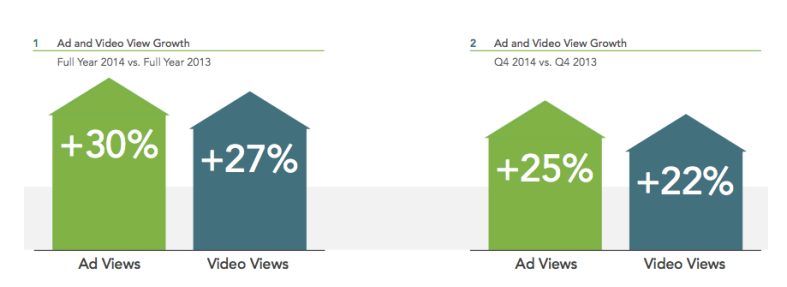
The overall industry has seen a 215 percent growth in video ad views for the fourth quarter of 2013. The charts below break down some of the finer details.

In this chart, you see that traditional television advertising is still popular, but not quite as strong as digital video, as the numbers show a slight difference by about three percent in both categories, including full year and Q4 breakdowns.

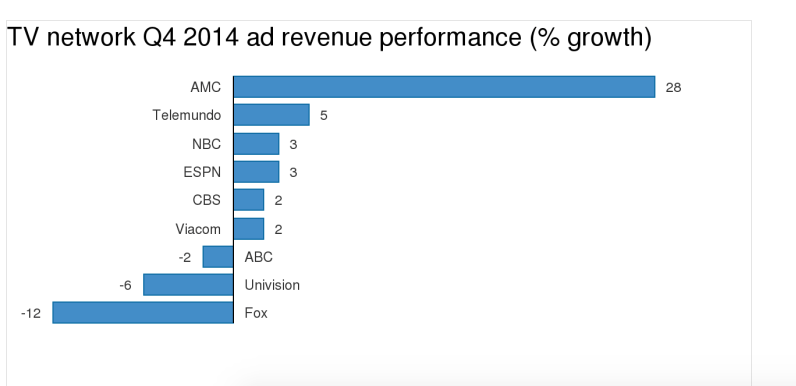
When it comes to ad revenue growth, total ad spend came to $68.5 billion, compared to just $6 billion for digital video the year before. Traditional networks are starting to find more of an audience, but, as you can see, AMC still rules the roost, behind such original programming as Breaking Bad and The Walking Dead.

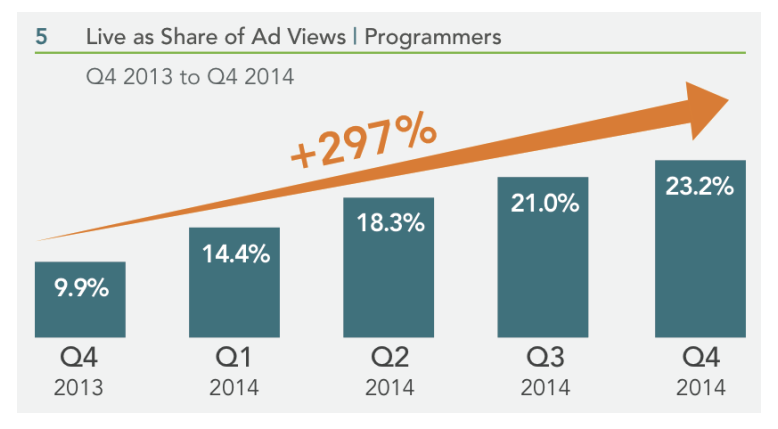
Live sports really make a difference with digital video, and sports play a part in that, along with TV shows and feature films. “Long-form” content, as it’s considered, accounts for 52 percent of overall digital ad views – and, as you can see from the chart above, it’s been rising steadily over each quarter.

“There’s obviously still a long way to go for digital video to match the scale of (traditional television), but it can happen in pretty quick bursts,” said Dutt. “The growth in TV Everywhere and live really speaks to that.

“It starts with the Olympics or World Cup or Super Bowl, these big events where if you’re not near your TV and need to engage with the content, you’re going to do whatever you need to do to watch,” he continued. “Then it becomes a way people want to continue engaging with content.”

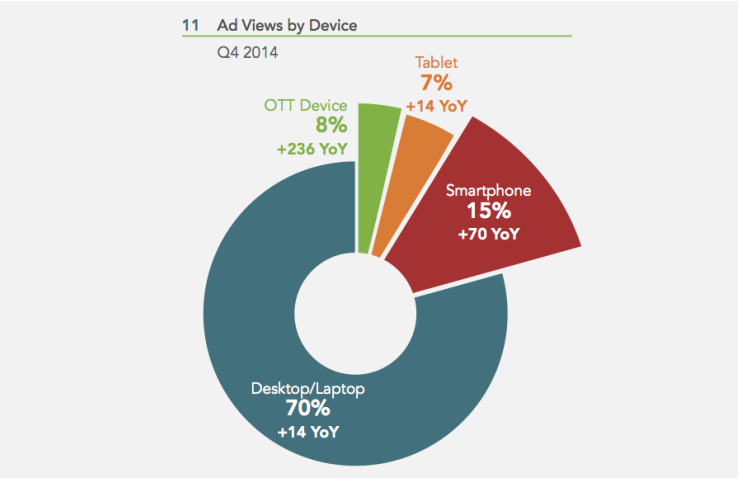
While tablets and mobile devices are key ingredients to digital viewing success, people still prefer set-top boxes and game consoles, like the PlayStation 4, to get their fix, according to this chart. 70 percent of overall views seem to come from a more stable desktop/laptop set-up, compared to only 15 percent for smartphones.

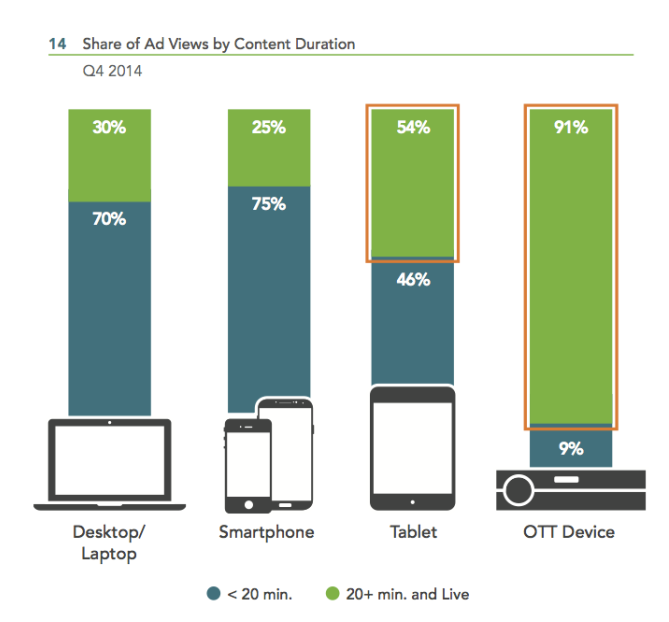
“A lot of the initial usage has been focused on subscription models, and also the download-to-own models,” explained Dutt. “The ad models have been a little bit slower to get into those environments, in part because of measurability issues… but, at the end of the day, the 50-inch screen in your living room has to be the place where people engage with premium content in an ad-supported environment.

“One day we’re all expecting that (over-the-top) devices will drive the lion’s share of the growth.”

You can learn more details about this report here.

Google’s Jason Spero On Getting Mobile Marketing Right

Marketing doesn’t come easy – nor should it. Exploring new ideas and finding products that can connect easily with consumers are always a work in progress, as companies attempt to improve upon their practices and, as a result, pick up more business.

But paying attention to the consumer and understanding their path to purchase is a vital ingredient in this success, at least according to Google vice president of performance media Jason Spero. Sometimes the path to what leads to a purchase can be more important than the purchase itself, according to this VentureBeat article.

Spero talked at this week’s VentureBeat Mobile Summit in San Francisco, explaining the logic behind this thinking. “The more you can capture data” for said path, “the more you can have a one-on-one conversation” surrounding the consumer, according to Spero.

Data plays a key part as well, as the more data that’s captured about the consumer’s lingering for a product, “the more you can build attribution models for a multi-touch world,” he explained.

Engaging consumers – and making sure the right teams are doing so – is also important. “It’s going to be about who has the data,” he explained, “who understands the user.”

Knowing intent is above all else, no matter what other data comes into play, though. He believes that “layers of intent” make all the difference.

Spero’s thoughts come at a time when mobile marketers are having a struggle trying to figure out how to attribute sales to specific content and devices, according to this subsequent VentureBeat piece. Joe Megibow, chief digital officer at American Eagle Outfitters, gave his thoughts on this subject at the Mobile Summit conference in Sausalito, California earlier this week.

With multiple devices being used, ads can be seen in a more common way, although marketers could have a tough time figuring out which ones are successful. Word of mouth is also hard to track at times, especially if social media isn’t used.

Megibow explained through an IBM study that, although 50 percent of consumers use mobile devices for purchases, far more actually go through their desktop computers, where they outweigh mobile ones nearly three-to-one.

“If mobile is growing like crazy but it is converting only a third as well as on the desktop, you have a serious problem,” he said. “The data is saying ‘don’t spend any more marketing dollars on mobile,’ but that’s obviously wrong.”

Mollie Spilman, Critero chief revenue officer, had her own thoughts as well, believing that 27 percent of sales now take place on smartphones – and they’ll only get better. “More sales are going to happen on smartphones than tablets or desktops,” she explained.

To learn more on this research, check out this report here.

There’s No Auto-Jump On Marketing Automation

Marketing automation plays a decent part in business these days, and, according to eMarketer, it’s only going to get bigger.

Of course, that’s because there’s plenty of room to grow. A report from Ascend2 held back in December indicates that only 24 percent of marketing professionals on a worldwide basis report using any form of marketing automation to an extent. However, there’s potential in growth in the years ahead, as 35 percent indicated they use it a limited amount, and 34 percent that weren’t currently using it stating that they would in the future.

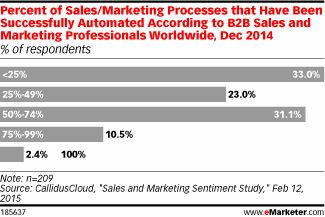
CallidusCloud had equally small findings, with just under 13 percent of those polled stating they had successfully automated 75 percent or more of their sales and marketing processes. More than half also said that fewer than 50 percent of their processes were automated.

However, it’s a big part of business for future purposes. Ascend2’s poll indicates that 86 percent of respondents believe marketing automation can be successful to achieving certain objectives for their companies. However, only 25 percent believe this could be “very” successful, with room for improvement in the user department.

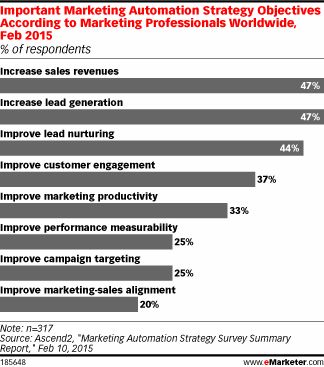
When it comes to a good marketing automation strategy, 47 percent of those polled believe increasing sales revenues and lead generation are key areas, followed by improving lead nurturing (44 percent), improving customer engagement (37 percent) and improving marketing productivity (33 percent).

However, only 20 percent of respondents stated that improving marketing-sales alignment was a top priority for marketing automation. This is a bit of cause for concern, but there’s always room to learn and, eventually, grow.

But spending is about to increase big-time with technology, as CIO reports that spending will jump by $120 billion over the next decade — a whopping jump from the $1.2 billion for this year. “This is unprecedented growth in any software category I’ve ever come across,” said Ashu Garg, general manager for Foundation Capital. “There’s a fundamental shift, an irreversible trend, of consumers living in a digital world” with a demand for more marketing technology.

That said, some marketers still need to figure out a way to master its tech, mainly in the social media department. Adweek reports that approximately 87 percent of business to business marketers use social media, but less than one in five (17 percent) can actually measure return on investment, or ROI for short. In the business to consumer market, the number is a little higher in both areas, but only by 87 percent for general social media use, and 27 percent being able to calculate ROI.

So, as you can see, there are still improvements to made all around with marketing tech — but the market will grow, and there’s no stopping it.

What Will Twitter And Google’s Deal Mean For Marketers?

When two social media giants team up, it provides enough impact for marketers to listen – and they probably won’t want to miss out on this.

Twitter CEO Dick Costolo confirmed that the social site has teamed up with Google in a “firehose deal,” which will allow the company’s tweets to be used in Google searches once again. As such, Twitter expects to drive in more traffic for the site.

Tweets disappeared from Google searches back in 2011, lessening the impact of looking up particular information posted on the social media site. Now, with this deal, they’ll be brought back into the spotlight, although Costolo stated that they won’t appear for “several months,” according to TechCrunch.

With the deal, Google will also benefit, as it’ll be able to use real-time content with its searches, along with traditional website searches. This, in turn, can benefit marketers in a number of ways. AdAge recently posted an article that explains five different tips that can be used to integrate these new search and social terms with the deal, and they’re briefly broken down below:

Search and intent-based optimization is now a critical factor. The right optimized content has to be used in search terms, or there’s a possibility that it can’t be seen at all. Brands need to revitalize with its search and social teams, having them work together to optimize tweets and social messages with high-value content.

Treat tweets like ads or landing pages. A tweet can be more than a simple message, as the Google results now allow it to have a large increase in organic reach. “Brands need to treat tweets like ads or landing pages,” the article reads. “Have a meaningful call to action in your tweets or have a link to the brand site with more information. A simple message is not going to get your user to take action.”

Monitor conversations and react. Interaction can be key for driving up a larger consumer base. Should someone leave a negative comment, ignoring it can be a problem. Companies will want to be proactive and engage or offer some form of remediation to fix the problem. In the past, brands may have just considered letting them pass; but with Google now being a factor, resolution becomes a necessity.

Words last forever. With Google and Twitter intertwined, tweets can still show up on Google, even after deletion, so brands will want to be careful with statements made on their sites, as well as security. (A recent breach on Chipotle’s Twitter page shows just how easily someone can go in and hack it with negative perception – consider it a lesson that brands should learn.)

Anticipate the search impact. With new content on a search results page comes a bigger impact on overall search traffic. A paid listing can have an effect with organic traffic, but posting tweets can improve that, along with paid traffic. They should still be monitored, though, with key terms and adjusted bidding for certain corporate outreach.

More information can be found in the report here.

Metaps Helps Launch Apps

Launching a new app or game on the market can always be a risky move, as there’s always a question with outreach — or how well it could do on a global scale. However, Katsuaki Sato is here to help.

A new company called Metaps, founded by Sato, can assist companies with maximizing app downloads and monetization, according to its official blog page. Tech In Asia managed to simplify the terms with its own blog entry.

Said Sato about the service, “We used a scientific, data-based approach in determining which paths to success are available for app developers looking to expand globally.”

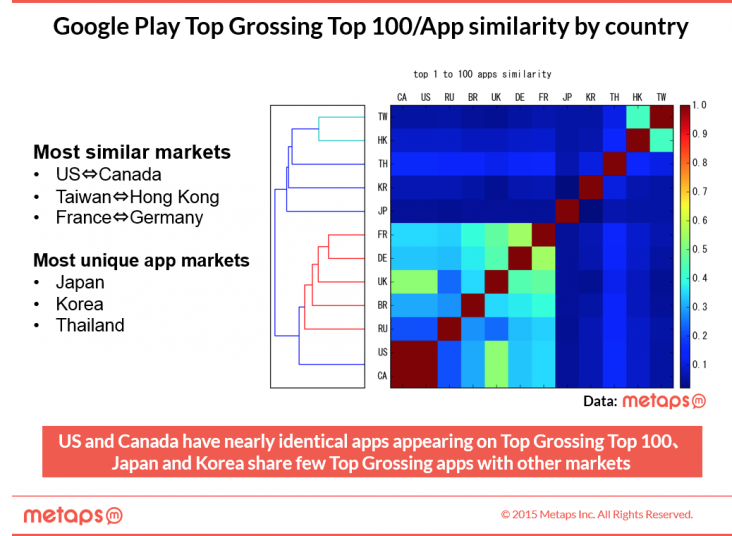
So how’s it work? The team utilizes the Google Play top grossing charts of 12 primary app markets, and then checks similarity based on the number of shared titles. In addition, genres that make up the top grossing charts are verified, and then checks in terms of similarities between countries.

Sato explains that the site also uses certain logic when it comes to determining the degree of crossover with the top grossing app charts across two markets. “If no specific apps are shared on the top grossing charts for country A and country B, then the two markets are to be considered similar,” he explained, delving right into the second point. “If all apps are shared, then the two markets are to be considered very similar.”

Sato’s team also put together a chart that breaks down these markets, with dark red markers that show similarities between the apps on the Google Play Top 100 chart, and dark blue posting a dissimilarity. As you can see, both are clearly marked on the chart, making it a little easier to understand.

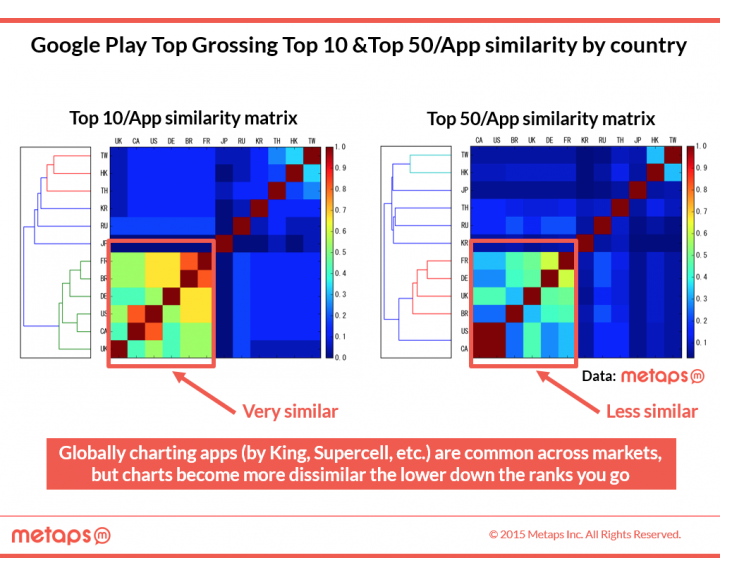
An additional chart was also put together, highlighting what would happen when the top 10 and top 50 apps were isolated, in order to point out notable differences in terms of tracking a pattern with similar apps.

Sato also noted at the conclusion of the report, “Finally, if you are looking to make a worldwide hit, there is one last point to keep in mind. Non-game apps do not tend to chart high on the Google Play top grossing chart, a trend shared amongst all markets considered here.”

To get more specific market data and learn more about what Metaps has to offer, check out this article here.

Twitch Going Convention-al With The Debut Of TwitchCon

We’ve seen conventions devoted to video games, comic books, movies and other levels of nerd-dom – so, it only makes sense that streamers on Twitch.tv get their day as well.

The channel, which was acquired by Amazon last year for $970 million, has announced that it will host its first convention, TwitchCon, in San Francisco on September 25-26. The company has stated that the show will “be an interactive convention for broadcasters and viewers alike to meet each other, learn how to take your Twitch game to the next level, and play together.”

“Twitch broadcasts have the most passionate fans, so we want to create an amazing experience where they can come together in person,” said Emmett Shear, CEO for Twitch. “TwitchCon will be an opportunity for the entire community – broadcasters, game developers, viewers and us – to play and learn together.”

TwitchCon is the latest convention show to be devoted to fans and users of a popular media outlet, as Penny Arcade has become famous for hosting similar shows with its yearly PAX events, which are held in Seattle, Boston, Australia and, most recently, San Antonio.

So what does TwitchCon mean for the streaming community and business in general Simple – it’s booming. Twitch continues to have big numbers when it comes to attracting gamers that want to show off their skills in games like League of Legends and World of Warcraft, and with its accessibility on game consoles like Xbox One and PlayStation 4, more casual players are getting into the action as well.

With TwitchCon, attendees can learn a thing or two about what it takes to thrive in the streaming business, between possible seminars that provide education on the matter (yet to be announced, but they’re looking likely) and popular Twitch stars that can provide a tip or two on how to achieve greatness. Companies can learn more about Twitch devotees, and use the opportunity for some information gatehring and perhaps some dealmaking. It’s a great event for marketers interested in everything related to Twitch — and its audience of more than 100 million viewers.

Twitch expects to announce a schedule for the event over the next few months. And for those who can’t attend, not to worry – some sessions are likely to be streamed. After all, it is a TwitchCon.

More information should be available on the official TwitchCon page soon.

Amazon Hires Former ABC Marketing Boss To Run Marketing For Original Series

by Sahil Patel

As its Amazon Studios arm continues to churn out more and more original series (and soon, movies), Amazon has hired a former ABC marketing executive to, well, market that content.

Mike Benson has been named head of brand marketing and creative development for Amazon Digital Video. In that capacity, he will oversee marketing and advertising for Amazon’s original series.

Benson has plenty of experience on this front, having spent 12 years as EVP of marketing for the Disney/ABC Television Group. There, he oversaw all marketing, advertising, and promotional pushes for ABC’s primetime, late-night, and ABC Studios-produced programming, including “Modern Family,” “Lost,” and “Desperate Housewives.”

Read more…

This article was originally posted on VideoInk and is reposted on [a]listdaily via a partnership with the news publication, which is the online video industry’s go-to source for breaking news, features, and industry analysis. Follow VideoInk on Twitter @VideoInkNews, or subscribe via thevideoink.com for the latest news and stories, delivered right to your inbox.

Machinima And Warner Bros. Team Up For Funding

Machinima is about to create a whole new wave of programming, thanks to a second investment with its recent partner, Warner Bros. Entertainment.

The company has given the online network another $24 million in financing, according to GamesIndustry International, which now puts its total of investment in Machinima to over $40 million. Warner, alongside other existing developers like Redpoint Ventures, MK Capital, Coffin Capital and Allen DeNBevoise, previously financed the network with an $18 million investment back in March.

As a result, Machinima’s viewership has been growing, with an increase by 70 percent in unique viewers. The U.S. alone accounted for a good chunk of this audience, tripling its usual viewer numbers. Diverse programming has certainly helped, including the debut of the Mortal Kombat: Legacy II series, which was an exclusive to the network.

“In 2014, Machinima regained our leadership position in the global digital video marketplace by focusing on our Talent Network and transforming our brand into one that is reflective of our content, our audience and our community of creators,” said Machinima CEO Chad Gutstein. “This additional funding will enable Machinima to accelerate our growth through increased investments in content and technology that better serves our audiences, advertisers, creators and distributors.”

Warner Bros. will no doubt play a huge part with the network’s programming, as it’s already lined up its new animated series Justice League: Gods and Monsters Chronicles to make its debut later on this year. There’s no given date yet, but it’s likely to be around late summer or early fall.

So what does this mean? It means that Warner Bros. is becoming more serious about involving itself with a digital network, while Machinima improves upon its business model with a wider range of programming. We’re likely to see more collaborations between the two over the course of the year, particularly with tie-ins to Warner Bros. products, such as movies and video games.

YouTube Adds Music Subscription

YouTube continues to be a popular outlet for some – and it has even allowed certain superstars to find a bigger outreach to TV, as noted by this recent deal through StyleHaul to bring its vloggers to the Oxygen cable network. However, there have been mixed feelings about the website’s new music subscription service, with some artists indicating that they’ve been unfairly shut out.

Regardless, YouTube is moving forward with the service – and has a new plan in place set to make it more appealing to a mass audience. Per CNBC, {link no longer active} the company’s subscription model would actually remove ads from music videos for paying customers. There are some catches, though.

The first is that the program only works with “eligible” music videos, although YouTube didn’t list the terms in regards to what counts as eligible. The second is that the ads would still continue for non-music related videos, which is the status quo for most of YouTube’s programming anyway.

YouTube hopes to launch the service sometime over the next few months, with the team still hammering away on things here and there to make sure it runs smoothly. If all goes according to plan for the company, it’s likely to open a new revenue source for the site, as well as give content creators the opportunity to gain a new audience – even though they can still post videos as they please with the service now.

This isn’t the first time that YouTube fiddled with a subscription service, although it’s on a much greater scale now. Back in 2013, YouTube tried a program where users could pay $1 a month to watch ad-free videos. Obviously, that program eventually faded away, but the same thing isn’t likely to happen with its music program – at least, that’s not the way it looks thus far.

We’ll see how this unfolds over the next few months, but we’re pretty sure that some people will still be skeptical of its success, especially when it comes to whether they feel like paying a subscription fee or not. Time will tell.