Hollywood Values Tweets Highly

Social media obviously plays a big part with movie releases — just look at the online hype behind such efforts as Sharknado 2 and Snakes On a Plane — but the real value comes from tweets that are pointed at films leading up to their release.

According to Variety, the value behind a single tweet, on average, that focuses on a film during its opening weekend, is estimated at $560. This information comes from a study conducted by Networked Insights. That value can vary, though, especially depending on how closely it goes up to coincide with the film’s premiere.

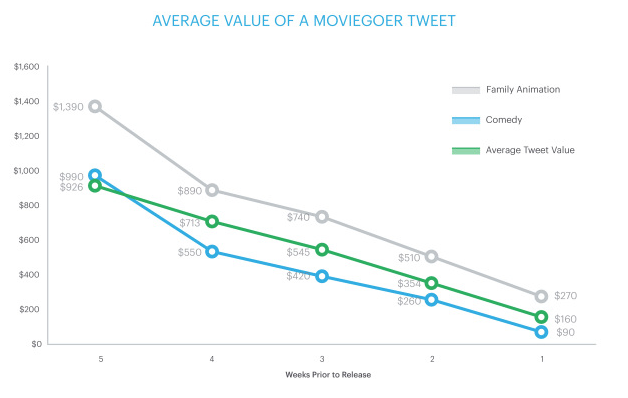
An example of this has a moviegoer’s tweet pricing around $713 on average for additional box office revenue, but it drops to as low as $161 a week before the film’s release. Thus explaining why even the most hyped films can have a severe drop-off, no matter what kind of hype gets behind it.

The report states that the value can vary by genre, with tweets to animated family films getting better exposure because of the multiple ticket holders that go see it — compared to, say, the hoopla surrounding Fifty Shades of Grey, which has seen a tremendous 70 percent drop-off in box office sales following its debut week.

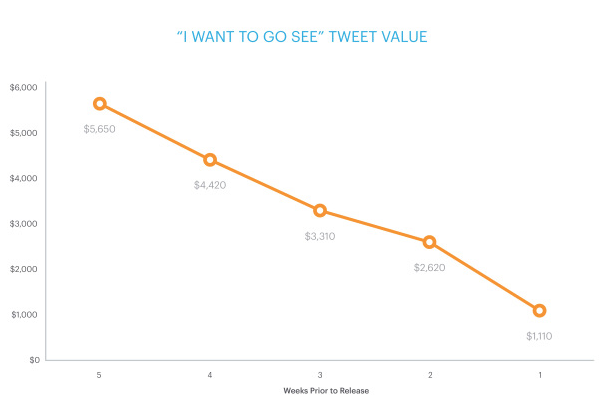
As you can see from the charts below, Tweets have a habit of degressing leading up to the film’s release, and you can see just how effective family animation is compared to, say, comedies.
There are factors that tie in with the excitement for a film, such as Marvel Studios revealing several character-oriented posters for The Avengers: Age of Ultron, leading into its May 1 release date. Also, TV spots that include footage from upcoming movies can play a part, enticing people to get that much more excited about a film. Star Wars: The Force Awakens managed to excite people all over the Internet, and that trailer debuted well over a year before the film’s release, which is December 18.

‘There’s been a lot of discussion over the value of social data when it comes to the movie business,” said Dan Neely, CEO of Chicago-based Networked Insights, which tracks social media discussions in real time. “We wanted to look at what’s the actual value of the consumer engaging with the movie landscape. Now you can actually put an empirical value on it.”

One other study that producers and studios could pay attention to is a new Tweet per Impression metric being introduced by Nielsen. Variety reports that with the system, studios can see just what kind of a social impact Twitter has on its products, be it movies or TV shows.

“We’re going to spend a lot more time focusing on this category,” said VP of client services Erika Faust, talking about the system. “Advertisers now want to start looking into this.”

Right now, the study is focused on the entertainment industry, although it could easily go into other categories if successful. “It’s early days, but we’re finding a lot of interest from studios using social as another indicator and for networks to use to their advantage as well.”

Looks like it’s time to go to the movies.
Mobile Cost Per Loyal User Hits Record

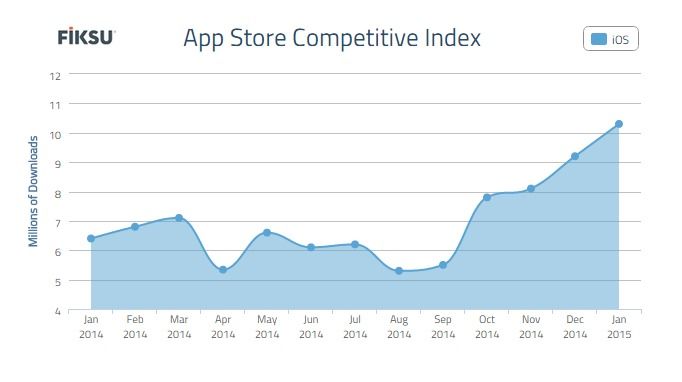
The January 2015 App Store Competitive Index already indicates a strong start for the year when it comes to mobile apps, as they easily surpassed the 10 million download mark, with 10.3 million daily downloads, up from the previous record of 9.2 million. That’s a 12 percent growth month-after-month, and a 61 percent leap from January 2014.

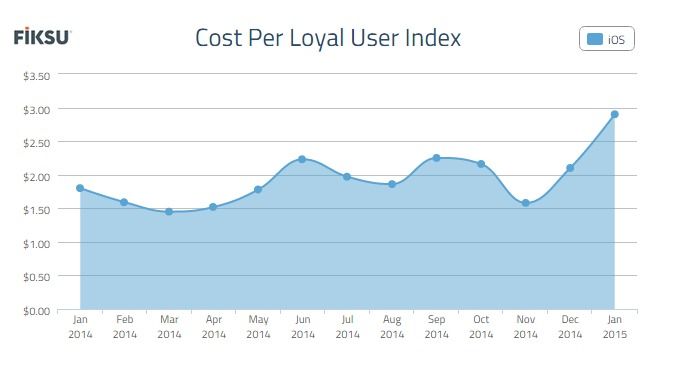
However, with that, mobile marketing costs are also on the rise, according to Fiksu. The Cost Per Loyal User Index (or CPLU) shows the cost of acquiring a loyal user for brands that actively market specific apps. It’s sitting at an all-time high of $2.90, highlighted by the chart below. That’s a 38 percent jump from the previous month, and a 61 percent year-over-year increase (compared to just $1.80 from January 2014). The numbers increased across both iOS and Android alike.

Marketers are following suit, adapting to what Fiksu calls “the new reality of apps” with consumer demands focusing more on major brands, thus building a new demand on the app landscape in general. Of course, there’s also some light concern with these costs, as some marketers have to make adjustments so that profit is still met. (With more popular apps, like Clash of Clans, this obviously isn’t too big a concern.)

What most companies are paying attention to now is to see if this growth in CPLU continues, since it has risen quite a bit over the previous year. With that, some marketers may have to adjust, becoming more strategic with their marketing plans and learning from channels that provide layers of audience targeting. This includes a heavy outreach via social media, including Facebook, Twitter and RTB. More precision targeting and bigger strategies could also help adjust costs with earnings, and hopefully keep the flow of popular apps going in the months ahead, leading into 2016 — where the numbers could be bigger than ever.

Fikus also tracked the rise in CPI for January. “The January Cost Per Install Index (CPI), which measures the cost per app installs directly attributed to advertising, increased to $1.28 on iOS, a 9 percent rise since last month and a 7 percent increase since last January. On Android, CPIs also rose 9 percent for the month, to $1.53, a 23 percent increase since last January. As the shift to more sophisticated targeting is evident, marketers can expect that a larger part of their mobile strategy will include channels that offer several layers of audience targeting, such as Facebook, Twitter and RTB, which will increase CPIs but also increase the value of each acquired user,” noted the company.

The full results of this report can be found here, on Fiksu’s page.

Image source

Why ‘Fable Legends’ Going F2P Matters

Microsoft sure is giving plenty of free entertainment to its subscribers. It’s offering a handful of favorites as part of its Games With Gold program next month, including Rayman Legends and Bioshock Infinite; and it recently announced a promotional Forza Horizon 2 expansion that ties in with the forthcoming film Furious 7. However, perhaps the biggest shocker is when developer Lionhead Studios decided the fate on the adventure game Fable Legends, opting to give it a free-to-play business model.

Microsoft announced the plan this week, in an effort to promote the forthcoming Xbox One/PC adventure game for its release later this year. The game will operate on a cross-platform basis, and its content will be wide open for players, with the option to purchase other goods through Microsoft’s virtual Xbox Live Marketplace.

The move is an important one for several reasons. First, while both Sony and Microsoft have allowed free-to-play games on their consoles before (World of Tanks on the Xbox 360, Warframe, DC Universe Online, and other games), this a major exclusive by the console owner, and it’s not an MMORPG. There will likely be many more free-to-play games appearing on consoles, and if they become increasingly successful this will put pressure on games that have a $60 up-front cost. Microsoft isn’t waiting for some other publisher to get established in this sector, but it’s going there ahead of them. This may accelerate the move to free-to-play, if it does well.

Speaking with Eurogamer, Lionhead Studios lead John Needham explained the decision, which, in a way, was influenced by Riot Games’ immensely popular adventure game League of Legends. “There’s no denying the similarities there,” he explained. “We all play League of Legends. I’ve spent a good year-and-a-half of my life hard playing League of Legends and love it. So there’s no denying that was the big inspiration of ours.”

Director David Eckelberry explained how well the free-to-play model works with certain console games, noting Wargaming’s World of Tanks for Xbox 360 – which is coming to Xbox One as well this year. “For me, the better ones for the customers are the ones where you get to enjoy all of the content without paying money. And then you pay if you want to.

“Our mission is for a fun experience on any platform. As a first-party studio our goal isn’t to invoke anything vaguely like buyers remorse. I want my players to feel like, oh, I bought something cool. I don’t regret that purchase. That’s what matters to me.”

He continued, “When I’ve played my 30th hour of Hearthstone, at some point I decided, I should probably give Blizzard some money. I felt like I owed them something because they’d made such a great game for me to play, and I didn’t need to spend money in the game, but I thought I should. So I bought some card packs. I did the same thing in Team Fortress and eventually in League of Legends.

“That’s the kind of feeling I want to invoke with our players. I want them to have such a fun experience that some percentage of them go, okay I’m going to buy a hero that just came out, or I’ll get Winter a new hairstyle and a cool-looking hood. That’s the kind of feeling we want to generate in our players where, we’ve offered them such a good time that they’re spending time in it that they feel valuable,” he concluded.

With the move, Microsoft could easily shift the market more in the favor of Xbox One, and intends to add even more to its library with announcements coming this June at E3…and perhaps even sooner.

Fable Legends will release later this year.

Issues Need Addressing For eSports To Grow

Twitch has had a remarkable year with its online broadcasts, ramping up the culture of eSports as we know it and also bringing out a number of players and fans that will follow it to no end. However, the COO of the popular channel, Kevin Lin, there are some things that could use ironing out.

Anyone who’s still concerned with legitimacy needs to move on, because it’s here. And it’s here to stay,” he said, speaking with GamesIndustry International about the phenomena of eSports.  He believes that the cycle of growth with eSports will continue, especially now that it no longer seeks outside validation to earn its place.

He added, “The first couple years, between 2010 and 2012, there was a lot of that search, that desire to be compared with a sport,” Lin said. “But over the last few years, because the audience has tuned in and everybody’s paying attention from the advertisers on down, it’s not really so much a search for legitimacy any more. It’s just a search for growth. That’s what people are aspiring to now. The legitimacy problem, in my opinion, is gone.”

However, new problems are in place, and Lin believes they could use addressing. “One big thing is as each [game’s] community grows, you start to see this huge influx of tournaments online and offline,” he explained. “And it becomes this sort of glut of events. There are only so many players and so many teams to participate in those events, and many events’ success really hinges on what teams they can get to come play. Now you’ve got almost every single weekend where players are flying from China to Sweden to the United States, and it wears on them.”

Although an answer isn’t in place for this yet, he believes that increased regionalization of tournaments to cut down travel for competitors could be a key factor, or even “inherently global.”

“People want to see the best teams from around the world play. That’s what they expect,” Lin said. “My guess is the organizations will start to organize with each other. They already do in some sense, making sure not to schedule over each other, but maybe there’s some more coordination.

“You see this constant influx of talent, but a big part of it is the storytelling for that talent, not only how you discover them, but how you help them become popular and well known, how you draw that star power, so to speak,” he continued. “There’s a lot of work to be done there by the whole industry to help that.”

A good ecosystem could also be the ticket to keep the health of eSports growing. “How do you fund these events How do you fund the prize money or pay for player travel Right now a lot of that hinges on sponsorships, ad revenue, subscriptions, and in some games there’s the opportunity to create in-game items that can help fund it, but it’s tough,” he said.. “It’s really tough going for a lot of these guys. One of the big things that will happen this year, and has been happening over the last couple years is bigger and bigger sponsors are coming in to help build that foundation. Hopefully sponsors start to respond, especially big non-endemics, start to pay attention, realize this is a great audience for their brand, realize it’s an interesting and growing cultural phenomenon, and that they begin to embrace that. That will really help boost the scene.”

One other major concern is the controversy of match-fixing, which has arisen a few times in tournaments over the years. “Every sport is not without its own scandal,” Lin said. “You look at traditional sports and they’ve got doping issues. They’ve got match fixing issues too. They have scandals around refs and whether they’re actually being non-biased. It’s just going to happen in a growing industry like this. So is match-fixing a problem Absolutely it’s a problem. Cheating is certainly a problem as well for online tournaments, and even physical tournaments where people figure out ways to apply cheats. And it’s just going to take maturity of the scene. It’s going to take everybody in that scene wanting to drive toward legitimacy to push that. It’s going to involve the game companies, the players, the team owners, the leagues. They’re all going to have to say, ‘Look, we want to create something here, and every time something like this happens, it really takes us a step back. So how do we all move forward together ‘ And it’s going to take a lot of coordination from all parties to do that.”

More input from Lin can be found in this article.

YouTube Relaxed On Enforcement Of Branded Content

Last week, YouTube didn’t exactly do video producers any favors when it put new rules in place when it comes to brand-sponsored videos. However, the popular video channel isn’t exactly going on a witch hunt when it comes to seeking offenders of said rules.

Digiday is reporting that while the rules of YouTube’s policy are certainly in place (which bans creators already monetizing their content through YouTube ads from inserting graphic title cards with their sponsors or product logos), they’re not actively seeking out those that are violating these rules – at least, for the time being.

The source who leaked the decision stated, “YouTube is not policing this policy yet unless they receive a complaint about the video, (though) that may change. But basically, using a brand logo as part of a paid placement or paid integration is a no-no unless the brand buys 100 percent share of voice on the video.”

So, until enforcement becomes wider, video overlays with sponsor logos can continue to be used in videos. However, such clips could be taken down once it does eventually kick in. Not to mention that competitors could easily place a complaint that would force YouTube to act.

For the time being, the company had no official comment on the enforcement plan, only that the rules were still in place.

The source also noted that users could still utilize brand-related hashtags in their videos, and those who weren’t being paid by sponsors could still use brand logos in their videos.

“If I were a creator, I would probably err on the side of caution,” said Paul Verna, a senior analyst for eMarketer. “There’s a lot they can still do and play by the rules…the lines have been shifted a little bit but not completely redrawn.”

One of the agents who has several clients on YouTube stated that they haven’t seen any issues with the distribution of branded content, although this could be subject to change.

So, with the policy in place, there’s still question – but it doesn’t look like the company’s charging out with pitchfork in hand. “A rule is only as good as how much it’s being enforced,” explained Verna. “But then again, it could pivot at any point. That’s the risk that all these creators take when they choose to participate in this ecosystem. Ultimate, it’s someone else’s platform, and the platform can do whatever it wants.”

Google Builds A Robot Gaming Pro

In the past, people have competed in gaming events to prove who’s better, whether it was the high-scoring competition in The King of Kong: A Fistful of Quarters or the yearly, multi-million dollar eSports competitions, where players compete for top cash prizes. However, Google may have just created its own champion, from an artificial intelligence-built system.

VentureBeat reports that Google has built a robot with AI that can actually teach itself gaming habits. The system operates just like the human brain, with the system capable of learning and adapting to rules when it comes to winning games, as tested on the Atari 2600 system across 49 unique titles.

Google has been working on this adaptive technology with its DeepMind Technologies subsidiary. It’s seeking out ways for machines to think more like humans, and this is a step in that direction although limited to certain games. With this research, Google hopes to get a better understanding of web content which it can then use to provide better services to consumers.

DeepMind vice president of engineering Dr. Demis Hassabis explained how the system works on a recent appearance at BBC news, showcasing how it could play Breakout – a classic ball-and-paddle set-up. “After 30 minutes of gameplay, the system doesn’t really know how to play the game yet,” he said. “But it’s starting to get the hang of it — that it’s supposed to move the bat to the ball. After an hour, it’s a lot better, but it’s still not perfect. And then, if we leave it playing for another hour, it can play the game better than any human. It almost never misses the ball, even when it comes back at very fast angles.”

The video below showcases this explanation. (This is a strategy) that the programmers and researchers working on this project didn’t even know (about Breakout),” said Hassabis. “We only told it to get the highest score it could.”

Microsoft And Universal Get ‘Fast And Furious’ With ‘Forza’

Furious 7, the latest chapter in the action-packed Fast & Furious movie franchise, isn’t that far off from its April release. With that, Universal Pictures is moving full speed ahead on tie-in promotions with the film – including a partnership with Microsoft’s Xbox division that will bring its collection of cars to a new medium.

A separate expansion to Microsoft’s hit racing game Forza Horizon 2 will be available on March 27, under the name Forza Horizon 2 Presents Fast & Furious. The game will be offered free of charge in its first week, but will then revert back to its original $9.99 price following the film’s release on April 3rd.

The game, which is its own property and doesn’t require the original Horizon to play, features a number of cars from the film series, including the 1998 Supra, a 70’s Road Runner, and a 70’s Cuda – all cars that are used by Vin Diesel’s Dominic and other characters in the films.

In the game, players will race these vehicles across a number of areas throughout France, in an effort to get them to Tej, a character from the film played by rapper Ludacris. The events will set the stage for what happens in Furious 7, when Dominic’s crew runs head-on into a vengeful criminal, played by Jason Statham.

The trailer below sets the stage for what players can come to expect from the Xbox One game, complete with plenty of high-stakes competition and open-world exploration – items that the original Forza Horizon 2 became known for when it released last September.


Some Amiibos, New 3DS XL Selling Out

The news is getting better out of Kyoto, as Nintendo continues to make progress in sales after a disappointing couple of years. The company is doing some solid numbers with the new Amiibo line of toys as well as the New 3DS XL handheld console, according to reports. Coupled with a strong software lineup for this year, Nintendo’s got a positive outlook ahead.

Nintendo’s killer game line-up for 2014 (that included Super Smash Bros. and Mario Kart 8) was not enough to boost Nintendo out of third place in the console wars, but at least profitability has been achieved. Nintendo continues its bounce back this year with strong sales of its new releases, namely its Amiibo interactive toys and the new version of its 3DS handheld, according to VentureBeat.

The new model of the 3DS XL, with a smoother 3D interface and secondary functions added, managed to sell out quickly, primarily the limited edition Legend of Zelda model. Nintendo reported that the system managed to sell over 175,000 units in America in its launch week, and just over 160,000 in Europe – a big increase from the 50,000 units that sold in each country for the original 3DS XL.

“At the end of last year, some video game enthusiasts who actively gather information on video games, held off on buying Nintendo 3DS hardware in anticipation of the New Nintendo 3DS launch,” said Satoru Iwata, Nintendo president and chief executive officer. “Thanks to these consumers and some highly anticipated titles being released simultaneously, we had a good launch despite it not being the usual sales season. Our next challenge is to keep this sales momentum.”

As for the Amiibos, a number of them are selling quite well, even to the point that hardcore collectors are paying top-dollar for ones that are sold out or out of print. Nintendo does have plans for second and third runs of certain figures, although others may just be replaced by cards to activate features in Super Smash Bros., amongst other games. (The company recently announced a special limited edition golden Mario Amiibo would be sold exclusively through Wal-Mart – and pre-orders are already long gone.)

As far as items selling out and not providing consumers enough means to buy these items, Iwata doesn’t see it as a problem. “I don’t think Nintendo views it as a bad thing that certain items sell out,” he said. “I’ve sat down with several Nintendo executives over the years who’ve said in passing that this or that is currently sold out, and they say it with a twinkle in their eye rather than with contrition.”

He did state that Amiibo sales were quite impressive. “We had already shipped 5.7 million Amiibo units worldwide by the end of last year,” he said. “Amiibos are performing especially well in the U.S., Canada, and Australia. Some figures are sold out and are being sold at online auctions at premium prices — something which none of us had predicted.”

Selling out of items is nothing new for the company, as its original Wii was tough to find when it launched years ago. “In the heyday of the Wii and DS, I think more of the sold-out systems and games were genuinely due to an underestimation of demand coupled with the occasional manufacturing and supply chain hiccups,” said IDC research director Lewis Ward. “In 2014 and 2015, I suspect that Nintendo is simply trying to minimize the slack in its supply chain.”

As far as Nintendo taking its time restocking items, “I don’t think Nintendo purposefully lowballs sales — leaving customers and retailers unhappy and money on the table,” said Ward. “I think they’re doing their best to model demand and it just so happens that there are surprises here and there.

“It’s part of managing the books as carefully as possible in a challenging competitive environment. But I don’t think they mind being sold out at retail every now and then since it does create ‘free’ media buzz.”

Whatever the case, Nintendo is enjoying this turn-around – and sales of the Wii U should pick up between unique titles like Splatoon, The Legend of Zelda and StarFox, among other games.

Spotify Learns From Its Music Business

Data collection is a great way for companies to figure out exactly what its customers want – although there is a slight concern as far as security is concerned. This week at the VentureBeat Mobile Summit in Sausalito, California, Spotify’s vice president of North American advertising Brian Benedik broke down just how the company utilizes data to get a better idea of what its consumers are listening to, as reported by VentureBeat.

With the requirement of a sign-in for consumers, who are either paying or not, Benedik explains that the company gathers an “enormous amount of data on what people are listening to, where, and in what context. It really gives us insight into what these people are doing.”

With a  user base of 15 million paying subscribers (up three million from the year before), Spotify has really flourished on figuring out what its consumers want. It also learned a thing or two about the age of its audience. “All that first-party data is wonderful,” he explained. “We can follow a listening from the desktop to other devices.”

From creating over 400,000 styles of playlists over the years, the company also learned about the kind of things users like to do, explained Benedik. This allows it to put together better advertising for the users that aren’t paying for the service, he believes.

The company came across a big “Oh My God” moment when it realized that it had found a way to renegotiate agreements with record companies in order to provide songs without charging people on mobile devices. Though the planning took about a year’s time, the pace of change with users moving to said devices has been “unbelievable.”

Spotify has also been able to work with typical brands in helping them create a better music experience, including Red Bull and Coca-Cola, who have sponsored musicians and promoted its own special playlists on the channel. “This system allows Coke to have a music identity on Spotify,” explained Benedik.

All of these business tactics combined together have helped Spotify generate better revenue, even from non-paying consumers, as Benedik believes “the longer you stay on (Spotify’s) free model, the more you are likely to upgrade to premium.

“Premium doesn’t work without free. There’s a graveyard of services that have tried to go at this over the last ten years with premium only. It doesn’t work unless you’ve got free and premium working together.”

Read more on Spotify’s findings in the article here.

OWSLA Brings The Music With New Twitch Channel

For the past few months, Twitch has been attempting to provide resolutions to broadcasters looking to play music in the background of their gameplay sessions. It hasn’t been an easy hurdle to come, mainly due to copyrights on most of the tunes. However, the channel is eventually finding solutions through partnerships with music companies, including a recent one that brought a bevy of new selections to the service.

This week, a new partner has entered the mix. OWSLA has announced that it has launched its own Twitch channel, which provides 24 hours of daily customized music. The channel features tracks from a number of independent artists, including Jack Beats, Hundred Waters, Seven Lions and others. What’s more, the songs are fully cleared for use by Twitch broadcasters, meaning that players can use them in the background of their sessions to their heart’s content.

In addition to streaming music, OWSLA also plans to provide a number of livestream events and special activities to attract a bigger fanbase, as well as hosting particular game sessions with artists and unveiling new content that users will be able to utilize in the near future.

This is just the latest move by Twitch to attract more members of the music industry to its channel, since it’s become quite popular for its live broadcasts, reveals and events. “With more than 100 million unique visitors per month, Twitch has quickly become the most popular live social video platform in the gaming space,” said the company in a statement. “Now that Twitch has recently opened its doors to the music industry, the appeal of livestreamed shows and parties with real-time interaction has caught on with labels and artists. At the forefront of this movement is OWSLA, who is embracing this new medium and continuing their reputation of cultivating a strong bond between its artists and fans.”

Although the channel still uses services to mute audio for familiar tunes that are copyrighted, this new deal provides broadcasters with more options for music to listen to as they play. It’s certainly a step in the right direction, and Twitch is likely to bring more partners on as 2015 moves forwards. Rock on, indeed.