Breaking Down The Perception Of Value

It’s funny how pricing has changed on certain items over the years. For instance, a large 512MB memory patch for a computer back in the 80’s would’ve run you easily a thousand dollars (if not more), where nowadays, a customer can easily pick up a 1TB hard drive for under a hundred dollars (or maybe even less). Meanwhile, some items have become more expensive over time.

With that, a new infographic, put together by Vouchercloud, breaks down the perception of value overall, comparing various things in one lengthy (yet informative) chart that discusses value across a number of categories, from the evolution of food (lobster going from prison food to gourmet item in restaurants) to getting healthier to “the new sound of value,” talking about the importance of iTunes and its effect on the CD market.

Using a number of resources, Vouchercloud was able to break these down specifically. For example, price can affect someone’s perception rather easily, with “Charm Prices” that are made to increase sales. They effectively do so, by 24 percent, versus nearby, rounded price points. Pricing an item between $34 and $44, for example, at $39 can make it easier to sell, as consumers can be more drawn in by prices that have the number nine in them.

Also, some consumers were given cups of wine to try, and even though they were the same, the participants were told that each sample came from different wineries across the world. Out of all the samples, the ones explained to be the most exotic got the highest ratings overall, and also prompted the participants to believe that it was worth a much larger price tag — again, even though it was the same wine.

The article also breaks down factors as to why consumers are willing to pay more for items — and a lot of it has to do with quality and speed. Several factors play a part, such as making a product easier to buy, arriving more quickly, and having a lower cost of ownership. Quality customer service seems to play a big part as well, since it prompts consumers to come back for more, rather than be turned off by someone rude.

The full infographic is below, and it’s something that marketers will want to take a look at.



Tablet Hype Is Over Now

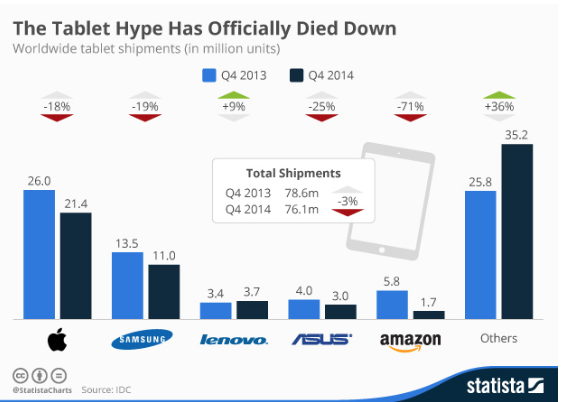
For a while there, it appeared that the mobile tablet market was unstoppable, with new models of Samsung’s Galaxy Tab and Apple’s iPad flying out the door. However, according to a report from Statista, sales towards the end of last year were off from the previous year.

The company reported that, in the fourth quarter of 2014, worldwide tablet shipments dropped for the first time since Apple introduced its original iPad in 2010. Numbers from IDC last week indicated that companies shipped a total of 76.1 million units between October and December 2014 — a drop from the 78.6 million devices that shipped in the previous year’s holiday period.

Out of all tablet producers, only Lenovo managed to emerge without any drops in shipments, mostly due to its position in the Asia/Pacific market. The company surged with a near 10 million increase over the previous year, going from 25.8 million to 35.2 million.

According to the chart below, Amazon probably suffered the most critical drop, going from 5.8 million units down to 1.7 million units over a year’s time. Apple came in closely behind, with a drop from 26 million units to 21.4 million units, respectively, while Samsung had a smaller drop from 13.5 million to 11 million units. Asus only had a one million unit drop, from four million to three million.

That’s not to say that the tablet market is in trouble — far from it. With millions of units still primed to sell, it’s hardly a fad that will be going anyway soon. Still, companies may want to take note of the drop-off, as they could fall even more come this holiday season, especially with the rise of “phablets” and larger phone devices that make it just as convenient to browse websites, watch videos and other functions.

Could this be the year we see big changes with tablets Only time will tell, but, judging by Apple and Samsung’s consistency to bring new technology to the table, it seems very likely. Apple is rumored to be working on a large-sized iPad, and perhaps there are other innovations in the works that could start tablet sales growing again.

Netflix May Produce ‘Legend of Zelda’ Series

Netflix has done a stellar job producing original content for its streaming service to keep its millions of subscribers happy, such as House of Cards (which enters its third season this month), Orange Is the New Black and Marco Polo. However, if reports are true, it may have just made its biggest acquisition to date. Yes, even bigger than Arrested Development.

The Wall Street Journal has reported that the company is hard at work on a series based on Nintendo’s best-selling franchise The Legend of Zelda. This live-action series would feature characters and locations based on the popular game series, and would feature a tone similar to Game of Thrones, but with a family-based approach, according to someone close to the project.

This would be a beneficial move for both Netflix and Nintendo, if it is in fact true. Netflix would benefit from having a hearty franchise joining its already large line-up of original programming, while Nintendo would be able to tie in the series with its forthcoming Wii U Legend of Zelda release, which was heavily hyped at last year’s Game Awards with the first video footage of gameplay. This footage can be seen below.


‘First Person Lover’ Puts A Strange Twist On Shooters

Usually, in first-person shooting games, the goal is to shoot enemies with traditional weaponry until they’re killed or incapacitated. However, with First-Person Lover, things work…much differently.

The project, put together by the team at Isbit Games, is actually a promotional release for Swedish fashion label Bjorn Borg, according to Fastcodesign. The goal of this unique first-person adventure is to not kill enemies, but rather to “blast” them with unique capabilities, such as a holographic kiss blow or a teddy bear bomb that explodes with a colorful array of love dust.

Hitting these enemies with these attacks will, in turn, strip them naked, which sends them cowering to cover themselves up. At that point, it’s up to the player to liberate them by dressing them in Bjorn Borg-based apparel, thus giving them a new lease on life.

It’s a strange idea having a first-person game like this to advertise a fashion label, but it seems to work for some players, even though it does get a bit strange. At one point, your character, dressed in aviator goggles and underwear, can use rainbow-colored energy beams to literally blast the clothes off of adversaries.

However, Jonas Lindberg Nyvang, marketing manager for Bjorn Borg, insists that the content of the game isn’t about being sexual or deviant in any way. “We are not forcing people (to have sex),” he explained. “As a love agent in the game, your mission is to liberate haters by undressing them with your love guns and then dress them in Bjorn Borg clothing.”

As seen in the trailer below, First Person Lover is definitely an acquired taste, and not really meant for younger players. Still, for those seeking a weird alternative to the usual first person shooting fare, it just might hit the spot. How effective it’ll be for selling the clothing line’s products, though, has yet to be seen.


Spotify Shows Streaming Audience Feels Emotional Connection With Brands

“We’re living in a time-shifted, screen-shifted and on-demand world. People spend 21 percent more time on mobile apps (and 79 percent more time on music apps) than they did last year,” says Spotify in a new brand impact study.

Spotify cites that streaming platforms as a whole have grown by 51 percent in the past year. In fact, for teens, streaming has become the new radio according to data from eMarketer. For brands, it makes perfect sense to get in on the action, but what kind of engagement can be expected

Of the 4,500 people surveyed in 9 countries, Spotify found that streamers are twice as likely as non-streamers to advocate and emotionally connect with brands. Sixty-one percent were more likely to recommend these brands to a friend, a high 74 percent would describe the brand as “the only brand for me” and 70 percent would see the brand as fun and playful.

Also of note in the study is that music inherently provides the ability for users to multitask while listening. Streamers were three times as likely to listen while shopping and traveling, two times as lilely to listen while at work, school or exercising.


Online Sports A Winner For Both Fans And Marketers

In the old days, sports fans used to gather around the television to watch big events, like the yearly Super Bowl or the Summer Olympics. These days, however, with the rising technology that’s slowly working its way into our hands, the times are a-changing.

With that, though, comes new opportunity, as Adweek reports that online sports broadcasts aren’t just a win for the viewers, but also the marketers that are looking to reach out more to said audience.

A report from the Adobe Digital Index (ADI) indicates that the average consumer watches 4.2 authenticated sports videos on a monthly basis, for the third quarter of 2014. That’s a 10.5 percent increase over the previous year.

In addition, ESPN and other channels that broadcast sports events will soon have a greater outreach, thanks to services like Sling TV and other streaming services. Being able to do so on a more affordable plan than monthly cable should provide better opportunities for viewers — thus extending the audience.

NBC broadcast the Super Bowl online, as well as on television, and reported that a peak of 1.3 million people streamed the broadcast, indicating that there was a huge demand for online viewing instead of just huddling around the TV.

Marketers can take huge advantage of this, getting a better outreach through a specified ad campaign that ties into the content. Per ADI, online viewers actually see 66 percent more ads per video than watching sports content than they do watching regular, non-sports related content.

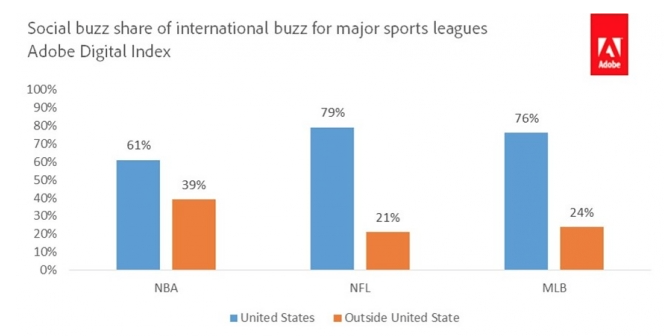
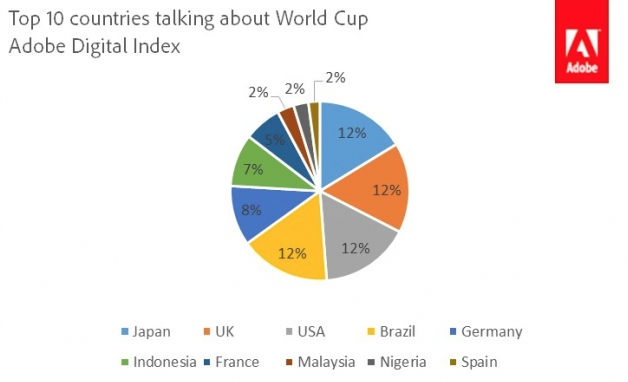
As you can see from the chart above, streaming possibilities also appear great outside of the United States, as the NBA, NFL and MLB all have decent overseas audiences, along with their domestic ones. And there’s no question that events like the World Cup would have a big impact if they manage to introduce some form of streaming service for its next event. The online hype behind the 2014 World Cup was proof enough of that, as you can see in the chart below.

The more sports stream over into the digital world, the more both fans and marketers will benefit. Sure, television may be getting a little shut out in the process, but there’s no doubt the popularity of the programming itself would remain as high as ever. Marketers certainly understand the benefit of streams that can be seen anywhere in the world, unlike broadcast TV that is limited to markets where they have agreements in place, Fans are where you find them, and by putting sports content online many more fans might be found.

Blizzard Sees eSports As Building Community

Making a game community doesn’t happen overnight. You need to have the right amount of devotees talking about your product, as well as the right balance of marketing (so that it doesn’t go overboard) and plenty of support from the company producing the game, so fans have something to look forward to.

Blizzard Entertainment knows all about community, as it’s produced a number of games over the years with an avid fan base, including Diablo, StarCraft and, most recently, the mobile hit Hearthstone. During the DICE Summit this week, Blizzard executive producer Chris Sigaty explained that that eSports can actually got a long way into building up a gaming community, if the games don’t do it enough themselves.

“At Blizzard, we view eSports as a community builder,” said Sigaty, according to GamesIndustry International. “We arrived at that not through statistical analysis or some sort of deep dive into big business or anything like that. It was arrived at with the advent of StarCraft and the growth that the community built up around the game and our appreciation and love for being a part of that.”

The developer and publisher don’t necessarily decide what game is going to be the next big hit in the eSports realm – those decisions usually rely on the players. “At least at Blizzard, we believe the community absolutely determines that and we take a careful approach with our games as we go in, we may have an idea that we think it will be a very fun game to watch competitively and turn into an eSport but we make no assumptions about that,” said Sigaty.

“We have now three major games that we’re dealing with, four really, and they’re all dealt with in different ways, subtly different ways, but every time we’re kicking the game off we one, have to know we have a competitive game that is fun, we’re going to be in it for the long haul with keeping the balance there, continuing to support it and then watch and embrace what the community is doing.”

So an eSports-based title shouldn’t be claimed as such right away, until the community reaction is first gauged. “The community has educated us in what is the approach, what do they want, we go to the community a lot,” said Sigaty.

“ESL, our partners are building the knowledge, we go outside to get those expertise and certainly we have a lot of ground to gain within the industry. When you look at ESPN, you look at NFL, you look at some of the major sports that are out there we still have room to grow, but there is an expertise that’s started along time to go, it continues to level up all the time and we go to that community to help put on the shows, what are the right ways to tell the story,” he concluded.

So let that be a lesson to those who want to jump into eSports right away – it’s all about getting the community on board, and not necessarily claiming right away that you have a winner. Let the players decide.

Nintendo’s Approach To YouTube Shows Effect On UGC

Nintendo has seen an improvement in the video game market over the past year, thriving on software successes as the Pokémon games, as well as big Wii U releases like Super Smash Bros. and Mario Kart 8, even though hardware sales continue to disappoint. However, Nintendo appears to be struggling in another department — with online videos.

Despite the fact that it opened up a community with YouTube support for Mario Kart 8 last year, Nintendo has seen a sudden drop in views and videos on YouTube since December 10, 2013. It probably didn’t help that the company put such strict policies on claiming revenue on users’ “Let’s Play” videos that contain content from its games, but the drop still seems somewhat drastic.

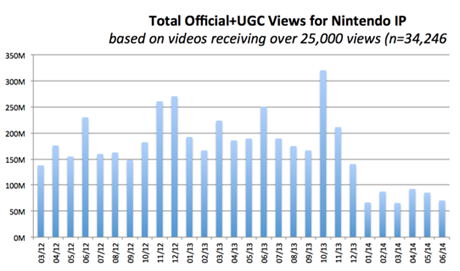
Tubular Labs reported that, from January to May 2014, there were an average of 697 videos uploaded per month regarding Nintendo IP, which reached 25,000 views or more on the social channel. These videos managed about 80 million views a month during this time.

That sounds like good news, but consider the numbers from the previous year, where, from January to May, there were an average of 1,361 videos uploaded with 25,000 views or more, with an average of 192 million views per month.

These numbers indicate a massive drop of 58 percent year over year over the period, which also show a similar drop month-after-month, according to Tubular.

As you can see from the chart, the differences in traffic are quite noticeable, and include a number of the company’s more popular games, including Smash and Mario Kart.

Tubular noted that the drop came right after Nintendo began claiming revenue on “Let’s Play” videos, as, before then, the numbers were quite healthy. Clearly, Nintendo doesn’t seem to be doing anyone any favors in this department.

And it’s probably going to go even lower. The company introduced a program that allows users to make money off of Nintendo-related videos, provided that they were approved. However, Nintendo limited this program to not include third-party games, and also shut out avid Smash Bros. players when it came to their replays, as well as Pokémon and Bayonetta 2 devotees.

Called the Nintendo’s Creator Program, it’s been met with a heavy dose of criticism. PewDiePie, one of YouTube’s most popular broadcasters, recently posted his thoughts on the matter, indicating how it was bad news for the YouTube community in general.

Despite a high number of requests to take part in the program, it appears that Nintendo has a ways to go to reclaim its YouTube audience. Now it’s just a matter of seeing what moves it makes next to bounce back. Trying to exert tight control over videos involving your game may sound like a good idea for a number of reasons, but video creators have plenty of other games they can showcase. Nintendo is losing visibility in a marketing channel where other companies are getting plenty of attention. Will the company figure out a way around this problem, or will it simply decide that Nintendo products will be shown on the company’s terms or not all, regardless of the consequences

Twitter Looks To Shake Up Its Marketing Game

Twitter is working hard to assure that its social audience remains not only constant, but growth-based, as it looks to expand its user base in a number of ways.

Re/code posted a number of stories indicating what the social site has in mind.

First up, Twitter has teamed up with the powerhouses at Google, which will allow content from the social site to appear through search results on the Google website. The results will now become much easier to find, should people be looking for a specific user or Tweet.

With this move, Twitter hopes to pick up its “logged out” audience, people who see tweets on a daily basis, even when they’re not signed into an account. Attempting to attract them could bring them back as a user and, thus, pick up user count.

Re/code also noted that the company has a new home page in the works, one that’s designed to attract those who are used to seeing Twitter’s layout, though they don’t have their own account set up.

The current home page, as it stands, doesn’t really offer much outside of viewing a minimal picture taken from one of the company’s accounts. With this new home page, however, Twitter hopes to attract visitors with a number of choices from categories like “General news sources” and “TV shows and stars,” thus making the site more attractive for newcomers. The page is currently in beta testing, but Twitter is likely to launch it soon.

Finally, Re/code talked about the company’s first time as a public company on the stock market, which produced less than stellar results. Still, that hasn’t stopped it from trying to prove to the market that it indeed belongs there, as a safe bet for investors.

Twitter is set to report a six cents per share profit of $453 million, according to analysts, and it can use that to its advantage when it comes to showing its strength in the social media realm. In addition, it’ll talk about its large daily audience, and, according to the same analysts, the growth from 19 to 21 percent over the same quarter from the previous year. While that’s a slight downfall from the previous year’s 22 percent, it’s still considered growth.

Between its syndicated tweets program, Google page support, new home page and other ideas, Twitter is sure to find ways to bring new members of an audience to its site. Here’s hoping the tweets keep on coming in.

Gaming Captures Kid’s Attention And Spending

Back in the “good old days,” children watched a lot of television and occasionally took part in video games. But these days, the times are certainly a-changing.

According to Business News Daily, this generation of kids have taken more of a focus to gaming than to television. A recently report from consumer market research company Interpret indicates that U.S. kids ages 6 through 12 generated a whopping $2 billion in game revenue for the whole year of 2013. The report was conducted with help from the Digital Kids Summit, which helps brand owners, game developers, marketers, producers and professionals to find ways to engage kids online, as well as through digital devices.

In addition, over 12.8 million kids in the United States own a smart toy of some sort, and usually spend around 12.1 hours per week playing games. Out of that time, a fourth, around 3.2 hours, is spent gaming on either smartphones or tablets.

The parents of the average gamer around the ages of 6 to 12 manage to spend around $29.40 a month, including around a tenth of that ($2.60) on mobile gaming apps and in-game purchases.

YouthBeat also had its own report, showing that 83 percent of kids in the age bracket of 6-13 use and download apps, while 71 percent of parents download apps for them.

Kids also spend a lot of time online, around 1.3 hours per weekday, and 1.9 hours on the weekend.

So why the sudden change in interest from television to gaming Well, it isn’t quite as sudden as you may think, as TechCrunch noted a number of reasons behind it, such as kids and “tweens” growing into digital natives with accessibility to mobile devices, and the ease of use for both kids and their parents. In addition, long-term brand loyalty can be of importance to marketers, as kids are “extremely influential” to household spending, according to a third of parents surveyed.

Protection also plays a key part, as ad inventory for games like these have to be compliant with both the Children’s Online Privacy Protection Act and the Children’s Advertising Review Unit. However, as expected, most companies are following these, so it appears that everyone wins. (Well, maybe not television.)

Indeed, gaming – particularly mobile gaming – appear to be playing a big part in kids’ lives, and that trend isn’t likely to change anytime soon.