Digital game sales continue to rise, as revealed in Superdata’s latest report, which recaps worldwide digital game sales for the month of January. Digital sales totals have reached $6.3 billion for the month, an increase of 8 percent over the previous year.
Part of that success comes from the PC release of Square Enix’s hit sequel Rise of the Tomb Raider, following its exclusive debut on Xbox One back in November. “As one of Square Enix’s most visible franchises, the Tomb Raider franchise performed in January, receiving both strong industry recognition and benefitting from a seasonal lull of AAA games,” said Superdata CEO Joost Van Dreunen. “The game sold almost three times as many units on PC than it did on console during its first month.”
The top digital seller of the month was once again Activision Blizzard’s popular first-person shooter Call of Duty: Black Ops III. However, other mainstays like FIFA 16 and Grand Theft Auto V continued to populate the list, and Fallout 4 continued to be a huge draw.
Van Dreunen also noted, “Add-on content drives 88 percent of FIFA 16‘s digital console revenues in January. Electronic Arts’ game remains near the top of the console charts thanks to strong sales of FIFA Ultimate Team card packs. (It) earns a greater share of digital revenue from additional content than any other console game in the top five.”
World of WarCraft led the list in pay-to-play, while League of Legends continued to dominate in the free-to-play market. Activision Blizzard also scored a victory in the PC DLC category, with StarCraft II holding a steady first-place spot.
However, Van Dreunen was quick to note other favorites like H1Z1 and Elite: Dangerous, and their recent expansions. “(They) have repurposed their games’ core mechanics and launched H1Z1: King of the Kill and Elite Dangerous: Arena. Despite steady player bases for each, both games aim to expand their reach by attracting competitive players and eSports audiences who have less of an interest in persistent worlds and in-game economies.”
H1Z1 is paying off better than expected, thanks to 11,000 concurrent viewers on average on Twitch, and a total of 7.9 million hours played for the month.
Finally, the mobile market continued to see domination from Supercell’s Clash of Clans, although Monster Strike and Puzzle & Dragons continued to be hits, alongside King’s Candy Crush Saga titles. “The market for mobile VR gaming is on track to hit $861 million,” noted Van Dreunen about the future of mobile.
With the introduction of Supercell’s recently released Clash Royale, its dominance will likely continue. “(It) comes at a critical time,” he said. “Over the past year, marketing costs on mobile have continued to increase, and Supercell now faces a growing number of both Western and Eastern publishers with deep pockets. Given the company’s financial momentum, with Clash of Clans earning an estimated $1.3 billion in 2015, Clash Royale will likely have enough runway to prove itself.”
Game designer Jesse Schell is an industry lifer, and a self-described VR-aholic. At first glance he appears to be a caffeine-aholic because he brings more energy and enthusiasm than a Starbucks barista to every conversation about virtual reality.
The affable Schell has worn many hats in the gaming industry and is part of the one percent who actually has a polished dossier to talk about VR. He earned a masters in computer networking and virtual reality – in 1994. He’s since authored books, headed international game developer associations, done Ted Talks and served as creative director of the Walt Disney Imagineering Virtual Reality Studio.
Twenty-two years after getting his master’s at Carnegie Mellon, he now teaches students how to build virtual worlds at his alma mater. And, oh by the way, he’s the CEO of the Pennsylvania-based game studio Schell Games for the last 14 years where they’ve already released VR titles like the award-winning I Expect You to Diefor the soon-to-be-released Oculus Rift.
Schell says he has more educational and transformational games in development because VR is finally here to stay. “VR headsets will permanently stay in the market from 2016 and beyond – forever,” Schell told [a]listdaily. “Maybe the Best Buy it’s sold in will go away, but VR won’t. People are going to want it, and pay for it. Virtual worlds promise utopia.”
Schell joined [a]listdaily to discuss tech’s hottest topic.
What made you so passionate about virtual reality?
I’m always excited about how you can use media and new technologies in order to help people transform themselves for the better. VR is just one of those technologies that is going to do incredible wonders, to break down barriers in education and deliver world-class educational experiences to everyone in the world – not to mention what it could do for empathy. It’s one thing to see about a situation on television. It’s a whole other thing to be in it and have it feel real all around you. One of the things that’s really important is that VR is going to bring us closer together as species, as a culture, because it’s going to allow us to go places we’ve never been able before.
What are some of the momentum-shifting events that need to happen for VR to fully take off?
People need to believe in it. Most people don’t believe in it because they haven’t experienced good VR. They’ve either had no VR experiences, or the weaker experiences from the past. The technology recently has crossed a threshold that can’t be shown on television or described with words. People have to try it, and feel it to see how powerful it is. When you have technologies like that, they somewhat lead to slow adoption. We saw the same thing with DVR … 2016 is going to be a lot of (people saying) ‘have you seen this’ and ‘have you tried that.’ There’s going to be a lot of talk, particularly centered around Christmas season.
How are gamers in the epicenter of the VR movement? How do you market them?
Yes, gamers are definitely going to be the ones most passionate about it. Gamers are already excited about new kinds of virtual worlds. They want something new, better and exciting, and they’re willing to pay for it. As a result, they are going to be the early adopters. They’re going to be at the heart of it in the beginning.
How do you bridge the real and virtual gap for enhanced experiences with the current projects you’re working on?
There’s so much to figure out in terms of how to bring these things into the creative space. We do things all over the map with different ways to bridge between physical and virtual reality. We do everything from stuff that’s kind of a pure VR play to things that are like museum and theme park experiences, and even with interactive toys. We’re actually doing an interactive one now that lets you build molecules with physical toys, and then you use your app to create an augmented reality experience that lets you figure out what molecules you’ve built. We’re doing everything from that to also working with the Google Tango and a Jenga experience. We’re just so excited because there’s so many things happening on so many different fronts.
What did it mean to win the “Inspire Award” at inaugural Vision Summit for your VR game I Expect You to Die?
It’s a game we’re excited about. Personally, I’m so excited what’s happening in VR right now. I’ve been working on VR for over 20 years, and to have it finally come into the mainstream, and to take everything we’ve learned over all that time and put it into experiences is just absolutely thrilling.
If there’s one piece of advice you could share with VR content creators, what would it be?
My main advice would be ‘don’t copy what came before.’ Don’t just say, ‘I’m going to take my favorite game from consoles growing up’ and just make it in VR because it’s unlikely to work very easily. You want to figure out what the medium is actually good at, and build around it. You can figure that out partly with experiment, but look back at the 30 years of experimentation that’s already been done.
You predicted Madden will have a VR edition to the game by 2020. How will sports experiences carry over into VR?
It’s a really big question – exactly how sports are going to blend into VR, certainly. We are going to see a lot of casual sports games – think bowling. We’re going to see a lot of stuff like that in the beginning as people are experimenting. Part of what’s exciting about sports is the feeling of being on the field with famous athletes. VR is going to give that feeling like we’ve never had before. The question comes down to: How much are people going to want to have virtual interfaces or be actually involved in the process of throwing a ball or blocking a shot? There’s going to be a lot of experimentation that needs to be done, but I feel certain that being in the same space with athletes is going to be a huge draw. The problems are hard to solve, but people are going to tackle them. … The most important sports experience is going to be the broadcasts of live events.
Attending sporting events costs a pretty penny, and can sometimes be problematic in actually physically getting there. Can VR easily replace the in-person viewing experience?
Hardcore sports fans will spend huge amounts of money to follow and be near a team they care about. Take a look back into history … who bought the first big-screen TVs? It was sports fans. Sports fans buying high-end VR that’s going to make them feel like they are right there at the game is totally going to happen. Will it replace the live element? I’m doubtful that VR is going to steal that away, but it will complement it. I would argue that it would actually make you want to go in-person even more.
What will it take for VR to not be a flash in the pan? What does it need to overcome?
Isolation. When you put on the gear, it’s an incredibly isolating experience. We don’t really have a way right now for you and I to be sitting side-by-side, each put on our helmets, and each have a 360-degree experience and still have a social experience. We don’t know how that works yet. No one has cracked that nut. … And I haven’t seen anything even remotely close to it yet.
What are you teaching the current crop of students at Carnegie Mellon that will soon hit the work force?
I teach classes like ‘Building Virtual Worlds’ and ‘Game Design’ at the Entertainment Technology Center. What we really focus on there is interdisciplinary innovation. We take artists and engineers and put them on teams together and have them invent new things that they couldn’t have invented alone. We’re very careful to make sure the students are not focused on the technology of today. We try very hard to have them looking forward and to be working with technologies that are still coming out. If you can get in the habit of mastering it, you’re always going to be in place to make the biggest difference in the world.
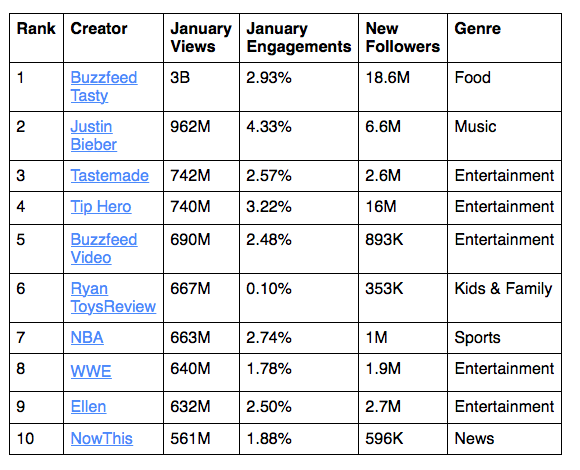
The team at Tubular Labs has released the official rankings for the most watched online video creators for January, and Buzzfeed has certainly left its mark.
The company’s Tasty channel has managed to find a strong number one spot in the overall video creators category (across global and devices) with over three billion views. Pop star Justin Bieber followed closely behind in the second place position with 962 million views.
Buzzfeed’s Tasty channel has seen a good amount of attention for the month, garnering 18.6 million new followers and keeping an engagement rate of 2.93 percent. It has also managed to beat a previous record as a result, as channels hovered just around the one million view mark months before. Bieber gained 6.6 million new followers and 4.33 percent engagement.
The full top ten is as follows:
It’s an interesting mix of entertainment, kids and family and sports categories, as the top 100 video brands and influencers overall managed to generate a total of 42 billion cross-platform views for the month – a 12 percent increase from December.
In the Facebook category, food content again led the charge with Tasty (along with its UK equivalent), Tastemade, Tip Hero and Buzzfeed Food taking over the top six spots, with the NBA cracking the top 10 with 351 million views.
On Instagram, it was all Bieber and the NBA, as the two climbed into the top spots, alongside Black Jaguar-White Tiger, to dominate the top-three spots. Additionally, the official Instagram channel saw plenty of attention, with 53 million views and over eight million new followers.
As for YouTube, Beiber showed no signs of slowing down with 824 million views and 1.3 million new subscribers. However, WWE (World Wrestling Entertainment) dropped a spot to make room for Ryan ToysReview, which took hold with 667 million views and 364,000 new followers. Still, WWE is probably pleased with the third place spot, with 576 million views and over 500,000 new followers.
When it comes to global brands, nothing seems to stop Red Bull. The company held a clear lead in the top ten with 233 million views and 470,000 new followers, followed closely behind by Lego (147 million views) and Supercell’s popular Clash of Clans (75 million).
Ad blocking has already been a concern for companies on desktop computers, but now it’s really leaving an impact with advertisers when it comes to mobile.
The Financial Timesrecently reported that ad-blocking is on the rise on both smartphones and tablets, as more than 200 million people worldwide use some form of software to block ads out – double the number from what was reported two years ago, according to PageFair and Adobe.
This is a concerning trend for companies. Studies from the Times indicate that 37 percent of mobile users have stated that they have blocked ads on their device within the last month. That’s quite a problem, considering the spend that’s going into digital ads (and the cost of ad-block), but it gets worse.
The survey also noted that 70 percent of respondents showed interest in blocking ads, either by doing so already or planning to in the future.
Charles Vasquez, vice president of digital media for Ayzenberg, said, “Ad blocking comes down to the fundamental issue of user experience from the relevance of the ads they receive to issues surrounding privacy. It’s forcing marketers to not only work around ad blocking technology but to improve the contextual relevance of their messages. We know, for example, that younger mobile audiences are a bit of a paradox. On one hand they are self-proclaimed to being ‘ad-resistant’ but on the other hand they accept brand messages when it comes through as relevant, informative and authentic. As ad blocking adoption grows, marketers will need to adopt more tailored messaging with pinpoint accuracy – something they should already be doing.”
Ayzenberg’s vice president of social strategy, Siobhan O’Neill, added, “We respectfully suggest to our clients that the ad-blocking trend presents an opportunity to connect business objectives to outcomes using creative solutions; it presents an opportunity to innovate around new mediums and content formats in ways that not just get attention, but deliver value in terms of information, entertainment, or deep-end fan experience. … Brands can take a cue from that and work to develop new models that leverage the relationships they have with their audiences to develop quality content that enhances, not detracts, from their overall experience, be it on mobile, tablet, gaming device – wherever they happen to be.” (Editor’s note: [a]listdaily is the media arm of the Ayzenberg Group.)
In essence, ad-blocking is a wake-up call for brands to better implement best advertising practices. Now it’s just a matter of seeing how — and when — companies adapt.
Microsoft is in the process of unleashing a powerful new weapon in the console wars, and it’s something that may be an important factor in the ongoing battle for market share against Sony. The idea, announced last year at the Game Developers Conference, is simple: buy a game on the Xbox One, get the Windows 10 PC version for free. This has been intended as an optional plan for publishers, and now one of Microsoft’s most highly anticipated Xbox One games, Quantum Break, has been announced as part of this cross-buy program.
It’s a daring move that, for some Xbox One owners, was problematic. A few gamers were annoyed that Microsoft was no longer making the game exclusive to the Xbox One. Xbox head Phil Spencer was responsive on Twitter, albeit incredulous that someone would be annoyed because another person gets to play a game. That minor issue will no doubt be quickly forgotten as the larger benefits of Microsoft’s plan begin to be felt.
@The_CrapGamer You cancelled a pre-order for a game you want to play because someone else get's to play the game on Windows?
At first glance, this might look like a problem for the Xbox One by reducing the number of exclusives for the hardware, and thus reducing the reasons for someone to buy the Xbox One. Phil Spencer was quick to point out a key reason against this: “High end PC gaming rigs aren’t the price of a console. People play on console because they love that experience, same for PC,” Spencer said on Twitter. Just so – getting a powerful gaming rig for $350 in the form of an Xbox One is a good deal, all the more so since fewer people are buying desktop PCs these days. Laptops, tablets and phones are handling more and more everyday computing tasks for people, and none of those play games like an Xbox One.
The more important reason why this cross-buy program is good becomes clearer when you look at Microsoft’s overall strategy. “Under the auspices of CEO Satya Nadella, Microsoft has shifted its focus away from trying to strong-arm competitors out of the market, and towards a future of providing apps and services on the iPhones, Android phones, and Macs that they already love using,” said Matt Weinberger in a recent Business Insider article.
Microsoft benefits by making its games more broadly available, and boosting the subscription revenue it’s getting from Xbox Live. The Xbox is being put more firmly into the overall family of Microsoft products and services, and that’s a good thing. Microsoft is not as concerned over the number of hardware units it sells as it is over the number of subscribers it has to various services. The software and the service is more important than the hardware, and we’re just seeing that principle applied to consoles.
Microsoft would like Xbox Live to be the most important thing for customers, because that’s a service you pay for year after year, long after you’ve purchased the hardware. And there’s more margin there, and potential for upselling to other digital products and services. Eventually, you’ll probably be seeing Xbox Live on other hardware than Xbox consoles.
With the Microsoft Cross-Buy program, exciting games like Quantum Break will not only help sell Xbox One consoles, they’ll help bring more excitement to Windows 10 as a gaming platform. Looked at another way, it expands the market from about 20 million Xbox One consoles to the over 200 million Windows 10 devices, which suddenly makes the PlayStation 4 market look small (at less than 40 million).
https://www.youtube.com/watch?v=d4or8YE-6P4
Market size is important, not just because it influences where publishers decide to invest resources. Many multiplayer games get better when the pool of players is larger, because finding balanced matches happens more swiftly. And, of course, the revenue potential for selling virtual goods and other DLC is much higher when the market is larger.
This also helps broaden the appeal of future Microsoft products and services. When the HoloLens finally becomes available, as a Windows 10 device it will automatically be both a business/enterprise device and a gaming accessory. This neatly avoids the issues surrounding the original Kinect, which took forever to get a Windows version and then never caught on in the business side of things. Now future devices will have the largest possible market to find success in, because the consoles are much more tightly integrated with the PC side of things.
Sony has also been signing up some exclusives on both PC and PlayStation 4, such as the highly anticipated No Man’s Sky. Yet, Sony’s plan appears to still center around the PlayStation ecosystem, which has been expanding with PlayStation Now, the PlayStation Network, and the upcoming PlayStation VR. Sony doesn’t have to support a broader ecosystem, but instead seems to be adding as much value as it can to its ever-stronger game brand. Many observers and analysts feel that Sony’s VR entry, PlayStation VR, will have a strong bid for market share with tens of millions of people already owning the hardware needed to drive the VR headset (a PlayStation 4) without the need to buy a new PC.
Don’t forget, that Microsoft has a strong position in the VR market, even without its own hardware. The Oculus Rift comes with an Xbox One controller to drive it, and you’ll need a powerful Windows PC to power the headset. The other high-end VR device, the HTC Vive, also runs from a powerful Windows PC. Will Microsoft take advantage of these VR connections? You’d better believe it. Nothing’s been announced, but at the very least you’d expect Microsoft to tout the fact that its software is behind two of the most powerful VR systems on the market. Beyond that, we may see some other marketing or product or service initiatives as well, especially as the market unfolds this year.
Microsoft will definitely be pushing more of its own titles into the cross-buy program, and will continue to encourage other publishers to take advantage of it as well. It makes good sense for game publishers to expand their market, and many are already planning PC versions of their games. The key sticking point would be the possibility of reduced revenue, but it doesn’t seem very likely that people would buy both a version for an Xbox One and a PC version. You’re not losing a sale by giving a buyer both copies; you’re creating a more satisfied customer. That, in the end, should prove more valuable to Microsoft.
This year’s Sports Illustrated Swimsuit Issue has had no trouble making waves on the social front, thanks to the return of UFC superstar Ronda Rousey, the introduction of plus-sized model Ashley Graham, and even a twist that puts consumers into the action via virtual reality.
However, thanks to a savvy promotion in conjunction with FX Networks, the annual issue is getting a little more… animated. The publication recently reported that three female stars of the hit show Archer have made their debut in the issue. Pics of each of the characters, including Lana Kane, Cheryl Tunt and Pam Poovey.
True to the smart-alecky nature of the show itself, each image of the Archer stars comes with a description, similar to that of pictures in the real issue. This includes the photographer (in this case, characters from the show, like Sterling Archer and Algernop Krieger), location and a small caption underneath.
This promotion is a win-win for both SI and FX Networks, as it enables even more promotion for the swimsuit issue, and brilliantly ties in with Archer‘s forthcoming seventh season of the series, which makes its premiere next month.
The show has become a pop culture hit since its debut back in 2010, featuring characters in a fictitious spy organization that attempt to stop criminal activities around the globe and falling into various comical situations along the way.
The girls’ move into print is just the latest promotion for the returning series, as it previously debuted a trailer lampooning the 80s action series Magnum P.I.
https://www.youtube.com/watch?v=LhaEowME4T0
FX Networks isn’t the only advertiser taking advantage of the swimsuit format of the magazine. Snickers also ran a humorous ad that appears on the back cover, featuring a model that’s been poorly photoshopped, with the sub-message “Photo retouchers get confused when they’re hungry.”
Could we see more potential ads like this in future issues? Perhaps. But for now, it’s all about Pam Poovey and company. Danger zone!
Over the coming months, consumers will be able to experience the full push of virtual reality on the market, whether it’s gear produced by Oculus (the Rift), HTC (the Vive) or Sony (PlayStation VR). Now the question is what people want the most when it comes to those experiences.
A new poll from Futuresource Consulting, as reported by eMarketer, provided an outlook when it comes to what sort of content consumers are looking for. Conducted back in October, the findings indicate that, while games remain a big factor in the VR world, the biggest thing that’s of interest are movies.
39 percent of those polled stated that they want to see what movies can do with virtual reality, although games followed very closely behind with 38 percent. Also making the list were TV/music videos, educational apps and sports-related experiences.
Virtual reality also holds great potential for marketers, considering the many age groups that will be partaking in its technology as new choices arrive. Another report conducted by Greenlight VR and Touchstone Research took a closer look at U.S. Internet users (by groups) that are interested in the tech.
The largest group turned out to be Gen Z (10-17), with 79 percent indicating they were interested in some form of VR. Millennials (18-34) followed close behind with 73 percent, followed by Gen X (35-50) with 70 percent and Baby boomers (51-69) with 64 percent.
Keep in mind that these poll numbers don’t quite cover the entire demographic of the consumer medium, as they were done with select groups late last year. But it does point an interesting picture for when the Oculus and HTC Vive arrive this spring, and what plans Sony may have in mind when it finally confirms what it’ll be doing with the PlayStation VR.
Now, it’s just a matter of seeing how the market adapts to price. The Oculus isn’t going for cheap, with pre-orders going for $599. Likewise, when the Vive launches in early April, it’ll sell for $799. That leaves Sony in an interesting position, as it could “budget price” the PlayStation VR to around $500, in an effort to sell more PlayStation 4 consoles.
We’ll see where the market leads in the months ahead…and if the consumers will follow.
Following its purchase of the franchise for $4 billion, Disney has made the most out of Star Wars. Along with a lucrative campaign featuring well-marketed toys, campaigns and other promotions (along with video games like the best-selling Battlefront and Disney Infinity), the company banked on the release of the first new film in over a decade: The Force Awakens.
It paid off big time, making $2 billion worldwide, and leading into what could be one of the year’s biggest home video sellers when it releases this April. This is merely the beginning for Disney’s plans with the franchise, as it indicated yesterday during its Disneyland 60 special, which aired on ABC. Along with paying tribute to a number of other franchises and iconic moments in Walt Disney’s history, the company took the opportunity to showcase what Star Wars-related expansions are coming to its theme parks.
The Force Awakens star Harrison Ford was on hand to present the footage, which provides a preview of many activities that users will be able to take part in when Star Wars Land opens in both Disneyland and Disney World Resorts. This includes an interactive gun battle aboard a First Order ship, being able to helm the controls of the iconic Millennium Falcon, and even stopping by a classic Star Wars cantina, where tourists will be able to engage with characters from the film along with aliens.
Other potential items include a marketplace, a museum devoted to events from the Star Wars films, and an intergalactic restaurant, among other items. These 14-acre expansions will obviously take some time to complete, as they aren’t likely to open for a few years.
In the meantime, Disney has plenty going on in the Star Wars pipeline in the meantime, including a new live-action series coming to Netflix, as well as other products, like the recently announced Lego Star Wars: The Force Awakens, which releases this June. Then, of course, there’s the next Star Wars movie, Episode VIII, which is already in production for a holiday 2017 release. In the meantime, another movie, Rogue One: A Star Wars Story, set to arrive this December.
https://www.youtube.com/watch?v=LUqyavuLr8s
Considering the money that’s generated from the series thus far, it’s safe to say that the force is strong for Star Wars Land.
Miuccia Prada has had no trouble leaving her impact in the world of fashion, but now she’s taking the next step in bringing artistry to a new medium – digital music. Prada has revealed a new project under her Miu Miu product line that will bring a new application to mobile devices.
Called Miu Miusic, the app will feature 10 custom soundtracks with music inspired by runway presentations, pieced together by renowned DJ Frederic Sanchez. The songs included in the app promise to bring a layer of complexity missing from most music services, with tracks that include “ride the Snake” and “Analog Dream,” along with many others. In addition, they will feature a number of graphic patterns and accessories sold by Prada’s Miu Miu line, which can be intertwined with the music.
The Miu Miusic app also provides a unique social opportunity to users. Short films can be put together through the app, and then shared across a number of media-related apps, improving upon Miu Miu’s already established social network. While Miu Miusic isn’t likely to be a direct competitor to bigger music services like Apple Music, Google Play Music, or YouTube’s music channel, it does give a unique opportunity for fans of Miu Miu (and fashion in general) to interact while sharing exceptional visions and sounds, as only the likes of Sanchez can deliver.
https://www.youtube.com/watch?v=gTaORj8pXJ0
The app is expected to launch sometime today on the Apple App Store, Google Play and the Microsoft Store.
The prospect of another solid growth year for the games industry is definitely positive, but that growth comes with plenty of challenges as the marketplace evolves. More than that, the increasing overlap between games and other entertainment media means overlapping challenges for marketers, and an ever-more-complex environment ahead. Let’s take a look at some of the challenges, and the strategies marketers might use in turning them into opportunities.
Virtual Reality (VR)
This is the year that VR hardware and software makes its way to the market, and by the end of the year we’ll see millions of units of high-end VR hardware in the hands of consumers – and millions more mobile VR units as well. This is a huge challenge for marketers of VR products, because unlike most new technologies VR is difficult to market with existing means. Marketers know the power of video in showing potential customers what a new product is like – but showing a VR experience through a video just doesn’t come anywhere close to giving the viewer an idea of what to expect. VR can be described or shown, but until you actually try out a unit you won’t really know what it’s like. Marketers, therefore, will have to find ways to bring a VR experience directly to consumers, and ideally in a way that millions of people can experience.
This may mean mall tours, traveling roadshows, appearances at consumer events like ComicCon or music festivals, in-store demos… we’re already seeing some of these methods being used. There’s no cut-and-dried solution yet, though, so marketers will have to get creative and deal with the complexity and cost of arranging personal VR experiences. On the plus side, when you do something creative with VR marketing you’re likely to get press coverage for it.
Another benefit to VR is that it can be used for creative marketing purposes, as Marriott has shown. There’s great power in VR, and the technology has a sexy lure that brings people in to check it out. Marketers for all kinds of brands are using VR as part of their plans, and the wider availability of VR hardware will make it even easier to tap this power. Even indirect use of VR can be powerful marketing – who wouldn’t be interested in a chance to win a VR headset, for instance?
Mobile Advertising
The entire subject of mobile advertising is vastly important to all kinds of products, as people increasingly spend more and more of their time on mobile devices. Yet, mobile advertising spend is still far lower than it should be based on time spent in that venue. It’s a continuing battle for marketers to get budget shifted into mobile from more traditional venues. At least you get plenty of data from mobile advertising, but so much data can be unwieldy to analyze, and you don’t necessarily get the precise kind of data you really want. Ad tech providers continue to change their features and tools, so marketers have to constantly be on top of what’s happening in the technology, and figure out how to apply it most effectively to their issues.
Added to those problems are the very basic issues of how and when ads should appear on mobile devices. Some games give you an option to go ad-free for a fee. Some only show ads for other games from the same publisher, some are in ad networks, some games let you earn in-game rewards for watching ad videos. It’s a complex environment, and this is an issue where marketers and game designers really have to work together to find the optimal solution for their particular audience.
We’re seeing some interesting innovation in this space, with companies like Zynga using specialized ad units to create integrated in-game advertising, with impressive results. It’s clear there’s enormous opportunity here, when for the typical free-to-play game more than 95 percent of all the users are not spending money on the game. Advertising is one obvious way to generate revenue from that vast audience – if you can figure out how to do it without losing them because you’re showing ads.
User-Controlled Marketing
One of the most important trends in marketing, not just for games but for all products and services, is the growth of user-controlled marketing. The brand, once in the iron grip of the marketer, has now escaped and is roaming freely among the users of a product or service. How is that possible? Through social media, streaming, YouTube, and other means of sharing information, users are creating and distributing messages every day that involve your brand – and often with far greater reach than any company can typically pay for. Minecraft is a perfect example, with billions of hours of Minecraft videos being watched every month. Those are billions of hours of brand impressions that were not created, vetted, or controlled in any way by Mojang (or its owner, Microsoft).
Losing control of your brand messaging in that fashion is a terrifying thought for some companies. Look at how Nintendo has tried to control YouTube videos and streaming involving Nintendo brands, for instance. All that’s done is reduce the amount of free impressions Nintendo gets, and other games have been the beneficiaries. Yet, one can understand Nintendo’s concerns. What if some YouTuber or streamer is doing something objectionable in connection with your brand? Or distorting it in some way that carries even more resonance than your branding message?
These are difficult issues for marketers to grapple with, but there’s no stopping the wave of social media and sharing. Marketers need to surf this wave or risk being pulled under by it. You have to be nimble, creative, and confident in your brand message. Working with influencers requires finesse and creativity, since ham-handed attempts to control influencers can easily backfire. That’s why utilizing services such as ION is very useful for marketers, tapping into expertise in dealing with influencers.
Marketing a brand has become bigger and more powerful than any one company. With the right brand that can engage and motivate users, brand messaging can reach amazing new heights and astounding reach. As social media extends its reach and its power, marketers will have to be ready, willing, and able to deal with this revolution in marketing. This will require paying close attention to new trends in technology and media, in marketing tech and ad tech and to the clever new techniques some marketers are employing. That’s part of what the [a]listdaily is trying to help with, so be sure to spread the word and stay tuned. Even better, tell us about the solutions you’re finding to deal with these issues – we’d love to bring that information to other marketers.