The History Channel Uses Comedy to Reach New Audience

For a while now, The History Channel has been a reliable source when it comes to revisiting many evens from years past, but now the channel hopes to turn a corner for an all-new genre of content: comedy.

The network has made forays into fictionalized programming before, including its well-received action/drama Vikings. However, it has recently decided to take a dive into late night comedy, and it could be a move that pays off in the long run, bringing in a fresh audience that will see beyond its “historic” approach.

Join Or Die, a new comedic talk show that made its debut last night, features host Craig Ferguson and three unique guests as they discuss something from history, whether it’s the worst medical treatments (surprise, lobotomies won) or the worst Presidential blunder in history. Though ratings haven’t been reported just yet, reception of the show has been positive, no doubt bolstered by how it lets viewers play along using social media with the #joinordie hashtag.

That’s just the beginning. Next week will see the debut of a series called Night Class, which focuses on short-form stories with portrayals of figures in history, played by celebrity guests. For example, Jack Black will portray Ludwig von Beethoven.

More series will also be making their debut in the future, with a lighthearted approach to history. Crossroads of History will look at some of the lesser characters in timelines, like Abraham Lincoln’s bodyguard, who stepped away from the theater the night of his assassination. How To Lose the Presidency will also make its debut soon, featuring moments that spelled doom for potential presidential campaigns.

So, what prompted History Channel’s turnaround into such programming? “When I see people talk about some of the things they’re watching, it’s on the fringes of the schedule, the things that really push the creative, like a late-night comedy experiment. And I realized that was new territory we could explore,” said Paul Cabana, executive vice president and head of programming for History, speaking with AdWeek.

The focus of these new shows seem to be aimed at millennials, primarily men, as well as potential advertisers looking to reach out to them. And the channel isn’t playing around either, as it’s brought some big talent on board to drive particular shows. Dan Harmon, the co-creator of the hit series Rick and Morty, is just one of the forces working on content, for example.

“It just made sense that we start to produce content that was as much at home on your phone as it was in your living room,” said Cabana. “We’re entering an age where it’s about cumulative viewers and good content being forward to each other, so it’s a great way for us to explore the digital space.”

“Our hope is this block becomes an opportunity to get into business with younger clients, maybe clients with a little more of a comedic take that don’t always look to History as their first or probably second choice,” added Peter Olsen, executive vice president for A&E Networks. “In success, we have an opportunity to talk in a much bigger way with groups of clients that we don’t do a ton of business with.”

Digital content could go a long way for the network. “More and more, we’re talking about creating digital content short-form things but using linear as a launching pad and another place to run it,” said Olsen. “On our big brands, we’re talking about doing some comedy stuff that doesn’t have to be a 30-minute sitcom. It can be a five-minute comedic piece that can run on linear and on digital. So we’re looking at our non-prime dayparts in a way that they can almost become digital verticals that run on linear and have a digital life as well.”

Casual Connect Embraces ESports

Casual Connect Europe just celebrated its biggest event ever with over 2,000 game developers, companies, journalists, and analysts from across the world converging for three days of talks, workshops, and networking in Amsterdam. Put on by the Casual Games Association, this marks the 11th year of the European leg of the global convention, which has its next stops in Singapore May 17-19 and San Francisco July 18-20.

Jessica Tams, founder and managing director of the Casual Games Association, explains why the conference is embracing eSports in this exclusive interview.

jessicatamsWhy is Casual Connect incorporating eSports into its panels?

ESports is something that really fits into the current audience at Casual Connect because if you think back to the early casual games days, the people who were involved in casual games were doing things similar to eSports in some ways. We did a lot of online contests and a lot of tournaments. King and GameDuell did contests against each other, and that that is very close to what eSports is now. It’s also very close to Social Casino, so we’ve taken that original track and split it off into eSports.

What opportunities do you see for indie games in eSports today?

A lot of eSports games are indie and one of the reasons is because it’s very difficult for an indie developer to get press. One of the best ways for them to actually get press and get notoriety and get some viral exposure for their games is to actually do an eSports contest. This is why you’re seeing a lot of indies that are doing eSports for their games.

How do you see the early success we’ve seen with Hearthstone and Vainglory in mobile opening up opportunities for this Casual Connect audience?

Once somebody who’s a bigger developer comes in and does something cool and enables the market to see that there’s an opportunity there, then it does really open it up for everybody. It makes it a little bit easier, so people will be using eSports and that type of promotion to actually get their games seen. If you think about the new marketing avenues for games, it’s eSports and then YouTube and Twitch gaming. These are two areas that the developers are starting to really focus on because it’s where they’re going to get their users.

When it comes to Casual Connect beyond Europe, is eSports now integrated going forward into all of your programming?

Yes, it is. We’ve actually had eSports content at our other events, but this is the first time we’ve had such a broad and deep range of topics. We also did a report that’s handed out to all the attendees that covers eSports to get everybody familiar with the topic and what’s going on. It really is a large area of growth that we feel that people should be looking into. We will see three days of content in San Francisco, and then that will continue moving forward. We’ll mail out that eSports report to our entire mailing list with some editorial in that report, so people can look for that in their mailboxes.

casualconnect

Virtual reality is another new area for Casual Connect. Outside of Sony and Ubisoft we’re not seeing much publisher support of VR. What does this open up for your Casual Connect audience?

We did some content on VR and AR in San Francisco last year and the thing that developers and indies and everybody should keep in mind about VR and AR is to not get too excited, not yet, because it’s not fully-fledged yet. This is why the publishers are ignoring it. They don’t have an install base yet, so that’s something that developers should definitely keep in mind when they’re designing their games so that they can help port them over when we do know where they should port, and what they should be porting to. Most of them are saying the big opportunity in VR and AR is actually more on the casual side of the games industry, rather than the hardcore side because what makes VR and AR cool is the interaction with other people. They’re going to be playing it on mobile devices and casual games will be a little easier for them to get in and get out of.

One of the top Samsung Gear VR games is Tommy Palm’s Solitaire Jester game, and he spoke about VR here in Amsterdam.

Yeah. Tommy is a big proponent of casual games for VR. He thinks that’s where it is, and he’s a big proponent of casual games.

How do you see VR and AR evolving at your conference moving forward?

For the next two or three years before VR and AR actually hits really big, our approach is to take VR and AR as one of our tracks. So we’re not going to become all VR and AR. It’s a nice global realistic approach on the market as a whole, of which eSports is a part, and YouTube and Twitch gaming is a part, and VR/AR is a part. When somebody’s defining their business, they need to be looking at all different avenues for their games, of which those are all very important.

Where is casual gaming today?

I remember when we first came to Amsterdam 11 years ago, we all talked about soon casual gaming’s going to be mass market; everybody is going to play casual games. I feel like now it’s almost like we made it. Everybody does play casual games. You see kids and parents playing on their phones and tablets. Casual games have really progressed from something that was very unique to something that’s common. Casual games have always existed, but they didn’t have the classification back when everyone played Microsoft Solitaire on their computer. Now that we have smartphones, instead of playing Solitaire people are playing Candy Crush or Clash of Clans.

What are the opportunities today in casual gaming with so much competition?

Yeah, there’s a lot of competition, but there’s a lot more people playing. Every year, there’s always the question: Can developers make it now? And developers can. Every single year I think, “There’s never been a better time to be an independent developer.” You just have to look at where the market is, where the market is going, and how do you fit in. You may have to change your business model and it might be hard, it might be trying to change it up and do something different, but there’s never been a better time.

How have you seen the opportunities open up from the Indie games competition that you do?

So Inde Prize has been a huge success this last year. We’ve done a lot more outreach into the local communities, so we tripled the number of submissions into Inde Prize this year than we had last year. We had well over 300 submissions into Inde Prize for 100 spots. It’s become a fierce competition. The game quality is definitely increasing significantly. And we’re seeing it as a way for publishers and platform holders to talk to all the developers to help them get their games up on their platforms and helping them get distribution with some marketing behind them. We’ve seen a lot of the games come out of the Indie Prize that have been successful. The reason that we have Indie Prize the way that we do with quite a large number of developers is because we feel that the next hit doesn’t always come from the person who just made the last hit. The joy is in the journey of becoming a full-fledged developer and starting from just getting their game into Indie Prize with a couple of people on their team to actually marketing it, and getting it out.

What’s in store for Casual Connect moving forward?

In Europe we have been planning to start touring around cities more frequently, and of course we get stuck in Amsterdam because Amsterdam is a beautiful city and everybody loves Amsterdam, as you can tell from our attendance numbers. It’s a very popular destination, but next year we’re going to Berlin, which is another hotspot in the gaming industry. We’ll start rotating the show more frequently and get some more people involved, make it so that it’s easier for some of the indies to travel in. But we’ll be coming back to Amsterdam, of course, so don’t worry.

What about the U.S.?

We’ll be in San Francisco this year but we’ll start rotating cities in the U.S. as well.

What about Asia?

We’re going to be in Singapore for a couple of years. We have a venue there reserved.

And Tel Aviv?

We’ll go back to Israel again. So this year will be Amsterdam, Singapore, San Francisco, and Tel Aviv.


How Netflix Prepared For a Global Audience

Netflix has become a juggernaut in the streaming industry over the past few years, thanks to the influx of original programming that it’s been introduced, as well as its debut in overseas market. But setting up in new markets isn’t as simple as flipping a switch.

The channel posted a recent blog that explained how it had to make changes to its recommendations section in order to reach new audience members, adjusting algorithms so that they would cater to specific tastes.

For instance, people in the U.S. see particular suggestions for action or comedy flicks, while categories would change for other viewers, like an anime fan based in Sweden. This was noted as a “precarious shift for a core technology” that the company has been working on for well over a year, across a team of just about 70 engineers.

“We were very worried that running the algorithms we knew worked well when we pulled data from a single country and a single catalog, if we tried across places where the catalog differed, the recommendations would be pretty bad,” said Carlos Gomez-Uribe, vice president of product innovation for Netflix, and part of the recommendation redesign team.

To put it into more technical terms, a pair of engineers broke down just how the process works, via the blog post:

“The dystopian Sci-Fi movie Equilibrium might be available on Netflix in the US but not in France. And The Matrix might be available in France but not in the US. Our recommendation models rely heavily on learning patterns from play data, particularly involving co-occurrence or sequences of plays between videos. In particular, many algorithms assume that when something was not played it is a (weak) signal that someone may not like a video, because they chose not to play it. However, in this particular scenario we will never observe any members who played both Equilibrium and The Matrix. A basic recommendation model would then learn that these two movies do not appeal to the same kinds of people just because the audiences were constrained to be different. However, if these two movies were available to the same set of members, we would likely observe a similarity between the videos and between the members who watch them. From this example, it is clear that uneven video availability potentially interferes with the quality of our recommendations.”

Most of the work went into building individual models for each region. “This could capture the taste differences between regions because we trained separate models whose hyperparameters were tuned differently,” the blog explained. “Within a region, as long as there were enough members with certain taste preference and a reasonable amount of history, a recommendation model should be able to identify and use that pattern of taste.

“However, there were several problems with this approach. The first is that within a region the amount of data from a large country would dominate the model and dampen its ability to learn the local tastes for a country with a smaller number of members. It also presented a challenge of how to maintain the groupings as catalogs changed over time and memberships grew. Finally, because we’re continuously running A/B tests with model variants across many algorithms, the combinatorics involving a growing number of regions became overwhelming.”

Despite the hefty difficulties that lied with finding a proper groove for the algorithms, it eventually paid off. “We found not just approaches that will make Netflix better for those signing up in the 130 new countries, but in fact better for all Netflix members worldwide,” the blog concluded. “Our global journey is just beginning and we look forward to making our service dramatically better over time.”

Considering that Netflix has over 75 million subscribers and climbing, with record international growth, there’s a reason to aim high.

TwitchCon Returns; Heading to San Diego This Year

Last year’s TwitchCon was a huge success for the team at Twitch, between the community being able to chat with their favorite streamers, companies hosting tournaments and giveaways, and informative panels that taught up-and-comers a thing or two about the art of streaming.

So, it should be no surprise then that the show is making a return, as TwitchCon 2016 has been dated to take place from September 30th through October 2nd this year. However, there is one notable change. Instead of Twitch’s hometown of San Francisco, the show is moving to San Diego, which is traditionally the spot of one of the biggest conventions in the world, Comic-Con.

To get a little more insight on the show’s move, as well as what to expect the second time around, [a]listdaily sat down with Twitch’s director of global events, Amy Brady.

Amy BradyWhat changes are the company looking to implement to make this year’s show bigger and better?

While there is nothing we are sharing at this time, we will be making announcements leading up to the event with our goal to make it an exciting and worthwhile experience for both new and returning attendees.

What prompted a change in location for the event from San Francisco to San Diego?

We wanted to explore other locations, yet still remain close enough to our home base of San Francisco given all of the staff that will be attending the event. San Diego is a city that has a lot of experience dealing with large fan-driven conventions, so we are excited to try it out this year.

Will we see more sponsors, like third party gaming companies, involved?

Game companies and software developers were a huge part of TwitchCon and we intend to expand their footprint in 2016 while staying true to the community-centric vibe of the event. What we really want to do is drive the interaction between games, game companies, and the Twitch Community. That’s a win for everyone.

Twitchcon

What promotion changes are you expecting to make for the event?

We will continue to leverage all of our social media channels, from Twitter and Facebook, to our blog, newsletter and Twitch Weekly show. We are also exploring ways to work with our participating broadcasters to incentivise them to encourage their communities to attend.

How has the community feedback affected any changes being made for TwitchCon 2016?

Community feedback is the cornerstone of everything that we do, so their feedback has played a significant role in how we are approaching TwitchCon 2016. This spans everything from the content and experiences to merchandise sales.

Are you already planning to stream a heavy amount of content from the event?

Yes. We are big proponents of broadcasting content from events, so it’s safe to say TwitchCon 2016 will get a lot of airtime.

Do you see more competitions taking place at this year’s TwitchCon, considering the growth of eSports when it comes to streaming?

We are exploring lots of ways to bring a broader experience into TwitchCon 2016, eSports included, but with our own unique Twitch flavor, of course.

More information about TwitchCon can be found at the official site.

Snapchat App Could Soon Include Shopping

Snapchat has had no trouble drawing in both millions of users and company advertising through its Discover section, but now it could be introducing a new service that could be a game-changer for some of these partners: shopping.

Joanna Coles, the editor-in-chief for Cosmopolitan Magazine and a member of Snapchat’s board of directors, recently spoke at Re/Code‘s Code/Media conference yesterday, explaining that the ability to shop on the popular app is coming sooner than you think.

“Sweet is a channel on Snapchat that Hearst and Snapchat have done together, and the tagline is ‘Love something new every day,'” Coles explained during the conference. “But at some point, that will morph into an eCommerce platform so you will be able to buy from it.”

As a result, the app could see a boost in revenue, and potential new partners ready to offer its wares for consumers to buy. Coles believes that it will benefit “clearly (through) eCommerce, but I don’t think necessarily the tech bit is quite there, quite yet for how we would like to do it.”

This is the first real confirmation regarding Snapchat looking into eCommerce-based sales through its app, following the hiring of head of commerce Krish Jayaram, previously with Paypal subsidiary Braintree, a year ago.

It has tried out services in the field before, like the introduction of a money-transferring service called Snapcash and the ability to utilize extra features such as photo filters and replays, but this would be its first major foray into selling items from other companies on the app.

Some companies have already expressed interest in such services. Hearst, the company that owns Cosmopolitan, is obviously on board with its Sweet investment, and the Wall Street Journal has also made it clear that selling subscriptions through the application would help drum up business.

Now it’s just a matter of seeing when Snapchat will make it an official feature, and how much users are willing to spend on its virtual goods.

Image source

How Two ‘H1Z1’ Games Take on the Zombie Apocalypse

In H1Z1, players put their survival skills to the ultimate test. Not only must they face a world filled with hordes of flesh eating zombies, they also need to find a way to stay alive against elements and even other players. The game went into Early Access last year, and has taken center stage at a number events, including the H1Z1 Invitational at last year’s TwitchCon.

The game’s development took an unexpected turn recently when it was announced that the game would be split into two standalone games with separate developers focused on them. H1Z1: Just Survive continues with the experience of surviving the zombie apocalypse with limited resources, while H1Z1: King of the Kill has players battling each other in competitive arena-style play.

Candace Brenner, Senior Director of Global Marketing at Daybreak Games, talks to [a]listdaily about the this split, and what it takes to get through the zombie apocalypse.

https://www.youtube.com/watch?v=c_HOyyJSMTM

cbrennerWhat led to H1Z1 being split into two games, and can you tell us what the differences are?

We released H1Z1 on Steam Early Access in January of 2015. Over the course of development through feedback on social channels and the forums, as well as in-game analytics, we started to notice that two distinct communities were forming with unique needs and desires.

Those that favored the survival game, now known as H1Z1: Just Survive, are looking for that gritty, survival experience – they want an immersive experience with a focus on crafting, scavenging and base building. Those that leaned towards Battle Royale want a fast-paced, high-intensity shooter, so we created King of the Kill.

On the development side, design decisions were diametrically opposed. When you think about progression and character investment, those decisions really differed between what we now call King of the Kill and Just Survive. Separating H1Z1 into two titles lets each game grow in their own distinguished ways with dedicated development teams, which is really great for the player communities.

How else has H1Z1 changed and grown since it entered Early Access?

Developing a game in Early Access has allowed us to better understand and communicate with our players. We are able to get real-time feedback, make refinements on live features, and make impactful changes to the game. When we first launched H1Z1 on Early Access, we had a little bit of everything but nothing was in its final state.

We treated everything in H1Z1 more like a placeholder because we wanted player feedback to help mold the game into the final product. From zombie appearances to zombie AI, to player characters to animation, nearly everything has evolved in the game since H1Z1’s Early Access launch last year. And in reality, development is never really complete; both H1Z1: Just Survive and H1Z1: King of the Kill will continue grow and develop until launch and beyond through game updates, new features, and more.

The H1Z1 Invitational hosted at least year’s TwitchCon turned out great. Is that a sign that H1Z1: King of the Kill will be developed as an eSport?

We were very happy with last year’s H1Z1 Invitational at TwitchCon – we were the most-watched event at the show with more than 118K concurrent viewers and the tournament was a huge success.

Perhaps the biggest takeaway from the Invitational was how that level of competition resonated with our players. We know that competition is at the core of H1Z1: King of the Kill, but it became even more apparent at TwitchCon. Beyond events like the Invitational, our main focus is on the development of organized play. We want to empower our players to create their own competitive experiences and we have the in-house expertise to create structured organized play and turn it into world-class competitions. We are working on mechanics that allow and encourage organized play, player-hosted games, and player-run tournaments, which will set the foundation for King of the Kill’s competitive future.

H1Z1 Zombies

There are quite a few zombie and survival themed games around. How does H1Z1: Just Survive stand out among them?

H1Z1: Just Survive combines massive scale and community, and adds a layer of zombie, survival and progression to create an authentic post-apocalyptic experience. We are working with our community through Early Access to create a unique world that puts players in that survival mindset; we want to capture the emotion and feelings of being one of the last remaining humans on Earth.

Why do you think so many people love the zombie apocalypse?

End-of-the-world scenarios are very intriguing because it is an automatic world reboot. It tests us at our foundation and allows us to get rid of any labels and redefine ourselves. You are no longer an accountant or a cook… you are a survivor. We get to imagine what life is like at the end of the world? Are you a leader or a follower? What is your role – are you part of a community or are you building a community? What do your last days look like? It’s a balance of humanity and survival. Plus, who doesn’t love zombies?

What is the craziest thing you’ve seen happen in H1Z1?

Last December we hosted the H1Z1 Showdown, which was a remote tournament where 75 of the top Battle Royale players fought against each other for a chance at H1Z1 fame and glory (and the opportunity to create an in-game item skin). The teams were handpicked by their captains, Twitch broadcasters, CDNThe3rd, summit1g, Trick2g, sxyhxy, Ninja, Mr. Grimmmz and Phaze Pyre.

During the broadcast of the Showdown, we did a special exhibition match where the team captains took on an entire server. But there was a catch. The captains were able to wear armor and scavenge for guns, while the others had to fight in underwear and were only allowed to use bow and arrows. The combination created a pretty hilarious fight; it’s crazy to see hundreds of arrows fly over a hill at a single target. Video of the exhibition match is still up.

The idea actually stemmed from one of the Twitch Broadcasters, CDNThe3rd. Leading up to the Showdown, CDNThe3rd used his whitelisted Battle Royale server to regularly host games with varying rulesets, such as Throwables Only, Shotguns Only, NFDY 500, and more.

He produced an awesome video summarizing his game modes here:

https://www.youtube.com/watch?v=l5viefUMaPg

What’s the most important thing to keep in mind when surviving the zombie apocalypse?

Find shelter and food ASAP! If Walking Dead taught me anything, it is that leadership is important because the apocalypse can make you go crazy. Also, relationships matter – it’s extremely hard to survive alone but you have to be extra careful about who you trust.


What Marketers Can Learn From the DICE Summit (So Far)

For years now, the DICE Awards has been a showcase for both experienced and up-and-coming game developers, discussing their drive in the art of making games. This year’s show is no exception, as the event has already kicked off with a panel on gaming/magic featuring performer Penn Jillette and Gearbox CEO Randy Pitchford, and another panel featuring game director Hideo Kojima and film director Guillermo del Toro is set to take place later in the week.

So, what can marketers learn from the annual event? Quite a bit, it turns out. While the panels focus on what generally makes games tick, it’s grasping this content for creative purposes that companies can take advantage of, like highlight a particular feature that’s set to be a huge draw for the game.

A majority of panels from the DICE event is streaming all week long, so that those that aren’t in attendance can still learn something from a number of gaming superstars and other media favorites.

The Right Kind of Promotion Works Wonders

“We’ve all had to get innovative to get discovered through a multitude of social media channels,” said Niccolo DeMasi, chairman and CEO of Glu Mobile, when it comes to the reception of games, as well as how they can increase their impact across the likes of Twitch, Facebook and other social means. Obviously this is a huge takeaway on the marketing front, since promoting a game the right way can help it reach new heights.

A key example of that: last year’s hit Rocket League, which found an immense audience through an introduction as a game in Sony’s PlayStation Plus program. In addition, the game has gotten a huge social push since its launch, including consistent streams on Twitch, as well as thousands of mentions on Facebook and Twitter. That, in turn, has made it a hit on other platforms, including Steam and, starting this week, Xbox One.

Immersion and Originality Go a Long Way

Ubisoft’s Tommy Francois also noted that “there needs to be a fight for player immersion and enrich player experiences.” That’s true, as some players feel certain titles act like “cookie cutter” pieces instead of delivering true gaming experiences. However, more titles these days seem to be producing more of an original result.

For instance, Ubisoft is set to deliver a one-two punch at retail over the next month in terms of immersive experiences. The first-person adventure Far Cry Primal (which ships next week) removes the typical gunplay factor, replacing them with a club, a bow and arrow set, and the ability to convince animals to do your bidding.

In addition, the long-awaited MMO Tom Clancy’s The Division, which arrives at retail on March 8th, promises to be far more engulfing to gamers than previous games in the military series, with an open-world environment, vast multiplayer options and a variety of missions to choose from — improving on the idea of giving players choice.

Finding the Right Attention At the Right Time

During the opening panel for the show this morning, Penn Jillette noted, “Gaming needs to be free of choice. Put the attention where they want it and study what people take for granted.” Making note of “hot trends” in the industry can be just what some companies need in terms of finding a right product for the right time.

For instance, Electronic Arts jumped on the Star Wars bandwagon at just the right time, bringing back the multiplayer game Star Wars: Battlefront one month before the release of the mega-blockbuster film The Force Awakens. Considering how many players requested its return, EA was more than happy to take advantage of the opportunity. As a result, the game has sold over 13 million copies, and is expected to continue selling well through the year, leading up to the release of the next Star Wars film, Rogue One.

There are several things happening at the DICE Summit over the next couple of days, with companies and developers taking part, including an Awards show that will honor the best of the best in gaming. There are plenty of trends for marketers to learn from games as a result.

How Effective Content Marketing Can Be

Brands have been moving from the usual “brand blog” to “brand as media company,” over the past few years, according to Contently. This in turn notes just how much content marketing has changed, even though it remains more effective than ever.

The company a new report titled Content Marketing 2016: Staffing, Measurement and Effectiveness Across the Industry, which breaks down a number of vital stats in various departments.

There are several takeaways from the report, including the following:

  • 73 percent of marketers actually managed to create more content this past year than they did in 2014.
  • Lead conversion (32 percent) continues to be the most popular metric for measuring content marketing success, although social shares and likes (19 percent) and page views (15 percent) were close behind.
  • 49 percent of marketers feel their content is either somewhat or very effective.
  • 67 percent of respondents in the poll devoted less than a quarter of overall marketing budget to content, while 63 percent devoted less than 1/10 of overall marketing budget to content marketing technology.

Screen Shot 2016-02-17 at 1.00.16 PM

  • 43 percent of companies have two full-time employees (and in some cases, more) handling content marketing, while 64 percent of marketers are creating 90 percent of more of their content in-house.
  • Email continues to be the most effective organic distribution channel, although Facebook has done rather well when it comes to paid distribution.
  • 30 percent of respondents don’t use any sort of platform or tool in terms of providing data for their content.
  • When it comes to turnaround time on getting content approved and created for a brand, most of those polled indicated a quick period of around seven days, while less than one percent said that it can take as long as six months.

Screen Shot 2016-02-17 at 1.01.17 PM

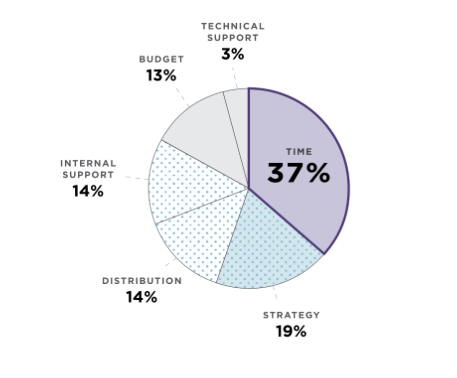
The biggest challenge that lies with creating content is time, with 37 percent feeling it’s a large factor in getting it done effectively. This makes sense, considering most companies want something that’s going to work right away, and sometimes it can take time to plan it out.

Other reasons included:

  • Strategy (19 percent)
  • Distribution (14 percent)
  • Internal support (14 percent)
  • Budget (13 percent)

Screen Shot 2016-02-17 at 1.02.24 PM

When it comes to programs in need of tweaking to make a marketing plan more effective, 33 percent of those polled state they do it on a monthly basis. Meanwhile, 25 percent say they check on this weekly, and nine percent daily. Only three percent of those feel that such campaigns don’t require tweaking.

Screen Shot 2016-02-17 at 1.03.48 PM

Image source

How Marketers Can Find the Right Campaigns For Consumers

Sometimes the key to making a successful business decision is finding the right kind of audience, but that doesn’t always come easy. However, AddThis and Oracle have put together a new report that can help point companies in the right direction.

Called State of the Industry: How Marketers Match Campaigns With the Right Audience, the report covers a number of details about appealing to the right audience. Here are some quick things we surmised from the report:

Creating standard audience segments don’t always come easy

30 percent of those polled indicated there was some sort of problem when it came to understanding how they work.

Screen Shot 2016-02-17 at 12.47.02 PM

Conversion is the most sought objective

As for understanding which marketing objectives are preferred when it comes to audience segments, only eight percent noted awareness as a factor. Meanwhile, 37 percent noted that conversion was most important, followed by loyalty (29 percent) and consideration (26 percent).

Screen Shot 2016-02-17 at 12.47.22 PM

Finding matches and tracking individuals present highest challenges

When it comes to the biggest challenges of reaching an audience, many feel that finding individuals that match said audience is the biggest obstacle, with 50.5 percent agreeing. However, targeting certain attributes and keywords that will make a difference to said audience is also vital (36.6 percent), as well as identifying said attributes when they really matter (47.3 percent). The most important, however, was tracking individuals across particular channels (58.6 percent).

Screen Shot 2016-02-17 at 12.48.31 PM

Understand your audience

Not understanding how audiences are built can have an effect on a marketing program. 34 percent of those polled in the report said they understand such processes either “not too well” or “not at all,” creating confusion with the model as a result.

Building a custom audience can have great effectiveness with a program

“Quality of and trust in the data is what matters whether you are talking about demographic, behavioral or any other targeting mechanism,” said Bryan Sherman, vice president and director of programmatic for Media Tech at DigitasLBi, in the report. “As data becomes a currency, quality data becomes the gold standard. When designing an audience, it is more important to believe in the quality of fewer data inputs than the potential value of many.”

Those that build custom audiences get better results from their campaigns

34 percent of those polled state they’re either “satisfied” or “very satisfied” with such results. Marketers can actually hone in on audience tastes this way, creating a more effective campaign.

Big Birds Can Fly: Lessons Learned from ‘Angry Birds 2’ Launch

Few brands are as recognizable as Angry Birds, the mobile game that has expanded with multiple spin-off games, a cartoon series, and an upcoming movie featuring an all-star cast. Last July saw the launch of the official sequel, Angry Birds 2, which released with high expectations from both the fans and its developer, Rovio.

Eric Seufert, VP of User Acquisition and Network Engagement at Rovio Entertainment, will discuss how franchise recognition impacts user acquisition at his GDC session, “Taking Flight Again: Planning the Launch of Angry Birds 2.” Furthermore, it will “outline the tactics and channels that were used to achieve more than 20 million installs in the first week of the Angry Birds 2 global launch.”

[a]listdaily speaks with Seufert about the challenges Rovio faced when launching a sequel to a game as big as Angry Birds.

Eric-Seufert-2015_400Given the broad recognition of the Angry Birds brand, what were some of the challenges in promoting Angry Birds 2?

One of the big challenges, from a user acquisition perspective, was trying to track the results of our marketing campaigns against the backdrop of the massive volume of media coverage the game’s launch garnered. Mobile user acquisition is a very performance-driven discipline, and the amount of “noise” in the market (that is, the visibility the game enjoyed as a result of the prominence it was given from various media outlets, as well as both Apple and Google) made it difficult to actually try to calculate what our ROI was on various campaigns.

This probably sounds like a good problem to have (and it was!), but it also made us more conservative in spending money on paid user acquisition campaigns, since we wouldn’t be able to easily tell what worked (in terms of generating interest and driving downloads beyond just the direct clicks we achieved) and what didn’t.

What kind of expectations did Rovio have for the game’s launch?

Our expectations didn’t really take the form of a single number: we had a range of installs that we thought we could achieve under different sets of circumstances. That said, 50mm installs was definitely at the very upper end of that range.

What did you learn from the Angry Birds 2 launch? Were there any surprises?

I’d say the biggest surprise, for me personally, was simply how massive the Angry Birds franchise is, and how excited people are about it. This isn’t to say that there was any doubt going into the launch that it would be large, but coming from a strictly mobile gaming background myself, I was blown away by the global scope of the excitement around the launch of the game.

Prior to my time at Rovio, I saw mobile games as a fairly specific form of entertainment that, generally speaking, only appealed to a certain subset of the world. What the launch of Angry Birds 2 taught me is that the entire world can get stirred up over a mobile game: mobile gaming is a truly global, borderless, humanity-wide past time. That was an incredible revelation, and it was a lot of fun to experience!

How different was promoting Angry Birds 2, compared to all-new games like Nibblers?

Any Angry Birds title obviously comes with a built-in fan base numbering in the hundreds of millions (or billions), and the franchise is so unique (in terms of aesthetic style and its premise) that an Angry Birds game is easier to promote than anything I’ve ever witnessed.

With Nibblers specifically, it has been fun (as well as educational) watching the game’s audience develop and evolve over time as the team adds more content and hones the look and feel of the first things players see (e.g. the different artwork in the platform stores or the first-time user session).

With Angry Birds, those things are already more or less defined, or at least, they are in the minds of the fan base. This is a huge boon to the franchise, of course, as that recognition makes it really easy to generate lots of downloads (as in the AB2 launch), but it’s also a standard that needs to be carefully considered when we run campaigns. We need to ask ourselves: Does creating this ad “feel” like Angry Birds? When people see this, will they immediately recognize that we’re promoting an Angry Birds game, or do we need to be more conservative with our treatment?

With Nibblers, that same historical precedent doesn’t really exist, so we can be a lot more experimental with how we promote the game. This allows us to test the limits of what the game’s core demographic is, or how we showcase the game’s characters in ads, or what aesthetic tone we use in ad creatives, etc. to a degree that we can’t with Angry Birds games.

What kind of promotions went into the Angry Birds 2 launch?

The Angry Birds 2 launch was a cooperative effort from many different teams at Rovio, and I’m sure that I’m not aware of every single thing that the company did to promote the game, so I won’t even attempt to list them all.

Within the realm of digital marketing, we ran a variety of traditional direct-response advertising campaigns across a number of mobile marketing networks, and we also ran a premium auto-play video campaign on Facebook. We also ran some influencer campaigns.

In what ways have you seen mobile game promotion grow and change over the past few years?

It has definitely become a lot more diverse in terms of the channels used! When I started in mobile user acquisition, the majority of traffic I acquired into games was generated through mobile app install ads purchased through a large number of advertising networks. With Facebook’s advertising platform as large and mature as it is now, I’d guess that many developers simply use Facebook and a modest (maybe 10-15) number of other networks on a regular basis, outside of game launches.

Influencer (e.g. YouTube star) campaigns have also been generating a lot of buzz, but I question whether most developers can use those effectively to drive large volumes of installs. TV and out-of-home campaigns have also become quite popular with the largest developers, but again I wonder if a developer needs a certain existing install base to achieve positive ROI with those — that is, do people need to have already heard of a game, or have friends playing a game, before they react to a television ad in large numbers?.

What do you think it takes for a game, even one as recognizable as Angry Birds, to compete in the mobile games market?

From a user acquisition standpoint, it takes some degree of virality (cooperative / competitive gameplay) and a very strong degree of retention (people stick around with the game for a long time) to compete on the basis of purchasing traffic.