VPC:
$7.46
▲
Value Per Click
Super Smash Bros. Wii U – Mewtwo and Lucas Reveal Trailers
Ah, the beauty of the DLC-era. What happens when the extensive roster of popular characters in a game like Super Smash Bros. just isn’t extensive enough You wait till they release more characters as downloadable content, of course While some may grumble at these reveals as just another cash grab, Nintendo is showing us here that Lucas and Mewtwo are not messing around on the Wii U. That teleport dodge by the legendary pokemon looks all extra kinds of fun to use/horrible to play against.
Mewtwo
Mario Kart 8 – 200cc Reveal Trailer
Going boldly where no Mario Kart has gone before, this trailer punches the engine into overdrive with the introduction of 200cc, the fastest and most difficult race class to ever grace the Kart series. This is where DLC is really beneficial in my eyes, and not just because it’s free (but free always helps)! Taking a racing game that’s already established great success and making it go faster Methinks it’s time to fire up the WiiU once again.
Sunset Overdrive – Dawn of the Rise of the Fallen Machines Trailer
Detecting a theme yet With DLC firmly in the center of this week’s crosshairs, we take a look at the newest, loudest, and most tongue in cheek addition to Sunset Overdrive yet… and that’s really saying something. Old action film clichés are ripe for the picking in this story add on, but with the success of Mystery of the Mooil Rig (the first piece of DLC in the Sunset season pass) I can only hope this this add on builds on this game’s success. Plus, you basically have a Super Monkey Ball-caliber force field that bowling balls robots. How does that NOT sound fun?
Would you be brave enough to broadcast your daily life and all your difficulties and triumphs to millions of viewers We’re talking everything: from births to the first loose teeth and relocating across the country. That’s what YouTube’s top parents are doing every day.
Judging by the millions of views these videos get, the daily lives of these YouTubers are fascinating to watch and for many, aspirational.
by Jocelyn Johnson
A year ago we headed into the Newfronts with the same enthusiasm for the biggest digital content market of the year as we will this year (stay tuned for Power-Sixer and Dealmakers news!) In all, VideoInk attended and covered 22 presentations last year. And looking back at our coverage of the programming announcements, there were a lot of stellar formats that emerged from those presentations.
However, the biggest thought that I walked away with, and that has stuck with me over the last 11 months, is this: Of those 22 presentations and nearly 200 formats that were screened, is there a matching buying appetite and/or financial ROI to merit that volume of content? Or are programmers still oversaturating the marketplace with a surplus supply that either drives down price or drives down the sense of urgency to buy, produce, and distribute And the question that looms every year — is the investment into the Newfronts even worth it
This article was originally posted on VideoInk and is reposted on [a]listdaily via a partnership with the news publication, which is the online video industry’s go-to source for breaking news, features, and industry analysis. Follow VideoInk on Twitter @VideoInkNews, or subscribe via thevideoink.com for the latest news and stories, delivered right to your inbox.
It’s no secret that Facebook has been increasing its emphasis on video in the past year. Now an after-hours side project of the team at Facebook has come to light, Riff. It’s yet another video app, yes. So what makes it different?
Riff is all about collaborative video and video length falls in-between Vine and Snapchat at 20 seconds or less. Video on Facebook now accounts for 30 percent of all content types on the social network, so the emphasis on shorter video feels necessary.
“The potential pool of creative collaborators can grow exponentially from there, so a short video can become an inventive project between circles of friends that you can share to Facebook, or anywhere on the internet, at any time,” said Facebook product manager Josh Miller in their blog announcement.
We chatted with Nic Mercado, project manager and social media strategist at Ayzenberg to find out what her initial thoughts are on Facebook’s pet app project.

Nic Mercado, Project Manager and Social Media Strategist at Ayzenberg
I’m always a little hesitant when Facebook launches something new because they are so brand-based now, but considering it’s a video app, it definitely piques my interest!
It’s smart of them to jump on the video wagon. There are so many interesting video apps and programs, I’m shocked it’s taken them this long to come up with something themselves.
As a huge Snapchat fan (and video in general), I am super excited to try out Riff. I have a lot of friends that do amazing things all around the world, so it would be nice to “collaborate” on a video from miles away. Photo and video sharing will never go away, so when there’s something new and exciting, I’m always stoked to try it out.
I use Snapchat on a daily basis and love how advanced it has gotten with geo-tagging and sharing stories. I’m constantly finding myself “snapping” things and sharing funny/interesting stuff happening in front of me. I also really like seeing my friends’ stories and seeing what they are up to all day. Also, I’m a little addicted to PHHHOTO but I wish more people were on it!
by Jessica Klein
It’s no surprise that April Fools Day makes a big impact on YouTube. There, pranks captured in video form can be shared with limitless viewers, and brands are naturally wise to this. In fact, it’s pretty much expected of any large brand to come up with some sort of April Fools’ “prank” on the internet today, as summed up in report from European MCN Divimove.
This rise in April Fools’ videos year on year is a notable one. The average reach of these videos went up 65 percent between 2011 and 2012, increased by another 50 percent in 2013, and then went up by a whopping 80 percent in 2014, according to Divimove’s data.

This article was originally posted on VideoInk and is reposted on [a]listdaily via a partnership with the news publication, which is the online video industry’s go-to source for breaking news, features, and industry analysis. Follow VideoInk on Twitter @VideoInkNews, or subscribe via thevideoink.com for the latest news and stories, delivered right to your inbox.
It seems like practically everyone is talking about Meerkat and Periscope these days. Now that our mobile devices are capable, livestreaming as a medium has finally become possible. Only it’s not at all like making your run-of-the-mill branded video.
We spoke with social strategist at Ayzenberg, Casey Reed, about what marketers really need to know about these platforms and what makes them so distinct from other kinds of video and even other streaming platforms.
 Casey Reed, Social Strategist at Ayzenberg
Meerkat and Periscope are getting a lot of notice right now from marketers as mobile video in general is really key so far this year. What is different about the content a brand would want to livestream on these or on, say, Twitch, versus posting video on a platform like YouTube or Facebook?
So, for me what separates Meerkat and Periscope from anything else out there is the livestream or live broadcast element. I imagine these platforms more as a longform Snapchat, with the ability to share real-time video content that doesn’t disappear after 10 seconds. It’s far more inherently social, tapping into the existing desire of consumers to share our experiences as we’re living them.
For brands, livestream video apps offer a lot of potential for the industry to both connect with their community on a more personal level but also drive business objectives. Working with brands on social marketing, we’re always looking for ways to bridge the gap between events and our social communities. There’s an element about a live experience that your 2:00 edited-down highlight reel on YouTube doesn’t capture.
People at home suddenly are able to get in on the action as its happening, rather than wait five days for a recap video on Facebook or YouTube. The impact of this on brands is invaluable for connecting audiences across platforms. Oftentimes brands pay millions of dollars just to have a presence at a live event, festival, convention or other experiential activation. You sit and hope for AdWeek or Mashable to pick up on it, but the reach is limited to those in the space. One could argue that the costs behind creating unique and clever stunts at trade-only events doesn’t always pay off. However, Livestream direct-to-mobile video sharing makes what happens on the ground so much more accessible and intimate.
You can also pick and choose how to frame the on-site events and package it to the audience at home. You can release exclusive interviews behind major product announcements, capture stunts, show audience reactions, give people at home a tour of your footprint on the grounds . . . It’s a really neat social way to compliment existing video or event coverage.
What are the audiences like on Meerkat and Periscope from what you can discern? What are some key functionalities and differences?
The greatest difference between Periscope and Meerkat audiences at first glance seems to be industry consumer versus social consumer. Periscope, due to its connection with Twitter, looks to be more brand-friendly and most likely delivers content to consumers interested in the advertising field — an audience that likely engages with brand content on other channels. Meerkat, thanks to SXSW, grew quickly as a real-time social video sharing platform similar to Snapchat. It looks to cast a wider net, but may be harder for brands to enter the conversation in an authentic manner.
My initial preference for marketing with Livestream video content is with Periscope, mostly because of the seamless integration with Twitter. Meerkat videos can be shared with your Twitter audience, but Periscope takes the integration a few steps further:
A few other benefits of Periscope over Meerkat for brands:
What kinds of things have you seen on Meerkat and Periscope that has caught your eye?
HEARTS! Periscope has this really fun yet beautiful way to encourage engagement using hearts. On Instagram, you can only “heart” a piece of content once to show you “like” it. On Periscope, users can engage with the videos they see, sending “hearts” that flutter up the side of the screen. The more hearts your video content gets, the higher up the hearts float on the screen, and the higher up you (as a brand or handle) appear in Periscope’s list of “Most Loved.”
On both platforms it looks like the comments aggregate in real-time, or bubble up over the content as it plays. This is a cool way of allowing your community to experience it all together, though separately through each individual’s device. But this could also inhibit the viewing experience. I think there’s a way to turn this feature off, but it’s a good question to ask before diving in as a brand.
What do marketers need to know about livestreaming before they dive into it?
Well, the above. Marketers should toy around with livestreaming apps themselves to learn more about the functionalities and natural behaviors, to inform how to create the best viewing experience. Functionalities like the hearts and bubbling-up comments could be cool for friend-to-friend video sharing, but may become distracting on livestreams with larger audiences.
Brands should also be observant of how social behaviors form on new platforms as they emerge. There are certain platforms on which brands and users don’t coexist as naturally as they do on, say, Facebook or Instagram. Users on Tumblr and Snapchat show resistance to seeing brands try to get in on the fun.
by Jessica Klein
Endemol Shine Group and Michelle Phan are launching Icon, a global lifestyle network, in the U.S. and U.K. on March 31.
Phan is the creative lead of the network, which includes premium content in the areas of beauty, fashion, food, DIY, human interest, travel, and health. Icon will also include new series and videos from online influencers such as Ann Le, Cassey Ho (aka Blogilates), Promise Phan, Charis Lincoln, and Rae from The Raeviewer.
Icon will also showcase newer digital talent, including Sonya Esman (a “Russian/Canadian digital superstar”), celebrity makeup artist Jamie Greenberg, and several others.
Here’s a list of the new, original series that will debut on Icon…
This article was originally posted on VideoInk and is reposted on [a]listdaily via a partnership with the news publication, which is the online video industry’s go-to source for breaking news, features, and industry analysis. Follow VideoInk on Twitter @VideoInkNews, or subscribe via thevideoink.com for the latest news and stories, delivered right to your inbox.
Spending on digital display advertising continues to flourish, as companies intend to spend as much as over $27 billion this year alone. However, new figures from eMarketer indicate that the number will continue to grow over the next couple of years — and social sites like Facebook and Twitter will lead the charge.
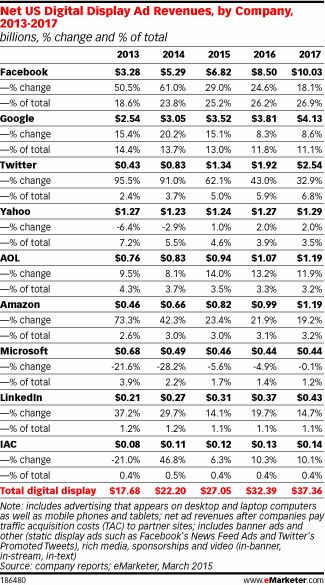
By 2017, according to the site, US digital display ad spending will reach $37.36 billion — a $10 billion increase in just two years’ time — and Facebook and Twitter will account for a third of that market, over 33 percent. That’s increase as well, since both sites have a 30.2 percent grip for this year in itself.
Facebook’s digital display ad revenue is quite impressive, set to reach $6.82 billion this year, which will account for over 25 percent of the overall market. Twitter may be behind, but it’s seeing profit as well, with revenues of $1.34 billion, and five percent of the overall market. By 2017, both these sites will see a minor increase, with Facebook accounting for 26.9 percent, and Twitter at 6.8 percent.
Even with its smaller numbers, Twitter will be able to surpass Yahoo in digital display ad revenues for the first time. Yahoo will still see positive results from its campaign, with 4.6 percent of the market for this year, but that’s a drop from the 5.5 percent it had last year, and the 7.2 percent it had in 2013.
Google will remain healthy in digital display ad funds, with 13 percent for this year. However, it’s worth noting that it’s a drop from the 13.7 percent reported last year, and eMarketer estimates it’ll dip even further, down to 11.1 percent, by 2017.
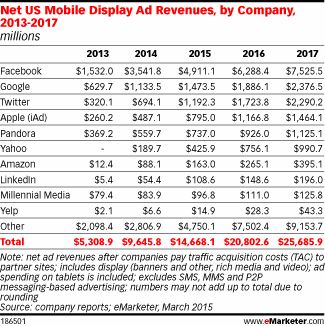
So where are all these changes coming from The report indicates that mobile advertising plays a big part of it, with an increase to $14.67 billion — over $5 billion more than what was spend last year ($9.65 billion). Desktop display ad spending has seen a drop by comparison, going down to $12.38 billion. That’s still a reasonable spending amount, but mobile is taking over.
Facebook will see $5 billion this year alone from mobile ad revenues, with Twitter following closely behind with $1.19 billion — accounting for 90 percent of its overall ad revenues. In just a couple years’ time, both of these numbers will grow, with Facebook accounting for $7.53 billion, and Twitter earning $2.29 billion — and continuing to hold a lead over both Yahoo and Google.
Digital display ads will be something to watch as far as trends and effectiveness are concerned.
Technology changes quickly, ensuring there’s virtually always something to talk about. Some top YouTubers are self-professed experts on the subject, covering anything and everything from household hacking and tips to destroying expensive precious iPhones. Whatever you’re looking for, YouTube is sure to have it.

